Mission: Autumn Bottom Trawl Survey Geographical Area of Cruise: North Atlantic Date: September 25, 2013
Science and Technology Log
I was told that the first 12 hour night watch shift was the hardest for staving off sleep and those who spoke were right. Tonight’s overnight shift seems to be flying by and I’m certainly awake. Lots of trawling and sorting this evening with four sorts complete by 6am. One was just full of dogfish, the shark looking fish, and they process quickly because other than weight and length there is little request for other data. The dogfish were sorted at the bucket end of the job so determining sex had already been completed by the time the fish get to my workstation. Again I’m under the mentorship of Jakub who can process fish faster than I can print and place labels on the storage envelopes. The placement of the labels is my weakness as I have no fingernails and removing the paper backing from the sticky label is awkward and time consuming. Still tonight I’m showing speed improvement over last night. Well at least I’m getting the labels on straight most of the time.
Sorting fish
In addition to the dogfish, we have processed large quantities of skate (the one that looks like a sting ray to me), left eyed flounders, croakers (no relation to the frog), and sea robins of which there are two types, northern and stripe. The sea robins are very colorful with the array of spines just behind the mouth. And yes it hurts when one of the spines goes through your glove. Sadly for me sorting has been less exciting tonight. With the big fish being grabbed off at the front of the line there has been little left for me to sort. I feel like the goal keeper in soccer – just don’t let them get past me. To my great surprise, so far I’ve experienced no real fear of touching the fish. The gloves are very nice to work with.
Species in specific buckets
And let us not overlook the squid. There have been pulled in by the hundreds in the runs today. There are two types of squids, long fin (the lolligo) and short fin (the illex). What they both have in common is the ability to make an incredible mess. They are slimy on the outside and inky on the inside. They remind me of a fishy candy bar with really big eyes. And for all the fish that enjoy their squid treat the species is, of course, (wait for it) just eye candy. The stories about the inking are really true. When upset, they give off ink; lots of ink. And they are very upset by the time they reach the data collection stations. If you could bottle their ink you would never need to refill your pen again. They are also very, very plentiful which might explain why there are no requests to collect additional data beyond how long they are. I guess they are not eye candy to marine scientists. However, there vastness is also their virtue. As a food source for many larger species of marine life, an absence of large quantities of squid in our trawling nets would be a bad sign for the marine ecosystem below us.
Safety equipment
When the squid are missing, our friend the Skate (which of the four types does not matter) is glad to pick up the slack on the “messy to work with” front. As this species makes it down the sorting and data collecting line the internal panic button goes off and they exude this thick, slimy substance that covers their bodies and makes them very slippery customers at the weigh stations. It turns out the small spines on the tails were placed there so that fisheries researchers could have a fighting chance to handle them without dropping. Still, a skate sliding onto the floor is a frequent event and provides comic relief for all working at the data collection stations.
There was new species in the nets tonight, the Coronet fish which looks like along drink straw with stripes and a string attached to the back end. It is pencil thick and about a foot long without the string. We only caught it twice during the trip. The rest of the hauls replicate past sorting as dogfish, robins, skates, squid, croakers, and flounder are the bulk of the catch. I’ve been told that the diversity and size of the trawl should be more abundant as we steam along the coastline heading north from the lower coast of New Jersey. Our last trawl of the shift, the nets deployed collect two species new for our voyage, but ones I actually recognized despite my limited knowledge of fish – the Horseshoe Crab and a lobster! I grew up seeing those on the Jersey shore. We only got one lobster and after measuring it we let go back to grow some more. It only weighed in at less than two pounds.
Personal Log
The foul weather suit we wear to work the line does not leave the staging room where they are stored as wearing them around the ship is not allowed. After watching others, I have mastered the art of pushing the wader pants over the rubber boots and thus leaving them set-‐up for quick donning and removal of gear throughout the shift.
While the work is very interesting on board, the highlight of each day is meal time. Even though I work the night shift (which ends at noon) I take a nap right after my shift so I can be up and alert in time for dinner. My favorite has been the T-‐bone steaks with Monterey seasoning and any of the fish cooked up from our trawling like scallops or flounder. The chef, Dennis, and his assistant, Jeremy serve up some really fine cuisine. Not fancy but very tasty. There is a new soup every day at lunch and so far my favorite has been the cream of tomato. I went back for seconds! Of course, breakfast is the meal all of us on the night watch look forward to as there is no meal service between midnight and 7am. After 7 hours of just snacking and coffee, we are ready for some solid food by the time breakfast is served.
Seas continue to be very calm and the weather sunny and pleasant. That’s quite a surprise for the North Atlantic in the fall. And the sunrise today was amazing. The Executive Officer, Chad Cary, shared that the weather we are experiencing should continue for at least four more days. I am grateful for the calm weather – less chance to experience sea sickness. That is something I’m determined to avoid if possible.
NOAA Teacher at Sea Louise Todd Aboard NOAA Ship Oregon II September 13 – 29, 2013
Mission: Shark and Red Snapper Bottom Longline Survey Geographical Area of Cruise: Gulf of Mexico Date: September 23, 2013
Weather Data from the Bridge: Barometric Pressure: 1009.89mb
Sea Temperature: 28˚C
Air Temperature: 28.2˚C
Wind speed: 8.29knots
Science and Technology Log:
The haul back is definitely the most exciting part of each station. Bringing the line back in gives you the chance to see what you caught! Usually there is at least something on the line but my shift has had two totally empty lines which can be pretty disappointing. An empty line is called a water haul since all you are hauling back is water!
After the line has been in the water for one hour, everyone on the shift assembles on the bow to help with the haul back. One crew member operates the large winch used to wind the main line back up so it can be reused.
Winch holding the main line
The crew member operating the winch unhooks each gangion from the main line and hands it to another crew member. That crew member passes it to a member of our shift who unhooks the number from the gangion. The gangions are carefully placed back in the barrels so they are ready for the next station. When something is on the line, the person handling the gangions will say “Fish on”.
Nurse Shark on the line
Everyone gets ready to work when we hear that call. Every fish that comes on board is measured. Usually fish are measured on their sides as that makes it easy to read the markings on the measuring board.
Measuring a Yellowedge Grouper (Photo credit Christine Seither)Christine and Nick measuring a Sandbar Shark
Each shark is examined to determine its gender.
Determining the sex of a sharpnose shark (Photo credit Deb Zimmerman)
Male sharks have claspers, modified pelvic fins that are used during reproduction. Female sharks do not have claspers.
Claspers on a Blacktip
Fin clips, small pieces of the fin, are taken from all species of sharks. The fin clips are used to examine the genetics of the sharks for confirmation of identification and population structure, both of which are important for management decisions.
That’s me in the blue hardhat taking a fin clip from a Sandbar Shark(Photo credit Lisa Jones)
Skin biopsies are taken from any dogfish sharks in order to differentiate between the species. Tags are applied to all sharks. Tags are useful in tracing the movement of sharks. When a shark, or any fish with a tag, is recaptured there is a phone number on the tag to call and report the location where the shark was recaptured.
Some sharks are small and relatively easy to handle.
Small Cuban Dogfish (Photo credit Christine Seither)
Other sharks are large and need to be hauled out of the water using the cradle. The cradle enables the larger sharks to be processed quickly and then returned to the water. A scale on the cradle provides a weight on the shark. Today was the first time my shift caught anything big enough to need the cradle. We used the cradle today for one Sandbar and two Silky Sharks. Everyone on deck has to put a hardhat on when the cradle is used since the cradle is operated using a crane.
Silky shark coming up in the cradleSandbar Shark in the cradle
Personal Log:
I continue to have such a good time on the Oregon II. My shift has had some successful stations which is always exciting. We have had less downtime in between our stations than we did the first few days so we are usually able to do more than one station in our shifts. The weather in the Gulf forced us to make a few small detours and gave us some rain yesterday but otherwise the seas have been calm and the weather has been beautiful. It is hard to believe my first week is already over. I am hopeful that we will continue our good luck with the stations this week! The rocking of the boat makes it very easy for me to sleep at night when my shift is over. I sleep very soundly! The food in the galley is delicious and there are plenty of options at each meal. I feel right at home on the Oregon II!
Did You Know?
Flying fish are active around the boat, especially when the spotlights are on during a haul back at night. Flying fish are able to “fly” using their modified pectoral fins that they spread out. This flying fish flew right onto the boat!
NOAA Teacher at Sea
John Clark Aboard NOAA Ship Henry B. Bigelow September 23 – October 4, 2013
Mission: Autumn Bottom Trawl Survey Geographical Area of Cruise: North Atlantic Date: September 24, 2013
Survival suits!
Science and Technology Log
Today is my first full 12 hour shift day. I’m on the night crew working midnight to noon. Since we left port yesterday I’ve been trying to adjust my internal clock for pulling daily “all night”ers. On Monday, after we left port, safety briefs for all hands occurred once we made it out to sea and I got to complete my initiation into the Teacher at Sea alumni program – the donning of the Gumby suit as I call it. It is actually a bright red wet suit that covers your entire body and makes you look like a TV Claymation figure from the old TV show. In actuality it is designed to help you survive if you need to abandon ship. Pictures are of course taken to preserve this rite of passage.
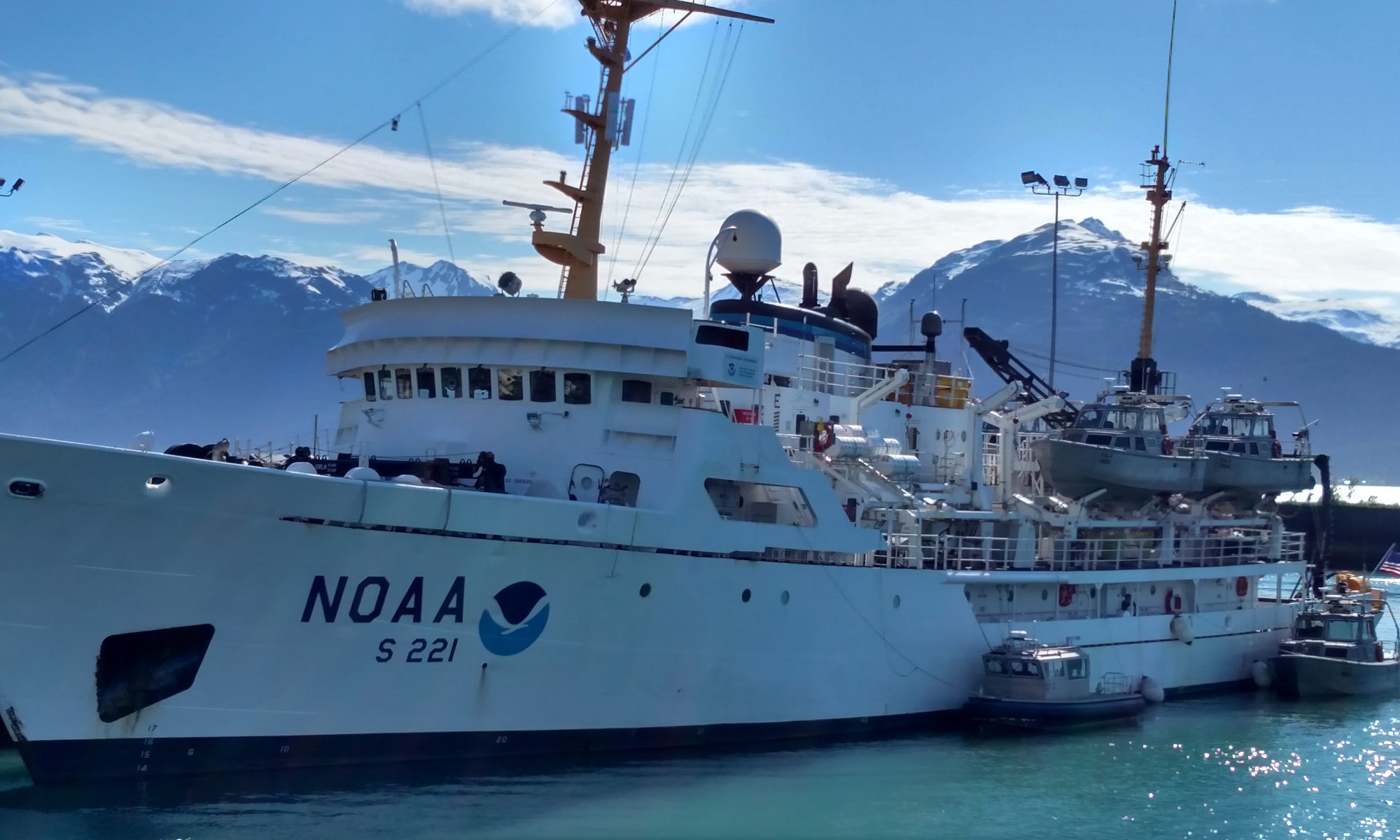
The Henry B. Bigelow is a specially-built NOAA vessel designed to conduct fisheries research at sea. Its purpose is to collect data that will help scientists assess the health of the Northern Coastal Atlantic Ocean and the fish populations that inhabit it. The work is invaluable to the commercial fishing industry.
The Bigelow in port
Yesterday, I learned how we will go about collecting fisheries data. Our Chief Scientist, Dr. Peter Chase, has selected locations for sampling the local fish population and the ship officers have developed a sailing plan that will enable the ship to visit all those locations, weather permitting, during the course of the voyage. To me its sounds like a well-‐planned game of connecting the dots. At each target location, a trawling net will be deployed and dragged near the bottom of the sea for a 20 minute period at a speed of 3 knots. Hence the reason this voyage is identified as a bottom trawl survey mission. To drag the bottom without damaging the nets is not easy and there are five spare nets on board in case something goes wrong. To minimize the chance of damaging the net during a tow, the survey technicians use the wide beam sonar equipment to survey the bottom prior to deployment. Their goal is to identify a smooth path for the net to follow. The fish collected in the net are sorted and studied, based on selected criteria, once on board. A specially designed transport system moves the fish from the net to the sorting and data collection stations inside the wet lab. I’m very excited to see how it actually works during my upcoming shift.
The big net.
Work is already underway when our night crew checks in. The ship runs 24/7 and the nets have been down and trawling since 7pm. Fish sorting and data collection are already underway. I don my foul weather gear which looks like a set of waders used for British fly fishing. There is also a top jacket but the weather is pleasant tonight and the layer is not needed. I just need to sport some gloves and get to work. I’m involved with processing two trawls of fish right away. I’m assigned to work with an experienced member of the science team, Jakub. We will be collecting information on the species of fish caught on each trawl. Jakub carries out the role as cutter, collecting the physical information or fish parts needed by the scientists. My role is recorder and I enter data about the particular fish being evaluated as well package up and store the parts of the fish being retained for future study.
Ship equipment
Data collection on each fish harvest is a very detailed. Fish are sorted by species as they come down the moving sorting line where they arrive after coming up the conveyer belt system from the “dump” tank, so named because that is where the full nets deposit their bounty. Everybody on the line sorts fish. Big fish get pulled off first by the experienced scientists at the start of belt and then volunteers such as I pull off the smaller fish. Each fish is placed into a bucket by type of fish. There are three types of buckets and each bucket has a bar code tag. The big laundry looking baskets hold the big fish, five gallon paint buckets hold the smaller fish, and one gallon buckets (placed above the sorting line) hold the unexpected or small species. On each run there is generally one fish that is not sorted and goes all the way to the end untouched and unceremoniously ends up in the catch-‐all container at the end of the line. The watch leader weighs the buckets and then links the bar code on the bucket to the type of fish in it. From there the buckets are ready for data collection.
The sorting line
After sorting the fish, individual data collection begins “by the bucket” where simultaneously at three different stations the sizing, weighing, and computer requested activities occur. By random sample certain work is performed on that fish. It gets weighed and usually opened up to retrieve something from inside the fish. Today, I’ve observed several types of data collection. Frequently requested are removal of the otolith, two small bones in the head that are used to help determine the age of the fish. For bigger fish with vertebra, such as the goose fish, there are periodic requests to remove a part of the backbone and ship it off for testing. Determining sex is recorded for many computer tagged fish and several are checked stomach contents.
Of the tools used to record data from the fish, the magic magnetized measuring system is the neatest. It’s rapid fire data collecting at its finest. The fish goes flat on the measuring board; head at the zero point, and then a quick touch with a magnetized block at the end of the fish records the length and weight. Sadly, it marks the end of tall tales about the big one that got away and keeps getting bigger as the story is retold. The length of the specimen is accurately recorded for posterity in an instant.
Personal Log
Flying into Providence over the end of Long Island and the New England coast line is breath taking. A jagged, sandy coast line dotted with summer homes just beyond the sand dunes. To line up for final approach we fly right over Newport where the Henry B. Bigelow is berthed at the Navy base there. However, I am not able to spot the NOAA fisheries vessel that will be my home for the next two weeks from the air.
I arrive a day prior to sailing so I have half a day to see the sites of Newport, Rhode Island and I know exactly where I’m headed – the Tennis Hall of Fame. My father was a first class tennis player who invested many hours attempting to teach his son the game. Despite the passion in our home for the great sport we never made it to the Tennis Hall of Fame in Newport. Today I fulfilled that bucket list goal. I still remember being court side as a young boy at The Philadelphia Indoor Championship watching the likes of Charlie Pasarell, Arthur Ashe, and Pancho Gonzales playing on the canvas tennis court that was stretched out over the basketball arena. Also in the museum, to my surprise, was a picture of the grass court lawn of the Germantown Cricket Club from its days as a USTA championship venue. I grew up playing on those grass tennis courts as my father belonged to that club. After seeing that picture, I left the museum knowing my father got as much out of the visit as I did.
NOAA Teacher at Sea Susy Ellison Aboard NOAA Ship Rainier September 9-26, 2013
Mission: Hydrographic Survey Geographic Area: Cold Bay, Alaska Date: September 22, 2013
Weather: current conditions from the bridge GPS Location: 55o 15.190’ N 162o 38.035’ W
Temp: 8.6C
Wind Speed: 10 kts
Barometer: 1008.3mb
Visibility: 10 miles
You can also go to NOAA’s Shiptracker (http://shiptracker.noaa.gov/) to see where we are and what weather conditions we are experiencing.
What would you think if you saw someone bundled in warm clothing, sitting in an office chair on a pier with a pair of binoculars, a watch, and a clipboard? Are they counting waves? Counting birds? Keeping track of the clouds or the wind speed? In my case it was ‘none of the above’; I was watching a measuring stick, taking measurements every 6 minutes over a period of 3 hours. Why would anyone want to sit in a chair on a pier and stare at a stick for 3 hours?
The answer, of course, is science! Now, this wasn’t just any sort of stick. This tide staff was attached to an automatic tide gauge that the crew of the Rainier installed during their last visit to Cold Bay in August. That gauge has been recording tidal data that is used during their hydrographic survey work. But, as with any automatic data-gathering device, it is critical to field check its accuracy, both in measuring and reporting the data. The gauge measures the depth of the water column at 6-minute intervals, using the pressure of the water column as a proxy for that depth (deeper water exerts a greater pressure on the subsurface opening of the gauge—for a more in-depth explanation, you can check out my blog from September 13th). My job was to stare at the staff for a period of 1 minute every 6 minutes, and determine both the highest and lowest height of the water lapping at the markings on the stick.
This might sound easy, but it wasn’t quite so simple. The wind was howling and the waves were bouncing—it took a little practice to make what I hoped was an accurate estimate of both the high mark and the low. After each observation period I recorded these numbers on a spreadsheet and then spent the next few minutes watching the birds that were flying and landing on the water. Then—back to the stick! The tide was dropping with each observation and the winds died down enough to make it a little easier to read the high and low points on each successive 6 minute interval. By the 10th observation I had it figured out!
NOAA Corps ENS Clark demonstrates proper form for tide gauge observation.Picture trying to read this from far away as the water bounces up and down the staff.
The data I collected was matched against data from the tide gauge for that same time period. I was pleased to see that my observations matched those of the gauge. Apparently, both of ‘us’ are good observers of tidal changes. Now I have one more skill to add to my resume!!
This graph compares my observations with that of the tide gauge. What do we observe vs. what does a computer measure?
AAARGH, MATEY—HOW’S YOUR NUMBER SENSE? APPLIED MATH ON THE HIGH SEAS
It would be hard to find an aspect of life aboard the Rainier that doesn’t involve number sense or math. This ship’s daily operations run like clockwork; breakfast from 0700-0800, Safety Meeting and deployment of the launches at 0800, lunch from 1130 to 1230, launches return at 1630, dinner from 1700 to 1800, etc. Pretty simple numbers to deal with, but numbers, nonetheless.
That’s just the start of your applied math tour of the high seas. Maybe you have to figure out how much diesel fuel the ship has onboard. Since the Rainier uses 20,000-40,000 gallons for each leg of its cruise, it would be pretty horrible to run out before you reached port. The ship’s tanks can hold around 100,000 gallons of diesel and are usually filled to within 95% of that. Unlike your car, there’s no fuel gauge on this ship. So how do you figure out how much fuel is in the tank? It’s time for some simple, yet essential math. First, you need to know the volume of the fuel tank. Get out your math books and find that formula. Then, you take what is called a ‘sounding’—you bang on the tank to determine the level of fuel. Not too complicated, but certainly a skill that takes some practice. So, now you know the total volume of the tank as well as the actual height of your fuel; if you figure out the volumes for each and do some subtraction, you can find out what percentage of your total fuel is still in the tank.
We might all be better at determining volume and percent if we had images of a fuel tank on the dashboards of our cars instead of a linear gauge reading ‘E’ to ‘F’! What about drinking water? The Rainier uses a distillation system to create fresh water from seawater. There are tanks down in the engine room where seawater is heated to the boiling point. There’s a little more math and science in this process—the pressure in the distillation tank is lowered, to lower the boiling point (if you’ve ever camped at a high elevation you might notice that water boils at a lower temperature—your tea might not be quite as hot when it’s boiling) so the water doesn’t have to be heated quite so much to get it to boil. This steam is captured in the upper portion of the distiller and cooled using cold seawater that flows through pipes. The condensation from cooling is captured, filtered to remove any impurities, and distributed as fresh water to all onboard. The ship uses around 2500 gallons of water each day.
Here’s where all our fresh water is produced. This distiller takes in seawater and, through boiling and condensation, produces fresh water.
If you’re running the galley it’s essential to calculate how much food you’ll need for each leg of the trip. No one wants to do without their morning eggs if your multiplication is off and you ‘forget’ to buy a few dozen. Taking a recipe that is designed to feed 8 people and ‘upsizing’ it for 48 people takes a bit of mathematical manipulation. Just planning a menu for a three-week journey takes some mathematical thinking as you visualize the weeks, days, meals, and individual ingredients needed for those meals. You have to factor in a few variables; which foods have the longest shelf life, when do you have to switch from fresh to frozen or to canned foods, how much food does the ‘average’ person eat, and what about all those people with food allergies or preferences? While this might not sound quite as earth-shattering as using a detailed computer program to concatenate multiple data files, this is math that counts—especially when you’re feeding a boatload of hungry crew.
This is a glimpse of some of the supplies stored on the ship.Don’t forget to buy enough fruit and vegies!Hmmm, what’s in the freezer?
So now it’s time to consider the math used to pilot the ship. Think about degrees in a compass bearing and the need to do some rapid mental math as you’re steering a 231-foot ship through some very tight spaces. Quick—take a course of 340o, now look ahead and get ready to change your bearing to 28o. Rainier’s draft (how deep it sits in the water) is around 16’. Will the channel be deep enough? What if you’re traveling in a supertanker, one that might be over 400’ in diameter and have a draft up to 80’ deep? If your ship is that big, you need to scale up on your mental math calculations as you’re searching out appropriate harbors and routes! What about tying up the ship when we’re in harbor? Did you remember to learn something about vectors before you stopped taking math classes?
When we were at port in Cold Bay, the winds were expected to increase in strength and to shift so that they would be coming out of the west. Since the pier was oriented perpendicular to the predicted wind direction, our Chief Bo’ sun, Jim Kruger had to do some mental calculations of the angles needed to secure the ship to the pier and keep it from bouncing too much. He doubled and even tripled some of the lines, taking into account how the winds might move the ship as well as the strength of each line. It takes some stout lines to hold this ship; each 300 ft. line is 1” in diameter and has a tensile (breaking) strength of 164,000 lbs. Vector angles were equally important as we pulled away from the pier in a 50-knot wind. Just pulling up our gangway with a crane required some careful mental calculations of where to place lines to steady it as it rose through the air and was lifted onboard. If your mental math and visualization skills were wrong, you might be rewarded with a wildly swinging piece of metal.
Double (and triple) up the lines holding the ship to the pier. Make sure the angles are right.Hang tight to the gangway as it swings onboard. Make sure you’re holding it at the correct angle to compensate for the wind.Strong winds–this digital anemometer records current wind speed in knots as well as the highest gust.
How about all that hydrographic data collection; there’s plenty of opportunity there for some pretty extreme mathematical calculations. You might even wish you had taken a class in calculus—or a few classes! But there are also plenty of times that some basic number sense and arithmetic come in mighty handy. As I sat on the pier watching the tide gauge, one of the tasks I had to do was to calculate the average between high and low water marks on the tide staff. Not such hard math, but it’s a good skill to be able to do averages in your head while your hands are getting cold and the wind is howling. The tide gauge calculations were referenced to Coordinated Universal Time (UTC). This has been our world standard since 1972, and is referenced to the 0o meridian at Greenwich, England. It is precisely measured using an atomic clock. You might also hear it referred to as Zulu Time. Even airplanes use this time designation. This way, there is no ambiguity about whether you are in daylight savings or standard time, or your time zone. When measuring tides or collecting information about water chemistry using the CTD, or calculating the launch’s daily gyrations, it is important to reference everything to the same time standard. Since the Rainier is on RST (Rainier Standard Time), the calculation gets even more important because we are in the Alaska time zone, but have set our clocks back one more hour to give us more daylight working hours).
What’s your time zone? GMT stands for Greenwich Mean Time. It is also the UTC time standard we use.
Just in case your brain hasn’t been addled by all this talk of mathematics, there’s one more concept that might come in handy here on the high seas—a sine wave. Huh? Sine waves are a mathematical curve describing smooth repetitive oscillations. Like…tides, sonar pulses, sunrise/sunset observations, or the music booming out of your iPod.
Tide charts show a predictable, repeatable sine wave pattern.
I even use math to calculate how long I should run on the elliptical trainer down in the ship’s exercise space. If I set the resistance to 8, and use a cross training setting, it takes around 35 minutes to ‘run’ the equivalent of one slice of cake!
Here’s some of the exercise equipment on the ship.35 minutes or one slice of pie–whichever comes first!
Just in case you haven’t gotten the message—math is good. Number sense is critical—even if you want to run off to sea!
Personal Log
IT’S A FIELD TRIP!!
The entire Cold Bay School fits into this truck!
I love a field trip. There’s nothing like loading up in the bus and taking off in search of the great unknown. While we were parked at the Cold Bay pier, we had a visit from the Cold Bay School. The 8 students, plus their teacher and a classroom aide, came to check out the Rainier. CO Rick Brennan gave them a tour, starting at the bridge, and ending with lunch in the wardroom. Along the way, they learned about ships and ship life, NOAA, and the science of hydrography. Lunch was a real hit, since the kids all bring their own lunches to school. Who wouldn’t like halibut tacos with all the fixings from the galley, or a peanut butter and jelly sandwich handmade by Commander Rick Brennan with a fresh cookie for dessert?
Cold Bay students check out some of the ship’s BIG tools.
I tagged along on the tour to talk with some of the kids and their teacher and to compare notes about schools. While I always think of my school as small, with only 150 students, the school in Cold Bay is really small. There are 8 students and they represent grades 1 through 7. While the school is small, each student uses an iPad to access a wide variety of educational resources. It’s even better when that technology-based learning is supplemented by some hands-on field trip-based learning. This was their second field trip of the week; they had spent a day with a wildlife biologist helping install a motion-sensitive camera in the Izembek Wildlife Refuge (http://www.fws.gov/alaska/nwr/izembek/index.htm).
Future hydrographers head back to school.
SAFETY FIRST
Where I live, in Colorado, we occasionally get snow days, when the roads are too dangerous to transport children to school. Here at sea, we don’t worry too much about snow, but wind can create hazardous working conditions. Yesterday we had what I would call a ‘Wind Day’; none of the survey launches went out. The winds were gusting up to 50 knots, and were fairly steady at 30 knots. That’s windy. The surface of the bay was a froth of water, waves, and whitecaps. Even the Black-legged Kittiwakes were having trouble flying!
Whitecaps all across the bay. Definitely NOT a day to survey the sea floor.
Certainly not the sort of day where you want to send out teams of hydrographers in 28 foot long launches. While safety is paramount, data quality also suffers in such ‘bouncy’ seas. As the launch bounces from side to side or from front to back, the sonar sends its pings far afield. It becomes difficult or impossible to drive straight, overlapping lines as you ‘mow the lawn’ through your polygon (Wait, there’s another math term!) , and turning the craft requires timing and skill as you move through the rolling seas. As the Rainier nears the end of its time at sea and in Cold Bay, each day becomes critical to achieve its charting goals—but there’s plenty of work to do on board on a day like this.
NOAA Teacher at Sea Susy Ellison Aboard NOAA Ship Rainier September 9-26, 2013
Mission: Hydrographic Survey Geographic Area: South Alaska Peninsula and Shumagin Islands Date: September 18, 2013
Weather: current conditions from the bridge
You can also go the NOAA’s Shiptracker (http://shiptracker.noaa.gov/) to see where we are and what weather conditions we are experiencing.
GPS coordinates: 55o 12.442’ N 162o 41.735’ W
Temp: 9.6C
Wind Speed: 20.3 kts
Barometer: 994.01mb
Visibility: grey skies, foggy
Science and Technology Log
WHERE ARE WE? HOW DO WE KNOW?
As we float about all day collecting gigabytes of data to turn into charts, there’s ample time to reflect on the art and science of cartography, or map making. To me, maps are an elegant means for transforming the 3-dimensional landscape around us into a 2-dimensional story of our world using lines and points, geometric shapes, numbers, and a variety of colors and shadings. It’s science, technology, engineering, math, and, as always, a bit of magic! It’s quite amazing to think about the changes in mapmaking and our expectations for information from the first hand-drawn lines on small pieces of clay or in the dirt to the concatenated gigabytes of today.
Consider some of the earliest maps that have been found. Archaeologists have unearthed clay tablets in Babylonia that date back to 600 BC. These hand-sized clay tablets were simple line representations of local geography. Roman maps from around 350BC were utilized to provide information to conquering armies. Where were they heading; which villages were going to be conquered today?
The earliest maps were, both literally and figuratively, flat; they were a 2 dimensional image of a world that was believed to be flat. That changed in 240 BC when Eratosthenes, who believed the earth to be a sphere, calculated earth’s diameter by comparing the length of noontime shadows at distant sites. No advanced computing power was used for this calculation! Once geographers and cartographers were united in their use of a spherical representation of the earth, the next challenge was how to project that spherical surface onto a flat page. Ptolemy, sometime around 100 AD figured this out. He went a step further, assigning grid coordinates (latitude and longitude) to the maps to use as identifiers. His latitude lines, rather than expressed as degrees from the equator, were categorized by the length of the longest day—not such a bad proxy for degrees north and south and certainly an obvious change as you head north or south. Longitude, instead of referencing the Greenwich Meridian as 0o, was set at 0 at the westernmost point that he knew. Much of his work was not used until it was rediscovered by monks poring through manuscripts in the 1300s. One monk was able to use the coordinates in these manuscripts to create graphic representations (maps!) of Ptolemy’s concepts. These were printed in 1477 as a map collection known as Geographia. It is almost mind-boggling to consider the efforts that went into this volume from its initial intellectual conception, to its rediscovery, to using some of the first printing presses to make multiple copies that were used to plan and guide some of our most amazing voyages of discovery. Ptolemy’s concepts were further refined when Gerardus Mercator invented a cylindrical projection representing globe on a map’s flat surface. Each refinement both changed and enhanced our view of the planet.
Sailors set forth with maps using these concepts for many years, seeking out new lands and new wealth for the countries they represented. As they returned with new discoveries of continents, cultures, and meteorological conditions, they were able to replace some of the ‘dragons’ on maps with real information and add new layers of information on top of the positions of continents and oceans—an early sort of GIS (geographic information systems) process! In 1686, Edmond Halley created a map that incorporated the prevailing winds atop a geographical map of the world. A new layer of information that told a critical story. For a sailor navigating using the wind, the story this map told was incredibly useful. Further layers were placed on the surface geography as Johann Friedrich von Carpenter created the first geological map in 1778. This map included information about what was under the surface, including soils and minerals.
Halley’s map included information about global wind patterns. Pretty important if you’re on a sailboat navigating around the world!The first geological map included information about what lay below the surface http://earthobservatory.nasa.gov/IOTD/view.php?id=8733
To me, perhaps one of the fundamental changes in how we represented the earth came in 1782, when the first topographic map was created. Marcellin du Carla-Boniface added still more layers of information to our ‘flat’ surface, including contour lines that were like slices of the landscape whose spacing indicated the slope of the feature. Suddenly, we were going from a 3-dimensional world, to a 2-dimensional image, and back to a system of symbols to represent that third dimension. More data, more layers, more information on that one sheet held in your hand, and a more detailed ‘story’ of the landscape. Each cartographical and technological advance has enabled us to put more information, with increasing accuracy, upon our maps. Go one step further with this and click on Google Earth. A 3-dimensional view on a 2-dimensional screen of 3-dimensional data. Go one more step as you use your smartphone to display a 2-dimensional image taken from a 3-dimensional Google Earth view, made using layers of information applied to a flat map image. It’s a bit more sophisticated than the original flat clay tablet—but it basically ‘tells’ you how to get from here to there. While the complexity of our world has not actually increased, the stories we are telling about our planet have increased exponentially, as has our ability for combining datum from a variety of sources into one, tidy little package.
This is a small piece of the first topographic map which included elevation information about surface features http://www.datavis.ca/milestones/
A modern topographjic map, produced by USGS
THERE MAY BE DATA!
With each new technique and layer of information our ability to tell detailed stories with maps has improved. We can add data to our maps using colors—just look at a modern colorful weather map in USA Today if you want to see an example of this. Early cartographers used colors and shading to depict disease outbreaks or population numbers. Here on the Rainier, we use color variations to show relative depth as we survey the ocean floor. The final charts have lines to denote depth changes, just as lines on a land-based topographic map show changes in elevation.
So, you might be asking yourself at this point, ‘How does a history of mapping relate to mapping the coastline in SW Alaska?’ Why are we currently anchored out here near Cold Bay, Alaska? NOAA had its beginnings in 1807 when the first scientific agency, the Survey of the Coast, was established. Since then, NOAA’s mission has broadened to include the following “NOAA is an agency that enriches life through science. Our reach goes from the surface of the sun to the depths of the ocean floor as we work to keep citizens informed of the changing environment around them.” We are here as part of that mission, working through their National Ocean Service. You might not realize it, but almost every imported item you buy spent some part of its life on a ship. While Alaska’s coastline may seem a trifle remote, if you check out a map you might notice that it’s almost a straight shot from some of the ports in Asia to the west coast of the US.
Nautical chart showing the Cold Bay areaA Google Earth image of Cold BayTake a look at this map of the major world shipping routes. See how many pass near SW Alaska.
The Alaska Maritime Ferry also passes through these coastal areas on its way to towns and villages. While these areas are, indeed, remote, they are united by a common coastline. The Rainier, in over 40 years of ‘pinging’ its way northward each season from Washington and Oregon, has mapped this coastline. That, to me, is an amazing feat!
Think of where we’ve come in our ability to tell stories about our landscape and how the intersection of all those stories has played a part in creating the world in which we live. I, for one, still delight in the most simple of maps, drawn on a scrap of paper or the back of a napkin, showing someone how to get from point ‘a’ to point ‘b’. Those maps are personal, and include the layers of information that I think are important (turn left at this house, turn right at that hill, go 2 miles, etc) and that tell the story I want to tell. We now have the ability to add endless layers to our mapping stories, concatenating ever more data to tell an amazingly precise version. In spite of this sophistication I hope there’s still a few dragons left out there!
There still may be some dragons out there!!
If you want to know more, here’s some of the websites I looked at while researching this information:
For a great cartographic mystery, check out this book:
The Island of Lost Maps; A True Cartographic Crime by Miles Harvey
Personal Log
Today’s blog blends the scientific with the personal. Maps are both of these things; a way to categorize and document our planet in a methodical, reasoned, repeatable, and scientific manner, and a way to personalize our planet to tell a story that we want to tell. Cool stuff to think about as we drive back and forth across our little polygon here in Cold Bay. It puts our work into perspective and creates both a sense of its importance and its relevance to describing a piece of our planet. Hmmmm, in my next lifetime maybe I should be a hydrographer……
Student Driver!I might need to fine tune my driving skills before anyone really lets me be a hydrographer. Those white gaps are ‘holidays’–no data was collected.


 There was new species in the nets tonight, the Coronet fish which looks like along drink straw with stripes and a string attached to the back end. It is pencil thick and about a foot long without the string. We only caught it twice during the trip. The rest of the hauls replicate past sorting as dogfish, robins, skates, squid, croakers, and flounder are the bulk of the catch. I’ve been told that the diversity and size of the trawl should be more abundant as we steam along the coastline heading north from the lower coast of New Jersey. Our last trawl of the shift, the nets deployed collect two species new for our voyage, but ones I actually recognized despite my limited knowledge of fish – the Horseshoe Crab and a lobster! I grew up seeing those on the Jersey shore. We only got one lobster and after measuring it we let go back to grow some more. It only weighed in at less than two pounds.


