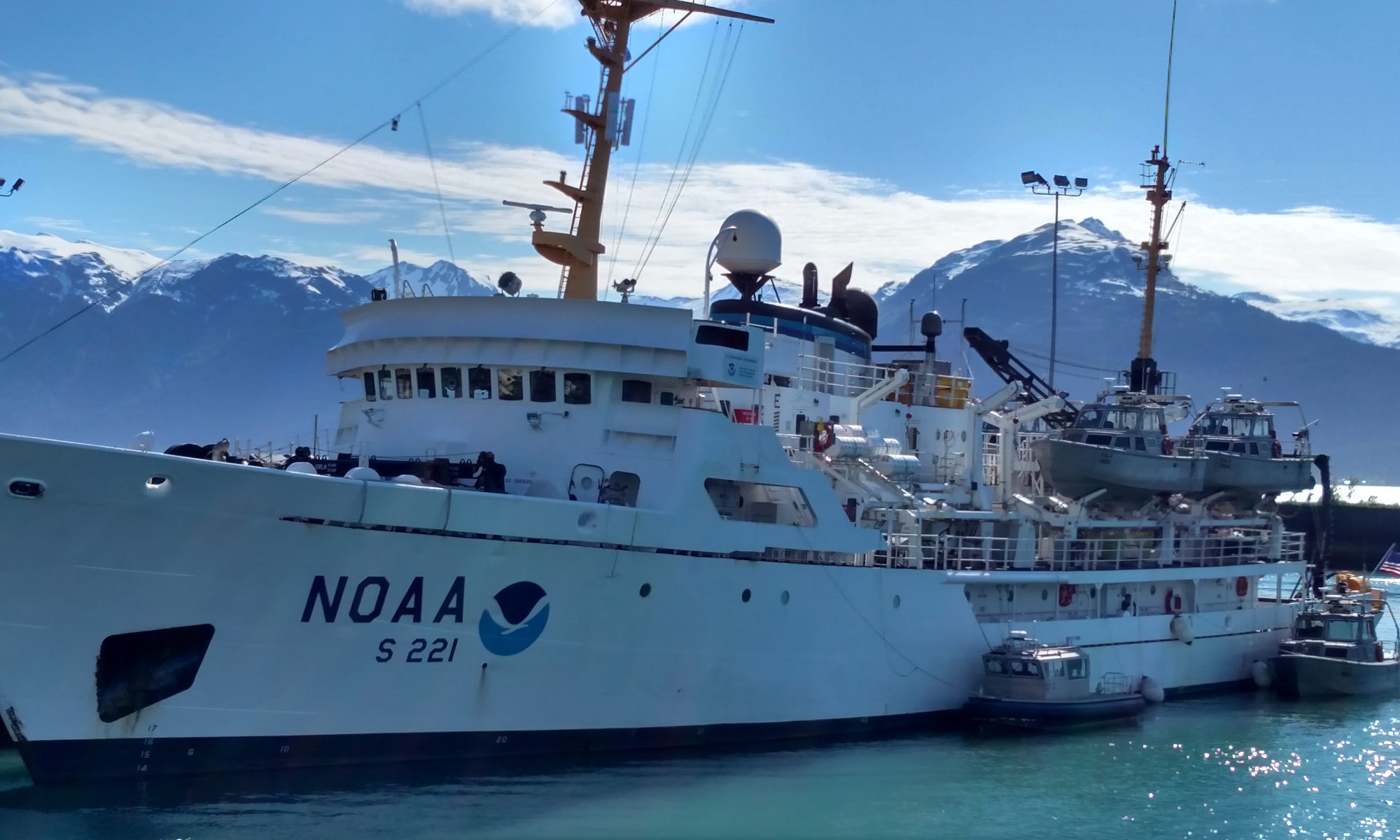
Kevin McMahon, July 31, 2004

NOAA Teacher at Sea
Kevin McMahon
Onboard NOAA Ship Ronald H. Brown

July 26 – August 7, 2004

Mission: New England Air Quality Study (NEAQS)
Geographical Area:
Northwest Atlantic Ocean
Date:
July 31, 2004

Weather Data from the Bridge
Lat. 43 deg 38.20 N
Lon. 69 deg 57.97 W
Speed 8.9 kts
Barometer 1016.68 mb
Rel Humidity 97.27%
Temp. 18.16 C

Daily Log

0835 hours. The wind speed has increased and is now at about 16 kts which lend a slight roll the ship.

We came within a couple of miles of Fletcher Point, ME. Before turning around, at present we are heading in an easterly direction.

Helped to launch an ozonesonde at 1000. The winds had kicked up to about 20 kts out of the southwest which made it somewhat tricky. In all though it was a successful launch.

I learned later that the ozonesonde made it to an altitude of 39.9 kilometers, not the record but pretty close.

I’ve been up on the bridge. The views of the Maine coastline are spectacular.

Talking to some of the men and women who operate the ship I am amazed at the complexity of the vessel. Aside form the scientific aspect, the bridge alone seems to have more in common with a Boeing 747 than it does with a ship on the sea. Gone are the ships wheel and binnacle and the entire nautical flavor as described by Melville.

The RONALD H. BROWN is as modern a ship as you will find on the ocean.

She is 274 feet in length with a beam of 52.5 feet and a draft of 19 feet.

Its diesel engines do not drive the propellers directly, rather they produce electricity which intern powers electric motors that drive the ships twin aft thrusters and single bow thruster. The ship does not have rudders but is instead maneuvered by the thrusters which have the ability to rotate 360 degrees.

The ships wheel has been replaced by a joystick type apparatus which allows for minute movement in all direction. The GPS navigational system allows the ship to maintain a fixed course over an extended period of time or, hold a steady fixed position within one meter of a desired location.

Questions

How does a GPS system work?

Does the GPS system on the ship differ from the one we use for class fieldwork?

Kevin McMahon, July 30, 2004

NOAA Teacher at Sea
Kevin McMahon
Onboard NOAA Ship Ronald H. Brown

July 26 – August 7, 2004

Mission: New England Air Quality Study (NEAQS)
Geographical Area:
Northwest Atlantic Ocean
Date:
July 30, 2004

Weather Data from the Bridge
Lat. 42 deg 37.86 N
Lon. 70 deg 12.37 W
Speed 8.6 kts
Barometer 1018.96 mb
Rel Humidity 93.16%
Temp. 18.9 C

The seas are calm. The skies have a distant haze. The New England atmosphere so common at this time of year. As is usual for the day, at 0700 we sent aloft a radiosonde, and then at 1000 an ozonesonde.

I was lucky enough to see a couple of finback whales; but unfortunately I had left my camera on my bunk, before beginning a discussion with Drew Hamilton about alternative power generation. Many of the scientists lead very diverse lives. Drew has a house in Seattle and wants to get off the electrical grid. He has worked for NOAA for 25 years and has seen much of the world. Thirty years ago he started out at the University of Miami, never in a thousand years dreaming he’d be involved in the kind of research he’s doing.

Ever hear of di-methyl sulfide DMS? As chemistry teacher I’d heard the name but never understood its significance to the atmospheric work the scientist aboard the ship are undertaking. It turns out that di-methyl sulfide is produced by plankton and is part of a planktons waste process. DMS is one of the major contributors of atmospheric sulfur. Overly high levels in the atmosphere can act as a reflective unit not allowing enough sunlight through our atmosphere. As a result, in certain areas the Earth does not receive the needed heat for some of the biological processes to take place.

Weather Data from the Bridge
Lat. 43 deg 17.84 N
Lon. 69 deg 33.83 W
Speed 9.3 kts
Barometer 1018.3 mb
Rel Humidity 86.16%
Temp. 20.65 C

1530 hours and there seems to be a flurry of activity among many of the scientist. A radiosonde is being rapidly readied to be sent aloft. It seems that the ship has reached a position somewhat east of Portland, ME and we have found a plume of ozone. The initial spike on the instrumentation showed 80-85 ppb (parts per billion) but then it jumped again to 101 ppb. This spike in the ozone was enough to request that another ozonesonde be readied and sent aloft. They have also requested a fly over by the DC3 out of Pease. Onboard the DC3 is a LIDAR (Light Radar) which measures atmospheric ozone. I am told that the cost of one ozonesonde is approximately one thousand dollars, so I assume that the readings on the instrumentation are justifying the expense. It will be interesting to see what they all have to say at the evening science meeting which is held each evening at 1930 hours.

We seemed to have found a large plume of ozone. It is as everyone, the science staff at least, had assumed. We have indeed found a large plume of ozone.

1930 hours. We are now heading in a westerly direction for Cape Elizabeth, ME.

Kevin McMahon, July 29, 2004

NOAA Teacher at Sea
Kevin McMahon
Onboard NOAA Ship Ronald H. Brown

July 26 – August 7, 2004

Mission: New England Air Quality Study (NEAQS)
Geographical Area:
Northwest Atlantic Ocean
Date:
July 29, 2004

Weather Data from the Bridge
Lat. 42 deg 43.99
Lon. 70deg 02.99
Barometer 1015.71 mb
Rel Humidity 94.6%
Temp. 17.1 C
Radiosond aloft at 0710.

Daily Log

Science meeting at 0800. It has been decided that we will try to rendezvous with the J31 out of Pease at approximately 1130 and if all goes well send another radiosonde aloft.

Since I came onboard the RONALD H. BROWN on the 26th of July I have been completely amazed at how sophisticated life onboard a modern research vessel has become. On the first day waiting in line for lunch I inquired as to how long we can expect to have the fresh fruits and vegetables? Mr. Whitehead, the chief steward answered me that, “we always serve up fresh salads, very little of our produce is frozen.” When I inquired as to how they do it, I was informed that the ships refrigeration system was equipped with a device which filters out the Ethylene, a compound which causes produce to rot. As a result we can expect to have fresh salads on a daily basis.

This little tidbit of information got me to thinking about the possibility of a lesson plan which would incorporate some chemistry and some biology.

Questions

1. Can you draw the molecular structure of Ethylene?

2. What bacteria are involved in the spoilage of food and how does the elimination of ethylene play a part in this process?

Most of my time over the last 3 days has been spent getting to know the ship, the crew, and the scientific staff. It is odd in that I am being drawn more towards the operation of the vessel than I am to the scientific community. But both aspects are keeping me busy.

I have been working with Dan Wolfe, one of the main meteorologists onboard. I had thought that because I teach Earth Science, I knew something about weather forecasting. I have a long way to go. It has been an education. We have been sending aloft four radiosonde balloons per day. One every six hours. Each device is carried aloft by a balloon filled with helium. The radiosonde sends back to the ship its location, direction of travel, velocity, and altitude as a result of the barometric pressure.

Question

Which gas law equation does one use to calculate the relationship between pressure and volume?

1400 hours and I have just been informed that my hands are needed to assist with the preparation and launch of an ozonesonde. 1500 hours and we have been informed that a DC3 out of Pease will rendezvous with us in about 30 minutes. An ozonesonde has many of the characteristics of the radiosonde but also has the capability to measure ozone levels at various altitudes. It also has a longer life span and stays aloft about 2 hours and 45 minutes. The DC3 is really an aerial platform which has equipment onboard to measure ozone. I have been informed that the DC3 is nearing our location so it is time to fill the balloon.