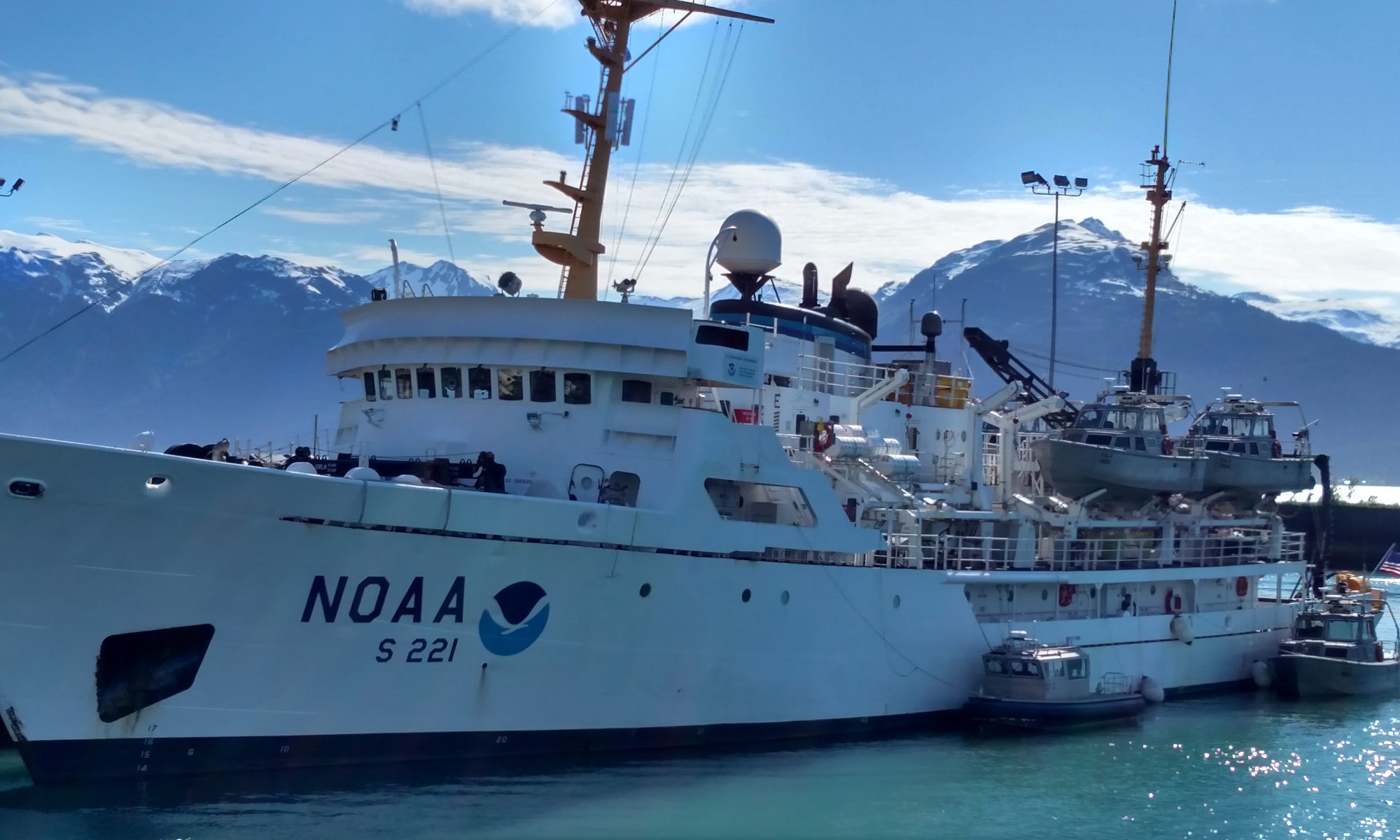
Philip Hertzog, August 7, 2005

NOAA Teacher at Sea
Philip Hertzog
Onboard NOAA Ship Rainier
July 25 – August 13, 2005

Mission: Hydrographic Survey
Geographical Area: Aleutian Islands, AK
Date: August 7, 2005

Weather Data from Bridge

Latitude: 56˚ 00.3’ N
Longitude: 158˚ 45.7’ W
Visibility:  10 nm
Wind Direction: light
Wind Speed: airs
Sea Wave Height: 0 feet
Sea Water Temperature:  12.2˚ C
Sea Level Pressure: 1006.0 mb
Cloud Cover: 1, cumulus, altocumulus

hertzog_log14fScience and Technology Log 

Today I actively participated as a full member of the launch crew conducting a new type of survey for me, sediment sampling.  The launches typically carry three crew members, one to handle the boat and two others to work the sonar and computer equipment. Generally Mike Laird (the other the teacher at sea) and I have gone along as a fourth person to observe. However, today we only had three people aboard launch RA 2, the smallest and lightest of the launches.  Survey Technician Dan Boles and Coxswain Erick Flickenger (Flick) co-led our survey mission.  Dan described to me today’s goal of collecting sediment samples from several locations around Mitrofania Island. Sediments are the material found on the bottom surface of water bodies. It includes materials like mud, silt, sand, clay, pebbles, rocks, shells or hard pan.

The nautical chart makers place sediment information on their maps so ship captains can determine if they have a safe location to set anchor. If the bottom is too rocky, the ship’s anchor may get stuck and trap the boat.  If the bottom is not firm enough, the anchor will drag across the bottom and the ship could end up drifting to a dangerous location like a reef or rocky shore. The sediments in an anchorage area also determine the type of anchor a captain chooses to use. Some types of anchor work better than others in certain sediment types.

I helped unhook the launch from the RAINIER’s crane and Flick got us underway. Dan immediately showed me how to work the sonar and computer equipment.  We used a Knudsen 320 M echo sounder to measure bottom depth at our sample locations.  Dan had me turn it on and I watched the sounder trace the depth on a roll of paper:

hertzog_log14

The sounder recorded a black line on a scale so we know or bottom depth at the sampling location. Dan also had me write the type of sediment we found on the same paper. I then entered the data into the computer.  We needed both an electronic and paper copy in case the computer crashes which sometimes happens when the launch bounces around. To the right a photo of Dan entering data while Flick watches in RA 2’s small cabin.

On the launch deck we used a “clam shell” sediment sampler.  The sampler is shaped like a large, round clam shell with two metal jaws held shut by a large spring. We pried open the two jaws and set a trigger to keep the jaws opened. It works like a bear track with the trigger lever on the side. We took great care setting the trigger because the jaws can break our fingers if it snaps shut on them. Once set, you then lower the sediment sampler over the side.  The sampler free falls through the water column and plunges into the bottom which triggers the jaws to snap tight and capture the sediment sample. You then winch the sample up to the surface, open the jaws and record the sediment type.  The following photos show the sediment sampling process:

hertzog_log14c

We found mostly fine black sand and pebbles of volcanic origin in our sediments around Mitrofania Island which matches the local geology.  As mentioned in previous logs, the explosion of an ancient volcano formed Sosbee Bay (a caldera) on the south side of the Mitrofania Island. To the north of the island, the shield volcano, Mount Veniaminof dominates the landscape:

hertzog_log14g

Our sediment sampling went well with one exception.  We transited out to a sample location far south of Mitrofania Island.  A combination of wind and tide suddenly hit us with two to three foot choppy waves as we took our sample.  Our light weight launch took two to three nose dives down the face of a three foot wave as Flick tried to hold our position in one spot for the sample.  Dan and I got knocked into the railings on the deck and the clam shell sampler almost snapped on my fingers as I tried to adjust it.  Inside the cabin, equipment flew off the shelves and onto the cabin floor.  Flick pronounced the sea conditions as too unsafe for us to work on the deck and yelled for us to get back inside the cabin.  We then made tail and headed back towards land getting bounced about until we entered the wind shadow created by the lee side of the island. Flick later told us he considered having us put the life raft out on the back deck of the launch as a safety precaution.

Dan and I talked about boat safety. Dan told me that anyone on board the launch can call for it to return due to unsafe conditions. In our case, we did the right thing by not trying to finish the sampling south of Mitrofania and quickly returning to calmer waters.  The rest of the day we worked on the protected side of the island and finished early.  We fished near Cushing Bay and waited for the RAINIER to arrive and pick us up.  The RAINIER again moved location to seek settler from the changing winds.  We will spend our few remaining nights in Cushing Bay, our first location when we arrived at Mitrofania about two weeks ago.

Peering over the control panel

Personal Log 

I enjoyed the opportunity to work today as a full member of the launch team.  I appreciated Dan Boles putting me on the computer right away and the way we took turns collecting sediment samples out on deck.  I found Flick to be a master at handling the launch in rough conditions and ensuring our safety.

I have felt safe on the launches, but our situation south of Mitrofania proved a bit worrisome.  I’m glad Flick called off our work out there right away and brought us into a more protected area. While waiting for the Rainier, I got to fish and caught numerous sea bass near a kelp bed.  We also saw a “fish ball” go by. The fish ball consisted of a large school of small candlefish tightly grouped into a ball shape about 7 feet in diameter just below the surface. Seagulls hovered over the fish ball and snatched out tiny fish as tasty treats.  As the fish ball passed under the launch, we saw the outlines of large fish following the candlefish.

After supper we had another beach party out on the spit near the HorCon station.  We had a beautiful, clear evening and watched the sun set.  We again had a large bon fire and plenty of good conversation and company. I returned at 11:00 pm with an orange and deep blue dusky sky as a backdrop for our skiff ride from the beach.  The days have grown shorter since my arrival, but night still arrives after 11:30 pm.

Question of the Day 

What sediment bottom type do you think will best hold an anchor and keep a ship safe?

Philip Hertzog, August 6, 2005

NOAA Teacher at Sea
Philip Hertzog
Onboard NOAA Ship Rainier
July 25 – August 13, 2005

Mission: Hydrographic Survey
Geographical Area: Aleutian Islands, AK
Date: August 6, 2005

The processing room
The processing room

Weather Data from Bridge

Latitude: 56˚ 00.3’ N
Longitude: 158˚ 45.7’ W
Visibility:  10 nm
Wind Direction: light
Wind Speed: airs
Sea Wave Height: 0 feet
Sea Water Temperature:  12.2˚ C
Sea Level Pressure: 1006.0 mb
Cloud Cover: 1, cumulus, altocumulus

Science and Technology Log 

I spent the afternoon in the plot room behind the bridge.  After collecting data on the launches, the hydrographic technicians need to process and make it usable before sending the information to map makers in Washington, D.C.  This processing takes place in the plot room.

The plot room has a large table in the middle with eight work stations crowded around the outer edge of the room.  Each work station has two computer screen monitors where the technician can pull up multiple windows. The room has a couple of portholes to provide light, though these can be shaded to make the monitors more visible. I observed the Ensigns and survey technicians concentrating on their work.  The plot room impressed me as the quietest location on the RAINIER with people clicking on their computer screens and checking their data for accuracy.  Once in a while one of the technicians got up to ask another for clarification on a problem.  The four people in the room all wore headphones to listen to CD or mp3 players.

Processing the data
Processing the data

The technicians processed data by first “cleaning” it up. The hydrographers put the sonar data up on the screen and looked for mistakes in the readings.  Mistakes can occur by the launch computer skipping measurements or missing a GPS satellite signal.  The plot room computers also adjust for the movement of the launches in several directions caused by buffeting seas. After cleaning data, the crew corrected the sonar readings for sound velocity by using the CTD probe readings taken from the launches. As noted previously, the speed of sound in water is affected by conductivity (a measurement of salt content), temperature and density). The CTD data is used to correct the sea bottom depth readings obtained from sonar. The technicians made one final correction to the sonar data by loading in tidal information to adjust for the height of the launch above mean lower low water.  With the corrected sonar data, three-dimensional maps can now be generated and the hydrographer gets a picture of the ocean bottom over a wide area.  Additional work will be done before the information is sent on to the chart makers off the ship.

After supper I went up to the plot room to get some photographs for this log entry.  To my surprise, Ensigns filled every work station and I saw them checking on today’s data.  The Ensigns discussed with Lt. Ben Evans the strategy for tomorrow’s mapping.  What dedication! It’s Saturday night, yet the work never stops for the hard working crew of the RAINIER. Too bad for them, I’m going fishing now!

The hydrographers highlight the incorrect data and click on it to remove it

Personal Log 

I had a very quiet day. The routine on a research vessel like the RAINIER is a mix of excitement and concentrated computer work.  The crew averages about one day of cleaning and processing data for each day of collecting data on the launch.  Though the computer work may seem tedious at first, think about the sense of accomplishment when you see your data become a three-D map of the ocean bottom and know that other people will use your work.

I hope my own students will recognize that hard work can pay off and provide a sense of accomplishment and purpose.  The crew of the RAINIER has provided me with examples to show my middle school students that they can balance exciting work with hard dedication to make a meaningful difference to society.

Question of the Day 

Why must the hydrographers carefully check their data for mistakes? What can happen if a mistake is made on a nautical chart?

Philip Hertzog, August 5, 2005

NOAA Teacher at Sea
Philip Hertzog
Onboard NOAA Ship Rainier
July 25 – August 13, 2005

Watching the computers

Mission: Hydrographic Survey
Geographical Area: Aleutian Islands, AK
Date: August 5, 2005

Weather Data from Bridge

Latitude: 56˚ 00.3’ N
Longitude: 158˚ 45.7’ W
Visibility:  10 nm
Wind Direction: light
Wind Speed: airs
Sea Wave Height: 0 feet
Sea Water Temperature:  12.2˚ C
Sea Level Pressure: 1006.0 mb
Cloud Cover: 1, cumulus, altocumulus

Science and Technology Log 

I went out on launch RA 5 today to help survey more transect lines near the east entrance to Sosbee Bay and over by Spitz Island. Ensign Andrew Halbach led our survey with Greg King as the Survey Technician and Steve Foye as our coxswain.

Driving the launch
Driving the launch

Greg King, in his late twenties, has been on board the RAINIER for about a year and graduated from Pacific Lutheran University in Tacoma with a degree in geology.  Prior to NOAA, Greg worked for consulting firms conducting a variety of work including environmental assessment, mining geology and hazardous waste site investigations.  Greg and I know a lot of the same people from my own professional experiences prior to teaching. Greg became disillusioned with consulting and wanted to have a career where he could make a difference, help the environment and feel good about his work.  A friend told Greg about NOAA so he applied, got hired, and has been happy with the work he does. Greg plans to make a career with NOAA and the federal government.  Greg says most of the Survey Technicians tend to stay on the ships for a few years and then advance up into other jobs with NOAA onshore. Greg will become a father in October and NOAA will grant him several weeks of leave to spend with his new child and wife.

In the survival suit

Greg’s duties on the RAINIER include running the sonar and data recording equipment on the launches.  He also puts data into the mainframe computer on board the RAINIER and looks for errors that need correction. The Survey Technicians tend to spend a few days in on the launches and then work on board the ship for a day or two processing data before going out on the water again. Above is a photo of Greg at work on the RA 5 launch.  Steve Foye, our coxswain, has been on the RAINIER for about 15 years and on NOAA ships for a total of twenty years. Mr. Foye is a crusty sailor with an earthy sense of humor.  Foye served in the Navy and became a meat cutter in south Seattle after finishing military service and getting married.  However, Mr. Foye missed the sea and the outdoors. NOAA gave him the opportunity to travel and see Alaska. Foye particularly enjoys driving a launch all day and watching the scenery while the technicians run the sonar. All of the crewmembers speak highly of Mr. Foye and he mentors the younger deck hands. Steve Foye serves as the RAINIER’s Boatswain’s Group Leader and is responsible for ensuring the proper handling and maintenance of all the launches. Foye has a merchant marine seaman’s card, which he renews every five years.  Steve takes classes and documents his sea time to renew his card.  Even sailors need to continually educate themselves and keep current on the latest technologies.  Many of my middle school students don’t realize that the skills they learn in school will serve them for a lifetime and they must continue to educate themselves.  Above is a photo of Mr. Foye handling launch RA 5.

The control screen on the computer.

After getting underway, Mr. Foye threw a buoy overboard and yelled “man overboard.”  Ensign Andrew Halbach quickly took over the helm and Greg grabbed a boat hook while I pointed at and kept my eyes on the buoy to make sure we don’t lose site of it in the rolling waves. The Ensign skillfully brought the launch around and as he approached the “victim,” turned the launch a hard left and reversed the engine.  The stern of the launch swerved to the right and the starboard side ended up next to the buoy where Greg scooped it out of the water with the boat hook. Mr. Foye repeated the “man overboard” two more times with Greg and I taking a turn at the helm.  Mr. Foye guided me in maneuvering the launch to the buoy, though it took me more than one try to reach our “victim.” Everyone on board the RAINIER needs these important rescue skills to ensure the safety of all crewmembers.  Even the coxswain can fall over board and one needs to be prepared to take over the helm in an emergency.

After the over board drill, I practiced putting on my bright orange survival suit.  I had donned it once on board the steady Rainier, but it proved challenging while rocking back and forth on the launch in the open ocean. Though the survival suit won’t keep me dry, it will allow me to live for many hours instead of a few minutes if we abandoned ship in the 50-degree waters of the Gulf of Alaska.  We spent a productive day running transects and collecting bottom depth data.  Ensign Halbach and Survey Tech Greg King showed me how the equipment works.  They even let me run the two computers.  I selected lines (transects) that we followed and then hit control “S” (for start) on the key board to write the sonar data to a computer file.  When we finished a transect, I hit control “E” for end and the computer stopped logging (writing) information.  We then repeated the process and the computer generated a separate file for each transect.

Catch of the day
Catch of the day

The Ensign and Greg also showed me how to control and fine-tune the sonar. A master window on the computer controls the sonar and allows you to set power, gain and depth.  The power controls the strength of the sound wave sent to the bottom.  The deeper the bottom, the stronger the signal required. The gain controls how sensitive the sonar receiver picks up the sound waves bounced off the bottom.  It’s like a volume control on your radio.  You want to set it so you eliminate static and “hear” the music at the right loudness and quality.  The depth control determines how far down the signal will go. The survey technician adjusts all three controls to account for bottom type (sandy, rocky, hard) and other factors that affect the quality of the sonar signal.

After a long day, the swell of the ocean increased and our ride on the launch became bumpy.  The RAINIER has moved a few miles to the west in Sosbee Bay to seek protection from the increasing north winds.  We returned to the RAINIER in time for supper and I fished out on the fantail (stern) without any luck.  The steady wind from the north made it one of the coldest evenings of the trip and I put on a jacket.  Around 9:30 pm a group of crewmembers returned from fishing in the launch with a catch of lingcod and rockfish (red snapper) to finish the evening.

Matt Boles, survey tech, lands the big fish of the day

Personal Log 

I really enjoyed today. Steve Foye gave me a great education on how to operate the launch. I also appreciated the way Ensign Andrew Halbach and Greg King patiently taught me how to run the sonar.  Using the technology gave me greater understanding about how all this works.

For supper, we had a cookout on the fantail. The stewards (cooks) had the propane barbeque grills fired up and made ribs, chicken, corn and an assortment of salads.  We all sat out on the deck, talked and ate.

Question of the Day 

If I wanted to pick an object out of the water to the right side of my boat, why would I turn the launch a hard left and put the motor in reverse? Explain your answer in words and include a diagram.

Philip Hertzog, August 4, 2005

NOAA Teacher at Sea
Philip Hertzog
Onboard NOAA Ship Rainier
July 25 – August 13, 2005

Mission: Hydrographic Survey
Geographical Area: Aleutian Islands, AK
Date: August 4, 2005

hertzog_log11Weather Data from Bridge

Latitude: 55˚ 50.8’N
Longitude: 158˚50.0’W
Visibility:  10 nm
Wind Direction: light
Wind Speed: airs
Sea Wave Height: 0 feet
Sea Water Temperature:  12.2˚ C
Sea Level Pressure: 1011.5 mb
Cloud Cover: 2, stratocumulus, altocumulus

Science and Technology Log 

Four launches left early today (7:00 am) and I got up to watch the deck crew lower them into the water. Two launches took off to finish up mapping in the Fish Ranch Bay area while the other launches went across to Mitrofania Island to map shoreline and submerged rocks on aerial photographs.

hertzog_log11aWith our mapping work nearly completed in this area, the Commanding Officer moved the RAINIER to Sosbee Bay located on the south side of Mitrofania Island.  The RAINIER traveled along the north side of Mitrofania and made a left turn to skirt the southwestern shore and Spitz Rock before a second left turn into Sosbee Bay.  The move took approximately 2 hours.

Along the way, I saw at least two dozen Sei whales surface and blow spray in groups of up to four individuals.  As we approached each group of whales, they would submerge and then reappear several hundred yards behind the ship.  At one point the whales seemed to surround the RAINIER in a 270-degree arc: In my earlier log entries, I mistakenly called these creatures fin whales and provided the wrong life history. Sei (pronounced “say”) whales live in all ocean waters of the world.  They can reach up to 18 meters in length and have a small dorsal fin forming a 40 degree angle back with the body. The dorsal fin is located down about two thirds of their body length from the snout. A single ridge runs along on the top of their heads from the snout to the blow hole. Sei whales have black colored backs covered with oval scars that results in a shiny, metallic appearance. Lamprey bites cause the scars when the whales migrate into warmer waters.

Safety gear
Safety gear

Sei whales skim the water and remove tiny marine organisms called copepods for food with long, narrow plates (baleens) under their heads.  These whales tend to feed close to the surface and leave large swirls on the surface as they move their tails. I saw many of these swirls next to the RAINIER after whales had submerged in front of us.

I spotted the Sei whales by first seeing a black snout appear followed by an inverted cone shaped spray about 2 to 3 meters high.  A sleek long, shiny back then glides over the surface followed by the dorsal fin near the rear of the body.  The back then gracefully disappears without the fluke (tail) breaking the surface.  Once in a while the tail does appear as shown in the photo above.

Survey launch being lowered into the water

After passing the whales, the ship practiced an emergency fire drill and we reported to our assigned stations. The RAINIER’s fire fighting crew donned bumper gear and oxygen tanks and pretended to put out a fire by spraying water from a pressurized hose over the side of the ship.  Within 30 minutes of the fire drill, we had an abandoned ship drill. We grabbed our survival suits and hurried to our stations.  During the drill an Ensign described how to deploy the life rafts by first tying off the canister (see photo below) and then yanking on a release cable. A sensor automatically opens the raft when it hits the water. A rope holds the raft to keep it from drifting a way, but each raft comes equipped with a sharp knife to cut the rope if the ship should sink into deep water: The ship conducts the emergency drills at least once every two weeks to ensure we remain sharp on these important safety skills.  In the event of a real emergency, we have no place to go except into cold water where one could survive for only a few minutes without protection. The RAINIER’s crew takes these drills seriously so we can solve problems (like putting out fires) and prevent the need to enter the water.

After the drills, the RAINIER slowly coasted into Sosbee Bay.  We entered a new environment.  An arc of steep cliffs rose out of the water and surrounded the bay.  We distinctly recognized the shape of a caldera, former volcano that exploded long ago and left a large crater now filled with ocean water.  Tonight, we will sleep on board the ship located inside the remains of a crater.

The Southwestern Alaskan Peninsula is part of the Pacific “ring of fire.”  A large tectonic plate located far beneath the surface of the Pacific Ocean slowly runs into the North American plate.  The meeting of the plates causes earth quakes and friction creates large chambers of magma (molten rock) that can form large volcanoes when it reaches the surface of the earth.  All around us, we have seen signs of past volcanic activity from the large shield volcano, Mount Veniaminof, to the north of Mitrofania to the small pieces of pumice found on the beaches.  However, Sosbee Bay provided a sober reminder of the power and destructiveness of nature. The rest of the day I spent reading and completing my documentation.

Personal Log 

I had another busy day on the RAINIER learning about Sei whales and practicing my photography. Again, the galley crew fed us well and I’m need of some exercise.  I’ll go hit the small gym below deck tonight to work off some calories.  On a ship I find it difficult to get sufficient exercise.  If I ever get permanently assigned to a ship, I’ll have to become disciplined in setting up an exercise routine.

Question of the Day 

What is the “ring of fire” and where is it located?

Philip Hertzog, August 3, 2005

NOAA Teacher at Sea
Philip Hertzog
Onboard NOAA Ship Rainier
July 25 – August 13, 2005

Mission: Hydrographic Survey
Geographical Area: Aleutian Islands, AK
Date: August 3, 2005

The launch, at work
The launch, at work

Weather Data from Bridge

Latitude: 56˚ 00.3’ N
Longitude: 158˚ 45.7’ W
Visibility:  10 nm
Wind Direction: light
Wind Speed: airs
Sea Wave Height: 0 feet
Sea Water Temperature:  12.2˚ C
Sea Level Pressure: 1006.0 mb
Cloud Cover: 1, cumulus, altocumulus

Science and Technology Log 

Mike Laird (the other Teacher at Sea) and I had been assigned to stay on the RAINIER today so we slept in an extra hour. However, as I returned from breakfast, Lt. Evans asked me to take his place on R8 skiff and go out to the HorCon station.  I quickly said yes, grabbed my gear, and jumped on board R8 within 5 minutes.

HorCon stands for Horizontal Control where we broadcast global position satellite (GPS) signal corrections to help the mapping launches accurately locate their positions.  In essence, the radio signals allow the launches to control their horizontal position so they have correct latitude and longitude readings. In past log entries I referred to the HorCon station as the transmitter station.  HorCon stations are also called flyaway stations when set up on temporary basis.

Ensigns Andrew Halbach and Olivia Hauser led our mission with assistance from Matt Foss. Jonathon Anderson drove the skiff under the watchful eye of his trainer, Able Seaman Erick Davis.  AB Davis has been on the RAINIER for one year and prior to that served in Iraq with the Army Reserve.  AB Davis also served on other NOAA ships for two years before going to Iraq.

Uploading data
Uploading data

As we left the protected waters of Fish Ranch Bay, the skiff bucks and slams hard into waves as we enter the open waters between the southwest Alaskan peninsula and Mitrofania Island. The HorCon site now lies 8 miles from the RAINIER.  We held on tight to the hand rails of the skiff while salt water splashed onto our faces and soaked our orange, bulky float jackets. Once in a while our feet lifted off from the deck of the skiff as we crested a wave and then slammed our feet down hard when the boat dropped into a trough. Everyone on the skiff had smiles on their faces as we raced toward our destination. As I noted in yesterday’s log, the HorCon station’s computer crashed and the batteries drained their electrical charge.  Upon arriving at the station, we hauled the computer and six large, 12 volt deep cycle batteries up to the transmitter.  We timed our unloading of the skiff to avoid sea swells washing up the beach and soaking our feet.

Ensign Halbach and Matt Foss went to work installing the new batteries and computer, while Ensign Hauser and I hopped into the skiff and traveled over to the tide gauge station a mile away.  As mentioned in previous logs, the tide station provides vertical control (up and down) so the launch crews can correct the sonar for the rise and fall of the tides and make the nautical charts to show water depth from mean lower low water.

The tide station works by sending pressurized nitrogen gas through a tube that goes from a sensor into the water at a set location. As the tide rises and falls, the ocean water presses against the nitrogen gas in the tube and the computer sensor uses this information to measure sea level height.  The computer then transmits the sea level height to a satellite which routes the information to the main mapping office in Washington, D.C.

Ensign Hauser set up the tide station three weeks ago and it now needed a new nitrogen bottle. I carried the heavy, three-foot long metal bottle off the skiff and up a short steep slope. We hooked up the new nitrogen tank and Ensign Hauser operated a computer to make sure the station works correctly.  In the mean time, Jonathon practices his skiff landings with advice from AB Davis.

We returned to the HorCon station and joined Ensign Halbach and Technician Matt Foss.  They changed out the batteries and plugged in the reprogrammed computer.  The computer indicated that it was transmitting data, but Ensign Halbach saw only binary (zeros and ones) code on the screen instead of latitude and longitude readings.  A radio check with the launches determined they can pick up our transmission, but Ensign Halbach may need to make another trip out to the HorCon station to ensure the problem has been fixed.

We loaded up the old batteries and jumped into the skiff for a wild eight-mile ride back to the RAINIER and arrived with plenty of time before supper.

Personal Log 

After a late night of fishing, I found the “salt water bath” during our skiff crossing to Mitrofania Island refreshing and invigorating. I never felt tired for the rest of the day.  I enjoyed working with Ensign Hauser who patiently showed me how the tide gauge station computer logs data. I also got my work out by carrying the heavy batteries and nitrogen bottle.

The salt water bath left me with an interesting problem. Salt crystals flaked off my hair and face onto my clothes.  It looked like I had a major case of dandruff. My next stop after finishing this log entry is to hit the shower and get rid of the saline grime.

Hopefully the HorCon station’s problems were fixed and no more major work will be needed. In science, you run into these problems in the field and it can prove frustrating.  However, problem solving is part of the challenge of working out in remote locations.  In my classroom and Tacoma Public Schools, we try to teach students important problem solving skills.  No matter how much students memorize, it all boils down to using knowledge to creatively trouble shoot problems.

Question of the Day 

Here is a problem for my Electronics students.  The HorCon station runs off six, 12 volt batteries. The 12 volt batteries are recharged with a set of five solar panels.  Should you set up the batteries in series, in parallel or a combination of both? Should you set up the solar panels in series, parallel, or combination of both?  Write out a schematic for your design and explain your thinking.