Alex Miller: Smooth Sailing So Far, May 31, 2015

NOAA Teacher at Sea
Alexandra (Alex) Miller, Chicago, IL
Onboard NOAA Ship Bell M. Shimada
May 27 – June 10, 2015

View of the Hatfield Marine Science Center and NOAA dock as the Shimada pulled away.


Mission: Rockfish Recruitment and Ecosystem Assessment
Geographical area of cruise: Pacific Coast
Date: Sunday, May 31, 2015

Weather Data: 

  • Air Temperature: 11.1°C
  • Water Temperature: 11.8°C
  • Overcast skies
  • Wind Speed (kts) and Direction: 15, SSE

Science and Technology Log

Last of the bridge we'll see for some time.
Last of the bridge we’ll see for some time.

We finally weighed anchor and set sail at 1032 Friday morning. Fog blanketed the shores of Newport as we passed below the Yaquina Bay Bridge and out into the channel created by the North and South Jetties. One of our last sights from shore was Chief Scientist Ric Brodeur’s wife, who had come to see us off. The fog was so thick that before we had even reached the end of the jetty her lime green jacket was hidden from view.

Emily and I and several of the other scientists watched our departure from the flying bridge, the highest observational deck on board the ship. It provides an almost unobstructed 360-degree view of the surroundings—making it perfect for Amanda’s surveys—but it’s also right next to the foghorn, which had to be blown every two minutes until we reached greater visibility. Needless to say, we all found somewhere else to watch the waves.

IMG_7894
Visibility was low as we left Newport.

Once the ship had moved farther offshore, some of the fog cleared but the moisture in the air was still enough to cause concern for the computers so Amanda went to the bridge, an enclosed deck that houses the navigational instruments that the captain and other officers use to drive the ship. Here she began setting up her survey equipment.

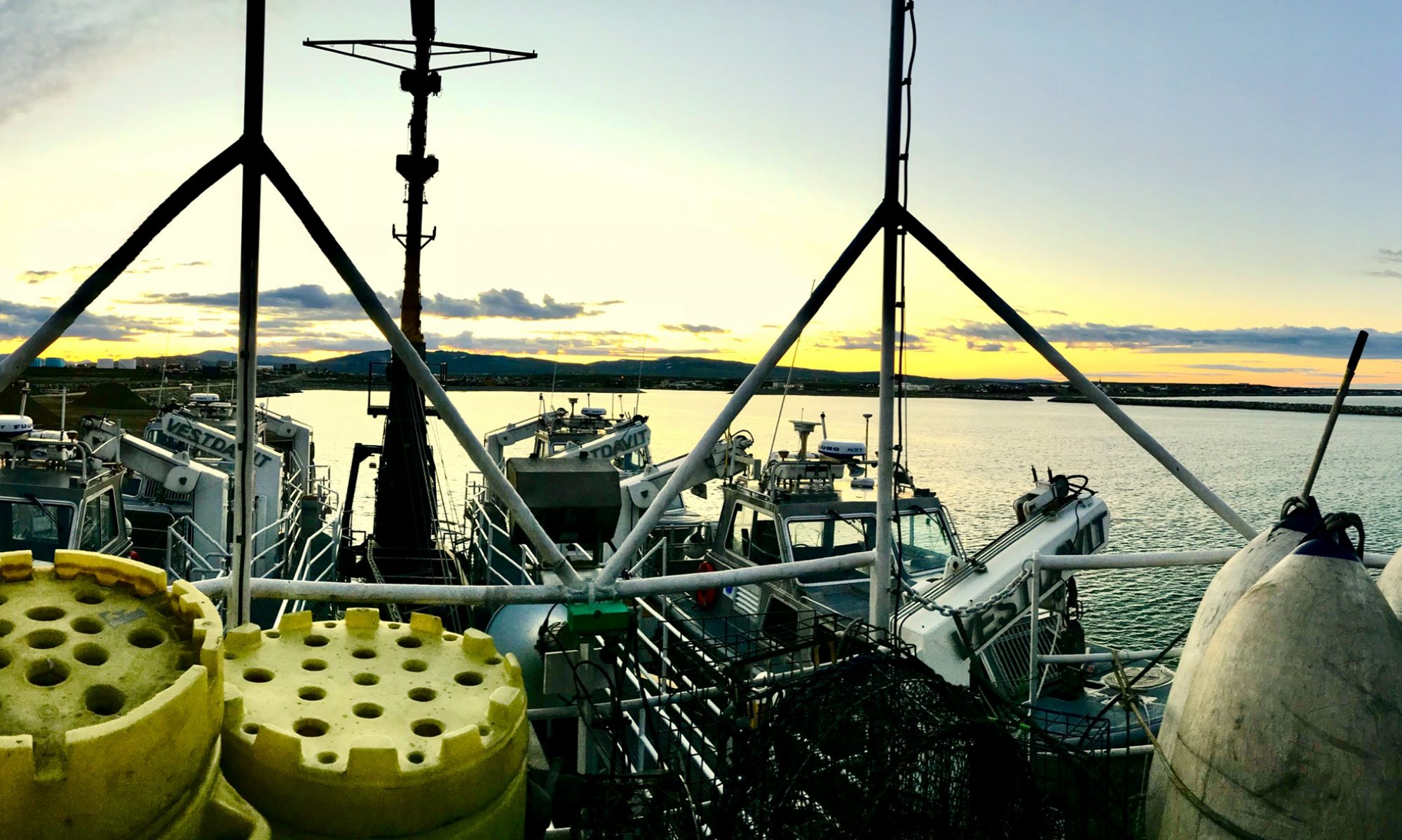
Up to this point, I’d been getting a lot of great advice about handling the first few hours on board the moving ship. Some people suggested I lay down, but the go-getter in me wanted to work. Using a program that is linked to the ship’s GPS, Amanda taught me how to code the observations she was making of the seabirds and marine mammals. As she kept her eyes glued on the 90-degree quadrant made by making a quarter port (while facing the front of the ship, counter clockwise or left, for you digital folks) turn from the bow (front of the ship) (in the image at the top of this post, you can see a panoramic view of quadrant I, the port bow of the ship), she would call out codes for the species, distance from the ship and behavior of the bird she observed. If she were to spot any marine mammals–pinnipeds (pin-eh-peds) (seal and sea lions) or cetaceans (ceh-tay-shins) (dolphins and whales)–that gets entered in a separate database.

Amanda surveying from the flying bridge.

Amanda has to be prepared to work alone as she is the only ornithologist on the ship, but with a Teacher at Sea and other volunteers on board willing to learn and help out, she’s able to rely on us to share some of the work. She and I were working as quite the well-oiled machine for a solid 20 minutes before I made peace with the fact that I did not have my sea legs. To my great relief, it’s something you can sleep off.

__________________________

While at sea, the most important thing to remember is to be safe, so once we had been underway for a few hours, the ship’s crew and team of scientists went through drills to practice safety protocols for two of the three significant events that could happen at sea. A 10-second blast on the horn sounded the alarm for the fire drill, and all crew and scientists mustered (gathered) in their assigned locations. Next, 7-short, and 1-long blast signaled the start of the abandon ship drill. The need to abandon ship is highly unlikely, but out at sea you need to be prepared for anything. Most importantly, you need to know how to get into your survival suit, and fast.

Emily and I decided to practice since we were both first-timers to these impressive red neoprene onesies. Since they’re designed to be large enough to fit over your shoes and warm clothes, they can be awkward to put on, especially when you get to the zipping part. And who cares how they look when the water is 8-10° Celsius, a temperature that could cause hypothermia or fatal loss of body temperature.

Emily and I managed to get the survival suits on!

__________________________

Saturday was spent sampling a little bit of everything. Of course I paid a visit to Amanda up on the flying bridge to hear about how the birding (and marine mammal-ing) was going. Often, I find Emily there assisting with data entry. Since Amanda can only survey when the ship is traveling faster than 7 knots, traveling from station to station gives her time to look, but sometimes these distances are short and our time at the stations, releasing the various equipment needed for different scientists’ data collection, can be long. This is when Amanda goes off effort (not collecting data) for longer periods of time and during these times, Emily and I have taken to teaming up to check out what’s going on in the wet lab.

IMG_7970
Jaclyn releases the neuston tow into the water.

Home to most of the science crew, the wet lab is wet. Initially, I thought foul weather gear was meant for, well, foul weather, but between the hauling in, spraying down and rinsing of the samples caught in the nets, everyone in the wet lab is wearing theirs full-time. Also, everyone must wear hard hats and PFDs (personal flotation devices, also known as life jackets) when out on deck as the equipment is being released or hauled in. Safety first, as always!

My cabin mate, Jaclyn Mazzella, and Phil White, are the two survey technicians on the Shimada. They help release and monitor the nets and equipment that are being used on this research cruise. More on these two interesting cats later.

Emily and I working hard to haul in the CTD.

While in the wet lab, Emily and I witnessed the CTD being hauled in. CTD stands for conductivity, temperature and depth. Conductivity is a measurement of salinity, or how salty the ocean water is. The way it works is by passing an electric current through the water and measuring how fast it travels. This is connected to how salty the water is because when salt is dissolved in water, it separates into ions, these particles carry a charge and allow electric current to pass through. More conductive water will be salty, less conductive water will be less salty or fresh. 

We know that temperature provides a measurement of how hot or cold something is. In this case, we’re measuring the temperature of the water. It is mostly cold off the Oregon coast, though the scientists on board have been discussing a recent unexplained area of warmer water, dubbed the “warm blob.” Biologists aim to discover if the warm blob is going to have an impact on the fisheries.

As the CTD is lowered and raised, it can take measurements of these and other factors which allow biologists to compare the diversity and number of species they collect in their nets to the data collected. One of those nets is the neuston tow, a net that skims the surface of the water. It is one of several nets that are being used to collect samples from different layers of the ocean. The scientists on board expect to find jellies and larvae of different species in this net.

Curtis filters the cod-end of the neuston and finds a whole bunch of Vallela vallela.
Curtis filters the cod-end of the neuston and finds a whole bunch of Vellela vellela.

I got a chance to see the neuston being released. After it was hauled in, Dr. Curtis Roegner, a fisheries biologist with NOAA, detached the cod-end–a small container at the bottom of the net that collects everything the net caught–and filtered out the contents. Inside were a bunch of beautiful blue jellies! These guys are commonly known as by-the-wind sailors thanks to their interesting sail adaptation that allows them to harness the power of the wind to aid in their dispersal (scattering) throughout the ocean. I helped Sam Zeman, a biologist with the University of Oregon, Tyler and Curtis measure the diameter–the length at the widest point–of the bodies of the jellies.

Vallela vallela, by the wind sailors.
Vellela vellela, by the wind sailors.
Curtis, Tyler and I working to measure and record the lengths of the sails on the Vallela vallela. (Thanks to Sam for taking this picture!)
Curtis, Tyler and I working to measure and record the lengths of the sails on the Vellela vellela. (Thanks to Sam for taking this picture!)

Personal Log

The more time I spend on the Shimada, the more determined I am to figure out how time travel works so I can go back and thank my September 2014 self for putting in the Teacher At Sea application. I’ve been on the ship for three days now and I love being able to go anywhere, day or night, and be able to observe and assist in research and data collection, but also just sit and talk with people who have all followed many different paths that led them to this ship, for these two weeks.

You might think my biggest struggles right now would be seasickness (which I’m not!) or missing my friends and family, but honestly, the hardest part is keeping the blog down to a readable length. There’s an enormous amount more happening here than I have the room to tell you but I will try and cover everything before our time is up.

Lastly, it’s true, I miss my friends and family, a lot, but there are certain creature comforts here that help ease the transition from land to sea. NOAA certainly knows how to keep morale and productivity up, with a well-stocked kitchen open 24 hours, meals prepared on site by talented cooks, and a TV lounge for socializing with a selection of over 500 movies, it’s easy to feel at home. And when finding a work-life balance is not possible, it’s necessary, all of this helps.

Well, that’s all for now, catch the next installment coming soon to a computer screen or mobile device near you!

Acknowledgements

Special thanks to Prof. Mary-Beth Decker consulting on the spelling of Vellela vellela and Brittney Honisch for teaching me a good way to remember port vs. starboard. When facing the front of the ship, port is left and both words have four letters.

Alex Miller: Delayed but Still Determined, May 28, 2015

NOAA Teacher at Sea
Alexandra (Alex) Miller, Chicago, IL
Aboard and Inport NOAA Ship Bell M. Shimada
May 27 – June 10, 2015

Mission: Rockfish Recruitment and Ecosystem Assessment
Geographical area of cruise: Pacific Coast
Date: Thursday, May 28th, 2015

Personal Log

A panoramic view from Yaquina Point, gray whales can often be seen from the Point on their migration route, one of the longest in the animal kingdom.

Greetings from NOAA Ship Bell M. Shimada!

From my time onboard I have learned it takes a lot of people to run a ship this size, which helps explain why, due to a staffing issue, we have been delayed until tomorrow, Friday, at 1000. All scientists and crew are being asked to assemble on deck at 0800 for a briefing where I imagine we will go over responsibilities and safety precautions before heading out to sea.

Our run has changed its course slightly since cutting down to 13 DAS (days at sea); we will now cruise between Southern Oregon and Gray’s Harbor, WA, with all the same mission objectives. While we haven’t gone anywhere yet, this time in port is affording me the opportunity to explore Newport and assist in and observe research that is being done by the scientists on land.

Newport has a considerable number of marine science facilities and most of the scientists I will be working with have or will have labs here in which they process the data they collect while in the field—the field can either be the sea or the land, depending on the study—and while the various organizations at the Hatfield cooperate and share research findings (as all good scientists do), there are distinctions in terms of what each scientist studies and, essentially, who pays them to do it.

The lighthouse at Yaquina Point.
The lighthouse at Yaquina Head.

Let’s start at the beginning. Most of the scientists going on this cruise of the Shimada are biologists. Biologists are scientists who study living things (bio-life, ology-study of) and so far I have met two kinds. Amanda’s specific field of biology is ornithology (making her an ornithologist), which specializes in the study of birds. Will Fennie, among others who you will hear more about, is an ichthyologist, a scientist who studies fish. For both, they will work at sea and on land to first collect and then process the information or samples (known as data in the scientific community). As I mentioned before, Amanda works with the Seabird Oceanography Lab at Oregon State University and starting in the fall semester, Will will begin his Ph.D. studies there as well. Other scientists on board are affiliated with other schools, like University of Oregon and Yale University, and some NOAA employs directly. You’ll meet some of them later on.

So, while I may not be at sea, I’m taking every opportunity I can to learn about how these scientists work, what their lives are like on and off the ship and what the significance of their research is. Yesterday, I rode with Amanda up to the Yaquina Head Outstanding Natural Area (it’s a beautiful name, really, but hereafter I will refer to it as Yaquina Head). Yaquina Head is home to Oregon’s tallest and second oldest lighthouse, one of a series that were built along the coast to guide fisherman home. It also happens to be home to a unique nesting site, also known as a colony, for many species of seabird, including the western gull and common murre.

Common murres return to their nesting sites once the eagles are out of sight.

We were there to try and adjust an antenna that was meant to pick up VHF signal (very high frequency, just one of several different radio signals that can be used) for a common murre she and her lab mates had previously tagged. Scientists use trackers (or “tags”) for a variety of reasons because they allow them to collect information on the birds’ location. This information will be put into a computer program that can then organize it so scientists can look for trends. Trends are patterns in data, which scientists analyze to gain new understanding or develop theories (ways to explain why these trends exist). For example, maybe the data will show a trend of no pings at the colony for several hours and scientists might theorize that eagles came to hunt during that time, scaring the murres away.

All of that was just hypothetical, but in fact, eagles had been hunting at Yaquina Head earlier that morning so thousands of murres were off the colony and sitting in the water. If you click on the first image in this post and zoom in you can see what look like black dots in the water. Each one is a seabird. As Amanda and her lab technician, Ian, worked to try and get the signal to come in clear without static, I wandered and watched for birds. I was also hoping to spot a spout, the tell tale sign of a whale or dolphin, but, alas, no luck.

In the end, the antenna issue was not resolved. Amanda said another member of her lab would be able to come out and take a look at it, another upside of being able to work in collaboration with others. At sea, she will mostly work solo, keeping a careful watch for various seabird and marine mammal species, but she’s already recruited me for data entry so that while she watches, I can help keep track of which species are spotted, what they were doing when they were spotted, and which direction they were traveling. All of this will be GPS stamped and stored to create a database of information, which will be shared among labs and researchers at different universities and institutions. When it’s operating at its best, science is a collaborative endeavor with the end goal being better understanding of our world.

Amanda and Ian adjust the VHF antenna to try and catch 24-hour presence-absence data for a tagged common murre.
Amanda and Ian adjust the VHF antenna to try and catch 24-hour GPS data for a tagged common murre.

________________________________

Today, I wanted to hike on the South Jetty to get a bit of exercise so I caught a ride with Will who was heading out to surf. If you choose to be an oceanographer or marine biologist, odds are you’ll end up living most of your life by the ocean, so if, like Will, you enjoy being in the water, it’s certainly something to consider.

A panoramic view of the South Jetty and the beaches of Newport.

Hiking out on the South Jetty, the path is easy-going for the first 150 feet or so, after that the distances between the rocks require a more careful eye and take up a bit more of your attention. Every now and then I would stop and try to catch a decent close-up picture of some of the seabirds that were constantly flying overhead.

IMG_7629
A cormorant flies by me.

The sheer number of animals that live off the Oregon coast can keep your head turning for hours, which is good because I was trying to split my time between watching the horizon for spouts and snapping photos of the gulls, cormorants and murres. My eyes may have been playing on tricks on me—I really, really want to see a whale—but I swore I saw a spout. A big part of me wanted to take off running down the jetty to get a closer look, but that was a near impossibility unless I wanted to run the risk of jumping from rock to slippery, yellow-lichen covered rock. I did however manage to get a few of the types of photos I was hoping to get.

IMG_7611
A flock of what appear to be cormorants.

After a quick coffee run, Will and I decided to check out the Oregon Coast Aquarium. While it can boast being a member of the top-10 best aquariums in the country, I think its real claim to fame is its former celebrity resident, Keiko the orca (killer whale), star of Free Willy, the 90s film that launched a generation of children who wanted to grow up and become marine biologists.

The aquarium focuses on education about the different marine life native to the Oregon coast, with exhibits on sea otters, harbor seals and California sea lions as well as the mysterious giant Pacific octopus. We were lucky to catch the rotating exhibition on shipwrecks, which focused both on the process by which archaeologists discover, unearth and study artifacts from shipwrecks in order to learn the story of their demise and how they become teeming centers of life, functioning as artificial habitat, once they make their way to the ocean floor.

________________________________

For our last night in port, Ric wanted to bring together as many of the scientists and crew as he could to give everyone an opportunity to get to know each other a bit before we made way. I met Tyler Jackson, a marine biologist from Oregon State University who is studying crab populations and Emily Boring, an undergraduate from Yale University. She’s just finished her freshman year, and she’s taking advantage of her summer to learn a bit more about a career she’s been interested in since she was in fourth grade. I would say that Emily is making a great choice to learn more and she’s definitely getting a head start if a life of research is what she ends up wanting.

________________________________

In darkness, we drove across the Yaquina Bay Bridge for the last time, the lights from restaurants and homes outlined the coast and traced down the docks, drawing our eyes to the Shimada, illuminated and waiting for us to take to the sea.

shimada at night
Good night Shimada. 

Did You Know?

Giant Pacific octopus are highly intelligent and have such sophisticated camouflage that they can mimic color and texture of their surroundings, allowing them to hide and then pounce on their prey.


Correction:

You were told there would be seabirds in that panoramic picture and unfortunately, there are not. There are seabirds in this picture below.

IMG_7415


Alex Miller: A Sailor’s Life is a Life for Me (for the Next 15 Days), May 26, 2015

NOAA Teacher at Sea
Alexandra (Alex) Miller, Chicago, IL
Soon to Be Aboard NOAA Ship Bell M. Shimada
May 27 – June 10, 2015


Representing the Teacher At Sea program

Mission: Rockfish Recruitment and Ecosystem Assessment
Geographical area of cruise: Pacific Coast
Date: Tuesday, May 26, 2015

Personal Log

Ahoy! Alex Miller, Teacher At Sea, here reporting to you from Newport, OR where in just under 24 hours NOAA Ship Bell M. Shimada will be underway for 15 DAS (days at sea) which will be filled with fisheries research, seabird surveys and other oceanographic endeavors that I will do my best to report faithfully and in vivid detail. For all images and video, click for a larger view.


Preparing for Sea

My adventure started with my arrival into PDX, the airport in Portland, OR, yesterday afternoon around 2:00PM. I was lucky enough to have the generous Amanda Gladics, a biologist from Oregon State University, pick me up and give me a place to stay before our trip down to the coast this morning. Apparently no one told either of us that we were going to have plenty of time onboard the ship to get to know each other because, after grabbing some snacks to make it through those upcoming night shifts, we sat up in her living room and talked until both of us looked around wondering why it was suddenly dark outside and we were both starving.

We set out at 0700 this morning in order to be in Newport by 1000. (NOAA and other maritime organizations use the 24-hour clock, which begins at midnight and counts up, so from here on out I will be using that format for time keeping). Amanda and I drove (well, she drove, I talked) down this morning so that she could attend a lab meeting with other scientists to prepare for her time onboard the Shimada.

A view from the front seat along Route 34.
A view from the front seat along Route 20.

As we drove in along Route 20 and through the Yaquina Valley, all I could see for miles were forests of Douglas Firs. Timber is a major industry in the Pacific Northwest and the timberlands out here cycle through periods of harvest, planting and new growth. Amanda remembers a section that was planted when she moved away from Newport just 6 years ago and those trees look to be almost 40 feet tall already! So for most of the 2.5 hours from Portland to Newport, our landscape was uninterrupted green, and then we came around a bend in the road and the tree line abruptly stopped, giving way to the steely gray ocean and my future home for the next two weeks.

Crossing the Yaquina Bay Bridge to reach the Hatfield Marine Science Center, I learned just how unskilled I am at taking pictures in a moving car, so after I met NOAA researcher, Ric Brodeur, Chief Scientist of our cruise, I took a hike up a nearby dune (which I later learned is affectionately called “Mount NOAA” because it is the sand that was dug out to make room for the large NOAA ships to dock without getting stuck on the bottom of the bay) to try and capture some images that actually do justice to this beautiful place. Later today Ric will take me to make sure I have all the waterproof gear I’ll need and then we’ll load up all the equipment and either have dinner onboard the ship or maybe get a chance to explore a seaside restaurant. No matter what we do for our last meal before launch, last night was my last night on land. I’ll sleep onboard the Shimada tonight to be ready for launch at 0800 tomorrow.

Once the cruise is underway, the researchers onboard have several goals they hope to accomplish during their time at sea. When NOAA ships go to sea, they have a mission statement that describes their main purpose for heading out; often however, other researchers can benefit from being at sea as well and will join the cruise but have other research goals in mind. Ric Brodeur and other researchers from Oregon State University plan to use these 15 DAS (Days at Sea) to characterize the plankton groups found just off the coast. Essentially, I’ll be helping them find and net samples to figure out what these groups are like. They’re paying special attention to young–referred to as larval or juvenile depending on age and development level–pelagicmeaning they are found near the surface of or in the first 10-30 m of ocean–rockfish and plankton. I’ll keep you informed of the goals of the other scientists I meet onboard the ship.

From atop Mount NOAA, the NOAA Ship Bell M. Shimada. It's 208 ft. long!
From atop Mount NOAA, the NOAA Ship Bell M. Shimada. It’s 208 ft. long!


A Bit About Me

Back in Chicago, I am a member of the Village Leadership Academy family of schools. As the science teacher at the Upper School, I aim to bring my students relevant content that will prepare them to be informed leaders that are capable of confronting future challenges. Our school teaches a social justice focused curriculum so my goal as an educator is to instill a love of learning about the natural world, but also a sense of stewardship and responsibility to the other creatures that share our home. Social justice and environmental justice are inextricably linked and too often, the most vulnerable populations, human and animal alike, bear the brunt of the abuses of the environment.

Me and several of my younger students canoeing at the forest preserve.
Me and several of my younger students canoeing at the forest preserve. Photo credit: Silvia Gonzalez

I believe education and awareness are part of the biggest reasons ocean conservation is not a hot-topic issue for all Americans. Just look at how much of the country is inland! While my students and I may take a field trip to the wonderful Shedd Aquarium every now and then, the ocean, and the life within it, cannot help but remain an abstract concept for someone who has never seen it. I wish I could take them all on the ship, but for now, I hope that my experiences as a Teacher at Sea will help to open eyes to the reality of the oceans and shed more light on the importance of maintaining their health and creating a more environmentally-just future, not just for marine life, but for all life on this planet.


Signing Off

That’s all for now! Stay tuned over the next two weeks as the Shimada travels up and down the coast between Flint Rock Head, CA and Gray’s Head, OR, trawling for young rockfish and keeping its eyes peeled for seabirds and marine mammals.

Commercial fishing boats are docked for the night, with the Yaquina Bay Bridge in the distance.


Did You Know?

The NOAA Corps is one of the seven uniformed services of the United States of America. This means there is a chain of command, with the Executive Officer or XO in charge of overseeing all operations and issuing orders to maintain those operations onboard each NOAA ship. I’ll be sure to follow orders and do my part to make the cruise run smoothly!

Prints found atop Mount NOAA. Comment if you think you know what animal left these behind.