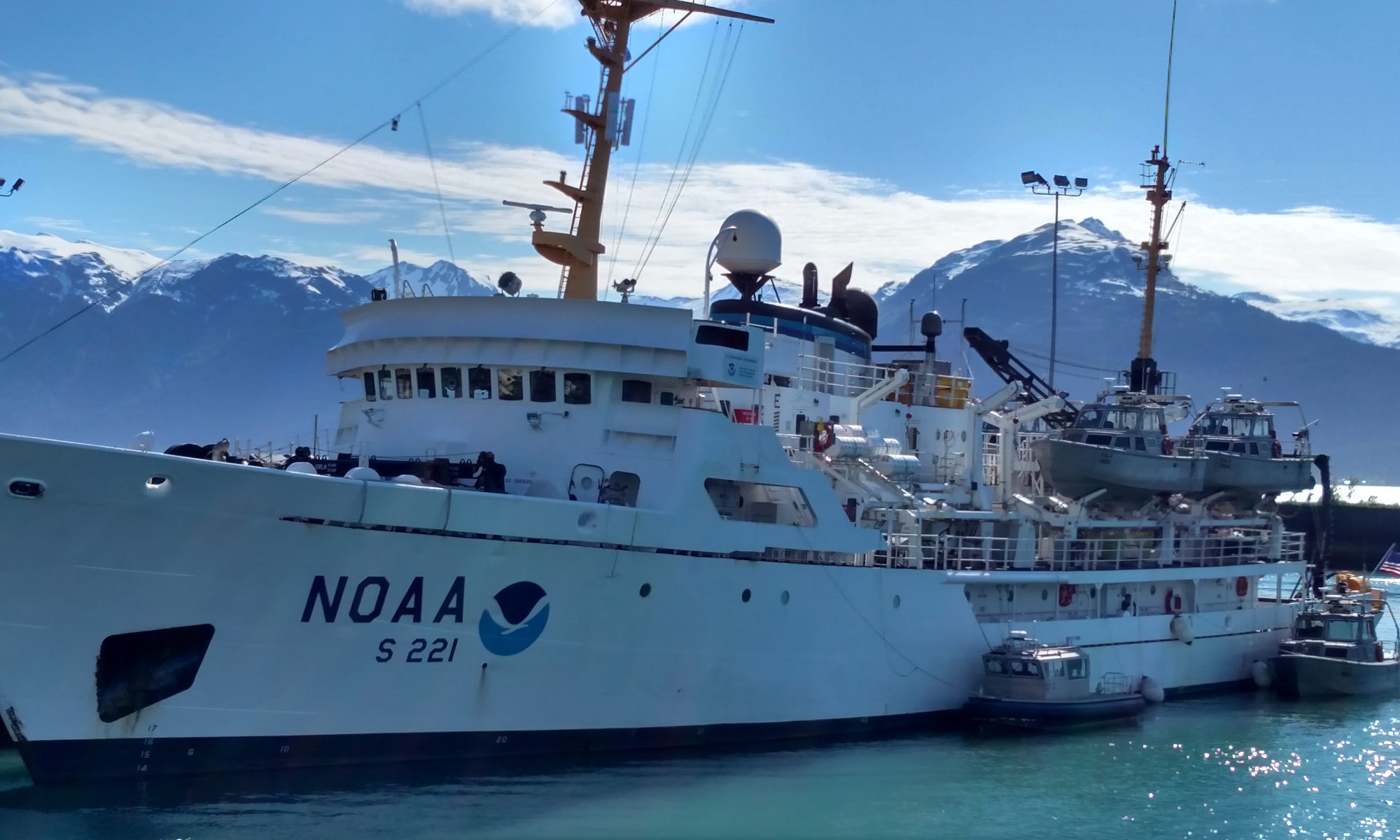
Allison Irwin: Traveling to the Ship, July 8, 2019

NOAA Teacher at Sea

Allison Irwin

Aboard NOAA Ship Reuben Lasker

July 7-25, 2019


Mission: Coastal Pelagic Species Survey

Geographic Area: Northern Coast of California

Date: July 8, 2019

Weather at 0800 on Monday 08 July 2019.

Winds and sea are calm. Weather is cool. Heavy overcast layer of white, thick clouds in the sky. Very comfortable out on deck with a sweater or light jacket. The visibility is unreal – I can see for miles! Nothing but cold water and salty air.


PERSONAL LOG

Friday Night

05 July 2019

Tomorrow Iโ€™ll board a ship with NOAA Officers and scientists headed for a three week research cruise in the Pacific Ocean. My whole life at home is not skipping a beat without me. But I feel like Iโ€™ve hit a pause button on my character. Like I wonโ€™t return to the movie of my life until the end of July. Important decisions get made without me. Disputes with family and friends wonโ€™t include my voice again for almost a month. Everything moves forward at home this summer but me.

I have a new appreciation for folks who dedicate their lives to careers requiring them to be away from home for long periods of time. This is only three weeks. I canโ€™t imagine the way I would feel if I were leaving for three months. Or a year.  I do feel very grateful for the opportunity to spend the next three weeks with these people though. They will be, no doubt, passionate about their careers, and Iโ€™ll learn a lot from traveling with them.

THE SCIENCE

Saturday Morning

06 July 2019

After a 6 hour flight from the East Coast to the West Coast and a 2.5 hour car ride from Portland International Airport to Newport, Oregon, Iโ€™m finally on NOAA Ship Reuben Lasker! A handful of scientists, two volunteers, and myself met at the airport. We coordinated so all our flights would arrive within an hour of each other so we could drive together. As soon as we got there, my roommate gave me a tour of the ship. It didnโ€™t take very long, but there are a lot of ways to get lost! I felt a little disoriented after that. There is a galley and dining area which they call the mess. Iโ€™ve been told we have one of the best chefs on board our ship! A laundry room, exercise room, plenty of deck space, the bridge where NOAA Officers will navigate and operate the ship, and stairs. So. Many. Stairs.

Upon meeting the chief scientist, Kevin Stierhoff, it became clear that the Coastal Pelagic Species Survey is a big deal. NOAA runs this survey every year for about 80 days! They break it up into four 20 day legs. Most of the scientists will rotate through only one or two legs, but the NOAA Corps Officers in charge of the shipโ€™s operation typically stay for the full survey. Thatโ€™s a very long time to be away from home.

Weโ€™re traveling on the 2nd leg, so the survey has already been underway since June. It started farther north off the coast of Vancouver Island, British Columbia and will meander down the coast for almost three months until it reaches the US-Mexico border. Kevin described the shipโ€™s movements like someone explaining how to mow the lawn โ€“ we will run perpendicular to the coast in a back-and-forth pattern traveling south, slowly, until we get to the waters off San Francisco Bay. First weโ€™ll travel straight out into the ocean, turn south for a bit, then travel straight back toward the coast. Repeat. Repeatโ€ฆ for three weeks.

mowed lawn
Patterned lines in a freshly mowed lawn – accessed on pixabay.com

Why such a funky pattern, you might ask? Weโ€™ll be using acoustic sampling during the day to determine where the most densely populated areas of fish are located. Then at night, weโ€™ll put that data to good use, immediate use, as we trawl the waters for specific types of pelagic species. There are five species in particular that the scientists want to study โ€“ anchovy, herring, sardines, mackerel, and squid โ€“ because theyโ€™re managed species or ecologically important as prey for other species. That funky pattern of travel allows us to sample the whole coastal region.

It reminds of me of one of the scanning patterns the Civil Air Patrol uses when we conduct search and rescue missions from a Cessna. When I was trained to be a scanner in the back seat of the plane, they taught me to look for signs of a missing person or downed plane below me in a systematic way. If I just look sporadically at everything that pops into my line of scan, Iโ€™ll never find anything. Itโ€™s too haphazard. But if I start from a fixed point on the aircraft and scan out up to a mile, then bring my scan line back in toward the plane, Iโ€™ll naturally scan all the ground below me for clues as the plane moves forward.

Even though theyโ€™re looking primarily at those five coastal pelagic species, the scientists will catalogue every kind of fish or marine life they find in their trawl nets. They are meticulous. Itโ€™s such an important endeavor because it helps us to fish our waters using sustainable practices. If this survey finds that one of the fish species in question is not thriving, that the population sample of that species is too low, then NOAA Fisheries and the Pacific Fisheries Management Council will set harvest guidelines next year to help that species rebound. If itโ€™s looking very dire, they might even determine that commercial fishing of that species needs to be put on pause for a while.

For more details about NOAA Fisheries and the importance of the annual Coastal Pelagic Species Survey, read this short two page guide called U.S. Fisheries Management: Sustainable Fisheries, Sustainable Seafood.

TEACHING CONNECTIONS

Saturday Evening

06 July 2019

Since the three hour time change traveling in this direction worked in my favor, I gained three extra hours of daylight to explore Newport.  I spent most of the evening walking around the small port where NOAA docked Reuben Lasker. Itโ€™s only a couple square miles, but it houses the Oregon Coast Aquarium, the Hatfield Marine Science Center’s Visitor Center, Rogue Brewerโ€™s on the Bay, and a public fishing pier. I walked a total of 6 miles today and was never bored.

The fishing culture struck me the most. Kids, adults, everyone seemed to have a working knowledge of local sustainability, ecosystems, commercial fishery practices, things that are so foreign to me. I suppose it would be like going to Pennsylvania and asking someone to explain deer hunting. Trust me, we can. But fishing? Not as much. I wish that we as teachers would tap into the local knowledge base more fully. From Pennsylvania for example, we could share Amish culture and heritage, details about the coal mining industry, steel production and engineering practices, hunting, and so much more. Until I realized how unaware I was of the local knowledge here in Newport, I never stopped to think about how rich and diverse my studentsโ€™ local knowledge must be as well. One thing I plan to do this school year is dig into that local culture and explore it with my students.

I watched one gentleman as he filleted his catch at the filleting station just off the pier. To me it looked like a cooler of fish. I could tell you with certainty that they were indeed fish. But he knew each type, why the Lingcod had blue flesh instead of white, how many of each type he was allowed to take home with him, how to cook them, and the list goes on. I was impressed. In talking with others this evening, it seems like thatโ€™s par for the course here. Later, a couple of fishermen with a cooler full of crab started talking to me and offered me some to try. It was cleaned, cooked already, fresh out of Yaquina Bay. It was delicious โ€“ sweet and salty.

The people I interacted with today, every single one of them, were genuinely kind. They were patient and explained things to me when I didnโ€™t understand. This is a lesson every teacher can take to the classroom. We know how important it is to smile and be kind. We know it. But sometimes itโ€™s hard to put that into practice when weโ€™re rounding into May and having to explain that one tricky concept again, pulling a different approach out of our magic hat, and hoping that this time it will click.

Itโ€™s not always easy to mask the frustration we feel when something that is so natural for us (in no doubt because we love the subject and have studied it for at least a decade) just doesnโ€™t make sense to a student. And itโ€™s not always the student I get frustrated with, itโ€™s myself. Teachers tend to be their own worst critics. When a lesson doesnโ€™t go as well as we expected, we double down and try harder the next day. No wonder so many of us burn out in the first five years and switch to a different career!

TEACHING RESOURCES

Catherine Fuller: Crossing Boundaries, July 5, 2019

NOAA Teacher at Sea

Catherine Fuller

Aboard R/V Sikuliaq

June 28 โ€“ July 18, 2019


Mission: Northern Gulf of Alaska (NGA) Long-Term Ecological Research (LTER)

Geographic Area of Cruise: Northern Gulf of Alaska

Date: July 5, 2019

Weather Data from the Bridge

Latitude: 59ยฐ 54.155โ€™ N
Longitude: 146ยฐ 18.252โ€™ W
Wave Height: 2 ft
Wind Speed: 12.6 knots
Wind Direction: 264 degrees
Visibility: 1 nm
Air Temperature:  14ยฐC
Barometric Pressure: 1022 mb
Sky: Overcast, light fog


Science and Technology Log

Dr. Suzanne Strom, from Western Washington University, is the team leader for work being done in the wet lab.  Simply put, her team is examining the amount and production rate of phytoplankton (single-celled algae) captured at various depths.  The team uses information from sensors on the CTD during each cast to read light levels and determine the depths at which to collect water samples containing phytoplankton. 

After bottles are filled from the CTD, the team introduce 13C (a heavy isotope of carbon) into the bottles and then packages them in varying layers of mesh bags to recreate light levels at the depths from which they were sampled, simulating 50%, 30%, 10%, 5% and 1% of surface light.  For example, the sample representing 1% of surface light has seven layers of mesh over it.  Depending on the concentration of particles in the water, the 1% sample might range from 20 meters down near shore to 50 meters or more in open ocean. After a 24-hour incubation, the team filters the plankton out of the water samples and has them analyzed for 13C content, which indicates the amount of primary production that has taken place in each bottle (and, by extension, at each depth in the water column). Once the production is known, it can be related to measures of phytoplankton abundance that are obtained from the sensors attached to the CTD.

CTD Screen
Here is the live readout that comes from the CTD as it is lowered into the ocean and raised again.

Dr. Strom is in the process of discovering a way to estimate the production of phytoplankton based on the amount of chlorophyll present in the water.  Currently, on site testing has to be combined with information from sensors and from satellite imagery (which will indicate the amount of chlorophyll present in the surface ocean).  When a relationship between the two is established, it will allow scientists to make accurate predictions about plankton populations and their production without actual sampling.  The spring bloom is a time of greater chlorophyll content and primary production and thus is a critical component of her data set. 

Suzanne and Hana
Suzanne and Hana working in the lab.

Hana Busse is a graduate student from WWU who is studying under Dr. Suzanne Strom. Her work is based on the perceived distinction between phytoplankton (which photosynthesize) and microzooplankton (which feed on other organisms) and the identification of organisms that cross those boundaries.  These organisms are called mixotrophic, and they can both photosynthesize and feed.  She hopes to find out why particular organisms have developed that ability and how it helps them survive in a varied environment. 

Although mixotrophy has been observed for a long time, it was commonly thought to be an anomalous phenomenon.  However, with better sampling technology, mixotrophy has been discovered to be ubiquitous.  Because this is a relatively new branch in the study of plankton, there are still many questions to be answered. Does mixotrophy promote โ€˜phytoplanktonโ€™ blooms?  Does it promote resilience of species and communities? Can mixotrophs switch strategies, i.e. from photosynthesis to feeding and vice versa? 

As a part of her research process, Hana is incubating a natural community of photosynthetic organisms in gradients of light and added nutrients. 

plankton nursery assembly
The plankton nursery is being assembled on the main deck.

She will be trying to discover whether ingestion rates change according to the amount of light or nutrients a mixotrophic population is exposed to.  Is the reverse true? Is feeding driven by lack of nutrients or by prey?  Prey concentration experiments?

Because of the relative newness of this kind of a study (it has been growing in importance over the last ten years or so), the results will have important implications for the food web because you have organisms that fit both categories (phytoplankton and microzooplankton) rather than just one or the other.  Hana is working with a modeler on this project to incorporate mixotrophy in models of the ecosystem we are sampling.  Her work also has implications for previous studies that did not take mixotrophy into account.  Although there are different kinds of mixotrophs, she is focused on dinoflagellates, while others, such as Dr. Strom, are looking at ciliates (they โ€œborrowโ€ chloroplasts to photosynthesize).  Hana is also looking at different strategies that organisms use to become mixotrophic. Do they steal chloroplasts? Do they create them themselves when they are in need? Can they switch back?  Her work has huge implications for our understanding of environmental variability, the food web and the dynamics of marine ecosystems worldwide.


Personal Log

There have been more safety protocols in place over the last few days that are noteworthy.  First of all, since weโ€™ve been traveling through fog, the ship must sound fog signals at a two-minute interval to alert other vessels of our presence.  Every two minutes, it sounds like a VERY large angry goose or an annoyed Tyrannosaurus Rex sounds off.  I think most of us have learned to ignore it, although, with the labs being open to the working deck, it is louder in there.  Yesterday for the Fourth of July, Third Mate Artie and the Chief Mate led a safety briefing and demonstration on flares, rockets, projectile line launchers and preventing polar bears from coming on board the ship.

Announcement
The announcement of the afternoon safety briefing on the message board in the Mess Hall.

Itโ€™s not something weโ€™ll be dealing with, but it is an issue the ship encounters when it goes on arctic cruises.  The line launcher is used to transfer a line over a distance to another vessel or to deploy it to someone in the water. 

Artie and line launcher
Third Mate Artie explains how the line launcher is used.

Kim, the Chief Steward and head chef on board volunteered to fire it.

Kim takes aim and fires!

To deter bears, two different shells are fired off: one that makes a loud bang and another that makes a loud squeal.

Chief Mate
The Chief Mate explains how to deter bears from boarding the ship.

Both are fired from a small pistol at a 45-degree angle (to go over the head of the bear).ย  A number of the crew as well as the science team took the opportunity to try firing the pistol.ย 

Ayanda tests the bear deterrent pistol

Being that it was a relatively warm and sunny day (58 degrees outside), and that we were basically circling while one of the science sensors was being fixed, both the science team and the crew were able to enjoy some โ€œoverlapโ€ and have a relaxing afternoon together.ย  Luckily, we were also close enough to land for most of us to be able to text, if not call our loved ones.ย  We were located in the Copper River plume in fairly shallow water, which meant that the color of the water was close to a tropical green, and was reminiscent of home.ย 

Tropical-green waters
It almost looks like home out here.

Iโ€™ve decided that I definitely over-packed for the conditions weโ€™ve experienced so far on this voyage.  I expected to find temperatures to be much colder and thus I brought two more jackets than I need.  I brought a combination of short sleeved and long sleeved shirts, planning on layering, but have not had to do much of that yet, although weโ€™ve still got a couple of weeks to go.  I also brought a spare pair of shoes that I havenโ€™t worn yet.  I am glad, however, that I packed workout clothes, as the food on board is so good that I definitely need to exercise!  I discovered the rowing machine in the gym and spent almost an hour on it last night. 

One diversion for a few of us yesterday was rescuing a hummingbird that had gotten into the Baltic Room (which opens onto the main deck) and couldnโ€™t get out.ย  One of the crew was able to assist by opening the cargo door and the bird flew out.

hummingbird
An unusual visitor on board: a hummingbird.


Birds Seen Today:

White-winged Scoters
White-winged Scoters, a type of duck, fly towards islands at the mouth of the Copper River.


Did You Know?

Did you know that the draft of R/V Sikuliaq is less than 10m?


What do you want kids to learn from your research?

Hana: The boundaries that we see in nature are not as firm as people expect them to be.  There is a lot of overlap; everything is related.

Erica Marlaine: No Peanut Butter and Jelly but PLENTY OF JELLYFISH, July 1, 2019

NOAA Teacher at Sea

Erica Marlaine

Aboard NOAA Ship Oscar Dyson

June 22 โ€“ July 15, 2019


Mission: Pollock Acoustic-Trawl Survey

Geographic Area of Cruise: Gulf of Alaska

Date: July 1, 2018

Weather Data from the Bridge:

Latitude: 56ยบ 50.94N
Longitude: 155ยบ 44.49 W
Wind Speed: 11.3 knots
Wind Direction: 240ยบ
Air Temperature:  12.98ยบ Celsius
Barometric Pressure: 1027.5 mb

Crew Member Spotlight

At present, there are 31 people onboard the NOAA Ship Oscar Dyson, and each plays a vital role in making sure that everything runs as it should.  One person whose job touches each and every one of us is Judy Capper, the Chief Steward.  One might think that being onboard a ship for three weeks would mean limited food choices, or lots of peanut butter and jelly sandwiches, but so far every meal onboard the NOAA Ship Oscar Dyson has been abundant and delicious. From shrimp kabobs to stuffed pork loin to homemade soups to delicious baked goods, Judy keeps everyone onboard fed and happy.

I got a chance to talk to Judy about her job and her journey to becoming a NOAA Chief Steward.  Judyโ€™s first career was in the corporate world (including Hewlitt-Packard) but being the oldest of 5 siblings, she has been cooking since the age of 12.  An interest in cooking led her to study culinary arts at UCLA and other locations.  She then took seamanship training at Orange Coast College.  At the time, she owned a sailboat, and enjoyed cooking and entertaining on the boat.  The captain loved her cooking and asked if she would be interested in cooking on some sailboat charters.  That led to working on yachts and supply ships, and lucky for us, in 2015, Judy was hired by NOAA.  Judy loves her job as a NOAA Steward.  She says it is never boring and allows her to be creative.  Her advice for anyone interested in following in her footsteps is to eat in good restaurants so that you develop your taste buds, get good training, and watch cooking shows.

Judy Capper
Judy Capper, Chief Steward Extraordinaire


Science and Technology Log

Last night we used a different kind of net, known as a Methot net, in order to collect macroscopic zooplankton. Named after its designer, Richard D. Methot, it is a single net with a large square opening or mouth attached to a rigid steel frame. The net is deployed from the stern and towed behind the vessel.

Methot Net
Deploying the Methot Net

The Methot uses fine mesh (e.g. 2×3 mm) but has openings that are slightly larger.  This design allows the net to be towed at high speeds. A flowmeter suspended in the mouth of the Methot net measures the flow of water moving through the net.  Scientists use the flowmeter data to calculate the volume of water sampled.

The flowmeter
The flowmeter

Watching the crew preparing to launch the Methot net was a lesson in teamwork. Everyone knew their job, and they reviewed what each would do when.  They even discussed what hand signals they would use (โ€œIf I make this movement, that means XYZโ€).

The Methot net did catch a lot more krill than I had seen before, as well as many jellyfish.

Erica and jellyfish
One of the many Chrysaora melanaster we came across.


Fun Jellyfish Facts:

Jellyfish are invertebrates, and have no brain, heart, eyes, or bones.  Instead they have a bag-like body that feels like slippery jello and tentacles covered with small, stinging cells.  They sting and paralyze their prey before eating it.  A jellyfish sting can be painful, but it is not usually harmful for humans.  However, some people may be allergic to the venom, and will have a reaction.

Catherine Fuller: Out of the Sea and into the Lab, July 3, 2019

NOAA Teacher at Sea

Catherine Fuller

Aboard R/V Sikuliaq

June 29 โ€“ July 18, 2019


Mission: Northern Gulf of Alaska (NGA) Long-Term Ecological Research (LTER)

Geographic Area of Cruise: Northern Gulf of Alaska

Date: July 3, 2019

Weather Data from the Bridge

Latitude: 58ยฐ 54.647โ€™ N
Longitude: 146ยฐ 00.022โ€™ W
Wave Height: 4-5 ft.
Wind Speed: 1.9 knots
Wind Direction: roughly 90 degrees, but variable
Visibility: 1 nm
Air Temperature: 13.2 ยฐC
Barometric Pressure: 1014.4 mb
Sky: Clear, then foggy

Weather overview

We have been fortunate so far to have very calm conditions.ย  Winds have been variable or light and are expected to continue to be so through the weekend at least.ย  Wave heights have generally been about 3 feet, although theyโ€™re up to 4-5 feet today, and are expected to drop tomorrow.ย  The calm weather is critical for some of the testing being done, and thus is allowing more to happen.

Science and Technology Log

The focus of all of testing on board is plankton.  As the base of the food web, all species depend on their health and abundance for survival. There are multiple teams who are focused on various aspects of plankton and their reaction to environmental conditions.  Kira Monell is a graduate student at the University of Hawaii at Manoa who is working under the direction of Dr. Russ Hopcroft while on board.  She is studying zooplankton, or the animal version of plankton.   She is specifically focusing on Neocalanus flemingeri, a type of sub-arctic copepod.  It is important to study zooplankton because they provide a link between phytoplankton (the plant version of plankton) and larger fish on the food web.  Copepods are extremely abundant and varietal, found just about everywhere in the world.  They are an important food source for most aquatic species (they exist in both salt and fresh water).  They are a trophic link โ€“ a connection in the food web.  Her target species is special because they mostly eat phytoplankton during the seasonal plankton blooms.  They convert their food into a lot of lipids (fats) and thus are great sources of food and energy for larger fish.  After fattening up, they go deep into the ocean to hibernate around mid-summer. 

Kira is specifically focused on the termination of their hibernation (technically called diapause).  She is doing genetic testing to see which genes are activated or deactivated during this phase of their lives.  Messenger ribonucleic acid (or mRNA) coded by these genes is required to construct the enzymes that cause changes in body functions, so she is looking at levels of different mRNA in the copepods. She is expecting to see an increase in genes relating to oogenesis (egg formation).  Her female copepods go into diapause ready to start making eggs, so she expects to see changes in genes relating to egg growth as they come wake up from diapause.

Kira is examining copepods through three different experiments.  With some samples, she adds a stain called EDU (a dye that labels cells that are just about to divide) into her samples and then checks them at 24 hours to see which cells have divided.  Because the copepods are still alive, she can check back to see what further cell division have happened over longer periods of time.  A fluorescent microscope is required to see the EDU.  Scientists still struggle to understand what actually triggers emergence from diapause since deep water copepods donโ€™t experience seasonal light changes, or other potential triggers that might exist on the surface. 

Another thing she is looking at is in-situ hybridization.  She makes a tag that is very specific for the gene she wants to examine.  When the probe gene is introduced, it attaches to the gene she wants to look at only if it is being actively copied.  Kira then attaches a colored or fluorescent dye to the probe and in that way she can track which genes are being expressed in specific areas of the body.

The third project that she is working on is trancriptum analysis, which requires building a complete โ€œcatalogโ€ that shows all the RNA used by a species. She can then look at which gene transcripts are present, and in how abundant they are, so as to compare them to the โ€œaverageโ€ version of a transcriptum to see which genes are being turned off and on under certain conditions.

To obtain samples of copepods, the zooplankton team, including Kira, uses Calvet nets.  These are four long nets that terminate in collection tubes. Weight is added to the bottom of the nets and they are submerged off the stern to 100 meters of depth and then pulled back up (a process that takes roughly five minutes).  The nets are then rinsed to collect the samples in the tubes, which are transferred into jars and brought to the lab for more detailed sorting and examination. 

Calvet rising
The Calvet is returning to the surface after being submerged
Kira and Kate rinse net
Kira and Kate rinse the length of the nets to collect their samples in the tubes in the end.

As the Calvet rises you can see the full net. (This video has no dialogue.)


Personal Log

back deck
This is the main working deck at the stern of the ship.

Getting prepared to go out on deck safely!

All of the sample collection happens on the working deck at the stern of the R/V Sikuliaq or in the adjacent Baltic Room.ย  The back deck is equipped with a variety of cranes and winches that are designed to handle heavy weights and lines under tension.ย  As such, it is critical to wear the proper protective gear when youโ€™re out there: boots (preferably steel-toed), a hard hat and a flotation vest of coat.ย  If thereโ€™s a potential to get wet or dirty, rain gear or waterproof bibs are essential to stay dry and relatively clean. Being properly dressed is a process that took getting used to, but now itโ€™s habit.ย  Again, weโ€™re lucky to have had good weather, so the deck is usually warm enough to wear a t-shirt and jeans.ย  I find it calming to be outside, so I am enjoying learning about the sampling methods of other teams by watching and sometimes assisting them.ย  There are also observation decks at the bow that do not require safety gear.ย  A few of us have discovered that the forward decks are much quieter and are good spaces to decompress and look for sea life.ย 


Animals Seen in the Last 24 Hours:

Weโ€™ve seen a few species of birds including black turnstones, glaucous-winged gulls, Black-winged kittiwakes, as well as deeper water birds such as storm petrels and shearwaters.  In addition, there have been small pods of dolphins in the distance and one humpback whale (all we saw was the tail).

Erica Marlaine: Onboard the City That Never Sleeps, June 28, 2019

NOAA Teacher at Sea

Erica Marlaine

Aboard NOAA Ship Oscar Dyson

June 22 โ€“ July 15, 2019


Mission: Pollock Acoustic-Trawl Survey

Geographic Area of Cruise: Gulf of Alaska

Date: June 28, 2018

Weather Data from the Bridge:

Latitude: 58ยบ 28.54 N
Longitude: 154ยบ 46.05 W
Wind Speed: 16.8 knots
Wind Direction: 190ยบ
Air Temperature:  11ยบ Celsius
Barometric Pressure: 102


Science and Technology Log

Scientists aboard NOAA Ship Oscar Dyson are estimating the numbers and biomass of walleye pollock in the Gulf of Alaska.  They use acoustics (sound data)  to help them do this.

acoustic readout
Acoustic representation of fish in the area


Acoustic representation of fish in an area

Echo sounders send an acoustic signal (ping) into the water.ย  The sound bounces off objects that have a different density than the surrounding water (such as the swim bladder in a fish) and returns back to the echo sounder.ย  Using the speed of sound, this technology can determine how deep the fish are in the water column.ย 

How much sound each object reflects is known as the target strength.  The target strength is dependent upon the type of fish and the size of the fish.  A bigger fish will give off more of an echo than a small fish will.  A fishโ€™s swim bladder is primarily what reflects the sound.  Smelt and krill do not have swim bladders. As a result, they do not reflect as much sound as a pollack would. Even though a big fish gives off more sound energy than a small fish of the same species, it is possible that a return echo could indicate either one big fish or several smaller fish clumped together. A big fish of one species could also give off similar sound energy to a big fish of a different species. For that reason, actual fish are collected several times a day in the nets described in a previous blog.

From a net sample, scientists determine the number of each species in the catch as well as the length and weight of individuals of each species. 

Measuring pollock
Measuring pollock

Additionally, scientists also determine the sex and age of the pollock.  The catch data is used to scale the acoustic data, which in turn allows scientists to estimate how many pollock there are of various size and age groups in a given area. These numbers help scientists  determine the sustainability of the pollock population, which in turn allows the North Pacific Fishery Management Council to set catch quotas. 

Counting krill
Counting krill


Krill Fun Facts:

Krill (aka euphausiids) are small crustaceans (a couple of millimeters long) of the order Euphausiacea.  The word โ€œkrillโ€ is a Norwegian word meaning โ€œa small fry of fish.โ€ Krill are found in every ocean and are a major food source. They are eaten by fish, whales, seals, penguins, and squid, to name a few.  In Japan, the Phillipines, and Russia, krill are also eaten by humans.  In Japan, they are called okiami.  In the Phillipines and Russia, they are known as camarones. In the Phillipines, krill are also used to make a salty paste called bagoong. Krill are a major source of protein and omega-3 fatty acids.

krill on spoon
There are many kinds of krill. Thus far, in the Gulf of Alaska, we have been seeing mostly Thysanoessa enermis, which measure approximately 1/2 inch in length.

Personal Log  

People often refer to New York as the city that never sleeps. The same can be said for the NOAA Ship Oscar Dyson. Life onboard the Oscar Dyson carries on 24 hours a day, 7 days a week.  There is never a time that the ship is not bustling with activity.  Everyone on the boat works 12-hour shifts, so someone is always working while others are sleeping (or doing laundry, exercising, or watching a movie in the lounge before they go to sleep.) Most people on the boat work either the noon to midnight shift or the midnight to noon shift.  However, the science team works 4 a.m. to 4 p.m., or 4 p.m. to 4 a.m. I am in the latter group.  It was easier to get accustomed to than I had imagined, although it is sometimes confusing when you look at your clock and wonder whether it is 5 a.m. or 5 p.m. since the sun is shining for most of the day.  Kodiak has only 4-5 hours of darkness now, and the sun sets at approximately midnight.  Therefore, it does not really feel like nighttime for much of my shift.

View
The view from NOAA Ship Oscar Dyson
Sunset
Views (and sunsets) like these make it easy to work the night shift!