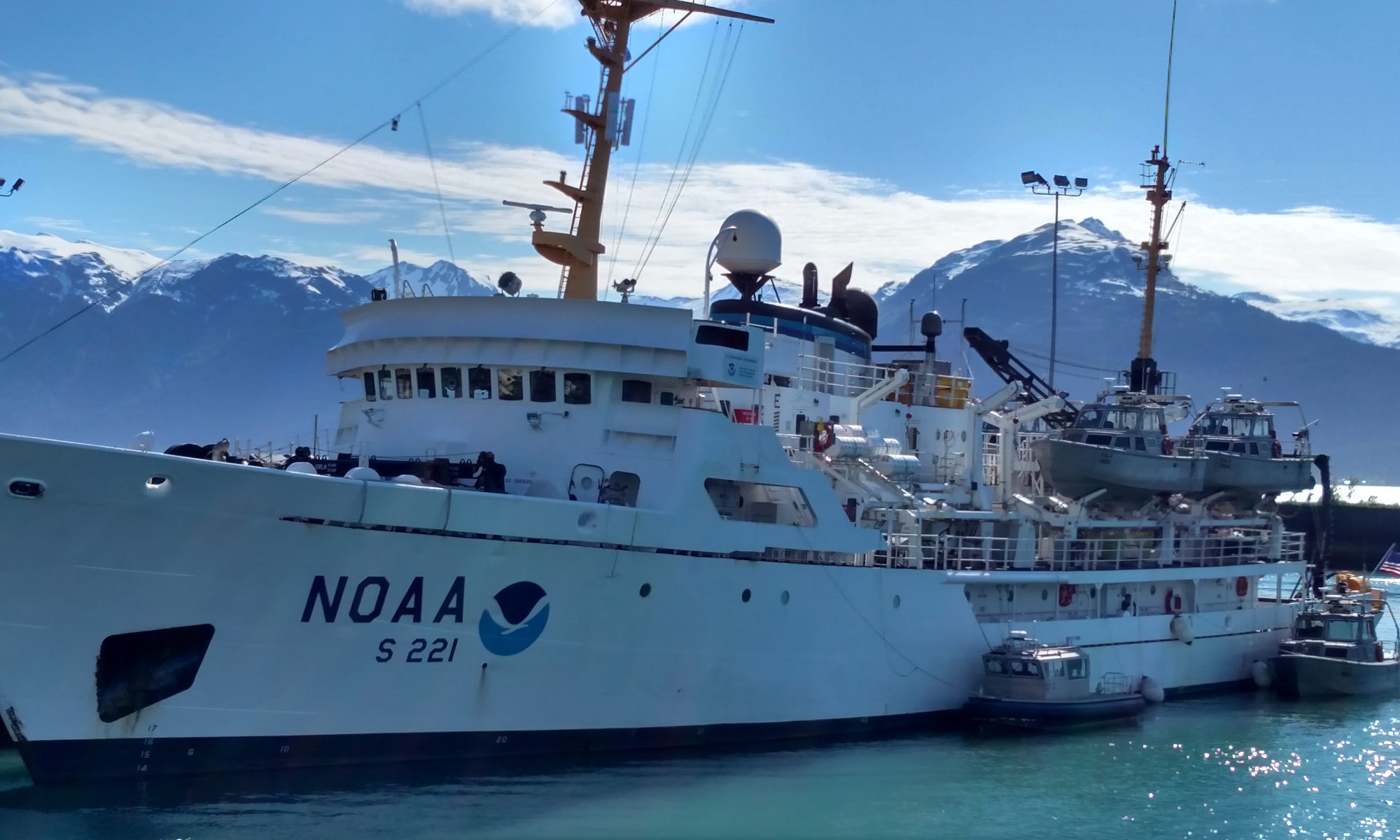
NOAA Teacher at Sea Heidi Wigman Aboard NOAA Ship Pisces May 27 – June 10, 2015
Mission: Reef Fish Surveys on the U.S. Continental Shelf Geographical Area of Cruise: Gulf of Mexico (29°30.456’N 87°47.246’W) Date: May 29, 2015
Weather: 80°, wind SE @ 8-13 knots , 95% precipitation, waves 2-3 @ 3 sec.
Science and Technology Log
During my time aboard the Pisces, I wanted to focus on the use of mathematics in the day-to-day shipboard operations, and during science ops. I have been lucky to find math everywhere – even down to the amount of pressure it takes to open a water-safe door (which is a lot). As the officers navigate the Pisces through the Gulf of Mexico, special attention needs to be on the vast number on oil rigs in the area, as well as getting the scientists to the designated drop points. As a course is charted through the water, environmental effects (current and wind) can alter its final outcome. Basically, this is where trigonometry comes in to play – a real-life application, and answer, to the notorious “when am I ever going to use this?”
Suppose that the Pisces is traveling at a cruising speed of 15 m/sec, due East, to get to the spot of deployment for a camera rig. The ocean current is traveling in a Southern direction at 10 m/sec. These values are the “component vectors” that, when added, are going to give a resultant vector, and will have both magnitude and direction. If you think of the two forces acting upon each other as the legs of a right triangle, and the resultant vector as the hypotenuse, then using the Pythagorean Theorem will allow you to compute the resultant velocity. Use a trig function (invTAN) to find the angle at which the Pisces needs to travel to get to its drop point.
Personal Log
Time goes by slowly at sea – and that’s a good thing for me! I miss my family and friends, but this is an experience that I am enjoying each minute of. Thanks Pisces crew for being awesome!
Coming next . . . Bandit Reels, CTDs and AUVs – oh my!
AM watch (0400-0800) plotting our coursePisces cruising the Gulf of MexicoNavigation tools of the trade
NOAA Teacher at Sea Dieuwertje “DJ” Kast Aboard NOAA Ship Henry B. Bigelow May 19 – June 3, 2015
Mission: Ecosystem Monitoring Survey
Geographical area of cruise: Gulf of Maine Date: May 28, 2015, Day 11 of Voyage
Interview with Student Megan Switzer
Chief Scientist Jerry Prezioso and graduate oceanography student Megan Switzer
Megan Switzer is a Masters student at the University of Maine in Orono. She works in Dave Townsend’s lab in the oceanography department. Her research focuses on interannual nutrient dynamics in the Gulf of Maine. On this research cruise, she is collecting water samples from Gulf of Maine, as well as from Georges Bank, Southern New England (SNE), and the Mid Atlantic Bight (MAB). She is examining the relationship between dissolved nutrients (like nitrate and silicate) and phytoplankton blooms. This is Megan’s first research cruise!
In the generic ocean food chain, phytoplankton are the primary producers because they photosynthesize. They equate to plants on land. Zooplankton are the primary consumers because they eat the phytoplankton. There are so many of both kinds in the ocean. Megan is focusing on a particular phytoplankton called a diatom; it is the most common type of phytoplankton found in our oceans and is estimated to contribute up to 45% of the total oceanic primary production (Yool & Tyrrel 2003). Diatoms are unicellular for the most part, and a unique feature of diatom cells is that they are enclosed within a cell wall made of silica called a frustule.
Diatom Frustules. Photo by: Steve SchmeissnerDiatoms! Photo by: Micrographia
The frustules are almost bilaterally symmetrical which is why they are called di (2)-atoms. Diatoms are microscopic and they are approximately 2 microns to about 500 microns (0.5 mm) in length, or about the width of a human hair. The most common species of diatoms are: Pseudonitzchia, Chaetocerous, Rhizosolenia, Thalassiosira, Coschinodiscus and Navicula.
Pseudonitzchia. Photo by National Ocean ServiceThalassiosira. Photo by: Department of Energy Joint Genome InstitutePhoto of Coscinodiscus
Diatoms also have ranges and tolerances for environmental variables, including nutrient concentration, suspended sediment, and flow regime. As a result, diatoms are used extensively in environmental assessment and monitoring. Furthermore, because the silica cell walls are inorganic substances that take a long time to dissolve, diatoms in marine and lake sediments can be used to interpret conditions in the past.
In the Gulf of Maine, the seafloor sediment is constantly being re-suspended by tidal currents, bottom trawling, and storm events, and throughout most of the region there is a layer of re-suspended sediment at the bottom called the Bottom Nepheloid Layer. This layer is approximately 5-30 meters thick, and this can be identified with light attenuation and turbidity data. Megan uses a transmissometer, which is an instrument that tells her how clear the water is by measuring how much light can pass through it. Light attenuation, or the degree to which a beam of light is absorbed by stuff in the water, sharply increases within the bottom nepheloid layer since there are a lot more particles there to block the path of the light. She also takes a water sample from the Benthic Nepheloid Layer to take back to the lab.
Marine Silica Cycle by Sarmiento and Gruber 2006
Megan also uses a fluorometer to measure the turbidity at various depths. Turbidity is a measure of how cloudy the water is. The water gets cloudy when sediment gets stirred up into it. A fluorometer measures the degree to which light is reflected and scattered by suspended particles in the water. Taken together, the data from the fluorometer and the transmissometer will help Megan determine the amount of suspended particulate material at each station. She also takes a water sample from the Benthic Nepheloid layer to take back to the lab. There, she can analyze the suspended particles and determine how many of them are made out of the silica based frustules of sinking diatoms.
This instrument is a Fluorometer and is used to measure the turbidity at various depths. Photo by: DJ Kast
She collects water at depth on each of the CTD/ Rosette casts.
Rosette with the 12 Niskin Bottles and the CTD. Photo by DJ KastRosette with the 12 Niskin Bottles and the CTD. Photo by DJ KastUp close shot of the water sampling. Photo by DJ Kast
CTD, Rosette, and Niskin Bottle basics.
The CTD or (conductivity, temperature, and depth) is an instrument that contains a cluster of sensors, which measure conductivity, temperature, and pressure/ depth.
Here is a video of a CTD being retrieved.
Depth measurements are derived from measurement of hydrostatic pressure, and salinity is measured from electrical conductivity. Sensors are arranged inside a metal housing, the metal used for the housing determining the depth to which the CTD can be lowered. Other sensors may be added to the cluster, including some that measure chemical or biological parameters, such as dissolved oxygen and chlorophyll fluorescence. Chlorophyll fluorescence measures how many microscopic photosynthetic organisms (phytoplankton) are in the water. The most commonly used water sampler is known as a rosette. It is a framework with 12 to 36 sampling Niskin bottles (typically ranging from 1.7- to 30-liter capacity) clustered around a central cylinder, where a CTD or other sensor package can be attached. The Niskin bottle is actually a tube, which is usually plastic to minimize contamination of the sample, and open to the water at both ends. It has a vent knob that can be opened to drain the water sample from a spigot on the bottom of the tube to remove the water sample. The scientists all rinse their bottles three times and wear nitrile or nitrogen free gloves to prevent contamination to the samples.
On NOAA ship Henry B. Bigelow the rosette is deployed from the starboard deck, from a section called the side sampling station of this research vessel.
The instrument is lowered into the water with a winch operated by either Adrian (Chief Boatswain- in charge of deck department) or John (Lead Fishermen- second in command of deck department). When the CTD/Rosette is lowered into the water it is called the downcast and it will travel to a determined depth or to a few meters above the ocean floor. There is a conducting wire cable is attached to the CTD frame connecting the CTD to an on board computer in the dry lab, and it allows instantaneous uploading and real time visualization of the collected data on the computer screen.
CTD data on the computer screen. Photo by: DJ Kast
The water column profile of the downcast is used to determine the depths at which the rosette will be stopped on its way back to the surface (the upcast) to collect the water samples using the attached bottles.
Niskin Bottles:
Messenger- The manual way to trigger the bottle is with a weight called a messenger. This is sent down a wire to a bottle at depth and hits a trigger button. The trigger is connected to two lanyards attached to caps on both ends of the bottle. When the messenger hits the trigger, elastic tubing inside the bottle closes it at the specified depth.
Todd holding a messenger to trigger the manually operated Niskin Bottle. Photo by: DJ Kast
Todd with the manually operated Niskin Bottle. Photo by: DJ KastManual CTD fully cocked and ready to deploy. Photo by DJ Kast
Here is a video of how the manual niskin bottle closes: https://www.youtube.com/watch?v=qrqXWtbUc74
The other way to trigger Niskin bottles is electronically. The same mechanism is in place but an electronic signal is sent down the wire through insulated and conductive sea cables (to prevent salt from interfering with conductivity) to trigger the mechanism.
Here is a video of how it closes electronically: https://www.youtube.com/watch?v=YJF1QVe6AK8
Conductive Wire to CTD. Photo by DJ KastPhoto of the top of the CTD showing the trigger mechanism in the center. Photo by DJ KastTop of the Niskin Bottles shows how the lanyards are connected to the top. Photo by DJ KastThe pin on the bottom is activated when an electronic signal is sent through the conductive sea cables. Photo by DJ Kast
Using the Niskin bottles, Megan collects water samples at various depths. She then filters water samples for her small bottles with a syringe and a filter and the filter takes out the phytoplankton, zooplankton and any particulate matter. She does this so that there is nothing living in the water sample, because if there is there will be respiration and it will change the nutrient content of the water sample.
Filtering out only the water using a syringe filter. Photo by DJ KastSyringe with a filter on it. Photo by: DJ Kast
This is part of the reason why we freeze the sample in the -80 C fridge right after they have been processed so that bacteria decomposing can’t change the nutrient content either.
Diatoms dominate the spring phytoplankton bloom in the Gulf of Maine. They take up nitrate and silicate in roughly equal proportions, but both nutrients vary in concentrations from year to year. Silicate is almost always the limiting nutrient for diatom production in this region (Townsend et. al., 2010). Diatoms cannot grow without silicate, so when this nutrient is used up, diatom production comes to a halt. The deep offshore waters that supply the greatest source of dissolved nutrients to the Gulf of Maine are richer in nitrate than silicate, which means that silicate will be used up first by the diatoms with some nitrate left over. The amount of nitrate left over each year will affect the species composition of the other kinds of phytoplankton in the area (Townsend et. al., 2010).
The silica in the frustules of the diatom are hard to breakdown and consequently these structures are likely to sink out of the euphotic zone and down to the seafloor before dissolving. If they get buried on the seafloor, then the silicate is taken out of the system. If they dissolve, then the dissolved silicate here might be a source of silicate to new production if it fluxes back to the top of the water column where the phytoplankton grow.
Below are five images called depth slices. These indicate the silicate concentration (rainbow gradient) over a geographical area (Gulf of Maine) with depth (in meters) latitude and longitude on the x and y axis.
Depth slices of nitrate and silicate. Photo by: GOMTOX at the University of Maine This is the type of data Megan is hoping to process from this cruise.
NOAA Teacher at Sea Trevor Hance Soon to be Aboard R/V Hugh R. Sharp June 12 – 24, 2015
Mission: Sea Scallop Survey Geographical area: New England/Georges Bank Date: May 28, 2015
Personal Log: Permission to Come Aboard?
Greetings from Austin, Texas. In less than two weeks, my grand summer adventure begins. I will be flying out of Austin, and heading to Boston where Peter Pan will magically transport me down the Woods (Rabbit?) Hole and out to sea aboard the R/V Hugh R. Sharp, where I will support scientists conducting a Sea Scallop Survey.
Photo from the NOAA Fisheries website that I’ve been using to determine how to dress!
My Real Job
I teach at a fantastic public school in Austin that incorporates student interest surveys in lesson design and enrichment opportunities across subjects. Although we are within the city of Austin, our campus backs up to a wildlife preserve (30,000 acres, total) that was set aside as land use patterns changed, and threatened habitat and ecosystems of 2 endangered birds, 8 invertebrates and 27 other species deemed “at risk.” We have about 5 “wildspace” acres on our actual campus property that is unfenced to the larger Balcones Canyonlands Preserve. We use that space as our own laboratory, and over the last decade, fifth grade students at our school have designed, constructed and continue to support the ecosystem through ponds supported by rainwater collection (yes, they are quite full at the moment!), a butterfly habitat, water-harvesting shelter/outdoor classroom, grassland/wildflower prairie and a series of trails. In the spring, I post job descriptions for projects that need work in our Preserve and students formally apply for a job (i.e. – resume/cover letter). They spend the balance of the spring working outdoors, conducting research relating to their job, and doing their part to develop a culture and heritage of sustainability on our campus that transcends time as students move beyond our campus during their educational journey. My path through the curriculum is rooted in constructivist learning theory (project-based, place-based and service learning) and students are always outdoors. Parents, of course, always get a huge “thank you” at the end of the year from me for not complaining that I’ve ruined too many pairs of shoes.
Below are a few pictures from our game cameras and shots I’ve taken of my classes in action this spring.
Texas bluebonnets are beautiful, and even more spectacular when you get close and see “the neighborhood.”Rain or shineEarly morning observation in the PreserveGambusia — my favorite!Western ribbon snake snacking at the tadpole buffet.One of our frog surveys in actionSo, did anyone figure out what does the fox say?Wild pigs rootingBandits abound when the sun goes down.
The endangered golden cheeked warbler, taken by me early May
As I write, there are about 5 days left of this school year, which means that most of our big projects are complete and the rain has paused, so we’re spending a few days having a big “mechanical energy ball” competition (aka – “kickball”), and I get the distinct feeling that the students are quite prepared for their summer break!
My Background
I was an “oilfield kid” and grew up in Lafayette, Louisiana, the heart of Cajun Country, and about an hour’s drive to the Gulf of Mexico. In college, I worked in the oilfield a bit, and after finishing law school, I was a maritime attorney, so I was able to spend some time aboard vessels for various purposes. My time aboard the Hugh R. Sharp will be my longest stint aboard a vessel, and I’m quite excited for the work!
My Mission
R/V Hugh R. Sharp (btw students, it is a vessel or ship, not a “boat”) is a 146-foot general purpose research vessel owned by the University of Delaware (go Fighting Blue Hens!). Each summer I get a travel coffee mug from the college where I attend a professional development course, and I’m hopeful I can find one with a picture of YoUDee on it this year!
Photo from the Woods Hole Center for Oceans and Human Health
Photo from the University of Delaware bookstore website of the mug I might pick up while traveling this summer
R/V Hugh R. Sharp
While aboard the vessel, we will be conducting surveys to determine the distribution and abundance of scallops. My cruise is the third (and northernmost) leg of the surveys, and we’ll spend our time dredge surveying, doing an image based survey using a tethered tow-behind observation vehicle, and some deeper water imaging of lobster habitat. Those of you who know me, know that I am genuinely and completely excited and grateful for the opportunity to “nerd out” on this once-in-a-lifetime get-away-from-it-all adventure! Check back over the summer and see what I’ve been up to!
NOAA Teacher at Sea Heidi Wigman Aboard NOAA Ship Pisces May 27 – June 10, 2015
Mission: Reef Fish Surveys on the U.S. Continental Shelf Geographical area of cruise: currently @ 30°22.081’N 088°33.789’W (Pascagoula, MS) Date: May 26, 2015
Weather Data from Bridge: 82°, wind SW @ 10 knots , 90% precipitation, waves 3-5 @ 3 sec.
Science and Technology Log
We are 3 hours from raising anchor, untying from the dock, and heading out to sea. Being aboard the Pisces for 2 days before departure turned out to be a blessing: getting to map out the lay of the 206′ labyrinth, hanging out with the crew, and even getting in a couple of runs around Pascagoula (even in the extreme humidity).
Yesterday was a day of dewatering drills, in case of lower-level compartment flooding. We used the diesel and the electric pumps to run through set-up in the event of a flood in the engine compartment. As the resident TAS, I don’t think that I would necessarily be relied upon to place gear in an emergency, but nevertheless, I wasn’t going to sit out and miss all of the fun.
Today we are running through a series of drills: fire, man overboard, and abandon ship. Each of these events has a series of alerts that indicate what the emergency is, and all hands are to report to their designated muster areas – in the case of an abandon ship, that would be the life rafts. Each of these drills also requires everyone to bring their immersion suits and PFD (Personal Flotation Device), and in my case, to don the suit.
Another training that we did today was to learn how to use the Ocenco EEBD (Emergency Escape Breathing Device) – basically a cool re-breather that fits in a pouch and provides about 10 minutes of fresh oxygen. This would generally be used in case of a fire, not if you are submerged.
So, with all of the drills and trainings, I feel ready for any major disaster that we may encounter while at sea. Thanks NOAA Corps for making sure that I am safe and in good hands!
FRB – Fast-Rescue BoatOscar – waiting to be the star in the man-overboard drillLife rafts awaitingBright safety orange so you won’t miss it
NOAA Teacher at Sea Alexandra (Alex) Miller, Chicago, IL Soon to Be Aboard NOAA Ship Bell M. Shimada May 27 – June 10, 2015
Representing the Teacher At Sea program
Mission: Rockfish Recruitment and Ecosystem Assessment Geographical area of cruise: Pacific Coast Date: Tuesday, May 26, 2015
Personal Log
Ahoy! Alex Miller, Teacher At Sea, here reporting to you from Newport, OR where in just under 24 hours NOAA Ship Bell M. Shimada will be underway for 15 DAS (days at sea) which will be filled with fisheries research, seabird surveys and other oceanographic endeavors that I will do my best to report faithfully and in vivid detail. For all images and video, click for a larger view.
Preparing for Sea
My adventure started with my arrival into PDX, the airport in Portland, OR, yesterday afternoon around 2:00PM. I was lucky enough to have the generous Amanda Gladics, a biologist from Oregon State University, pick me up and give me a place to stay before our trip down to the coast this morning. Apparently no one told either of us that we were going to have plenty of time onboard the ship to get to know each other because, after grabbing some snacks to make it through those upcoming night shifts, we sat up in her living room and talked until both of us looked around wondering why it was suddenly dark outside and we were both starving.
We set out at 0700 this morning in order to be in Newport by 1000. (NOAA and other maritime organizations use the 24-hour clock, which begins at midnight and counts up, so from here on out I will be using that format for time keeping). Amanda and I drove (well, she drove, I talked) down this morning so that she could attend a lab meeting with other scientists to prepare for her time onboard the Shimada.
A view from the front seat along Route 20.
As we drove in along Route 20 and through the Yaquina Valley, all I could see for miles were forests of Douglas Firs. Timber is a major industry in the Pacific Northwest and the timberlands out here cycle through periods of harvest, planting and new growth. Amanda remembers a section that was planted when she moved away from Newport just 6 years ago and those trees look to be almost 40 feet tall already! So for most of the 2.5 hours from Portland to Newport, our landscape was uninterrupted green, and then we came around a bend in the road and the tree line abruptly stopped, giving way to the steely gray ocean and my future home for the next two weeks.
Crossing the Yaquina Bay Bridge to reach the Hatfield Marine Science Center, I learned just how unskilled I am at taking pictures in a moving car, so after I met NOAA researcher, Ric Brodeur, Chief Scientist of our cruise, I took a hike up a nearby dune (which I later learned is affectionately called “Mount NOAA” because it is the sand that was dug out to make room for the large NOAA ships to dock without getting stuck on the bottom of the bay) to try and capture some images that actually do justice to this beautiful place. Later today Ric will take me to make sure I have all the waterproof gear I’ll need and then we’ll load up all the equipment and either have dinner onboard the ship or maybe get a chance to explore a seaside restaurant. No matter what we do for our last meal before launch, last night was my last night on land. I’ll sleep onboard the Shimada tonight to be ready for launch at 0800 tomorrow.
Once the cruise is underway, the researchers onboard have several goals they hope to accomplish during their time at sea. When NOAA ships go to sea, they have a mission statement that describes their main purpose for heading out; often however, other researchers can benefit from being at sea as well and will join the cruise but have other research goals in mind. Ric Brodeur and other researchers from Oregon State University plan to use these 15 DAS (Days at Sea) to characterize the plankton groups found just off the coast. Essentially, I’ll be helping them find and net samples to figure out what these groups are like. They’re paying special attention to young–referred to as larval or juvenile depending on age and development level–pelagic—meaning they are found near the surface of or in the first 10-30 m of ocean–rockfish and plankton. I’ll keep you informed of the goals of the other scientists I meet onboard the ship.
From atop Mount NOAA, the NOAA Ship Bell M. Shimada. It’s 208 ft. long!
A Bit About Me
Back in Chicago, I am a member of the Village Leadership Academy family of schools. As the science teacher at the Upper School, I aim to bring my students relevant content that will prepare them to be informed leaders that are capable of confronting future challenges. Our school teaches a social justice focused curriculum so my goal as an educator is to instill a love of learning about the natural world, but also a sense of stewardship and responsibility to the other creatures that share our home. Social justice and environmental justice are inextricably linked and too often, the most vulnerable populations, human and animal alike, bear the brunt of the abuses of the environment.
Me and several of my younger students canoeing at the forest preserve. Photo credit: Silvia Gonzalez
I believe education and awareness are part of the biggest reasons ocean conservation is not a hot-topic issue for all Americans. Just look at how much of the country is inland! While my students and I may take a field trip to the wonderful Shedd Aquarium every now and then, the ocean, and the life within it, cannot help but remain an abstract concept for someone who has never seen it. I wish I could take them all on the ship, but for now, I hope that my experiences as a Teacher at Sea will help to open eyes to the reality of the oceans and shed more light on the importance of maintaining their health and creating a more environmentally-just future, not just for marine life, but for all life on this planet.
Signing Off
That’s all for now! Stay tuned over the next two weeks as the Shimada travels up and down the coast between Flint Rock Head, CA and Gray’s Head, OR, trawling for young rockfish and keeping its eyes peeled for seabirds and marine mammals.
Commercial fishing boats are docked for the night, with the Yaquina Bay Bridge in the distance.
Did You Know?
The NOAA Corps is one of the seven uniformed services of the United States of America. This means there is a chain of command, with the Executive Officer or XO in charge of overseeing all operations and issuing orders to maintain those operations onboard each NOAA ship. I’ll be sure to follow orders and do my part to make the cruise run smoothly!
Prints found atop Mount NOAA. Comment if you think you know what animal left these behind.