Diane Stanitski: Day 14, August 24, 2002

NOAA Teacher at Sea

Diane Stanitski

Aboard NOAA Ship Ka’imimoana

August 16-30, 2002

Day 14: Saturday, August 24, 2002

The FOO’s quote of the day: 

“I believe because it is impossible.” – Tertullian

Weather log:
Here are our observations at 0900 today:
Latitude: 4°40.8’N
Longitude: 139°58.7’W
Visibility: 12 nautical miles (nm)
Wind direction: 180° (constantly shifting)
Wind speed: 16 kts
Sea wave height: 3-4′
Swell wave height: 5-7′
Sea water temperature: 27.7°C
Sea level pressure: 1011.3 mb
Cloud cover: 7/8, Cumulus, Stratocumulus

Science Log:

Another buoy was repaired this morning because its anemometer wasn’t functioning. The anemometer is the highest object on the buoy and, therefore, is the most vulnerable. Because it’s not as protected and is a moving part, it can be easily damaged by people fishing the area, or by extreme weather. Dave was out on the buoy sitting in the horseshoe (a square opening on the starboard side of the buoy deck permitting you to work on the bottom of the buoy from the deck below) today testing and preparing it for deployment tomorrow. This will be our first buoy replacement, which means that when we retrieve the next buoy there will be oodles of work to do on the ship, including counting the thousands of barnacles that have attached themselves to the bottom of the brace. I can’t wait to smell the deck after they’re removed from the bottom – mm, mm!

On the agenda today is a full tour of the ship. John taped me both inside and outside explaining every part of the ship as we walked from deck to deck and bow to stern. I learned so much through that process. John first explained what we were looking at and then I provided my version as I tried to incorporate the technical terms. We also prepared some fun clips interviewing people about what they do on board.

Despite volunteering to do a CTD launch at 3°N tonight at 1930, the device wasn’t working. The 0130 reading at 2.5°N tomorrow morning was also cancelled because Larry and Jason need to switch out a major part that is malfunctioning. It will soon be time to rise and shine for a buoy retrieval (my first!) and deployment.

Personal Log:

I awoke this morning to sunshine streaming through our porthole. This is an unusual occurrence since it has been so cloudy. I walked outside and smelled FISH! The guys had pulled in the tow lines and they caught 4 gorgeous silvery mahi mahi fish, one over 20 lbs. When I went downstairs, they were filleting them in the kitchen for lunch and hopefully dinner! Wow! This is what I call fresh. They found tuna in one of the stomachs of the largest mahi mahi. I’ll have to make sure that I’m around when they pull in the next group.

Lobo, the Chief Engineer on board the ship, provided John, Takeshi (scientist from France), and me with a tour of the engine room this afternoon. The most fascinating thing to me is how fresh water is produced on the ship. We use approximately 3,000 gallons of fresh water per day, which means that we are each allotted about 100 gallons. This is plenty per person. The majority of the water is used for the CTD cast because fresh water has to be used to spray down the winch, wire, and cylinders after they are brought out of the water (see photo log for picture), and also for cooking and laundry. It is an extremely comfortable ship. The CO was saying today at lunch that the main halls are much wider than many ships and the staterooms are also more roomy. I was surprised at how decadent my room seems to be. Check out the photo log for a picture of my stateroom.

It is hard to believe how close we are to the equator. We continue moving southward along 140°W. I’m getting a little bit nervous about the fact that there are at least 6 people who have never crossed the equator before in a boat/ship. This means that we are called pollywogs. If time permits, there might be a ceremony at the crossing for all first timers, after which you become shellbacks. It’s not quite that easy, though. There is a certain amount of harassment (all in fun, of course) that must first take place to ensure that the wogs EARN the right to cross. Rumors are spreading that something might happen soon. I’ll keep you updated.

You would not have believed the bioluminescence in the water tonight! Kirby and Don spotted it first and suggested that I go up to the bow to peer over the edge at the bottom of the bow as it plows through the water. The phytoplankton become disturbed, which causes them to glow. There are often patches or clumps of these species that are visible making them look like a glow stick in the water. We may have also seen some jellyfish glowing, but only because they’ve eaten the bioluminescent phytoplankton. It’s so interesting. I love hanging my arms over the railing of the bow watching it carve out the water far below.

The sunset and moon rise were incredible tonight. The sun’s rays continued to light up the sky for about an hour after the sun actually set. The colors of light blue growing into bright pink were beautiful. We also had low cumulus clouds far beneath high cirrus clouds that turned pink. It was a spectacular scene (see photo log). I wish that I could have captured the moon rise over the ocean. It looked HUGE and was bright orange. There were thin clouds in the foreground that created an eerie, yet beautiful glow. The moon is almost full and illuminates the ocean surface like a huge flashlight. The Milky Way is in full view and the constellations are brilliant. We were looking for the Southern Cross tonight and think that we may have spotted it. Aaaahhhh!

I’ll write more tomorrow.
Diane

Diane Stanitski: Day 13, August 23, 2002

NOAA Teacher at Sea

Diane Stanitski

Aboard NOAA Ship Ka’imimoana

August 16-30, 2002

Day 13: August 23, 2002

The FOO’s quote of the day: “Happiness depends upon ourselves.”
– Aristotle

Weather log:
We started this morning with some cloud cover but with bright sunlight illuminating the buoy deck where our live broadcast was about to be filmed. Moments after we finished, the skies opened up – downpour! Here are our observations at 2200 this evening:
Latitude: 5°48.6’N
Longitude: 140°1.7’W
Visibility: 8 nautical miles (nm)
Wind direction: 350° (constantly shifting)
Wind speed: 10 kts
Sea wave height: 2-3′
Swell wave height: 4-5′
Sea water temperature: 28.4°C
Sea level pressure: 1011.9 mb
Cloud cover: 8/8, rain with cumulus clouds

Here’s the update on what is now Hurricane Fausto, currently located at 15.3°N, 120.0°W and heading 280° (just north of west) at 14 kts. Its central pressure has dropped to 959 mb and its maximum sustained winds are 105 kts, gusting to 130 kts. It’s still running strong.

Science and Technology Log:

I believe that our live broadcast went quite well today, but only after being disconnected twice after only seconds of the first two takes. No harm done in the end. The interviewees were great! They are all such interesting and unique people with fascinating lives. After reviewing the show later, we discovered that a loud buzz muffled some of the interviews. The problem was detected and will be fixed before Monday’s broadcast.

Congratulations to Holly Smith, one of my graduate students at Shippensburg University, who answered our KA quiz question, “What is a Kelvin wave?” correctly. Her answer is “A Kelvin wave is a warm pacific wave that forms near Indonesia and travels east toward the Americas. It can carry warm air and a bit of rain with it too!” Yes, although Kelvin waves can form anytime, this wave is often highlighted during El Niño events because the weakening or reversing of wind direction in the tropics permits the warm water in the western Pacific to move eastward shifting the high sea-surface temperatures from the western to the central Pacific, which affects the atmospheric circulation. It also tends to shut off the upwelling in the eastern Pacific, which reduces the number of marine organisms in that region. Holly, you’ll receive a NOAA T-shirt for your efforts and knowledge – great job!

I volunteered to do the CTD test by myself this afternoon with a little (ok, a lot of) help from Jason, the survey technician. I think I’ve got it down at this point and will gladly assist with these readings that need to be taken approximately every six hours. It’s a time intensive job and tonight’s 3 AM readings will take around 3 hours and sample water from the bottom of the ocean, near 4000 meters depth.

After the CTD sampling, I interviewed Larry Wooten, our technician on the ship, in order to discover how he arrived at the Ka’imimoana. Larry had been in the Air Force in South Dakota as a missile technician. He then went to South Dakota State University to become an electronic engineering technician. He said that he typically spends 6 months on the ship and 6 months off during the year so he can return to Seattle to spend time with his wife and daughter. He is able to do almost anything on the ship, however, the majority of his time is now spent as network administrator (helping with software applications and fixing computers) and less on hands on electronics. Overall, a great guy ready to help in a flash.

Personal Log:

Shortly after Larry’s interview, we had a fire drill followed by an abandon ship drill. The fire was supposedly in the computer lab, the location where we’re all supposed to go in case of a fire. So, I found myself on the upper deck with two other scientists. It was only after much searching that we discovered all of the other scientists in the forward lounge. Whoops! Now I know where to go in both situations. The abandon ship drill went well. We all had to don our gumby suits this time to ensure that we know how to quickly suit up in case we need to go directly into the water. We also have to bring long pants and a long-sleeved shirt in case we end up spending a long time in the rescue boats in the sun. Fortunately, everything is extremely safe on the ship, but the drills help us to know what to do in all situations.

I received an excellent question from Austin at the National Weather Service in Phoenix, Arizona. He is wondering how the MGO, Kelvin wave, and thermocline are all linked. Now that we know about Kelvin waves based on Holly’s correct answer, you can see the relationship with the thermocline. But, what about the Madden-Julian Oscillation? This is a phenomenon named after the two scientists who initially discovered the oscillation. This oscillation triggers an extremely wide band of convective activity that sweeps from west to east across the equator every 30-60 days. It has been hypothesized that the MJO could possibly be a trigger for El Nino.

In just a few moments I play the Captain in Scrabble. It’s my favorite game that I often play with my Mom and best friend, Lisa. I’ll get back to you regarding the outcome.

The question of the day for all of you is: 

What causes a halo to form around the moon (or the sun)?

Keep in touch,
Diane


Diane Stanitski: Day 12, August 22, 2002

NOAA Teacher at Sea

Diane Stanitski

Aboard NOAA Ship Ka’imimoana

August 16-30, 2002

Day 12: August 22, 2002

Weather log:
We currently have nearly overcast skies again with rain falling from cumulus and stratocumulus clouds. Our observations at 0800 this morning are:
Latitude: 10°38’N
Longitude: 141°26’W
Visibility: 12 nautical miles (nm)
Wind direction: 200° (direction from which the wind is blowing)
Wind speed: 13 kts
Sea wave height: 4-6′
Swell wave height: 6-8′
Sea water temperature: 27.6°C
Sea level pressure: 1010.0 mb
Cloud cover: 7/8, rain from cumulus and stratocumulus clouds

I awoke last night to swells approaching 8′ and the ship rockin’ and a rollin’! We were in the tail end of a low pressure system with lots of convection (new word from yesterday’s log) causing turbulence in the air and seas. A bottle had fallen over in the bathroom and it continued to roll back and forth hitting the walls for about 10 minutes before I was awake enough to realize the source of the sound; I then climbed down the ladder from the top bunk to rescue the bottle.

Right now, we are attempting to avoid Tropical Storm Fausto, which is currently located to our east and heading 275° (just north of west) at 11 kts. Its central pressure is 994 mb and its maximum sustained winds are 55-65 kts with 12′ seas. The Hurricane Prediction Center’s 72-hour forecast shows 75 kt winds with the possibility of gusts to 90 kts on the 25th with continued movement NW. We should slide just south of the storm and might feel some effects, but they’ll likely be minimal. Aaah, wonderful tropical weather in August! Check out www.weather.gov and view their tropical weather or hurricane page to determine the actual path of the tropical storm.

Science and technology log:
We conducted another live test broadcast this morning with the main Office of Global Programs office and Caption Colorado, the company that will provide captioning for the broadcast. It was 18 minutes long and the transfer was a success. The decision has been made that we’ll do a 20 minute live broadcast tomorrow (Friday) to be received at 4:00 PM EST in the U.S. If you miss Friday’s live broadcast, be sure to contact Jennifer at jennifer.hammond@noaa.gov before next Monday to tune into our upcoming broadcasts next week. I’m also anxious to hear from more of you about your interests in oceanography and climatology and the questions that you have for me that I’ll share with our global audience next week. I will do my best to find the answers!

The first official CTD data collection took place last night at 7:30 PM (1930) and a 3:30 AM reading this morning also proved to be successful. I awoke at 2 AM to see if Jason and Paul needed help, but it wasn’t yet time to conduct the test so I happily went back to bed. I did assist with today’s CTD at 12:20 this afternoon. I was so amazed at the entire process. First, the ship must stop and hover for approximately 1 to 1-1/2 hours over the same spot while the CTD sampling takes place. There are 12 depths at which water samples are collected in large cylinders between the ocean’s surface and 1000 m down (See yesterday’s photos for a picture of the CTD cylinders.). Just think of the pressure being exerted on the cylinders at over 3000 ft below the surface! Kirby, one of our two NASA scientists, gave me a styrofoam cup that was intentionally sent down with the cylinders and it’s now a small crushed, but perfect cup. I can’t wait to show my students! The person who controls the CTD from the computer end must work in close cooperation with the winch operator who is in charge of carefully lowering the heavy CTD device into the water and releasing it at different rates of speed to various depths. Any air bubbles that are present must be pushed out of the cylinders so the CTD is first lowered to 10 m, raised to just below the surface, and then lowered again to the greater depths. If the ship’s schedule is not rushed (unlike today), the CTD is lowered to approximately 200 meters off the ocean floor, which could be down to almost 5000 meters, our current depth below this ship! We only had time to lower the sensors to 1000 m today, and then the winch operator raised the CTD to 12 different depths where the carousels (cylinders) were “fired” to allow the bottles to flush and for samples to be collected. Lastly, two samples were taken at the surface. Once the CTD was lifted out of the water, Nadia, my roommate, collected water samples (see photo log) from each of the 13 cylinders to study salinity levels, which tells us something about the conductivity of the water. One reason that this is useful is because the degree of salinity in the water is related to flow of warm and cold ocean currents to and from higher latitudes, and may have been responsible for sudden shifts in climate in the past based on the slowing of our global currents! I have found that it’s incredibly important to ask why each study on the ship is significant to place it in context and to understand the big picture.

John and I met in the early afternoon to create the storyboard for tomorrow’s broadcast. We will highlight the Captain or Skipper of the ship; our Chief Scientist; Medical Officer; Lobo, the Chief Engineer; and Doretha, the Cook. We’ll also have an opportunity for you to win a NOAA T-shirt if you respond with the correct answer to our KA quiz question.

The Chief Scientist and I played 2 out of 3 Yahtzee games tonight just after dinner. It looks like I’m heading to the next round, lucky me! That’s about all that Yahtzee is, luck, but an awful lot of fun. I was invited to ride the RHIB tonight to make our way to a buoy that needed repair. The evening ride was beautiful! There was a full moon with a gorgeous halo around it (good question for tomorrow’s log) and approximately 4′ swells that made it just a bit rocky. There were six of us in the boat. Two scientists hopped onto the floating buoys and started making repairs because there was major damage to the anemometer and the precipitation gauge. One of them started feeling seasick because you’re swaying (just a bit) back and forth and you’re about 8′ above the ocean surface. He hopped off and they asked if I’d like to jump on to help with the buoy repair! Wow! (Mom, please skip this part…I couldn’t help myself.) It was safe, yet thrilling. I helped get the new rain gauge in order and placed small spikes on the top to keep birds from sitting on the edge of the sensor making their own contributions to the contents of the inner gauge. I also helped test it by pouring water through as Dave downloaded data from all the sensors to a computer and checked to make sure they were up and running. I couldn’t believe how lucky I was! I was floating on a buoy in the middle of the Pacific Ocean helping to fix meteorological instrumentation! The ship was all lit up in the distance about ½ a mile from the buoy. We found the exact location of the buoy because of the ship’s radar that spotted it right away and led us to the floating donut. I’ll include some (very dark) photos of this adventure tomorrow.

Well, I’m going to review my notes for tomorrow’s broadcast before heading to bed. It has been another grand day on the great Pacific.

The question of the day for all of you is: What are crepuscular rays? Yes, please consult your meteorology text sitting on your shelf, the Web, or my photo log, to find out. Then, email me to let me know how smart you are!

The FOO’s quote of the day: “Adversity is the first path to truth.”
– Lord Byron

Hope to hear from you soon,
Diane

Diane Stanitski: Day 11, August 21, 2002

NOAA Teacher at Sea

Diane Stanitski

Aboard NOAA Ship Ka’imimoana

August 16-30, 2002

Day 11: August 21, 2002

Weather log:
I awoke and went out on the buoy deck this morning to find rain falling from overcast skies! Here are our observations at 0800 this morning:
Latitude: 13°28’N
Longitude: 143°28’W
Visibility: 12 nautical miles (nm)
Wind direction: 100° (direction from which the wind is blowing)
Wind speed: 15 kts
Sea wave height: 4-5′
Swell wave height: 5-7′
Sea water temperature: 27.4°C
Sea level pressure: 1012.2 mb
Dry bulb temperature: 25.0°C
Wet bulb temperature: 24.0°C
Cloud cover: 8/8, rain from altostratus clouds

If you’ve been mapping out our course on a “chart” of the Pacific Ocean (as I’m sure you all are!), you may have noticed that we’ve made a sudden shift to the south! Why? To divert away from a tropical depression forming to our east! The Commanding Officer, CDR Mark Ablondi, made the decision late last night, after French class, to reverse the order of our trip. Instead of visiting the buoys from north to south along 125°W and then cruising west toward the 140°W line, we’ll first head south along the 140°W meridian and then toward 125°W. Flexibility is key to the success of the trip, especially when considering the safety of the crew. A tropical wave is heading our way with a tropical depression behind it. To our north there are a series of subtropical high pressure cells which will cause the tropical depression to slide due west, very close to our original path, thus the reason for the change. We’re hoping to avoid all signs of the storm. However, we currently have overcast skies and rain falling from beautiful altostratus clouds. The only thing constant about the weather is change – gotta love it!

Science log:
Our most exciting part of the morning so far has been a live test broadcast with Jennifer Hammond at NOAA’s Silver Spring office and others who will enable a future broadcast to come live to you. We had to attempt it three times because we kept getting disconnected. Larry, our very important computer technician on board, is looking into the cause of the problem. We’ll try another live broadcast test tomorrow morning before our first general broadcast, hopefully later this week (stay tuned on the web site for further information).

The constructed buoy that was going to replace the one to be removed at 8°N, 125°W, will now be used for the 2°N, 140°W replacement. Because ocean currents are much stronger near the equator, the buoys require more flotation. This means that two extra fiberglass inserts are placed inside the buoy (sort of like adding the donut hole to the donut). This will enable the buoy to float more effectively.

We tested the CTD profiler early this afternoon. CTD stands for conductivity, temperature, and depth. This instrument continuously records data as it is lowered through the water column to nearly the bottom of the ocean. It also collects water samples at preselected depths. Water is then brought to the surface from these depths and analyzed for salt and nutrient content. I have been asked to take some of the CTD measurements since we’ll be doing them a few times every day and I’m told it takes 1-2 hours. I’m very interested to see what it entails. I think that Jason will train four of us tomorrow.

Well, I reread my logs and decided that I need to provide some context as to why we’re all on the Ka’imimoana in the first place. El Niño! You’ve all heard the term, I’m sure, but what does it mean, and should it concern us?

Here is the story…
El Niño, Spanish for “the boy” or “the Christ Child”, is a phenomenon that refers to a warm ocean current that typically occurs around December (Christmas-time) off the west coast of Peru and lasts for many months. This appears to be related to a warming of the entire tropical Pacific Ocean.

Let’s go back even further… Under normal ocean and atmosphere conditions (during non-El Niño years), the trade winds in the Pacific blow from east to west across the tropical Pacific Ocean, dragging the ocean water beneath with them (due to friction). Because the water is being moved toward the western Pacific, it piles up such that the actual surface of the water near Indonesia can be up to approximately ½ meter (~1.5′) higher than off the west coast of South America – amazing! The sea surface temperature near Indonesia is also about 8°C (how many °F?) warmer than near South America because it has been warmed by the sun as it crossed the Pacific near the equator. Near South America, cold subsurface water then emerges at the ocean surface to take the place of the water that moved westward. This process is known as “upwelling” and brings cold, nutrient-rich water to the surface, which is attractive to many fish species, including the anchovy.

Warm ocean water is important for many reasons, primarily because it has a direct relationship with the atmosphere above it. Above warm water, evaporation increases, winds at the surface flow together, and clouds form. Thunderstorms form much more easily under these conditions causing rain. Heat is transferred from the ocean to the atmosphere in this process, known as “convection”. This shows why there is such a direct and important link between the ocean’s temperature and the winds in the atmosphere. Convection usually occurs over the warmest water and winds blow toward the warm rising air from all directions. Energy is transferred and this is one of the important flows across earth. I always tell my students that the earth constantly tries to maintain a balance and this is why there is movement. Earth is dissatisfied with excess heat near the equator and cold air hovering around the poles. In a move toward equilibrium, the wind flows and the ocean currents move…energy is being transferred! Okay, I could go on for days about this because I love it so much. Let’s move on to El Niño. During El Niño events, which typically occurred every 3-7 years in the past, but may be happening more often now, large-scale winds that normally blow from east to west across the Pacific Ocean diminish, and occasionally even reverse direction. Now, the warm water that is typically found in the western Pacific moves toward the eastern Pacific and, voila!, little upwelling occurs along the coast of South America resulting in fewer nutrients for the phytoplankton and other marine life that survive on the nutrients brought from below. With warmer water in the eastern Pacific, the process of convection shifts eastward with the warm water so the rising air and ensuing storms are found closer to the central Pacific.

Why is this important? El Niño results in changes to temperature and rainfall on a GLOBAL basis. For instance, because convection shifts eastward, parts of northeastern Australia often experience a major drought while the coast of Chile can receive severe floods. The 1997 El Niño event, one of the strongest ever experienced and recorded, resulted in heavy rains over the southern U.S., record rains in California, and a mild winter in the mid-western states of the U.S. At times, the monsoon that affects Southeast Asia arrives much later than normal. We are on the Ka’imimoana to help predict upcoming El Niño events . This is done with the help of 70 buoys that are located on the tropical ocean surface between 8°N and 8°S latitude. Sensors on these buoys measure atmospheric conditions like wind speed, wind direction, air temperature, relative humidity, radiation, and ocean temperature data from the surface to 500 meters below, to help determine if an El Niño event is occurring, or not. We do know that an El Niño is currently forming in the Pacific. Now, we need to ensure that all possible data are available by checking to make sure the sensors are functioning properly and that data are being sent via satellite to researchers who are using models to predict the severity of this event.

With early prediction of an El Niño, countries can adjust the types of crops that they grow, and plan in areas such as water resources, fisheries, and reserves of grain and fuel. Countries that have experienced the effects of El Niño in the past can also effectively plan in advance for drought, floods, and extreme weather, a consequence of the phenomenon, El Niño.

If you are a teacher, I’m writing a lesson plan related to the current El Niño conditions in the Pacific that you can use in your classroom. I will provide optional assignments so that you can use it from the middle school to college level. Please check my lesson plans in the next week to find this activity. Paul Freitag, Chief Scientist on board, is assisting with the exercise by providing current ocean temperature data and informed ideas.

Personal log:
I have remarked a few times today how helpful everyone is on the ship regarding questions that the new people have (that includes me!) or things that we need. This is a tremendous group of people. The Doc helped lower my bunk bed on the first day, after I spent 15 minutes trying every possible hole, button, lever, etc., until she discovered it was actually screwed into the wall. Doug McKay is helping me practice my knot tying which I started learning with my husband in Honolulu; I hope to be of some use on the RHIB or on the decks in the future when things need to be tied down.

John Kermond has answered every imaginable question, many times more than once. He has been very patient. The Chief Scientist endures my many inquiries about the TAO buoys and manages to come up with appropriate manuscripts and manuals whenever I need extra information. The Captain took the time to provide an overview of Pacific Ocean weather this morning before our test broadcast. It’s amazing how many questions I have each day. I even had to learn how to open the doors to go out on the deck. There is a lever that you lift to a certain point which allows you to exit; you then need to lower the lever again once you leave. This keeps the doors from flying open on their own and also keeps them water tight. I ended up sleeping with my stateroom door open the entire first night on the ship because I didn’t realize that it clicks shut only after much force. I woke up and the door was wide open. Taking a shower is always interesting. I’ve learned to stand with my feet wide apart to brace myself and I often use the walls for stability. Fortunately, I don’t even need to think about many of these details anymore. It’s remarkable how we all adjust to our surroundings.

Spiderman is the movie of choice tonight. I’m writing to you from my corner computer and peering out at a group of about 8 people sitting in the main lounge watching the movie. I haven’t watched any movies so far, but I am signed up for the game tournaments to start sometime later this week. In the first round I’m competing against the Commanding Officer (CO) in Scrabble (Yikes!), against the Chief Scientist in Yahtzee (Yikes again!), and am partners with our Cadet on board when we play Sequence. This is an evening program initiated by the Doc to keep morale high on the ship. Sounds good to me!

Well, I’m off to fold laundry before going to bed. Another outstanding day on the ship…I could really get used to this!

Hope all is well with you. Keep in touch!
Diane

Diane Stanitski: Day 10, August 20, 2002

NOAA Teacher at Sea

Diane Stanitski

Aboard NOAA Ship Ka’imimoana

August 16-30, 2002

Day 10: August 20, 2002

Our location and the weather observations at 1500 today were:
Latitude:
 15°37.4’N
Longitude: 145°25.0’W
Visibility: 12 nautical miles (nm)
Wind direction: 030 (direction from which the wind is blowing)
Wind speed: 18 kts
Sea wave height: 4-5′
Swell wave height: 5-7′
Sea water temperature: 26.0°C
Sea level pressure: 1011.9 mb
Dry bulb temperature: 25.8°C
Wet bulb temperature: 24.2°C
Cloud cover: 7/8, Cumulus

Today’s quote: 

“A man is ethical only when life is sacred to him…and when he devotes himself helpfully to all life that is in need of help.”
– Albert Schweitzer


WELCOME to a new time zone! We are now 9 hours off Greenwich Mean Time (GMT), the current time in Greenwich, England along the 0° meridian. We just crossed into this new time zone overnight as we cruised southeast toward 8°N latitude, 125°W longitude. At 8°N, 125°W we’ll find the first buoy that needs to be replaced, which is typical after floating in the water for one year (see the web site http://www.pmel.noaa.gov/tao for a map and description of the Tropical Atmosphere Ocean (TAO) buoy array). During our travels southward along the 125°W longitude line, a few of the moorings (buoys) will simply need to be repaired instead of replaced. The sensors that will be replaced may have been vandalized by fishermen, damaged due to severe weather, or the sensors may need to be recalibrated. In any case, we’ll either replace sensors or fix them at each buoy.

I just walked (well, swayed) out on the buoy deck and discovered that the ship’s first replacement buoy is being constructed. This buoy will replace the one currently floating at our first stop. It’s amazing how the whole project comes together with many scientists working in harmony. See today’s photo log for pictures of the newest buoy at various stages of completion.

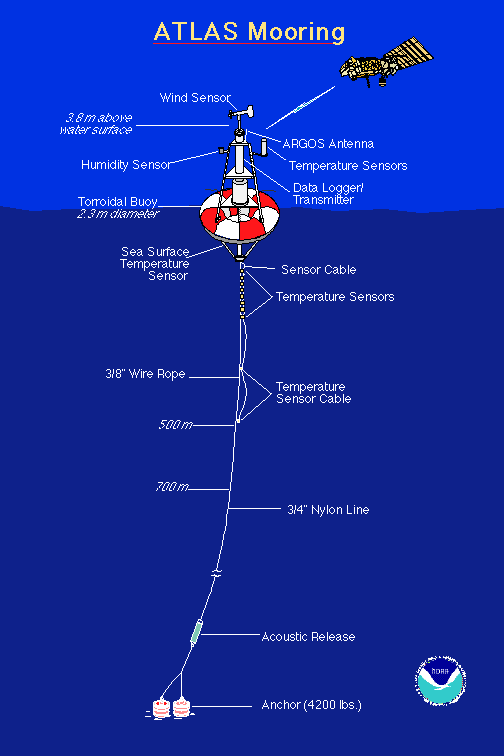
Dr. Paul Freitag, our Chief Scientist, provided some more information about the instruments on the buoys. First, the buoys are anchored to the ocean floor, which is still hard for me to believe. All of the buoys have sensors to measure temperature/relative humidity and an anemometer to measure wind speed along with wind direction. Some of the buoys have sensors measuring precipitation and solar radiation, but not all are equipped to with this expensive instrumentation. The buoy itself (the orange and white donut part) is composed of a foam core surrounded by fiberglass. Below this there is a rigid stainless steel bridle connected to a wire rope which is used for the first 500 meters of the mooring. On these 500 meters of wire rope there are nine subsurface temperature sensors (thermistors) followed by two pressure sensors accompanying two more thermistors. The pressure readings correspond well with measurements of ocean depth. Water temperatures are measured below the surface at 1 meter (m), 20 m, 40 m, 60 m, 80 m, 100 m, 120 m, 140 m, 180 m, 300 m, and 500 m. Below 500 m, eight-strand plaited nylon line is used down to the anchor, with some sites requiring nearly 3 miles of line (see the diagram at http://www.pmel.noaa.gov/images/atlas.gif). The amazing thing is that the subsurface temperature sensors transmit and receive data from the buoy with an inductive coupling technique, which means that they’re not wired directly to the main line, yet data are transmitted along the cable. The sensors simply clamp onto the wire rope that serves as one of the inductive elements. This makes it much easier to assemble and deploy the extremely long cable. One aspect of meteorology that I find fascinating is the instrumentation, so I spend much of my time looking at the wiring and instrument manufacturers and asking the scientists many questions about what and why and how…they haven’t seemed to mind so far.

Here is some more information about the people and activities on the ship. There are 31 people on board (seven of us are women) with bunk space available for only two more. There are 5 officers, 1 cadet, 10 scientists, and the remaining crew members who focus on making the ship and science work efficiently. We all greatly appreciate their help. Everyone eats breakfast from 7:00-8:00 AM (0700-0800), lunch from 11:00-12:00 (1100-1200), and dinner from 4:30-5:30 PM (1630-1730). There is a small store selling candy and snacks, soda, shirts and hats on the ship that is open each night from 1930-2000 hours. We can email from any computer on board (I’ve counted at least 14 computers) and all of our email messages are sent and received in a bundle two times a day around 0900 and 1600. There is a laundry room with three washers/dryers on the second deck forward on the starboard side of the ship. There are two lounges with library materials including books, magazines and board games. Movies are shown every night on two channels in the lounges at both 1730 and repeated at 2000. So, you can see that it’s easy to keep busy on the ship. Two extra treats on this cruise include guitar/music playing sessions for all those who brought their musical instruments on board, and French lessons every other night. Je m’appelle Diane. J

After seeing more flying fish today, I decided to do some research to find out exactly what these fish are all about. I learned that they’re often referred to as “bluebirds of the sea” and that they spread their pectoral fins, glide for a few seconds, and then splash back into the sea. When they swim, their long fins are folded against their body. Flight speeds of up to 35 miles per hour have been monitored and flights as long as 13 seconds covering up to 450 feet have been timed. Photography has proven that they are gliders and not true flyers (all information obtained in “Fishes of the Pacific Coast” by Gar Goodson, Stanford University Press, 1988). I’ll keep my eye on these beauties and attempt to take a photo so you can share this delight!

The first person to answer my question of the day posed in my August 17th log was Tom Taddeo (my incredibly smart uncle from Mechanicsburg, PA – thanks for responding!) who gave the correct answer regarding the definition of pitch, roll, and yaw of a ship. Yes, pitch is when the ship tips in a fore-and-aft direction (from front to back), roll means the ship tips from side to side due to the sea or swell, and yaw means that the ship swings involuntarily from side to side when advancing forward. I’d love to hear from more of you so I can acknowledge more people in my logs.

The afternoon was spent testing the computer and camera equipment that will enable us to connect with all of you via upcoming live webcasts. Fortunately, everything seems to be working very well! We even managed to get a wireless microphone to work. We’ll be testing again tomorrow and hope to have a general broadcast ready to go by the end of the week. Please contact Jennifer Hammond at jennifer.hammond@noaa.gov if you’d like to receive the live broadcast. We’ll be interviewing scientists and talking about life at sea!

We enjoyed a wonderful dinner again tonight and I’m nearly ready for bed. It was great to hear from Dana Tomlinson (our last Teacher at Sea!), Nancy from ASU, and as always, my husband, family members, and friends. I invite more of you to email with questions that you might have about the Ka’imimoana or what it’s like to live on a ship.

Until tomorrow when I discuss CTD’s (what are they, you ask?!? – more tomorrow!)…bon soir.

Question of the day: What is the difference between sea wave height and swell wave height?

More tomorrow…
Diane

P.S. I just walked outside and rain was falling on the buoy deck under bright pink clouds – beautiful!