David Murk: Do You Know Your ABCs? May 14, 2014

NOAA Teacher at Sea
Dave Murk
Aboard NOAA Ship Okeanos Explorer
May 7 – 22, 2014

Mission: EX 14-03 – Exploration, East Coast Mapping
Geographical Area of Cruise: Off the Coast of Florida and Georgia – Western portion of the Blake Plateau (Stetson Mesa)
Date: May 14, 2014

Weather data from Bridge:

We are sailing south and are at 28.55 degrees  North, 79.44 degrees  West

Wind: 23 knots out of the southeast.
Visibility: 10 miles
Water Depth in feet: 653 feet
Temperature: 27 degrees Celsius  – both sea and air temp. are 80 degrees!

Our location can also be found at:  (http://shiptracker.noaa.gov/).

Science and Technolgy Log:

DO YOU KNOW YOUR ABCs?

Can you understand this sentence?

“During a watch change, the XO checked the AIS then handed control over to the  CO.  When contacted by the mapping room regarding the XBT launch and CTD termination check, the CO said,“Roger that”.  

After reading this- you’ll have a better idea what some of these acronyms mean and how we use them on the Okeanos Explorer. In other words, you’ll be able to say- “roger that” to show you understand and agree.

Let’s start with the XO and CO  –  They are easy and make sense.

CO – The Commanding Officer – He or she is responsible for everything on the ship. (see Personal Log for more information on Commander Ramos of the Okeanos Explorer)

XO – The Executive Officer – Reports to the Commanding Officer and is second in command.

AIS –What is it and why do we need it?

Okeanos Explorer AIS screen

Automatic Identification System.  The Okeanos Explorer has an electronic chart display that includes a symbol for every ship within radio range.  Each ship “symbol” tells Commander Ramos the name of the ship, the actual size of the ship, where that ship is going, how fast it’s going, when or if it will cross our path, and a lot of other information just by “clicking” on a ship symbol!  Here is a link to get more information on AIS.  I also took a picture of the Okeanos Explorer AIS screen and below that there’s the actual picture of our closest neighbor,  the ship named “Joanna”(look closely on the horizon) .  If the CO feels like the ship is going to need to change course, he will inform the scientists in the mapping room right away.  Safety and science RULE!

Explanation of AIS

Our closest neighbor,  the ship named “Joanna”(look closely on the horizon).
Our closest neighbor, the ship named “Joanna”(look closely on the horizon).

XBT- What is it and why do we need one?

Sam Grosenick, mapping intern, launches the XBT.

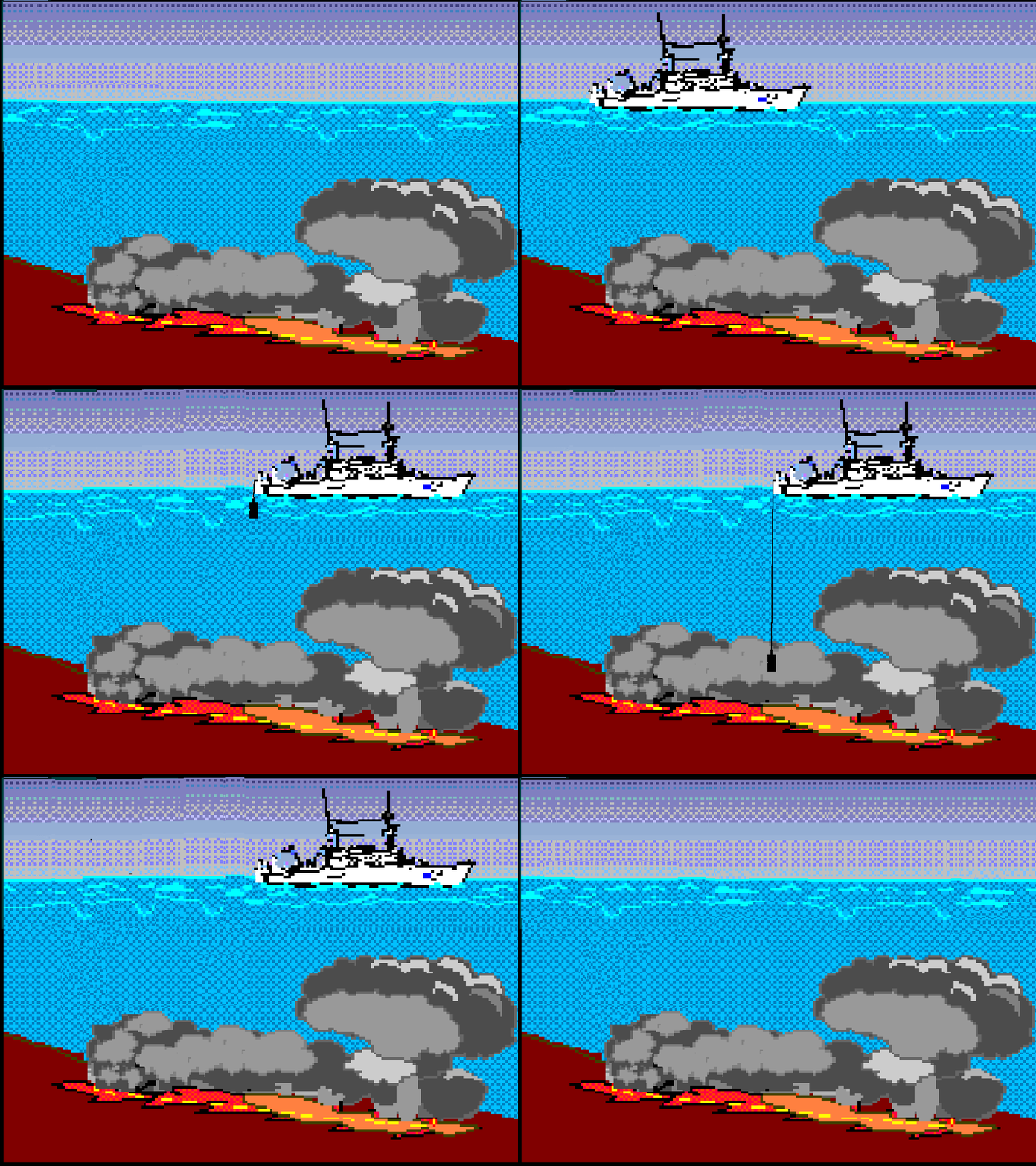
Every two or three hours the mapping team calls the bridge (the driver seat of the ship) and asks permission to launch an XBT – which is short for an eXpendable BathyThermograph.   That’s a heavy weighted probe that is dropped from a ship and allows us to measure the temperature as it falls through the water. WHY do we need to measure the temperature of the water if we are using sonar?  Sound waves travel at different speeds in different temperature water, just like they travel at different speeds in cold air than warm air.  So they need to know the temperature of the water to help calculate how fast the sound or ping that the ship’s sonar sends out so they can map the bottom of the ocean.  A very thin wire sends the temperature data to the ship where the mapping team records it.  There is more information about XBT’s here:

explanation of XBT

NOAA’s network of XBT data

CTD – What is it and why do we need one?

Chief Electronics Technician Richard Conway and Chief Boatswain Tyler Sheff prepare for a dawn launch of the CTD

Many oceanographic missions use CTD’s.  The Okeanos Explorer is no exception.  CTD stands for conductivity, temperature, and depth, and refers to the electronic instruments that measure these properties. The grey cylinders are water sampling bottles and the big white frame protects everything.   WHY do scientists need CTD’s? Scientists use a CTD to measure the chemistry of the Ocean from surface to bottom.  The CTD can go down to near the bottom and the cylinders close when the scientist on board ship pushes a key on the computer and close so that a water sample is captured at that depth.  It’s a lot easier than swimming down there and opening up a jar and closing it.

WHY do they want to know about conductivity? Why do they care how much electricity can go through the water?   If the water can conduct more electricity, then it has a higher salinity, i.e. more salt.   That helps the scientists know the density of the water at that depth and can help inform them of the biology and ocean currents of that area.

It’s a CTD, not a railing! (picture taken by Kalina Grabb)
Close-up of CTD
Close-up of CTD

More info on a CTD from NOAA

CTD vertical cast


Personal Log 

Commander Ramos at the helm

As I mentioned in last blog, everyone plays a part on the Okeanos Explorer.  The CO plays a big part in making sure the scientists achieve their goals.  The man in charge- Commander Ricardo Ramos answered a few of my questions last night  in his office in the forward part of the ship.

When I say Oregon Trail, fifth graders usually think of covered wagons.  I doubt that they think of a family of immigrants from Mexico deciding to leave family and friends in sunny Los Angeles and hit the trail north to rainy Oregon. But the devastating riots in Watts in the 1960s caused Commander Ricardo Ramos’s parents to do exactly that. There were some adjustments to be made to life in tiny Klamath Falls, Oregon but his parents, 3 brothers and sister were up to the challenge of no family support and a new community.  The family worked for Weyerhaeuser and Commander Ramos knew he did not want to work in the plant the rest of his life.  It was never IF he’d go to college, but “WHERE”.  He was the second of the five children to attend college, earning 2 Associates degrees and a degree in Electrical Engineering.   After entering NOAA and gaining his masters from Averett University, he spent time on various NOAA ships and in other capacities.  He is also a graduate of Harvard’s Senior Executive Fellows program.

He had a couple words of advice for elementary school students.  First, take advantage of all learning opportunities, for you will never know when you might need the knowledge you will gain.  Second, that communication, both written and oral,  is probably the most important part of his job.  He is not afraid of getting input and editing of his writing for the job.  His greatest reward is realizing that he is charge of a tremendous asset of the United States that provides a platform for scientist to explore our vast oceans.


Did You Know? 

My ship – The Okeanos Explorer is about  70 meters - the length of the top of the  arch on the Eiffel Tower!
My ship – The Okeanos Explorer is about 70 meters – the length of the top of the arch on the Eiffel Tower!

Displacement – When you think displacement, you probably think of a quick definition like “moved aside” that we learned when we made aluminum foil boats.  When you get in a kiddie pool, bathtub or any body of water, you move aside water. If you measure the weight or amount of water that you move aside, that is your displacement.  The Okeanos Explorer moves aside a lot of water – more than 2,500 TONS of water.  That’s about 700,000- gallons of water that gets displaced.  The ship is 224 feet long and 43 feet wide in its widest part.  Now, I don’t know about you – but I start thinking about the really big ships and tankers that we see passing by the Okeanos Explorer on the radar (their ‘deets’ are given to us by the AIS system – See the Section on ABC’s for an explanation of AIS) Well, there was a ship called “The Knock Nevis” and it was 1500 feet long!  Did it displace water?  You bet!. 650,000 tons of water when fully loaded! (use a ton of water = gallon converter on google to figure out how many gallons that is). Let’s just say that it’s a lot more than our little MUFFIN – the winner of the Coon Creek Boat Race.

MUFFIN, the boat race “WINNER” and Mr. Murk on the high seas. (picture taken by Sam Grosenick)
MUFFIN, the boat race “WINNER” and Mr. Murk on the high seas.
(picture taken by Sam Grosenick)

Paul Ritter: Lock and Load the XBT – The Joke is on Me, July 22, 2013

NOAA Teacher at Sea
Paul Ritter
Aboard the NOAA Ship Pisces
July 16– August 1, 2013 

Mission: Southeast Fishery-Independent Survey (SEFIS)
Geographical area of cruise: southeastern US Atlantic Ocean waters (continental shelf and shelf-break waters ranging from Cape Hatteras, NC to Port St. Lucie, FL)
Date: July 22, 2013

Weather Data from the Bridge

7-22-13 ship data

Science and Technology Log

Yesterday was a very exciting day.  After we dropped off our first traps, the ship’s officers brought the ship to a full stop and it was time to release the CTD.  What is a CTD?  CTD stands for Conductivity, Temperature, and Depth.  The CTD unit  is an array of sensors that is lowered to just above the bottom of the ocean to take a continuous profile of the water column.  Moments after the CTD reaches the bottom it is brought back to the surface and the deck hands bring it back on board the ship.  From here, the scientific crew can analyze the data from the CTD to determine the water conditions for the drop area.  On some expeditions, the CTD is fitted with a device that actually takes water samples at the different depths for chemical and biological analysis.   This information allows the scientists to get a complete picture of the water column where the traps are set and where the fish live.

What is a CTD? CTD stands for Conductivity, Temperature, and Depth.

Another instrument that is used by the ship is the Expendable Bathythermograph or XBT.  This device was used by the military for many years to measure the temperature of the water at various depths.  The most interesting thing about this probe is how it is deployed.

Warren Mitchell, a fisheries biologist for NOAA’s Beaufort Laboratory, decided it would be a good idea for me to be trained firsthand to deploy this vital instrument.  The first thing I had to do was put on my hardhat and safety vest and step on to the recovery deck.  At that point Warren called up to the bridge to ask for permission to drop the XBT.  The officers on the bridge gladly gave us permission and Warren then got me into a launching position with my feet spread apart and my elbow braced on hip.  The CO then happened to walk by and asked me if I had my safety glasses on, to which I immediately said yes.

It was at this point that Warren gave me permission to launch the XBT.  I was excited.  I was ready.  I could not wait for Warren to give me the signal.  The only problem was I did not know the signal and I could not find the trigger.  I did not know what to do.  I was getting worried.  Warren then repeated the orders “launch”.  “How?” I replied.  Tip the barrel forward, lean forward, he replied, and the XBT slid out of the tube into the water.

The joke was on me.  Here I had been led to believe that this was going to be some grand launch something just shy of the space shuttle taking off into space.  The reality was that the XBT just falls into the water.  Very non-exciting for me but everyone on the boat laughed for hours.  So did I.  It is good to be treated like one of the family.  After our final set of traps for the day, I ventured out to see what it is like to work in the acoustics lab.

Warren Mitchell NOAA Scientist instructs Paul Ritter on the proper use of the XBT.
Warren Mitchell NOAA Scientist gives instruction to Paul Ritter on the proper deployment of the XBT.

Personal Log

Monday 7-22-13

Nurse shark outside chevron trap.
Nurse shark outside our chevron trap.

To this point this expedition has been so amazing.  Would you believe there are 3 people aboard the NOAA Ship Pisces that live or once lived within 60 miles from my home town? Crazy I know.  We have had only one medium sized squall to this point with 3 to 5 foot seas.  We have brought up traps with tons of jellyfish, in which I got a nematocyst (jellyfish stinging cell) to the hand.  It was not too bad but I did feel a slight burning sensation.

We have had a number of different types of starfish, all of which I have never seen.  One particular trap that we sent to the ocean floor, while upon retrieval did not have any fish, but did have a secret to share.  After Julie Vecchio, one of our volunteer scientists replayed the video cameras that are on the top of the trap, we discovered that a nurse shark had been trolling the area around our trap. I have seen so many amazing things.  Several days ago we were hauling traps and just as we brought our trap up there was a sea turtle that came up to the boat.  I snapped a couple of photos, as quick as I could and then went right back to work.  It was not two minutes later and I saw a baby sea turtle the size of a fifty cent piece.  Immediately, the first thing that came to my mind was thought of Crush and Squirt from Disney’s Finding Nemo talking to me.

Crush: Okay. Squirt here will now give you a rundown of proper exiting technique.

Squirt: Good afternoon “Paul”. We’re gonna have a great jump today. Okay, first crank a hard cutback as you hit the wall. There’s a screaming bottom curve, so watch out. Remember: rip it, roll it, and punch it.

 Paul: Whoa! Dude! That was totally cool!

Turtle off the port bow.

Tuesday July 23, 2013

Somewhere in the middle of the night the wind picked up and so did the waves.  I share a stateroom with Zach Gillum a graduate student from East Carolina University.  This kid is amazing.  We really have become great friends.

One of the great things about this trip is to be totally immersed in an expedition with like-minded people. We will all hang around waiting for traps, or eating dinner and start conversations about some environmental issue or ecological principle.  I sure wished I lived closer to my new friends.  Anyway, our stateroom window is about 4 foot above the waterline.  Many times during the night, our window was under the water as a wave passed by.  When we woke up, the wind and waves increased.  A four to seven foot wave is enough to make many run for the toilet.  So far so good for me when it comes to sea sickness.

I just hope we don’t find any bigger waves.  We gathered on the aft deck as we usually do but we delayed deployment, waiting for improvement in weather conditions.  The major problem we had was with larger waves comes the possibility of the traps bobbing up and down on the ocean floor.  With adverse conditions on pick-up, we are also more likely to drag traps across the bottom.  We set the first six traps, pulled them up and just as we had suspected not many fish.  Around 1:00 P.M. Zeb Schobernd, our Lead Scientist, made the decision to head to another location.   It just goes to show you that when you are at sea, you need to follow the 3 F’s.  Flexibility, fortitude, and following orders.

Waiting to work.
Waiting to work.

Did You Know?

Did you know that a jelly fish’s nematocyst are like mini speargun?

These little stinging cells fire when they come in contact with the surface of and organism.  Some jellyfish tentacles can contain up to 5000 or more nematocyst.

Elizabeth Nyman: Tropical Storm Andrea Edition, June 6, 2013

NOAA Teacher at Sea
Elizabeth Nyman
Aboard NOAA Ship Pisces
May 28 – June 7, 2013

Mission: SEAMAP Reef Fish Survey
Geographical Area of Cruise: Gulf of Mexico
Date: June 6, 2013

Weather Data:
Wind Speed: 19.97 knots
Surface Water Temperature: 27.78 degrees Celsius
Air Temperature: 28.40 degrees Celsius
Barometric Pressure: 1010.40 mb

Science and Technology Log

The Pisces is on its way to port, having had to suspend operations in wake of the bad weather that has since become Tropical Storm Andrea. We were supposed to go into Mayport Naval Base, right outside of Jacksonville, FL, but due to the storm we have been redirected to Port Canaveral.

Ocean
It’s been pretty rough out there! (Picture courtesy Ariane Frappier)

Despite all of this, we made the best of a bad situation. Even though we couldn’t do fishing or camera drops yesterday, we did still manage to get some data. We spent as much time as we could mapping the seafloor before we had to dodge the storm, and we took the time in the morning to do an XBT, an Expendable Bathythermograph.

You can use an XBT to get a temperature and depth reading for the water without having to actually stop the ship. A tube with a probe on it is attached to a launcher and is fired into the water. The probe has copper wire attached to it to send the data back to the ship.

So…you drop the probe, you get the readings, and at least you get some data even if you can’t stop the ship to send more delicate equipment down.

XBT
Launching probe…

Other than that, the past couple of days have been all about cleanup and dodging the storm. To a certain extent that makes the scientific posts a little quieter than usual, but it’s been a very interesting experience watching everyone work together to make sure that the scientists could get as much work done as possible without endangering the ship or its crew.

We didn’t get to do everything that we wanted to do on this leg of the trip, unfortunately. But we still got a lot accomplished, and I feel like it was just as interesting to see how everyone was able to react to the weather and still get their job done.

Personal Log

Whew! I didn’t imagine when I got on the Pisces in Tampa that I’d spend the last bit of the trip dodging the first named Tropical Storm of the Atlantic hurricane season. But I definitely have a greater appreciation that, with science as in all things, sometimes life does not go quite to plan.

If all goes to schedule, I will be leaving the Pisces tonight, for our detour into Port Canaveral. We had to stop working a day early, and we’ll end up arriving a day early and into a different port. My last day has mostly been spent trying to rearrange for my travel home from a new city and with assisting the science crew in cleaning up the lab spaces.

All data collection requires a certain amount of flexibility. I knew that already – social science data is notoriously difficult to collect – but the problems that I face in my work are quite different from these. When international relations scholars have trouble with data, it’s usually because of things like difficulties in getting governments and/or people to tell the truth, etc. But sometimes, as now, it’s because conditions make it unsafe to collect the data. We can’t send people into shooting wars to count casualties, and we can’t send scientists into a hurricane to count fish.

Science is a method, not a subject, and the scientific method is one wherein we all simply do our best with what we have. Science has been so profoundly influential because of the simple power of this process, testing over and over what we think to be true, so that we can learn if we are wrong. It’s true if you study fish, if you study policy, or if you study anything in between.

There are many things we’ve discovered about our oceans, and the fish and other creatures that inhabit them. But there are still many more things to learn. I’m glad that we have scientists like the ones I met on the Pisces out looking for our fish, and glad that NOAA, in conjunction with states and other government agencies like the Coast Guard, are looking out for our oceans.

My thanks go out to the entire crew of the Pisces, and the great people at the Teacher at Sea program, for letting me be a part of the process.

Did You Know?

NOAA is predicting a highly active hurricane season for the Atlantic this year. Stay safe!

Amanda Peretich: CTD and XBT – More Acronyms? July 8, 2012

NOAA Teacher at Sea
Amanda Peretich
Aboard Oscar Dyson
June 30 – July 18, 2012

Mission: Pollock Survey
Geographical area of cruise:
Bering Sea
Date:
July 8, 2012

Location Data
Latitude: 57ºN
Longitude: 172ºW
Ship speed: 11.2 knots (12.9 mph)

Weather Data from the Bridge
Air temperature: 6ºC (42.8ºF)
Surface water temperature: 7ºC (44.6ºF)
Wind speed: 2.5 knots (2.9 mph)
Wind direction: 156ºT
Barometric pressure: 1020 millibar (1.0 atm, 765 mmHg)

Science and Technology Log
Today’s post is going to be about two of the water profiling devices used on board the Oscar Dyson: the CTD and XBT.

CTD
CTD stands for Conductivity, Temperature, and Depth. It’s actually a device that is “dropped” over the starboard side of the ship at various points along the transect lines to take measurements of conductivity and temperature at various depths in the ocean. On this leg of the pollock survey, we will complete about 25-30 CTD drops by the end. The data can also be used to calculate salinity. Water samples are collected to measure dissolved oxygen (these samples are analyzed all together at the end of the cruise). Determining the amount of oxygen available in the water column can help provide information about not only the fish but also other phytoplankton and more. Although we are not doing it on this leg, fluorescence can also be measured to monitor chlorophyll levels.

CTD
From left to right: getting the CTD ready to deploy, the winch is used to put the CTD into the water, the CTD is lowered into the water – notice that the people are strapped in to the ship so they don’t fall overboard during deployment

DYK? (Did You Know?): What exactly are transect lines? Basically this is the path the ship is taking so they know what areas the ship has covered. Using NOAA’s Shiptracker, you can see in the photo where the Oscar Dyson has traveled on this pollock survey (both Leg 1 and Leg 2) up to this point in time.

Transect Lines
Using NOAA’s Shiptracker, you can see the transect lines that the Oscar Dyson has followed during the pollock cruise until July 8. The ship started in Dutch Harbor (DH), traveled to the point marked “Leg 1 start” and along the transect lines until “Leg 1 end” before returning to DH to exchange people. The ship then returned to the point marked “Leg 2 start” and followed transect lines to the current location. The Oscar Dyson will return to DH to exchange people before beginning Leg 3 of this survey and completing the transect lines.
Deploying the CTD
I was lucky enough to be able to operate the winch during a CTD deploy. The winch is basically what pulls in or lets out the cable attached to the CTD to raise and lower it in the water. Special thanks to the chief boatswain Willie for letting me do this!

The CTD can only be deployed when the ship is not moving, so if weather is nice, we should just stay mostly in one place. The officers on the bridge can also manually hold the ship steady. Or they can use DP, which is dynamic positioning. This computer system controls the rudder and propeller on the stern and the bowthruster at the front to maintain position.

Here is a video from a previous Teacher at Sea (TAS) about the CTD and showing its “drop” into the water: Story Miller – 2010. Another TAS also has a video on her blog showing the data being collected during a CTD drop: Kathleen Harrison – 2011.

XBT

Thermocline
The thermocline is the area where the upper isothermal (mixed) layer meets the deep water layer and there is a decline in temperature with increasing depth.

XBT is the acronym for the eXpendable Bathymetric Thermograph. It is used to quickly collect temperature data from the surface to the sea floor. A graph of depth (in meters) versus temperature (in ºC) is used to find the thermocline and determine the temperature on the sea floor.

DYK? Normally, temperature decreases as you go farther down in the sea because colder water is denser than warmer water so it sinks below. But this is not the case in polar regions such as the Bering Sea. Just below the surface is an isothermal layer caused by wind mixing and convective overturning where the temperature is approximately the same as on the surface. Below this layer is the thermocline where the temperature then rapidly decreases.

The MK-21IISA is a bathythermograph data acquisition system. This is a portable (moveable) system used to collect data including ocean temperature, conductivity, and sound velocity and various depths using expendable probes (ones you can lose overboard and not get back) that are launched from surface ships. The depth is determined using elapsed time from surface contact and a known sink rate.

There are three different probes that can be used with this data acquisition system:
1. XBT probe – this is the probe that is used on OD, which only measures water temperature at various depths
2. XSV probe – this probe can measure sound velocity versus depth
3. XCTD probe – this probe measures both temperature and conductivity versus depth

On the XBT probe, there is a thermistor (something used to measure temperature) that is connected to an insulated wire wound on two spools (one inside the probe and one outside the probe but inside the canister). The front, or nose, of the probe is a seawater electrode that is used to sense when the probe enters the water to begin data collection. There are different types of XBT probes depending on the maximum depth and vessel speed of the ship.

XBT Canister and Probe
This shows a sideview (left) and topview (middle) of the canister that houses the probe (right) released into the water during an XBT.

There are really four steps to launch the XBT probe using the LM-3A handheld launcher on board:
1. Raise contact lever.
2. Lay probe-containing canister into cradle (make sure to hold it upwards so the probe doesn’t fall out of the canister!).
3. Swing contact level down to lock in canister.
4. Pull release pin out of canister, aim into ocean, and drop probe.
Important: the wire should not come in contact with the ship!

Launching an XBT
“Launching” an XBT probe from starboard side on the Oscar Dyson. There is no actual trigger – you just make a little forward motion with the launcher to allow the probe to drop into the water.

Be sure to check out the video below, which shows what the data profile looks like as the probe is being dropped into the water. An XBT drop requires a minimum of two people, one at the computer inside and one outside launching the probe. I’ve been working with Scientist Bill and ENS Kevin to help out with the XBT launches, which also includes using the radios on board to mark the ship’s position when the probe hits the water.

Personal Log

Quickest Route?
We’ve been taught in school that the quickest way from point A to point B is a straight line, so you’d think that the red voyage would be the fastest way to get from Seattle, Washington across the Pacific Ocean to Japan. But it’s actually a path up through Alaska!

It’s been a little slow on the trawling during my shift recently, so I’ve had some extra time to wander around the ship and talk to various people amidst researching and writing more blog posts. I think one of my favorite parts so far has been all of the great information I’ve been learning up on the bridge from the field operations officer, LT Matt Davis.

DYK? When looking at the map, you’d think the quickest route from Seattle, Washington to Japan would be a straight line across the Pacific Ocean. But it’s not! Actually, ships will travel by way of Alaska and it is a shorter distance (and thus faster).

View from the Bow
View from the bow of the Oscar Dyson.

Vessels  use gnomonic ocean tracking charts to determine the shortest path. Basically a straight line drawn on the gnomonic projection corresponds to a great circle, or geodesic curve, that shows the minimum path from any two points on the surface of the Earth as a straight line. So on the way to Japan from Seattle, you would travel up through Alaskan waters, using computer software to help determine the proper pathway.

I’ve also had some time to explore a few other areas of the ship I hadn’t been to before. I’ve learned some new lingo (look for this in an upcoming post) and plenty of random facts. One of the places I checked out is the true bow of the ship where, if I was standing a bit higher (and wearing a PFD, or personal flotation device), I’d look like I was Rose Dawson in one of the scenes from Titanic.

Animal Love
All of the time I spend on the bridge also allows for those random mammal sightings and I was able to see a few whales from afar on July 7!

Whale Sighting
Whale sighting from the bridge! You have to look really closely to see their blow spouts in the middle of the photo.

Cathrine Fox: Issue Ten: Red King Crabs, a twenty word synopsis

NOAA TEACHER AT SEA
CATHRINE PRENOT FOX
ONBOARD NOAA SHIP OSCAR DYSON
JULY 24 – AUGUST 14, 2011Mission: Walleye Pollock Survey
Location: Kodiak, Alaska
Date: August 7, 2011

Weather Data from the Bridge
Latitude: 57.33° N, Longitude: 152.02° W
Air Temperature: 10.6° C
Water temperature: 9.3° C
Wind Speed/Direction:8.25kn/338.45
Barometric Pressure: 1017.59
Partly cloudy (35%) and sun

Personal Log:

First things first: we have left the dock! We are surrounded by sea!

Being at sea is lovely. Pulling out of Women’s Bay a few of us went up above the bridge to the “flying bridge” (aptly named, as you are up in the air with the birds) for a view. In the mouth of the bay, sea otters swam through bull kelp forests and a humpback whale breached right off of the bow. Although horned puffins were more numerous by the Coast Guard pier, the farther we got offshore, the more tufted puffins there were. Pelagic (?) cormorants used the buoys as platforms to dry their wings and later, when we tested the net reels, Northern fulmars and black-footed albatross sailed in to see if we were pulling in fish: as if they were classically conditioned. The movement of the ship makes me feel sleepy when I am without a porthole; other than that, I haven’t felt any adverse effects at all. I love it.

Adventures in a Blue World, Issue 10

I also feel really lucky to be working with such an interesting group of people. One of the scientists, Dr. Jodi Pirtle (now at the University of New Hampshire) studied juvenile Red King Crabs for her dissertation at the University of Alaska Fairbanks, School of Fisheries and Ocean Science, Juneau. It is because of her and requests from three of you out there in cyber-land that Adventures in a Blue World, Issue 10 explores the natural history of these interesting organisms. I hope you enjoy Red King Crabs, a twenty word synopsis. (Cartoon citation 1. Hint: the twenty word synopsis starts with “I bite.”)

Science and Technology Log:

    Oscar Dyson's multibeam echo sounder
Oscar Dyson’s multibeam echo sounder

I came on shift this morning at 4am and immediately was able to take part in some really interesting work. Jodi (the scientist that shared her juvenile crab research) is working on mapping habitats in untrawlable places of the ocean floor using acoustic and other methods. During the night, the ship will be driven in tight transects over areas that she has identified as being potentially “untrawlable:” rocky ledges, areas with lots of pinnacles, or other areas with un-level bottoms. The ship’s multibeam echo sounder broadcasts and receives signals, providing an acoustic map of the floor. Three times during the trawl, Jodi will lower a camera down to the bottom to get live feed on what the habitat looks like.

This morning we tested the stereo video camera and lowered it 78.81 meters down. Watching it was like being able to control a live feed on the Discovery Channel! Euphausiids (krill) swarmed the lights, a huge burgundy colored halibut swam along the silty bottom, flat fish, pacific cod and a sturgeon poacher perused the camera and mushroom-like anemones called Netridium farcimen swayed with the currents.

In last summer’s cartoon series (Pura Vida Adventures, Issue 2), I quoted Stephen Sharnoff: The eye often cannot see what the mind does not already know” to explain how difficult it was to see lichen diversity until you knew what you were looking for. I think the reverse is true for life on the ocean floor. I know that the ocean is very alive. Seeing it 80 meters down in the pre-dawn light as if it were a bustling city is an all together different experience.

In the future, I will try to capture a few stills directly from the live video feed. For now, I will leave you with a few other images of science, technology and shipboard life.

Until our next adventure,
Cat

Lowering the stereo-video-camera.
Jodi "drives" the lowered stereo-video-camera, watching the live feed.
Jodi “drives” the lowered stereo-video-camera, watching the live feed.
Darin Jones brakes while Jodi drives.
Dawn in Kalsin Bay, Kodiak.
Deploying the Expendable Bathythermograph (XBT): click here to find out more