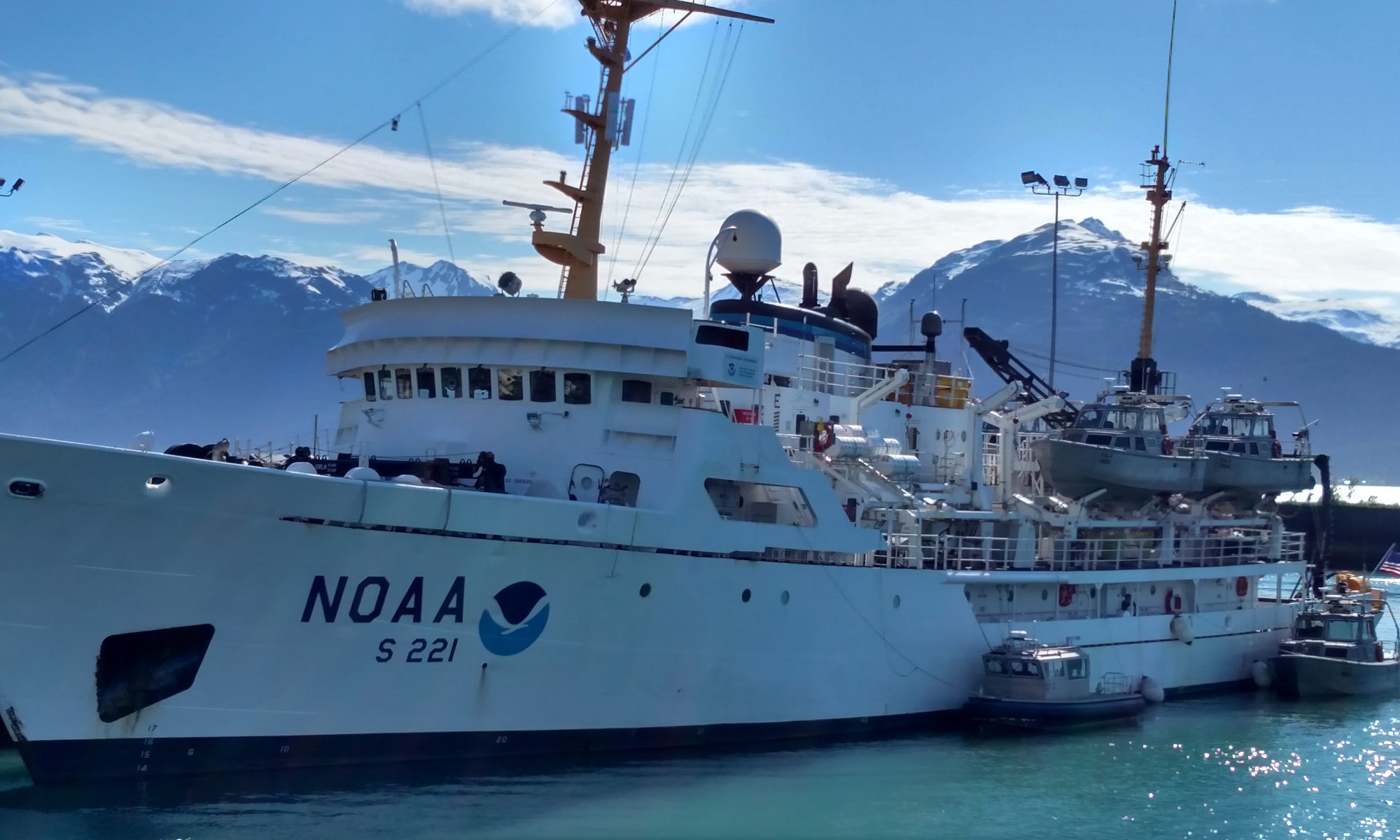
Linda Armwood, April 27, 2006

NOAA Teacher at Sea
Linda Armwood
Onboard NOAA Ship Fairweather
April 25 – May 5, 2006

Mission: Hydrographic Survey
Geographical Area: Aleutian Islands, Alaska
Date: April 27, 2006

Weather Data from Bridge 
Visibility: 4  nautical miles (nm)
Wind direction: 120 °
Wind speed:  20 kt
Sea wave height: 1-2 ft.
Swell waves dir: 300
Swell waves height: 2 ft.
Sea level pressure: 1006.0mb
Present weather: Drizzle
Temperature:  °C~ 7.6dry/7.1wet

Science and Technology Log 

I attended the navigation meeting in preparation for today’s departure from home port.  The personnel responsible for conducting the navigation meeting and providing all of the essential information for exploration are junior officers who are trained in atmospheric science, oceanography, mathematics and navigation technology.  Several charts were displayed to show the route of travel and the location of the intended areas for research.  The first priority of the project is tide gauge installation.  One particular area of the travel route (Snow Passage) will present a challenge because it is hard to go through during this time of year as a result of the currents in the narrow parts.  One of the areas of research (Gulf of Esquibel) contains lots of navigational hazards such as rocks and low water levels near high water levels. The FAIRWEATHER only needs four fathoms of water to navigate, but generally stays in water deeper than ten fathoms due to the nature of the seafloor and the age of the charts.

An in-depth explanation of the survey tech procedures in data acquisition and processing was provided by a member of the survey tech team.  Survey techs are given a charted sheet that represents their area of concentration.  In order to do this, the tech first collects raw data, including depth information, with the Global Positioning System (GPS), the Shallow Water Multibeam (SWMB), and the Position and Orientation System for Marine Vessels (POS-MV) in operation at the same time.  The POS-MV does the inertial motion of the vessel’s roll, heave, pitch, and gyro positions.  Next, the tech uses processing systems as a visual way to look at the surface of the water.  The third and fourth steps are to apply motion corrections and tide corrections.  The fifth step is to create the sound velocity profile based on water conductivity, temperature, and density.  The next step is to combine each of the files into one file – a concatenated file.  Following is the step involving computing total propagated error.  This will result in the error value based on error associated with sonar data.  Step eight is for the tech to make a digital terrain model which is a basic grid from XYZ data. The final step is to view or look for errors caused by the system. These errors may indicate dangerous uncharted errors.

Personal Log 

First time feeling the boat leave dock was a rush!  The whale sighting was awesome!  Too far from my cellular phone extended network coverage to call home and share with family.

Question of the Day 

Environmental Science Students 

Explain the importance of water conductivity, temperature and density to sound velocity.

Geospatial Semester Students 

Using course software, produce a map that indicates the bodies of water associated with the Gulf of Esquibel. Identify those areas that have less than 30-40 fathoms.

Mrs. Armwood

Leyf Peirce, July 15, 2004

NOAA Teacher at Sea
Leyf Peirce
Onboard NOAA Ship Rainier

July 6 – 15, 2004

Mission: Hydrographic Survey
Geographical Area:
Eastern Aleutian Islands, Alaska
Date:
July 15, 2004

Time: 18:00
Latitude: N 56°22.60
Longitude: W 152°56.70 Visibility: 10 nm

Wind direction: 115
Wind speed: 8 knots
Sea wave height: 0 – 1 ft
Swell wave height: 2 – 3 feet
Sea water temperature: 12.2 °C
Sea level pressure: 1013.5 mb
Air temperature: 13.3 °C
Cloud cover: 5/8

Science and Technology Log

We are still in transit today to Kodiak, with a planned stop for some “biological testing”, a.k.a. fishing. About two hours before we were going to stop to fish, we heard the bridge announce, “Whales breaching off the port bow!” This is the call for everyone to rush to the portside to see the whales. And what an incredible sight! I was atop the fly deck with TAS Norton and ENS Slover, and none of us could believe the symphony of spray that lay 150 meters ahead of us. It seemed choreographed, almost, with one humpback whale to the right blowing spray into the air at the same time as a whale on the left side. The finale consisted of at least 3 whales breaching so far out of the water you could see their entire underside! Just when we thought the show was over, two whales came within 20 meters of the portside of the boat and breached, waving hello as they went under. Luckily, we had slowed the boat down, so the chances of hitting these whales were small. For such massive and mysterious creatures, these animals completed their whale ballet show gracefully!

We later started fishing, and this sight was yet another of awe at the creatures that inhabit this part of the world. After only 10 minutes, there were about 12 fish on the fantail, 3 of which were halibut that were over 125 pounds, one which was at least 5 feet! After another 10 minutes, the fantail was covered with fish and blood and guts, promising a feast for weeks to come. The birds circled above waiting in anticipation, arguing when a piece of fresh fish was thrown overboard. Again a new image to me, the albatross intimidated the other gulls with its large wing span and threatening call. This day was certainly full of wildlife!

Personal Log

I have never seen whales breach in the wild before, and it truly was an amazing spectacle! Parallel to that, I have never caught a fish any bigger than a 20 inch rainbow trout. Catching a 25 pound black rockfish was extremely exciting, as well as seeing all of the halibut caught! I will say that while fly fishing takes a lot more patience and technique, the fishing that occurred today required more strength and team work. There were at least 4 people helping lug the largest of the fish onto the ship!

We are almost to Kodiak, should be there by morning, and I find myself sad to leave this boat. It has truly been an amazing experience, one in which I learned a lot about the wildlife, research, crew, and myself. I realize now that two weeks at sea really does allow for a lot of self-contemplation and growth. I am very thankful to have had this experience.

Question of the Day:

How big is the biggest humpback whale recorded? How big is the biggest whale recorded? How does this compare to the average sized person?

Leyf Peirce, July 10, 2004

NOAA Teacher at Sea
Leyf Peirce
Onboard NOAA Ship Rainier

July 6 – 15, 2004

Mission: Hydrographic Survey
Geographical Area:
Eastern Aleutian Islands, Alaska
Date:
July 10, 2004

Time: 18:00
Latitude: N 55°17.29
Longitude: W 160°32.13
Visibility: 6 nm
Wind direction: 110
Wind speed: 12 knots
Sea wave height: 0 – 1 foot
Swell wave height: —
Sea water temperature: 10.6 °C
Sea level pressure: 1016.3 mb
Air temperature: 13.3 °C
Cloud cover: 3/8

Science and Technology Log

Today was the first day we launched the survey boats. I was assigned to a boat with SS Foye, ENS Welton, and ENS Samuelson. A very interesting and eventful day, the best way to describe it is with a timeline:

08:00 board 5 boat with SS Foye, ENS Welton, and ENS Samuelson; Lt. Slover (the FOO—Fieldwork Operations Officer) came aboard for about 20 minutes to run tests on the Reson 80101 multibeam echo sounding equipment we are using (soon dropped Lt. Slover back at the Rainier); NOTE: Reson 80101 is used primarily for shallower water, for it has better resolution at depths less than 75 meters

08:45 arrived at our first way point near Halfway Rock; took first cast with the CTD (testing for conductivity, temperature and depth—all things that factor into velocity speed profile) and found an average depth of about 65 meters

09:00 started doing lines (mowing the lawn pattern) around Halfway Rock; after about 3 lines, Lt. Slover called us back in because the data he had taken did not process correctly—the new programs aboard the ship were not working as well as they had thought

11:25 board the RAINIER while FOO checked our equipment; turned out we had to switch to 6 boat—including downloading new maps and figuring out a new system

11:45 board launches 6 boats and sets out for new set of lines at deeper water than the morning; this boat uses the ELAC multibeam systems which are better for deeper waters (up to 400 meters)

12:00 arrived at new line destination (lat: N 55/14/54, long: W 160/27/43) and ate lunch before doing our CTD cast

12:30 conducted first CTD cast, but computer messed up, so had to repeat the cast and got a better reading (average depth = 150 meters) began line pattern

** After a few lines of learning the computer program, SS Foye allowed me to drive the boat for almost the rest of the time—my experience on boats made this part so much fun—especially using the computer imaging as a navigational chart**

17:30 arrived back at RAINIER for dinner

I was truly impressed with the amount of different technology aboard these ships: 5 computer screens, 2 key boards, and a lot of different software programs used to immediately process the information we were gathering. This was also a great change from being on the big ship all day!

Personal Log

This was definitely my favorite day on the ship so far! The fog lifted early this morning to reveal beautiful islands, puffin, sea gulls, kelp, and even a whale! I was able to experience what it is like to have to make computer programs do what you want them to do (any researcher knows this isn’t always easy), and I had to do this on a rocking boat (for all of you “land researchers”, I suggest you trying it once!). SS Foye, ENS Welton, and ENS Samuelson were all extremely helpful and very good at explaining the technology and theory behind what we were doing. I was extremely impressed with how everyone handled various problematic situations. Computers and technology can be very frustrating sometimes, and the crew aboard the boat handled everything optimistically and professionally. SS Foye asked if I ever would consider giving up teaching and join NOAA—after my experience today, I said I would definitely consider it!

Question of the Day:

What is the effect of different densities of water on sound waves?