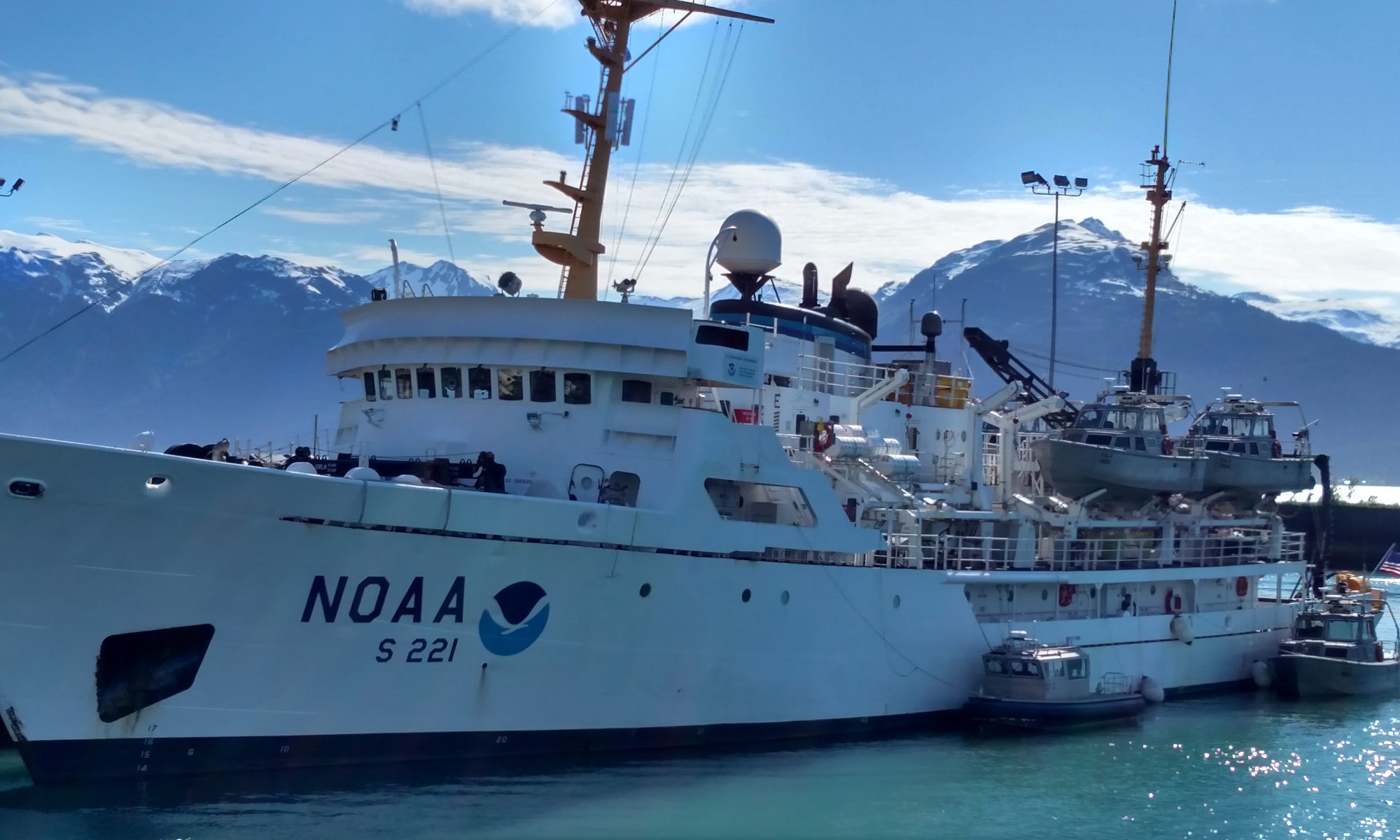

NOAA Teacher at Sea
Mike Lynch
Onboard NOAA Ship Delaware II
June 20 – July 1, 2005

Mission: Clam and Quahog Survey
Geographical Area: New England
Date: June 27, 2005
Weather Data
Latitude: 3938.834N
Longitude07316.810W
Wave Height: 1 foot
Swell Height: 3 Foot
Weather: cloudy
Visibility: obscured
Wind Speed: 14 mph
Science and Technology Log
Today’s log will continue the exploration of the DELAWARE II, her crew, and the concept of an ocean going vessel as a self-reliant community. This log, like the last on this theme, is inspired by a sudden revelation; Clams can be stinky. Actually, clams themselves probably aren’t all that stinky, but constant application to clothing over a prolonged period of time at accelerated temperature certainly produce stink. Having come to this hypothesis, I concluded that the solution was laundry. (Pretty scientific, huh?)

Laundry on board the DELAWARE II, in itself, doesn’t pose a large problem. You wait until about 2 AM, go down past the galley and into the Ship’s Store, and you find two sets of washers and driers. Simple, there is really nothing to it, until you begin to investigate the processes that are involved in providing laundry service. Where does all the fresh water come from? How does the onboard electrical system work? Where does the wastewater and soap go? To find answers to these questions I interviewed Lieutenant Jeff Taylor, who is scheduled to become the X.O. (Executive Officer) off the DELAWARE II.
The first question dealt with fresh water. “Water, water everywhere, but not a drop to drink”. I’m not exactly sure who said that, but it pretty much explains where we are. We have not seen land in over a week, so where is all this fresh water coming from? Lieutenant Taylor explained the process. Fresh water is used onboard for drinking, washing, cooking, and of course, laundry. Initially the answer is simple, 5,000 gallons of water is taken onboard when dockside. This water is supplied to different areas of the ship using an electrical pumping system; the electricity is supplied by generators that are powered by diesel… simple! But what happens when we start to deplete the water? The answer to this is an onboard water purification process that uses an evaporation system to create fresh water. Jeff explained that sea water was taken onboard through what are called sea chests. The seawater is then run through coils that are heated to boiling by the diesel power plant that powers the ship. The resulting steam produces fresh water and the remaining salt solution is returned to whence it came. Simple, we have just distilled fresh water from salt. The newly created water is now pumped into the holding tanks to replenish the water source. The potable water tank is subjected to a bromine treatment, and we are good to do laundry. The creation of fresh water in this manner really is a big deal. It in essence removes one of the three elements that limit the time a ship may stay out at sea: water, food, and fuel. Fresh water is in constant supply to the thirty-man crew of the ship. Fresh water is pumped to each of the staterooms, two common bathrooms, the galley, the ship’s store, the emergency showers, and the wet deck in the science area. The nine fire stations and the onboard hydrants on each of the decks use seawater.

The second question deals with power generation. Power generation onboard the DELAWARE II is supplied by two “Ship’s Service Generators”. These are diesel powered 375 amp generators. On this survey, one of the generators is used to power the ship’s electrical needs and the other is dedicated to the Clam Survey equipment, primarily the winches and the 440 service to the underwater pump. Usually only one generator is used at a time, and runs for 250 hours between oil changes. There is also an emergency generator onboard that supplies a 70-amp service. The generators, as well as the ship’s two powerful engines, are diesel powered. The ship’s diesel capacity is approximately 40,000 gallons, enough for 19 days at full operation, 24 hours a day. The last component of the laundry equation is the matter of wastewater. There are two distinct wastewater systems onboard the DELAWARE II. These are “grey water” and “black water” systems. Grey water comes from sinks, showers, and laundry. Disposal of grey water is a simple enough process, it can be pumped overboard. The Environmental Protection Agency and the United States Coast Guard, however, strictly regulate black water, or human waste disposal. No black water may be disposed of within three miles of the United States’ coastline. Beyond three miles, processed waste may be disposed of, and beyond the twelve-mile mark; untreated human waste may be pumped overboard.
Aboard the DELAWARE II, a Marine Sanitation Device (MSD) treats all black water. The sewage treatment is essentially a large holding tank, with a macerator. Biologicals are added (yeast), and the black water is treated and released. There are also regulations and protocols for the disposal of garbage at sea. A wet and dry garbage log is kept on the bridge. If the galley wants to dispose of left over food, they must request permission; specify the amount, the type, the time and the day on the report. These items would fall into the category of wet garbage. For things like cardboard and paper, a similar log with similar notations is kept. For dry garbage, it must be reduced to pieces 1” or smaller if released between 3 to 12 miles of the coast. Oil and plastics can never be dumped at any location. The wet and dry garbage logs are routinely checked and cross-referenced to the materials that were taken aboard. The DELAWARE II does not dump much, if any, dry garbage, but instead uses a compactor, bags and wire gages to store the garbage for shore disposal. Well, my laundry is done, and what seems like an everyday mundane task turns out to be a wonder of applied science. Things smell better now.