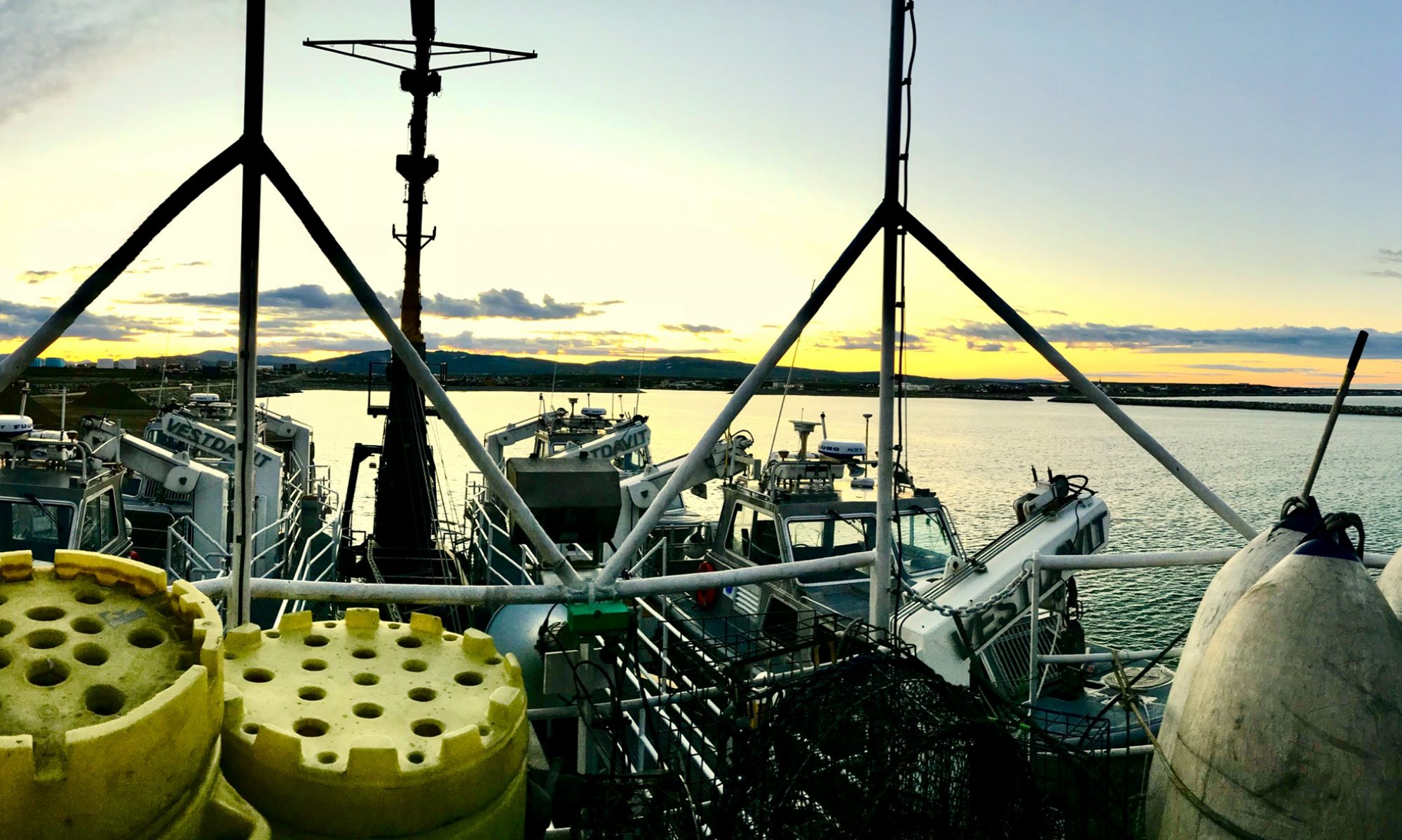
Mission: Alaska Walleye Pollock Survey
Geographical Area: Gulf of Alaska
Date: July 18, 2013
Julia Harvey. Photo by Wilson Garland
My name is Julia Harvey and I currently teach biology and environmental science at South Eugene High School in Eugene, Oregon. Eugene is at the southern end of the Willamette Valley and just a short drive from the Pacific Ocean. I have taken many trips over the coastal range to Florence and the beautiful Oregon Coast.
Oregon Coast
And while the weather is not always cooperative, the ocean is always gorgeous. This last spring I took a group of students on a short marine discovery cruise out of Newport, where NOAA (National Oceanic and Atmospheric Administration) has based their Marine Operations Center for the Pacific.
Marine Operations Center for the Pacific located in Newport, Oregon photo courtesy of noaa
It was my dream since 2nd grade to become a marine biologist. Mrs. Hellwege inspired me to learn more about the ocean as we studied marine mammals. My career path remained unchanged as I attended Occidental College and spent time on the college’s boat the Vantuna. I put my academic education on hold after graduating to serve in the Peace Corps. My passion for the sea continued while I was stationed in the South Pacific on an island in the Kingdom of Tonga. But as I became a teacher, I realized the perfect career would combine my love for biology and my new love of teaching. 22 years later, I now have to opportunity to revisit my childhood dream.
I learned about the NOAA Teacher at Sea program as I was taking an Oceanic Studies course. I decided to apply last October because I wished to connect my students directly with current research that is impacting our ocean environment. I also wanted to learn first hand how oceanic data was being collected since I have been out of the lab setting for quite some time. I was ecstatic when I learned in February that I was selected to sail. I am truly honored and appreciate the opportunity to involve my students in oceanic research and to present to them potential oceanic careers.
The ship Oscar Dyson photo courtesy of noaa
I will be sailing in the Gulf of Alaska aboard the Oscar Dyson and participating in a Walleye pollock fish population survey. Walleye pollock is the largest fisheries in the United States and one of the largest in the world. These fish become fish sticks, fish sandwiches and imitation crab. I am looking forward to learning more about the science involved in assessing a fish population. What makes fisheries healthy and sustainable?
My bags are packed with clothes, cameras, workouts, books and lots of enthusiasm. I am excited beyond description. I will be blogging several times a week and I hope you will continue to follow my journey at sea.
Location Data
Latitude: N 26° 03.476′
Longitude: W 080° 20.920′
Weather Data from home
Wind Speed: 7.8 knots (9 mph)
Wind Direction: East
Wave Height: 2 ft
Surface Water Temperature: 28.9°C (84°F)
Air Temperature: 30°C (86 °F)
Barometric Pressure: 1016 millibars ( 1 atm)
Science and Technology Log:
Below are the numbers that Johanna (my fellow Teacher at Sea) put together at the end of our mission.
We completed 44 hauls in our leg of the survey and caught approximately 118,474 pollock. All of those pollock weighed a collective 24,979.92 kg (= 25 tons)! Last year’s official total allowable catch (called a quota) for all commercial fishermen in Alaska was 1.17 million tons!
So, we only caught 25 tons/ 1,170,000 tons = 0.00002 = 0.002% of the yearly catch in our study.
The estimated population of pollock in the Bering Sea is 10 million tons (10,000,000 T). This means we caught only 0.00025% of the entire pollock population!
So, as you can see, in the big picture, our sampling for scientific analysis is quite TINY!
Continuing with more cool pollock data…
We identified 7,276 males and 7,145 females (and 2,219 were left unsexed)
We measured 16,640 pollock lengths on the Ichthystick!
Pollock lengths ranged from 9cm to 74cm
We measured 260 lengths of non-pollock species (mostly jellyfish, pacific herring, and pacific cod)
We collected 1,029 otoliths for analysis
Personal Log:
After two full days of travel including a long red-eye flight across country, I am back in Ft Lauderdale, Florida. I had the most incredible experience as a NOAA Teacher at Sea on the Oscar Dyson! The trip was absolutely amazing! Here are some parting shots taken on my last day in Dutch Harbor, Alaska.
The scientists onboard the Oscar Dyson on this leg of the Alaska Walleye Pollock Acoustic Trawl Survey. From left to right we see fellow Teacher at Sea Johanna, chief scientist Taina, scientists Rick and Kresimir, myself, then scientist Darin.The bottom-trawl net all wrapped up and ready to off-load. Note the label says “used and abused.” This is to remind workers in the net yard to check and mend the net. It reminds me that we worked hard and worked the equipment harder. Sign me up again for another NOAA Teacher at Sea experience!!!
In closing, I would like to thank a few people. The NOAA Corps officers and deck crew are wonderful and do a great job running a tight ship. I would like to thank them all for keeping me safe, warm, dry, and well fed while out at sea. They all made me feel right at home.
The NOAA scientists Taina, Kresimir, Rick and Darin did a fabulous job patiently explaining the science occurring onboard and I appreciate them letting me become a part of the team! I loved immersing myself back in the practice of real scientific inquiry and research!
I would like to thank the NOAA Teacher at Sea program for allowing me to take part in this incredible research experience for teachers! Teachers and students in my district are very excited to hear about my experiences and I look forward to continuing to share with them about NOAA Teacher at Sea! Sign me up, and I’d be happy to “set sail” with NOAA again.
Finally, I would like to thank my readers. I truly enjoyed sharing my experiences with you and hope that, through my blog, you were able to experience a bit of the Bering Sea with me.
Location Data
Latitude: 53°54’41” N
Longitude: 166°30’61” E
Ship speed: 0 knots (0 mph) In Captains Bay at Dutch Harbor during calibration.
Weather Data from the Bridge
Wind Speed: 17 knots (19.5 mph)
Wind Direction: 184°
Wave Height: 1-2 ft
Surface Water Temperature: 10.2°C (50.4°F)
Air Temperature: 12.5°C (54.5°F)
Barometric Pressure: 1005.9 millibars (0.99 atm)
Science and Technology Log:
Imagine a time when fish surveys could be done through remote sensing, thus eliminating the need to catch fish via trawling to verify fish school composition, length, weight, and age data. During our “Leg 3” of the Alaska Pollock Acoustic Midwater Trawl Survey, we caught, sorted, sexed, and measured 25 tons of pollock! While this amounts to only 0.002% of the entire pollock quota and 0.00025% of the pollock population, wouldn’t it be nice if we could determine the pollock population without killing as many fish?
Cam-Trawl sitting on deck after several successful trawls.
Introducing the “Cam-Trawl,” a camera-in-net technology that NOAA scientists Kresimir and Rick are developing to eventually reduce, if not eliminate, the need to collect biological specimens to verify acoustic data. Cam-Trawl consists of a pair of calibrated cameras slightly offset so the result is a stereo-camera.
The importance of setting up a stereo-camera is so you can use the slightly different pictures taken at the same time from each camera to calculate length of the fish in the pictures. Eventually, a computer system might use complex algorithms to count and measure length of the fish that pass by the camera. If the kinks are worked out, the trawl net would be deployed with the codend open, allowing fish to enter the net and flow past the camera to have their picture taken before swimming out of the open end of the net. Some trawls would still require keeping the codend closed to determine gender ratios and weights for extrapolation calculations; however, the use of Cam-Trawl would significantly reduce the amount of pollock that see the fish lab of the Oscar Dyson. On this leg of the survey, the NOAA scientists installed the Cam-Trawl in a couple of different locations along the trawl net to determine where it might work best.
Installing Cam-Trawl into the side of the AWT trawl net so the NOAA scientists may capture image data during trawls.
Below are some photos taken by Cam-Trawl of fish inside the AWT trawl net. Remember, there are two cameras installed as a stereo-camera that create two images that are taken at slightly different angles. In the photos below, I only picked one of the two images to show. In the video that follows, you can see how scientists use BOTH photos to calculate the lengths of the fish captured on camera.
Pollock (Theregra chalcogramma) as seen by Cam-Trawl.A Sea Nettle (Chrysaora melanaster) jellyfish at top right, Chum Salmon (Oncorhynchus keta ) at bottom right, and Pacific Herring (Clupea harengus) on the left as seen by Cam-Trawl installed in the AWT trawl net.
Another NOAA innovation using stereo cameras is called “Trigger-Cam.” Trigger-Cam is installed into a crab pot to allow it to sit on the ocean floor. For this type of camera deployment, the NOAA scientists removed the crab pot net so they would not catch anything except pictures.
Trigger-Cam back on the deck of the Oscar Dyson after a successful test run.
The real innovation in the Trigger-Cam is the ability to only take pictures when fish are present. Deep-water fish, in general, do not see red light. The Trigger-Cam leverages this by using a red LED to check for the presence of fish. If the fish come close enough, white LEDs are used as the flash to capture the image by the cameras.
Skilled Fisherman Jim lowering down the “heart” of Trigger-Cam for a trial run. On this dip, Trigger-Cam went down to 100 meters. Several of these tests were done before installing Trigger-Cam into a crab pot.
The beauty of this system is that it uses existing fishing gear that crab fishermen are familiar with, so it will be easily deployable. Another stroke of brilliance is that the entire device will cost less than $3,000. This includes the two cameras, lights, onboard computer, nickel-metal hydride batteries, and a pressure housing capable of withstanding pressures of up to 50 atmospheres (500 meters) as tested on the Oscar Dyson! Here is a short animated PowerPoint that explains how Trigger-Cam works. Enjoy!
Here are a couple of picture captured by the Trigger-Cam during trials!
Two pictures taken from Trigger-Cam during testing.
While these pictures were captured during tests in Dutch Harbor, they do provide proof-of-concept in this design. With a cheap, easily deployable and retrievable stereo-camera system that utilized fishing gear familiar to most deck hands, Trigger-Cams might contribute to NOAA’s future technology to passively survey fish populations.
NOAA scientists Kresimir Williams (in center), Rick Towler (on right), and me, after assembling and testing another stereo-camera system for a NOAA scientist working on the next cruise. Kresimir and Rick designed and built Trigger-Cam!
Personal Log:
A little fun at sea! We needed to do one last CTD (Conductivity, Temperature, Depth), and decided to lower the CTD over deep water down to 500 meters (1,640.42 ft)! Pressures increases 1 atmosphere for every 10 meters in depth. At 500 meters, the pressure is at 50 atmospheres!!! We wondered what would happen if… we took styrofoam cups down to that depth. We all decorated our cups and put them in a net mesh bag before they took the plunge. Here is a picture showing what 50 atmospheres of pressure will do to a styrofoam cup!
Three styrofoam cups that went 500 meters deep in the Bering Sea! These cups were originally the size of the undecorated white styrofoam cup in the background.
We missed the Summer Olympics while out on the Bering Sea. T-T We did get in the Olympic spirit and had a race or two. Here is a little video in the spirit of the Olympics…
All for now… We are back in Captains Bay, Dutch Harbor, but are calibrating the hydroacoustic equipment at anchor. Calibration involves suspending a solid copper sphere below the ship while the NOAA scientists check and fine-tune the different transducers. This process will take about 7 hours! We have been out at sea for 3 weeks, are currently surrounded by land, but must wait patiently to finish this last and very important scientific task. If the calibration is off, it could skew the data and result in an inaccurate population estimation and quotas that may not be sustainable! This Landlubber can’t wait to have his feet back on terra firma. The thought of swimming crossed my mind, but I think I’ll wait. Then we will see if I get Land Sickness from being out at sea for so long…
Location Data
Latitude: 60°25’90” N
Longitude: 177°28’76” W
Ship speed: 3 knots (3.45 mph)
Weather Data from the Bridge
Wind Speed: 5 knots (5.75 mph)
Wind Direction: 45°
Wave Height: 2-4 ft with a 2 ft swell
Surface Water Temperature: 8.6°C (47.5 °F)
Air Temperature: 8°C (46.4 °F)
Barometric Pressure: 1019 millibars (1 atm)
Science and Technology Log:
In my last blog, we learned about how the scientists onboard the Oscar Dyson use some very sophisticated echo-location SONAR equipment to survey the Walleye pollock population.
Can the Walleye pollock hear the “pings” from the SONAR?
No. Unlike in the movies like “The Hunt for Red October” where submarines are using sound within the human audible range to “ping” their targets, the SONAR onboard the Oscar Dyson operates at frequencies higher than both the human and fish range of hearing. The frequency used for most data collection is 38 kHz. Human hearing ranges from 20 Hz to 20 kHz. Walleye pollock can hear up to 900 Hz. So, the pollock cannot hear the SONAR used to locate them…
Can the Walleye pollock hear the ship coming?
Normally, YES! Fish easily hear the low frequency noises emitted from ships.
A comparison of hearing ranges for various organisms showing the anthropogenic source noise overlap (courtesy of oceannavigator.com).
If you are operating a research vessel trying to get an accurate estimate on how many fish are in a population, and those fish are avoiding you because they hear you coming, you will end up with artificially low populations estimates! The International Council for the Exploration of the Seas (ICES) established noise limits for research vessels that must be met in order to monitor fish populations without affecting their behavior. Fish normally react to a threat by diving, and that reduces their reflectivity or target strength, which reduces the total amount of backscatter and results in lower population estimates (see my last blog).
A comparison of two ships and fish reaction to the noise produced by each. The Oscar Dyson has a diesel electric propulsion system as one of its noise reduction strategies. Notice the smaller noise signature (in blue) and fewer fish avoiding (diving) when the ship approaches (www.uib.no).
That is why NOAA has invested in noise-reducing technology for their fish survey fleet. The Oscar Dyson was the first of five ships build with noise-reducing technology. These high-tech ships have numerous strategies for reducing noise in the range that fish might hear.
There are two main sources of engine noise onboard a ship: machinery noise and propeller noise.
The two main sources of ship noise. (www.nmfs.noaa.gov/pr/pdfs/acoustics/session2_fischer.pdf)
The best acoustic ship designs are going to address the following:
1) Address hydrodynamics with unique hull and propeller design.
2) Use inherently quiet equipment and choose rotating rather than reciprocating equipment.
3) Use dynamically stiff foundations for all equipment (vibration isolation).
4) Place noisier equipment toward the centerline of the ship.
5) Use double-hulls or place tanks (ballast and fuel tanks) outboard of the engine room to help isolate engine noise.
6) Use diesel electric motors (diesel motors operate as generators while electric motors run the driveshaft.
Propeller Design:
The U.S. Navy designed the Oscar Dyson’s hull and propeller for noise quieting. This propeller is designed to eliminate cavitation at or above the 11 knot survey speed. Not only does cavitation create noise, it can damage the propeller blades.
Photo of cavitation caused by a propeller. These air bubbles that form along the edge of the blades can cause damage to the propeller and cause excess noise. (www.thehulltruth.com/boating-forum/173520-prop-cavitation-burn-marks.html)
Hull Design:
The Oscar Dyson’s hull has three distinguishing characteristics which increase its hydrodynamics and reduce noise by eliminating bubble sweep-down along the hull. The Oscar Dyson has no bulbous bow, has a raked keel line that descends bow to stern, and has streamlined hydrodynamic flow to the propeller.
To reduce a ship’s noise in the water, it is absolutely crucial to control vibration. The Oscar Dyson has four Caterpillar diesel gensets installed on double-stage vibration isolation systems. In fact, any reciprocating equipment onboard the Oscar Dyson is installed on a double-stage vibration isolation system using elastomeric marine-grade mounts.
A picture of one of the Caterpillar diesel generators before installation in the Oscar Dyson. Notice the double vibration isolation sleds to reduce noise (www.nmfs.noaa.gov/pr/pdfs/acoustics/session2_fischer.pdf).
Since the diesel engines are mounted on vibration isolation stages, it is necessary to also incorporate flexible couplings for all pipes and hoses connecting to these engines.
A look at one of the four diesel generators onboard the Oscar Dyson. Notice the black flexible hose couplings in place to allow vibration isolation in the white pipes.
Any equipment with rotating parts is isolated with a single-stage vibration system. This includes equipment like the HVAC, the electric generators for the hydraulic pumps, and the fuel centrifuges that remove any water and/or particles from the fuel before the fuel is pumped to the diesel generators.
A close-up of the single sled vibration isolation system supporting the hydraulic pumps that run the deck winches.
Low Noise Equipment:
The only equipment that does not use vibration isolation stages are the two Italian-made ASIRobicon electric motors that are mounted in line with the prop shaft. Both are hard-mounted directly to the ship because they are inherently low-noise motors. This is one of the benefits of using a diesel-electric hybrid system. The diesel motors can be isolated in the center of the ship, near the centerline and away from the stern. The electric motors can be located wherever they are needed since they are low noise.
Even the propeller shaft bearings are special water-lubricated bearings chosen because they have a low coefficient of friction and superior hydrodynamic performance at lower shaft speeds resulting in very quiet operation. They use water as a lubricant instead of oil so there is a zero risk of any oil pollution from the stern tube.
Acoustic Insulation and Damping Tiles:
The Oscar Dyson uses an acoustic insulation on the perimeter of the engine room and other noisy spaces. This insulation has a base material of either fiberglass or mineral wool. The middle layer is made of a high transmission loss material of limp mass such as leaded vinyl.
The Oscar Dyson also has 16 tons of damping tiles applied to the hull and bulkheads to reduce noise.
The Results:
All of these noise-reducing efforts results in a fully ICES compliant research vessel able to survey fish and marine mammal populations with minimal disturbance. This will help set new baselines for population estimates nationally and internationally.
As you can see from the graph above, The Oscar Dyson is much quieter than the Miller Freeman, the ship that it is replacing. You can see the differences in the hull design from the picture below.
The quieter Oscar Dyson (on right) replaced the noisy Miller Freeman (on left) http://www.afsc.noaa.gov.
Next blog, I will write about new, cutting edge technology that might reduce the need for biological trawling to verify species.
Sources:
Special thanks to Chief Marine Engineer Brent Jones for the tour of the engineering deck and engine room, and for the conversations explaining some of the technology that keeps the Oscar Dyson going.
I found out drills aboard ships are serious business! Unlike a fire drill at school where students meander across the street and wait for an “all clear” bell to send them meandering back to class, fire drills on a ship are carefully executed scenarios where all crew members perform very specific tasks. When out at sea, you cannot call the fire department to rescue you and put out a fire. The crew must be self-reliant and trained to address any emergency that arises. When we had a fire drill, I received permission from Commanding Officer Boland to leave my post (after I checked in) and watch as the crew moved through the ship to locate and isolate the fire. They even used a canister of simulated smoke to reduce visibility in the halls similar to what would be experienced in a real fire!
Robert and Libby suit up during a fire drill!
Late last night, we finished running our transects! Our last trawl on transect was a bottom trawl which brought up some crazy creatures! Here are a couple of photos of some of the critters we found.
From left to right, Blue King Crab (Paralithodes platypus), Alaska Plaice (Pleuronectes quadrituberculatus), Red Irish Lord eating herring on the sorting table (Hemilepidotus hemilepidotus), and Skate (unidentified).
Next blog will probably be my last from Alaska. T-T
Location Data
Latitude: 60°55’68” N
Longitude: 179°34’49” E
Ship speed: 11 knots (12.7 mph)
Weather Data from the Bridge
Wind Speed: 10 knots (11.5 mph)
Wind Direction: 300°
Wave Height: 2-4 ft with a 4-6 ft swell
Surface Water Temperature: 8.7°C (47.6°F)
Air Temperature: 8°C (46.4°F)
Barometric Pressure: 1013 millibars (1 atm)
Science and Technology Log
Previously, we learned how the biological trawl data onboard the NOAA Research Vessel Oscar Dyson are collected and analyzed to help calculate biomass of the entire Bering Sea Walleye pollock population. Last blog, I mentioned that the scientific method for estimating the total pollock biomass is not complete without acoustics data, more specifically hydroacoustics! In fact, hydroacoustic data are the real key to estimating how many pollock are in the Bering Sea! That is why our mission is called the Alaskan Pollock Midwater ACOUSTIC-trawl Survey.
Screenshot showing our transects on leg 3 of the pollock midwater acoustic survey. Fish icons indicate where we validated acoustic data with biological sampling. Hydroacoustic data were collected continuously along north/south transects.
The Oscar Dyson is using hydroacoustics to collect data on the schools of fish in the water below us, but we do not know the composition of those schools. Hydroacoustics give us a proxy for the quantity of fish, but we need a closer look. The trawl data provide a sample from each aggregation of schools and allow the NOAA scientists that closer look. The trawl data explain the composition of each school by age, gender and species distribution. Basically, the trawl data verifies and validates the hydroacoustic data. The hydroacoustics data collected over the entire Bering Sea in systematic transects combined with the validating biological data from the numerous individual trawls give scientists a very good estimate for the entire Walleye pollock population in the Bering Sea.
So what is hydroacoustics and how does it work???
Hydroacoustics (“hydro” = water, “acoustics” = sound) is the field of study that deals with underwater sound. Remember, sound is a form of energy that travels in pressure waves. Sound travels roughly 4.3 times faster in water than in air (depending on temperature and salinity of the water). Here is a link with an interactive animation comparing the speed of sound in water, air, and steel! This change in speed will become very important later… keep reading!
Lower sound frequencies travel farther. This is how humpback whales can communicate over great distances with their whale songs! Click on whale songs to hear one!
Whales are not the only aquatic organisms to use sound! Much like dolphins use sound to echo-locate, people use technology to “see” under water using sound energy. We call this technology SONAR (Sound Navigation And Ranging).
An animation of dolphin echo-location (courtesy of Discovery of Sound in the Sea).
On a typical recreational watercraft, this technology can be found in the form of a “fish-finder.”
Recreational “fish-finders” can be found on many personal watercraft (courtesy of Discovery of Sound in the Sea).
In commercial fishing, this technology is used in much the same way, just on a larger scale. Here is an animation showing a commercial trawler using SONAR to locate fish.
Commercial fishing boat using hydroacoustics to locate fish. This animation illustrates how a fish shows up as an arch on the onboard display (courtesy of Discovery of Sound in the Sea).
The Oscar Dyson has a much more powerful, extremely sensitive, carefully calibrated, scientific version of what many people have on their bass boats. These are mounted on the pod, which is on the bottom of the centerboard, the lowest part of the ship. The Oscar Dyson has an entire suite of SONAR instrumentation including the five SIMRAD EK60 transducers located on the bottom of the centerboard that operate at different Khertz, the SIMRAD ME70 multibeam transducer located on the hull, and a pair of SIMRAD ITI transducers on the trailing edge of the centerboard (one pointed toward the starboard side, the other toward port).
Illustration of the Oscar Dyson showing the hydroacoustic transducers located on the centerboard and the hull of the ship.
This “fish-finder” technology works by emitting a sound wave at a particular frequency and waiting for the sound wave to bounce back (the echo) at the same frequency. The time between sending and receiving the sound wave determines how far away an object is, whether it be the bottom or fish. When the sound waves return from a school of fish, the strength of the returning echo helps determine the fish density (how many fish are there).
An echogram taken from the Oscar Dyson. Shades of yellow and red show extremely large, dense schools of fish. The solid red at the bottom of the picture is the bottom of the sea which is at 94.12 meters at this location.
Another piece of the puzzle… how reflective an individual fish is to sound waves. This is called target strength. Each fish reflects sound energy sent from the transducers, but why? For fish, we rely on the swim bladder, the organ that fish use to stay buoyant in the water column. Since it is filled with air, it reflects sound very well. When the sound energy goes from one medium to another, there is a stronger reflection of that sound energy. The bigger the fish, the bigger the swim bladder; the bigger the swim bladder, the more sound is reflected and received by the transducer. We call this backscatter, or target strength, and use it to estimate the size of the fish we are detecting. This is why fish that have air-filled swim bladders show up nicely on hydroacoustic data while fish that lack swim bladders (like sharks), or that have oil or wax filled swim bladders (like Orange Roughy) have weak signals.
X-ray of fish showing the presence of a swim bladder (courtesy of DeAnza College).
Target strength is how we determine how dense the fish are in a particular school. Scientists take the backscatter that we measure from the transducers and divide that by the target strength for an individual and that gives you the number of individuals that must be there to produce that amount of backscatter. 100 fish produce 100x more echo than a single fish. We extrapolate this information to all the area of the Bering Sea to estimate the pollock population.
A close look at part of Transect 27. In this echogram, the area backscatter numerical values are included. At the top of the water column, you can see what are probably jellyfish which have little backscatter since they have no swim bladders. Along the bottom are groundfish. In the center of the water column are several large schools of Walleye pollock with strong backscatter. The square that has a value of 2403.54 shows several large schools!
So the goal is to measure the hydroacoustic density along each transect and extrapolate that data to represent the entire survey area between transects (the area not sampled because the Oscar Dyson can’t cover every square meter of the Bering Sea). When you combine the hydroacoustic data for all of the 30 transects (a total of ~5,000 nautical miles in an area of 100,000 square nautical miles) and the lengths collected in the biological trawl data, you can convert the length data into target strength data to create a distribution of target strengths and find the average target strength for the population. In doing so, you get a complete picture of the Walleye pollock population in the Bering Sea.
The BIG picture. This is the combination of hydroacoustic data and biological trawl data analyzed to show what the entire walleye pollock population looked like for 2009 (courtesy of the Alaska Fisheries Science Center www.afsc.noaa.gov/Publications/ProcRpt/PR2010-03.pdf). Analysis is still being done on the current survey. This year’s results will be out in a report this fall. Expect some changes!
But there’s more!!! Scientists ALSO use hydroacoustic data when trawling to determine if they have caught a large enough sample size to collect fish length data to validate their target strength data. If you recall reading my first blog from sea that taught about the parts of the net, I wrote about and had a drawing of the “kite” on which the “turtle” was attached. The “turtle” is a SIMRAD FS70 trawl SONAR. It has a downward facing transponder that shows a digital “picture” of the size of the net opening. You can also see individual fish and/or schools of fish enter the net by watching this display. Since the scientists only need about 300 fish for a statistically significant sample, they watch this screen carefully so that they do not take more fish than they need. When the lead scientist thinks there are enough fish in the net, she gives the request to the Officer on Deck to “haul back.” Unlike commercial trawlers, a typical trawl on the Oscar Dyson only lasts 25 minutes. Sometimes, we are only officially fishing for 5 minutes if we pull through a large school.
What are the data telling us?
The Walleye pollock data suggest that the population is currently stable; however, there is some evidence of pollock in waters that have traditionally been north of their uppermost documented population range. Are warmer waters due to climate change to blame for this possible shift? Here is an interesting article that addresses this issue and raises several other trends regarding pollock population response to changes in food source and predation due to climate change. Click on the picture to open the article!
How might climate change affect fish sticks? Click on the picture to read more!
The economic and ecological implications of a shifting pollock population range are a bit unsettling. Fish do not know political boundaries. As the pollock population range possibly shifts north, more of that range will lie within Russian waters than in previous years. This may hurt the U.S. commercial fishing industry as they settle for less of a resource that was once abundant. Since quotas are set based on last year’s numbers, there is a time lag which may result in overfishing in U.S. waters that might lead to a collapse in the Alaskan Walleye pollock fishing industry. The U.S. has invested a tremendous amount of research into maintaining a sustainable pollock fishery. Other countries may be responding to a variety of factors in which sustainability is just one when they are managing pollock stocks and setting catch quotas. Since pollock is a trans-boundary stock, this could lead to greater uncertainty in management of the entire population if pollock increasingly colonize more northern Bering Sea waters as influenced by climate change.
Food for thought…
Next blog, we will learn about cutting edge technology that may eventually make hauling back fish and collecting biological fish data on board the acoustic survey missions obsolete.
Personal Log
It’s tomorrow, TODAY! This morning at 6am Alaska Time, we crossed the International Date Line (IDL). The IDL is at 180° longitude. General Vessel Assistant Brian Kibler and I went out to the bow of the ship so we would be the first onboard to cross the line!
Map of the Bering Sea showing both the International Date Line and the 180th longitude. Our closest point to Russia was 12 nautical miles from Cape Navarin which is very close to 180 longitude.
Over the next two days, our transects take us back and forth over the IDL 3 more times. Fortunately, onboard our Oscar Dyson time warp machine we simply observe the Alaska Time Zone (the time zone from our port of call). With everyone onboard operating different shifts, and with 24/7 operations, it would be quite confusing if we kept changing our clocks to observe the local time zone.
The Order of the Golden Dragon!
Mariners who cross the IDL when at sea are inducted into the “Order of the Golden Dragon” and receive a certificate with the details of this momentous crossing. There are several other notorious crossing that receive special recognition. They are:
▪ The Order of the Blue Nose for sailors who have crossed the Arctic Circle.
▪ The Order of the Red Nose for sailors who have crossed the Antarctic Circle.
▪ The Order of the Ditch for sailors who have passed through the Panama Canal.
▪ The Order of the Rock for sailors who have transited the Strait of Gibraltar.
▪ The Safari to Suez for sailors who have passed through the Suez Canal.
▪ The Order of the Shellback for sailors who have crossed the Equator.
▪ The Golden Shellback for sailors who have crossed the point where the Equator crosses the International Date Line.
▪ The Emerald Shellback or Royal Diamond Shellback for sailors who cross at 0 degrees off the coast of West Africa (where the Equator crosses the Prime Meridian)
▪ The Realm of the Czars for sailors who crossed into the Black Sea.
▪ The Order of Magellan for sailors who circumnavigated the earth.
▪ The Order of the Lakes for sailors who have sailed on all five Great Lakes.