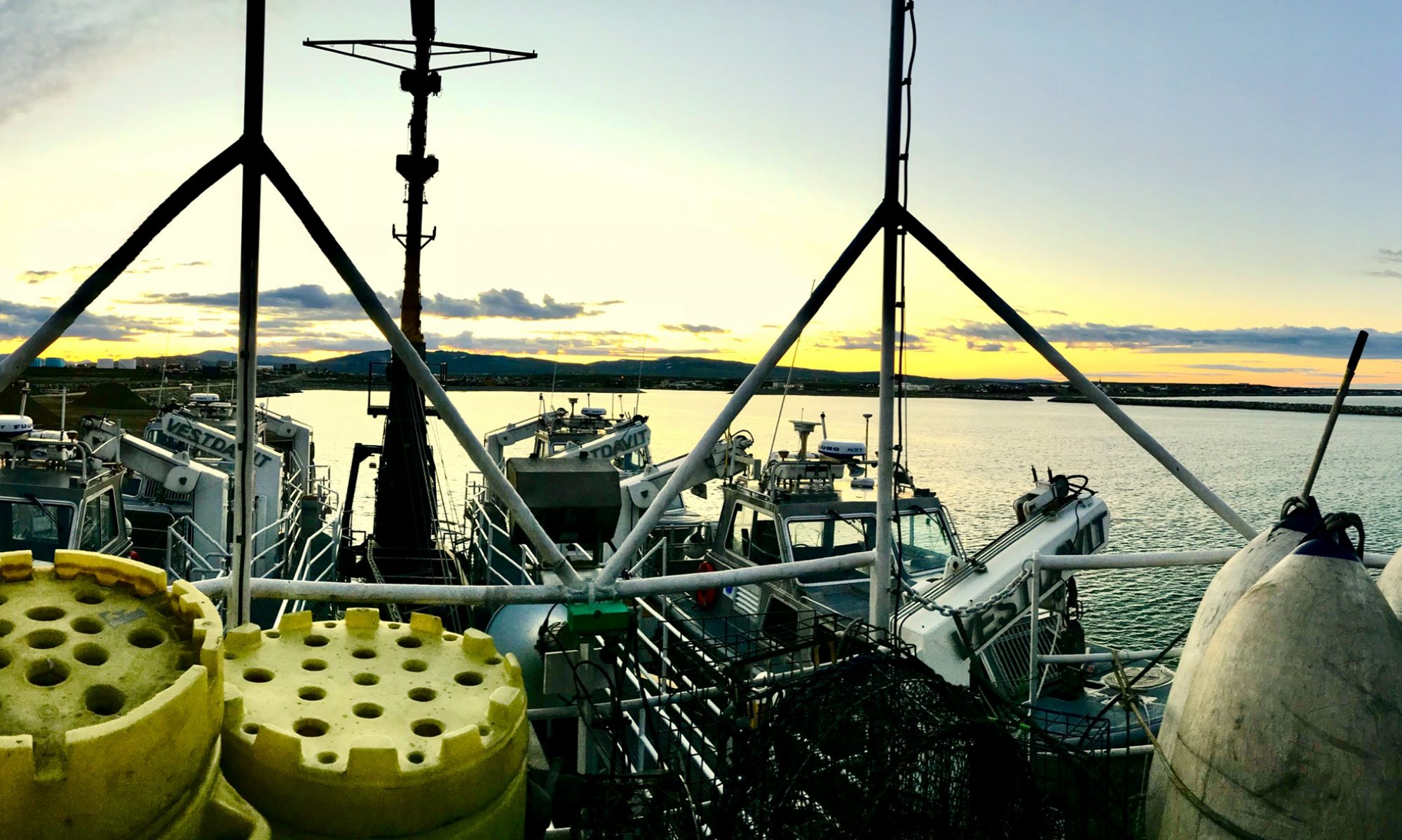
Katie Turner, July 25, 2008

NOAA Teacher at Sea
Katie Turner
Onboard NOAA Ship Miller Freeman
July 10 – 31, 2008

Mission: Pollock Survey
Geographical Area: Eastern Bering Sea
Date: July 25, 2008

Bald eagles are abundant around the port in Dutch Harbor

Weather Data from the Bridge 
Visibility: 10 nautical miles
Wind Direction: 075
Wind Speed: 13 knots
Sea Wave Height: 1-2 feet
Swell Wave Height: 3 feet
Seawater Temperature: 7.1˚C.
Present Weather Conditions: Cloudy, 9.3˚C, 94% humidity

Science and Technology Log 

After spending 3 weeks at the dock in Dutch Harbor, MILLER FREEMAN finally began the cruise with less than a week left to complete the study. We pulled away from the dock Thursday afternoon, 24 July, and sailed to nearby Captain’s Bay to calibrate the acoustic instruments.

A line diagram of MILLER FREEMAN showing the location of the centerboard below the hull

Background 

Acoustics is the scientific study of sound: its generation, transmission, and reception.  Sound travels in waves at known rates, and the physical properties of the material the waves travel through affect the speed of sound.  These properties of sound waves enable their use in medical diagnosis, testing critical materials, finding oil-bearing rocks underground, and counting fish in the ocean. Sound travels through seawater of average salinity about 5 times faster than through air (~1,500 m/s, or about 15 football fields in one second).  Many animals that live in the ocean rely on sound more than vision for communication and survival. You are probably already familiar with echolocation and communication vocalizations in whales and porpoises.

Picture of the transducers in the centerboard, which is lowered when the ship is at sea. Lowering the transducer away from the hull reduces the noise interference of bubbles running along the hull while underway.
Picture of the transducers in the centerboard, which is lowered when the ship is at sea. Lowering the transducer away from the hull reduces the noise interference of bubbles running along the hull while underway.

The speed of sound in water increases as temperature and salinity increase.  It also increases with depth due to the increase in pressure.  Therefore, in order to know the speed of sound at a given location in the sea, you need to know the temperature, salinity, and depth. There are other factors that are important to consider as well.  As sound travels through seawater it loses energy because of spreading, scattering and absorption.  When sound waves strike bubbles, particles suspended in the water column, organisms, the seafloor, and even the surface, some of the energy bounces off or is scattered. When the sound energy is scattered at angles greater than 90 degrees it is referred to as backscatter.

Fish Assessment 

Scientists use acoustics to measure fish abundance in the ocean by emitting sound waves at specific frequencies and then measuring the amount of backscatter.  Different organisms and other objects will have a characteristic backscatter that is dependent on many biological factors as well as the physical properties of the medium. The most important biological factor is presence and the size of a swim bladder, but also the organism’s size, shape and orientation.  If scientists know the backscatter signature of the target species (which can be determined experimentally or by mathematical models), they can use sound to identify and measure certain fish populations in the ocean. Onboard the ship, sound waves are emitted from an instrument called a transducer, which is located in the centerboard of the ship. The transducer generates sounds directly beneath the ship into the water column below (pings).  When these sound waves are backscattered from the fish below back to the transducer, they are converted to an electrical signal that is sent to the scientist’s computer.  There, a profile can be created that represents the fish in a graphical image.

Chief Scientist, Patrick Ressler, attaches calibration spheres to the line that will be lowered beneath the ship.
Chief Scientist, Patrick Ressler, attaches calibration spheres to the line that will be lowered beneath the ship.

Before making any actual measurements during this study, it is necessary to calibrate the acoustic instruments on board the ship. Calibrations of instruments and other measuring devices are done by using a known standard to compare the output of the instrument. So for example, if I wanted to calibrate a stick as a measuring device, first I would compare its length to a known standard such as a ruler. We anchored in Captain’s bay, on both bow and stern to keep the ship from moving much, and spheres with known acoustic properties were suspended beneath the ship at a known distance below the transducers. Acoustic data were then collected on backscatter from the spheres. Knowing the distance to the spheres, their acoustic qualities (how they will backscatter the sound), and the physical qualities of the medium (seawater temperature and salinity) allowed the scientists to standardize their equipment.   While acoustic calibrations were performed by the scientists, the survey technicians collected seawater temperature and salinity. The way these properties are measured is standard practice on research vessels.  An instrument package called a “CTD” measures conductivity (which is converted to salinity), temperature, and depth.  Sensors for each of these make up the package, and are mounted on a metal frame called a rosette. The rosette is lowered into the water column by a crane, and the data collected is transmitted via a cable to a computer on board. Once the calibration and CTD measurements were completed, we pulled anchor and headed northwest into the Bering Sea to meet up with NOAA Ship OSCAR DYSON.  We expect to reach our rendezvous point by late Friday to begin our study.

Survey Technician Tayler Wilkins monitors the CTD data transmission while communicating with the crane operator as the rosette is lowered through the water column. The computer automatically produces a profile of temperature and salinity with depth.
Survey Technician Tayler Wilkins monitors the CTD data transmission while communicating with the crane operator as the rosette is lowered through the water column. The computer automatically produces a profile of temperature and salinity with depth.

Personal Log 

The long stay in Dutch Harbor made the departure that much more exciting.  I am looking forward to what little time is left.  The crew of MILLER FREEMAN have all made me feel welcome, and have been helpful in answering my questions and educating me on shipboard operations.

New Terms 

acoustics, calibration, backscatter, centerboard, transducer, CTD rosette

Learn more here 

Katie Turner, July 18, 2008

NOAA Teacher at Sea
Katie Turner
Onboard NOAA Ship Miller Freeman
July 10 – 31, 2008

Mission: Pollock Survey
Geographical Area: Eastern Bering Sea
Date: July 18, 2008

The ship
The ship

Science and Technology Log 

Where is the Bering Sea?

The Vessel 

NOAA Ship MILLER FREEMAN is a 215 foot fishery and oceanographic research vessel, and one of the largest research trawlers in the United States.  She carries up to 34 officers and crew members and 11 scientists.  The ship is designed to work in extreme environmental conditions, and is considered the hardest working ship in the fleet.

She was launched in 1967 and her home port is Seattle, Washington. MILLER FREEMAN has traditionally been used to survey walleye pollock (Theragra chalcogramma) in the Bering Sea.  These surveys are used to determine catch limits for commercial fisherman.  In 2003 NOAA acquired a new fisheries research vessel, the NOAA Ship OSCAR DYSON. OSCAR DYSON is to eventually take over MILLER FREEMAN’s research in Alaskan working grounds, allowing MILLER FREEMAN to shift her focus to the west coast. OSCAR DYSON was built under a new set of standards set by the International Council for the Exploration of the Sea (ICES), which reduces the amount of noise generated into the water below, while MILLER FREEMAN is a more conventionally-built vessel which does not meet the ICES standards.  The assumption is that marine organisms, including pollock, may avoid large ships because of the noise they make, thus altering population estimates.  It is therefore important for scientists to know the difference between population estimates of the two ships. This is done through vessel comparison experiments, in which the two ships sample fish populations side by side and compare their data.  The primary purpose of this July 2008 cruise is to complete a final comparison study of the two ships and measure the difference in the pollock population data they collect.  

Image of the eruption of Okmok, taken Sunday, July 13, 2008, by flight attendant Kelly Reeves during Alaska Airlines flights 160 and 161.
Image of the eruption of Okmok, taken Sunday, July 13, 2008,
by flight attendant Kelly Reeves during Alaska Airlines
flights 160 and 161.

The Location 

The Bering Sea covers an area of 2.6 million square kilometers, about the size of the United States west of the Mississippi.  The maximum distance north to south is about 1,500 kilometers (900 miles), and east to west is about 2,000 kilometers (1,500 miles).  The International Date Line splits the sea in two, with one half in today and the other in tomorrow. The area is also bisected by a border separating the Exclusive Economic Zones (EEZ) of Russia and the United States. The EEZ is the area within a 200 mile limit from a nation’s shoreline; where that nation has control over the resources, economic activity, and environmental protection. More than 50% of the U.S. and Russian fish catch comes from the Bering Sea. It is one of the most productive ecosystems in the world.  The broad continental shelf, extensive ice cover during the winter, and the convergence of nutrient-rich currents all contribute to its high productivity. It is a seasonal or year round home to some of the largest populations of marine mammals, fish, birds, and invertebrates found in any of the world’s oceans.  Commercial harvests of seafood include pollock, other groundfish, salmon and crab.  The Bering Sea has provided subsistence resources such as food and clothing to coastal communities for centuries.

Aleutian Island volcaneos

Repairs and Delays 

Anchorage high school teacher, Katie Turner, arrives at the pier in Dutch Harbor, Alaska
Anchorage high school teacher, Katie Turner,
arrives at the pier in Dutch Harbor, Alaska

While all aboard were anxious to begin this Bering Sea Cruise, the ship could not sail until crucial repairs could be made.  During the previous cruise a leak was discovered in the engine cooling system that brought the ship in from that cruise early.  The location of the leak was the big mystery.  After days of testing and a hull inspection by divers the leak was located.  It was in a section of pipe that runs hot water from the engine through the ship’s ballast tanks and into a keel cooler on the outside of the ship’s hull, where it is cooled before circulating back to the engine. This turned out to be a very labor intensive job and workers spent days draining and cleaning the tanks before the leak could be repaired.

In the meantime, a repair to one of the engine’s cylinders required a part that had to be shipped from Seattle via Anchorage (about 800 miles northeast of Dutch Harbor). To complicate the arrival of this part, a nearby volcano erupted, spewing ash 50,000 feet into the path of flights to and from Dutch Harbor.   Alaska has many active volcanoes. The Aleutian Island arc, which forms the southern margin of the Bering sea, comprises one of the most active parts of the Pacific’s “ring of fire”. This tectonically active area has formed due to the subduction of the Pacific plate beneath the North American plate. So far we do not have a definite departure schedule.  Each day spent at the dock is one day less for the scientific team to complete the goals of the cruise.  Meanwhile, OSCAR DYSON is completing its survey in the Bering Sea, and anticipates the arrival of MILLER FREEMAN to complete the comparison study.

NOAA Teacher at Sea, Katie Turner, gets a tour of the bridge and quick navigation lesson from Ensign Otto Brown
NOAA TAS, Katie Turner, gets a tour of the bridge and quick navigation lesson from Ensign Otto Brown

Personal Log 

I arrived in Dutch Harbor on July 9th with a forewarning that repairs to the ship would be necessary before heading out to the Bering Sea, and that I would have some time to explore the area. I have managed to keep busy and take advantage of opportunities to interview the crew, hike, and find my way around town. The weather in Dutch Harbor has been exceptional with many sunny days. It’s uncommon for a NOAA research ship to spend so much time at the dock, and we attracted the attention of a newsperson from the local public radio station. Commanding Officer Mike Hopkins and Chief Scientist Patrick Ressler were interviewed by KIAL newsperson Anne Hillman while MILLER FREEMAN was delayed for repairs in Dutch Harbor. Unalaska Island has few trees and along with other islands on the Aleutian chain is known for its cool and windy weather. There are no large mammals such as bear on the islands but small mammals, such as this marmot, are common along with many species of birds and a wide variety of wildflowers, which are in bloom this time of year.

Chief Scientist Patrick Ressler explains how he uses acoustic equipment to study pollock in the Bering Sea.
Chief Scientist Patrick Ressler explains how he uses acoustic equipment to study pollock in the Bering Sea.
A marmot spotted on a ridge alongside the road up Mt. Ballyhoo on Amaknak Island
A marmot spotted on a ridge alongside the road up Mt. Ballyhoo on Amaknak Island
A Bald Eagle guards the crab pots stored near the pier
The view from Mt. Ballyhoo on Amaknak Island. Lupine, a common plant found on the island, is in bloom in the foreground
The view from Mt. Ballyhoo on Amaknak Island. Lupine, a common plant found on the island, is in bloom in
the foreground
Black Oystercatchers take flight over the harbor

Learn more about the Bering Sea ecosystem at these Web sites: 

http://www.avo.alaska.edu/volcanoes/aleutians.php http://www.worldwildlife.org/what/wherewework/beringsea/index.html http://www.nature.org/wherewework/northamerica/states/alaska/preserves/art19556.html http://www.panda.org/about_wwf/where_we_work/europe/what_we_do/arctic/what_we_do/marine/bering/index.cfm

Terry Welch, June 28, 2008

NOAA Teacher at Sea
Terry Welch
Onboard NOAA Ship Rainier
June 23-July 3, 2008

Mission: Hydrographic Survey
Geographical Area: Pavlov Islands, Gulf of Alaska
Date: June 28, 2008

A self-contained breathing apparatus

Weather Data from the Bridge 
Wind: West/Southwest/10
Precipitation: rainy, drizzle, clearing
Temperature:  High 48
Seas 1-3’

Science and Technology Log 

Yesterday, I was able to go out on a launch and continue with the hydrographic survey around Belkofski Point with Ensign (ENS) Tim Smith as the Hydrographer in charge (HIC), Jodie, our Coxswain, and Fernando, a Hydrographer in training.  They use a lot of acronyms here on the ship that I’m learning.  We worked a long day until about 5:30 p.m. since the weather was nice and seas calm. The weather can change quickly in this area, so the survey team tries to work as much as possible when it’s nice out.

Ship Log 

A 10-minute air supply system

Captain Don Haines and the crew are very safely conscious and we have already practiced several drills and we have a morning safely meeting before going out on the launches. On the first day out, I was issued a hard hat, survival suit (sometimes called a Mustang suite), life vest or PFD (personal floatation device) and float jacket.  When boarding the launches in the morning, we don the float jacket and hard hat. Once the launches are in the water and we have moved safely away from the Rainier ship, we can switch to our life vests (PFD), which are more comfortable to wear on the small boats.

Drills:  We practiced three drills while in route (or transit) to the Pavlof Islands; man-overboard, abandon ship, and fire. There is a different ship bell ring pattern for each event. When theses drills or event occur, all hands (crew) meet (muster) at a pre-assigned location.  The person in charge at our muster locations marks off if we are there. This system of accountability ensures that all personal is accounted for and safe.

The fire drill was interesting to me since I’m a volunteer fire fighter/EMT on Whidbey Island where I live. They use much of the same equipment as we do to fight fire including bunker gear (fire pants/coat/helmet), SCBA’s (self-contained breathing apparatus) and masks.  One of the crew demonstrated how to put on the SCBA and mask. Another safety air supply device is called an OCENCO EEBD. These 10 minute air supply systems are located all over the ship and would give someone enough clean air to exit the ship if an accident occurred.

Engine Room Tour 

Josh gave me a tour of the engine room and explained the basics of how the ships power is produced and maintained.  From a control room, the ship’s engine controls can be monitored by computer.  Every hour, the crew inspects the engine and support components and ensures that everything is running smoothly.  The area was loud, so we wore protective earplugs and it was also very clean considering all the oil that is used in the system. 

Garret in control room, control room gauges, and the main engine
Garret in control room, control room gauges, and the main engine 

Desalination System: Another interesting aspect of the ship is how the process water.  All fresh or potable water is made from salt water in an apparatus called an “Evaporator”.  Salt water is pumped into the evaporator and heated up to about 175 degrees.  Because it’s under pressure, the water boils at this lower temperature instead of the usual 212 degrees. The heat comes from generators that help create the electricity on the ship.  So, the whole system is very efficient.  Large 8000 gallon storage tanks hold the fresh water afterwards.  The evaporator produces about 500-550 gallons of fresh water per hour, so there is always plenty to use and it tastes good. 

Evaporator
Evaporator

Personal Log 

It was very informative for me to get a tour of the engine room today and learn how the ship’s power is produced.  Josh has the job of an “Oilier” and is only 23 years old.  He had an interest in welding and mechanics and has a high school degree.  Garret is the “First Engineer” and also has a high school degree. Both men enjoy working for NOAA and explained that many men and women learn skills on the job.  They stressed that you don’t need a college degree to work for NOAA, but it helps to have an aptitude for the job they are interested in such as working the engines.

Aleutian Islands
Aleutian Islands

Yesterday, several of us were able to scout out an abandoned settlement near to where the Rainier is anchored after dinner.  It is called “Native Village of Belkosfski”. Originally built for the fur trade in the 1860’s, it later became home to native Americans There were several old wooden structures and one larger cement and brick building that was the school.  Judging from the date on one of the food items in a kitchen, this area was inhabited in the early 1980’s last.  It’s amazing to see that many structures were still standing given the harsh climate around here.  More information can be found here. The teacher who taught there in the 60’s/70’s talks about his life there.

Dust and ash spew from the volcano .
Dust and ash spew from the volcano

Habitat Log 

According to the Global Volcanism Program, Pavlof volcano erupted in August 2007. NOAA’s satellite imagery recorded ash plumes and lava spewing from Pavlof and lahars or mudflows occurred.  The attached pictures are from Global Volcanism’s website, listed on the next page.

Questions of the Day: How do volcanoes shape the southeast strip of Alaska?  How active are they and why are they active?

Animals Seen Today: 

  • One young Grizzly bear
  • Humpback whales
Another map indicating the location of Pavlof

Barney Peterson, August 28, 2006

NOAA Teacher at Sea
Barney Peterson
Onboard NOAA Ship Rainier
August 12 – September 1, 2006

Mission: Hydrographic Survey
Geographical Area: Shumagin Islands, Alaska
Date: August 28, 2006

Weather Data from Bridge 
Visibility: 10 nm
Wind:  light airs
Seawater temperature: 9.4˚C
Sea level pressure:  1015.8 mb
Cloud cover: partly cloudy

CB Jimmy Kruger modeling the use of the line thrower with the help of AS John Anderson.

Science and Technology Log 

This morning provided me an example of some of the training that goes on for the entire crew aboard the RAINIER.  We all assembled in the Crew’s Mess for remarks from the Captain about plans for the next few days, followed by 1.5 hours of training on the use of three different kinds of safety equipment.  We started with a manufacturer’s video and then moved to the fantail for demonstrations.

The first equipment we looked at is the PLT Line Thrower, a device that uses pressurized air to send a projectile attached to a light line up to 250 meters long.  The line is attached to a missile-shaped projectile on one end that is aimed at a target in the water. The business end of the PLT, containing the compressed air cylinder, is braced firmly against the ship to help absorb the strong recoil. The device is pointed toward the target at an angle of about 27˚ and the trigger is depressed, firing the projectile up and out so it will (hopefully) fall past the target, dropping the line where it is easy to reach. Demonstrations showed that firing is the simplest part of the operation.  Retrieving the line by pulling it into neat coils in a bucket is tricky. The line is then rinsed to remove the salt water, hung up to dry thoroughly, and stuffed neatly back into the tube for the next use. Even with the help of a pneumatic line stuffer the process is a bit like putting an earthworm back into its hole.

CB Kruger demonstrating fire suppression foam on the fantail of the RAINIER.

On RAINIER the PLT is stored mounted on the wall in the Chief’s mess.  There are four bright orange projectile tips, the loaded line tube, and the compressed air cylinder.  Each cylinder contains enough air for about four shots before it needs to be refilled at the compressor. Chief Boatswain Jimmy Kruger also demonstrated use of the foam fire suppression equipment.  Hooked into the ship’s fire hose system, an extra line siphons a solution to mix with the water and form a thick layer of foam when sprayed out through the high-pressure nozzle. This foam would be used on fires such as burning liquids. CB Kruger demonstrated using a solution made with dishwashing detergent.  The actual firefighting foam is made with non-toxic chemicals with high surface tension so very thick foam is produced.  Cleanup involves a thorough wash down of the area to dilute the foam and clean the surfaces it covered. When the foam was used to fight a fire at sea, the water from the wash-down is captured and stored in the bilges and removed into tanks for treatment when the ship reaches port.  Only in the case of a dire emergency would it be release into the ocean.

CME Brian Smith showing the three types of de-watering pumps.

There are a number of possible causes for areas being flooded on a ship, but all of them need the same response:  stop the flooding and “de-water” the space.  Chief Marine Engineer Brian Smith demonstrated three types of de-watering pumps and discussed the specific uses of each one. First was the big diesel pump, capable of pumping 250 gallons per minute (about 14,000 gallons per hour).  It is only used where the pump engine can be outside so exhaust fumes are dispersed easily.  The pump itself is immersed as deeply as necessary in the water and has a check valve to prevent backflow if the engine is suddenly stopped. This pump would be used for large-scale work on a major problem. Next, CME Smith showed us the 440 Volt electric pump, capable of clearing about 200 gallons per minute (12,000 gallons per hour) and designed for use inside.  The ship has several special electrical outlets for using this pump.  It is designed for use in compartments flooded by leaks or firefighting.  He emphasized the need to wear protective rubber (electrical) gloves, rubber boots, and have the pump sitting on a rubber mat.  This pump is very efficient and very quiet.

Intern Umeko Foster watching spawning salmon on Mitrofania Island.

The final pumps that CME Smith demonstrated were 5 horsepower gasoline engines, much like those used for lawn mowers, and operated the same way.  With a choke and a recoil pull-rope starter, they seemed comfortably familiar compared to the higher-tech larger pumps.  These little pumps are stored in two different places on the ship, should be used outside in well ventilated spaces, and are capable of moving about 100 to 150 gallons of water per minute.  At one time the crew of RAINIER took one of the pumps to help out a fishing boat that was taking on water and needed assistance.  These little pumps are the most portable of the three types and the simplest to use. Throughout all of these equipment demonstrations, crew members were invited to try things out and there was practice time after the talks ended.  Safety was always very strongly emphasized.

Both CB Kruger and CME Smith gave very clear information about where safety equipment is stored and how to clean it up and put it away ready for the next use. All Officers and crew were required to attend this briefing excepting for those on watch on the Bridge.

I finally got a clear look at the top of Mt Veniaminof.
I finally got a clear look at the top of Mt Veniaminof.

Personal Log 

We are anchored near Mitrofania Island in a beautiful little bay.  The land angles sharply up from the ocean into tall, rugged cliffs covered by bright green brush.  It looks, as the Captain says, “…like the Land of the Lost.”   The crew hopes to have time to do some fishing here for an hour or so because this has been a good place to catch salmon in the past. I hope to get a chance to go out in the kayak again. This place begs to be explored!

(Six hours later) I spent a couple of hours out in the kayak this afternoon with Umeko Foster, the intern from Cal Maritime.  We paddled over to a small bay where a stream comes into the salt water and found eagles and seals feeding on salmon heading upstream to spawn.  The seals became more interested in watching us than in fishing.  We got out and hiked around to watch the salmon, the eagles flew off, and the seals kept peeking at us from the water just off shore. The beach was littered with salmon carcasses.  There were some rusting iron eyebolts in two large boulders on the shore that led us to believe that there may have been a fish trap anchored here at some time in the past. The weather has been beautiful, clear and calm, and I keep hoping to get a look at the top of the large volcano to the north on the Alaska Peninsula.  So far the top has been covered with clouds moving in from the Bering Sea to the northeast.

Question of the Day 

What is a shield volcano and how is it different from other types of volcanoes?

Lisa Kercher, June 15, 2006

NOAA Teacher at Sea
Lisa Kercher
Onboard NOAA Ship Fairweather
June 11 – 24, 2006

Back in beautiful Homer, AK, boats are  constantly coming and going
Back in beautiful Homer, AK, boats are constantly coming and going

Mission: Hydrographic and Fish Habitat Survey
Geographic Area: Alaska
Date: June 15, 2006

Science and Technology Log 

Last night we spent time in port back in Homer, AK. I had to opportunity to explore the small town but unfortunately did not take my camera with me. What was I thinking!?! This morning we left port and began our journey towards the Shumagin Islands where we will be conducting hydrography studies. The greatest part of today’s leg so far was the amazing volcano that I got to see. We passed by the St. Augustine volcano before noon. This area is known for its volcanoes and small earthquakes.

A view from under the pier

The Saint Augustine volcano! Notice the steam coming out of the top and the deep trenches down the side of the mountain.

kercher_log5c

Question(s) of the Day 

  1.  Of the three types of geologic plate boundaries: convergent, divergent, and transform fault; deduce what type(s) of boundary must be near the St. Augustine volcano and this area of Alaska?
  2.  When was the last time that the St. Augustine volcano erupted?