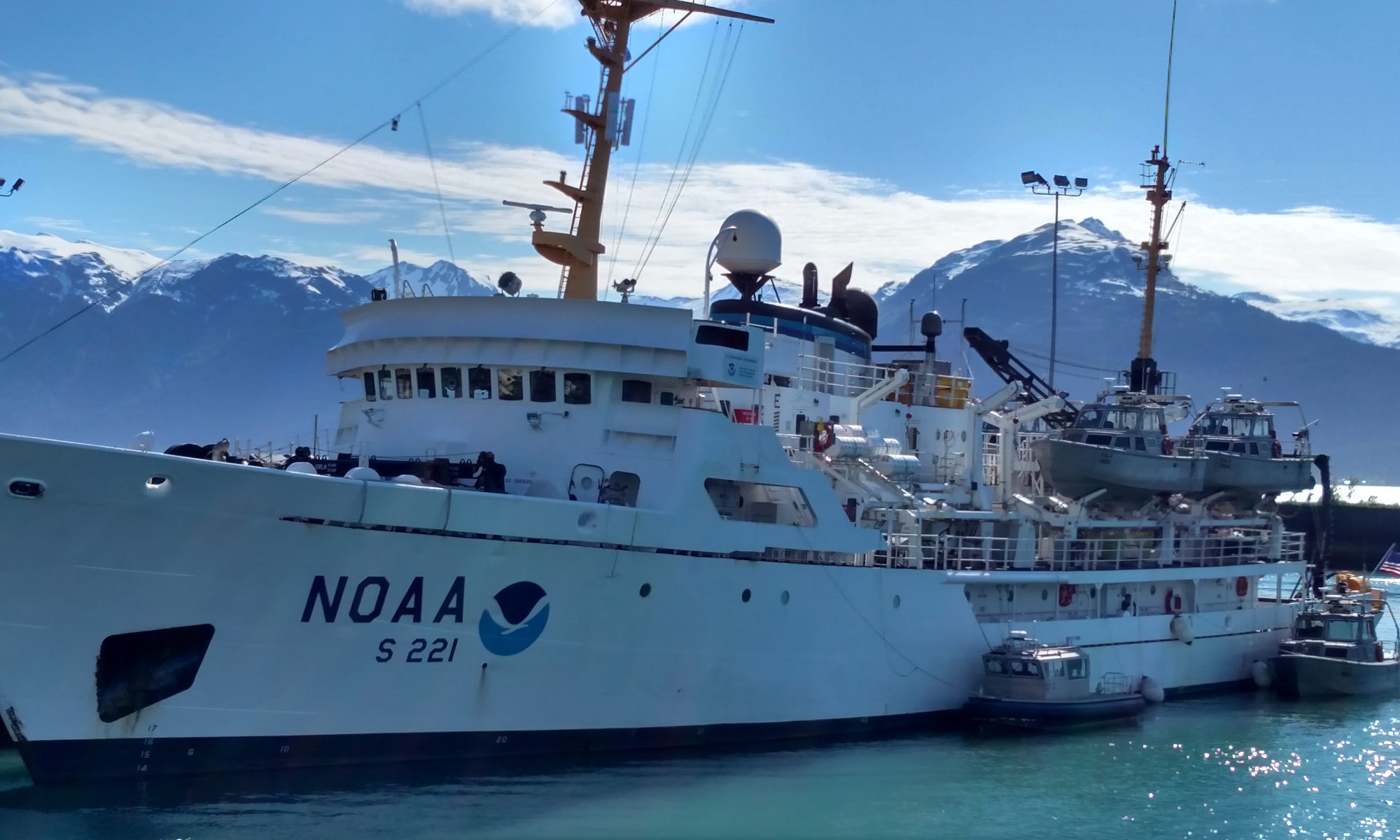
Geoff Goodenow, May 17, 2004

NOAA Teacher at Sea
Geoff Goodenow
Onboard NOAA Ship Oscar Elton Sette

May 2 – 25, 2004

Mission: Swordfish Assessment Survey
Geographical Area:
Hawaiian Islands
Date:
May 17, 2004

Time: 1600

Lat: 18 24 N
Long: 157 47 W
Sky: Stratus cloud layer shielded us from the sun until longline was in then it started to break up by 1030. Sun for awhile then clouded over again by midafternoon. Thinning by evening but still a good blanket on us.

Air temp: 27.3 C
Barometer: 1011.24
Wind: 35 degrees at 7 knots
Relative humidity: 54.5%
Sea temp: 26.8 C
Depth: 4489.2 m

Sea: 2-3 foot swells; no problems

Science and Technical Log

Yesterday after picking up the line we began a westward passage toward Swordfish Seamount. It was a long way off and there was no hope of getting there last night. The line was set along our course at 18 34 N and 156 47 W at no particular oceanographic feature that I am aware of. Perhaps that is why out haul today was none too exciting — a couple escolar, a snake mackeral and two blue sharks. Only one of the blues was brought on board. We will be at Swordfish to set tonight and look forward to a more interesting catch tomorrow.

I have covered each of the areas of research going on by the science teams aboard for this cruise. Today, my focus will be on sharks. We have caught 4 species so far and that has aroused my interest in these animals. I’ll provide some general info as well as some specifics for the species we have caught. For those of you interested in more, my information comes from two sources: Smiths’ Sea Fishes by Margaret Smith and Phillip Heemstra, and Diversity of Life by E.O. Wilson.

Sharks along with skates and rays are among 700-800 species in the subclass Elasmobranchii of the Class Chondrichthyes. Like all members of the class, their skeletons are entirely cartilaginous, but Elasmobranchs are distinguished by an upper jaw that is not fused to the skull and 5-7 pairs of gill slits.

There are about 350 species of sharks ranging in adult size from the 23 cm green lanternshark to whale sharks, the largest of all fishes, which reach 13 meters. Sharks lack a swim bladder, but produce large amounts of lipids which are stored as oils in the liver for buoyancy. The liver can account for up to 25% of the animal’s total weight. Sharks maintain osmotic (water) balance by maintaining a high concentration of urea (so high as to be deadly to most fishes) in their blood and tissues thereby reducing water loss to their salty environment.

All sharks we have caught (except the bigeye thresher, Order Lamniform) belong to the Order Carchariniform. This is the largest group of sharks; it includes about 200 species. These two orders are distinguished from one another in the following ways:

Carchariniforms: purse-like egg cases or live bearing; a movable nictitating membrane (eye covering).

Lamniforms: bear live young with uterine cannibalism (now there’s an interesting bit) evident in some; no movable nictitating membrane. There are also differences between the orders in the internal structure of their intestines — very interesting but I won’t go into description.

Specifics about each species of shark we have taken follow.

Blue sharks: the most fecund of all sharks; viviparous and bear 35-135 pups per litter; 50 cm at birth; attain 3.5 m; widespread in all oceans; favor water 12-16 C.

Oceanic white tip: in all oceans; away from continental shelves; viviparous bearing 6-8 pups usually; 60-65 cm at birth; up to 3 m; abundant in tropical seas.

Silky: widespread, prefer warm water; feeds inshore and in deep water; viviparous bearing 9-14 pups; 80-85 cm at birth; up to 3 m.

Bigeye thresher: widespread in warm ocean waters; ovoviviporous (provides embyo with no nourishment beyond the original yolk); 2 pups per litter; 100-130 cm at birth; attain 4.5 meters.

Personal Log

Well, I guess you can tell what I did today, and I might have a few more tidbits about sharks to add tomorrow. I am completing the log before the line set tonight so as to take in a movie afterwards. Don’t know what’s playing tonight, but it will be free and relaxing.

Tomorrow begins our last week at sea. Little time remains for you to file your questions with me. I’m looking too for suggestions for topics to try to address so if you have ideas, please suggest. I have asked for a tour of the engine room which is a possibility for Tuesday if tickets aren’t sold out. That might give me some interesting goodies to pass along.

Question:

We have seen fish that are rather uniformly dark in color and some that are brightly colored. What are some of the roles of coloration in fishes (as well as other animals)? Describe countershading and how it serves an animal like the blue shark.

Geoff

Geoff Goodenow, May 16, 2004

NOAA Teacher at Sea
Geoff Goodenow
Onboard NOAA Ship Oscar Elton Sette

May 2 – 25, 2004

Mission: Swordfish Assessment Survey
Geographical Area:
Hawaiian Islands
Date:
May 16, 2004

Time: 1615

Lat: 18 25 N
Long: 156 13 W
Sky: A dreary morning with gray stratus clouds all around and an occasional misting of precipitation. Much brighter sky by 1300 — enough to cast shadows, but remained mostly cloudy throughout the day. A pleasent evening with clearing skies.

Air temp: 25.7 C
Barometer: 1011.61
Wind: 352 degrees at 13 knots
Relative humidity: 71.5%
Sea temp: 26.4 C
Depth: 5012.1 m
Sea: 2-3 foot swells

Scientific and Technical Log

Longline retrieval started on a bad note this morning as the line went under the ship. It caused only a short delay as maneuvers were quickly and successfully made to keep it out of the propellers. We brought up an escolar, 2 snake mackeral, and a broadbill swordfish head. A large, angry silky shark came in also. The shark was released after being tagged and “kindly” relinquishing a remora. And finally, a new species for the record, a lancetfish (Alepisaurus ferox). These guys look much like the snake mackeral, a long thin body up to 200cm, nearly cylindrical with a tall uneven dorsal fin (sail)standing perhaps 5 body widths high over nearly 2/3 of its back. The snake mackeral’s dorsal fin does not rise nearly so much. The lancet’s skin was very smooth, scaleless in fact, iridescent and rather pale. They have narrow snout with long sharp teeth.

For those interested in the studies of pelagic fishes, the Pelagic Fisheries Research Program (PFRP) publishes a newsletter which can be viewed online (I think) at http://wwwsoest.hawaii.edu/PFRP . For more on the eye work being done by Kerstin and others see Vol. 6 Number 3 (July-September 2001).

Other studies aboard the SETTE:

Melissa is a master’s program student at Virginia Institute of Marine Sciences (VIMS). She did her undergraduate study at UC San Diego. She has been collecting remoras, larvae from our plankton tows and stomach contents from some fishes, and fin clips from sharks. Here’s what it’s all about:

The remoras are being collected as a favor for her labmate’s work at VIMS. That person is looking at the phylogenetics of remoras and also that of their hosts which include sharks, billfishes, and the occasional baitfish or float. She is also collecting fin clippings from sharks of the genus Carcharhinus (e.g. oceanic white tips, silky sharks) for another labmate working on the sandbar sharks (also in the Carcharhinus genus) off of Virginia, looking at natal homing patterns.

From the plankton tows, Melissa is interested in larvae of the fish family Scombridae which incldes tunas, wahoo, bonitos, and mackeral. Can we find ways to identify them based on their genetics? Samples from all will be sequenced using their mitochondrial DNA in an attempt to find unique interspecific (between species) genetic markers. The value of this is that it would allow easier identification of larval types than does morphological identification. We might more readily then identify where and when particular species spawn and thereby attain a better understanding of their life histories. Are the genetics of a species uniform throughout the range of the fish? If there are significant genetic differences in populations then perhaps it is wise to manage fisheries of that species by area as opposed to globally (one size fits all approach) so as to preserve gene pool diversity. Answers to these questions could lead to management practices that better protect these resources.

This work also has applications in forensic studies. Fish that have been taken illegally and already filleted can be identified by genetic markers enabling better enforcement of regulations. Also, morphological identification of degraded tissue, as in stomach contents where enzymes have done their deed, is impossible.  Stomach contents collected here will be screened using genetic markers for the tuna larvae to see if the larvae are part of that particular fish’s diet.  Applications from this work could potentially aid studies of trophic levels and predator/prey relationships.

Goodenow 5-16-04 shark on cradle
Shark being lifted aboard

Personal Log

Suffered my first injury in shark wrestling today with a slight abrasion to left knee — not enough to scare me away from the next match. Nothing too news worthy to report about the day. It was a rather slow day. Not much sun, humidity was above the norm — a bit uncomfortable outside. Continued reading Wilson’s book, did wash and stewards offered a linen change today which I took advantage of.

There was a moment of excitement this afternoon when a marlin took off with a troll line. It was out of control and our two champion fisherman couldn’t handle it. Gears were stripped in the reel which actually smoked from the heat generated as line spinned off. That rod is out of action for the duration; the fish won that round.

This evening our electronics technician, John, gave me a pictorial introduction to other research cruises of the SETTE which I will share with you another time. And, relieved of longline duties tonight, I spoke with Mike and science in general and some specific regarding his work in fisheries research.

To all of my ’02-’03 Advanced Biology students, I am sorry to report that I was not able to make use of my Secchi disk nor did I even see one on the ship.

Question:

What does the term upwelling mean? Identify several general locations in the oceans where upwelling occurs. What is the biological impact of upwelling in those areas?

Geoff

Geoff Goodenow, May 15, 2004

NOAA Teacher at Sea
Geoff Goodenow
Onboard NOAA Ship Oscar Elton Sette

May 2 – 25, 2004

Mission: Swordfish Assessment Survey
Geographical Area:
Hawaiian Islands
Date:
May 15, 2004

Time: 1550

Lat: 18 52 N
Long: 155 47 W
Sky: Bright and sunny over us but the island has a layer of stratus obscuring views to top
Air temp: 26.3 C
Barometer: 1012.72
Wind: 202 degrees at 12 knots
Relative humidity: 62.4
Sea temp: 26.2 C
Depth: 2015.4 m

Sea: Rolling along with 2-3 foot swells; no big deal.

Scientific and Technical Log

Scientific name for the pomfret we caught yesterday is Brama brama and for the silky shark (caught a week or so ago) it is Carcharhinus falciformis.

Today as we trolled just off the Hawaii shoreline as we steamed south to our longline set position. Mike and Chris teamed up again to land a shortbilled spearfish (Tetraturus angustirostris) 161 cm and 17 kg, silvery body with a deep blue dorsal fin — beautiful fish. This one was kept for eye studies and other tissue samples. We pulled a nearly intact fish about 20 cm long from its stomach. The 2 man team of Chris and Mike is working smoothly and efficiently; no fish has a chance against them now.

We will set the longline tonight southeast of the southern tip of Hawaii at Apuupuu Seamount, 929 m below. (18 31N, 155.24 W). Following the set we will be doing a plankton tow.

Vision (one more time):

Another aspect of the vision studies is trying to assess the animal’s speed of vision. Electroretinography measures the response of an eye to light pulses from a flickering source. So called flicker fusion (FF) is reached when the eye loses its ability to perceive individual pulses of light. A relatively high FF value is characteristic of shallow living species compared to deeper dwellers. In the dim light the speed of light gathering is slowed similar to the need to slow a camera’s shutter speed to gather sufficient light.

In concluding this abbreviated look at the vision studies, I’ll try to draw some of the pieces together. Pop up tags show where these animals spend their time in terms of depth, light and temperature realms. We can tell how sensitive an eye is to light and how fast it works. As you will recall, some of these fishes deep dwelling fishes have heat a exchange system located in the eye which keep it warm. It has been shown that speed of vision is affected by temperature change — a warm (above ambient) eye functions more effectively. Much more goes on, but perhaps you get a sense of how different areas of study contribute to a better picture of this function in these pelagic fishes.

To other (non-vision) studies tomorrow.

Personal Log

We steamed toward Kona through the night so that we could ferry Steven to shore and flights to other places. It was great to have met him; I’m sorry he had to jump ship. I got up at 5:30 to experience sunrise (around 6 o’clock). I thought it would be nice to see it rise over the island, but didn’t count on the clouds hanging over the mountains to obscure anything that might have been spectacular; it wasn’t even good from our perspective. But it was nice to see a color that I haven’t seen (except as a flash) in over a week — green. We have been wrapped in a beautiful blue and white world (which I am sure would excite fans of the Penn State Nittany Lions and the Mifflinburg HS Wildcats), but I tend to favor green fields and forests in the mix.

Unfortunately, we didn’t get to touch the green or for that matter the briny deep as snorkeling was denied us. So it was a day of leisure on board. I spent time reading (Diversity of Life), making some journal entries and enjoying the sight of land — perhaps the last for another 9 days (not complaining). I tried to ignore the typical signatures of human presence at Kona: autos, the Big K-Mart and Lowes perched to give exiting customers a grand view across the sea, a cruise ship at anchor, shore front hotels and homes dotting the mountainside. I directed my focus on the crashing surf, blankets of exposed black lava rock interrupting the predominant green, and shear black cliffs dropping to the sea — the natural stuff. It got better the further south we moved along the coast.

Dan guided Kylie and me through filleting of the spearfish this afternoon. Between the three of us (and the catch team, of course) we secured a good bit of food for the crew. This evening I split spool duty with Kerstin then took a chair from which to watch the rest of the set, read and talk with super fisherman Chris.

It’s a great night back in the world of blue and white.

Question:

Can you find the point on the sea where you would be most distant in any direction from land?

Geoff Goodenow, May 12, 2004

NOAA Teacher at Sea
Geoff Goodenow
Onboard NOAA Ship Oscar Elton Sette

May 2 – 25, 2004

Mission: Swordfish Assessment Survey
Geographical Area:
Hawaiian Islands
Date:
May 12, 2004

Time: 1745 (Later than usual due to busy late afternoon fishing)

Lat: 18 33N
Long: 158 20 W
Sky: Somewhat overcast this morning but a nice sunny day overall.
Air temp: 26.5 C
Barometer: 1013.5
Wind: 90 degrees at 10 knots
Relative humidity: 63.5%
Sea temp: 26.3 C
Depth: (forgot to check)
Sea condition: Good sized swells today kept us rocking and rolling pretty good throughout the afternoon and evening. But it wasn’t discomforting at all.

Scientific and Technical Log

Brought up 3 escolar and one wahoo on the longline this morning — not a very exciting time. The set was about 30 miles NE of Cross seamount. After retrieval we steamed south again through/over Cross and back to the area of success around Swordfish seamount to set the line tonight. Along the way we encountered several so called “bird piles”, congregations of birds on the water, indicative of fish below.   Passing over Cross we pulled in 5 mahi mahi, a small yellowfin tuna, and 4 bigeye tunas. It was a busy late afternoon. There’s lots of fish on ice for upcoming meals!

Returning now to the vision studies:

This afternoon Eva gave me the tools and an escolar eye and had me go through the procedures she follows to get what she needs for her studies. (Kylie basically does the same procedure but uses skipjack tunas). I’m not ready for microsurgery yet, but she gave my effort a thumbs up as I successfully secured the materials she needs for later study.

As the eye is taken from the animal marks are made on it with a scalpel to mark its orientation in the animal. After measuring eye cup and pupil size, the cornea and lens are removed and a bit more scraping and cleaning eventually leaves her with optic nerve, retina and vitreous to be preserved. This took me about 45 minutes to do.

Back at her university lab, the retina alone will be used. Sections of the retina will be mounted for microscopic examination. With it she can answer questions such as 1) what do the photoreceptor cells look like? 2) Is there a variety of types of receptors in their eye? 3) What is the density/distribution of receptors across the retina? In another study she makes other preps for microscopic examination to observe density of ganglia in the retina.

Personal Log

I had some ideas for tonight’s entry in this section, but this boat is rocking pretty hard right now and sitting in front of the computer is not particularly pleasant. I’m cutting things short tonight.

Geoff