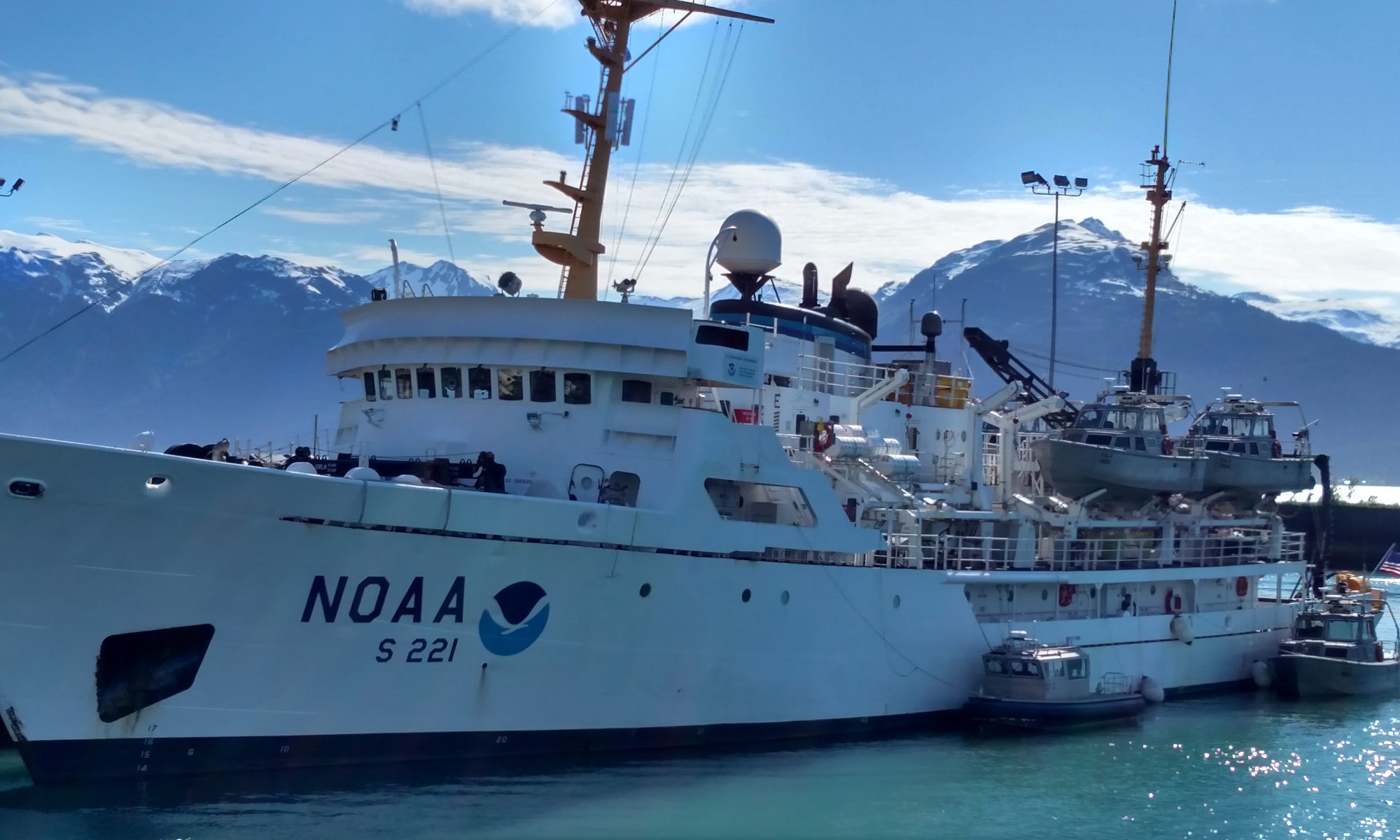
Allison Irwin: Traveling to the Ship, July 8, 2019

NOAA Teacher at Sea

Allison Irwin

Aboard NOAA Ship Reuben Lasker

July 7-25, 2019


Mission: Coastal Pelagic Species Survey

Geographic Area: Northern Coast of California

Date: July 8, 2019

Weather at 0800 on Monday 08 July 2019.

Winds and sea are calm. Weather is cool. Heavy overcast layer of white, thick clouds in the sky. Very comfortable out on deck with a sweater or light jacket. The visibility is unreal – I can see for miles! Nothing but cold water and salty air.


PERSONAL LOG

Friday Night

05 July 2019

Tomorrow I’ll board a ship with NOAA Officers and scientists headed for a three week research cruise in the Pacific Ocean. My whole life at home is not skipping a beat without me. But I feel like I’ve hit a pause button on my character. Like I won’t return to the movie of my life until the end of July. Important decisions get made without me. Disputes with family and friends won’t include my voice again for almost a month. Everything moves forward at home this summer but me.

I have a new appreciation for folks who dedicate their lives to careers requiring them to be away from home for long periods of time. This is only three weeks. I can’t imagine the way I would feel if I were leaving for three months. Or a year.  I do feel very grateful for the opportunity to spend the next three weeks with these people though. They will be, no doubt, passionate about their careers, and I’ll learn a lot from traveling with them.

THE SCIENCE

Saturday Morning

06 July 2019

After a 6 hour flight from the East Coast to the West Coast and a 2.5 hour car ride from Portland International Airport to Newport, Oregon, I’m finally on NOAA Ship Reuben Lasker! A handful of scientists, two volunteers, and myself met at the airport. We coordinated so all our flights would arrive within an hour of each other so we could drive together. As soon as we got there, my roommate gave me a tour of the ship. It didn’t take very long, but there are a lot of ways to get lost! I felt a little disoriented after that. There is a galley and dining area which they call the mess. I’ve been told we have one of the best chefs on board our ship! A laundry room, exercise room, plenty of deck space, the bridge where NOAA Officers will navigate and operate the ship, and stairs. So. Many. Stairs.

Upon meeting the chief scientist, Kevin Stierhoff, it became clear that the Coastal Pelagic Species Survey is a big deal. NOAA runs this survey every year for about 80 days! They break it up into four 20 day legs. Most of the scientists will rotate through only one or two legs, but the NOAA Corps Officers in charge of the ship’s operation typically stay for the full survey. That’s a very long time to be away from home.

We’re traveling on the 2nd leg, so the survey has already been underway since June. It started farther north off the coast of Vancouver Island, British Columbia and will meander down the coast for almost three months until it reaches the US-Mexico border. Kevin described the ship’s movements like someone explaining how to mow the lawn – we will run perpendicular to the coast in a back-and-forth pattern traveling south, slowly, until we get to the waters off San Francisco Bay. First we’ll travel straight out into the ocean, turn south for a bit, then travel straight back toward the coast. Repeat. Repeat… for three weeks.

mowed lawn
Patterned lines in a freshly mowed lawn – accessed on pixabay.com

Why such a funky pattern, you might ask? We’ll be using acoustic sampling during the day to determine where the most densely populated areas of fish are located. Then at night, we’ll put that data to good use, immediate use, as we trawl the waters for specific types of pelagic species. There are five species in particular that the scientists want to study – anchovy, herring, sardines, mackerel, and squid – because they’re managed species or ecologically important as prey for other species. That funky pattern of travel allows us to sample the whole coastal region.

It reminds of me of one of the scanning patterns the Civil Air Patrol uses when we conduct search and rescue missions from a Cessna. When I was trained to be a scanner in the back seat of the plane, they taught me to look for signs of a missing person or downed plane below me in a systematic way. If I just look sporadically at everything that pops into my line of scan, I’ll never find anything. It’s too haphazard. But if I start from a fixed point on the aircraft and scan out up to a mile, then bring my scan line back in toward the plane, I’ll naturally scan all the ground below me for clues as the plane moves forward.

Even though they’re looking primarily at those five coastal pelagic species, the scientists will catalogue every kind of fish or marine life they find in their trawl nets. They are meticulous. It’s such an important endeavor because it helps us to fish our waters using sustainable practices. If this survey finds that one of the fish species in question is not thriving, that the population sample of that species is too low, then NOAA Fisheries and the Pacific Fisheries Management Council will set harvest guidelines next year to help that species rebound. If it’s looking very dire, they might even determine that commercial fishing of that species needs to be put on pause for a while.

For more details about NOAA Fisheries and the importance of the annual Coastal Pelagic Species Survey, read this short two page guide called U.S. Fisheries Management: Sustainable Fisheries, Sustainable Seafood.

TEACHING CONNECTIONS

Saturday Evening

06 July 2019

Since the three hour time change traveling in this direction worked in my favor, I gained three extra hours of daylight to explore Newport.  I spent most of the evening walking around the small port where NOAA docked Reuben Lasker. It’s only a couple square miles, but it houses the Oregon Coast Aquarium, the Hatfield Marine Science Center’s Visitor Center, Rogue Brewer’s on the Bay, and a public fishing pier. I walked a total of 6 miles today and was never bored.

The fishing culture struck me the most. Kids, adults, everyone seemed to have a working knowledge of local sustainability, ecosystems, commercial fishery practices, things that are so foreign to me. I suppose it would be like going to Pennsylvania and asking someone to explain deer hunting. Trust me, we can. But fishing? Not as much. I wish that we as teachers would tap into the local knowledge base more fully. From Pennsylvania for example, we could share Amish culture and heritage, details about the coal mining industry, steel production and engineering practices, hunting, and so much more. Until I realized how unaware I was of the local knowledge here in Newport, I never stopped to think about how rich and diverse my students’ local knowledge must be as well. One thing I plan to do this school year is dig into that local culture and explore it with my students.

I watched one gentleman as he filleted his catch at the filleting station just off the pier. To me it looked like a cooler of fish. I could tell you with certainty that they were indeed fish. But he knew each type, why the Lingcod had blue flesh instead of white, how many of each type he was allowed to take home with him, how to cook them, and the list goes on. I was impressed. In talking with others this evening, it seems like that’s par for the course here. Later, a couple of fishermen with a cooler full of crab started talking to me and offered me some to try. It was cleaned, cooked already, fresh out of Yaquina Bay. It was delicious – sweet and salty.

The people I interacted with today, every single one of them, were genuinely kind. They were patient and explained things to me when I didn’t understand. This is a lesson every teacher can take to the classroom. We know how important it is to smile and be kind. We know it. But sometimes it’s hard to put that into practice when we’re rounding into May and having to explain that one tricky concept again, pulling a different approach out of our magic hat, and hoping that this time it will click.

It’s not always easy to mask the frustration we feel when something that is so natural for us (in no doubt because we love the subject and have studied it for at least a decade) just doesn’t make sense to a student. And it’s not always the student I get frustrated with, it’s myself. Teachers tend to be their own worst critics. When a lesson doesn’t go as well as we expected, we double down and try harder the next day. No wonder so many of us burn out in the first five years and switch to a different career!

TEACHING RESOURCES

Allan Phipps: Show Me the Data! August 2, 2012

NOAA Teacher at Sea
Allan Phipps
Aboard NOAA Ship Oscar Dyson
July 23 – August 11, 2012

Safety first!

Mission: Alaskan Pollock Mid-water Acoustic Survey
Geographical Area: Bering Sea
Date: August 2, 2012

Location Data
Latitude: 61°12’61” N
Longitude: 178°27’175″ W
Ship speed: 11.6 knots (13.3 mph)

Weather Data from the Bridge
Wind Speed: 11 knots (12.7 mph)
Wind Direction: 193°
Wave Height: 2-4 ft (0.6 – 1.2 m)
Surface Water Temperature: 8.3°C ( 47°F)
Air Temperature: 8.5°C (47.3°F)
Barometric Pressure: 999.98 millibars (0.99 atm)

Science and Technology Log

At the end of last blog, I asked the question, “What do you do with all these fish data?”

The easy answer is… try and determine how many fish are in the sea.  That way, you can establish sustainable fishing limits.  But there is a little more to the story…

Historically, all fisheries data were based on length.  It is a lot easier to measure the length of a fish than to accurately determine its weight on a ship at sea.  To accurately measure weight on a ship, you have to have special scales that account for the changes in weight due to the up and down motion of the ship.  Similar to riding a roller coaster, at the crest of a wave (or top of a hill on a roller coaster), the fish would appear to weigh less as it experiences less gravitational force.  At the trough of a wave (or bottom of a hill on a roller coaster), the fish would experience more gravitational force and appear to weigh more.  Motion compensating scales are a more recent invention, so, historically, it was easier to just measure lengths.

One of the motion-compensating scales onboard the             Oscar Dyson.

For fisheries management purposes, however, you want to be able to determine the mass of each fish in your sample and inevitably the biomass of the entire fishery in order to decide on quotas to determine a sustainable fishing rate.  So, you need to be able to use length data to estimate mass. Here is where science and math come to the rescue!  By taking a random sample that is large enough to be statistically significant, and by using the actual length and weight data from that sample, you can create a model to represent the entire population.  In doing so, you can use the model for estimating weights even if all you know is the lengths of the fish that you sample.  Then you can extrapolate that data (using the analysis of your acoustic data – more on this later) to determine the entire size of the pollock biomass in the Bering Sea.

How do they do that?  First, you analyze and plot the actual lengths vs. weights of your random sample and your result is a scatter-plot diagram that appears to be an exponential curve.

Scatterplot showing observed Walleye pollock weights and lengths for a sample of the population.

Then you create a linear model by log-transforming the data.  This gives you a straight line.

Linear regression of the Walleye pollock length and weight data.

Next, you back-transform the data into linear space (instead of log space) and you will have created a model for estimating weight of pollock if all you know are the lengths of the fish.  This is close to a cubic expansion which makes sense because you are going from a one-dimensional measurement (length) to a 3-dimensional measurement (volume).

Observed weight and length data showing the model for predicting weight if all you know are lengths.

Scientists can now use this line to predict weights from all of their fish samples and then extrapolate to determine the entire biomass of Walleye pollock population in the Bering Sea (when combined with acoustic data… coming up in the next blog!) when the majority of the data collected is only fish lengths.

Another interesting question… How does length change with age?  Fish get bigger as they get older, all the way until they die, which is different from mammals and birds. However, some individual fish grow faster than others, so the relationship between age and length gets a little complicated.  How do you determine the age distribution of an entire population when all you are collecting are lengths?

Several age classes of Alaskan pollock (Theragra chalcogramma).  Can you tell which one is youngest?                Are you sure???

Just like weight, you can determine the age from a subset of fish and apply your results to the rest. This works great with young fish that are one year old.  The problem is… once you get beyond a one-year-old fish, using lengths alone to determine age becomes a little sketchy.  Different fish may have had a better life than others (environmental/ecological effects) and had plenty to eat, great growing conditions, etc and be big for their age relative to the rest of the population.  Some may have had less to eat and/or unfavorable conditions such as high parasite loads leading them to be smaller…   There are also other things to consider such as genetics that affect length and growth rate of individuals.  Here is where the collection of otoliths becomes important.  By collecting the otoliths with the lengths, weights, and gender data, the scientists can look at the age distributions within the population.  The graph below shows that if a pollock is 15 cm long, it is clearly a 1 year old fish.  If a pollock is 30 cm long, it might be a 2 year old, a 3 year old, or a 4 year old fish, but about 90% of fish at this length will be 3 years old.  If a fish is 55 cm long, it could be anywhere from 6 to 10+ years old!

Graph showing age proportions of the Walleye pollock population when compared to length data.

Collection of otoliths is the only way to accurately determine the age of the fish in the random sample and be able to extrapolate that data to determine the estimated age of all the pollock in the fishery.  Here is a photo comparing otolith size of Walleye pollock with their lengths.

    A comparison of otolith sizes. These otoliths were taken from fish that were 12.5cm, 24.5cm, 30.5cm, 39.0cm, 55.5cm, and 70.0cm counter clockwise from top, respectively.
A comparison of otolith sizes. These otoliths were taken from fish that were 12.5cm, 24.5cm, 30.5cm, 39.0cm, 55.5cm, and 70.0cm counter clockwise from top, respectively.

If we wanted to find out exactly how old each of these fish were, we would need to break the otoliths in half to look at a cross section.  Below is what a prepared otolith looks like (courtesy of Alaska Fisheries Science Center).  You can try counting rings yourself at their interactive otolith activity found here.

Cross section of Walleye pollock otolith after being prepared (courtesy of the Alaska Fisheries Science Center).

All of these data go into a much more complicated model (including the acoustic-trawl survey walleye pollock population estimates) to accurately estimate the total size of the fishery and set the quotas for the pollock fishing industry so that the fishery is maintained in a sustainable manner.

Next blog, we will learn about how the various ways acoustic data fit into this equation to create the pollock fishery model!

Personal Blog

Ok, so here is a long overdue look at the NOAA Ship Oscar Dyson that I am calling home for three weeks.  I was pleasantly surprised when I saw my state room.  It is bigger than I thought it would be and came with its own bathroom.  I was also pleasantly surprised to learn I would be sharing my state room with Kresimir Williams, one of the NOAA scientists and an old college friend of mine!  Here is a picture of our room.

My state room on the Oscar Dyson. The curtains around each bunk help block out light.

The room has a set of bunk beds.  Thankfully, my bed is on the bottom.  I do not know how I would have gotten in and out of bed in the rough seas we had over the last couple of days.  If I do fall out of bed, at least I will not have far to fall.  Last year, the ship rocked so hard in rough seas that one of the scientists fell head first out of the top bunk!  The room also had two lockers that serve as closets, a desk and chair, and our immersion suits (the red gumby suits).  The bathroom is small and the shower is tiny!  Notice the handles on the wall.  These are really handy when trying to shower in rough seas!

The bathroom in my state room. Notice the essential handles.

Next, we have the Galley or Mess Hall.  This is where we have all of our meals prepared by Tim and Adam.  Notice that all of the chairs have tennis balls on the legs and that each chair has a bungee cord securing it to the floor!  There are also bungee cords over the plates and bowls.  Everything has to be secured for rough seas.

The Mess Hall, also known as “The Galley.”

The chairs in the galley have tennis balls on their feet and have bungee cords holding them down so they will not move during high seas.

The coffee bar and snack bar in the galley.

The Mess Hall also has a salad bar, cereal bar, sandwich fixings, soup, snacks like cookies, and ice cream available 24 hours a day.  No one on board is going hungry.  The food has been excellent!  We have had steaks, ribs, hamburgers and fish that Tim has grilled right out on deck.  Here is a picture of my “surf and turf” with a double-baked potato.

“Surf and Turf” meal, courtesy of Stewards Tim and Adam. Yummy!

Most of my work here on board (other than processing fish) has been in the acoustics lab, also known as “The Cave” since it has no windows.  This is where the NOAA scientists are collecting acoustic data on the schools of fish and comparing the acoustic data with the biological samples we process in the fish lab.

The acoustics lab, also known as “The Cave” since it has no windows.

I also spend some time up on the Bridge.  From the Bridge, you can see 10 to 12+ nautical miles on a clear day.  This morning, we saw a couple of humpback whales blowing (surfacing to breathe) about 1/4 mile off our starboard side!  A couple of days ago (before the weather turned foul), we spotted an American trawler.

An American Trawler spotted in some foggy weather.

Today, we got close enough to see the Russian coastline!  Here is a picture of a small tanker ship with the Russian coastline in the background!

Land Ho! A small tanker off the Russian coastline.

Here are some pictures of the helm and some of the technology we have onboard to help navigate the ship.

The “helm” of the Oscar Dyson.

Radar showing numerous Russian fishing vessels near the Russia coastline.

I have also spent some time in the lounge.  This is where you can go to watch movies, play darts (yea, right!  on a ship in rough weather???), or just relax.  The couch and chairs are so very comfy!

The Lounge aboard the Oscar Dyson.

When you have 30 people on board and in close quarters, you better have a place to do laundry!  Here is a picture of our very own laundromat.

The onboard laundry facilities.

All for now.  Next time, I will share more about life at sea!