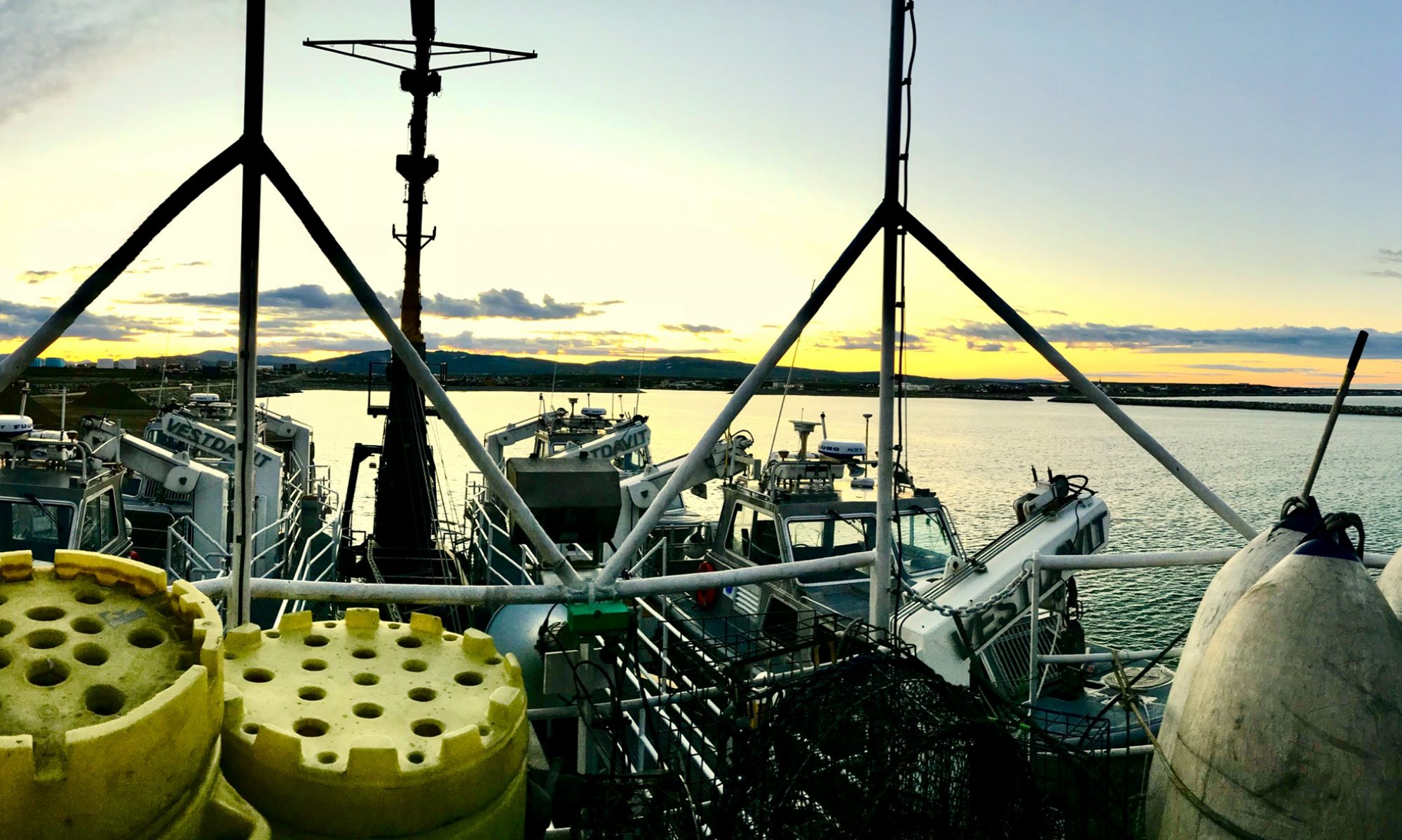
Linda Armwood, May 2, 2006

NOAA Teacher at Sea
Linda Armwood
Onboard NOAA Ship Fairweather
April 25 – May 5, 2006

Mission: Hydrographic Survey
Geographical Area: Aleutian Islands, Alaska
Date: May 2, 2006

Weather Data from Bridge 
Visibility:  10 nautical miles (nm)
Wind direction:  130°
Wind speed: 7kt
Sea wave height: 0 ft.
Sea water temp: 10.2
Sea level pressure:  1030.0 mb
Present weather: Mostly cloudy
Temperature:  °C~ 9.0 dry/7.5wet

Science and Technology Log 

The ship continued to perform the Gulf of Esquibel data collection.  Today, however, the ship used the Moving Vessel Profiler (MVP), also known as the “Fish,” in place of the Seacat to provide multiple vertical profiles of the water’s data to include sound velocity and the CTD cast. Two advantages of using the MVP are 1) the ship does not have to come to a complete stop and 2) it is automatically deployed from the ship or initiated by the MVP operator without the need for deck personnel.  Once the MVP has created the profile, the survey tech is able to immediately view the data.

I witnessed the operation of the anchor as we prepared to leave San Fernando Island.  As able seamen positioned themselves on the ship’s bow to raise the anchor, it was clear that it is a major undertaking dependent upon teamwork.  There are two anchors, one on the port side (north left) of the ship and the other on the starboard side (north right) of the ship, that are alternately used.  Each anchor has eight shots of chain.  One shot of chain is equivalent to 90 feet. Of the eight shots of chain, there are selected color-coded chains in red, white, blue and yellow. These color-coded combinations allow the able seamen to determine how many shots to drop in the water and how many shots have been dropped in the water. As a rule, the number of shots dropped should be three to five times the depth of the water which is measured in fathoms.  One fathom of water equals six feet.

Personal Log 

Thanks Able Seaman Grayeagle for letting me read your book, Whittier–The Strangest Town in Alaska, truly a memorable nugget.

Question of the Day 

Geospatial Semester and Environmental Science Students 

Solve the following problem:  The FAIRWEATHER Ship dropped anchor in 35 fathoms of water. 1) What is the depth of the water in feet, 2) At least how many shots of chain should be dropped, and 3) Approximately how much chain is left out of the water?

A Profile of Ensign Matthew Glazewski 

Ensign Glazewski is the newest Junior Officer aboard the NOAA Ship FAIRWEATHER.  As a Junior Officer, he has several collateral duties in ship management — Tides, Training Assistant, Weather, Discharge Certificates and Mess Treasurer.  He graduated from Penn State University, PA with a Bachelor of Science degree in Meteorology in 2005. His concentration of courses included Calculus, Physics and Weather Systems. His initial interest in meteorology began at an early age when he became curious about why trees fell on his parents’ home.  Matthew, nicknamed Matt, has an interest in tropical meteorology and has completed a case study of a 1975 tropical cyclone that traveled north while maintaining its characteristics in northern latitudes.  A short-term career goal for Matt is to pursue graduate studies in order to obtain a Master’s degree in Ocean Atmosphere Interaction.  His long-term career goal is to become an expert in the field of marine forecasting.

Matt wanted to become an Officer in the NOAA Officer Corps instead of working as a civilian. He believes that his experience on the NOAA ship FAIRWEATHER gives him an opportunity to see and apply what he has studied at Penn State and provides him with a better understanding of factors that influence small-scale climates.

Mrs. Armwood

Linda Armwood, April 26, 2006

NOAA Teacher at Sea
Linda Armwood
Onboard NOAA Ship Fairweather
April 25 – May 5, 2006

Mission: Hydrographic Survey
Geographical Area: Aleutian Islands, Alaska
Date: April 26, 2006

Weather Data from Bridge 
Visibility:  5 nautical miles (nm)
Wind direction: 130 °
Wind speed:  12 kt
Sea level pressure: 1004.5 mb
Present weather: Drizzle, mostly cloudy
Temperature:  °C~ 7.5dry/6.5wet

Science and Technology Log 

During the morning I concentrated on the Electronics Department to see how this operation is run. This department covers a significantly large portion of the ship in several locations. The Chief Electronics Tech explained the functioning of the iridium and INMARSAT satellites. The iridium satellite is used for low speed communication such as the telephone and e-mail.  This is primarily used at sea for hourly email transit except when launches are out.  The iridium also has a tie-in for sensors such as wind speed and barometric pressure.  The INMARSAT satellite is for high speed communication such as voice, faxes and two-way data transfer.  The management of these satellites, the Automated Information System (AIS) and all other electronic/electrical systems for the ship are managed, coordinated and maintained by the Electronics Department.

The afternoon was spent on one of the launches to observe survey technician launch operations. During the training there was a demonstration of the use of several components of data acquisition and processing.  Some of the data that is collected is sonar, boat voltage, vertical waterfall, bathymetric in 2-D view, position and orientation, heave, distance and altitude. All of this data is then processed and becomes the responsibility of the survey technician to combine the data into a single file, known as a concantenated file.

Personal Log 

I appreciate the ability to view the hydrographic navigation charts in my room through INMARSAT. This allows me to know where we are while preparing for the day.  Thanks to the Chief Electronics Tech for giving me the ship tracker web site for students and other interested persons.

Mrs. Armwood

Kathy Virdin, July 23, 2004

NOAA Teacher at Sea
Kathy Virdin
Onboard NOAA Ship Rainier

July 20 – 28, 2004

Mission: Hydrographic Survey
Geographical Area:
Eastern Aleutian Islands, Alaska
Date:
July 23, 2004

Latitude:55 degrees 43.34’N
Longitude: 159 degrees 10.967’ W
Visibility: 10 nautical miles
Wind direction: 175 degrees
Wind speed: 8 kts.
Sea wave height: 0-1 ft.
Swell wave height: 0-1 ft.
Sea water temperature: 11.7 C.
Sea level pressure: 1016.2 mb.
Cloud cover: Cloudy

Science and Technology Log

Today we have been in transit to the Shumagin Islands. Two launches were sent out to do Reson (shallow to mid-depth) measurements and one launch did the Elac (mid-depth to deep waters). This area really needs accurate depth measurement, since it’s an area where fishermen come frequently. The information that is received and processed on board the RAINIER is then sent to the Nautical Data Branch of NOAA where it is interpreted and made into the hydrographic sheets with added interpretative data. Then it next goes to a production team who apply it to charts. The next step for the information is to go to the Update Service branch which combines all data and puts it in the final form of nautical charts that is used by the Navy, cargo ships, tanker ships and all mariners (such as fishermen). So the RAINIER plays a vital role in getting critical information to those who use it daily to ensure their safety.

I was able to catch several of the crew for an interview. I interviewed Megan Palmer, who is a survey technician. To prepare for her job, Megan received a degree in geography and received additional training in computer systems, including the complex GIS system. She explained that NOAA is moving toward electronic nautical charts that will allow you to set your scale close or far away on the computer, depending on what you need. Alarms will go off if you get into shallow water. However, there will always be a need for nautical charts and that’s where NOAA excels. Megan enjoys her job as it gives her the opportunity to see Alaska while being on the water, and the chance to look for the unexpected in surveys. Often, she is part of the team that is charting waters that have very few depth soundings. She also enjoys the fact that NOAA tests software to see how well it works and then make recommendations to companies to improve features that the survey technicians need. She notes that there is definitely a need for more survey technicians and that it’s a rewarding and exciting career for any student who loves the ocean and wants to travel.

Personal Log

Today we had the thrill of seeing a whale swimming in the distance while we all tried to take a picture (very difficult since it moves in the water so quickly). We dropped anchor tonight in the Shumagin Is. We’ll stay here several days while the survey launches run lines in different areas. We’ve entered into an area of heavy fog and it was neat to hear the fog horn being sounded every few minutes as we move through the water. I enjoyed looking a computer file of pictures that show all the places the RAINIER has been in Alaska. Beautiful scenery!

Kathy Virdin, July 22, 2004

NOAA Teacher at Sea
Kathy Virdin
Onboard NOAA Ship Rainier

July 20 – 28, 2004

Mission: Hydrographic Survey
Geographical Area:
Eastern Aleutian Islands, Alaska
Date:
July 22, 2004

Latitude: 55 degrees 39’N.
Longitude: 157 degrees 54’W.
Visibility: 10 nautical miles
Wind direction: 270 degrees W.
Wind speed: 6 kts.
Sea wave height: 0-1 ft.
Swell wave height: 2-3 ft.
Sea water temperature: 12.8 C.
Sea level pressure: 1013.0 mb.
Cloud cover: Partly cloudy

Science and Technology Log

Today I interviewed several crew members, which gave me a much better perspective of the extent of work that is being conducted on the RAINIER. I first spoke with Jeremy Taylor, who is a survey technician whose job is to collect data on the ocean floor depths for the purpose of updating nautical charts. The RAINIER is dedicated to survey work that can enable all maritime vessels to successfully maneuver the ocean waters. As a survey technician, Jeremy is considered a scientist on board since the data he gathers is used by the scientific community. He collects the data from the multi-beam swaths and cleans it by deleting invalid or weak information, then sends it to other branches of NOAA (such as the cartographers) who review it, compare it to current nautical charts and then update those charts based on the new data. What is amazing to me is that the RAINIER does survey work in areas which may not have been surveyed since the 1800’s and have only had a few soundings listed. Their work is vital to commerce, fisheries management and the fishing industry. Jeremy said what he enjoys most about his job is being in Alaska, having the opportunity to go out in launches and receiving good data. He feels his job is extremely important since scientists need this data to find the habitats of various marine species. One example he gave was the fact that they can chart seamounts which are an area that contain a lot of marine life. This gives data that could help scientists discover new habitats for various species. Jeremy recommends a degree in hydrography to best prepare for this work, but also maintains that a degree in any area of science would be good basic preparation and on-the-job training would be supplied.

Next, I interviewed Briana Welton who is a Junior Officer, an Ensign in the Corps. She has a degree in math which has helped her greatly in her work. She is undergoing training to be an Officer of the Deck who will drive the ship. She also participates in the hydrographic surveys. She recommends students applying to the Maritime Marine Academy which is in New York. Briana loves the experience of being a hydrographic pioneer, as they are often charting unmeasured waters. She also loves being at sea and says it’s exciting to drive the ship. There are several divisions of ships that NOAA operates, such as the oceanographic studies, hydrographic and fisheries. The information gained by a hydrographic ship is first and foremost to be used for nautical charts, which are used by all mariners, from small fishing boats to large Navy vessels. The RAINIER also takes bottom samples that they can process in their lab to determine content and physical features of the ocean floor. The CDTs that they lower give temperature, salinity and density information to scientists that enable them to look for variations in the ocean climate that will affect marine habitats. Briana loves working on a ship and being part of a close-knit community.

Personal Log

This morning I thoroughly enjoyed talking with several crew members about their work and getting new information about all the facets of ship life. This afternoon I plan to work on lesson plans and tonight I’ll watch the survey technicians scan and clean up the data that comes in from the two launches that went out today. I also hope for some time to do more research on the complexities of the mission of NOAA and study some nautical charts. It’s amazing to me that I can walk out on deck at 10:30 at night and it will still be light. In Alaska in the summer there are about 19 hours of daylight.

Wow!