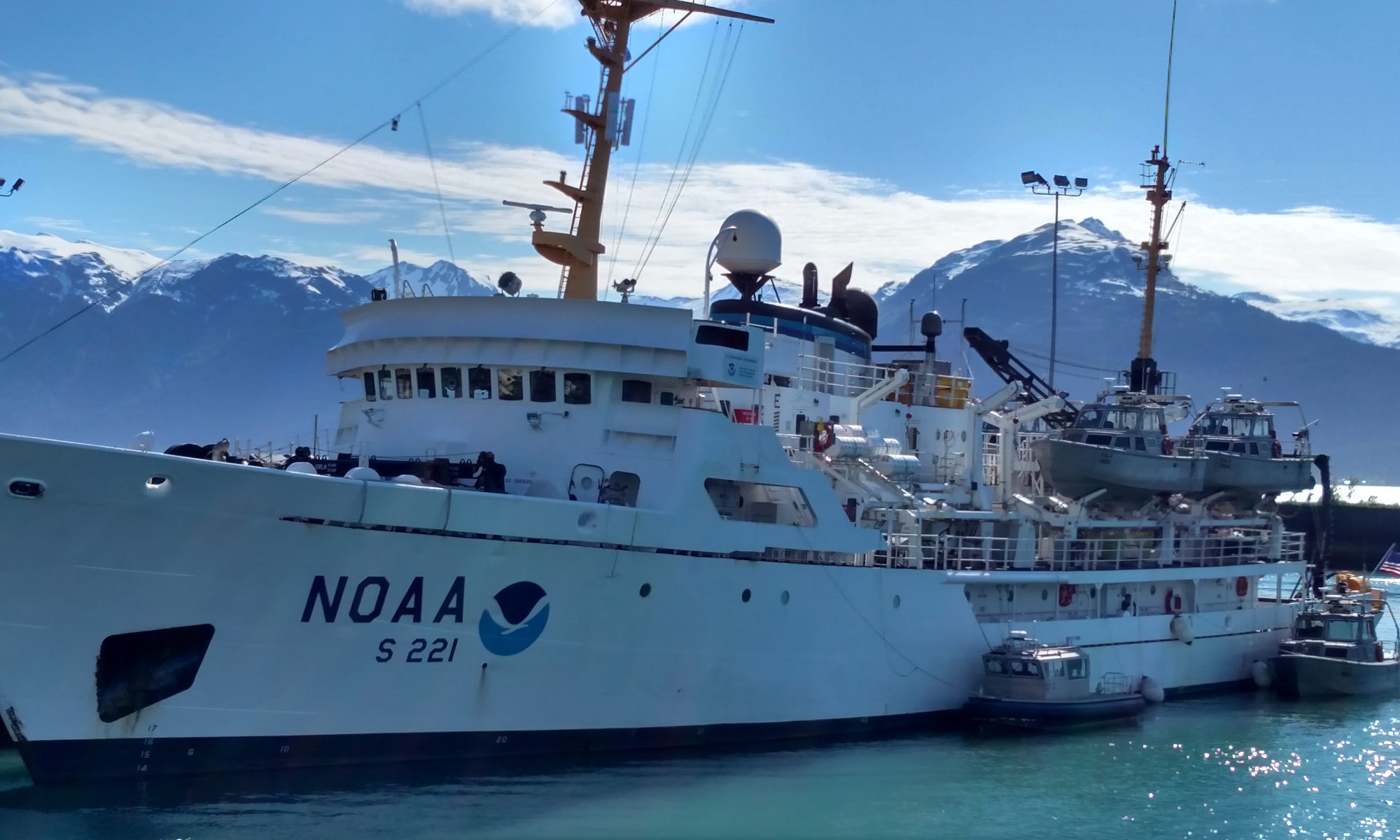
NOAA Teacher at Sea Kiersten Newtoff Aboard NOAA Ship Pisces January 6 – January 29, 2025
Mission: Atlantic Marine Assessment Program for Protected Species (AMAPPS) Geographic Area of Cruise: North Atlantic Coast Date: January 13, 2025 Current Location: 38°02.141′ N, 73°30.716 W (you can follow us on Windy in real time!) Weather from the Bridge:
Team Spotlight: The Michelin Stars
While the purpose of NOAA cruises is conducting science, it’s not just scientists on board. There is a whole community of people who make the day-to-day on the Pisces possible. In addition to the blog series on the different science teams, we will also meet the different teams that run the Pisces. First stop – the galley.
The kitchen is the soul of the ship. Jean
Meet Jean and Julius, easily the most loved crew members of all because they keep our bellies full of the good stuff. You know how you overeat during the holidays and when they pass you try and workout more and lessen your eating? Yeah, this cruise right after the holidays is definitely not the time to start a new diet. Jean and Julius make us three meals a day, and lunch and dinner always have dessert! I attempt to only grab 2-3 food items from the buffet bar, but it’s really hard and I rarely do. And how does someone not take dessert when they are just sitting there, waiting to be consumed? I guess I’ll start with those New Year’s resolutions after getting back.
The Michelin Stars make a wide variety of dishes each day that accommodates the diets of the 34 folks on board, and everything is incredibly delicious. Not only do they make sure that everyone has something substantial to eat; they also take care of the crew that have to miss meals based on their shift. I’m impressed that they are always so prompt with the meals; always finished the moment the meal starts. If you have seen the reality TV show Below Deck, you know that the food is never on time. I had no idea what to expect as I’ve never done a trip like this before, so most of my boat knowledge comes from that show. And it’s nothing like this. NOAA Pisces is so much better!
Jean (foreground) and Julius (background) put the finishing touches on dinner.
Meet the Michelin Stars
The chief steward on board is Jean (pronounced like “John” but fancier) and the second cook is Julius. Jean is half black – half Panamanian, where he grew up. His parents met in Panama where his father was working. Jean used to work in offshore drilling, but during the COVID shutdowns, only small teams were working. Jean really wanted stability in his career and his mom, who works for NOAA, recommended filling out an application with the agency. Jean got the position and began in the laundry department. While he doesn’t work for NOAA, his dad works as a chief steward on a University of Hawaii vessel. Something tells me that Jean was destined for a chief steward role in NOAA. His first assignment was on Rainier, which experienced a fire in September 2023. Jean was on the fire team and after 3 hours the team was able to control and extinguish it. None of the 41 passengers on the ship were injured, but there was quite a bit of damage and the ship had to be towed from America Samoa to Honolulu. Since the Rainier was out of commission, Jean needed to transfer to another boat. He already knew some people aboard the Pisces and shared that it is important to have good working relationships with your crew. Jean only recently was promoted to Chief Steward, and so far, he is really enjoying the role because he gets to make decisions and please people.
Julius is a man of many hats. When he first started with NOAA in 2014, he started on deck and moved to sewage and engine before settling in as the second cook. Technically, he is assigned to the Brown, but it has been docked for repairs for Julius has been floating around different vessels. He plans on making a switch to the Pisces because he really likes the crew and working with Jean. Julius doesn’t have a culinary background, but he’s picked up a lot of skills from floating around departments and working with the different stewards for the past decade. Of all the positions he has worked, he enjoys working in the kitchen the most.
Julius and Jean do more than just cook though, there’s a lot of moving pieces to make a perfect meal. They have to inspect and repair the cooking vent systems, manage the linens, make menus (3 per day!), and ensure that dishes are clean and sanitary and not break during foul weather.
If the food’s good, people are going to be happy. Jean
Jean (left) and Julius (right) preparing the crew meal in the kitchen.
I asked the Michelin Stars about their favorite parts of their job. Julius says he really enjoys cooking and he likes seeing the crews’ faces light up as they eat something good. I think I can easily say that everyone on board loves the food, so hopefully we have been bringing them lots of enjoyment! Jean’s initial answer is that he likes getting off work and getting paid. I mean, you can’t really fault him for that, because same. He then agreed with Julius, and I am choosing to believe that would have been his real answer.
They both agreed that the hardest part of the job is being away from home so much. Julius has a wife and two kids at home and Jean has a partner at home. Jean shares that it’s hard getting into arguments when you can’t really make up. They have missed birthdays, anniversaries, and other important milestones, which is difficult. But the stableness of a position with NOAA and doing something they truly love to do has helped get through the difficulty times.
How Can You Work in the Steward Department?
Both Jean and Julius would look on USAJobs for positions with NOAA but couldn’t find any. Julius then went to the NOAA website where he found a position for the deck crew that he applied for. He got the position, but soon after boarding, he asked if he could work as a second cook, which they granted. Jean didn’t find much on the NOAA website (this was during the shutdowns when he was looking), but fortunately his mom works at NOAA and was able to forward along some job opportunities.
Neither Jean or Julius started in the steward department, they both worked their way up. You likely will have to start at a lower rank, but your work ethic will be noticed – and that goes in both directions. Although NOAA ships are found all across the US, nearly everyone knows everyone else. If you change ships, you can guarantee that word about your work ethic has already spread to your new crew. And if your work ethic is as great as Jean and Julius’, then you will be going places.
Breakfast, a Limerick It’s 0600 and breakfast is ready. Half of the crew is there already. Pancakes, bacon, sausage, and cereal, All the best for a perfect meal. Lunch is next, hoping for spaghetti!
Geographic Area of Cruise: Pacific Coast, near Northern California
Date: September 6, 2024
Weather Data from the Bridge (Mendocino Ridge Essential Fish Habitat Conservation Area):
Latitude: 40º18.178’ N
Longitude: 124º48.470’W
Wind Speed: 5.87 knots
Air Temperature: 14.3ºC/57.74ºF
Conditions: Foggy
Science and Technology Log
There are many methods of studying the ecosystem of the ocean on the mission that I am on, and another method we are utilizing is that of Environmental DNA (referred to as eDNA). Every living organism in the ocean leaves behind traces of its existence. Much like humans shed skin cells and hair, and cats and dogs shed fur, ocean organisms leave behind skin, scales, and waste products. These artifacts contain DNA, and can last in the water for anywhere from 7 to 21 days. Scientists have ways of collecting eDNA using the CTD (Conductivity, Temperature, and Depth) rosette.
Deploying the CTD
CTD off the side of the ship.
A CTD rosette is a device that is routinely lowered off of the ship to monitor the temperature and conductivity of the water at measured depths in the water column. NOAA Ship Bell M. Shimada’s rosette has 12 containers, called Niskin bottles, that are opened before deployment, and then triggered at different depths one at a time as the rosette ascends, trapping the water from that depth inside. Separate from these collections, sensors analyze the temperature, salinity (salt levels), pressure, dissolved oxygen, turbidity (cloudiness), and other useful information. The data collected from the CTD shows up instantaneously on a computer screen aboard the ship.
Data coming in from the CTD dive
To collect eDNA, the scientists look at where the biggest temperature changes happen (called the thermocline). Once the CTD is back aboard the ship’s deck, the scientists pump the water collected in the Niskin bottles triggered at the depths surrounding the thermocline through a filter. The eDNA material is collected and strained into this filter, where it is preserved to be sent to a lab for further analysis. Once the eDNA gets to the lab, scientists look at the DNA “fingerprints” left behind by organisms and match them to a database of known DNA. The scientists then have knowledge of what organisms were present in that location in the ocean at the depths those samples were collected from.
Scientist Alice Kojima-Clarke pointing out the eDNA filter
This goes hand in hand with the work I blogged about last on the MultiNet. The identification of the plankton that Jenn is doing is part of the work that goes into the database helping scientists identify DNA from the eDNA samples.
Personal Log
I’ve gotten a lot of questions about what the food is like on the ship, and anyone who knows me knows that food is a big part of my life! The ship’s cook, Ronnie, is amazing. He cooks the food from scratch, and it is not uncommon to see meatballs being rolled out for the next meal, or other prep taking place. The meals are served buffet-style, and there is no shortage of food. Even the pickiest eater would be happily satisfied here.
The menu from a few days ago
Dinner from tonight
For Labor Day, we got to have a cookout on the ship’s back deck. It was quite the feast, featuring all of the grilled meat and fixings you could want.
Grilling steaks for Labor Day
Also, if at any meal you ‘forget’ to take dessert, Ed, the steward, will remind you. He’s always looking out for your best interest! He also always has the best jazz music playing in the kitchen.
Ed always has the biggest smile on his face – you can tell he takes great pride in his job! Ronnie is in the background, and his food is spoiling us!
Finally, I have to take a minute to wish my Dad a happy birthday! I had some cake to celebrate you today, Dad!!!
I saved you a piece of Red Velvet Cake!
Music Connections
In looking at how the eDNA analysis works, I’m going to compare it to listening to an audio recording of a high school band. When a person listens to a recording of the band, they can tell what instruments are represented in the recording. For example, you may notice that there are flutes, oboes, clarinets, and saxophones, but perhaps the band is missing a bassoonist. If the group does a really good job of section playing, you would have a very tough time picking out HOW MANY flutists are in the recording. You may be able to hear that there are a lot of them, based on the depth of sound you hear throughout the dynamics being played, but you could not say with any confidence whether there are 7, 8, or 9 flutists. You also would not know whether one of the high school students was absent that day, or whether a guest was playing on the recording as well. The process of eDNA analysis is the same way – scientists can tell what was present in that one snapshot of time, based on the DNA present in the sample. They cannot tell you how many of each organism is present, or whether those organisms live there or were merely just migrating through the area.
For today’s audio clip, I recorded the ship’s horn being blown as a result of the reduced visibility from the fog. I learned that there are several different patterns for the horn to blow, and the example I have for you here is the long fog horn blast followed by two short blasts, signaling that we are unable to change course (in this case, due to the fact that we are acoustically tethered to the AUV that was in the water at the time)
The ship’s fog horn
Student Questions
Students asked me to be on the lookout for dolphins. On our third day at sea, we saw a whole pod of dolphins right next to the ship! Here’s a very short video to watch them all, and I am not zoomed in at all with my phone!
Pod of dolphins swimming past NOAA Ship Bell M. Shimada
An Electronic Chart Display and Information System (ECDIS) display of our current hydrographic survey progress. ECDIS is a system used for nautical navigation that serves as an alternative to paper nautical charts. The colorful lines indicate where we have used the Multibeam Echo Sensor (MBES) to measure the depth and physical features of the lake bottom.
Science and Technology Log
As explained in a previous blog, hydrographic survey uses sound energy. NOAA hydrographers use various tools to measure the speed of sound from the time it is sent out to the time it is received as an echo. Sound waves traveling through water of different density cause refraction (or bending) of the energy wave. The density of water is affected by the salinity, temperature, and depth of the water. Scientists need to measure these parameters (things) and then use this knowledge to correct the data depending upon the properties of the water the sound is traveling through. (If you have been following this blog, nothing so far is new.)
Today’s question is how is the temperature and salinity of a column of water measured? Hydrographers use different types of tools to measure the temperature, salinity, and water depth. As a group, these tools are called “sound velocity profilers”. A conductivity, temperature, and depth sensor (CTD) can measure these three things in a column of water and then it calculates the speed of sound in water using a formula called the Chen-Millero equation. (I do not claim at all to understand this equation!)
To make matters more interesting, there are two (I’m sure there are more than two, however, to simplify things, we will assume that there are only two) types of CTDs. One type is sent overboard when the ship is not moving. The other type can be used when the ship is moving. Using a CTD while the ship is moving is a great thing, because to get good data, CTD data must be taken frequently (every 1-4 hours) and this big ship is difficult to stop!
Most Valuable Player Award
NOAA Ship Thomas Jefferson has both types of CTD sensors. They rely heavily on the type that can be used when the ship is moving. In fact, it is so important that we call it our MVP. This does not stand for Most Valuable Player – although it is extremely important! A moving vessel profiler (MVP) can be used to measure the water column when the ship is moving at regular survey speeds (8-10 knots). It kind of looks like a torpedo. The MVP system can be set up to drop to a given depth determined by the hydrographers in charge of the project – not to shallow & not too deep . . . just right.
Moving Vessel Profiler (MVP) utilized by NOAA field units.
Here is the information should you want to order a MVP. :o)
After the MVP is put in the water, it can deployed and controlled with a computer in the Plot Room.
The MVP is placed overboard and into the water using a crane.
It can be controlled remotely with a computer without needing someone to be on deck. Deploying the MVP is called a “cast”. The benefit of deploying a sound speed profiler like the MVP while the ship is moving is significant. It is a real time-saver! Surveyors do not need to stop the ship at regular intervals – this makes their time at sea much more efficient.
Yesterday, I got the opportunity to deploy the MVP. From the acquisition desk in the plot room, one first needs to get permission from the bridge (the “upstairs office” filled with people driving and navigating the ship), to take a “cast”. The conversation over the intercom goes something like this:
Laura: “Bridge, this is Survey.”
Bridge: “Go ahead Survey.”
Laura: “May I please take an MVP cast?”
Bridge: (If the area is clear of small boats and obstructions, they will respond,) “Go ahead Survey.”
Laura: (Once permission is granted, all you need to do is to push the “start” button. A lot of cable attached to the MVP automatically pays out and it drops to a set depth, a few meters above the bottom. Once this started to happen, I informed the Bridge by saying,) “Fish is away.”
Bridge: “Copy.”
Laura: (After reaching the designated depth, the cable drum turns quickly in reverse and hauls the MVP back up to near the surface. I finished by saying,) “Cast complete”.
I was a bit nervous talking to the bridge, but I think I did okay.
This is the computer that controls the MVP. The Hydrographer In Charge (HIC) does this from the acquisition desk in the Plot Room. The blue line above shows the movement of the MVP and its location in the water column. It was sent down to 1.5 meters above the floor of the lake.
Meet the Crew
Sydney Catoire is using a gyro compass to get a visual reading on a prominent antenna near Erie, PA.
Sydney Catoire is a Lieutenant in the NOAA Corps. (More about the NOAA Corps in a future blog post.) She is an Operations Officer in Training (OPS IT). Sydney comes from a Navy family and grew up on Virginia Beach, VA. Ms. Catoire studied marine biology and mathematics at Old Dominion University in Norfolk, VA. Wanting to combine aspects of the Navy as well as work as a scientist led her to apply to the NOAA Corps. She received her Master of Science in Geospatial Information Sciences (GIS) while working for the Office of Coast Survey.
Why is your work important? The safety of navigation is our primary goal as hydrographers. We use the data to update nautical charts to make it safe to sail. The bathymetric products provided are open source (free for anyone to download and use) and are used for ocean and lake bed mapping. For example, the data can be used for tsunami storm surge modeling, coastal erosion, and habitat mapping. All this data is super critical and is used by a wide variety of scientific organizations and research institutions.
How will your job change once you become an Operations Officer (OPS)? She will still be involved with the day-to-day workings of the hydrographic survey, however, once she becomes an OPS, she will take a leadership role in the survey, assigning sheets (areas to survey), and mentoring sheet managers who develop the line plans (the path that the ship travels to complete the survey). In other words, she will decide on the most efficient methods to “mow the lawn.” She will also help to train junior officers, organize the processing of the data, and work directly with the Office of Coast Survey Hydrographic Division.
What is the thing about your job you like the most? She likes being on the bridge, navigating and driving the ship, as well as looking out the window for marine life – which lately has been very limited since we are sailing on the Great Lakes.
Tell us a few things about yourself outside of being an OPS IT. Sydney and her sister have a dog named, Max. She likes to scuba dive, hike, and hang out with her family and nephews when she is on shore.
Good Luck, Sydney as you strive to become an Operations Officer! For not originally knowing about thiscareer path you sure have excelled and are an example for others with similar interests.
Personal Log
All the people on TJ have been very nice and hospitable. They freely answer my questions and are fun to hang out with during meals. There are three people, however, who are super important to the smooth sailing of TJ. They are the stewards, Ace & Brent and the Chief Steward, Miss Parker. I never imagined that the food would be so varied and tasty! A well-fed crew = a happy crew!
Each day the menu is posted outside of the galley. Just look at Tuesday’s offerings!
Roasted duck, grilled vegetables, and wild rice. Just a normal meal on the TJ.
Beautifully decorated three-layer cake with strawberry icing and filling.
The Heroes of the Galley (from left to right): Brent, Miss Parker, and Ace.
For the little Dawgs . . .
Q: Where is Dewey today? Hint: it is the back of the ship.
Be careful, Dewey! We don’t want you to fall into the water!
A: Dewey is sitting on the stern of the ship. The propellers are under the stern.
Dewey is sitting on the stern of the ship. “Stern” rhymes with “learn”. We are learning the different parts of the ship.
Well, that’s all for today. Spending time aboard NOAA Ship Thomas Jefferson has been a terrific learning experience. I am so thankful for the opportunity!
Geographic Area of Cruise: U.S. Southeastern Continental Margin, Blake Plateau
Date: June 8, 2019
Weather Data:
Latitude: 30°30.7’ N
Longitude: 078°11.2’ W
Wave Height: 3 feet
Wind Speed: 13 knots
Wind Direction: 150
Visibility: 10 nm
Air Temperature: 26.6° C
Barometric Pressure: 1015.9
Sky: overcast
Science and Technology Log
Throughout my blogs you have been hearing an awful lot about NOAA. But what is NOAA? NOAA stands for the National Oceanic and Atmospheric Administration. NOAA informs the public all about environmental happenings from the deepest depths of the ocean floor all the way to the sun.
NOAA was formed in 1970 as a federal agency within the Department of Commerce. It was the result of bringing three previous federal agencies together, U.S. Coast and Geodetic Survey, Weather Bureau, and U.S. Commission of Fish and Fisheries. Through research, NOAA understands and predicts changes in climate, weather, oceans, and coasts. Through outreach and education, NOAA shares the research with end users and the public with the purpose of conserving and managing coastal and marine ecosystems and resources (NOAA, 2019. https://www.noaa.gov/our-mission-and-vision).
In order to accomplish its mission, NOAA hires a whole slew of people including Commissioned Officers, administrators, career scientists, research technicians, vessel operators, educators, etc. These people may work on land or out at sea. In this blog I will focus on some of the NOAA careers at sea.
NOAA Commissioned Officer Corps (NOAA Corps)
The NOAA Corps is a descendant of the US Coast and Geodetic survey, the oldest federal scientific agency dedicated to surveying the ocean coast. Today, officers of the NOAA Corps command NOAA’s fleet of survey and research vessels and aircraft.
In order to be eligible to apply for NOAA Corps one must have a four-year degree in a study area related to the scientific or technical mission of NOAA. There are many other eligibility requirements and you can check them out here. Once you meet the requirements, you apply to the program, and if accepted you will head to the Coast Guard Academy in New London, Connecticut where you will attend a 19-week basic officer training class. Once officers graduate, they are assigned to sea duty for two years. After sea duty, officers rotate to land duty for three years. And the pattern continues as long as the officers choose to remain in the NOAA Corps.
NOAA officers fill many roles on Okeanos Explorer. Their primary role is to safely navigate the ship. All officers stand two 4-hour watches. During these watches, they are responsible for navigating and driving the ship, taking weather, and handling the ship per the requirements needed for the science mission whether it be for a series of ROV dives, mapping project, or emerging technology cruise. When not on watch, officers are responsible for collateral duties. There are many collateral duties, some of which are described below:
Safety officer: responsible for the safety drills and equipment.
Navigations officer: maintains charts, loads routes, plots routes on paper charts, updates electronic chart, and creates inbound and outbound routes for ports of call.
MWR (Morale, Welfare and Recreation) officer: responsible for fun activities when at sea or in port. These activities have included ice cream socials, movie nights, and baseball games.
Public affairs officer: Responsible for giving ship tours to the public, maintain the ships social media presence, and performs public outreach.
There are also many officer ranks (follow the ranks of the US Navy) aboard the ship. The entry level rank is ensign or junior officer and the highest rank is admiral, allowing for 10 ranks in total. In addition to rank classes, there are varying positions. Ensigns or junior officers are recent graduates of basic officer training and on their first sea assignments. They are learning how to navigate and drive the ship, the tasks associated with standing watch, and learning about the other collateral duties. The operations officer is responsible for all mission operations while at sea and in port. They serve as the liaison between the science team and the commanding officer. If project instructions change, the Operations Officer is responsible for managing operations, understanding requests or change and then speaking with the commanding officer to approve the change. They are also responsible for all logistics when in port such as shore power, vehicles, trash, potable water, fuel, and sewer. The next highest position (second in command) is the Executive Officer who also coordinates with many of the port duties, and is supervisor of the varying departments on the ship. They are also responsible for all paperwork and pay. The highest duty on the ship is that of Commanding Officer. They are ultimately responsible for mission execution and for the safety of the ship and people aboard.
The NOAA Commissioned Officers aboard Okeanos Explorer. From left to right: Ensign Brian Caldwell, Lieutenant Steven Solari, Lieutenant Rosemary Abbitt, Ensign Kevin Tarazona, Commander Eric Johnson, Ensign Nico Osborn, Lieutenant Commander Kelly Fath, Lieutenant Commander Faith Knighton, and Commander Nicole Manning.
Professional Mariners
Professional mariners provide technical assistance needed to support operations while at sea. They support the ship in five different expertise areas: deck, engineering, steward, survey, and electronics. More information about the professional mariners and job posting information can be found here. Some have attended maritime school to receive training or licensure to work aboard a ship at sea. Others get their training while at sea, take required training courses, and complete onboard assessments. These mariners that work their way up to leadership positions are known as hawse-pipers (for example, the Chief Boatswain, Jerrod Hozendorf, many years ago was a General Vessel Assistant and has worked up to the Department Head of the Deck Department.)
Deck
Deck hands and able bodied seamen who attend maritime school or training where they learn how to support ship operations, including but not limited to maintenance of the ship’s exterior, maintenance and operation of the ship’s cranes (places ROV (remotely operated vehicle) or CTD (conductivity temperature depth) in the water) and winches (lowers ROV and CTD into the water), and conducts 24/7 watches to ensure the safe operation and navigation of the ship. Augmenters also rotate through the fleet, while others are permanent crew on a ship.
The deck crew aboard Okeanos Explorer. Back row from left to right: General Vessel Assistant Sidney Dunn, Chief Bosun Jerrod Hozendorf, Able Bodied Seaman Angie Ullmann (augmenting), and General Vessel Assistant Deck Eli Pacheco. Front row from left to right: Able Bodied Seaman Peter Brill and Able Bodied Seaman Jay Michelsen (augmenting).
Engineering
The engineers aboard are responsible for the water treatment, air quality systems, and machines needed to make the ship move through the water. The also oversee the hydraulics of the cranes and winches. Engineers receive a four-year engineering degree at either a maritime academy or regular college. Depending on their degree, they will come aboard at different engineer expertise levels. Engineers move into higher level positions based on their days at sea and successful completion of licensing tests.
The engineers aboard Okeanos Explorer. From left to right: General Vessel Assistant Christian Lebron, Engine Utility Will Rougeux, Acting Chief Marine Engineer Ric Gabona, 3rd Assistant Engineer Alice Thompson (augmenting), Junior Utility Engineer Pedro Lebron, and Acting First Assistant Engineer Warren Taylor.
Stewards
The stewards on board are responsible for the preparation and management of the culinary services and the stateroom services such as bed linens. Tasks include meal planning, food purchasing and storage, food preparation, and oversight of the galley and mess.
The stewards aboard Okeanos Explorer. From left to right: General Vessel Assistant Eli Pacheco (assisting the stewards for this cruise), Chief Cook Ray Capati, and Chief Steward Mike Sapien.
Survey
Survey technicians are responsible for the operation of all survey equipment aboard the ship needed for mapping, CTD deployment, and ROV operations. Equipment includes echo sounders and meteorological and oceanographic sensors. They are also responsible for data quality control and processing, disseminating data to land data centers so it can be shared with the public, and working alongside the science team to assist with other data and equipment needs. A college degree is not required for survey technicians, but many of them have one in the fields of environmental or applied science.
Electronics
Electronic technicians are responsible for all electronics aboard such as the intercoms, radios, ship’s computers and internet access, sonars, telephones, electronic navigation and radar systems, and most importantly satellite TV! Chief Electronic Technicians rotate between land and sea, typically spending 2-3 months at sea.
Chief Electronic Technician Mike Peperato and Senior Survey Technician Charlie Wilkins pose with the CTD.
Personal Log
We saw dolphins today!!!! It was absolutely amazing. We believe them to be Atlantic Spotted Dolphins. Spotted you say? The one in the picture to the left is not spotted because it is less than one year old. They do not receive their spots until their first birthday. Spotted dolphins are very acrobatic. They enjoy jumping out of the water and surfing on the bow waves created by vessels. To date one of the best moments of the trip so far. Yay dolphins!!!!!
Atlantic spotted dolphins surfing the bow of the ship.
Did You Know?
Including all the NOAA officers and professional mariners aboard Okeanos Explorer, 12,000 people work for NOAA worldwide!
Latitude: 48° 25.012′ N
Longitude: 122° 44.039′ W
Sea Wave Height: 1-3 feet
Wind Speed: 10-20 knots
Wind Direction: NE
Visibility: 14.1 km
Air Temperature: 14oC
Sky: Scattered Clouds
Science and Technology Log
As NOAA Ship Fairweather began its northward journey through the Inward Passage, I took advantage of a few days at sea to conduct interviews with crew from each of the various departments onboard: deck crew, engineers, officers, stewards, and survey technicians. Through the interview process I realized just how much goes in to making Fairweather successful. Two themes arose again and again in conversations: First, the crew of the Fairweather loves what they do — the crew’s commitment and passion for being at sea was unanimous. . .and contagious. Second, Fairweather is family.
Enjoy the five interviews below, the first of which is with a Edward Devotion School alum. . .
An Interview with AB Carl Coonce, Fairweather Deck Crew & Devotion School Alum (1971-1974)
AB Carl Coonce at the Helm
AB Carl Coonce & Devotion School Alum on Fairweather’s Bridge
Q: What is your role aboard NOAA Ship Fairweather?
A: I’m an able-bodied seaman or AB. My permanent job is to take care of the ship. Some duties include maintaining the ship’s cleanliness, ensuring the security of the vessel, and steering the ship.
Q: Why is your work important?
A: Without AB’s, the ship can’t be driven. AB’s also maintain the security of the ship and watch out for the safety of the ship’s personnel. AB’s work on the upkeep of the ship’s inside and outside condition, checking to prevent rust and other damage. The AB’s ready the equipment for different missions and load and unload equipment, too. Finally, the AB’s help with the officers’ work, with surveying, and with engineering.
Q: What do you enjoy the most about your work?
A: I love being at sea. I love being able to see different sunrises and sunsets every day. I see things most people only see on TV or in pictures. For example, I’ve seen two rainbows cross before at sea. Sometimes rainbows are so close when you are at sea that you can almost reach out and touch them. Every day at sea is a new adventure.
Q: Where do you do most of your work?
A: I mostly work as a helmsman (driver) up on the bridge (which is like the front seat of the car/ship). A helmsman is the person who drives the ship. A helmsman keeps watch, looking for any potential dangers such as things floating in the water, other ships, and certain parts of land (such as sand bridges). Another important part of my job is to understand how to read maps and use all of the radar and other navigational equipment up on the bridge.
Q: What tool do you use in your work that you could not live without?
A: Sleep!
Q: When did you know you wanted to pursue an ocean career?
A: I always wanted to come to sea because my father was a sailor. I took a different route for a long time, but about 15 years ago I started my ocean career. I guess it was in my blood. It was hard to get started because I knew nothing about ships and what was required in the beginning. I went online and researched shipping companies and sent my resume out to a few hundred companies. I received a call from NOAA and began my sea career in Woods Hole, Massachusetts on a fishing vessel, NOAA Ship Albatross. By the way, Albatross is actually where the NOAA Teachers at Sea Program started.
Q: What part of your job with NOAA did you least expect to be doing?
A: I didn’t expect to be around the same people 24/7. You are always with the people with whom you work and your boss. Eventually, though, it becomes like a family.
Q: How do you help wider audiences to understand and appreciate NOAA science?
A: I would tell other people that NOAA is a wonderful job for people interested in going to sea. When you start off, you can go out to sea for a few weeks at a time. With NOAA, you have a chance to see and do things that you don’t get to do on commercial boats. You also are able to see new parts of the country. I’ve seen the east and west cost. The benefits are outstanding. Aside from traveling, I also have three months of vacation each year, something I would probably not have with a desk job, even after many years.
Q: How did you become interested in communicating about science?
A: When I was on the east coast, I was on NOAA Ship Henry Bigelow out of Newport, Rhode Island. A group of scientists came onboard, and we sailed up by Newfoundland. We sent a special net nearly three miles down into the ocean. The most memorable thing was catching a fish that was about 2.5 feet long, incredibly white, paper thin, and had bright red fins. The scientists told me that this fish only lives two miles down. Experiences like this are once in a lifetime. That was one of the most exciting and memorable trips I’ve had with NOAA.
Q: What advice would you give a young person exploring ocean or science career options?
A: Don’t take the sea for granted. There is a mystery for the sea. We know more about the moon than we do about the oceans. There is so much to learn at sea. Even after fifteen years at sea, there is so much more to learn about the ocean. It is never the same. There is always something new to see. I’m still amazed by some of the things I’ve seen at sea, even if I’ve seen them over and over again. For example, hearing the sound of the glaciers hitting the water is unforgettable. Seeing the different colors of the ocean, you realize there is so much more than green and blue. Once you think you’ve learned it all, the ocean changes again on you.
Q: What do you think you would be doing if you were not working for NOAA?
A: I’d probably be back in Boston working as a chef. I went to school for culinary arts, but I think I’d be miserable if I wasn’t at sea.
Q: Do you have an outside hobby?
A: When I’m home, I like to work in my backyard. I like to work on my garden. I also like to work out.
Q: What is your favorite memory as a student at the Edward Devotion School?
A: I loved growing up in Brookline. It was a wonderful town to grow up in. I really feel now that being a kid at Devotion School was one of the happiest parts of my life. There is so much history at the Devotion School. Even after having traveled all around the country with NOAA, I love going back home to Boston and Brookline. Boston and Brookline are my favorite places. I still keep in touch with five of my friends from school in Brookline. We’ve been hanging out together for over thirty years. My friendships from grade school and later at Brookline High are still tremendously important to me today.
An Interview with HST Bekah Gossett, Fairweather Hydrographic Survey Technician
HST Bekah Gossett
The View from the Plot Room
One of HST Gosset’s Projects from Last Season: Notice the Green Plot Lines and Surrounding Glaciers
A Finished Sheet from Last Season: Notice the Contrasting Depths (69 fathoms on a Previous Chart v. 94 fathoms Based on Sonar Data)
Comparing Updated Charts with an Outdated One (Green Represents Data Matched, Blue/Red Show One Data Set is Deeper/Shallower than the Other)
Q: What is your role aboard NOAA Ship Fairweather?
A: My role on the ship is to acquire and process data that gives us information about the depth of the seafloor.
Q: Why is your work (or research) important?
A: This work is important because it contributes to updating and creating charts (maps) that are navigationally significant for US mariners to keep them safe and to support them economically. And, it’s cool!
Q: What do you enjoy the most about your work?
A: I really like working on the small boats (the launches) and working in Alaskan waters is great. It is a really open and good learning environment for this field of work. I have learned a whole lot in just a year and a half. This goes beyond hydrography. I’ve learned a lot about others and myself and about working with people.
Q: Where do you do most of your work?
A: I do most of my work in the plot room and on the launches. During the field season, we’re on the launches almost every day. The plot room is the data processing room where there are lots of computers. It is adjacent to the bridge, the central and most important location on the ship.
Q: What tool do you use in your work that you could not live without?
A: A computer!
Q: If you could invent any tool to make your work more efficient and cost were no object, what would it be and why?
A: I would create something with lidar (lasers) or a super sonar. Lidar is used on planes or drones to scan and provide data back. Lidar on launches would help us get data quicker.
Q: When did you know you wanted to pursue an ocean career?
A: I studied art in school, but then I switched to science. I’ve always liked ocean sciences. I decided to pursue an ocean career when I was 19.
Q: What part of your job with NOAA did you least expect to be doing?
A: I run the ship store, which is never something I expected to be doing. The ship stores sells snacks, candy, soda, and ship swag for the crew to keep morale high.
Q: How do you help wider audiences to understand and appreciate NOAA science?
A: I usually explain the ship’s mission as updating and correcting nautical charts. Sometimes we have different projects. Last year, for example, we were searching for a ship that sunk in Alaska in February 2017. We found it!
Q: How did you become interested in communicating about science?
A: When I was in college studying geology, I realized exactly how important it is to communicate science, because there is a lot of knowledge there that we can all learn from and use.
Q: What advice would you give a young person exploring ocean or science career options?
A: There are a lot of different things one can do. There are many different degrees from engineering, to environmental science, to biology. You can study ocean science, but you don’t have to. Any science can be applied in the ocean. It is not just science. You can learn about many different careers in oceans. Engineers and deck crew are great fields to pursue. You could also be a steward and travel a lot.
Q: What do you think you would be doing if you were not working for NOAA?
A: I would probably be working for an environmental agency, but I would probably not be very happy. I might be at home with my dog.
Q: Do you have an outside hobby?
A: I like to paint. I also have a ukulele. I also love to read.
An Interview with EU Tommy Meissner, Fairweather Engineer
EU Tommy Meissner Hard at Work in Fairweather’s Boat Shop
First Assignment: In the Navy, Onboard the USS Forrestal, The World’s First Supercarrier at 1,060 Feet Long in 1990
EU Tommy Meissner: An Engineer & His Electric Guitar
Q:What is your role aboard NOAA Ship Fairweather?
A: I’m a utility engineer. I stand watch on the main engines and check all of the propulsion equipment. I do maintenance on the small boats. I work on air conditioning, refrigeration, heating, etc. I am jack-of-all-trades.
Q:Why is your work (or research) important?
A: There is always something too hot or too cold, something leaking or blocked. There is always too much of something or not enough of something else. That is really the challenge of the job.
Q:What do you enjoy the most about your work?
A: The travel aspect is the best thing about my job. I can go anywhere in the world I want to go, whenever I want to go. The oil field in Mexico is opening back up, and so now there is lots of work available.
From a work aspect, it is challenging to understand why a piece of equipment isn’t working. Fixing the engines. . .or anything really. . . is all about following a process, working methodically. It feels good to be able to fix the boat and keep it in the water.
Q:Where do you do most of your work?
A: I do most of my work in the boat shop on the small boats on E-Deck. That’s where all the maintenance is performed while the launches are in the davits (the machines that put the boats in the water). When underway, I spend eight hours a day in the machine room, but when in port I work mostly in the boat shop. Eight hours a day, four hours a watch. In addition to the two watches, I usually do at least two hours of overtime a day. During a watch, I walk around, checking all the machines, pumps, generators, boilers, air conditioners, fridge, freezer, etc.
Q:What tool do you use in your work that you could not live without?
A: The first thing I always grab is a pipe wrench. It is always good to have one nearby. A pipe wrench is a tool that we use to take apart plumbing and to loosen and tighten any connections. I am pretty well known on this boat for unclogging restrooms and showers.
Q:If you could invent any tool to make your work more efficient and cost were no object, what would it be and why?
A: I would want a third hand! There is always a time when you need another person. It would be helpful to have one more hand to do work more efficiently. There are lots of times when I can’t reach or need that extra hand.
Q:When did you know you wanted to pursue an ocean career?
A: I’ve been sailing since 1990. I joined the Navy in 1989. All my life I’ve liked being around boats and on the water. Even though I lived around the water when I was little, I never had the opportunity to go to sea, so it was something I dreamed about for when I was older. Living in Fort Lauderdale, I saw the Navy come through and watched all the ships. I thought it would be cool.
Q:What part of your job with NOAA did you least expect to be doing?
A: I had no idea where I would be going when I joined NOAA. Before I said yes to the job, they gave me the choice to go on the Fairweather or the Rainier. Initially, I wondered about Alaska. Nome, Alaska is as far away from home for me as Dubai. I had never been so far west. Alaska has been great, though.
Q:How do you help wider audiences to understand and appreciate NOAA science?
A: Everyone I talk to doesn’t seem to know what NOAA is. NOAA has various missions, mapping the bottom of the ocean, studying coral reefs, fish ecology (understanding how many tuna are in the middle of the Gulf of Mexico and what species of fish are on the reef off North Carolina). I don’t think people know enough about NOAA.
Q:What recommendations do you have for a young person interested in pursuing an ocean career?
A: I would study oceanography and math and science if you want to go to sea. Decide what type of career you would like; there are so many options at sea.
Q:What do you think you would be doing if you were not working for NOAA?
A: If I wasn’t working for NOAA, I would go back to South Carolina and work in building or construction. I prefer NOAA!
Q: Do you have an outside hobby?
I play guitar and teach guitar. I was always a metal head.
An Interview with 2C Carrie Mortell, Fairweather Steward
2C Carrie Mortell Serving a Delicious Meal in Fairweather’s Galley
Q: What is your role aboard NOAA Ship Fairweather?
A: I work in the galley (kitchen), which is very, very busy. It is kind of like the heart of the ship. We work to feed everyone, make sure everything is kept clean, etc. There is a lot to do! We work twelve hours everyday. Many people think the galley is just cooking, but there is a lot more to the galley such as keeping track of massive amounts of stores (supplies), keeping everything fresh, and more.
Q: Why is your work (or research) important?
A: Keeping the mess deck (dining area) clean and keeping people happy and healthy with good meals is key. We boost morale. People look forward to sitting down and having a good meal at sea. We try to take peoples’ requests and keep the crew satisfied.
Q: What do you enjoy the most about your work?
A: I love being at sea. I love to cook. I like to see people happy and satisfied. I always try to keep upbeat. We all have to live together, so it is important to keep morale up. We’re like a big family at sea.
Q: Where do you do most of your work?
A: I spend most of my day in the galley. All of the stewards cook. We rotate every week. One week, one cook is in the galley, and then we switch into the scullery (where dishes are cleaned).
Q: What tool do you use in your work that you could not live without?
A: My hands!
Q: If you could invent any tool to make your work more efficient and cost were no object, what would it be and why?
A: Another pair of arms to help cook. It is really, really busy in the galley!
Q: When did you know you wanted to pursue an ocean career?
A: Well, I used to commercial fish. I have always loved being on the ocean. I grew up around fishing people. When I was little, I always wanted to live in a lighthouse. I also like being able to go to different places. It is exciting to always get to travel when at sea. I loved the French Polynesian Islands, where I traveled with NOAA. I worked out of Hawaii for about eight years, so I spent a lot of time sailing around the Pacific, visiting Guam, Sonoma, the Marshall Islands, and crossing the equator several times. On the East Coast, I enjoyed sailing Puerto Rico and the Caribbean. I also love Alaska, so sailing on Fairweather is great! Eventually, I want to move back to Alaska.
Q: What part of your job with NOAA did you least expect to be doing?
A: I really love cooking, which is what I get to do everyday. I feel really passionate about my job. There isn’t anything I didn’t expect. You do have to really like what you do, though, at sea.
Q: How do you help wider audiences to understand and appreciate NOAA science?
A: All the ships do different missions. NOAA Ship Fairweather, for instance does mapping. Another NOAA ship I worked on put out buoys for tsunamis. NOAA helps keep oceans clean. NOAA also works with fisheries and brings many scientists out to sea to study the population of our oceans. NOAA even has gone on rescue missions for aircraft and other ships in distress.
Q: What advice would you give a young person exploring ocean or science career options?
A: First, you should love the sea. It is hard sometimes if you have a family. Sometimes you miss out on important events, but if you pick a ship in the right area, you can see your family more often. Sometimes, NOAA isn’t what people expect. It is really hard work, but I love it. There are lots of different departments and jobs on the ship though, so it is possible to find something you love.
Q: What do you think you would be doing if you were not working for NOAA?
A: I definitely would be working in culinary arts somewhere.
Q: Do you have an outside hobby?
A: I love to write, paint, draw, crochet, and read. I’ve always dreamed of writing children’s books. I used to tell my children stories, especially scary ones which they loved.
An Interview with ENS Linda Junge, Fairweather Junior Officer
ENS Linda Junge on the Bridge
ENS Linda Junge Leading a Navigation Briefing, Explaining Fairweather’s Course for the Inside Passage
Q: What is your role aboard NOAA Ship Fairweather?
A: I’m a junior officer (JO).
Q: What’s the process for becoming a JO?
A: The process to apply to become a JO is much like applying to graduate school. You write essays, get three to five letters of recommendation, fill out the application, and have an interview. You need a BS in a field relating to NOAA’s mission, which can be pretty much any math or science field (geology, physics, calculus, engineering, biology, environmental sciences, etc.). Then you attend BOTC (Basic Officer Training Class), which is held at the Coast Guard Academy along with their officer candidate school. Another way to become a JO is to transfer in if you were formerly enlisted. BOTC for JO’s lasts five months, and we have lots of navigation classes.
Q: Why is your work (or research) important?
A: NOAA Ships have three main categories: oceanography, hydrography, and fisheries. The major job of JO’s on ships is driving, we’re like bus drivers for science. When we are underway, 50% of my work is navigation, driving the ship, and deck stuff. 30% is collateral duties, extra administrative things to make the ship run such as thinking about environmental compliance and working as a medical officer. 20% (which can fluctuate) is focused on hydrographic survey, driving small boats or helping with survey sheets, managing an area, collecting data, and being sure data is processed on time.
Q: What do you enjoy the most about your work?
A: I really enjoy knowing that I’m keeping people safe while they are sleeping. I really enjoy traveling. I really enjoy the sense of family that comes from living on a ship.
Q: Where do you do most of your work?
A: All of the navigation is done from the bridge. The rest of the work is desk work. Any ship needs lots of administrative work to make it run. It’s like a space ship, a hotel, a restaurant, a family. To make all of those things run you need cooks, plumbers, etc., you need a lots of admin. It is like a government-run hotel. There is lots of compliance to think about. It’s a JO’s job to make sure everything is done correctly and all is well taken care of because it is paid for and continues to be paid for by tax payers. Everyone who serves aboard a ship has documented time of when you have been on the ship, sea-service letters. A commercial ship may have human resources (HR), and yeomen (arranges paperwork for travel, keep everything supplied and running, stocked, etc.), pursers (who manage money and billable hours), but all of these tasks are done by JO’s on Fairweather.
Q: What tool do you use in your work that you could not live without?
A: Red lights. At night, it is dark on the bridge. We can’t destroy our night-vision, so we use red lights, which are gentle on the eyes and don’t affect one’s night vision. It’s important to be able to see the charts as well as to maintain night vision while keeping watch.
Q: If you could invent any tool to make your work more efficient and cost were no object, what would it be and why?
A: I would hire someone to be the yeomen to make sure we never ran out of pens, always had travel vouchers, made sure copiers ran, and helped with all the other random jobs.
Q: When did you know you wanted to pursue an ocean career?
A: Before I did this, I was a fisheries observer. I was a biologist who went out to sea. I always loved standing on the bridge and hearing the stories. I loved not commuting, not having to go to the office. I loved casting out to sea, working hard, and then, pulling in, tying up, and feeling a huge sigh of relief that the crew worked hard and arrived safely back in port. It stuck with me, I enjoyed that, and I decided to pursue a career with NOAA.
Q: What part of your job with NOAA did you least expect to be doing?
A: All the administrative stuff!
Q: How do you help wider audiences to understand and appreciate NOAA science?
A: NOAA is everywhere, and sometimes people don’t appreciate that. NOAA produces weather reports and regulates fisheries in Alaska, where I’m from. NOAA could do a better job of advertising to the public its many pursuits.
Q: What advice would you give a young person exploring ocean or science career options?
A: There are many cool internships on research vessels. The commercial sector will always take people looking for adventure. If you don’t make a career of it, that’s fine. At the worst, you learn something new about yourself while having a really cool experience. That is not such a bad thing. I highly recommend giving an ocean job a try.
Q: What do you think you would be doing if you were not working for NOAA?
A: I would probably be in grad school. I would study city planning.
Q: Do you have an outside hobby?
A: I like walking. I like being in the woods.
Personal Log
While most of the crew spends days working on the bridge (navigation), the plot room (data analysis), in the galley (preparing meals), or in the engine room/boat shop (keeping everything running smoothly), there are a lot of other areas on the ship that help make Fairweather feel more like home. Below are some pictures of such key places:
The Ship’s Gym Next to the Engine Room
The Ship’s Movie Theater. Some Nights the Crew Gathers to Watch Films Together or Play Games.
The Ship’s Library – Lots of Science Fiction and Suspense!
The Ship’s Mailroom – Mail is Sent to Each Port; One of the Many Things to Look Forward to in a New Destination.
The Ship’s Conference Room Where Navigation Briefings and Safety Meetings Are Held
The Ship’s Laundry Room
The Ship’s Store – Candy & Snacks – Treasures at Sea
The Ship’s Store – Swag
A Berth (or Living Space) on the Ship Shared by Two Members of the Crew. Note the Bunk Beds & Curtains. The Crew Works Various Shifts 24/7.
Did You Know?
There is a lot of lingo aboard! Here are some terms helpful to know for navigating a ship:
Aft: towards the back of the ship
Bow: the front of the ship
Bridge: the navigation or control room at the front/top part of the ship
Deck: a floor/level on a ship
Flying Bridge: the top-most deck of the ship that provides unobstructed views
Fantail: area towards the back of the ship
Galley: the ship’s kitchen
Hands: a popular way to refer to the crew or people working aboard the ship
Head: the bathroom on a ship
Helm: the “steering wheel” of the ship
Hull: the outside sides/bottom of the vessels
Mess: dining area on the ship
Scullery: where dishes are washed
Starboard: to the right of the ship
Stores: the supplies kept in the hull that the crew will need while away at sea for a long time
Stern: the back of the boat
Port: to the left of the ship
Challenge Question #3: Devotion 7th Graders – Create a scale drawing of your ideal research or fishing vessel! Be sure to include key areas, such as those shown above. Remember that your crew will need space to eat, sleep, navigate, research, work, and relax. At a minimum, include the plan for at least one deck (or floor). Include your scale factor, show conversions and calculations, and label each area using some of the vocabulary included above. Needs some ideas? Check out this link to NOAA’s Marine Vessels for some inspiration.