Executive Officer Chris Duffy looking over the planned survey for the day
Executive Officer (XO) Chris Duffy greeted me as I climbed the stairs to the bridge with, “The best job on the boat!” and then promptly asked if I wanted to drive the ship. I asked for a tour of the bridge first. He pointed out the main engine and auxiliary engine and then spoke about how it was especially beneficial to use the auxiliary engine in tight spaces for a finer control of the ship. He also pointed out the ship’s communication system including two radios and then he showed me the two radars. There are two different radars and each works with a different frequency. One is a higher frequency (X-band with a frequency of about 10 GHz) and one is lower (S-band which is around 3 GHz). The X-band radar is used for collision avoidance and can even help identify some weather patterns like rain that is coming in. The S-band radar is used more to see bigger things like large ships further away or in bad weather. I was surprised by how easily the ship turned under my hand. I was only making adjustments of 5-15 degrees from the center of the ship and yet she turned around easily and quickly.
View from the Bridge
Then, he showed me the navigation system. It is possible to control the ship “in hand” and that means a person is controlling the ship’s motion instead of the computer. There is also an “auto” feature, which can set the ship on a heading and the ship will continue on that heading forever or until someone gives the ship’s computer another parameter. And finally, there is a different type of auto navigation, where the ship follows a predetermined path like if you could have your car follow a Google Maps route without having to touch the steering wheel. This setting is referred to as “nav nav” because you press the “nav” button twice. When this setting is used, the map is usually created by those down in survey because they have two programs running. One is seeing where the SONAR swath has been and they have the software that runs nav nav as well, which is also shown on the bridge.
My chance at the helm
Once I got familiar with the bridge, it was my turn. XO called out angles, “Right 15 degrees rudder” and I would follow his instructions, and then he would call out another angle, “Right 5 degrees rudder,” until we got the ship turned around so we could collect the next line of data with the multibeam.
I wasn’t really sure how the angles and the directions were being decided because I couldn’t picture it in my head. So, just like in my own classroom, XO pulled out a whiteboard and gave me a mini-lesson on what he was doing. I thought this would be a good chance to show his teaching in action, so the video of the impromptu lesson is below.
XO’s navigation lesson
Personal Log
Having spent years working with the American Physical Society to recruit physics majors, I am always on the lookout for physics in the real world. National graduation numbers highlight a stark gap: in the 2024–2025 academic year, only about 8,100 students earned a bachelor’s degree in physics, compared to roughly 141,000 in engineering. Yet, physics graduates are essential for advancing fields like quantum computing, fusion energy, and artificial intelligence.
While I have loved seeing hands-on physics applied across the bridge, survey room, and engine room, I was especially thrilled to meet someone using their physics degree outside of academia: Operations Officer Mark Meadows.
Operations Officer Mark Meadows as he collects a sample from the bottom of the lake
Mark discovered NOAA while completing his undergraduate degree. After participating in a research cruise, he fell in love with life at sea and applied to the NOAA Commissioned Officer Corps. The Corps requires officers to hold a college degree with at least 48 semester hours in STEM coursework.
After completing basic officer training, Mark joined NOAA Ship Thomas Jefferson as a junior officer, mastering ship handling, watchstanding, and maritime operations. Now in his sixth year with NOAA, he serves as one of two Operations Officers on board, helping lead ship operations and troubleshoot complex challenges.
What Mark loves most is how seamlessly his role blends seamanship with active science. On any given day, NOAA Corps officers work side-by-side with the hydrographic survey team—deep in data acquisition, processing, and “sheet” management (how we break down survey areas)—while simultaneously steering the ship, running small boats, and leading maritime operations.
Another huge draw of the NOAA Corps is its unique career rotation: officers typically complete a two-year sea assignment followed by a three-year shore assignment. This cycle gives them hands-on experience across the entire agency, allowing them to bring real-world operational insight into land-based research, policy, and management roles before heading back to sea.
Did You Know?
The hydrographic survey crew frequently detects shipwrecks in their multibeam SONAR data. We recently mapped one during our run:
Shipwreck detected by SONARA Shipwreck detected by the SONAR
While raw SONAR images can take a moment to interpret, comparing the structural outlines to a ship’s internal frame brings the target into focus. As processing continues, the survey team will clean up the imagery and all the detailed information (location, depth, dimensions of the wreck, imagery, etc.) is packaged up and sent to the State Historical Preservation Office (SHPO). They will then assess whether the wrecks have historical significance.
Mission: Hydrographic Survey of the Pribilof Islands
Geographic Area of Cruise: Pribilof Islands, Alaska
Date: July 16, 2023
Weather Data
Location: 55’21.02° N, 161’02.02° W
Outside temperature: 11°C
Water temperature: 10°C
True Winds: 337°, 6.5 kts
Skies: Overcast and Cloudy
Science and Technology Log
What is Surveying?
I was in port with the NOAA Ship Fairweather for a little under a week but right now we are en route to the Pribilof Islands. During the time at port, the survey team surveyed surrounding areas, calibrated equipment and practiced troubleshooting survey systems. The goal of surveying is to gather the bathymetry data of the seafloor, or the depths and shape of the seafloor.
Surveying equipment is located on NOAA Ship Fairweather as well as four smaller boats called survey launches, which each get deployed from the ship. Depending on the mission, sea conditions and the project plan, the ship or launches may both be used, or a combination of both.
Global Positioning System (GPS) records position. The Inertial Measurement Units (IMU) measures the motion of the ship. Multibeam Echosounder (MBES) is when sound is pinged from a vessel to the seafloor and the time lapse is used to determine the depth of the seafloor. MBES is a type of sonar that uses multiple beams to get a more complete picture of the seafloor with depths and characteristics. After the data is pinpointed to a specific location, variability associated with tides is also taken into account by transforming the data vertically to the mean lowest low tide. Bathymetry data taken on NOAA Ship Fairweather as well as its four survey launches appears as strips on a map, as the ship or boat moves.
Data is measured to the mean lowest low tide because that level of water is on average the lowest of any tide for a given area. Using the lowest depth in navigation is conservative, thus allowing vessels to navigate safely through mapped waters.
Survey Data shown as green strips.
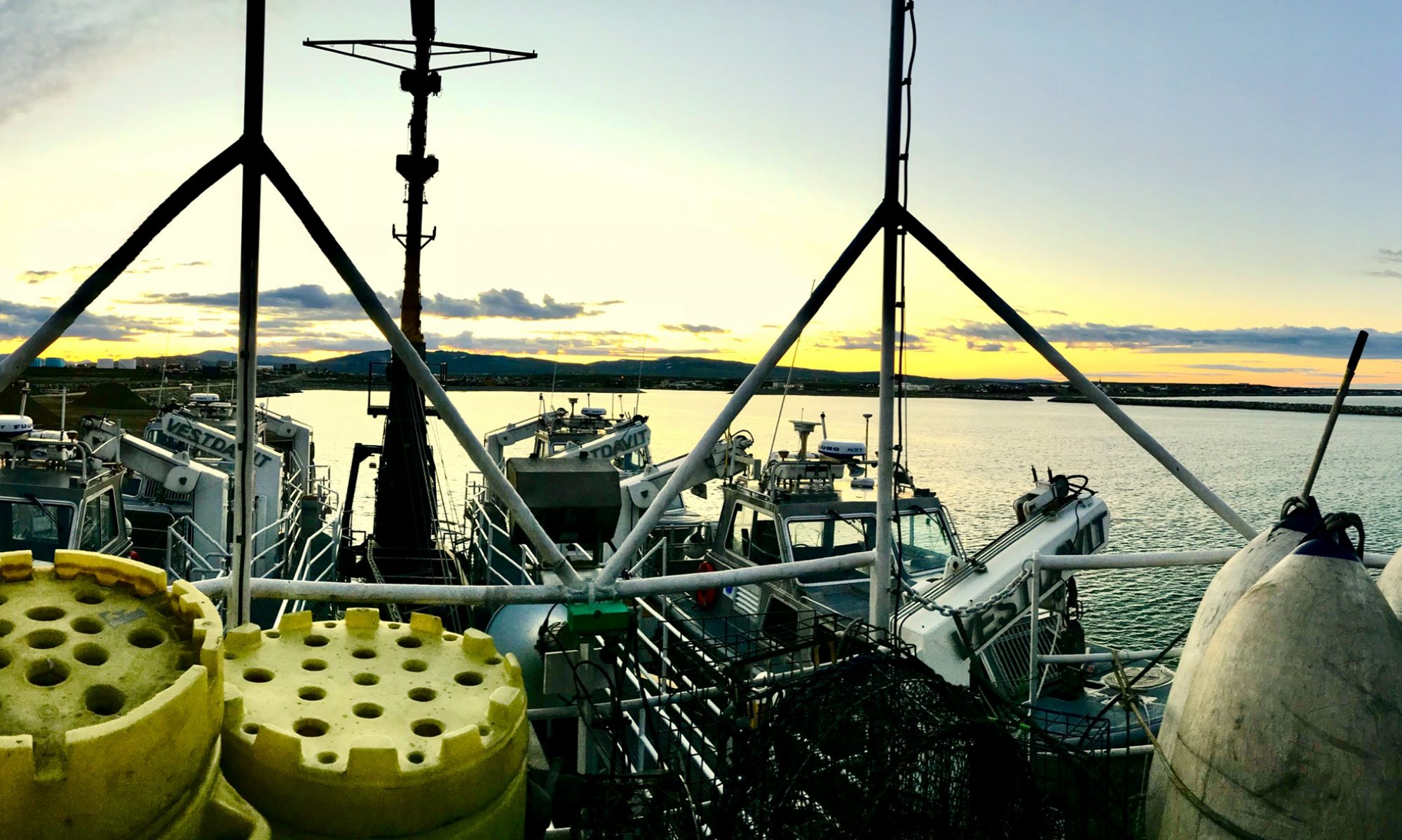
Survey launches being stored on NOAA Ship Fairweather as well as one deployed in the harbor
TAS Elli Simonen aboard one of the survey launches.
Calibrating the Data
During our time in port we took out some of the survey launches to perform a patch test; that is, calibration procedures to ensure the data we collect is as accurate as possible. A correctly calibrated system will show the same mapping of the seafloor in repeated tests, without the influence of confounding variables – speed, direction and ship motion. In a patch test, time delay, pitch, roll and heading are calculated multiple times over different depths, obstructions and slopes on the seafloor and compared to known data. The obstruction we surveyed was a shipwreck.
Planning the Patch Test
Map of the planned surveys for the Patch Test.
Survey Data showing the Wreck
To correct for how the speed of sound changes in ocean water, during surveying every four hours Conductivity, Temperature and Depth (CTD) is measured. The CTD measures Salinity and Pressure of the Water Column, aspects that can change the speed of sound. The CTD is used to further calibrate data because different depths have different levels of salinity and temperature, and therefore distort how fast the sound travels. CTD data is used in post-processing to correct for any distortions.
CTD on the survey launches.
Moving Vessel Profiler (MVP), a type of CTD that can be used while the ship is in motion, being deployed on NOAA Ship Fairweather by members of the surveying team.
Where does the data go?
Once the survey technicians gather bathymetry data, they still need to edit it before passing it along to National Centers for Environmental Information (NCEI), who package it for public view and is the data repository for environmental data in the U.S. and the U.S. Office of Coast Survey who create navigational charts. Editing the data involves rejecting spurious noise that MBES picked up that is out of range or incorrect. This data then is transformed into charts and more standardized bathymetry data.
Survey Technician showing TAS Elli Simonen the process of cleaning survey data
Personal Log
Members of the survey team are all smart, respectful and patient and take the time to explain to me the science at play no matter how many questions I have. I spend the majority of my day with the survey team but also explore other areas of the ship. I have now been onboard for over a week and things are beginning to feel routine. The sun does not set here until about 10:30pm and rises around 6am. Meals are served at regular times and more importantly, at least to me, coffee is available 24/7.
This is TAS Elli’s room aboard NOAA Ship Fairweather at 9:45pm
Mission: Microbial Stowaways: Exploring Shipwreck Microbiomes in the deep Gulf of Mexico
Geographic Area: Gulf of Mexico
Date: June 24-25, 2019
Science Log
On Monday I was introduced to the R/V Point Sur in Gulfport, Mississippi. Every nook and cranny of this vessel is packed, and it took the science crew most of the day to pack it even fuller with all the equipment they need. The largest single item is the remotely operated vehicle (ROV) Odysseus which makes a large footprint on the back deck. Over it hangs an enormous pulley that will be used to lift Odysseus in and out of the water.
R/V Point Sur in port
This the ROV Odysseus waiting to be deployed on a shipwreck. It’s as eager as I am to see it operate. It looks like it is ready to jump in!
When I arrived at the port, I met Dr. Leila Hamdan, the Chief Scientist, and some of the crew. We have two Rachels on board and they are both graduate students studying microbial biomes. Over time a layer of microbes form a “biofilm” on different kinds of wood and metal. This organic layer forms on the surface of a shipwrecks, and this is what the scientists are studying. They want to know how this layer speeds up or slows down the corrosion of shipwrecks and how other organisms use this habitat.
I was able to join in and help put together microbial recruitment experiment towers, or MREs for short. Each tower is a PVC pipe fitted with samples of wood, both oak and pine, and some metal samples. Each of these pipes fits loosely inside a second pipe, and then each set is roped together and attached to a float. Each tower is rigged in such a way that it will sink to the sea floor vertically, and then the outer pipe will rise to expose the inner tower and the sample plugs. After four months, the MREs will be retrieved, and the scientists will be studying what kinds of microbes grew on the samples. Their experiments add to our understanding of how shipwrecks act as a habitat for corals and other organisms
Here we are putting together one of the MREs which will be sent to the ocean floor near one of the shipwrecks.
Finally, at the end of the day we had to quickly load the last of the gear on the ship before a huge container ship of bananas arrived to dock in our space. We set up a “fire line” to hand the last of the gear into the ship as fast as possible. We could see the huge Chiquita banana ship heading our way. The port was already stacked four high with Chiquita banana shipping containers and more bananas were coming! Who is eating so many bananas?!
As the newbie member of the crew, I was allowed to stay on board as the crew moved the ship from the large loading dock to the smaller pier on the other side of the port. This meant I got a taste of the ocean breezes that are going to help keep us cool once we leave land. I saw pelicans glide low over the water as I stood on the deck and imagined all the new and amazing things I am about to see and do.
Day 2
If you’ve never been to Mississippi in the summer, I can tell you it is HOT and HUMID. It’s hard to imagine until you try to actually do something in it. If you were an egg, you would definitely fry on the sidewalk. Despite the heat, all over the ship crew and scientists are working, bolting things together, greasing mechanical parts, putting last minute touches on their experimental equipment, organizing the lab and working at laptops. To mitigate the heat and humidity outside, the air-conditioning runs on high inside the ship. This helps to keep the humidity from damaging the equipment, as well as to keep the crew happy. So it is actually COLD in here!
In addition to all this activity, a group of high school students visited the ship. They are participating in The Ocean Science and Technology Camp to learn about marine science careers and they will be tracking our progress from shore. Each of our many talented scientists shared a bit about their research and their roles in the ship. I will share more about that in another blog. We are scheduled to leave tonight at 1930 hrs, that’s 7:30PM for most of us! Stay with me, it’s going to be awesome!
Rachel explains how core samples are taken to summer camp students.
Mission: Microbial Stowaways: Exploring Shipwreck Microbiomes in the deep Gulf of Mexico
Geographic Area: Gulf of Mexico
Date: June 13, 2019
Introduction
In just two weeks I will be shipping out of Gulfport, Mississippi on the University of Southern Mississippi Research Vessel Point Sur. As a NOAA Teacher at Sea, I will actually be a student again, learning all I can about ocean archaeology and deep-sea microbial biomes. I feel very lucky to have this opportunity to learn what it is like to live and work at sea! In particular, I am looking forward to seeing how archaeologists work at sea. My undergraduate degree was in archaeology and I worked in the desert of New Mexico and southern Colorado where we mapped with pencil and paper, and took samples with a shovel. Ocean archaeology will require more sophisticated technology and a different approach!
Let me give you a little background about myself. My husband and I live in a tiny town called Husum on the White Salmon River in Washington State. My family enjoys outdoor activities including rafting and kayaking. This year my daughter is working as a raft guide on the White Salmon. I know when the commercial raft trips are passing by because I can hear the tourists scream as their boats go over Husum Falls! My son is studying Engineering in college and is spending this summer in Spain learning Spanish and surfing. Unfortunately for my husband, summer is the busy time for construction. As a general contractor, he will be working hard.
The whole family rafting the Deschutes River in Oregon, hmmm… quite a few years ago, but we still love it!
During the regular school year, I teach fourth grade math and science at the local intermediate school. One of our biggest science units each year is to raise salmon in the classroom and learn about the salmon life cycle, adaptations and the importance of protecting salmon habitat. In addition, this year we tackled a big project around plastic pollution in the oceans and how we can make a difference in our own community through education and action. My students are rightfully indignant about the condition of our oceans, and I have also become an ocean advocate since initiating this project.
Kids made scientific drawings of salmon, and then painted and stuffed them. They swam around the classroom ceiling all year!
Scientists on the Point Sur have several goals. First of all, they will map two shipwrecks that have never been explored. Both are wooden-hulled historic shipwrecks that were identified during geophysical surveys related to oil and gas exploration. Archaeologists hope to determine how old the ships are, what their purpose was, and their nationality, to determine if they are eligible for listing on the National Register of Historic Places (NRHP). A third shipwreck we will visit is a steel-hulled, former luxury steam yacht that sank in 1944. It was previously mapped and some experiments were left there in 2014 which we will recover.
In addition to mapping, we will take samples of the sediments around the ships to see how shipwrecks shape the microbial environment. The Gulf of Mexico is a perfect place for this work because it is rich in shipwrecks. Shipwrecks create unique reef habitats that are attractive to organisms both large and small. I wonder what kinds of sea life we will discover living around the shipwrecks we visit?
The first question my students asked me was if I was going to scuba dive. While that would be exciting, it’s not allowed for Teachers at Sea! To gather information about the shipwrecks, we will deploy a remotely operated vehicle (ROV) called Odysseus (Pelagic Research Services, Inc.) . Odysseus will have a camera, a manipulator arm to gather samples, a tray to carry all the sampling gear and SONAR and lights. I think I will be content to watch its progress on the ship’s video screens.
School is almost out, and my fourth graders are chomping at the bit to get out if the classroom and begin their own summer adventures, but I hope they will follow my blog and keep me company while I am on board ship! Am I feeling a little intimidated? Absolutely! But also very excited to have the opportunity to participate in what is sure to be a great adventure.
Mission: Conduct ROV and multibeam sonar surveys inside and outside six marine protected areas (MPAs) and the Oculina Experimental Closed Area (OECA) to assess the efficacy of this management tool to protect species of the snapper grouper complex and Oculina coral
Geographic Area of Cruise: Continental shelf edge of the South Atlantic Bight between Port Canaveral, FL and Cape Hatteras, NC
Date: May 19, 2018
Weather from the Bridge Latitude: 29°55.8590’ N Longitude: 80°16.9468’ W Sea Wave Height: 2-4 feet Wind Speed: 18.1 knots Wind Direction: 210.6° Visibility: 1 nautical mile Air Temperature: 25.3°C Sky: Overcast
Science and Technology Log
Extra Operations- Zodiac Hurricane Fast Rescue Boat:
Occasionally these Fast Rescue Boats are used for more than real emergencies and drills, practicing the pick-up of a man-overboard and rescue diver missions, in the case of day 2 of my trip on NOAA Ship Pisces, a camera replacement part became necessary. When a small crew change is needed or to pick up a repair part for an essential item, instead of bringing the ship to dock, the FRB (Fast Rescue Boat) is sent in.
Lead Fishermen, Farron “Junior” Cornell was the FRB coxswain (driver/operator of a ship’s boat
The LF or Lead Fishermen, Farron “Junior” Cornell was the FRB coxswain (driver/operator of a ship’s boat). His navigation skills were developed by working in the hydrographic division that performs regular bathymetry readings using these vessels on NOAA Ship Thomas Jefferson, making him a very capable pilot of this small watercraft in the NOAA fleet. The FRB has seating for 6, with 2 aft of console, 1 forward of engine cover, 2 sitting on foredeck on engine cover and 1 prone on deck by stretcher.
Some other specs on the boat includes the following: Length overall=6.81 meters including jet Beam overall=2.59 meters Fuel capacity=182 litres (48 US Gal) Bollard Pull ~600 kg/5884 N Endurance (hours @ 20 knots)~6.75 hours Max Horse Power=235kW, 315 hp At Light Load Operation Displacement = 2150 kg/4750 lbs Full Speed ~32 knots Fuel System =48 US gallon tank
Zodiac Hurricane H638 DJ, USCG Approved Fast Rescue Boat (FRB) with Miranda Hoist System
Zodiac Hurricane H638 DJ, USCG Approved Fast Rescue Boat (FRB) with Miranda Hoist System
Zodiac Hurricane H638 DJ, USCG Approved Fast Rescue Boat (FRB) with Miranda Hoist System
Engine Room Tour Pictures and Learnings:
Daily Duties: Freshwater Needs– Reverse Osmosis and Evaporators
Freshwater is necessary for a variety of reasons beyond drinking water for the crew. It is used for laundry, cooking, showers and on NOAA Ship Pisces, to fill the ballast water tanks. Approximately 31 gallons of freshwater is used on average per person per day, with 29 people on board for 12 days, totaling nearly 11,000 gallons by the end of the trip. One method to supply this freshwater supply is through reverse osmosis. Osmosis is the diffusion of water across a membrane.
Normally water moves, without an energy input from high to low concentrations. In reverse osmosis, water is moved in the opposite direction of its natural tendency to find equilibrium. The force at which water wants to move through the membrane is called its osmotic pressure. To get water to move against the osmotic pressure another force must be applied to counteract and overcome this tendency. Sea water is found in abundance and can be forced across a semi-permeable membrane leaving the ions on one-side and the freshwater to be collected into containment chambers on the other side. Technology has impacted this process by discoveries of better semi-permeable membranes that allow for faster and larger amounts of sea-water to be moved through the system. Pisces uses reverse osmosis and a back-up freshwater system of 2 evaporators. When the temperatures are high (as they were in the first few days of the cruise) the evaporators are the go-to system and make for tasty drinking water.
Evaporators take in sea water and distill the liquid water using waste heat collected from the engines that raises the temperature of water in the pipes. This temperature provides the energy that forces the liquid freshwater to vaporize and enter its gaseous phase, then under pressure this vapor is condensed and can be collected and separated from the brine that is removed and discharged.
Wastewater:There are different types of water that can be used for different tasks aboard a ship. Typically gray water (which is relatively clean wastewater from showers and sinks but may contain soaps, oils, and human hair/skin) is placed in the MSD (Marine Sanitation Device), which is similar to a septic system. Black water is wastewater from toilets, or any water that has come into contact with fecal matter and may carry potential disease carrying pathogens. Black water is also treated in the MSD. This black water sewage is first subjected to a macerator pump that breaks the fecal matter into smaller pieces, enzymes are added to further decompose and before disposal a bit of chlorine is added to ensure no bacteria remain alive. This water can be disposed of into the ocean if the ship is over 12 miles offshore. If the ship is within 12 miles the sewage must be either stored in containment system on board the vessel or taken to dock and disposed of by an in-shore treatment facility. For more information on the regulations for wastewater disposal while at sea see the Ocean Dumping Act.
Valves for ballast water tanks on NOAA Ship Pisces that are filled with freshwater to prevent the spread of nonnative species
Ballast Water and New Regulations: Ballast water tanks are compartments used to hold water to provide stability for the ship. This balance is necessary for better maneuverability and improved propulsion through the water. It can allow the crew to compensate and adjusts for changes in the ships cargo load or fuel/water weight changes over the course of a trip. Historically this water has been drawn up from the surrounding sea water to fill the tanks. Unfortunately, in the not so distant past, the ballast water from one location on the globe has been deposited into another area along with it, all of it foreign plants, animals and microbiota. This act led to the introduction of a host of exotic and non-native species to this new area, some of which became invasive and wreaked havoc on the existing ecosystems. Today there are a host of case studies in my students’ textbook like the Zebra Mussels (Dreissena polymorpha) and the European Green Crabs (Carcinus maenas) that were introduced in this way that resulted in devastating impacts both environmentally and economically to the invaded area.
The International Maritime Organization (IMO) passed new regulations in September of 2017 calling for better management of this ballast water exchange. Ballast Water Management Convention 2017.
Another high tech approach to this problem has been the development of a sea-water filtration systems, but these carry a heavy price tag that can range anywhere from $750,000 to $5 million.
The engine room area is staffed by 7 crew members. Back-up systems and the amount of en route repair necessary to keep the ship running and safe was apparent in the engine room. There were redundancies in the engines, HVAC, hydraulics, and fuel systems. Spare parts are stored for unexpected breaks or other trouble-shooting needs. The control panels throughout the tour had screens that not only allowed a check of every level of function on every system on the ship, there was another screen that demonstrated the electrical connections on how all these monitoring sensors were wired, in case a reading needed to be checked back to its source.
One of the 4 NOAA Ship Pisces CAT engines
Pictured here is a diesel engine on NOAA Ship Pisces. Pisces has 4 of these on board: 2 bigger engines that are CAT model 3512 vs. 2 smaller engines that are CAT 3508. When the ship is going at full steam they use 3 of 4 to provide power to turn the shaft, and when they need less power, they can modify their engine choices and power, therefore using less fuel. CAT engines are models 3512 and 3508 diesel driven at provide 1360 KW and 910 KW, respectively. There is also an emergency engine (CAT model 3306) on board as well providing 170 kw of power.
Control panel of screens for monitoring and controlling all mechanical and tank/fluid functions
Steven Clement, first assistant engineer, is showing me some of the hydraulics in the engine room.
The pressurized fluid in these pipes are used to move devices. Pisces is in the process of converting certain hydraulic systems to an organic andbiodegradable “green” oilcalled Environmentally Acceptable Lubricants (EALs).
The Bridge
NOAA Ship Pisces’ Bridge
This area is command central. I decided to focus on only a few features for this blog from a handful of screens found in this room that monitor a variety of sensors and systems about both the ships conditions and the environmental factors surrounding the ship. Commanding Officer CDR Nicholas Chrobak, NOAA demonstrated how to determine the difference on the radar screen of rain scatter vs. another vessel. In the image the rain gives a similar color pattern and directionality, yet the ship appeared more angular and to have a different heading then those directed by wind patterns. When clicking on the object or vessel another set of calculations began and within minutes a pop-up reading would indicate characteristics such as CPA (closest point of approach) and TCPA (Time of Closest Point Approach) as seen in the image.
Scanned Maps and monitors help to prevent collisions
ECDIS (Electronic Chart Display and Information System)
These safety features let vessels avoid collisions and are constantly being calculated as the ship navigates. GPS transponders on the ships send signals that allow for these readings to be monitored. ECDIS (Electronic Chart Display and Information System) charts provide a layered vector chart with information about the surrounding waters and hazards to navigation. One screen image displayed information about the dynamic positioning system.
ECDIS (Electronic Chart Display and Information System)
Paths and positions can be typed in that the software then can essentially take the wheel, controlling main propulsion, the bow thruster and rudder to keep the ship on a set heading, and either moving on a desired course or hold in a stationary position. These computer-based navigation systems integrate GPS (Global Positioning System) information along with electronic navigational charts, radar and other sailing sensors to ensure the ship can navigate safely while effectively carrying out the mission at hand.
The Mess Deck and Galley:
This location serves up delicious and nutritious meals. Not only do the stewards provide the essential food groups, they provide vegetarian options and make individual plates for those that may miss a meal during shift work.
The mess
Dana Reid, who I interviewed below, made me some amazing omelets on the trip and had a positive friendly greeting each time I saw him. I decided a few days into the cruise to start taking pictures of my meals as proof for the nature of how well fed the crew is on these adventures.
crab legs was one of my favorites- I went back for seconds
Breakfast of champions
Every day there was some sort of fish choice
chicken fried steak and the gumbo were especially tasty
Omelettes to order
There were occasional green things on my plate
Menu items for each day posted on NOAA Ship Pisces
Menu Screen on the Mess Deck
Steward CS Ray Mabanta and 2C Dana Reid in the galley of NOAA Ship Pisces
Each day a new screen of menus appeared on the ship’s monitors, along with other rotating information from quotes, to weather to safety information.
Personal Log
Today a possible shipwreck is evident on the sonar maps from the previous night’s multibeam readings. If weather permits, the science team plans to check out the unknown structure en route to the next MPA. This scientific study reminds me of one of the reasons I fell in love with science. There is that sense of discovery. Unlike pirates and a search for sunken gold, the treasure to be found here is hopefully a diversity of fish species and thriving deep coral communities. I found myself a bit lost during the discussions of fishing regulations for these areas designated as MPAs (Marine Protected Areas). I had always thought ‘protected’ would mean prohibitive to fishing. So I did a little research and will share a little of the basics learned. And I hope someday these regulations will become more restrictive in these fragile habitats.
The MPA , “marine protected area” definition according to the implementation of an Executive Order 13158 is “…any area of the marine environment that has been reserved by federal, state, territorial, tribal, or local laws or regulations to provide lasting protection for part or all of the natural and cultural resources therein.” But what that actually means in terms of the size of the area and approach to conservation, or the level protection and the fishing regulations seems to vary from location to location. The regulations are governed by a variety of factors from the stakeholders, agencies and scientists to the population numbers and resilience of the habitat to distances offshore.
For more information on MPAs visit https://oceanservice.noaa.gov/facts/mpa.html
Did You Know? Some species of coral, like Ivory Tree Coral,Oculina varicosa, can live without their zooxanthellae.
Oculina varicosa
Very little is known about how they do this or how their zooxanthellae symbiotic partners return to their coral home after expulsion.
Fact or Fiction? Oculina varicosa can grow to up to 10 feet high and have a growth rate of ½ inch per year. Check out the scientific validity of this statement at one of the following links:
What’s My Story? Dana Reid The following section of the blog is dedicated to explaining the story of one crew member on Pisces.
Dana Reid pictured here in the scullery, the ship’s kitchen area for cleaning dishes
What is your specific title and job description on this mission? Second Cook. His job description includes assisting the Chief Steward in preparing meals and maintaining cleanliness of the galley (kitchen), mess deck (tables picture where crew eats), scullery (part of the kitchen where dishes get washed) fridge/freezer and storage areas.
How long have you worked for NOAA? 5th year
What is your favorite and least favorite part of your job? His favorite part of this job is getting a chance to take care of people, putting a smile on people’s faces and making them happy. His least favorites are tasks that involve standing in the freezer for extended periods of time to stock and rotate foods. In addition he mentioned that he isn’t too fond of waking up very early in the morning.
When did you first become interested in this career and why? His initial food as a career-interest started when he was in high school working for Pizza Hut. He later found himself working for 2 years cooking fried chicken for Popeyes. His interest in the maritime portion of his career also began right after high school when he joined the Navy. In the Navy he worked in everything from the galley to a plane captain and jet mechanic. During his time in the Navy he worked on 5 different carriers and went on 9 different detachments including Desert Storm. After hurricane Katrina in 2006 he found himself interested in finding another job through government service and began working on a variety of NOAA’s vessels.
What is one of the most interesting places you have visited? He found the culture and terrain of Oahu one of his most interesting. He enjoys hiking and Hawaii, Alaska and Seattle have been amazing places to visit.
Do you have a typical day? Or tasks and skills that you perform routinely in this job? He spends the majority of his time prepping (washing and chopping) vegetables and a majority of his time washing dishes. In addition he is responsible for keeping beverages and dry goods stocked.
Questions from students in Environmental Science at Camas High School
How is cooking at sea different from cooking on land? He said that he needs to spend more effort to keep his balance and if in rough weather the ship rocks. This impacts his meal making if he is trying to cook an omelet and if mixing something in keeping the bowl from sliding across the prep table. He mentioned that occasionally when baking a cake that it might come out lopsided depending upon the angle of the ship and timing of placement in the oven.
What do you have to consider when planning and cooking a meal? He plans according to what meal of the day it is, breakfast, lunch or dinner. The number of people to cook for, number of vegetarians and the part of the world the cruise is happening in are all factored in when planning and making meals. For example, when he has been in Hawaii he’d consider cooking something more tropical – cooking with fish, coconut and pineapple; if in the Southeast they tend to make more southern style cooking, sausage/steak lots of greens; if in the Northeast more food items like lobster and clam chowder make their way onto the menu.
What is the best meal you can make on the ship, and what is the worst? He said he makes a pretty good Gumbo. He said one of his weakness is cooking with curry and said that the Chief Steward is more skilled with dishes of that flavor.
How many meals do you make in a day? 3; In addition he hosts occasional special events like ice cream socials, banana splits or grilling party with smoker cooking steaks to hamburgers on the back deck.