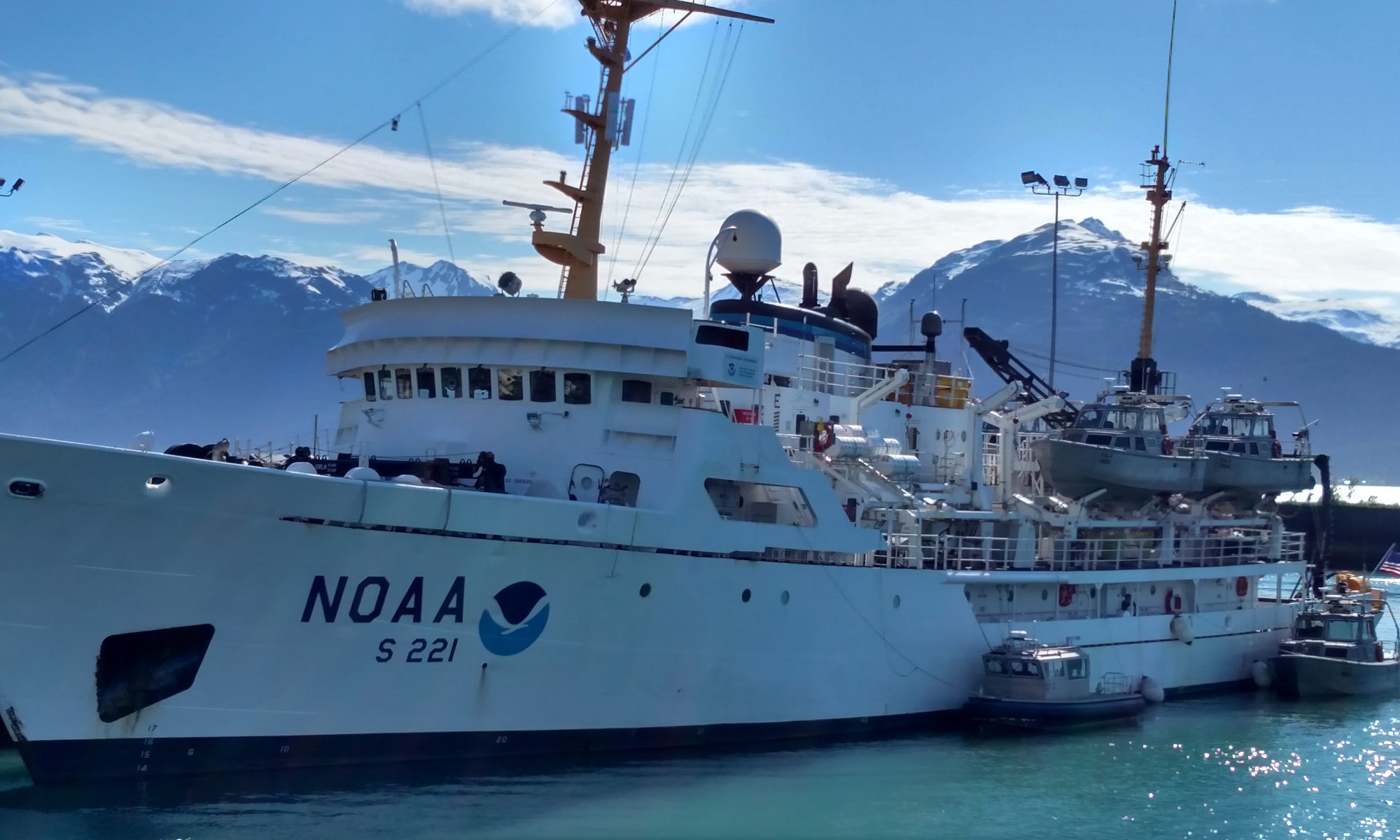
Helen Haskell: Life on a Ship, June 7, 2017

NOAA Teacher at Sea

Helen Haskell

Aboard NOAA Ship Fairweather

June 5 – 22, 2017

Mission: Hydrographic Survey

Geographic Area of Cruise: Southeast Alaska – West of Prince of Wales Island 

Date: June 7, 2017

Weather Data from the Bridge:

Latitude: 55 04.473 N

Longitude: 133 03.291 W

Wind: 9 knots from the east

Air temperature: 17C

Visibility: 10 miles

Barometer: 1004.2 hPa

Science and Technology Log

The mission of the Fairweather is to conduct hydrographic surveys for nautical charting. The Fairweather does this work in the waters off the United States Pacific coast, but principally in Alaskan coastal waters. The data is collected using sonar both by the Fairweather but also using a series of smaller boats that are launched as often as possible, each with a small crew of 3-4 people. These smaller boats are able to conduct the surveys much closer to the shoreline, and spend about 8-9 hours each day surveying a specific region. Many of the waters up here have had no recent data collected, and mariners are relying on charts that may have measurements taken in the 1800’s or 1900’s when technology was very different.

IMG_0282
NOAA Ship Fairweather

During the field season, Fairweather spends about 210 days at sea. During the rest of the year, the Fairweather stays at her homeport, allowing the crew to work on maintenance issues, take leave, work on the data and outfit the boat for the following season. During the field season, the boat conducts different legs of the research, spending 12-20 days out at sea at a time before returning to a port to re-supply. There are six departments on the ship: Command, Deck, Electronics, Engineering, Steward and Survey. Each person on the ship is hired with specific duties and responsibilities.

As a government vessel, the Fairweather is also available for use during the time of war or in case of an emergency. In the event of something along these lines, the ship and the officers would be transferred to the Armed Forces of the United States.

The Fairweather is named after the tallest peak in the Fairweather range in Alaska. The ship served in Alaskan waters for over 20 years but was decommissioned in 1988. In 2004, due to increasing demand for modern surveys in Alaska, it was retrofitted and put back in to the research fleet. Previously staterooms housed up to 4 people, but after the retrofit a maximum of two people share a room. The boat can house 58 people in 24 single staterooms and 17 double staterooms. The boat itself is 231 feet in length and 42 feet wide. Its cruising speed is 13 knots, with a survey speed of 6-10 knots.   The Fairweather has 7 levels, A-G, each containing many rooms and areas essential to the mission of this ship. Wires and pipes run throughout the ship with sensors monitoring equipments, sensors ready to trigger if needed. Lower levels of the ship contain tanks, ballast and engines. Diesel, drinking water and grey water are stored in the tanks. The next three levels contain staterooms, lots of machinery and storage, the Mess, the Galley, laundry, labs, the sick bay and one deck with small boat storage. The last two levels contain the ships Navigation Bridge, the data processing center, electronics office, and lots more equipment.

Personal Log

A few days in to my journey with the ship, things are starting to make more sense. While there are still doors I haven’t opened and rooms I am sure I have not been to, I feel that I am getting a better sense of the Fairweather and how it works, the roles that people play, and a slightly better understanding of what it means for home to be a ship.

There is a lot going on. Unlike many of the fisheries boats, where science staff works on a shift system, here on the Fairweather, much of the hydro data acquisition needs to be done on the small vessels during daylight. After the 8am meeting, boats are launched and the survey crew leave for the day. Meanwhile the rest of the scientists and survey crew works with the previously acquired data. Shift systems are in operation for most of the rest of the staff. There are always engineering projects and issues to sort out on a boat of this size, and engineers are always available and always problem solving. There are always NOAA Corps officers and deck crew on the bridge to monitor the ship and coordinate communication. From early in the morning there is always food to prepare, parts of the ship to be cleaned and decisions to be made, reviewed and modified. Somewhere around 4:30pm the survey boats return. Meal times and group meetings are places where most of the crew comes together to hear about how the day has gone and what is needed for the next day. After dinner, there is still work to be done. The day’s data needs to be processed in order for the plans for the next day to solidify. Small boats are checked after their day in the water, re-fueled and parts fixed if need be. After working hours the ship is patrolled hourly to make sure equipment is working and things are safe.


In between all these jobs, the crew does have down time. Those on a shift system hopefully manage to get some decent sleep, even if it is daytime. Laundry gets done. Personal emails are sent to communicate with families. Movies are watched in the lounge/conference room. Showers happen. People visit the exercise room. The ships store opens up for a while each night, allowing crew to splurge on a bag of chips or a candy bar. So, it’s a busy place. Whether it’s visible or not, there are always things going on.


In some very simple ways it is no different to your home or mine. There is food, shelter and water. In most other respects, it is very far removed from living on land. Most people don’t have breakfast, lunch and dinner with their work colleagues. Here we do. Most people don’t have bedrooms without windows in them. Here we do. Most people don’t have the floor swaying beneath their feet due to wave action. Here we do. And for what it’s worth, most people don’t get to look over the deck and watch curious sea otters swim by, knowing that a whale may breach any minute. Here we do.


Fact of the day:

NOAA has nine key focus areas: Weather, Climate, Fisheries, Research, Satellites, Oceans and Coasts, Marine and Aviation, Charting and Sanctuaries. NOAA employs 12,000 people worldwide, of which 6,773 are scientists and engineers studying our planet. NOAA’s roots began over 200 years ago with the establishment of the U.S. Coast and Geodetic Survey by President Thomas Jefferson. In 1870 the Weather Bureau was formed closely followed by the U.S. Commission of Fish and Fisheries. In 1970 these three organizations became the beginning of NOAA. For more information: http://www.noaa.gov/about-our-agency

Word of the day: Knot

Knot, in nautical terms is a unit of speed.  One knot is the equivalent of going one nautical mile per hour.

What is this?

What do you think this is a picture of? (The answer will be in the next blog installment).

IMG_0269

(Previous answer: The picture is of a light and whistle that are attached to my PFD (personal flotation device).

 Acronym of the Day

MPIC: Medical Person In Charge


Richard Jones & Art Bangert, January 20, 2010

NOAA Teacher at Sea
Richard Jones
Onboard NOAA Ship KAIMIMOANA
January 4 – 22, 2010

Mission: Oceanographic Survey
Geographical Area: Hawaiian Islands
Date: January 20, 2010

Science Log

Steaming and dreaming, that was the order of the day. We had the opportunity to spend a little more time on the bridge today. Here you can see three of the Ensign’s standing watch. While on the bridge we learn about how the radar works.
Learning about radar on the bridge
Most people in Montana are familiar with the concept of radar since that is the basic method used to measure our speed.What do you think is similar about the radar on the ship? What is different?
Radar screen
Radar screen
We also took a look at the ship’s wheel.Like most people we envisioned the wheel to be like one you would see in an old movie or perhaps like those on the tall ships of old. The wheel of the KA is smaller than the average steering wheel, but it gets the job done.
Steering the ship
Steering the ship
 We participated in several meetings to prepare us for our stay in Samoa.One presentation, made by Joe our Electronics Technician was focused on customs and taboos that we need to be aware of as guests and representatives of the US government. Joe has a unique and useful understanding of Samoa since his wife is from Western Samoa and he has lived here so he knows what we can and can’t do.
Laundry at sea
Laundry at sea
We also decided we better do laundry today! The washers and dryers will be secured tonight for our arrival in Samoa tomorrow morning. While the crew visits the island, the engineers will need to purge the sewage system of gray water – water from cooking, showers, toilets etc. The ship will also take on water from the port at Apia, Samoa were we are docking. The ship has great laundry facilities and also very nice exercise equipment. Even though we are seeing the pacific, we still have to take of our chores!
Joe, the electronics technician
Land tomorrow! Until then happy sailing and calm seas.

Ruth Meadows, July 9, 2009

NOAA Teacher at Sea
Ruth S. Meadows
Onboard NOAA Ship Henry B. Bigelow 
June 12 – July 18, 2009 

Mission: Census of Marine Life (MAR-Eco)
Geographical Area: Mid- Atlantic Ridge; Charlie- Gibbs Fracture Zone
Date: July 9, 2009

Venda, Shannon and Amy cleaning the baskets.

Weather Data from the Bridge 
Temperature: 14.2o C
Humidity: 61%
Wind: 6.5 kts

Scientific and Technology Log 

One of the last things to be completed before arriving in Newport, Rhode Island is a final clean up of the lab. Once all the sampling is finished it is important to leave all the equipment used in good shape for the next cruise. Everyone from both watches worked together to get everything clean. The baskets and trays that were used to hold the samples were scrubbed down and rinsed off. Luckily, the day was beautiful for working outside.

Shannon and I help Tom clean his suit.

While some of us cleaned the baskets, others rinsed them off and then placed them in the sun to dry.  Once they were dry, then they were returned to the correct location for storage. Once the baskets were cleaned the next step was to clean our foul weather gear.  These overalls and jackets had been used while collecting samples and they had all types of “dirt” on them, from “fish guts” to grease from the cables.  The easiest way to clean them was to scrub them while you had them on.  Someone would help make sure the back was clean and then someone would spray them with clean water.  It was simple, effective and fun all at the same time.

The serving line.
The serving line.

Personal Log 

Mealtime is a very important time aboard the ship.  Not only do we eat a variety of foods, but it is also a time when both the scientific crew and the working crew get a chance to talk and visit with each other.  The galley is a large open room with tables bolted to the floor to keep them from moving.  Some tables are for four people and others are for eight.  Each day the menu is posted before the food line and you may select what you want and how much.  There are usually two entrées (main dishes) and several side dishes to go along with them.  In addition, there is a fruit and salad bar that you can select. At the end of the cruise, you notice that some of the menu that some of the menu items have changed – we are out of lettuce and ketchup. We have been at sea for four weeks and some things just can’t be kept fresh that long. We still have apples, oranges, nectarines and ice cream!

The mess hall
The mess hall 

John Schneider, July 5, 2009

NOAA Teacher at Sea
John Schneider
Onboard NOAA Ship Fairweather 
July 7 – August 8, 2009 

Mission: Hydrographic Survey
Geographical Area: Kodiak, AK to Dutch Harbor, AK
Date: July 5, 2009

Position 
USCG Pier – Kodiak, AK

Personal Log 

Slept in some for a little fly-time recovery.  Once I got up (about 0900) I went up to the mess and had a cup of coffee and worked on yesterday’s log.  While doing so I met several members of the crew, most of who were up to doing something on an off day.  Hikes, chiropractor visits, shopping, etc. were all on the agenda. The engineers, however, were working down below in the engine room in preparation for our departure scheduled for the morning of the 7th.

When in port in Kodiak, the Fairweather has access to a van and a couple of vehicles for ship’s work and transportation to and from the town of Kodiak.  The “liberty van” runs every hour on the hour into Kodiak and back on the half hour.  Being new to the ship (and Alaska) I thought it would be a cool, scenic idea to walk into town.  A couple miles later, I changed my mind and resorted to something I hadn’t done in 30 years – hitchhiking (turns out it’s about 6••• miles!).  I got picked up by a local guy who moved to Kodiak 20+ years ago.  He took me all the way in to the commercial fishing docks and I walked the remaining quarter mile.  On Shelikof Road I went to Kodiak Marine Supply and bought a couple of charts for the areas we will be surveying.  I will use these to plot our positions whenever I get them from the bridge.

My cabin door.
My cabin door.

Once in town I had a great lunch with two of the crew – Ron and Mark – at a place called Henry’s. The crew members seem to migrate there for the food, although they all prefer eating on board the Fairweather. My ship is blessed to have 3 chefs in the steward’s department.  Two are graduates of the Culinary Institute and the third is out of Johnson and Wales!  I can’t wait to get under way!  On my second trip into town (this time by the liberty van,) Tami, a member of the survey team, told me she had rented a car on the island and was real glad to have done so.  I figured that was good advice and rented a small car for a day.  By the time I had gotten back to the Fairweather I had put on over 100 miles just driving around one side of the island.  Tomorrow I’ll put on some more miles and return the car in the late afternoon.  I went by Kodiak High School and Middle School and hope to stop into their board/district offices just to see what’s overtly similar and dissimilar to home. I’m all unpacked and settled in.  It’s 2330 hrs so I’ll have a glass of water and turn in.

Hanging locker and fold-away desktop.

I’m on C-Deck (the 3rd deck up from the bottom of the ship.) To the right in the picture is my hanging locker, then the top shelf folds into a desktop (on which I am writing now) and below it are 3 drawers for clothes.  The door to the left is the head and shower which I share with 1 other crew member.   In the photo, you can see the TV and dish network box to the left.  Below the bed are 2 more drawers.  Even though the space may appear small, I could easily move in here and have all the comforts of home.  Below that are a couple more shelves and an open space where my PFD (personal flotation device/life jacket) and immersion suit are stored.  At the upper left is a 10-minute air supply kit to be used in event of fire.  These kits are located all over the ship.

Kristin Joivell, June 23, 2009

NOAA Teacher at Sea
Kristin Joivell
Onboard NOAA Ship Fairweather
June 15 – July 1, 2009 

Mission: Hydrographic Survey
Geographical area of cruise: Shumagin Islands, Alaska
Date: June 23, 2009

The mess hall is a place where people tend to gather.

Weather Data from the Bridge  
Position: Northwest Harbor
Clouds: overcast
Visibility: 10 miles
Wind: 10 knots
Waves: less than 1 foot
Temperature: 8.5 dry bulb
Temperature: 7.2 wet bulb
Barometer: 1008.0

Science and Technology Log 

Disposing of all the trash made by people from eating, working, and other day to day tasks was something I was wondering about.  So, I asked crew members on the deck department how all this waste was disposed of. They showed me the incinerator.  The incinerator is the main device for dealing with waste management at sea, but if the amount of trash builds up too much, it is dealt with when the ship arrives back in port.

Here, I’m readying cardboard to be placed in the ship’s incinerator.  As you can see in the bottom right corner, trash tends to build up rather quickly. This picture was taken in the morning and the line up of trash to be incinerated was already building.
Here, I’m readying cardboard to be placed in the ship’s incinerator. As you can see in the bottom right corner, trash tends to build up rather quickly. This picture was taken in the morning and the line up of trash to be incinerated was already building.

The incinerator burns waste at very high temperatures of 850 degrees Celsius to 1150 degrees Celsius. If you’re not familiar with the Celsius scale (like me), you won’t realize that that equals 1562 degrees Fahrenheit to 2102 degrees Fahrenheit! The high temperatures are created using diesel as fuel with air vents helping to ventilate the fire as it burns.  The ash that is left when the waste is done burning takes up much less volume than the waste did and it is disposed of when the ship arrives back in port. There is a central location on deck near the incinerator for trash collection. Personal trash from state rooms can be placed there in bags for disposal.  The trash from the kitchen, deck, bridge, and survey departments are also place there. Workers from the deck department burn the trash in the incinerator periodically throughout the day. If the ship didn’t have an incinerator, the trash on board would build up very high and very quickly!  Each day since I came on board, there is a pile of waste to be incinerated. From cardboard boxes, to printer paper and food waste, to used rags from cleaning, most materials are disposed of in the incinerator.

The ship also has a collection area for recycling. There are collection bins for glass, metal, aerosol cans, and batteries in a central location near the mess hall. However, plastics are incinerated.  The temperatures in the incinerator are so high it seems that the plastic is basically vaporized. Naturally, there is also a filter on the exhaust pipe of the incinerator so that toxins do not enter the atmosphere. Additionally, the ship is going to begin recycling plastics in the near future.

Here I am examining the ship’s food stores.  This is the fresh fruit and vegetable section of the cooler, but there are many other sections as well.
Here I am examining the ship’s food stores. This is the fresh fruit and vegetable section of the cooler, but there are many other sections as well.

Personal Log 

People may be wondering how it is possible to feed almost 50 people everyday without stopping at the grocery store. I found that the Fairweather is well equipped to deal with everyone’s food needs and more!  I took a tour of the storage facilities and found them equivalent to a small grocery store.  There are stockpiles of dairy, meats, fresh fruit and vegetables, breads, freezer storage, and dry storage. According to the Chief Cook, the ship could theoretically sail for up to 60 days without going to a port if necessary.

Every day, there are three main meals and two between meal snack times offered. Fresh fruits and vegetables are in large supply; most foods are not prepackaged, but are created on the ship.  Vegetarian choices are available at every meal.  Coffee, tea, milk, water, and a variety of fruit drinks are always available any time of day or night.  Condiments in abundance are located on every table, too, and not just ketchup and mustard.  Different kinds of salad dressing are also available in the mess refrigerator at every meal.

The first meal of the day is breakfast.  Breakfast is served from 7 to 8 in the morning.  Each day at breakfast, there are a large variety of foods offered.  Today’s breakfast choices were as follows: fresh fruit, grits, bacon and ham, vegetarian sausage, French toast, hash browns, made to order eggs, breakfast sandwiches, and omelets, and hot and cold cereal.  I always get the fresh fruit because I love the blueberries and pineapple! Then, there is a midmorning snack offered sometime between breakfast and lunch.  These snacks are usually coffee cakes or breads. Today’s snack was apple bread with nuts.  It was made from scratch with fresh ingredients!

I chose a lemon blueberry jelly roll for dessert!  Yum!
I chose a lemon blueberry jelly roll for dessert! Yum!

Next, lunch occurs from 12 to 12:30pm.  Each day at lunch, there are usually salads, soup, a choice of two main courses with a vegetarian alternative, side dishes of pastas, potatoes, or rice, and a side dish of vegetables. Today’s lunch menu included the following:  kielbasa and kale soup, grilled reuben, grilled pastrami and Swiss sandwich, grilled cheese, and tater tots.  I love it that there is a vegetarian choice; even though I am not a vegetarian, I try to limit my meat intake. After that, an afternoon snack is offered sometime between lunch and dinner.  These snacks are usually cookies. Today’s snack was chocolate chip and peanut butter cookies. They were still warm when they were offered.

Finally, dinner is from 5 to 5:30.  Dinner choices include a main dish and a vegetarian alternative, a variety of side dishes, and a dessert prepared on the ship. As with all of the other meals and snacks, there is a focus on freshly prepared food instead of prepackaged items.  Today’s dinner menu included the following: mustard crusted rack of lamb, paella de marisco, herb cheese stuffed eggplant, creamy orzotto, sautéed bok choy, and lemon blueberry jelly roll for dessert. It’s hard to resist dessert because it’s so freshly made and delicious, so I usually have dessert at dinner, but avoid the two snack times during the day.

Additionally, the mess hall has facilities that are available for snacking at any time of the day or night. Salad ingredients, ice cream, frozen burritos and hot pockets, cold cereals, and fresh fruit are always ready to be eaten. If you’re not careful, you can be overwhelmed with all of the food choices on board and gain a lot of weight while at sea! Speaking to the crew about food is interesting.  Many of the crew has not so fond memories about “other” ocean ships that they have been on that did not offer such wonderful food choices.  Some crew members expressed the feelings that the morale of the crew basically depends on the food. I can see how a long trip at sea can be made more comfortable with the knowledge that the food will be great!

Create Your Own NOAA Experiment at Home 

NOAA ships use the Celsius scale to measure temperatures, but many people in the United States use the Fahrenheit scale.  You probably think of a day that is 100 degrees Fahrenheit outside as a hot, summer day, but did you know that this equals 37.8 degrees Celsius?  A cold, winter day is usually about 35 degrees Fahrenheit, but that is equal to 1.8 degrees Celsius. You can use a website from NOAA to easily convert Fahrenheit to Celsius and vice versa.  Just go to http://www.wbuf.noaa.gov/tempfc.htm and type a number into either the Fahrenheit or Celsius box. Then, click off the box and the temperature is automatically converted for you.  Try typing in temperature that you are familiar with like your body temperature (about 99 degrees Fahrenheit), the temperature that water freezes (32 degrees Fahrenheit), and the temperature that water boils (100 degrees Celsius).

You can also use a formula to convert temperatures.  This is helpful if you don’t have the internet.

For Fahrenheit to Celsius, use this formula
For Celsius to Fahrenheit, use this formula

Many thermometers also are scaled for both Fahrenheit and Celsius, so that you can read both temperatures on the thermometer itself.