David Babich, July 13, 2006

NOAA Teacher at Sea
David Babich
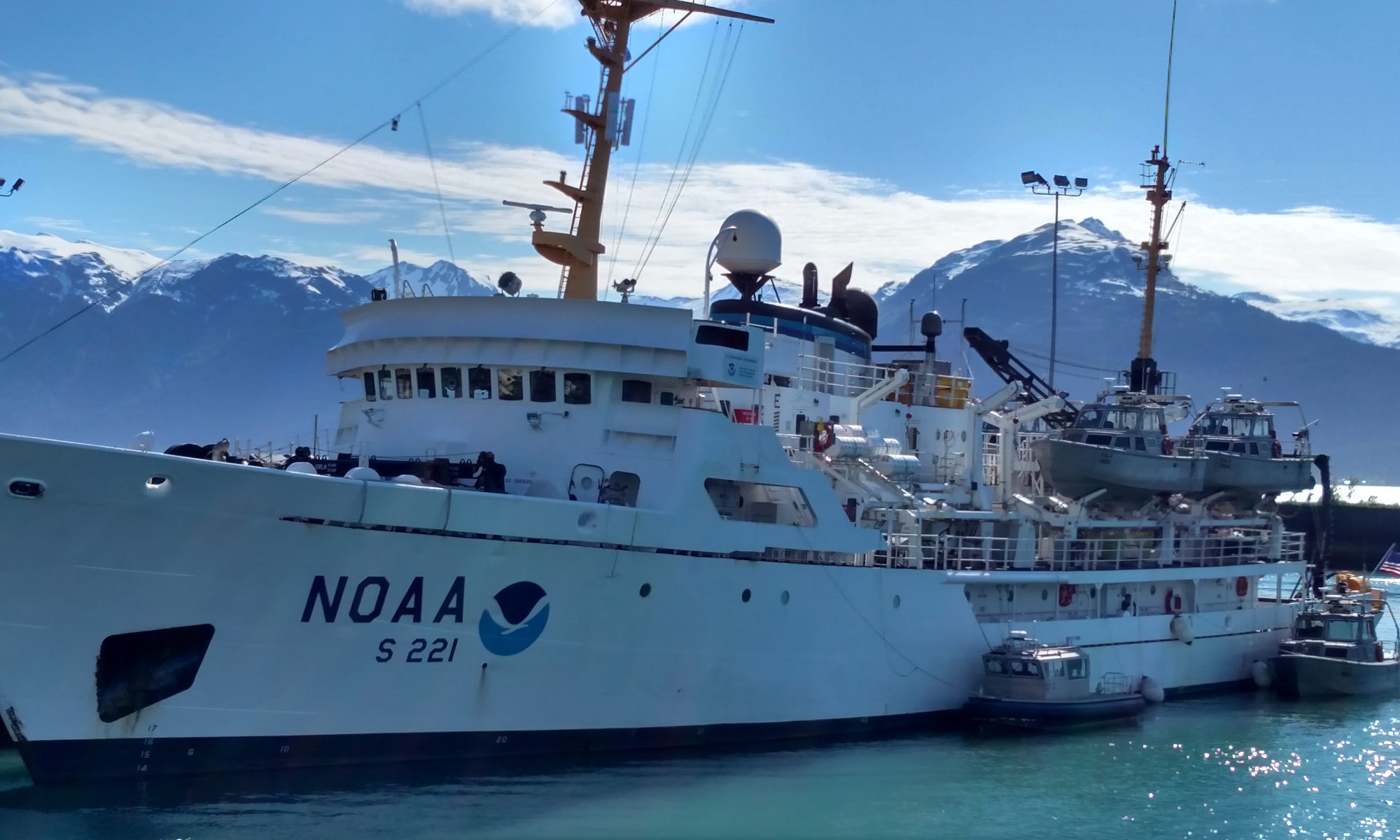
Onboard NOAA Ship Fairweather
July 5 -14, 2006

Mission: Hydrographic Survey
Geographical Area: Aleutian Islands, Alaska
Date: July 13, 2006

Weather Data 
WX Cloudy, fog
Wind  NW 20 kts
Sea 6ft
Temp 50’s

The Shumagin Islands’ spectacular scenery

Science and Technology 

For the past 30 hours the FAIRWEATHER has been on route back to port. We had beautiful weather most of the way back, which made it perfect for whale watching. Yesterday evening, many of the crew made their way out to the ship’s bow to watch at least 8-10 humpback whales swimming around the ship. It seemed like everywhere you looked, you saw another whale spout. It was quite exciting, as we all were snapping pictures trying to get the perfect shot. Unfortunately, they were just a little too far away. Later in the evening, the ship stopped to let some of the crew (those with valid fishing licenses) get a chance to do a little fishing. Several had good luck in catching halibut, before the ship had to continue on the voyage back to port. The FAIRWEATHER arrived back at port today at 11:00am. This gives the officers and crew time to prepare for tomorrow’s Fleet Inspection.

FAIRWEATHER Profile: Able Seaman Emily Evans 

More spectacular scenery.

Emily works in the Deck Department where she is responsible for a variety of duties. She is in charge of cleaning and general maintenance of the ship as well as operates cranes, stands bridge and anchor watch, and pilots the small boats (she drove the survey launch I was on). Not a position you might expect from someone with a B.S. degree in Physics!

Emily grew up in New York, close to Lake Ontario, and raced sailboats competitively. After college, Emily soon realized she wanted to get back to what she loved doing – sailing. She spent the next five years working on sailboats, primarily teaching environmental science classes aboard educational vessels and sailing skills. But she wanted to work with serious boat people. After discounted shipping out commercially, feeling it wouldn’t be stimulating enough, she looked into NOAA. It became a perfect fit!

Able Seaman Emily Evans is relaxing in the ship’s mess hall.

Working for NOAA has everything Emily was looking for – a serious, science oriented experience that has a lot of variety and opportunities. She actually heard about NOAA through her older brother, Ben. Ben happens to be the Field Operations Officer on the RAINIER. So it is very comforting to know she has family close by. Emily loves being on the water and driving the small boats. She feels very fortunate to be able to see parts of the country like Alaska that very few people get a chance to see. For now, she is just savoring her time aboard ship. She is studying to get certified for the survey department which will provide many more opportunities for her in the future.

Personal Log 

I’ve had a wonderful ten days in Alaska!  I want to thank everyone at NOAA and especially the officers and crew of the FAIRWEATHER for allowing me to join them for this leg of their hydrography season.  The knowledge I’ve gained from this experience will be shared with my students for years to come!

The NOAA ship FAIRWEATHER off the coast of the Shumagin Islands.
The NOAA Ship FAIRWEATHER off the coast of the Shumagin Islands.

Chris Harvey, June 25, 2006

NOAA Teacher at Sea
Chris Harvey
Onboard NOAA Ship Oscar Elton Sette
June 5 – July 4, 2006

Mission: Lobster Survey
Geographical Area: Central Pacific Ocean, Hawaii
Date: June 25, 2006

Crew Interview: Huntley Brownell, Deckhand

“Rather than defining my life by working a job, what will define me is the relationships I form along the way.”

The most remarkable thing about Huntley is that he was born in the backseat of a Greyhound bus heading down Highway 41. Since then it seems he has been on the move, discovering this world one place at a time. Originally from Charleston, South Carolina, Huntley left home after a year in college and set out to explore the world. Although his mother was not in full approval of his decision to leave, his father–a biologist working for NOAA–knew that he needed a bit of time out in the world before attending college.

After working several small jobs, Huntley put in his application with NOAA and then forgot about it for several months until one day he received a call asking if he was still interested. “Can you start work in 2 days,” the voice on the other end asked. Huntley accepted the offer and was at sea on the COBB between Seattle and Alaska almost immediately. After 3 months of working, he found out about an opening on the SETTE, based out of the tropics instead of the arctic, and has been working onboard the SETTE for the last two years.

Only planning on spending a summer or so working on the SETTE, Huntley found himself quickly addicted to the fix that traveling to remote parts of the world offered. “It is a good way to travel and see places you wouldn’t normally see as a tourist.” And sure enough, one cruise to Samoa turned into another to Marianas. Like most travelers, it was always the thought of the next trip that kept him going cruise after cruise.

While at sea, Huntley is an avid reader, crediting The Little Prince, by Antoine de Saint-Exupery, as one of his favorite, life-changing books. (I also agree, as a fellow journeyman, that this is one book not to be missed.) He is also teaching himself guitar and studying for his private pilot’s license. Flying when back in Oahu is one of the things that have opened Huntley’s perspective of life.

Although he cannot recall his favorite memory onboard the SETTE, as he says there have been so many, he narrowed down the years of past experience to two: the time that the fishermen were catching big tuna right and left and it was fun to be a part of that, even though he hadn’t earned his fishing spot yet, and the first time he came to the Northwest Hawaiian Islands and saw a part of the islands that most people never get to see.

Huntley loves the sea, but senses the urge inside of him to travel again. He has no immediate plans of where he might move on to, but with a strong feeling that it is nearing time, his options are unlimited: “The older I get, the less I know what I want to do. The more you travel, the more open doors you see. And you know you can walk through any one of them.”

Jessica Schwarz, June 23, 2006

NOAA Teacher at Sea
Jessica Schwarz
Onboard NOAA Ship Rainier
June 19 – July 1, 2006

Mission: Hydrographic Survey
Geographical Area: Alaska
Date: June 23, 2006

Assistant Engineer Kelly Baughman, checking gages in Central Engine Room Control.

Crew Interview Day! 

Today was another excellent day onboard the mighty RAINIER.  I awoke and made my way to the galley for an English muffin and some coffee before I made it to Central Engine Room Control to chat with Third Assistant Engineer Kelly Baughman.  Before Kelly made her way down to talk with me, Engineering Electronics Technician (EET) Joe Gallo took me beyond the center console and into the engine room.  I was able to see for myself the machinery that is powering the ship.  I checked out the main engines, the generators, the boiler, the evaporators, and all kinds of other noisy machines.  After my tour I sat down to find out what got Kelly into being an engineer in the first place. Kelly started out as a young girl with aspirations of becoming a naval pilot. This was interesting news to me because I didn’t realize the Navy had pilots in the first place.  I thought the Navy aircraft carriers were carriers for Air Force planes.  In actuality, the Air Force is only land based, and all Navy carriers support naval aircraft.

Photo of the port main engine. The starboard main engine is not shown but looks exactly the same and is directly across from the port engine.

As she grew up she changed her mind, deciding to pursue a Bachelors of Science in Marine Engineering Systems Design from the U.S. Merchant Marine Academy in Kings Point, NY.  Along with a BS, Kelly also received a minor in nuclear engineering.

The United States Merchant Marine Academy (known simply as “Kings Point”) is one of the five federal military training academies.  It is the only academy that allows its graduates to be hired as civilians with the expectation of completing their military service requirements.  Kelly is completing her requirements by working for the Navy Reserve. Kelly has traveled all over the world on various ships.  Before she even finished college she was onboard US Naval Ship LARAMIE during the time the United Nations decided to go into Kosovo.  LARAMIE was a Navy support ship that replenished the battle ships with fuel, food, and other consumables.  She mentioned these ships are the only military ships that will employ civilians and they follow the battle fleet for the sole purpose of providing support and supplies to the vessels.

While onboard Kelly was getting hands-on training as an engineer.  Students at Kings Point are required to have at least one year of hands-on training on a ship before graduating. While she was getting her training she was traveling to Japan, Australia, Spain, Alaska, Hawaii…and plenty of other places (I just can’t remember them all…there were so many).

Ordinary Seamen (OS) Megan Guberski fully suited in her turnout gear onboard NOAA ship RAINIER.

Now Kelly is an employee of the Maritime Engineers Beneficiary Association, which is the largest maritime union for engineers.  She was originally placed on NOAA ship RAINIER to work for 45 days beginning in April 2006, but after arrival, due to her level of experience as an engineer she was offered to stay onboard until August 2006.

I was just so impressed talking with Kelly.  She’s traveled all over the world working as an engineer on many different kinds of ships.  I really appreciated the time she took to explain how all the machines work to power the RAINIER!!  She is obviously doing what she enjoys and life at sea comes very natural to her.  After talking with Kelly, I spent some time responding to e-mails and chatting with the crew. Today is Friday, so in my normal routine that means…DAYS OFF!!!  Not for the crew of RAINIER…their schedule continues to rotate regardless of what day of the week it is. Ordinary Seaman (OS) Megan Guberski put it simply, saying “yeah, every day is a Tuesday.” They are working so hard out here…all the time.  I think when we come into port I’ll get to see what it’s like for the crew to get a break.  That’ll be nice.

OS Megan Guberski showed me a little bit of what it’s like to work on maintaining the quality of the ship. She spends her days cleaning, painting, scraping, scrubbing, fixing, etc and gets to use really cool power tools (she mentioned that’s why she enjoys her job so much).  When she had a little time, I asked Megan if she would put on her fire suit for a picture, or as it is supposed to be called, “turnout gear.” Turnout gear is the protective gear Megan has to wear to fight a fire onboard.

She went through Coast Guard Advanced Fire Fighting Training and is now one of five people responsible for putting out a fire onboard! I noticed the suit during our fire drill earlier in the week and I SO badly wanted to get pictures, but knew it probably wasn’t the best time.  I was still trying to figure out where I was supposed to go in case of a fire. As I mentioned earlier…I get lost easily so stopping for photos during a fire drill would be a bad idea.

Anyway, it’s supposed to take them around a minute to get the suit on.  That seems impossible to me because there are a lot of things Megan had to put on. The turnout gear was even more difficult to get into than the Gumby suit and that took some serious effort.

Megan, as well as all the crew on the RAINIER, has been excellent at taking time to explain how things work on the ship. She has been on the RAINIER for about a year and a half now and is working her way up to be an AB, Able-Bodied Seamen.  By September 3rd of this year she will have enough days at sea to qualify as an AB onboard. Megan is very ambitious and has already completed all the training necessary to qualify as an AB.  She will need to take a Coast Guard test before she will earn the title, but she said she’s not concerned about that. It’s just a matter of getting in her sea time.

It’s been so nice to have the opportunity to learn about the different job opportunities onboard a NOAA ship. Many of the positions require little to no training prior to employment and therefore training is provided onboard the vessel.  I think that’s awesome!

Showing off her air tank, OS Megan Guberski is dressed to fight a fire!

Personal Log 

Tonight I had halibut for dinner. The CO caught a 15-lb halibut off the stern of the ship and we all were able to enjoy!  There are hot springs on shore and rumor has it we’ll be visiting them soon. I’m looking forward to that.

I’m getting more used to the noises of the ship and am sleeping soundly.  My bunk is surprisingly cushy and very comfortable.  It wasn’t exactly easy getting out of it this morning.

I saw a sea otter today!!!  He was swimming on his back. We don’t have otters in Hawaii so I’m having my first otter encounters here in Alaska.  I guess some of the crew saw whales this morning as well, but I missed it!

Life is good out here on the RAINIER!  A little rainy today, but good!

This is cool…check it out! 

Go to NOAA’s website.

Lisa Kercher, June 18, 2006

NOAA Teacher at Sea
Lisa Kercher
Onboard NOAA Ship Fairweather
June 11 – 24, 2006

LCDR E.J. Van Den Ameele
LCDR E.J. Van Den Ameele, XO of the Fairweather

Mission: Hydrographic and Fish Habitat Survey
Geographic Area: Alaska
Date: June 18, 2006

Ship Crew

The ship’s Executive Officer (XO) is LCDR E.J. Van Den Ameele. The XO is responsible for the administration of the ship. He is synonymous with the principal of a school! He supervises each department, supervises the officers, and handles the budget, logistics, and personnel.

LT Jennifer Dowling
LT Jennifer Dowling

Field Operations Officer (FOO) LT Jennifer Dowling is the project manager for the activities that go on when conducting hydrography operations.  She describes some of her duties. “I am the liaison between the ship and scientists when they are aboard conducting their own missions. I determine what my resources are (qualified personnel, working boats, up-to-date equipment and software), and create daily plans to accomplish each mission.  I evaluate all data once it is processed and submit it to the CO who will send it off for final evaluation and publication. I also keep candy at my desk to lure junior officers and survey techs over so that I may give them jobs to do!”


Junior Officers (JOs) include ENS Jonathan French, ENS Matthew Glazewski, ENS Wendy Lewis, and ENS Allison Martin. Their duties include maintaining weather and deck logs, assisting in training the crew, planning for emergencies on board, acting as an Officer of the Deck (OOD), assisting with positioning of beacons and lights, and most importantly NAVIGATING THE SHIP!

Screen shot 2013-04-08 at 3.40.05 PM
Left to right: ENS Jonathan French, ENS Matthew Glazewski, ENS Wendy Lewis, and ENS Allison Martin

ENS Glazewski, a 2005 graduate of Penn State University, recalls, “like many people from PA, I always thought of Alaska as the little inset on the map of the US.  After moving here and driving around on the FAIRWEATHER, I’ve realized just how amazingly huge Alaska is, and how each area of the state has its own personality, climate, wildlife, terrain, and rugged beauty.”

kercher_log6e
ENS Allison Martin

ENS Allison Martin shares a memorable moment of her job, saying, “one of my duties on board is Assistant Horizontal Control Officer. Basically, this means that when we have a project that includes a beacon or another Aide to Navigation (ATON) we must get a precise position of it for the charts. In order to do this Grant Froelich and I get to climb up, often very tall, rocks or structures to reach the light. On our last project in the Gulf of Esquibel (near Ketchikan, AK), we got to climb up a 105-foot tall rock. That’s 10 stories high! It was a lot of fun.”

kercher_log6f
Chief Survey Tech, Lynn Morgan

Chief Survey Tech, Lynn Morgan describes her job: “My position as chief is to run the survey department and to ensure that the survey equipment is available and in good working order.  Most of our acquisition and processing of data is on computers, so there is a lot of installing and troubleshooting of software. Standard operating procedures are necessary to ensure quality data is collected and submitted, so the survey department maintains documentation on our procedures and trains new survey personnel and junior officers.”

Lynn shares a personal story about her life on the ship. “One of the most rewarding aspects of this job for me personally, besides getting to learn about hydrography from really sharp people, is that I’m getting to see what life was like for my father when he was on this ship 20 years ago. He was in the NOAA Corps and still works for NOAA’s Office of Coast Survey, so it’s a lot of fun to chat with him now about ‘ship stuff’ and to be able to relate to what he was doing when he wasn’t  home.”

kercher_log6gg
Electronics Technician (ET) Richard Conway

Electronics Technician (ET) Richard Conway can be seen doing all kinds of necessary jobs around the boat from repairing computers to establishing communications for the ship. “After several weeks of being on board and learning the layout of my sate room, I found out that I could navigate in my room in the dark without turning the light on. Well one night I went to the bathroom and being I did not want any bright lights in my eyes, I navigated my way in the dark. After flushing the toilet I suddenly saw all these green and white sparks start flashing in the bowl. ‘Oh no, what did I do?’ Being half asleep, my first thought was I had accidentally knocked something electrical into the toilet so I turned on the lights. I saw nothing…nada, zippo.  By then my brain was more awake and I remembered the FAIRWEATHER uses seawater to flush its toilets.  What I was seeing were the little critters, phytoplankton and zooplankton, that give off bioluminescence when excited. In this case it was the agitation from flushing. So I turned off the lights and waited for my eyes to adjust. I then flushed several more times, each time enjoining the light show.  Don’t tell anybody but I was pretending I was at a 4th of July fireworks show complete with Oooooo and Ahhhhh sound effects!”

Personal Log 

I have to admit that living on a ship with all of these people can be quite challenging, but so enjoyable at the same time. It is almost like teaching middle school! They all make me laugh all the time! The camaraderie on board is great. We often sit at meals joking around and sharing stories.  Everyone is of varying ages and backgrounds and from different parts of the United States, so they have many interesting experiences to share and a wealth of knowledge to pour out. Each night there are movies to watch and it is fun to get together with the others onboard to hangout in the evening after all your work is complete. There is a very apparent team effort when on the FAIRWEATHER which is very important for completing tasks that are as cutting edge as the research that these scientists are doing!  I am grateful to those aboard the FAIRWEATHER for making me feel so welcome and teaching me so much that I will be able to take back to use in my science classroom!

Chris Harvey, June 15, 2006

NOAA Teacher at Sea
Chris Harvey
Onboard NOAA Ship Oscar Elton Sette
June 5 – July 4, 2006

Mission: Lobster Survey
Geographical Area: Central Pacific Ocean, Hawaii
Date: June 15, 2006

Science and Technology Log 

I have lost track of time out here, both the date and the day of week, and am only reminded that it is the middle of June by the changing of the date on each of my new journal entries. It is kind of nice to forget about time for a while.  All I know of time is that I wake up each morning and go about the routine of hauling the traps in the morning and setting the traps in the evening. It has truly become Groundhog Day out here.  Regardless of what day it is, there is one thing I know I will be doing: waking and working. At least the scenery is nice!

The trade winds have continued to blow at a consistent 20 knots from the east, bringing with them long, deep swells and choppy surface waves.  It was much rougher today, and is still much rougher tonight, than it was on any other day.  So long, quiet Pacific.  As I stood on the bow of the ship to watch the sunset I thought about the fact that these trade winds have already come across my little Honduran island and have long since left.  The same winds, at some point, helped carry tropical storm Alberto across the Atlantic Ocean and towards my home in Jacksonville.  Of course, the energy and direction of the winds have fluctuated indefinitely over the time it takes them to wrap around the world, but they are essentially still the same. And I go back to my island in the Caribbean and think of how wonderful the trade winds are for keeping the mosquitoes and sand flies away during the summer time.  And how they inspired me to do anything and everything.  And now they make me sit outside long into the night to keep fresh air in my lungs and brain, and to keep a horizon of sorts on level ground for the sanity of my inner ear.

Many of the scientists have already given up the fight and have retired long before dinner. I, a fighter of nearly everything, have continued the battle against seasickness and am waiting for the trade winds to clear the clouds from the evening sky so that I might take in their beauty once again.  I am yet to miss a sunset on the ship, or a moment of utter awe at the night sky above me. And I doubt I will miss either the rest of the trip, even if I am ailing from the increased swells that can be anticipated from strong wind across a large section of water over a long time.  The view out here is definitely not something I get to see every day back home.

Work today was difficult with the waves splashing over the side of the ship.  I was a stacker today and found, at times, that stacking traps on the fantail was like climbing a mountain and dragging the traps behind. I would watch and wait for the ship to tilt bow up, so I could pull the traps “downhill” across the fantail in the rear of the ship.  Sometimes there was no “downhill” or “uphill” for that matter.  Sometimes we just bounced back and forth and rocked in almost every direction at the same time.  I guess my offerings of respect and love for the Pacific were not accepted.

In addition to having difficult trap drags on the deck, it took us much longer to move from the site where we hauled the traps to where we set them than it normally does.  (That sentence took a long time to write, not only because it seems grammatically deficient, but also because I had to sit and watch the mouse slide back and forth across the desk, dragging the curser on the screen along with it!  Talk about entertainment onboard a rocking ship!) In short, I ate a small dinner before I set the traps tonight.  So we were not done working until around 6:45 or so.  Long day. Plus I managed to get a nice sunburn.

I am again envious of our resident albatross.  I watched him soar back and forth and up and down, along the tips of the crests of waves up to the outline of the bottoms of clouds, without moving his wings once.  It was truly remarkable to watch him soar so freely without expending energy. A friend has informed me that only information can break the laws of physics. I think this albatross has come pretty darn close today.

Also, I will attach the “biographies” of two of the ship’s crew who have become good friends of mine. In an attempt to “practice” my creative writing and character development of stories, I am interviewing as many of the crewmen as possible and then writing a “fun” biography for the ships records.  Knowing how well I am at starting projects, and how poor I am at finishing them, these will probably be the only two I complete during the cruise.  But I am going to try to get everyone done before July 4, when we pull back into Honolulu. I make reference to many different people in my journal entries, and I have not done an adequate job of describing them.  I will try to fill you in on their characters and personalities, but no promises that you will be able to relate to my experiences out here any more or less as a result.

As you will read, Sarah is a junior officer on the ship and a peer of mine through age and life experience. She has taught me many things about the bridge and how the boat functions, as well as how the ship acquires weather data that it sends back to the National Weather Service every few hours, and of course, the Beauty of the evening sky and the many constellations that occupy its space.  We have a similar background that makes conversation easy and, as always, this conversation carries meaning for me because it constantly stretches my mind and perspective on how things in the world operate.

Bruce is the first of the crew that I met, and immediately struck a note with.  He is native Hawaiian, born in the house in the Oahu hills that his parent’s still live in today.  He has a wonderful laugh that makes me laugh every time I hear it, even if I do not hear the punch line of the joke or story he has just told.  He is about the happiest-go-lucky person I have ever met, with an outlook on life that is enviable.  I have been told that he can be mean at times.  But I haven’t seen that part of him.  And those times are so few and far between that his demeanor is positive in an almost excessive amount.  (When has positive attitude and behavior ever been excessive?  Certainly not in this world!)  He is one of those people who you can’t help but to hope that everything good happens to him in life- just because he is not expecting it to, and he is not demanding that it does.  I am learning a lot on this cruise from Bruce.

All quiet other than that. I thought of school today and made myself sick with worry.  So I stood up and walked to the very rear of the ship and watched the “screws” (props) churn up sky-blue water. I don’t like thinking of school.  There are so many things that I know I will have to do- so many things to worry about.  This is the last time I will mention it.  Worry is not for me.  Especially not here.

ENS Sarah Harris 

Junior Officer/Scientist

Sarah always wanted to be a professional clown when she grew up, but her feet were not large enough to fit into the shoes of a clown, and so she was turned down from the National Clown Academy upon her completion of high school.  Instead, she attended Long Island University in South Hampton, New York and earned a degree in marine biology. Upon completion of her degree, Sarah had a difficult time finding a job as a marine biologist.  Instead, she spent the better part of the two years after college working “stupid jobs” in order to make ends meet.

One day, working as a server in a Moroccan restaurant and as a bodyguard in a girls’ home, Sarah had an epiphany of sorts.  Memories of a Marine Ecology class came to mind.  She had used NOAA data in one of her class projects and had the sudden revelation that she should apply to become a NOAA officer. Sidestepping pressure to join the Air Force or Navy, she attended courses through the Merchant Marine Academy and within three months was qualified to begin work with NOAA onboard several ships.

In an interview for placement aboard a NOAA ship, Sarah commented that she would prefer to be on a Hawaii-based ship. She knew that the OSCAR ELTON SETTE had the best crew, and by far the best meals of any NOAA vessel.  As fortune revealed itself to Sarah, none of the other NOAA officers applied for Pacific ships, and she was given a position aboard the SETTE, based out of Honolulu, Hawaii.

Here she is at twenty-four years of age driving the SETTE through the waters of the Northwest Hawaiian Islands. Her unofficial capacity as an officer aboard the SETTE is to “drive the dang boat.” (As it would be, you can put a boat on a ship, but you CANNOT put a ship on a boat!). However, her official job description is to “help coordinate scientists and crew to accomplish the ship’s mission.”  (Proper use of the term “ship,” and might I add as an objective interviewer, very well stated!)

Sarah focuses daily on her short-term goal, which is to not jump overboard during the shark feeding frenzy that takes place on lobster cruises each afternoon.  In the long run, she hopes to use the GI Bill to help her earn her masters degree in the coming years.  She also aspires to become a treasure hunter and, if that does not work out, a pirate!

In her spare time, Sarah enjoys riding her beach cruiser.  Of course she cannot do that while at sea, so she also takes up the wonderfully entertaining hobby of reading.  Her fondest memory aboard the SETTE was the first day setting sail in January of 2006, when she earned the affectionate nickname of “Princess Spew Wog” for putting on a wonderful demonstration of what a hangover will do when mixed with Pacific swells and a moving ship.

Sarah carries a line with her everywhere she goes, whether out to sea or on land:

“Desire is Desire wherever you go. The Sun with not bleach it, or the Tides wash it away.”

Bruce Mokiao 

“Decky”

“Always look for the good in people.”

If there is a friendly face to know aboard the SETTE, and the warmest laughter to accompany a welcoming smile, it belongs to Bruce.  He has been a decky aboard the SETTE since it was commissioned on January 23, 2003.  Before that, he worked in the same capacity aboard the recently decommissioned NOAA vessel, the TOWNSEND CROMWELL.  Even further back than that, one might recognize Bruce’s voice in the song “Wipe Out.”  The royalties for the song have since run out, so Bruce takes to the sea to do what he has come to do very well.

Spending much of his time before NOAA as a commercial long-line tuna and marlin fishermen, he stumbled into his current position almost by accident.  A friend of his working on the Townsend Cromwell had given him an application many years back, which he held onto for two years before finally submitting it to NOAA.  Like many of us, he only knew NOAA for the National Weather Service, and not for its marine research.

On June 11, 2006 Bruce passed his five-year mark with NOAA, an accomplishment that he is very proud of. He has no real plans of leaving the ship any time soon, although he is finishing up testing with the Coast Guard when the ship is at port.  As long as tuna are being caught in the trolling lines and he has first dibs on a freshly beating tuna heart, Bruce will always be found aboard the SETTE.

Some of Bruce’s hobbies on the ship include making fun of the Teacher at Sea, and storytelling, both of which he does with such clear evidence of god-given talent it is amazing!  While the ship is not as sea, Bruce heads back to his parents home to spend time with them.  He has great love and respect for his mother and father, who make frequent appearances in his stories, and he strives to model their example in his own life for his daughter (21 years old) and his son (19 years old).  Bruce was recently married in January 2006 and takes great pride in his wife as well.

Some of the best advice that Bruce has to offer surrounds him, much like the quotes at the top and bottom of this page.

“I like to be happy every day.”