Cheryl Milliken: Only a Few Days Left, August 7, 2025

NOAA Teacher at Sea

Cheryl Milliken

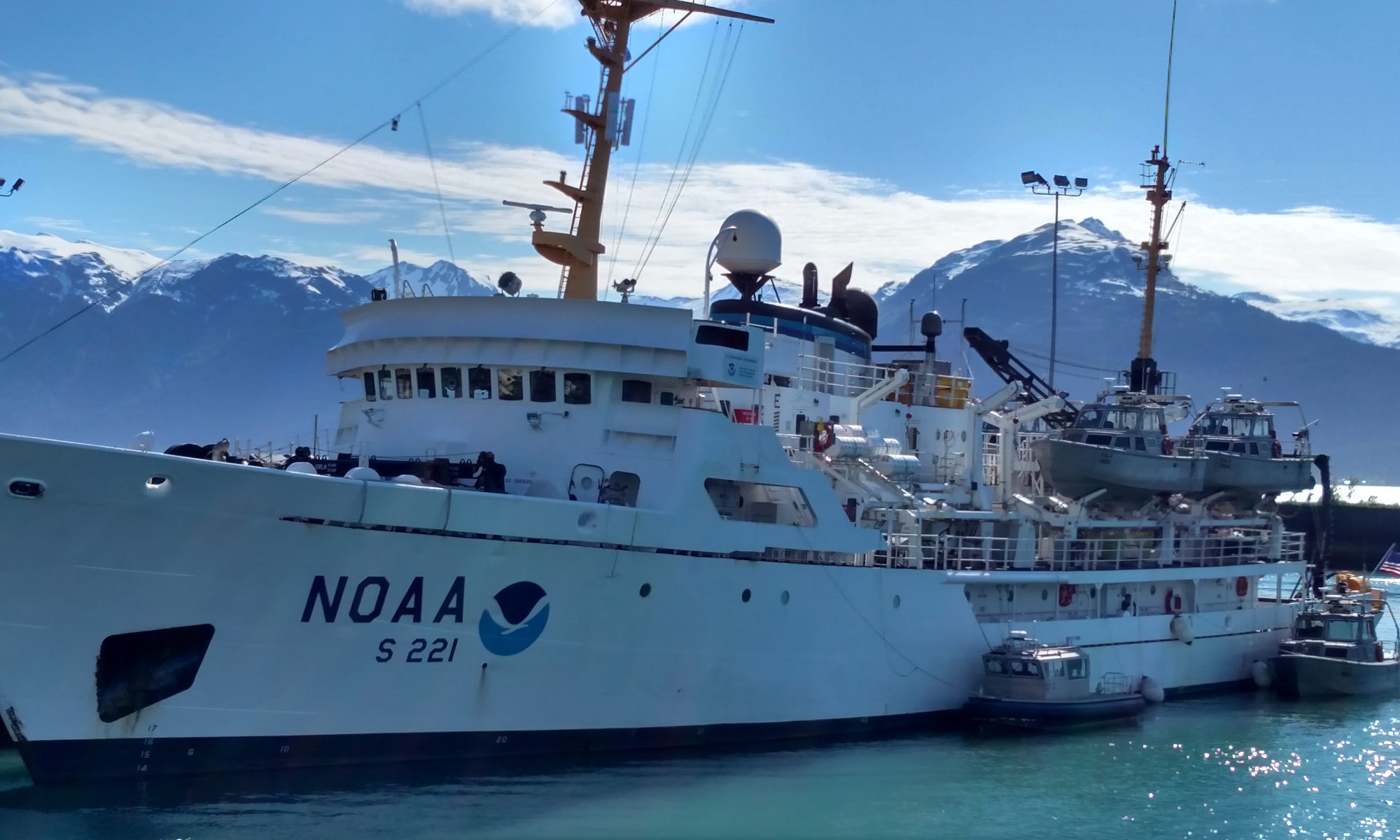
Aboard NOAA Ship Oregon II

July 25 – August 10, 2025

Mission: Bottom Longline Survey, Leg 1

Geographic Area of Cruise: Atlantic Coast of Florida

Date: August 7, 2025

Weather Data from the Bridge

Latitude: 32° 37.7′ N

Longitude: 078° 34.0′ W

Wind speed: 13 kts

Wave height: 2-3 ft

Air temp.: 28.5°C (Water temp. Is 28.7° C!)

Sky: BKN (broken cloud cover, meaning between 5/8 and 7/8 of the sky is covered by clouds)

Science and Technology Log

Yesterday the most exciting part of our watch was catching a spinner shark, a new species for me. Henry Legett, a volunteer on the other watch, is on the cruise to implant acoustic tags into any spinner or blacktip sharks we catch on this leg. Henry had to race out to the deck in order to perform this procedure. 

Photos, L to R: Spinner shark in cradle (photo courtesy of the Bridge). Acoustic tag that is now implanted into spinner shark. Henry Legett tying closing sutures on spinner shark.

At the beginning of our watch today we finished Station 38, and we are hoping to complete 46 stations during this leg before landing in Miami, FL. We aim for 5-6 stations per day, but sometimes the steam (distance to travel) between stations is long, and during this leg we had to avoid some weather (the tropical depression that was later named Dexter). Summer in this region of the Atlantic Ocean can be threatened by hurricane activity, so I would expect that this survey is used to working around weather.

At our first station, we had a small catch, but it is always exciting. I was able to tag another 2 meter long (6.6 feet) sandbar shark hauled up in the cradle. I had trouble cutting the fin for genetic testing, but Field Party Chief Trey helped me out. We also caught a small spotted eel (that was wrapped around the line) and a shark sucker. I am glad we were able to get a good look at the sharksucker. Apparently there are two species of sharksucker, and you have to count the number of grooves in the sucker in order to identify (the one we observed had 24).  

Photos, L to R: Trey, Cheryl, and Josh measure the sandbar shark for pre-caudal length, fork length, and total length. Cheryl inserts spaghetti tag into skin of sandbar shark. Scientists rely on the return of these tags to get information on growth and migration between tagging and recapture.

But then, we hit the mother lode! On the next station, we caught a shark that Trey Driggers, the chief scientist, has not seen in decades: an adult night shark. Gretchen and I took photos and videos to document the catch, while Trey and the fishermen measured, tagged, and took a fin clip of the female. As soon as she was lifted, Trey was teaching us about night sharks: “see how long the snout is and how big the eye is?” My pictures show Trey also removed and preserved parasitic copepods from her body to send to Ash Bullard, a parasitologist in Illinois, to identify. Based on scratches on her back, Trey said that she had recently mated. We feel privileged to have been a part of this catch. We knew it was a big deal when Trey got excited!

Night shark in cradle. Night shark in cradle with mouth open. Chief Scientist Trey Driggers removing parasitic copepods from night shark for preservation and future identification.

Interview with Matt Kupiec

Photos, L to R: Second Assistant Engineer Matt Kupiec immediately following his first time tagging a shark on the bottom longline survey. View from main deck down into the Engine Room, where engineers spend their work time on the vessel. I was most taken by the body outline on the floor because I teach forensic science at my high school.

NOAA Ship Oregon II, as does every ship, needs people on board to make sure everything is running smoothly, from a mechanical standpoint. Five engineers help to make that happen: Chief Marine Engineer Joe Howe, 1st Assistant Engineer Nate Durbin, 2nd Assistant Engineer Matt Kupiec, Junior Engineer James “MacDaddy” McDade, and oiler Mike Fountain (who has been assisting the day watch with fishing on this leg). 

Matt has been working on NOAA Ship Oregon II for a year this week (he started right around his birthday, which is coming up again this weekend!). Engineers in this job with NOAA generally work 2 months on followed by one month off. He will be off for the next leg of this cruise, which is about three weeks, so he will have time to fly home to Ashland, MA, where he shares a place with his brother.

I am most interested in Matt’s experience because he graduated from Massachusetts Maritime Academy (MMA), which is in my home town. At least three of my students last year are enrolling at MMA for marine engineering, so I am curious about their future. I know MMA claims a 99% employment rate following graduation, which is incredible.

How did you find out about your major?

“My cousin’s boyfriend went there and told me about it. He said engineers make a lot of money. My brother joined the Navy, and this is like the next step down. I chose marine engineering because I had never been on a boat before. The TS (Training Ship) Kennedy was my first love. I went out on a couple of sea terms (a period of time when maritime academy students gain hands-on experience on a ship) after graduating. They called me the maintenance hero because I was always on the ship. In my senior year I was Cadet Chief Engineer, which was a lot of work. It was a great experience, though. I was responsible for hundreds of kids as a kid. It would have been great for my hiring possibilities, but I came out at a tough time.” 

What do you do as an engineer on a ship?

“We are responsible for the plant, or the engine room. We make sure the boilers, pumps, HVAC, hydraulics, and electrical are all functioning. Oregon II is an older ship, so you can see  the mechanical parts of her. Newer ships have a lot more electronics, and it’s harder to find a faulty circuit board or something on them.”

What else have you done with your degree?

“My first job was on a cruise ship (Celebrity Summit) that sailed under foreign flag [owned by someone outside the United States]. That ship could take 5000 people out. I have seen every island in the Caribbean! I had a five month contract with them, and then a four month contract. Then a friend told me how much he was making on a US ship… I was the only US engineer in the fleet. I made $8000 a month as opposed to my friend making $20K per month plus benefits. I bounced around different jobs and then found AMO (American Maritime Officers union) about 5-6 years ago. I sailed all around the world moving cargo, working 4-5 months at a time, then had 4-5 months of vacation. During COVID I stopped sailing, took a break and worked at Sea World in San Diego [maintaining pumps and plants]. I had another shoreside job as lead building engineer for Lincoln Properties in Cambridge, MA, keeping science buildings running, but the commute was an hour each way and I was a slave to my cell phone, nights and weekends after working all week.” 

How did you learn to SCUBA dive?

“NOAA invited me to be on the SCUBA Diving Team. I took an open water course and dive school in Seattle in dry suits (43° F!).  

“I like working for NOAA because of the stability, and there’s less turnover. Oregon II is my first NOAA ship. Nate Durbin, the 1st Engineer, also went to MMA, so he was able to ask around to find out about me. This is only the third vessel I’ve stayed on for more than three trips. It’s a small boat, but the crew is awesome. Here everyone gets together outside of work. It’s a family atmosphere. I’m going diving on a shipwreck with some of the guys when we are off in Miami. It’s nice working on a ship based on science rather than moving cargo.”

Interview with Chuck Godwin

portrait of a man standing in front of a banner. he wears a suit and tie, but also a beanie. this image has been cropped out of a larger group photo; we see the cut-off arm of someone standing to his right.
Chuck Godwin present in February 2024 to receive Department of Commerce Gold Medal Award on behalf of Oregon II crew, who aided a vessel that was taking on water in 2022.

I had the pleasure of learning more about Chuck Godwin, the lead fisherman on NOAA Ship Oregon II. Chuck (Charles Scott) has been working on Oregon II since July 2000. When I looked up “Oregon II” on the internet, I found a photo of Chuck in a suit receiving the Department of Commerce Gold Medal in February 2024 after he and crewmates saved a vessel in distress (it was taking on water) in November 2022 (look it up!). He was excited to share his personal story with us. 

Chuck has four kids: two girls and two boys, ages 19-34, and three grandchildren who all live in Alabama. Chuck currently lives in Milton, FL, about two hours from Pascagoula, MS, where the ship is docked when not at sea. In his off time, Chuck likes to play guitar and harmonica, karaoke, kayak, hike, and go off-roading in his Jeep. He also likes reading and writing short stories and poetry, or trying to (but he will not share his writing with me).

What training have you had for this job?

“I graduated from the University of Florida (UF) with a degree in Wildlife Management and Ecology. I wanted to work for the Florida Fish and Wildlife Conservation Commission or any nearby State Fish and Game Department. I couldn’t find a job in that field after I graduated, so I joined the  U.S. Coast Guard and served 10 years, where I did Fisheries Enforcement and Search and Rescue. After separating from the military, I applied for a job with NOAA and found work on the Oregon 2 and have been here ever since.

I enjoy my work when underway, the shark cruise, especially. The people, boat, and various surveys have kept me around. The great white [shark] is my ‘dream catch.’”

When did you know you wanted to pursue a career near the ocean, or in science?

“I decided in high school. I grew up in, around, and under the water. I was raised in Florida and lived in Panama (the country) when I was 10-14 years old, and I became a certified scuba diver at age 12. I got to go back to Panama for a summer internship when I was in college, doing field work in biodiversity.” 

If you could invent any tool to make your work more efficient and cost were no object, what would it be and why?

“Robots to do this! Have you seen the robots that are out now? It’s only going to get more advanced and sophisticated. I could stand by and supervise….lol.”

Personal Log

I am getting ready to go home. This trip has been amazing, but it is also the longest time I have been away from my family, I know my pets and gardens are in good hands with my husband, Henry, but it’s time to go back and help out. Our beehives, in particular, need to be examined. I am hopeful the bees found some summersweet to tide them over.

Did You Know?

Sharksuckers, from the Remora family of fishes,  do not hurt sharks when they are attached. Their first dorsal fin is modified into a series of plates that form a suction pad to hitch a ride on sharks, turtles, whales, or other large marine creatures. They get a free ride and can eat the leftover scraps from their ride’s meal.

Animals seen since last blog:

Octopus! I saw three (or perhaps the same one, three times?) wrapped around the baited hook as it came up. 

Spinner shark

Sharksucker

Red grouper

Night shark!

Lynn Kurth: It’s Shark Week! July 31, 2014

NOAA Teacher at Sea
Lynn M. Kurth
Aboard NOAA Ship Oregon II
July 25 – August 9, 2014

Mission: Shark/Red Snapper Longline Survey
Geographical area of cruise:  Gulf of Mexico and Atlantic
Date:  July 31, 2014

Lat: 30 11.454 N
Long: 80 49.66 W

Weather Data from the Bridge:
Wind: 17 knots
Barometric Pressure:  1014.93 mb
Temperature:  29.9 Degrees Celsius

Science and Technology Log:
It would be easy for me to focus only on the sharks that I’ve  encountered but there is so much more science and natural phenomena to share with you!  I have spent as much time on the bow of the boat as I can in between working on my blogs and my work shift.  There’s no denying it, I LOVE THE BOW OF THE BOAT!!!  When standing in the bow it feels as if you’re flying over the water and the view is splendid.

BOW
My Perch!

From my prized bird’s eye view from the bow I’ve noticed countless areas of water with yellowish clumps of seaweed.  This particular seaweed is called sargassum which is a type of macroalgae found in tropical waters.  Sargassum has tiny chambers which hold air and allow it to float on or near the water’s surface in order to gather light for photosynthesis.  Sargassum can be considered to be a nuisance because it frequently washes up on beaches and smells as it decomposes.  And, in some areas it can become so thick that it reduces the amount of light that other plant species need to grow and thrive. However, the floating clumps of sargassum provide a great habitat for young fish because it offers them food and shelter.

IMG_2826
Sargassum as seen from “my perch”

IMG_2906[1]
Sargassum (notice the small air bladders that it uses to stay afloat)
We have hauled in a variety of sharks and fish over the past few days.  One of the more interesting species was the remora/sharksucker.  The sharksucker attaches itself to rays, sharks, ships, dolphins and sea turtles by latching on with its suction cup like dorsal fin.  When we brought a sharksucker on board the ship it continued to attach itself to the deck of the boat and would even latch on to our arm when we gave it the chance.

IMG_2944[1]
The shark sucker attaches to my arm immediately!
The largest species of sharks that we have hauled in are Sandbar sharks which are one of the largest coastal sharks in the world.  Sandbar sharks have much larger fins compared to their body size which made them attractive to fisherman for sale in the shark fin trade.  Therefore, this species has more protection than some of the other coastal shark species because they have been over harvested in the past due to their large fins.

Thankfully finning is now banned in US waters, however despite the ban sandbar sharks have continued protection due to the fact that like many other species of sharks they are not able to quickly replace numbers lost to high fishing pressure.  Conservationists remain concerned about the future of the Sandbar shark because of this ongoing threat and the fact that they reproduce very few young.

IMG_2928[1]
The first Sandbar shark that I was able to tag
Did you Know?

Sargassum is used in/as:

  • fertilizer for crops
  • food for people
  • medicines
  • insect repellant

Personal Log:
I continue to learn a lot each day and can’t wait to see what the next day of this great adventure brings!  The folks who I’m working with have such interesting tales to share and have been very helpful as I learn the ropes here on the Oregon II.  One of the friendly folks who I’ve been working with is a second year student at the University of Tampa named Kevin Travis.  Kevin volunteered for the survey after a family friend working for NOAA (National Oceanic and Atmospheric Administration) recommended him as a volunteer.  Kevin enjoys his time on the boat because he values meeting new people and knows how beneficial it is to have a broad range of experiences.


IMG_2798
Kevin Travis

Andrea Schmuttermair: Tows Away! June 26, 2012

NOAA Teacher at Sea
Andrea Schmuttermair
Aboard NOAA Ship Oregon II
June 22 – July 3

Mission: Groundfish Survey
Geographical area of cruise: Gulf of Mexico
Date: June 26, 2012 

Ship  Data from the Bridge:
Latitude:  2805.26N
Longitude: 9234.19W
Speed:  10mph
Wind Speed:  5.86 knots
Wind Direction:   E/SE
Surface Water Salinity:  35.867 PPT
Air Temperature:  28.8 C
Relative Humidity: 86%
Barometric Pressure:  1010.51 mb
Water Depth:  96.5 m

Science and Technology Log


Sunrise
Sunrise on the Oregon II

Opisthonema oglinum, Lagadon rhomboides, Chloroscombus chrysurus…..yes, I have officially started dreaming about taxonomic names of our fish. It’s day 4 and I now have a much better grasp at identifying the variety of critters we pull up in our trawls. I am always excited to be out on deck when they bring up the trawl to see what interesting critters we catch. Surprises are great!

Do you want to know where the Oregon II is headed?

Check out Ship Tracker at http://shiptracker.noaa.gov/

If you click on the link above, you can see the path that our ship is taking to hit all of our stations for the survey. We often have station after station to hit- meaning as soon as we are done sorting and measuring, we have to bring in the next catch. Because some stations are only 3-5 miles apart, we sometimes have to do “double dips”, where we put in the trawl for 30 minutes, pull it up, and put it right back in again.

It’s been interesting to note the variety of our catches. Croakers, bumperfish, and shrimp have been in high abundance the last 2 days as we were in shallower water. Before that we had a couple of catches that had a high abundance of pinfish. When we take our subsample, we typically enter data for up to 20 of that particular species. We take length measurements on each fish, and on every fifth fish. We will also weigh and sex it (if sexing is possible).

Shrimp in the Gulf
A comparison of the various sizes of shrimp we pull up from our trawls.

Shrimp waiting to be measures
A relatively small catch in comparison to the 200+ we’ve been pulling up recently.

When we were in shallower waters, we had a significant increase in the number of shrimp we brought up. Tuesday morning was the first catch that did not have well over 200 shrimp (this is because we’ve been moving into deeper waters).  For the 3 commercial shrimp, white (farfantepenaeus setiferus), pink (farfantepenaeus duorarum), and brown (farfantepenaeus aztecus), we take 200 samples, as opposed to our high-quantity fish, where we will only take 20 samples. For each of the commercial shrimp we catch, we measure, weigh and sex each shrimp. I’ve gotten very good at identifying the sex of shrimp- some of the fish are much more difficult to tell. The information we get from this survey will determine the amount of shrimp that boats can take during the shrimping season in Louisiana and Mississippi. During the first leg of the groundfish survey, the data collected determined the amount of shrimp that could be caught in Texas. The groundfish survey is crucial for the shrimping industry and for ensuring that shrimp are not overfished.

Students- think of the food chain. What would happen if we overfished and took out too many shrimp? (Hint: Think of predators and prey.)

Sunrise
The trawl net at sunrise

We’ve now started doing 2 different tows  in addition to our trawls. Some of the stations are trawl stations, whereas others are plankton stations.

The trawl on deck
Alex, Alonzo and Reggie unloading the trawl net.

At a trawl station, we lower the trawl from the stern down to the ocean floor. The trawl net is meant for catching larger critters that live at the bottom of the ocean. There is a chain, also known as a “tickler”, which moves lightly across the ocean floor to lure fish to leave their hiding spots and swim into our net. The trawl is down for 30 minutes, after which it is brought back on deck to weigh the total catch, and then brought back into the wet lab for sorting.

Another important mission of the groundfish survey is to collect plankton samples. To do this, we use a Neuston tow and a bongo tow.

neuston tow
The Neuston tow about to pick up a lot of Sargassum- oh no!

The Neuston tow has a large, rectangular frame with a fine mesh net attached to it. At the end of the net is a large cylindrical bucket, called a codend, with a mesh screen meant for catching the organisms. In comparison to the trawl net, which has openings of 41.4mm , the Neuston’s mesh is only 0.947mm. This means the mesh is significantly finer, meant for catching some of the smaller critters and plankton that would otherwise escape the trawl net. The Neuston tow is put on the surface of the water and towed for 10 minutes. Half the tow is in the water while half is out. We end up picking up a lot of Sargassum, or, seaweed, that is found floating at the water’s surface. When we gather a lot of Sargassum, we have to sift through it and spray it to get out any of the organisms that like to hide in their protective paradise.

Bongo tow
The bongo tow on deck waiting to be sent down to about 3m from the ocean floor.

After we’ve completed the Neuston tow, we do the bongo tow.  The bongo’s mesh is even finer than the Neuston tow’s mesh at only 0.333mm. The bongo has 2 parts- a left and a right bongo (and yes they do look a little like bongo drums- hence their name). The top part of the bongo is a large cylinder with an open bottom and top. The net is attached to this cylinder, and again at the bottom of each side is cylindrical tube  called codends meant to catch the plankton. The bongo tow is meant to take a sample from the entire water column. This means that instead of riding on the surface of the water, it gets sent down to about 3 meters from the ocean floor (there is a sensor at the top that is 2m from the bottom of the net)  and brought back up immediately.

Sifting through the sieve
The remnants from our Neuston tow. This is the sieve we use to weed out what we want and don’t want.

bongo leftover
Here are our 2 samples from the bongo tow. The left one is preserved in ethanol and the right is preserved in formaldehyde (10% formalin and sea water)

Neuston tow samples
Here is a sample from the Neuston tow. Carefully camouflaged are thousands of crab megalops, aka juvenille crabs.

For both tows, it is important to rinse the nets to get any lasting organisms we might not see with our own eyes into our sample. Once we’ve done this, we bring the tubes back into the wet lab where we continue to rinse them through a sieve so that only certain items are leftover. In the Neuston, we often find small fish (usually less than 3mm), baby shrimp, crabs and Jessica’s favorite, the Sargassum fish. Most recently a few flying fish got caught in our Neuston tow. Prior to pulling it up, I was enjoying watching them flit across the water- they were about all we could see in the water in the middle of the night. After being rinsed thoroughly through the sieve, we preserve them by placing the sample in a glass jar with either ethanol or formaldehyde solutions. They are preserved in ethanol for DNA work and in formaldehyde for long-term preservation. These samples are then saved to send to a lab in Poland, which is the sorting center for the SEAMAP samples.

Flying fish
Flying fish we pulled up in our Neuston tow at nighttime.

Personal Log

My stateroom
My sleeping quarters (top bunk), also known as a stateroom. My roommate is Kristin, one of the scientists on board.

Well, I think I am finally getting used to the schedule of working the night shift. I am thankful that my bunk is on the bottom floor of the ship- which means it is completely dark- so that I can sleep during the daytime. Yesterday was probably one of the least busy days we’ve had so far, and because we were in deeper waters, our trawls were much smaller. This means I had a little more time to work on my blogs, which at times can be hard to fit in. It amazes me that we have internet access on the ship, and it’s not even as slow as I expected. It goes down from time to time, especially when the waters are rough. We’ve been fortunate to have pretty calm waters, aside from the first day.

You may have heard about Hurricane Debby on the news as it prepared to hit the Gulf. On Sunday, we were heavily debating heading back to Galveston to “bunker down” and ride out the storm. However, the storm that was forming seemed to dissipate and head in a different direction, thank goodness.  I was not thrilled about the possibility of heading back to port!

We had our first drills the day after we set sail. The drills- fire and abandon ship are distinguished by different types of bells, similar to using Morse code. The abandon ship drill was fun. We got to put on our survival suit, which is like a big orange Gumby suit. It not only protects you in cold water, but also makes you highly visible. I remember reading some of the former TAS blogs, and this picture was always in. Of course, I’ve got to add mine as well.

Survival Suit
Here I am in my survival suit. Judd also decided to be in the picture. 🙂

I’ve been having fun exploring different areas of the ship, even though there is only so far you can go on the ship. Yesterday, I went up to the bridge, which is the front of the ship where the captain or the NOAA Corps officers steer the ship from. You can think of it like a control center of an airplane. There are navigation charts (both computerized and paper) and radars that help guide the ship so it knows what obstacles are out there. There is a great view from the bridge that you don’t get anywhere else on the ship. It’s also fun to watch the folks down on deck when they are deploying the CTD or either of the 2 tows.

We’ve caught such an abundance of critters, I thought I’d share some of my favorite catches thus far:

cownose ray
Here I am holding a cownose ray (Rhinoptera bonasus)- my favorite catch yet. He weighed about 25lbs! This one was the highlight of my day as rays are some of my favorite ocean critters!

Atlantic sharpnose shark
One of the 4 Atlantic sharpnose sharks (Rhizoprionodon terraenovae) we’ve caught so far.

Sharksucker
A sharksucker (Echeneis naucrates)- these guys hang onto sharks to catch a ride- he’s still alive so is able to hang onto my arm!

Critter Query Time!

Critter Query #1: What is a fathom (in your own words please)?

Critter Query #2: What are the differences between skates and rays?