Mark McKay, June 15, 2009

NOAA Teacher at Sea
Mark McKay
Onboard Research Vessel Knorr
June 10 – July 1, 2005

Mission: Ecosystem Survey
Geographical Area: Bering Sea, Alaska
Date: June 15, 2009

Hanging Valley outside of Dutch Harbor

Science Log

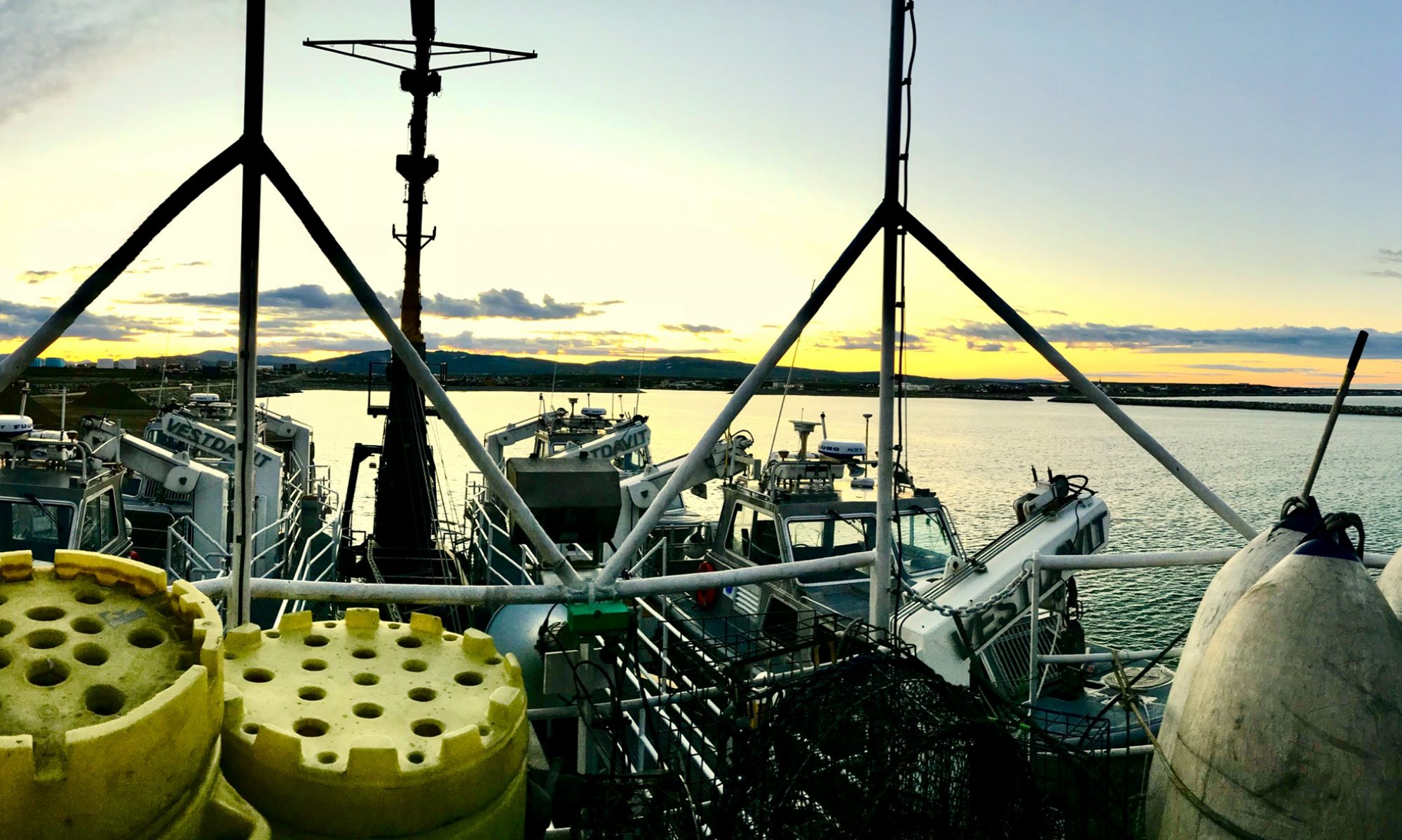
We are underway!!! Got up this morning to a flurry of activity as the Knorr was preparing to get underway. I hooked up with my researcher Dr. Ray Sambrotto from Columbia University. His interests are in phytoplankton and the different chlorophylls they produce. There is a lot of plankton work happening on this cruise, as well as some benthic (seafloor) studies and surveying of seabirds. It’s amazing how much science they squeeze into a cruise. One of the things I saw as we were heading out was a very cool example of a Hanging Valley. This geological feature is formed by glaciers. I saw it when we flew into Dutch Harbor but I didnt get a chance to get a picture of it. As we set out on the Knorr we passed right by it so I got my chance.

 Multicore Apparatus
Multicore Apparatus

The day before we departed was spent storing equipment, testing instruments, and getting settled in our quarters. Problems with equipment not arriving on time wont prevent the start of the mission. We got underway right about 11 am Alaska time and headed for our first station over the Bering Canyon.  Safety is everything onboard the Knorr so before anything really gets started we are required to undergo safety training. The ships crew is very concerned with making sure everyone is safe so they go through procedures in detail.

After the safety briefings and getting some of Dr. Sambrotto’s equipment running, I had a chance to play in the mud. Dr. Shull’s group from Western Washington University is looking at cores of sediment taken from the ocean bottom. Their interest is in how nutrients are cycled through deep-water sediments. They drop the sampling device, called a Multicore, which has specialized sampling bottles to the ocean bottom. The device pulls cores from the seafloor and when the sampling device is retrieved, the scientists have a sample of the sea floor.  My job came after the bottles were retrieved. The process was to slice through the cores at specific depths and save the samples for further analysis. Good way to get really dirty.

Mary Cook, January 3, 2005

NOAA Teacher at Sea
Mary Cook
Onboard NOAA Ship Ronald H. Brown
December 5, 2004 – January 7, 2005

Mission: Climate Prediction for the Americas
Geographical Area: Chilean Coast
Date: January 3, 2005

Location: Latitude 45°49.53’S, Longitude 75°03.22’W
Time: 0930

Weather Data from the Bridge
Air Temperature (Celsius) 11.90
Water Temperature (Celsius) 13.55
Wind Direction (degrees) 343.52
Wind Speed (knots) 5.85
Relative Humidity (percent) 66.50
Air Pressure (millibars) 1016.06
Cloud Cover 6/8 Altocumulus
Sunrise 0615
Sunset 2152

Question of the Day

What is phytoplankton?

Quote of the Day

“Dream no small dreams for they have no power to move men.” Johann Wolfgang von Goethe

Science Log

This afternoon I interviewed Co-chief Scientist, Julio Sepúlveda, an oceanography graduate student from the University of Concepción. Julio did his Master’s thesis work for eight months at Woods Hole Oceanographic Institution in Massachusetts. In April, he’s leaving for Germany to spend three years continuing his education toward a PhD. in marine organic geochemistry. Julio has been kind enough to further explain the work they’ve been doing onboard the RONALD H. BROWN. The Chilean group of scientists include Pamela Rossel, Sergio Contreras, Rodrigo Castro, Alejandro Avila, and Luis Bravo. He says that their work has two parts: the water column process and the sedimentary record. The water samples and the sediment traps give a “picture of the moment”. They conducted the transect of samples starting at the shallow coastal waters and moving into the deeper offshore waters. These samples will provide a gradient of the nutrient concentrations at the Bay of Concepción which is part of an active upwelling location. To put it simply, they are looking at how the phytoplankton (plant-like microscopic organisms) uses the nutrients in the water. In particular they are looking at the nitrogen stable isotopes (nitrogen atoms with different masses) and their concentrations. They are trying to see how this is related to El Niño which greatly affects Chile and many places around the world. Julio explained that normally the upwelling brings cooler water containing nutrient-rich materials up to the surface. During El Niño events, the upwelling brings warmer, less nutrient-rich waters to the surface. This changes many things including the weather. The causes of El Niño are multi-varied air-sea fluxes that are not fully understood. In the last ten years the scientific community has been especially interested in knowing the possible influence of global warming in the El Niño variability. It seems that its frequency is changing and several articles indicate that El Niño is occurring more often. So their research provides a few “pixels” for capturing the entire “picture” of El Niño.

The second part of their research involves the core samples. The purpose of the core sampling is to collect the layers of sediments on the ocean floor. Julio described the layers to be like pages in a history book. Each layer tells the “story” of what was going on in the water at that location during that time. They are also looking at the degradation of the organic matter in the core samples. So, Julio says the water samples tell us about the present and the core samples tell us about the past. Using these methods of research, it is their intention to better understand the history of El Niño and better predict future El Niño events.

Personal Log

This morning we entered the fjords! Several of us were up and outside on the deck at 0630, “ooohing” and “aaahing”, taking pictures even though it’s very cold and windy out there. It is an irresistible attraction. We’re passing by the peninsula Tres Montes and we’re headed for the Bay of Tarn. All morning we’ve been sailing by emerald forest-covered mountains and black craggy rocks that have been eroded into peculiar shapes by the waves relentlessly smashing against them. The clouds are ominous and hanging low. The albatross are soaring with wings spread wide. An occasional whale sends a plume of spray into the air. I want these scenes to be indelibly saturated into my mind’s eye. I never want to forget this. No dwellings. No other ships. It’s just us. Just us and the birds and the whales. It’s good. It’s all good.

Until tomorrow,

Mary

Mary Cook, January 1, 2005

NOAA Teacher at Sea
Mary Cook
Onboard NOAA Ship Ronald H. Brown
December 5, 2004 – January 7, 2005

Mission: Climate Prediction for the Americas
Geographical Area: Chilean Coast
Date: January 1, 2005

Happy New Year!!
Feliz Años Nuevos!!!!

Location: Latitude 37°47.97’S, Longitude 74°02.84 W
Time: 1000

Weather Data from the Bridge
Relative Humidity (percent) 91.44
Air Pressure (millibars) 1015.72
Air Temperature (Celsius) 17.28
Water Temperature (Celsius) 17.58
Wind Direction (degrees) 212.20
Wind Speed (knots) 12.20
Cloud Cover 8/8 Stratus
Sunrise 0638
Sunset 2120

Question of the Day

What causes seasickness?

Quote of the Day

“The best portion of a good man’s life is the little, nameless, unremembered acts of kindness and love.” William Wordsworth

Science Log

All the Chilean scientists plus Jordan Watson from Scripps and the ship’s wage crew are all sleeping soundly after their 48 hour marathon project of collecting water and sediments. They will continue collecting surface water every 30 minutes of latitude but the ship will not stop for these collections.

Sometime tonight we will meet up with the pilots who will safely guide the RONALD H. BROWN through the inside passages. There will be two pilots so that one will be on the bridge at all times.

Today, Les Cruise shared with me that it is a seafaring tradition that the first log entry of the year for the ship should rhyme. So I want to share with you the first log entry of 2005 for the NOAA ship the RONALD H. BROWN.

Underway in the South Pacific 2004 was terrific.
Collecting mud on station six, all three thrusters in the mix.
Punta Tumbes, bearing 119º, at 34 nautical miles away is the closest point of land, in accordance with the Ronald Brown science plan.
All our lights are burning fine and our bow thruster is on line.
Main Power Diesel Generator Two keeps us going through and through.
Ship Service Diesel Generator Five gives us power to survive.
Auto-Positioning is how she sits, on a heading of 206°.
The sky is clear, I will not lie, Watch-Stander Melton is standing by.
Engineer-on-Watch Jacobson is down below, making sure the engines go.
Maneuvering various courses and speeds for sediment trap recovery, maybe there will be a new discovery!
Multiple personnel working in accord have brought the sediment trap aboard. Main Power Diesel Generator Three on line to help us make good time.
Increase speed 700 rpm, Auto track mode now as then.
190° is the way we go. Bow thruster power taken to zero.
Security round complete. That Jim Melton, he’s pretty neat.
Lt. Jones has the deck and conn ensuring the ship carry on.
13.3 nautical miles is our distance run. Hope 2005 will be fun! ”

Personal Log

This evening, my seasick queasiness is much better. I took the medics advice which was, “Stop looking at the computer and go to bed in a dark room. And stay there!” He was right.

But as a consequence of taking his advice my personal log is severely lacking. Most of the time, I’ve been in my stateroom, snuggled under a blanket looking at the backside of my eyelids.

Until tomorrow,

Mary


Mary Cook, December 31, 2004

NOAA Teacher at Sea
Mary Cook
Onboard NOAA Ship Ronald H. Brown
December 5, 2004 – January 7, 2005

Mission: Climate Prediction for the Americas
Geographical Area: Chilean Coast
Date: December 31, 2004

Location: Latitude 36°13.8’S, Longitude 73°31.25’W
Time: 0830

Weather Data from the Bridge
Wind Direction (degrees) 206.36
Wind Speed (knots) 3.94
Air Temperature (Celsius) 15.50
Water Temperature (Celsius) 14.58
Relative Humidity (percent) 96.10
Air Pressure (millibars) 1015.21
Cloud Cover 3/8 Altocumulus and Cirrus
Sunrise 0639
Sunset 2114

Question of the Day

Why are the daylight hours getting longer as we travel southward?

Quote of the Day

“Information is the commodity of science.” Kevin Sullivan

Science and Technology Log

No stargazing last night due to cloudiness. So I’ll try again some other night.

Today we’ve been hovering in one place for six hours waiting on the drifting sediment trap to do its thing, which is to trap sediment.

We’re farther from land and in deeper water so it takes longer for the trap to collect a sufficient amount of sediment. They’ve just gotten it out of the water so now we’ll transit for about two hours to the next station and hover there for about eight hours. At this station they will deploy the bigger, heavier core sampler that looks like a 4 meter-long hollow rocket. It will go down to about 1000 meters depth and gravity will ram it into the mud. The layers of sediment will fill the hollow tube then it will close under the pressure as it is brought back to the surface by the winch.

This afternoon as we hovered in one place, the seagulls gathered around the ship for a siesta. There were hundreds of them just sitting in the water like ducks. It was almost like they were waiting to see what we were up to. It was interesting to watch them take to flight from the water. They’d spread their wings and begin flapping. But that wasn’t providing enough lift so they’d start paddling with their feet. It looked they were walking on water!

Finally, up they’d go, soaring through the air and then swooping down, gliding just above the water’s surface.

Personal Log

Today, I’ve been moderately seasick. I think it was the 10-12 feet swells passing under the ship as we hovered at station. The seasick medicine made me drowsy so I’ve spent time lying down in my stateroom off and on all day.

At 0230 in the morning we are supposed to make the turn due south and steam toward the inside passages! I’m ready to move on.

I eagerly anticipate traveling the same paths as the great explorers of Ferdinand Magellan and Sir Francis Drake. We’ll meet up with the pilot who will board the ship and take us safely through the narrow straits.

This is the last day of 2004. As I reflect back on my life during the past year I can’t help but know I’m blessed. With a wonderful family and circle of friends that love me, a good job and great co-workers, good health and great opportunities to live life abundantly. And for all this I am deeply thankful. Of course, we all know that life isn’t always smooth sailing. We all have struggles. Some are life and death struggles, some are relational struggles, some are financial struggles, and some are spiritual struggles. This journey in the Pacific has been more than an adventure for me. Being removed from my comfort zone has compelled me to contemplate. Contemplate just about everything. There’s one phrase that keeps coming to my thoughts over and over again. “It is more blessed to give than to receive.” And I don’t think this means money or other material possessions. I think it means giving of self. This is a much greater challenge, for me anyway. I want to absorb this into my life philosophy for the coming year and for always. I fully realize that I do not know the depth to which I may be called upon to live out this truth, but I have confidence that the future is brighter with this mind set.

Happy New Year!!

Until tomorrow,

Mary

p.s. Happy Birthday, Diane!

Mary Cook, December 30, 2004

NOAA Teacher at Sea
Mary Cook
Onboard NOAA Ship Ronald H. Brown
December 5, 2004 – January 7, 2005

Mission: Climate Prediction for the Americas
Geographical Area: Chilean Coast
Date: December 30, 2004

Location: Latitude 36°21.31’S, Longitude 72°59.65’W
Time: 9:15

Weather Data from the Bridge
Air Temperature (Celsius) 14.33
Water Temperature (Celsius) 14.81
Air Pressure (millibars) 1015.24
Cloud Cover 3/8
Cloud Type: Stratus
Wind Direction (degrees) 325.6
True Wind Speed (knots) 1.26
Sunrise 636
Sunset 2112

Question of the Day

What is a light year?

Positive Quote of the Day

“The influence of each human being on others in this life is a kind of immortality.” John Quincy Adams

Science Log

Last night I went up to the bridge at about 2300 hours. Vickie, Jeff, and Jackie were stargazing in search of the Southern Cross. There it was, almost directly in front of the ship! It had just risen over the horizon and looked more like a baseball diamond than a cross. We also spotted Alpha and Beta Centauri. At about 4.3 light years away, these are among the closest stars to Earth other than our Sun. Vickie also pointed out Orion with his belt of stars and the seven sisters called Pleiades. I’m going to get out my textbook and read up on the Magellanic Clouds because I’m wondering if we can see those from here. Then Jackie looked over the edge of the ship in the wake and caught a glimpse of some momentary flashes of light! Bioluminescence! I stood there pressing my face against the window staring at the darkened waters waiting patiently for some more microorganisms to glow. Sure enough it happened. They looked like little sparks of lightening in a cloud. It happened several times. I’ll definitely be back on the bridge again in search of more wonders of the sea at night.

For this leg of the journey, I’ve been moved to a different stateroom. I’m now down below in the science quarters. The sounds are different down here. I can hear the water splashing up against the ship’s hull. It sounds like I’m in a perpetual carwash!

It’s a soothing sound, though. I slept like a bear in hibernation.

Today begins the science operations. Right now, the scientists are on the fantail preparing the drifting sediment trap with its radar-reflector, floaters and nighttime strobe light. We’ll deploy the instrument then leave it while we make a short transit to the next station for CTD casts and core sampling. Afterwards, we’ll return and retrieve the sediment trap. According to the work plan, we’ll do this same thing at six different locations across the continental shelf and slope off Concepción, Chile. Most of the CTD casts are in fairly shallow water with the deepest one going down to 980 meters. These scientists will be working 48 hours non-stop.

It’s beautiful here in the Bay of Concepción. The water is so smooth and glistening in the sunshine. We’re nearly surrounded by a crescent-shaped coastline and we can see houses, forests, and other ships. This afternoon, we saw several ghostly-white jellyfish pumping their way through the water. Jim pointed out little anchovies swimming nearby. Yum!

I spoke with Kevin Sullivan of the NOAA research branch in Miami and Jordan Watson from the Scripps Institution of Oceanography. They patiently explained some of the science to me. And I really appreciate that.

This is how the drifting sediment trap works. After the instrument collects the sediments from the water near the surface and is retrieved, it will be set aside for a few hours to allow the sediments to settle to the bottom of the tubes. Then a lever is turned that empties the sediments into bottles containing a preservative. Sediments can be particles from the air like dust or particles from the ocean such as little deceased sea creatures called diatoms.

The Rhumor gravity core sampler is basically a one meter long hollow tube with heavy weights attached to the top. After being lifted by the winch, it is slowly lowered into the water. When the tube gets about 10 meters from the ocean floor it is lowered very quickly and gravity rams it into the mud. In this process, the mud layers fill the hollow tube and as the core sampler is raised the pressure closes a valve that keeps the mud from coming out.

I’ve noticed on the SeaBeam readout that the depth here is only about 100 meters. That’s a huge contrast to a couple of weeks ago when we were in waters with a depth of 5000 meters!

It is my understanding that the rationale for their research is to explore the effects of nitrogen distribution and how that affects the marine algae nutrient usage in the present day water column. They are conducting the sampling in this location because of the upwelling that occurs which brings nutrients to the surface and because there are algae present that utilize the nutrients in these upwelling plumes. Likewise, they are interested in evaluating the amount of nitrogen left in the sedimentary record. This will help scientists better understand the history of the oceans.

Personal Log

Today has been a quiet but interesting day. All the science was new to me so I had to pay attention and ask lots of questions. It’s very rewarding to have people around who are eager to share with me what they are doing and the significance of it all in the whole scheme of things. I’ve learned a tremendous lot and my brain is kind of tired. Plus, I miss my mentor. She’s got enough energy for two people! I did take some time to go to the ship’s bow and watch the water skim by and look around for animals. I saw lots of birds and jellyfish. I like watching jellyfish because I never see jellyfish in Arkansas. To me they are intriguing critters because they are transparent. I can see right through them!

Well, I’m headed for the exercise room to rest my brain and work off that cake with chocolate icing that I ate for dessert. Then, after dark, up to the bridge for more stargazing in the Southern Hemisphere!

Until tomorrow,

Mary

p.s. Congratulations Brandon and Becky!