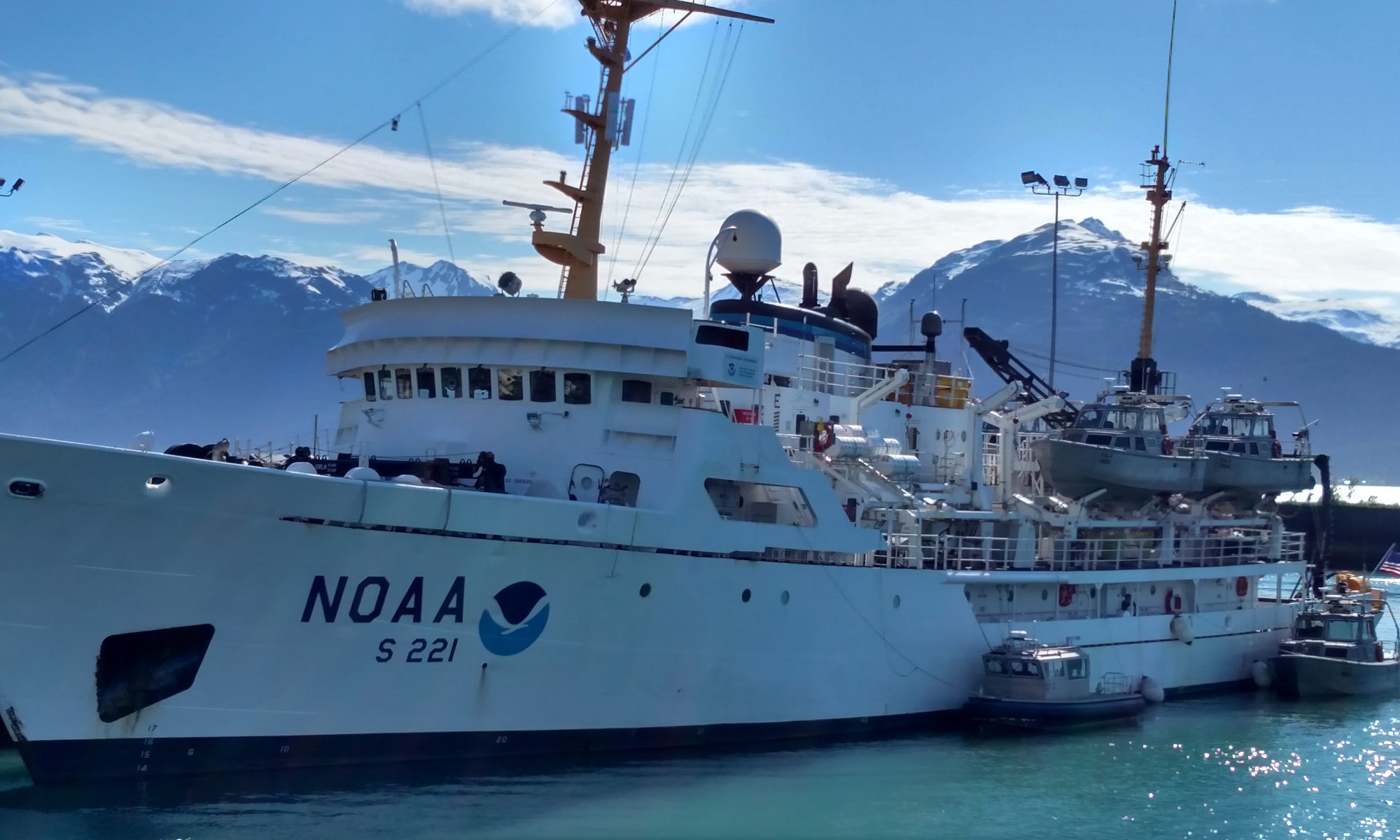
Kimberly Pratt, July 19, 2005

NOAA Teacher at Sea
Kimberly Pratt
Onboard NOAA Ship McArthur II
July 2 – 24, 2005

Greg Hubner
First Mate Greg Hubner

Mission: Ecosystem Wildlife Survey
Geographical Area: Pacific Northwest
Date: July 19, 2005

Crew Interviews: “The Officers of the McARTHUR II”

Officers of the McARTHUR II are commissioned by NOAA.  They are uniformed personnel with the exception of the First Mate.  They all are assigned different watches and their primary responsibilities are, under direction of the Commanding Officer, to run the ship, navigate, take care of the ship’s medical needs and to make sure that shipboard operations are running smoothly.

The McARTHUR II has 6 officers on board – LCDR Morris, First Mate Greg Hubner (who is not uniformed), Operations Officer Nathan (Herb) Hancock, Navigation Officer Paul Householder, and Junior Officers, Ensign Steven Barry, and Ensign Paul Smidansky.  All NOAA Corps Officers have two years at sea, initially followed by three years of shore duty and rotate between sea and shore duty unless they are aviators.

Nathan Hancock
Operations Officer Nathan Hancock

First Mate Greg Hubner has been with NOAA for 26 years. He has a background in the Navy and started with NOAA as a deck hand. He is currently a licensed Officer and enjoys being out to sea. He likes seeing different countries and his favorite port is an island off of Spain. Another NOAA ship, RONALD H. BROWN, is involved with international research so some NOAA ships travel the world, and Greg has had the opportunity to see many countries and cultures.

Operations Officer Nathan Hancock is readily noticeable by his sense of humor and laughter.  Nathan graduated with a BS degree in Environmental Sciences and a MS degree in Geology and Geophysics. Nathan really enjoys his position as it enables him to “drive the boat”.  In the future, he would like to be transferred to the Key Largo Marine Sanctuary or fly into hurricanes. Nathan developed a love for the water when he was a child living at the ocean and running charters with his father a marine biologist.

Navigation Officer Paul Householder is also the medical person in charge.  He has a BA/BS in Chemical Engineering and joined NOAA after being laid off during the downsizing of the semi- conductor era. He’s been with the ship for over a year and is adjusting to sea life. He likes seeing the different places, but does miss his weekends.

Paul Householder
Navigation Officer Paul Householder

Ensigns Barry and Smidansky both have a background in Meteorology and Barry would like to join the National Weather Service. Barry, who joined NOAA in February ’04, enjoys the adventure of meeting different people.  On this tour, it will be his first time visiting Hawaii.  Ensign Smidansky, is a licensed airplane pilot, and is looking to join the air fleet of NOAA, but for the time being is enjoying his time at sea.

In order to become a NOAA Corps Officer, you need a college degree, preferable with a background in science or math.  You must be under 35 years old, with no arrests or criminal background.  Also, it takes between 6-9 months for your application to be processed and then the Secretary of the Commerce grants you a temporary commission.  The Senate grants you permanent status.  You must undergo three months training at the Merchant Marine Academy and then are assigned to a ship at sea to become a qualified deck officer. NOAA is constantly training officers for higher positions and Officer Householder will be promoted soon to Lt. Jr. Grade. All of the officers while professional and polite still have a sense of humor, they are gracious enough to keep answering the question – “where are we?”

Question: Malka, grade 5 – Where does the ship/vessel get fresh water?  The ship makes its own water, we take salt water and process it to turn it into fresh water.  Everyday we make 2,000 gallons worth. The process is started 10 miles out to sea.

Steven Barry
Ensign Steven Barry
Paul Smidansky
Ensign Paul Smidansky

Kimberly Pratt, July 18, 2005

NOAA Teacher at Sea
Kimberly Pratt
Onboard NOAA Ship McArthur II
July 2 – 24, 2005

MAC433-AR1, OO
Photo credit: Cornelia Oedekoven

Mission: Ecosystem Wildlife Survey
Geographical Area: Pacific Northwest
Date: July 18, 2005

Weather Data from Bridge

Latitude:  3614.084N
Longitude: 12213.868W
Visibility: <1 mile
Wind Direction: 340 Wind Speed:  22 knots
Sea Wave Height: 5-6 feet
Sea Level Pressure: 1014.6
Cloud Cover: Foggy, Drizzle
Temperature:  14.8

MAC433-AR1, OO
Photo credit: Cornelia Oedekoven

Scientific Log 

Our days have been mostly foggy with the sun peaking through rarely. After not seeing the sun for days, we were all delighted when the bridge announced that there was sun and many of us ran outside right away!  Right now we’re outside of Pt. Reyes, continuing on transect lines. The animals we’ve observed lately are: a pod of Killer Whales feeding, several Humpback Whales, schools of Pacific White-sided Dolphins, Risso’s dolphins and Northern Right Whale dolphins.

The Zodiac was launched and tissue samples and photo ID was taken of the Killer Whales. (photos attached) This evening two Humpbacks gave us quite a show.  They rolled next to the ship, breached, and slapped their flippers. Many times we could see their bellies as they lazily made their way by the ship rolling and diving, quite peacefully.  Video and photo was taken of these amazing animals.

MAC433-AR1, OO
Photo credit: Cornelia Oedekoven

The bird observers have been especially busy. In the past few days they’ve identified Black-footed Albatross, Common Murre, lots of Sooty Shearwaters, Pink footed Shearwaters, Ashy Storm Petrels that breed on the Farallons, and Cassini’s Auklets. Also seen are South Polar Skua’s, and Red Neck Phalaropes who are Artic breeders.  We’ve also seen Mola Mola fish, and a Mako shark with a pointy snout.  We’re continuing Bongo Net Tows and continue to collect plankton, larvae and small jellyfish.

Personal Log

Thanks to Rich Pagen being back on board, I am now focusing more on taking video, completing interviews, doing logs and e-mail correspondence. My interviews have gone well; the crew has been responsive and also forgiving when I’ve made mistakes.  For the remainder of the trip, I’ll be focusing on interviewing more of the scientists, developing curriculum and completing logs.  It’s been great meeting all the crew and finding out more about them. With less than a week to go, I’m treasuring every moment. This has been a great trip!

MAC433-AR1, OO
Photo credit: Cornelia Oedekoven


Until later…
Kim

Thanks to Cornelia Oedekoven for the Orca photos.

Kimberly Pratt, July 17, 2005

NOAA Teacher at Sea
Kimberly Pratt
Onboard NOAA Ship McArthur II
July 2 – 24, 2005

Kevin Lackey

Mission: Ecosystem Wildlife Survey
Geographical Area: Pacific Northwest
Date: July 17, 2005

Crew Interviews: “Dynamite Deck Crew”

If you walk around the McARTHUR II you will encounter hardworking and dedicated Mariners.  These individuals are the deck crew. Outside my door every morning is Korie Mielke, diligently sweeping and swabbing the hall.  On the deck below you will find Charles Sanford painting along with Dave Hermanson, and Teresa Moss. In the evenings, Jake Longbine operates the cranes and wenches for the CTD tests. Throughout the day you’ll find Steve Pierce and Kevin Lackey busily fixing items or on the bridge.The deck crew is responsible for the operation of all the ship’s machinery.  They also paint and clean the ship.  They are instrumental in helping the scientists complete their mission assisting with collections and run the small boat operations.  A deck hand will do watches as a quartermaster who is a lookout for things that may damage the ship and also report on weather observations. In addition, they drive the ship at the Officer’s command.

Jake Longbine

The deck crew comes from a variety of backgrounds, some have college degrees, and others have prior military experience.  Teresa has a fashion and marketing background. She joined NOAA through her mother who is a security officer for NOAA in Seattle. Charles’ who has a military background often thinks about becoming a teacher.  Kevin’s background is in wildlife conservation and his position with NOAA is the first sea duty he’s had.  Kevin really likes the variety and has enjoyed going to see Alaska and sail in Russian waters.  He, like some of the other deck crew found that being on duty with no weekends is taxing.  Also, living and working with other people in a space the size of 224 x 42 ft, (about the size of Cabello’s cluster of classrooms #22 – 26), can be difficult at times.  The deck crew like being a part of the McARTHUR II and it is evident by their good nature and hardworking spirits. After porting in San Francisco, they will be headed off to Hawaii – to warmer waters and climates.

Charles Sanford

School Questions:

Aira grade 5: What is the size of one room on a ship?

Answer: Average size is 10×12

Tania, grade 5 – Where do you guys sleep?

Answer: Some people have a single room with a double sized bed. Others sleep in bunk beds.

Malka, grade 5 – What type of food do you eat?

Answer: The food is very good, usually at every meal there is a meat choice and a vegetarian choice.  At lunch and dinner, you can have salad bar and there is always dessert.

Teresa Moss


Korie Mielke

Kimberly Pratt, July 16, 2005

NOAA Teacher at Sea
Kimberly Pratt
Onboard NOAA Ship McArthur II
July 2 – 24, 2005

Mission: Ecosystem Wildlife Survey
Geographical Area: Pacific Northwest
Date: July 16, 2005

Humpback Fluke – white and black

Weather Data from Bridge

Latitude: 3650.918 N
Longitude: 12159.753 W
Visibility: < 1
Wind Direction: 280
Wind Speed: 3 knots
Sea Wave Height :< 1
Swell Wave Height: 3-4 feet
Sea Level Pressure: 1011.6
Cloud Cover: Foggy/light drizzle
Temperature: 16.7 c

Scientific Log 

Our days lately have been mostly foggy and drizzly, making marine mammal observations very difficult. During the times that observations were made, we’ve seen Humpback Whales, Fin Whales, Harbor Porpoise, a Blue Whale, Pacific White-sided Dolphins, Grampus Dolphins, and Sea Lions.  I’ve attached pictures that show Humpback Whale flukes.  The scientists are using the pictures to ID them.  Yesterday, Fin Whales surfaced approx. 200 meters off our bow and swam with the ship for a little while.

Humpback Fluke – all black

We observed Harbor Porpoise as we entered Monterey Bay. They are a small porpoise and are identified by their small pointy dorsal fin.  Observation of Harbor Porpoise is difficult and you can only get a fleeting glance at their dorsal fins before they are gone.

At first you might mistake Grampus dolphins for Killer Whales by looking at their dorsal, but upon closer inspection you’ll find they have a light body marked by scratches or lines. Two nights ago, we did a Bongo Net drop and were able to collect 7 jars full of krill, plankton and myctophids (small Lantern fish).  This showed that the area was very healthy and full of abundance. As far as birds go, we observed part of the Monterey Bay flock of Sooty Shearwaters numbered at approximately 250,000. Today we picked up Scientist Rich Pagen in Santa Cruz, joining us after being ill and we hope to continue observations as we head back out to sea from Monterey Bay.

Humpback Fluke – barnacle marking

Personal log

We’ve had quite a bit of down time enabling me to answer e-mail, do logs, and interviews. When we are “on effort” I am on the Flying Bridge helping with data entry, observations and trying to video our sightings. At night I help the Oceanographers, Mindy Kelley and Liz Zele doing the Bongo Net Tows and we are often out until 10:30 or 11:00 pm.  Today, we were close to shore, so we had cell service to call friends and loved ones.   I’m still having a really good time, the whales and dolphins are breathtaking. I envy your hot weather!

Sea Lions
Sea Lions

Kimberly Pratt, July 15, 2005

NOAA Teacher at Sea
Kimberly Pratt
Onboard NOAA Ship McArthur II
July 2 – 24, 2005

pratt_interview8Mission: Ecosystem Wildlife Survey
Geographical Area: Pacific Northwest
Date: July 15, 2005

Crew Interviews: “Electronic Gurus”

The McARTHUR II is fortunate to have two very talented men handling its electronics and surveys.  They are Electronic Chief Clay Norfleet and Sr. Survey Tech Lacey O’Neal. Electronic Chief Clay Norfleet is responsible for all the radar, radio, Simrad, computers, networks e-mail communication and ship cell phones. Clay comes to NOAA after an extensive career in the US Navy. In the Navy, he conducted torpedo research and traveled extensively. His favorite port was Seychelles, 200 miles east of Madagascar. He enjoys his position with NOAA and likes the camaraderie with his shipmates.  He will be sailing with the McARTHUR II to Hawaii and then will be boarding the OSCAR ELTON SETTE, sailing to Guam and Saipan to lend support to NOAA personnel. Clay is used to extended time at sea.  In the Navy, he was out for 9-10 months at a time and one time he didn’t see land for 124 days.  While in port in San Francisco, he plans to shop for things for the ship.  His advice for someone wanting to be an Electronics Tech would be to get certifications before applying.

pratt_interview8aAnother talented man works in the dry lab, surrounded by beautiful photos of Humpback, Killer Whales and dolphins. This man is the very helpful Sr. Survey Technician, Lacey O’Neil.  Lacey helps the oceanographers do their work. He runs the computers for the CTD, SCS system an also runs the ship store. He’s been on both the McARTHUR and McARTHUR II for a combined 7 years.  He was previously in the military serving as a paratrooper. His hobby is photography, so being on the McARTHUR II gives him an opportunity to take great pictures of marine mammals.  He also enjoys going to Hawaii with the ship and gets to meet a lot of interesting people.