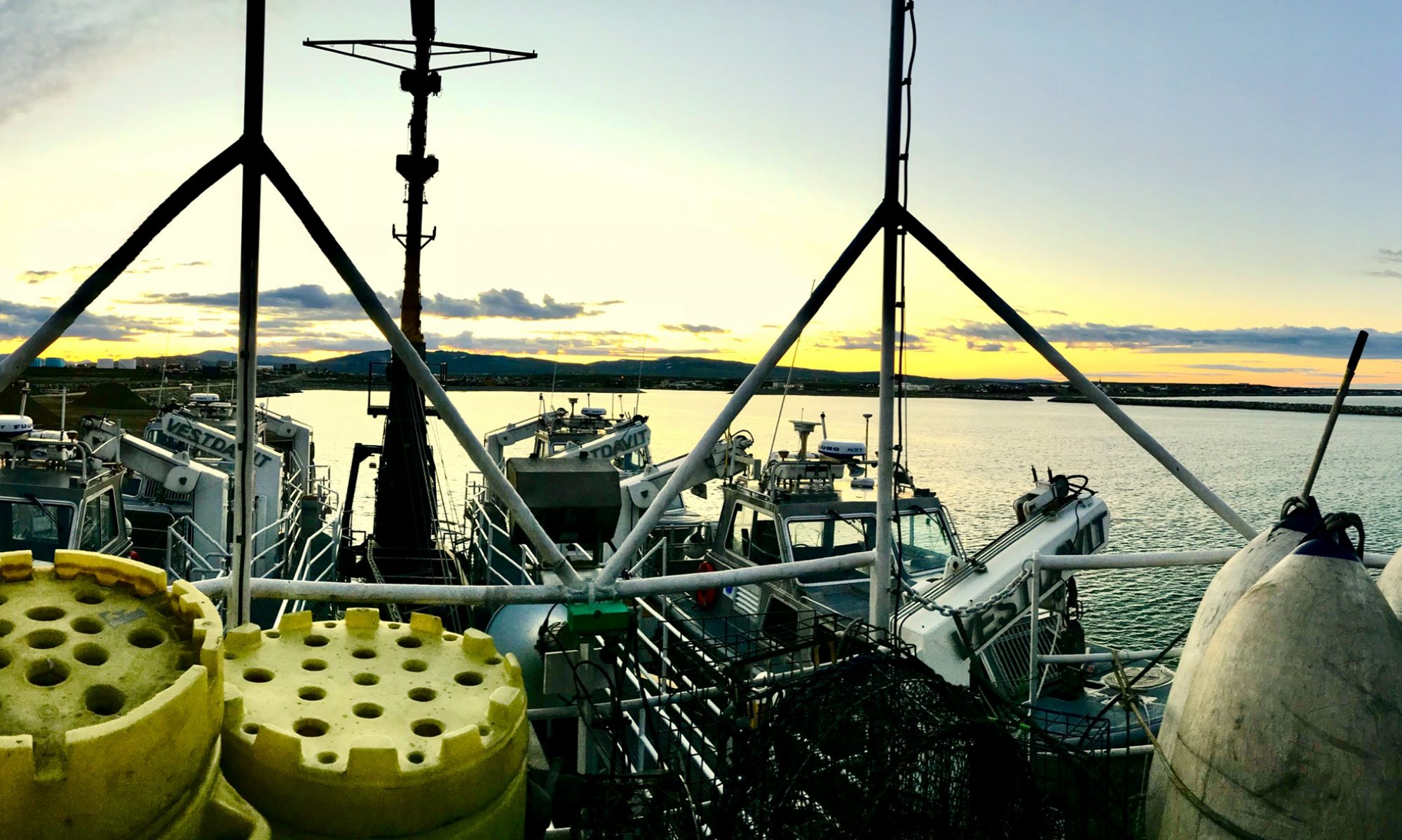
Susan Dee: From the Bottom of the Food Chain to the Top, June 3, 2018

NOAA Teacher at Sea

Susan Dee

Aboard NOAA Ship Henry B. Bigelow 

May 23 – June 7, 2018

Mission:  Spring Ecosystem Monitoring Survey

Geographic Area of Cruise: Northeastern Coast of U.S.

Date:  June 3, 2018

Weather From Bridge

Latitude: 43°47.1′
Longitude: 068°40.41′
Sea Wave Height: 4-6 ft
Wind Speed:  20 knots
Wind Direction:  NE
Visibility:  10
Air Temperature:  10°C
Sky:  few clouds


Science and Technology Log

Birds on water
Sea Birds

As the Henry B. Bigelow traverses the Gulf of Maine sampling the microorganisms at stations, another pair of scientists are observing bird and marine mammal populations. Much of my time between sampling stations, I head up to the flying bridge and join  Nicholas Metheny and John Loch, Seabird Observers, on the lookout for the seabird and marine mammals. The seabirds most commonly observed in the Gulf of Maine are the Wilson Storm Petrel and the Sooty Shearwater.  These two species account for 60% of the birds seen.  These pelagic seabirds live offshore and only return to land to breed, often on remote islands.

birders on deck
Seabird Observers on Observation Deck


South Polar Skua
South Polar Skua (photo by Nicolas Methany)

All the samplings taken with bongo nets are samplings of the producers and primary consumers, the small organisms in the food chain.  On the observation deck, the fish and marine mammals that rely on a healthy bottom food chain are observed.  Spotting  marine mammals adds much to the excitement of the day. The bridge will announce a sighting and if possible, one gets to the flying bridge to see the wildlife.   One of the first sightings was of humpback whales in the distance, followed by sperm whale and pilot whale sightings.

Sperm Whale
Sperm Whale (Photo by Nicholas Methany)


Short Beaked Common Dolphin
Short beaked Common Dolphins (Photo by Nicholas Methany)


The most fascinating sightings were of Mola Mola- Ocean Sunfish.  They were spotted often and very close to the ship.

Mola Mola  - Ocean Sunfish
Mola Mola – Ocean Sunfish (Photo by Nicolas Methany)


Blue Shark
Blue Shark (Photo by Nicholas Methany)


Personal Log

The science crew is kept busy sampling at each station.  There is some down time steaming from station to station at 12 knots but it is enjoyable. I spend the down time talking to crew and scientists.  Chief Scientist Jerry Prezioso has been an awesome mentor and photographer! I am learning so much and am so excited to bring it back into my classroom next year. The seas have been relatively calm but the forecast for the end of the cruise is not favorable for sampling due to high winds. If winds are over 30 knots, the crew has difficulty deploying the nets so sampling is suspended.  The science crew has taken samples from 114 stations.  These samples will be sent off to be analyzed at different labs.

Filled jar samples
Samples collected, boxed and ready to be shipped to analyze
work deck
Science Lab Work Deck
Deck Crew
Andrew and AJ helping deploy instruments

The deck crew and scientist party have been a pleasure to work with. I have learned so much from each of them

Science Party
Science Party Day Crew: Jerry P, Mark, and Chris T
Route map shows path of cruise
Final Day of Cruise Route map shows path of cruise

The cruise was cut short by two days due to high winds.  The last sampling station was in Cape Cod Bay. Tomorrow the ship will  head back to port through the Cape Cod Canal, ending a fantastic cruise.  I am so excited to see the data from  all these samples.  Thanks Teacher at Sea program for a great adventure!

Teacher at Sea Susan Dee

Kathryn Lanouette, July 22, 2009

NOAA Teacher at Sea
Kathryn Lanouette
Onboard NOAA Ship Oscar Dyson
July 21-August 7, 2009 

Mission: Summer Pollock Survey
Geographical area of cruise: Alaska
Date: July 22, 2009

Looking back on Unalaska, AK

Weather Data from the Ship’s Bridge 
Visibility: 3 nautical miles
Wind direction: 288.27 degree (N, NW)
Wind speed: 20 knots
Sea wave height: 8-10 feet
Air temperature: 7.4 ˚C
Seawater temperature: 6.8 ˚C
Sea level pressure: 29.3 inches Hg and rising
Cloud cover: 8/ 8, stratus

Science and Technology Log 

It will take about 2 ½ days of non-stop sailing until we reach the fish survey starting area. Before that research gets underway, I’ve been spending a lot of time getting to know my way around the ship and learning about life at sea. My favorite part of the ship to spend time has been the bridge, the navigation and operations base for the entire ship. From the bridge, I’ve been able to learn more about the weather and birds that live at sea. Every hour, the weather is recorded using the boat’s instruments. This weather is then relayed to NOAA’s National Weather Service. Using the Oscar Dyson’s data, the National Weather Service is better able to predict and model weather patterns, increasing their forecast’s accuracy for this remote region. As the waves kicked up a lot on Tuesday evening, I learned about the Beaufort Scale of Wind Force.

Using estimated wave speed and wave height, you can calculate the severity of the weather. On Tuesday evening, we were sailing through a Force 7 on the scale, a gale with wave heights of 13.5 to 19 feet and a wind speed of 28-33 knots (aprox. 35-37 mph) with gusts up to 45 knots (aprox. 50 mph) Luckily, the waves have calmed down a lot by Wednesday evening because the lower pressure system has passed us to the east.

A Northern Fulmar (Courtesy Aaron Lang, USFWS)

In addition to fisheries research, there are two bird observers from the U.S. Fish and Wildlife Service (USFWS). For almost 16 hours each day, they observe and record information about the seabirds that they see flying within 300 m of the boat. Seabirds spend most of their lives living out on the open seas, looking for food. A lot is known about their cliff nesting areas by the water because these locations are relatively easier to access. Much less is known about their time spent at sea. The information gathered here helps scientists learn more about the birds that inhabit the Bering Sea. By looking at their data from prior years, they can sea how different birds are affected by human caused events (like oil spills, global warming, and commercial fishing) and non-human caused events like volcanic eruptions. All their research is part a bigger research program called the Bering Sea Integrated Ecosystem Research Program (BSIERP).  As one seabird was flying close to the boat, I noticed it had a slender tube on top of its bill. It turns out that this bird was a Northern Fulmar, part of a group of birds called “tube-noses.” This tube enables the birds to drink saltwater, a cool adaptation to life at sea.

Here I am practicing wearing my immersion suit.

Personal Log 

On Tuesday afternoon, as we left the protected bay of Dutch Harbor, we started sailing out towards the more open waters of the Bering Sea.  It was a strange feeling to see the Fox Islands, a smaller part of the Aleutian Island chain, slipping out of sight. Our next chance of seeing land will be as we get closer to Russia. Even then, it might be too cloudy. It is strange to think that I might not see land again for over two weeks. By 9pm on Tuesday night, I was sick as a dog, “hanging over the rails” if you will. But with some sleep and seasickness medicine, I am feeling a lot better today. Seems I have found my “sea legs” as food seems appealing once more and the boats rocking is becoming more of a lulling motion than a lurching one. Around noon on Wednesday, we had our first fire drill and abandon ship drill. As part of the drills, we had to practice putting on our immersion suits. In case we had to abandon ship for any reason, these suits would keep us warmer and more visible. I felt a bit like Gumby!

Animals Seen 
Northern Fulmar Black Legged Kittiwake Tufted Puffin Horned Puffin Black-Footed Albatross Laysan Albatross Murre

New Vocabulary 
Knots – units of speed, nautical miles per hour Nautical mile – 1.15 statute (regular) mile