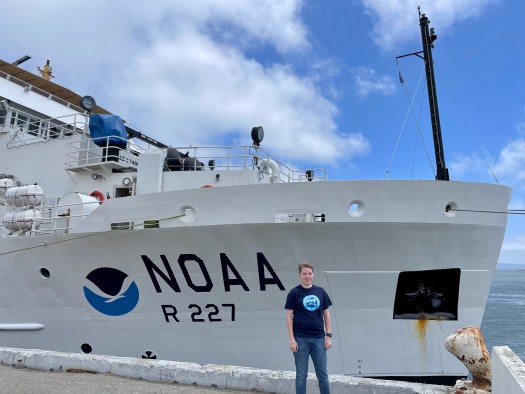
Geographic Area of Cruise: Pacific Coast, near Northern California
Date: September 2, 2024
Weather Data from the Bridge (Humboldt Canyon)
Latitude: 41.6º N
Longitude: 124.8º W
Wind Speed: S at 4.59 knots
Air Temperature: 15.1º C (59.18º F)
Conditions: Mostly Sunny
Science and Technology Log
One of the other interesting components of the EXPRESS Project is the use of MultiNets to study plankton in the mid layers of the water column. MultiNets are exactly what they sound like – a collection of nets that are lowered into the water to grab a sampling of plankton from the area. There are different ways of using MultiNets. Sometimes they are used horizontally, where they are dragged through the water to grab samples. For our mission, however, they are being deployed vertically.
MultiNet being lowered into the water with the ship’s winch
There are 5 nets that are each attached to a red canister. The net bags are all closed prior to deployment in the water, so that water flows freely through the frame. Upon the net frame being lowered to the deepest desired depth of study, the first net is opened to collect the water at that depth. As that canister is closed, the next one is opened at the new depth. This goes on as the MultiNet is pulled upwards until all 5 canisters have collected samples at the varying depths being studied. The MultiNet that is being used for this project also has a side net. The side net is used for capturing everything in the water column all the way up from 1000 meters upwards.
One of my favorite parts of the day is what I call “Show and Tell with Jenn,” where Jennifer Questel, the scientist deploying the MultiNet, goes through everything found in the collection from the side net. She pours small portions of the samples from the side net at a time into a glass dish to sift through and pull out the organisms of interest for separate preservation to study in a lab later.
Jennifer, sifting through the samples from the day’s collection
The jar of collected samples from the side net
The very first time she did this, I was so excited to see a few jellyfish and a lantern fish. I thought that was all that was caught. When Jenn went through the samples, however, she pulled out these incredible clear living organisms that I hadn’t even noticed floating in the sample water.
Examples of what Jenn found in her samples
I even got to hold a salp, which looks really squishy and slimy, but does not feel that way – it definitely has its own structure!
Holding a salp!
Personal Log
Captain Laura Gibson arranged for me to get a tour of the engine room. Although there is plenty of science in the ship’s day-to-day operations, too, I’m going to use the “Personal Log” section of my blog to discuss ship specifics, particularly since I’ve gotten so many questions about life on NOAA Ship Bell M. Shimada.
There are many systems that keep the ship operating. Obviously there is the engine that keeps the ship running, but there is so much that many people wouldn’t think of. For example, did you know that the water is put through a reverse osmosis system so that it is drinkable? I know we have a system like this in my basement for my house, but it is nothing compared to this system!
Reverse Osmosis System for the ship
There is a very important system on the ship that handles all of the waste from the toilets. It is a very sensitive system and it was reiterated many times that you CANNOT flush anything other than toilet paper down the pipes, or you will be very unpopular amongst the ship engineers! In fact, we learned that most ‘flushable wipes’ that you find are not flushable in any marine system. I imagine this is a system many of you would not have thought about, but it is a system that you definitely want to be working smoothly!
Engine room control board
The Chief Marine Engineer Rob Dillon has a digital system in which he can watch all aspects of NOAA Ship Bell M. Shimada in action at any given moment. He is retiring in a month, and it was fun to hear his stories of working on steam ships first, then diesel, and also watching the transition to the digital displays. He has been all over the world, including making deliveries to the USSR before the end of the Cold War. I could have listened to his stories all day long!
Rudder Post – I could see the subtle turning as we were standing there!
The real fun was seeing the rudder control and the ship propeller. It was such a fascinating feeling to imagine what was happening in the water just on the other side of what I was seeing inside the ship!
Getting to the ship’s propeller shaft!
The ship’s propeller shaft – the cloth is there because they clean the shaft often to keep it running smoothly
Music Connection
Today’s music connection comes courtesy of Ensign Megan Sixt. I was visiting the bridge, and asking questions about the structure of the NOAA Corps (the uniformed service men and women who run the ship operations) and the science teams. Megan beautifully explained that the ship runs like a symphony orchestra – every person has their role, and each role is important. She talked about how there are certain roles on the ship that would be very difficult for her to do, and she is grateful for the people who do them so well on NOAA Ship Bell M. Shimada.
It is a very inspiring experience to watch the NOAA Corps and the science team collaborate. Both parties highly respect what the other is doing, and you can see that in every interaction. Everyone on the ship wants the mission to be successful and they all understand their individual role in making it happen. Just like in an orchestra where a trombonist would not be covering an oboist’s part, the people on NOAA Ship Bell M. Shimada know their role and do not try to tell other people what to do in their roles. It is so refreshing to be in a place where everyone appreciates and supports each other fully. The trust in each other and respect for each person is very high here, and it is a great lesson for the students I teach to hear about. There is rarely a collaboration that does not end in thanking the other person for their help, insight, or critique. The bigger picture – whether it is a scientific mission, or a symphony orchestra performance, is the ultimate goal that everyone focuses on.
Also, I want to share another audio clip with you all – this is what a group of albatross sound like. You can hear Popoki, as well, as we are recovering her from her dive.
This audio clip contains the sounds of the albatross
Student Questions
Part of the homework I had to do for the students I work with was to find out about squid in the area I am working. They will be excited to know that I saw one off the side of the ship tonight! I couldn’t get a picture of it, as the lighting was not great for an iphone photo. However, there also happens to be a squid in the lab for the freezer.
Pretty sure this guy wants to say hi to St. Bruno Wildcats!
The samples from the MultiNet have also included some tiny squid.
Jenn says this is paralarvae, probably from a squid, found in the side net collection
Mission: Fisheries: Pacific Hake Survey (More info here)
GeographicRegion: Pacific Ocean, off the coast of California
Date: July 16, 2023
– – ⚓ – –
Weather Data from the Bridge
July 14 (1200 PT, 1500 EST) Location: 38° 34.9’ N, 123° 42.7’ W 15nm (17mi) West of Stewarts Point, CA
Visibility: <1 nautical miles Sky condition: Overcast, fog Wind: 19 knots from NW 330° Barometer: 1014.6 mbar Sea wave height: 3-4 feet Swell: 5-6 ft from NW 300° Sea temperature: 11.0°C (51.8°F) Air temperature: 13.1°C (55.6°F) Course Over Ground: (COG): 330° Speed Over Ground (SOG): 10 knots
July 15 (1200 PT, 1500 EST) Location: 38° 56.3’ N, 124° 02.1’ W 13nm (15mi) West of Point Arena Lighthouse, Point Arena, CA
Visibility: 10 nautical miles Sky condition: Overcast Wind: 20 knots from NW 340° Barometer: 1013.1 mbar Sea wave height: 3-4 feet 3-4 Swell: 7-8 ft from NW 320° Sea temperature: 10.8°C (51.4°F) Air temperature: 13.3°C (55.9°F) Course Over Ground: (COG): 270° Speed Over Ground (SOG): 9 knots
July 16 (1200 PT, 1500 EST) Location: 39° 36.2’ N, 124° 01.6’ W 14nm (16mi) Northwest of Fort Bragg, CA
Visibility: 10 nautical miles Sky condition: Overcast Wind: 29 knots from NW 320° Barometer: 1011.4 mbar Sea wave height: 3-4 feet Swell: 5-6 ft from NW 320° Sea temperature: 11.3°C (52.3°F) Air temperature: 13.9°C (57.0°F) Course Over Ground: (COG): 280° Speed Over Ground (SOG): 7 knots
– – ⚓ – –
Science and Technology Log
Without a vessel and without a crew, none of this mission would be possible. As I’ve said before, this crew is special. Like any job, employees are required, but that does not mean that you will work well cohesively and passionately towards a goal. The two weeks I’ve been spending with this crew who is so wholeheartedly excited about their job and role, while being on the ocean, has been so rewarding and inspiring. More later, this is starting to remind me of crying along with my sobbing fourth graders on the last day of school.
While I’ve discussed a lot of the daily operations of the crew and ship, and what I’ve been learning and working on myself, however, I have not discussed the vessel and agency that has made all of this possible. Many people question, “What is NOAA?” when I explain this opportunity.
About NOAA
“The National Oceanic and Atmospheric Administration (NOAA) is a U.S. government agency that was formed in 1970 as a combination of several different organizations. The purpose of NOAA is to study and report on the ocean, atmosphere, and coastal regions of Earth.”
“Our mission: To understand and predict changes in climate, weather, ocean, and coasts, to share that knowledge and information with others, and to conserve and managecoastal and marine ecosystems and resources.” NOAA: “About Our Agency”
NOAA Ship Bell M. Shimada can carry a total crew of 24, which include NOAA Corps officers, engineers, other crew members, and scientists.
“The NOAA Commissioned Officer Corps (NOAA Corps) is one of the nation’s eight uniformed services. NOAA Corps officers are an integral part of the National Oceanic and Atmospheric Administration (NOAA), an agency of the U.S. Department of Commerce, and serve with the special trust and confidence of the President.”
NOAA Ship Bell M. Shimada, commissioned in 2010, is a fisheries survey vessel designed to produce a low acoustic signature, built to collect data on fish populations, conduct marine mammal and seabird surveys, and study marine ecosystems. The quiet operation provides scientists the ability to study fish and marine mammals without significantly altering their behavior.
Stats and Specs (Link for more information) Length: 208.60 ft Beam (width): 49.2 ft Draft (bottom of the lowered centerboard to waterline): 29.7 ft Displacement (full load): 2,479 tons (4,958,000 lbs) Speed: 11.00 knots Endurance: 40 days Range: 12,000 nautical miles Home port: Newport, Oregon Crew: – 24 (5 NOAA Corps officers, 4 licensed engineers, and 15 other crew members) – Plus up to 15 scientists
Namesake
“[Dr.] Bell M. Shimada (1922-1958), served with the United States Fish and Wildlife Service and the Inter-American Tropical Tuna Commission, and was known for his studies of tropical Pacific tuna stocks.”
The ship’s namesake was known for his contributions to the study of Tropical Pacific tuna stocks, which were important to the development of West Coast commercial fisheries following World War II. Dr. Bell Shimada and colleagues at Pacific Oceanic Fisheries Investigations (POFI) Honolulu Laboratory were among the first to study the population dynamics of tunas and the oceanography affecting their abundance and distribution.
Dr. Bell M. Shimada, circa 1957. Wikipedia: “Bell M. Shimada”
“In her remarks at the christening and launch, [Dr. Shimada’s daughter] Julie Shimada offered the following, “I hope the Bell M. Shimada is a lasting testament that no life is too short, no career too brief, no contribution too small, to make a difference.”
NVC Foundation: “NOAA Honors Nisei With Launch of Fisheries Vessel “Bell M. Shimada””
– – ⚓ – –
Interviews with the Crew (Part 1 of 2)
(Take note of the similarities and differences between how these crew members chose an ocean-related career and got to be assigned to NOAA Ship Bell M. Shimada)
Executive Officer Commander Laura Gibson
What is your role aboard NOAA Ship Bell M. Shimada? CDR Gibson’s role includes a lot of administrative work, handling the budget, standing bridge watches as the Officer on Duty (OOD), along with other executive duties.
What do you enjoy the most about your role? The mission and camaraderie of the crew, as well as getting to know the ship and happy, successful operations.
When did you know you wanted to pursue an ocean-related career? CDR Gibson enjoys Scuba diving and grew up on lakes. She worked on a research ship in college and continued working on the water which led her to NOAA. She mentions her Dad as a large motivator and inspiration of wanting to pursue an ocean-related career.
What do you think you would be doing if you were not working for NOAA? Working a boring 9-5 desk job!
Favorite animal Rhinoceros
Fun Fact: she brings a stuffed animal dog with her from her son, named Barfolomew.
His nickname is Barf!
Operations Officer Lieutenant Nicole Chappelle
What is your role aboard NOAA Ship Bell M. Shimada? Coordinate with scientists to make the plan of the day, assist in navigation and operation of the vessel.
What do you enjoy the most about your role? Nicole enjoys seeing all of the sea life and creatures, and hearing and learning what the scientists are doing and why.
When did you know you wanted to pursue an ocean-related career? She originally wanted to work with animals, which she did as a member of a rehabilitation team at Sea World. She then wanted to join uniformed service. Nicole chose NOAA’s uniformed service (NOAA Corps) because their science missions aligned with her interests.
What do you think you would be doing if you were not working for NOAA? Working with animals and marine life or being a scuba instructor.
Do you have an outside hobby? Horseback riding, Scuba diving, jogging, kayaking, hiking.
What’s something you were surprised to see or learn about living and working onboard when you first started? Nicole remarked on the times she’s been out in the ocean, hundreds of miles away from shore, and how few other vessels you see there. She says it gave her a much greater appreciation for just how big the ocean is.
Favorite animal Horses
Junior Engineer Deb Rose
What is your role aboard NOAA Ship Bell M. Shimada? Junior Engineer Deb Rose (in her words) handles the “hotel services” of the vessel. Her role includes plumbing, electrical work, repairs, and many other behind the scene tasks to keep the vessel running safely.
What do you enjoy the most about your role? I get to fix stuff! Troubleshooting, figuring out what’s wrong, and fixing the problem were among steps that she described as part of her work onboard.
When did you know you wanted to pursue an ocean-related career? While working at Firestone, Deb met and befriended Jason who became a wiper on NOAA Ship Oscar Elton Sette. She saw pictures and heard his stories of how he is now a licensed engineer, and decided to follow in his footsteps! She mentions Jason as a motivator that inspired her to pursue an ocean-related career.
What do you think you would be doing if you were not working for NOAA? Continue to work on the Alaska Marine Highway ferries. (These ferries cover 3,500 miles of Alaska’s coastline.)
Outside hobbies: Video games, Scuba diving, swimming, fishing
What’s something you were surprised to see or learn about living and working onboard when you first started? How few women there still are in the industry. Deb has often been the only or one of the only female crew members both on land and at sea. She hopes that this trend will keep changing and that women will be in more engineering industries.
Favorite animal Her favorite animals are the Jackson Chameleon and dogs.
Fun Fact: Humans are more related to salps than any other creatures we catch. She can also identify 12 Rockfish species!
Deck Department Connor Rauch
What is your role aboard NOAA Ship Bell M. Shimada? Connor is a General Vessel Assistant as part of the Deck Department. He helps deploy and recover the trawl net and CTD rosette, stands watch as a lookout, helps keep the ship clean, and much more! He took classes at Seattle Maritime Academy for one year and is now applying his education on his first NOAA vessel!
What do you enjoy the most about your role? He is enjoying his first assignment on a NOAA vessel and traveling up and down the Pacific coast. He says he is also enjoying being on the water, applying new knowledge to tasks, and training to a real ship. He also enjoys learning about trawling and commented on how nice the people onboard are.
When did you know you wanted to pursue an ocean-related career? He wanted to try something new after working for a non-profit group during the Covid-19 pandemic assisting those in need. He decided to work on the water since he grew up sailing and kayaking. He thought of working on local ferries, but after taking classes at Seattle Maritime Academy, he had the confidence to apply for NOAA.
Do you have an outside hobby? Reading, kayaking, camping, and hiking.
What’s something you were surprised to see or learn about living and working onboard when you first started? Connor said he was pleasantly surprised at how tight the crew is, how easy it is to sleep, how comfortable the ship is, and the good food!
Favorite animal Beavers and dog
– – ⚓ – –
Personal Log
As this experience comes to the end, I reflect on all parts of this mission. The crew, vessel, marine life, food, sleep, friendships, and more. I’m so thankful I was able to have this experience and share NOAA’s Teacher at Sea program more with coworkers, family, friends, and my students. Meeting and talking with the crew resulted in long conversations and plenty of laughs and connections amongst each other that they previously had not known.
Winds and swells picked up over the weekend and on Sunday July 16 we only caught six Hake. After that trawl and an increase in marine mammals being sighted when we were trying to trawl, fishing was called off for the rest of the Leg. At 1020 Monday July 17, we completed our last transect for Leg 2 of the Survey and headed due North for the long trek to Newport, Oregon. We still found ways to entertain ourselves, nap, snack, share stories and riddles, take photos of sunsets and marine mammals, watch shooting stars and have a movie night. Below are photos of our art craft: fish prints of two Chilipepper Rockfish!
Art stationFish prints hanging to dryFinished fish print
– – ⚓ – –
Did You Know?
NOAA Ship Bell M. Shimada has an endurance, the amount of time the vessel can be at sea in a row, of forty days. This is not because the ship can’t make its own fresh water through reverse osmosis from sea water, or a lack of fuel, oil, extra parts, or a way to exhume waste and trash in an environmentally friendly way…
but because of food!
Our galley crew is amazingly talented and spoils us with a huge all you can eat buffet, desserts, and drinks every day! But, as per various laws and for the safety of the crew, they are lawfully entitled to fresh fruit, vegetables, meat, etc. within set guidelines and window of time.
Salad and food service bar in galleyFresh fruitShip’s mess
– – ⚓ – –
Animals Seen Today
Pacific White-Sided Dolphins! Although these energetic friends caused us to abandon a trawl attempt after multiple marine mammal watches ended early because of their presence, they were so much fun to watch! I brought my DSLR camera up to the bridge deck and eventually sat down on the deck watching them jump and race through the ocean waters next to the hull. Below are some of my favorite photos I took of the pod.
Mission: Fisheries: Pacific Hake Survey (More info here)
Geographic Region: Pacific Ocean, off the coast of California
Date: July 10, 2023
– – ⚓ – –
Weather Data from the bridge:
July 7 (1200 PT, 1500 EST) Location: 36° 00.4’ N, 122° 05.9’ W 16nm (21mi) West of Big Sur, CA
Visibility: 10 nautical miles Sky condition: Overcast Wind: 20 knots from NW 330° Barometer: 1013.1 mbar Sea wave height: 3-4 feet Swell: 6-7 ft from NW 320° Sea temperature: 14.0°C (57.2°F) Air temperature: 14.4°C (57.9°F) Course Over Ground: (COG): 323° Speed Over Ground (SOG): 10 knots
July 8 (1200 PT, 1500 EST) Location: 36° 34.5’ N, 122° 05.3’ W 17nm (20mi) Southwest of Monterey, CA
Visibility: 10 nautical miles Sky condition: Few clouds Wind: 19 knots from NW 330° Barometer: 1013.8 mbar Sea wave height: 5-6 feet Swell: 6-7 ft from NW 330° Sea temperature: 14.0°C (57.2°F) 13.7 Air temperature: 14.4°C (57.9°F) 14.3 Course Over Ground: (COG): 089° Speed Over Ground (SOG): 10 knots
July 9 (1200 PT, 1500 EST) Location: 37° 06.8’ N, 123° 00.5’ W 30nm (35mi) West of Pigeon Point Light Station, Pescadero, CA
Visibility: 10 nautical miles Sky condition: Overcast Wind: 13 knots from NW 332° Barometer: 1016.0 mbar Sea wave height: 2-3 feet Swell: 4-5 ft from NW 310° 4-5 Sea temperature: 14.3°C (57.7°F) Air temperature: 15.2°C (59.4°F) Course Over Ground: (COG): 093° Speed Over Ground (SOG): 10 knots
July 10 (1200 PT, 1500 EST) Location: 37° 26.7’ N, 123° 06.4’ W 32nm (37mi) West of Pescadero, CA
Visibility: 8 nautical miles Sky condition: Overcast, fog in vicinity Wind: 20 knots from NW 330° Barometer: 1015.9 mbar Sea wave height: 2-3 feet Swell: 3-4 ft from NW 320° Sea temperature: 14.5°C (58.1°F) Air temperature: 13.6°C (56.5°F) Course Over Ground: (COG): 314° Speed Over Ground (SOG): 3 knots
– – ⚓ – –
Science and Technology Log
Me holding a Hake before sorting. After observation, we determined this was a developmentally mature female, measuring 50cm (20in) long!
In my July 6 blog post, I explained how NOAA Ship Bell M. Shimada is equipped to collect acoustic data in the form of echo grams. The acoustics team uses the data to determine if there are enough return signals to suggest fish are present and attempt a trawl. In this blog post, I will explain how we get the fish onboard, and what we do with the sample of marine life once it is collected from the net.
One question I had after learning about the acoustics and environmental DNA (eDNA) pieces of the survey mission was, “How does physically collecting and researching Hake samples fit into the puzzle of understanding their ecosystem and supporting sustainable fisheries?” (NOAA Fisheries quick facts and video here)
“While echosounders are useful, they do not provide certain quantitative data that researchers need to understand the ecology of these organisms and the midwater zone. To collect quantitative data, such as biomass, length and weight, and age class distributions, researchers must gather representational samples and take direct measurements of them. The best way to do this is by employing trawls.”
So, although acoustics and eDNA research is important to the overall survey, they are only pieces of the puzzle, and the puzzle is not complete without conducting trawls and physically researching samples. NOAA Ship Bell M. Shimada uses a midwater trawl net that is deployed from the stern over the transom, and towed behind the vessel. As the name suggests, midwater trawls occur in the middle section of the water column, versus surface and bottom trawls. The net is conical in shape and uses two metal Fishbuster Trawl Doors, and two sets of heavy chain links called Tom weights, in order to keep the trawl in the middle of the water column.
“The midwater region is especially important because the creatures that inhabit it constitute the majority of the world’s seafood. Understanding the ecology of midwater organisms and their vast environment can provide us with better information to manage these important natural resources and prevent their overexploitation.”
Deck department assisting in recovering the trawl net after a successful deployment.
Once the net is onboard, the net is emptied one of two ways depending on the size of the sample. For large samples, marine life is deposited into a hopper and subsequent conveyor belt. For smaller samples, the Hake will be put into a large basket then divided into smaller baskets of approximately 100 Hake each. Any other marine life like Salps, Myctophids, Pyrosomes, Rockfish, King of the Salmon, and small bony fish, etc. are recorded in the database and returned to the ocean.
“The ship’s wet lab allows scientists to sort, weigh, measure and examine fish. The data is entered directly into the ship’s scientific computer network.”
NOAA Office of Marine and Aviation Operations (OMAO): “Bell M. Shimada”
Large basket containing a sample of Hake with a few (red) Splitnose Rockfish.
NOAA Ship Bell M. Shimada’s Wet Lab with multiple scales, Ichtystick electronic measuring boards, trawl camera, vials for otolith (ear) bones, disposal chute, and tools including scalpels, tweezers, and knives.Wet Lab team member Maddie Reifsteck holding a Hake sample.Hake coming down the hopper ramp and onto the conveyor belt. Also in photo: Pinkish-brown Sea Pickle (Pyrosome) and translucent Salp.Basket of freshly caught Hake waiting to be sexed, sorted and have their length measured.Chemistry Lab team member Abi Wells using a scalpel to remove an organ sample from a Hake for further research of RNA.
With our boots and bright orange rubber pants and gloves on, our first task is to distribute the sample of Hake into baskets of about 100 each. Based on how many baskets we fill, a random selection of baskets will be kept, and the others will be returned to the ocean. With the remaining groups of Hake, we determine their sex and length.
In order to do this, we use a scalpel to make an incision on the underside/belly of the Hake. Once open, we are able to examine their organs, including the gonads to determine if the fish is male or female, and if they are developmentally immature or mature. Young Hake are difficult to sex, and it takes practice to get over any initial fears of cutting into an animal; let alone being able to locate and identify the gonads. Hake usually spawn in early winter, so many of the smaller Hake we sample from during the summer are age one or younger.
Our largest Hake thus far was a developmentally mature female, measuring 50cm (20in). In order to accurately and consistently measure the length of the sample, we use a waterproof, magnetic plastic board with metric (centimeter and millimeter) markings called an Ichthystick (think: high-tech meter stick). The fish is placed on the board with its mouth touching the black board at 0cm, then a magnetic stylus is placed at the fork of the fish’s tail. Once the magnetic stylus is placed on the board, the length to the nearest millimeter is displayed on the LCD screen and automatically entered into the database program. The length data is grouped with the date, time, and identified sex for later observation and comparison.
Additional information, abstracts and outline about Ichthystick here
Ichthystick’s LCD display, motherboard, magnetic board, and magnetic stylus. Digital scale in background.
An even smaller subgroup is then selected and examined to record weights of individual Hake, collect ear bones called Otoliths for aging, stomach samples for diet, liver for RNA, and ovaries for maturity development. Otolith bones help determine the age of the Hake because they grow a new “layer” of bone each year, similar to coral structures and annual tree rings. Organs and bones removed from the Hake are sent to NOAA Fisheries centers for analysis and included in databases with the date, identified sex, length, weight, and location in which they were collected.
This data is used to build more of the puzzle, along with acoustical information, water samples, and eDNA data in order to further understand the ecosystem, biomass, diet, and
“support sustainable populations of Pacific hake on the West Coast.” (…) “It provides vital data to help manage the migratory coastal stock of Pacific hake. The hake survey, officially called the Joint U.S.-Canada Integrated Ecosystem and Pacific Hake Acoustic Trawl Survey, occurs every odd-numbered year.”
Although this subtopic of explaining the Integrated Ecosystem and Pacific Hake Acoustic Trawl Survey is a bit easier to understand than my July 6 Acoustics Lab post, it certainly does not mean it’s an easy task!
When I had a tour on July 4, I remarked how clean and organized the Wet Lab is. I hadn’t see it in action yet, but noticed how everything had its place and use. On July 6 we conducted our first trawl and collected a sample of 11 baskets of Hake (approximately 1,100 Hake since we group about 100 Hake together in each basket.) From that sample, we kept four baskets and counted, sexed, and measured 541 Hake.
Five of us were working together in the Wet Lab for that haul. I’ll admit I probably didn’t sex 100+ Hake. It took a few minutes of watching the others carefully and swiftly cut into the underside of a fish, open the two sides, and know what to look for to determine the sex of very young Hake. Eventually I found the courage to slice in and take a look. By the fourth or fifth Hake, the uneasiness had subsided and I found the process very interesting and educational. Although young samples are hard to sex as they are often undeveloped, the others encouraged me and answered my questions and guesses with enthusiasm and support.
While working on measuring the lengths of our samples, one Science Team member paused and remarked how beautiful he found the fish. Although they do not have vibrant, bold colors, shimmering scales, or anything else particularly remarkable, he found the beauty in them. He digressed into a conversation of their role in the ecosystem, how they are living and breathing creatures, and how they probably all have their own personalities and slight physical differences. I noticed some of their eyes were shiny and sparkling, and how their faces and expressions were noticeably unique the more you looked. That “down to earth”, heartfelt discussion was very special and demonstrated how the crew respects the process of catching and sampling Hake, while keeping each other and marine mammals safe.
From the NOAA Corps Officers, to the deck department, to the engineers, electronics, science team, survey team, galley crew, volunteers, and everyone in between; the crew on NOAA Ship Bell M. Shimada is special. They take pride in their vessel and job, and always seem to have a smile and kind greeting. Being away from land and loved ones for weeks and months at a time will certainly take a toll on the body and mind, but this team is there for each other. To all of the crew, thank you for making me feel so welcomed and appreciated. We’re almost halfway through the mission, and as tired as I may get after (sometimes) 12+ hour days, I sleep well knowing the crew trusts their vessel and each other; and look forward to learning and becoming more and more acquainted each day with the people that make this mission possible. Thank you!
– – ⚓ – –
Did You Know? (FAQs)
1. Are you finding schools of them?
We’ve had seven successful trawls out of nine attempts for Pacific Hake fish. They often come with pyrosomes (Sea Pickle) myctophids (Lanternfish), and salps in the net too. Some trawl attempts are successful without a hitch, but more often than not we have to restart our Marine Mammal watches a few times before deploying in order to keep our ocean life safe and not get tangled in the net. Two trawl attempts have been abandoned because of the amount of persistent marine mammal life and playfulness near the ship. (I think they know we’re watching and show off for our cameras.)
2. What’s your average depth?
The transects (Set and numbered longitudinal east-west lines NOAA Ship Bell M. Shimada navigates on while collecting acoustic data) usually range from 50m – 1,500m (164ft – 4,921ft) in depth.
However, right now one of the displays in the Acoustics Lab, the depth reading is 3,240m which is about 10,630ft or just over two miles deep!
This depth is only 1,870ft shallower than the wreck of the RMS Titanic!
(We were on a long transect, we do not often see depths this great.)
3. Have you gotten seasick? Seasickness should subside after about 3 days.
I’ve never gotten seasick thankfully! Knock on wood and all the other premonitions, please.
4. What is the Hake role in the ecosystem?
More info on this coming in later posts after explaining our Chemistry lab and technology aboard!
However, as predators, they can be cannibalistic towards their own kind.
As far as their role in human consumption: They are often used as a substitute for Cod and Haddock, and in fish sticks and imitation crab meat.
Mission: Fisheries: Pacific Hake Survey (More info here)
Geographic Region: Pacific Ocean, off the coast of California
Date: July 6, 2023
Weather Data from the Bridge:
— July 5 Departure (1800 PT, 2100 EST) Location: 37° 44.9’N, 122° 39.2’W Docked at Pier 30/32 San Francisco, CA
Visibility: 10 nautical miles Sky condition: Overcast Wind: 17 knots from NW 300° Barometer: 1012.8 mbar Sea wave height: 1-2 feet Swell: 2-4 ft from W 270° Sea temperature: 14.2°C (57.6°F) Air temperature: 14.7°C (58.5°F) Course Over Ground: (COG): N/A Speed Over Ground (SOG): N/A
— July 6 (1200 PT, 1500 EST) Location: 35° 38.2’ N, 121° 18.9’ W 16nm (18mi) West of San Simeon, CA
Visibility: 10nm Wind: 6 knots from 330° Barometer: 1013.9 Sea wave height: 1-2ft Swell: 2-4ft from 280° Sea wave temperature: 14.4°C (57.9°F) Air temperature: 14.9°C (58.8°F) Course Over Ground: (COG): W 270° Speed Over Ground (SOG): 10 knots
– – ⚓ – –
Science and Technology Log
On July 6, our first full day at sea, we gathered in the acoustics lab to observe and keep watch on data from various screens. Data includes our current course plotted on a digital chart, a camera showing current sea state, measurements of the wind speed and direction, and displays of the multiple frequencies at which the Simrad EK80 transmitter emits sound. The EK80 is used while traveling on numbered longitudinal east-west lines called transects. NOAA Ship Bell M. Shimada navigates on these lines while collecting acoustic data along the west coast of the U.S. and into Canada, in hopes of finding schools of Hake to collect for surveying.
Map showing transects 1-45 off the coast of California. Transect 1 is south of Morro Bay, CA and transect 45 is near Crescent City, CA. (We hope to survey transects 8-35 by Cape Mendocino, CA before traveling north to dock in Newport, OR.)
“For acoustic surveys, the ship uses a multibeam echo sounder (MBES) that projects a fan-shaped beam of sound that bounces back to the ship. The ship’s MBES—one of only three systems of its type worldwide—acquires data from both the water column and the sea floor.”
NOAA Office of Marine and Aviation Operations (OMAO): “Bell M. Shimada”
The Simrad EK80 emits sound waves from the hull of the vessel down to the sea floor. The process is very similar to a dolphin or bat using echolocation to find prey. Any object the signal hits that has a different density and reflectivity than the surrounding water will cause the waves to bounce back to the ship. An image, called an echo gram, is pieced together each time this occurs and the acoustics team is able to use this information to determine if there are enough return signals that suggest fish are present to attempt a trawl.
EK80 displaying returned sound waves at two different wave frequencies.Display from sonar camera showing the outer edge of the net (between ring 2 and 3)Image demonstrating the use of a MBES “The sound pulses travel down into the water column, illustrated by the white cones here, and bounce back when encountering resistance.” NOAA Fisheries: “Acoustic Hake Survey Methods on the West Coast”
Fish that have swim bladders, like bony fish, reflect or echo the sound wave back to the vessel very strongly. Other marine life such as myctophids and zooplankton also have a different density than the sea water, and reflect sound, although not as strongly as fish with air-filled swim bladders. The sea floor itself also reflects sound very strongly, because of the density difference between water and rocks, sand, and mud.
Marine life that have swim bladders (represented in blue) reflect or echo the sound wave back to the vessel. Examples of such marine life include bony fish, myctophids, and zooplankton, as well as the sea floor itself, which has a different density than the sea water.
Image: Cross section example of a Black Sea Bass to show a swim bladder.
If the acoustics team determines there is enough marine life (that they are interested in surveying) to attempt a haul, they will notify the bridge deck and officers that they would like to have the fishing net deployed.
Before an attempted haul, the science team conducts a marine mammal watch for ten minutes. In this time window, several pairs of eyes are observing from the bridge deck and stern for any signs of dolphins, whales, sea lions, seals, and any other marine mammals that are within 500 meters of the vessel. If any marine mammals are spotted within the ten minute observation, we will stand down and wait ten minutes before restarting the marine mammal watch. Net deployment cannot occur until the full observation window has completed.
First haul July 6: 1422-1432 Mammal watch, no marine mammals spotted. The net deployment started, at which time the vessel continues forward at two knots. Vessel speed increases to three knots when the net is fully deployed with doors and weights in the water, which assist in opening the conical shaped net outwards linearly and laterally. During this time the science team watches displays of the EK80 frequencies and observe the linear width and depth of the net. Scientists can compare these displays to determine if the net is in the correct position to have the best chance of collecting fish.
Chief Scientist Steve de Blois monitoring EK80 frequencies and net information.Deck department deploying fishing net.Wet Lab team takes over sorting Hake and other marine life.
Hauling back the net occurs after several minutes, at which time the vessel returns to a speed of two knots, and we estimate how many fish were collected. The amount of time in which the net is submerged depends on the depth of the water and acoustic information about the size of the school of fish the net is (hopefully) sampling. After recovery, the haul is deposited into a hopper which feeds onto a conveyor belt in the wet lab, then into large baskets and the wet lab team takes over.
During the first attempt, two sea lions were spotted which required the haul attempt to be paused. We restarted the ten minute marine mammal watch from 1500-1510, the deck department retrieved and reset the net, and the vessel was turned around to return to the start of the noted longitudinal transect. With no marine mammals spotted during the observation period, the second attempt was successful and resulted in:
– 1604-1634: 30 minute haul at 350m depth.
– 11 baskets of Hake collected.
– 4 sample baskets kept at random.
– 541 Hake counted and studied in the wet lab.
Photo: Two deck department members about to open the net to allow the sample to drop into a large collection basket.
– – ⚓ – –
Personal Log
On July 4 I arrived to pier 30/32 in San Francisco, CA to board NOAA Ship Bell M. Shimada. Although I grew up volunteering on the 441’ WWII Liberty Ship SS John W. Brown in Baltimore, MD, seeing a new ship still resulted in a mix of emotions, nervousness, adrenaline, excitement, and everything in between. After five and a half years, finally seeing the 208’ vessel that would become my home for the next two weeks was a core memory and feeling I will always remember.
NOAA Ship Bell M. Shimada docked at Pier 30/32 in San Francisco, CA on July 4
Once onboard, I met Chief Scientist Steve de Blois and Wet Lab Lead Ethan Beyer. I was given a tour of the acoustic, chem, and wet labs and shown to my cabin. After dinner ashore, I joined some of the crew on the flying bridge to watch the July 4th fireworks. I met additional science team members and enjoyed a long night’s rest.
In the morning on July 5, we had a welcome aboard meeting, various trainings, a safety meeting and orientation, fire and abandon ship drills, and a science team meeting. We introduced ourselves, took an official team photo, and soon departed pier 30/32 for our 14 day mission. After passing under the Golden Gate Bridge and heading to the Pacific Ocean, our cold hands were warmed by a wonderful hot dinner of chicken, steak, fresh veggies, salad, and desserts from our galley crew. After dinner, we settled in for our first night at sea, waiting with anticipation for our first trawl on July 6.
Last morning on land: July 5 at Pier 30/32 in San Francisco, CA!Just after taking in lines and leaving Pier 30/32 on July 5Science Team! Back: Maddie, Ethan, Toby, Jamie, Beth Front: Myself, Steve, AbiSan Francisco, CA SkylineHeading out to the open sea of the Pacific Ocean
– – ⚓ – –
Did You Know?
– Hake can be cannibalistic! – Some larger Hake we have collected have had a smaller Hake in their mouth, throat, or stomach! – Their very sharp teeth often stick to our thick rubber gloves.
– – ⚓ – –
New Terms/Phrases:
“Salp: Barrel-shaped, planktonic tunicate in the family Salpidae. It moves by contracting, thereby pumping water through its gelatinous body.”
“Myctophid: Lanternfish (or myctophids, from the Greek μυκτήρ myktḗr, “nose” and ophis, “serpent”) are small mesopelagic fish (…) Lanternfishes are aptly named after their conspicuous use of bioluminescence.”
Simrad EK80: Multibeam Echo Sounder (MBES) transducer that emits sound waves from the hull of the vessel down to the sea floor. It allows scientists to observe and study returned sound wave signals that may suggest marine life is present.
Transect: Set and numbered longitudinal east-west lines NOAA Ship Bell M. Shimada navigates on while collecting acoustic data.
Last night I fell asleep, twice, at the lab bench in between trawls, since I am still adjusting to being on the night shift. We worked from 9:00 P.M. to 6:30 A.M. After the shift I had a nice hot shower and slept a solid 9 hours from 7:00 AM to 4:00 PM. Hopefully, I will be less drowsy tonight!
Upon waking, I went to the galley and grabbed some Raisin Bran and coffee and took it up to the flying bridge to hang out with Ornithologist Brian Hoover. Our current location is in the middle of the Channel Islands, an area I know something about because my friend Evan Morrison, mentioned in my first blog, helps with the Channel Islands Swimming Association, and I would like to swim between these islands one day. Lauren Valentino, Flora Cordoleani, Ily Iglesias and I congregated on the flying bridge and decided we should exercise. We joined Flora in her squat challenge (80 squats on this particular day), followed by 5 minutes of planking and a bit of erging. Half of female members of the fish sorting team are avid rock climbers. They did lots of pull-ups using the rock ring climbing training holds that are installed there.
It felt nice and warm when the ship stopped for deployment of the Conductivity, Temperature and Depth (CTD) Rosette, and it got chilly again as the wind picked up when the ship started moving again. We saw a few whale spouts in the distance and at 5:30 P.M. we went down to the galley for a delicious meal of steak and mashed potatoes. I am beginning to really appreciate how nice this whole experience has been in terms of amenities. The NOAA Reuben Lasker first set launch in 2014 and is a state of the art fisheries vessel with a sophisticated acoustics lab, fish lab, dynamic positioning system, CTD, etc., but is ALSO equipped with creature comforts including a movie lounge, an ice cream cooler loaded with ice cream sandwiches, snickers, fruit pops, you name it, and my personal favorite – a coffee bar where all coffee is freshly ground, an espresso machine, and all varieties of milk and creamers, including Reese’s cup whipped cream. The mattress in my stateroom bunk is quite comfortable and the shower gets hot within seconds! I doubt it can get much better than this for a research experience at sea?
Game Plan and Trawling Line: Point Sal line with five 15 minute hauls.
I am familiar with the sorting protocol now. The catch is dropped from the net into the bucket by members of the deck crew and survey tech, with the oversight of Keith Sakuma, Chief Scientist and NOAA Operations Officer Keith Hanson. The bucket is immediately placed in the fish lab and this is when the fish sorting team starts our work.
Dropping the catch from the Cobb Trawl net into the bucket.
A volume of fish just placed on a sorting tray. This catch has a lot of anchovies, krill, and California smoothtongues.
Separating the krill from the myctophids, Northern anchovies, and California smoothtongues.
Team Red Hats sorting fish. NOAA’s Keith Hanson in the rear left side.
SORTING AND COUNTINGMETHOD
We start by carefully picking through a 2000 mL or 5000 mL volume of the harvest, depending on Keith Sakuma’s initial assessment of the species density and volume in the bucket. The first volume of catch to be sorted is evenly dispersed onto four white sorting trays arrayed on the main lab bench. Once you have a pile of the catch on your tray, you start to separate them into piles of different types of organisms, such as Northern anchovies, ctenophores, krill, salps, pyrosomes, Californian smoothtongues, squid, rockfish, myctophids, and young of year (YOY) fish. I prefer to use my hands for sorting while others use forceps. Once sorted, we count the number of individuals for each species. If we have difficulty identifying an animal that we have not yet seen, we ask Keith Sakuma or a more experienced team member to help with identification. YOY fish, some in larval form, are particularly difficult for me.
Once sorted and counted, we verbally call out the common name and number of organisms to Keith Sakuma who manually records the data in a 3-ring binder for the lab hard-copy. For smaller organisms, such as krill or salps, or in hauls with a high number of any particular species, it would be quite tedious to pick out and count each individual in the total haul. This is why we start with a small subsample volume or 0.5, 2 or 5L, count the individuals in that small volume, establish the ratio for the number of individuals in that volume, and then extrapolate and calculate by the total volume of the haul. For example, if we counted 97 pyrosomes in the initial 5L sort, and we collected a total of 1000L, then we can say that there are 19,400 pyrosomes in the haul.
Chief Scientist Keith Sakuma recording the data from a haul during sorting.
Once 20 individuals of each species have been called out, we no longer have to count that species since the ratio for this catch has already been established and to expedite sorting the rest of the volume. Following sorting, the length of the twenty representatives of each species is measured using electronic calipers and the values populate on an Excel spreadsheet. After measuring, specimens requested by various research institutes including Scripps Institution of Oceanography, Moss Landing, and Monterey Bay Aquarium Research Institute (MBARI) are collected, labelled and frozen.
Flora Cordoleani keeping track of which specimens are to be preserved for various research groups.
Keith Sakuma bagging specimens to send to collaborators.
Creature(s) feature: Salps and Pyrosomes.
Salps What are these strange gelatinous organisms in our catch that look like little puddles of clear jelly with a red, green, yellow, and brown digestive organ in the center? They are goopy, small and slippery making them difficult to pick up by hand. They float on the sea surface and are ubiquitous in our hauls BUT NOBODY KNOWS ABOUT THEM.
These creatures are called salps and belong to the subphylum Tunicata. Tunicates have a notochord in their early stage of life which makes them members of the phylum Chordata, to which humans also belong. Having a transparent body is a way escape being preyed upon.
A group of salps. This species is dime to quarter sized and this number of salps occupies a volume of ~10-15 ml once placed in a beaker.
Salp digestive organs.
Salps are planktonic tunicates That can be found as individual salps or in long chains called blastozooids. The salps shown in the photo below were individuals and were notable in most of our hauls. Individual salps in this pile are dime to quarter sized and occupy a volume of ~10-15 ml. We measured the volume of salps in every haul.
While on the topic of salps, I will tell you about a cool 1 inch long salp parasite I found on my sorting tray (see image below). Keith Sakuma explained that it was a deep sea amphipod called Phronima which is a parasitoid that takes up residence inside of a salp’s body, eats the salp’s organs, and then lays its eggs inside of the salp. The King-of-the-salmon, Trachipterus altivelis, (which we are also catching) uses its protrusible jaw to get inside of the salp just to eat this amphipod!
Phronima amphipod – lives and reproduced in salp after eating the salp’s organs. King-of-the-salmon fish use their protrusible jaws to eat the amphipod.
King-of-the-salmon, Trachipterus altivelis
King-of-the-salmon, Trachipterus altivelis, who preys upon phronima living inside of salp, with jaw protruded.
A large haul full of salps.
Another type of salp we keep catching is Thetys vagina, a large solitary species of nektonic salp that feeds on plankton, such as diatoms, and is an important carbon sink in the ocean. Thetys has an external surface, or test, that is covered with bumps and ridges, as seen in the photo below.
Thetys vagina, the twin-sailed salp.
The internal filtering organ of Thetys vagina.
Kristin Saksa examining a larger Thetys vagina, or the twin-sailed salp. The dark colored tentacles are downward facing. This is the siphon where water enters the sac-filled body.
PyrosomesPyrosoma atlanticum are another type of planktonic tunicate which are very numerous in most of our hauls. Pyrosomes look like bumpy pink hollow tubes with openings on both ends. They are rigid in structure and easy to pick up by hand, whereas salps are goopy and difficult to pick up by hand. We have collected some pyrosomes that are 13 inches long, while most are in the 4-6 inch range. The small pyrosomes look like clear Tic Tacs, but they do not taste as such.
Pyrosoma atlanticum, with an ~6 inch specimen on the left and small pyrosomes on the right.
How can pyrosomes be so ubiquitous just 20 miles or so off of the Central California Coast, but I have never seen one that has floated up on the beach or while swimming?
Pyrosoma atlanticum are also planktonic tunicates, but are colonial organisms made up of many zooids held together by a gelatinous structure called the tunic. One end of the tube is wide open and filters the water for zooplankton and phytoplankton, while the other end is tighter and resembles a diaphragm or sphincter. The pyrosomes we harvested appeared in diverse array of pinks and purples. Pyrosomes are believed to harbor intracellular bioluminescent bacteria. Pyrosomes are drifting organisms that swim by beating cilia lining the branchial basket to propel the animals through the water and create a current for filter feeding.
Pyrosoma atlanticum assorted by color.
Moss Landing Graduate Student Kristin Saksa excited about the large haul of Pyrosoma atlanticum.