Mission: Rockfish Recruitment and Ecosystem Assessment Survey (RREAS)
Geographic Area of Cruise: Pacific Ocean; U.S. West Coast
Date: June 14th, 2024
Weather Datafrom the Bridge
Date: Friday, June 14, 2024 Latitude: 33°34.07 N Longitude: 119°03.108 W Sea Wave Height: 4ft Wind Speed: 5.57 knots Air Temperature: 62°F Sky: Clear
Science Log
View from the deck just before daybreak.
What ocean organisms are you finding?
Each night, the Lasker NOAA Corps Officers, crew, and science team work together to conduct a series of trawls, deploying nets behind the boat to collect samples for the Rockfish Recruitment and Ecosystem Assessment Survey (RREAS).
After the catch from the trawl comes onto the Lasker, scientists identify and measure each of the organisms on board. One of my main tasks during my time as a Teacher at Sea is to help the science team sort and identify the trawl catch each night. A sample of the organisms caught during each trawl, and all of the juvenile rockfish, are collected, labeled and saved for further analysis back at the Southwest Fisheries Science Center Santa Cruz Lab when the science team returns to shore.
Some of the most common organisms caught include pyrosomes, salps (including the large Thetys), krill, and fried egg jellyfish. We also catch a lot of fish, including juvenile anchovy, juvenile hake, many different varieties of myctophid fish, and of course rockfish. To me, some of the most exciting and special organisms caught include the juvenile octopus, all types of squid and king-of-the salmon fish. I am learning so much each day!
Photos: Trawl catch being sorted in the wet lab, trawl catch just after it came in on the ship.
Photos: Ocean organisms from the trawl being sorted in the wet lab, octopus saved from the catch.
Each night, and throughout the night, a member of the science team goes on “Mammal Watch” during trawling operations to protect marine mammals. Fifteen minutes before a trawl, a member of the science team goes up to the bridge mammal watch station, and looks for protected marine mammal species like dolphins, sea lions and whales. If a marine mammal is spotted, then the trawl cannot happen until there are no marine mammals within one nautical mile of the ship. When the trawl begins, another scientist begins mammal watch on the deck from the time the net is launched into the water, until it returns to the ship. Again, if a marine mammal is spotted during this time, the trawl will be canceled and the net will be reeled in immediately.
There are also devices attached to the net called “dolphin deterrent devices.” These devices, often called “dolphin pingers” by the science team, activate as soon as they hit water, and emit sounds to deter dolphins and other marine mammals. This helps to keep marine mammals away from the net to prevent them from getting unintentionally tangled, and do not cause harm to marine animals.
Retired marine mammal deterrent device with hand-drawn rockfish art (by Jackie – one of the ship’s deck crew)!
Personal Log
What is the NOAA Corps?
The NOAA Corps is one of the nation’s eight uniformed services, and the only one to consist only of officers. All NOAA Corps Officers attend the Basic Officer Training Class (BOTC) at the U.S. Coast Guard Academy and train alongside Coast Guard officer candidates. NOAA Corps Officers support all aspects of the NOAA mission and may be assigned to serve on either ships or aircraft. The Lasker currently has 6 officers aboard, under the leadership of Commander Claire Surrey-Marsden.
Photos: CDR Claire Surrey-Marsden on the flying bridge, Daily safety meeting in the bridge
I got a chance to interview CDR Claire Surrey-Marsden. Originally from the Bronx in New York City, CDR Surrey-Marsden has always been interested in the ocean and has a background studying marine biology from Florida Tech. After college, she interned and then worked for Florida Fish and Wildlife Conservation Commission, where she worked with manatee conservation. She then applied and was accepted into the NOAA Corps, and went on to officer training at the Global Marine and Transportation School (GMATS) at Kings Point Academy.
NOAA Corps officers alternate between land and sea assignments in different locations. Her second sea assignment was actually on the delivery team of the NOAA Ship Reuben Lasker, then NOAA’s newest fisheries ship. CDR Claire Surrey-Marsden had land assignments in the Marine Mammal Division, Southwest Fisheries Science Center, and in Washington D.C. working with NOAA Rear Admiral Cary. She now returns to the Lasker on her fourth sea assignment as the Commanding Officer, coming full circle from delivering the same ship early in her career.
When asked what advice she would have for a student interested in a marine science career, CDR Surrey-Marsden advises to volunteer for any opportunity/activity, and to do a good job wherever you go.
Book Recommendations
One of the people I work closely with on the ship is scientist Ily Iglesias. Before arriving on the Lasker, Ily just defended for her P.h.D in ocean sciences at University of California Santa Cruz.
Ily is also a mom to a 3 year old daughter, and they love to read books together. Ily gave me several recommendations of her and her daughter’s favorite science-themed books to read together. Ily has been on survey trips several times, and each time before she leaves she enjoys reading the children’s book Love, Mama by Jeanette Bradley. A story about baby penguin with a mama scientist that goes out to sea on a ship, and both a very relevant and helpful book for Ily and her family. Other ocean related favorites include Who’s Afraid of the Light? by Anna McGregor, and Where the Weird Things Are by Zoleka Filander. I’m excited to read these to my preschool students back in Alaska!
How’s the food?
One of the most asked questions of my family and friends from home is asking about what my meals are like at sea. I am happy to report that the food is great! Breakfast, lunch, and dinner are prepared each day by chefs Arnold and Jude, and available to everyone aboard the Lasker at specific times each day. Working the night shift, I typically begin my day with dinner at 1700, and end it with breakfast at 0700. At night while the science team is working, there is always a full salad bar available, as well as sandwich supplies, snacks and leftovers from the day before. Everyone available on the sip eats together in the “mess” – it’s a great time to relax and get to know everyone.
Beef and vegetablesLobster and baked potato
Photos: Some favorite dinners so far from the cruise.
Mission: Fisheries: Pacific Hake Survey (More info here)
Geographic Region: Pacific Ocean, off the coast of California
Date: July 10, 2023
– – ⚓ – –
Weather Data from the bridge:
July 7 (1200 PT, 1500 EST) Location: 36° 00.4’ N, 122° 05.9’ W 16nm (21mi) West of Big Sur, CA
Visibility: 10 nautical miles Sky condition: Overcast Wind: 20 knots from NW 330° Barometer: 1013.1 mbar Sea wave height: 3-4 feet Swell: 6-7 ft from NW 320° Sea temperature: 14.0°C (57.2°F) Air temperature: 14.4°C (57.9°F) Course Over Ground: (COG): 323° Speed Over Ground (SOG): 10 knots
July 8 (1200 PT, 1500 EST) Location: 36° 34.5’ N, 122° 05.3’ W 17nm (20mi) Southwest of Monterey, CA
Visibility: 10 nautical miles Sky condition: Few clouds Wind: 19 knots from NW 330° Barometer: 1013.8 mbar Sea wave height: 5-6 feet Swell: 6-7 ft from NW 330° Sea temperature: 14.0°C (57.2°F) 13.7 Air temperature: 14.4°C (57.9°F) 14.3 Course Over Ground: (COG): 089° Speed Over Ground (SOG): 10 knots
July 9 (1200 PT, 1500 EST) Location: 37° 06.8’ N, 123° 00.5’ W 30nm (35mi) West of Pigeon Point Light Station, Pescadero, CA
Visibility: 10 nautical miles Sky condition: Overcast Wind: 13 knots from NW 332° Barometer: 1016.0 mbar Sea wave height: 2-3 feet Swell: 4-5 ft from NW 310° 4-5 Sea temperature: 14.3°C (57.7°F) Air temperature: 15.2°C (59.4°F) Course Over Ground: (COG): 093° Speed Over Ground (SOG): 10 knots
July 10 (1200 PT, 1500 EST) Location: 37° 26.7’ N, 123° 06.4’ W 32nm (37mi) West of Pescadero, CA
Visibility: 8 nautical miles Sky condition: Overcast, fog in vicinity Wind: 20 knots from NW 330° Barometer: 1015.9 mbar Sea wave height: 2-3 feet Swell: 3-4 ft from NW 320° Sea temperature: 14.5°C (58.1°F) Air temperature: 13.6°C (56.5°F) Course Over Ground: (COG): 314° Speed Over Ground (SOG): 3 knots
– – ⚓ – –
Science and Technology Log
Me holding a Hake before sorting. After observation, we determined this was a developmentally mature female, measuring 50cm (20in) long!
In my July 6 blog post, I explained how NOAA Ship Bell M. Shimada is equipped to collect acoustic data in the form of echo grams. The acoustics team uses the data to determine if there are enough return signals to suggest fish are present and attempt a trawl. In this blog post, I will explain how we get the fish onboard, and what we do with the sample of marine life once it is collected from the net.
One question I had after learning about the acoustics and environmental DNA (eDNA) pieces of the survey mission was, “How does physically collecting and researching Hake samples fit into the puzzle of understanding their ecosystem and supporting sustainable fisheries?” (NOAA Fisheries quick facts and video here)
“While echosounders are useful, they do not provide certain quantitative data that researchers need to understand the ecology of these organisms and the midwater zone. To collect quantitative data, such as biomass, length and weight, and age class distributions, researchers must gather representational samples and take direct measurements of them. The best way to do this is by employing trawls.”
So, although acoustics and eDNA research is important to the overall survey, they are only pieces of the puzzle, and the puzzle is not complete without conducting trawls and physically researching samples. NOAA Ship Bell M. Shimada uses a midwater trawl net that is deployed from the stern over the transom, and towed behind the vessel. As the name suggests, midwater trawls occur in the middle section of the water column, versus surface and bottom trawls. The net is conical in shape and uses two metal Fishbuster Trawl Doors, and two sets of heavy chain links called Tom weights, in order to keep the trawl in the middle of the water column.
“The midwater region is especially important because the creatures that inhabit it constitute the majority of the world’s seafood. Understanding the ecology of midwater organisms and their vast environment can provide us with better information to manage these important natural resources and prevent their overexploitation.”
Deck department assisting in recovering the trawl net after a successful deployment.
Once the net is onboard, the net is emptied one of two ways depending on the size of the sample. For large samples, marine life is deposited into a hopper and subsequent conveyor belt. For smaller samples, the Hake will be put into a large basket then divided into smaller baskets of approximately 100 Hake each. Any other marine life like Salps, Myctophids, Pyrosomes, Rockfish, King of the Salmon, and small bony fish, etc. are recorded in the database and returned to the ocean.
“The ship’s wet lab allows scientists to sort, weigh, measure and examine fish. The data is entered directly into the ship’s scientific computer network.”
NOAA Office of Marine and Aviation Operations (OMAO): “Bell M. Shimada”
Large basket containing a sample of Hake with a few (red) Splitnose Rockfish.
NOAA Ship Bell M. Shimada’s Wet Lab with multiple scales, Ichtystick electronic measuring boards, trawl camera, vials for otolith (ear) bones, disposal chute, and tools including scalpels, tweezers, and knives.Wet Lab team member Maddie Reifsteck holding a Hake sample.Hake coming down the hopper ramp and onto the conveyor belt. Also in photo: Pinkish-brown Sea Pickle (Pyrosome) and translucent Salp.Basket of freshly caught Hake waiting to be sexed, sorted and have their length measured.Chemistry Lab team member Abi Wells using a scalpel to remove an organ sample from a Hake for further research of RNA.
With our boots and bright orange rubber pants and gloves on, our first task is to distribute the sample of Hake into baskets of about 100 each. Based on how many baskets we fill, a random selection of baskets will be kept, and the others will be returned to the ocean. With the remaining groups of Hake, we determine their sex and length.
In order to do this, we use a scalpel to make an incision on the underside/belly of the Hake. Once open, we are able to examine their organs, including the gonads to determine if the fish is male or female, and if they are developmentally immature or mature. Young Hake are difficult to sex, and it takes practice to get over any initial fears of cutting into an animal; let alone being able to locate and identify the gonads. Hake usually spawn in early winter, so many of the smaller Hake we sample from during the summer are age one or younger.
Our largest Hake thus far was a developmentally mature female, measuring 50cm (20in). In order to accurately and consistently measure the length of the sample, we use a waterproof, magnetic plastic board with metric (centimeter and millimeter) markings called an Ichthystick (think: high-tech meter stick). The fish is placed on the board with its mouth touching the black board at 0cm, then a magnetic stylus is placed at the fork of the fish’s tail. Once the magnetic stylus is placed on the board, the length to the nearest millimeter is displayed on the LCD screen and automatically entered into the database program. The length data is grouped with the date, time, and identified sex for later observation and comparison.
Additional information, abstracts and outline about Ichthystick here
Ichthystick’s LCD display, motherboard, magnetic board, and magnetic stylus. Digital scale in background.
An even smaller subgroup is then selected and examined to record weights of individual Hake, collect ear bones called Otoliths for aging, stomach samples for diet, liver for RNA, and ovaries for maturity development. Otolith bones help determine the age of the Hake because they grow a new “layer” of bone each year, similar to coral structures and annual tree rings. Organs and bones removed from the Hake are sent to NOAA Fisheries centers for analysis and included in databases with the date, identified sex, length, weight, and location in which they were collected.
This data is used to build more of the puzzle, along with acoustical information, water samples, and eDNA data in order to further understand the ecosystem, biomass, diet, and
“support sustainable populations of Pacific hake on the West Coast.” (…) “It provides vital data to help manage the migratory coastal stock of Pacific hake. The hake survey, officially called the Joint U.S.-Canada Integrated Ecosystem and Pacific Hake Acoustic Trawl Survey, occurs every odd-numbered year.”
Although this subtopic of explaining the Integrated Ecosystem and Pacific Hake Acoustic Trawl Survey is a bit easier to understand than my July 6 Acoustics Lab post, it certainly does not mean it’s an easy task!
When I had a tour on July 4, I remarked how clean and organized the Wet Lab is. I hadn’t see it in action yet, but noticed how everything had its place and use. On July 6 we conducted our first trawl and collected a sample of 11 baskets of Hake (approximately 1,100 Hake since we group about 100 Hake together in each basket.) From that sample, we kept four baskets and counted, sexed, and measured 541 Hake.
Five of us were working together in the Wet Lab for that haul. I’ll admit I probably didn’t sex 100+ Hake. It took a few minutes of watching the others carefully and swiftly cut into the underside of a fish, open the two sides, and know what to look for to determine the sex of very young Hake. Eventually I found the courage to slice in and take a look. By the fourth or fifth Hake, the uneasiness had subsided and I found the process very interesting and educational. Although young samples are hard to sex as they are often undeveloped, the others encouraged me and answered my questions and guesses with enthusiasm and support.
While working on measuring the lengths of our samples, one Science Team member paused and remarked how beautiful he found the fish. Although they do not have vibrant, bold colors, shimmering scales, or anything else particularly remarkable, he found the beauty in them. He digressed into a conversation of their role in the ecosystem, how they are living and breathing creatures, and how they probably all have their own personalities and slight physical differences. I noticed some of their eyes were shiny and sparkling, and how their faces and expressions were noticeably unique the more you looked. That “down to earth”, heartfelt discussion was very special and demonstrated how the crew respects the process of catching and sampling Hake, while keeping each other and marine mammals safe.
From the NOAA Corps Officers, to the deck department, to the engineers, electronics, science team, survey team, galley crew, volunteers, and everyone in between; the crew on NOAA Ship Bell M. Shimada is special. They take pride in their vessel and job, and always seem to have a smile and kind greeting. Being away from land and loved ones for weeks and months at a time will certainly take a toll on the body and mind, but this team is there for each other. To all of the crew, thank you for making me feel so welcomed and appreciated. We’re almost halfway through the mission, and as tired as I may get after (sometimes) 12+ hour days, I sleep well knowing the crew trusts their vessel and each other; and look forward to learning and becoming more and more acquainted each day with the people that make this mission possible. Thank you!
– – ⚓ – –
Did You Know? (FAQs)
1. Are you finding schools of them?
We’ve had seven successful trawls out of nine attempts for Pacific Hake fish. They often come with pyrosomes (Sea Pickle) myctophids (Lanternfish), and salps in the net too. Some trawl attempts are successful without a hitch, but more often than not we have to restart our Marine Mammal watches a few times before deploying in order to keep our ocean life safe and not get tangled in the net. Two trawl attempts have been abandoned because of the amount of persistent marine mammal life and playfulness near the ship. (I think they know we’re watching and show off for our cameras.)
2. What’s your average depth?
The transects (Set and numbered longitudinal east-west lines NOAA Ship Bell M. Shimada navigates on while collecting acoustic data) usually range from 50m – 1,500m (164ft – 4,921ft) in depth.
However, right now one of the displays in the Acoustics Lab, the depth reading is 3,240m which is about 10,630ft or just over two miles deep!
This depth is only 1,870ft shallower than the wreck of the RMS Titanic!
(We were on a long transect, we do not often see depths this great.)
3. Have you gotten seasick? Seasickness should subside after about 3 days.
I’ve never gotten seasick thankfully! Knock on wood and all the other premonitions, please.
4. What is the Hake role in the ecosystem?
More info on this coming in later posts after explaining our Chemistry lab and technology aboard!
However, as predators, they can be cannibalistic towards their own kind.
As far as their role in human consumption: They are often used as a substitute for Cod and Haddock, and in fish sticks and imitation crab meat.
Fishing nets like the ones used on the NOAA Ship Oscar Dyson or on commercial fishing boats can be very expensive. If one plans on doing a bottom trawl (fishing with a net that goes down to the sea floor) one wants to make sure that there are not rocks or other things that can snag or tear the net. If there are too many rocks or boulders or uneven topography, the area is considered “untrawlable”. While computer imagery can provide some guidance with regard to what lies deep beneath the surface, scientists onboard the NOAA Ship Oscar Dyson are hoping that video images taken with an underwater camera can provide a more complete picture and be the basis for a more precise computer model of what areas are in fact untrawlable.
Why is this important? Scientists onboard the NOAA Ship Oscar Dyson are surveying the fish that live in the middle of the water column. However, groundfish surveys need to account for all the fish living on the ocean floor. If the groundfish program can’t trawl in certain areas, then they don’t know what is there. For example, rockfish often live in untrawlable areas. If a groundfish survey can’t put a net in areas where rockfish live, then they won’t really “count” the correct numbers of rockfish in their survey. Data obtained using an underwater camera can help determine what species of rockfish are being underrepresented by the groundfish program.
One of the many perks of being on the 4 p.m. to 4 a.m. shift is that I get to watch the drop camera in action! The camera (with its attached light) is slowly lowered to the sea floor.
The drop camera
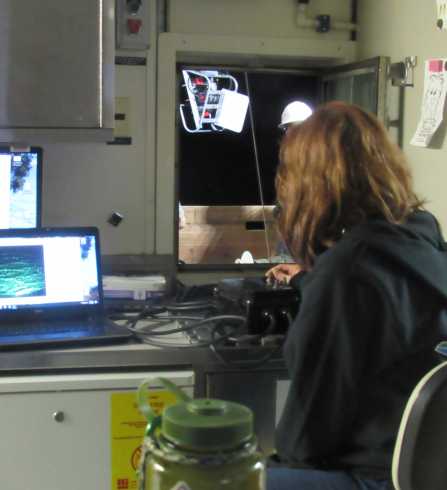
I have seen the camera take 4 minutes to reach the bottom or as long as 8 minutes depending upon the depth of the water being surveyed. The camera is then “driven” along the bottom (or right above it) for 15 minutes via a control box on the boat (similar to a tiny joystick). I even got to drive it a few times!
My turn to drive!
The images are recorded and also seen in real time on several computer screens on the boat. We have seen rocks, of course, but also jellyfish, sea whips, crabs, anemones, octopuses, sea stars, and a wide variety of fish. One night, there were thousands of sand dollars. It looked like we had come across a buried treasure! It is fascinating to see what is happening deep beneath the boat. It’s kind of like virtual scuba diving!
Sand dollars and brittle stars
Tiger Rockfish
Flatfish
Giant Pacific Octopus
ANOTHER Giant Pacific Octopus!
Kelp Greenling
Quillback
Drop Camera Elementary School Math Fun
If the stereo drop camera takes 8 minutes to reach the bottom when the water is 200 meters deep, how long might it take to reach the bottom if it was:
100 meters
deep? ____________
50 meters
deep? ______________
300 meters
deep? _____________
Personal Log
It’s time to come clean and admit that I suffer from Pareidola. Don’t worry, it’s not contagious, or even dangerous. In fact, I think it’s a lot of fun. You see, Pareidola is a psychological phenomenon where you see patterns. Quite often, people with Pareidola will see faces in objects where there really isn’t one, like on an electrical outlet.
Electrical outlets… do you think they look like faces?
My Pareidola
has reached a new level on the NOAA Ship Oscar Dyson as I am seeing not
just faces but ROBOTS like these:
Robot!
Robot!
Let me
know if you see any robots at your house, and I am on the lookout for more
here!
Game Plan and Trawling Line: Four trawls on the San Miguel Line in the Channel Islands.
Time Recap: 5:00 PM: Wake up and then Squat Challenge. 5:30 PM: Dinner. 8:30 PM: Report to fish lab. Learn how to count to ten in French. Kristin sang France’s National Anthem (she learned in 7th grade). 10 PM: First Haul. 3AM: Kaila used her face flip app to turn us into the opposite sex and it was the most hilarious thing ever. 4AM: Latte made by Kaila. A lot of laughing. 6:20 AM: Finish fish lab clean up. 6:21 AM: Still heavily caffeinated so Team Red Hats headed up to the flying dock to watch the sunrise. The sea was very smooth and glassy as we approached Conception Point. We saw several dolphins and a humpback whale. 7:00 AM: To the Galley for a breakfast of blueberry pancakes. 7:45 AM: Lights out.
Part 1: How to distinguish between myctophid species in our catches
In this survey, we are conducting trawls at 30 meters, which is technically the epipelagic zone, so why do we catch deep sea creatures? Many deep sea creatures, such as myctophids, participate in a daily vertical migration where they swim up into the upper layer of the ocean at night, likely following the migration of zooplankton on which they feed. Myctophids are also known as lantern fish or lampfish and they feature photophore organs which bioluminesce. Around 250 species of mcytophids have been described. Graduate student Ily Iglesias is saving a lot of the myctophidae we catch on this cruise for her dissertation work.
Tonight most of the catches were small in volume (filling about 10% of a blue bucket), but had good species density. The catches consisted mostly of salps, anchovies and several species of myctophids. It is important to learn how to properly distinguish between the various myctophids in our catches. This is a daunting task for the novice fish sorter, such as myself, since these fish are small (1 to 2 inches long) and appear very similar to each other. It is worth noting that most of the myctophids lose their skin (scales) during the trawling operation. This exposes the underlying pink muscle tissue, however, their photophores remain intact. Fish collected in a bongo net deployment typically have better preserved scales.
Northern lampfish, Stenobrachius leucopsarus, have 3 photophores in a slanted line under the lateral line while the similar looking Mexican lampfish, Triphoturus mexicanus, have more streamlined bodies and have 3 photophores on the lateral line. Many of the Northern lumpfish had a heart parasite which is evident in the photo below. California lanternfish, Symbiophorus californiensis, are typically larger fish and have a distinguished lateral line. California headlight fish, Diaphus theta, have two photophores “headlights” on the front on their face. Blue lanternfish, Tartetonbeania crenularis, are easy to distinguish from the others because they have wider bodies and blue/silver scales.
Northern lampfish, Stenobrachius leucopsarus, have three photophores in a row (circled).
Mexican lampfish, Triphoturus mexicanus, are more narrow than Northern lampfish and have three photophores right on the lateral line.
California lanternfish, Symbiophorus californiensis, have a distinguished lateral line.
California headlight fish, Diaphus theta, are easy to distinguish because of the two large photophores on the face.
Blue lanternfish, Tartetonbeania crenularis, collected in a bongo net with intact scales. Photo courtesy of Lauren Valentino.
Photoorgans lining ventral surface of Blue lanternfish, Tartetonbeania crenularis.
Part 2: Rockfish: why are we catching so few?
Last night there were 4 rockfish in the last haul, and the fish sorting team got excited because we have not seen very many. The title of this survey is officially “Juvenile Rockfish Recruitment and Ecosystem Assessment Survey,” however, sampling for pelagic juvenile rockfish is only one of the project’s objectives. Other objectives include sampling for other epi-pelagic micronekton species, studying prevailing ocean conditions and examining prominent hydrographic features, mapping the distribution and abundance of krill (Euphausiacea), and observing seabird and marine mammal distribution and abundance.
Rockfish, perch, or redfish are common names for the Sebastes genus of fish (with more than 100 species) which are abundant off of the California coast, and are a very important genus for the commercial fishing industry. Rockfish are benthic fish that live among rocks, and can be found in kelp forests or in the bathypelagic zone. One of the goals of this survey is to inform the fishing industry on the status of the population of rockfish so that reasonable catch limits can be set.
This year is proving to be a poor year for the rockfish pre-recruitment index, lower than the previous several years, says Chief Scientist, Keith Sakuma. He explains that one year of a weak young of year (YOY) rockfish class is not enough to have an impact on the fishing industry, but if the index was low for say, 10 years in a row, then this could potentially affect the exploitable population. He explains that since rockfish can live to be 100 years old or greater, they have many seasons to reproduce. Rockfish prefer cold water habitats. Keith’s research has demonstrated that most poor pre-recruitment index years are correlated to El Nino events which cause an increase in water temperatures and a reduction in cold water upwelling. This year’s slump in terms of rockfish numbers is not correlated to a strong El Nino event.
Two young Cabazon Rockfish, Scorpaenichthys marmoratus.
Part 3: Environmental DNA (eDNA) Sampling on the Reuben Lasker
Last night Flora Cordoleani and I helped Dr. Kelly Goodwin collect water from the Conductivity, Temperature and Depth (CTD) bottles for the purpose of collecting environmental DNA (eDNA). Kelly’s assistant, Lauren Valentino, is primarily on the day shift (see photo of Lauren with the CTD apparatus below). Isolation of eDNA from seawater is a newer technique used to determine which species swam through a particular location based on the DNA they left behind, through shedding of cells. This technique does not require that the organism be harvested to know that it had been present, and could be of value in detection of the presence of endangered species, for example.
For this CTD deployment, three bottles are filled at depths of 5 and 100 meters, and at the chlorophyll max somewhere between 5 – 20 meters. The water from each depth is run through a filter (pore size of 2 microns) in the eDNA lab on the ship (see photo below). The vacuum filtration procedure is a time-consuming process, as samples must be processed in triplicate, and in which aseptic technique is paramount so that human DNA does not contaminate the water. Once the DNA is trapped on the filters, they are stored at -20C. The DNA will be purified from the filters back in the San Diego NOAA lab using a Qiagen kit. Species-specific regions of DNA known as bar-code regions will be amplified by Polymerase chain reaction (PCR) using 3 primers sets for analysis of DNA from bacteria, plankton, and fish. Illumina techology will be used to obtain DNA sequences, which are compared to DNA libraries for species determination.
The results from the eDNA study will give us a list of species that were present at each trawling station up to 48 hours prior to CTD deployment and fishing using the Cobb Trawl. We will be able to compare this list with the list of species that were physically caught in nets. Nighttime CTDs are deployed at the same station as bongo nets. Daytime CTD trawls occur at the same stations as night fishing.
Lauren Valentino with the Conductivity, Temperature and Depth (CTD) Rosette on the Reuben Lasker.
Kelly Goodwin filtering water in the eDNA lab on the Reuben Lasker.
Part 4: Career Spotlight: NOAA Commissioned Officer Corps, Scientist Interview: Keith Hanson, NOAA Lab Operation Officer B.S. Marine Biology, University of Miami (UM) Hometown: Rye, New York
NOAA Lab Operation Officer Keith Hanson with a large catch of anchovies.
NOAA Lab Operation Officer Keith Hanson sorting the catch.
Keith Hanson joins this survey to assist with research and is a knowledgeable and experienced member of the science team. Keith has taught me a lot about the fish we are collecting and was the first to show me around the ship.
Keith earned a Bachelor’s degree in Marine Biology from the University of Miami (UM) where he was vice president of the scuba club. His favorite part of being a student at UM was being located so close to ocean and the many trips he took to Biscayne Beach and The Everglades. While at UM, Keith worked as a Naturalist at the Biscayne Nature Center and with the Marine Operations Department at The Rosenstiel School of Marine and Atmospheric Science (RSMAS), where he managed boats and vehicles.
After graduating from UM, Keith started the NOAA Corps Basic Officer Training Class (BOTC) at the U.S. Coast Guard Academy in New London, Connecticut. His first assignment as a Junior Officer was on the NOAA Ship Nancy Foster in Charleston, SC which has a multi-mission platform with fish habitat and population studies, seafloor mapping surveys, oceanographic studies, and maritime heritage survey. Keith enjoys the traveling opportunities afforded in this line of work. On the Nancy Foster, he got to travel to Cuba, the Caribbean, and Mexico. After 2.5 years of service, Keith advanced to OP Officer.
Keith is currently on his land assignment in Santa Cruz NOAA working as the Vessel Operations Coordinator and he manages a fleet of small boats from kayaks to a 28 foot barge. Most vessels are used for river salmon work and groundfish research. His favorite vessel is the Egret offshore fishing boat which is used for rockfish hook and line sampling.
When asked what advice he has for undergraduate students wanting to purse degrees and careers in marine biology, he suggests getting involved in a research lab early on to gain a competitive edge.
Geographical area of cruise: Seattle, Washington to Newport, Oregon
Date: September 9-11, 2018: Day 7-9
Location: West of the Columbia River and Astoria, Oregon
Where Are We?After fishing off of the Straits of Juan de Fuca on Friday and Saturday, we headed south. We ended up west of the Columbia River off the coast of Astoria, Oregon and continued to fish for a few days.
Heather and I with a large hake
A canary rock fish
Hello Sunday morning!
A chilly morning aboard the Shimada outside the Oregon coast
Beautiful cloudy evening
Cruise ship
Lots of krill
The fishing and sampling continues:A typical day consists of the scientists waking up before sunrise to begin scouting for fish. We use the information from the acoustic transducer to find fish.
Chief Scientist Rebecca Thomas spots signs of fish on the sonar
The sonar from the acoustic transducer showing signs of fish
Paired Trawling: Last week I wrote about our goals of the cruise. One of them was to perform paired trawls to determine net size impact to evaluate the differences between the US 32mm net liners and the Canadian 7mm net liners. A paired trawl is when we fish approximately the same location and depth two times using two different size liners. Data is collected on the size, characteristics, and species of fish being caught to eliminate the possibility that there is bias in the data between the two liners. Below are pictures of the nets being sent in and brought back based on information from the sonars. This typically happened 2-4 times per day (1-2 paired trawls).
The net out
The net getting pulled back in
The catch
The catch being dumped in the hopper
The catch being dumped in the hopper
The catch in the hopper
Sorting the Fish Aboard:
The fish coming down from the hopper
The fish coming down from the hopper
The fish coming down the conveyor belt
Rebecca sorting the fish by species
A yellow rock fish is sorted
The hake continues down the belt
Dr. Dezhang Chu inspects the different species
A rockfish covered with krill
Jellyfish covered in krill
A small squid
Sorting the rockfish
One of numerous hake baskets
Lampreys
Rockfish
Charlie and Heather sorting the catch
A rockfish photo shoot 🙂
How We Collect Data:
When fish come aboard we follow this flow chart to determine what analysis needs to be done on the catch.
Our instructional chart for how we analyze the hake and other species
Hake is the majority of the fish we catch. It is also the main species we are researching this cruise.
A random sample of 250 are set aside and the rest are sent back in to the ocean. Of the approximately 250 random hake, 30 are dissected for enhanced sampling (length, weight, sex, maturity, and other projects).
220 are set aside for sex/length analysis. All other species of fish must be logged into the computer and some are kept for special research projects. See pictures below:
Male vs. female hake distinction:
A Pacific hake
Determining the sex of the hake
A male hake
A female hake
Determining the length of the hake:
Determining the length of rockfish
Determining the length of each hake
Determining the length of hake
Enhanced sampling (length, weight, sex, maturity, and other projects):
Dr. Melanie Johnson dissects a hake
Scientist Steve de Blois measuring hake
Scientist Steve de Blois plus in data from his station
Dissecting the hake to enhance sample
Special Projects:There are also a number of special projects going on aboard:
Fish X-ray: Scientist Dezhang Chu x-rays samples of fish occasionally. The x-ray is used to determine the volume of the swim bladders in certain species of fish (see picture below). The volume of different species’ swim bladders affects the observed acoustics. I spoke to him about the purpose of this study. He said that the present acoustic transducers are great to capture whether fish are present below the ship’s surface but are still not able to classify the type of species being observed. He is working on a team that is trying to use x-ray’s from multiple species to solve that problem. When asked how long he thought it may take for there to be an acoustic system advanced enough to better predict the species onscreen, he said, “People have and will continue to spend their entire careers on improving the system.” If we have more scientists like Dr. Chu on this project, I predict it will be much sooner than he leads on.
X-ray of a rock fish
Dr. Dezhang Chu teaching me about the x-ray project
Dr. Dezhang Chu x-raying a rockfish
Dr. Dezhang Chu x-raying another rockfish
“Super Chu” and I with his new apron I made him for x-raying
Filming the Catch: Melanie Johnson leads the science team’s visual analysis. During each trawl a camera is placed securely on the net. The purpose of the net is to analyze approximately which depth and time certain fish enter the net.
Cameras being detached from the net for analysis
Scientist Melanie Johnson collects data from the camera that was in the fishing net
Camera footage of fish entering the net
———————————————————————
Getting to know the crew: As promised in other blog posts, here is another interview from the incredible crew aboard NOAA Ship Bell M. Shimada who continue to make my journey such a rich experience:
Mr. Arnold Dones, Head Chef
Arnold Dones is our head chef or what I like to call him, “Master Chef.” Since the minute I’ve been aboard I quickly noticed the incredible work ethic and talent of our chef. To be clear, every meal has incredible! When I spoke to my mom a few days into the cruise my exact words were, “The food aboard is better than a buffet on a cruise ship. I expected to come aboard for two weeks and lose a few pounds. Well that’s not going to happen!”
Chef Arnold and his incredible food artwork
Arnold was born in the Philippinesand his family migrated here when he was twenty. When he first got here he knew very little English and worked hard to learn the language and the American culture. He worked a few odd and end jobs until he joined the United States military as a chef. During his first years in the military, he showed so much promise as a chef that he enrolled in “A School” which allowed him to learn how to be a master chef in the military. He spent more than a decade working on military vessels. His last ship placement was aboard the USS Ronald Reagan where he and his team prepared meals for 6,000 soldiers per meal. Two months ago he joined the NOAA Ship Bell M. Shimada family as head chef. Arnold has two children and a wife who live back in San Diego.
After a tour of the galley with Arnold, I learned how much work it takes to pull 42 meals in 14 days for over 40 crew members without a supermarket nearby. A few weeks out, Arnold has to create his menu for the next cruise leg (typically two weeks). He then has to order the food required to make the meals and do so by staying under a strict budget. When the ship ends a leg and pulls in to port, a large truck pulls up and unloads all his ordered food in large boxes. He then organizes it in the order he plans to prepare it in his large freezer, refrigerator, and store rooms. The trick is to be sure his menu is organized so nothing spoils before it is used. Arnold’s day begins at 05:00 (5am) and goes until 19:00 (7pm) with a short break after lunch. The only days off he has is a day or two once every two weeks when the boat is in port.
Master Chef Arnold showing me his organized refrigerator
The mess hall
The menu is posted for every meal
An amazing buffet is served three times a day at 7am, 11am, and 5pm.
Salad is available 24 hours a day
Arnold’s art work
Lunch one day
Dinner one night
Here is a sample menu for the day:
Breakfast (7-8am)- Eggs benedict, blueberry pancakes, french toast, hash browns, scrambled eggs, oat meal, cut fresh fruit, and breakfast danish.
Lunch (11-12pm)- Bacon wrapped rockfish, chicken wings, Chinese noodles, brussel sprouts, bread, a large salad bar, homemade salads, avocado, bean salad, homemade cookies, and ice cream.
Dinner (5-6pm)- Stuffed pork chops with spinach and cheese, fine braised chicken thigh, baked salmon, Spanish rice, oven potatoes, peas, dinner rolls, a large salad bar, homemade salads, homemade apple pie, and ice cream.
Snack (24/7)- Soup, crackers, ice cream, and salad/fruit bar
King crab legs!
Crab legs and t-bones at sea 🙂
We dock in Newport, Oregon on Friday, September 14, 2018. My final post will be on Friday. Thank you for continuing to follow along in this journey. I am grateful for your support and for the amazing people I have met aboard.