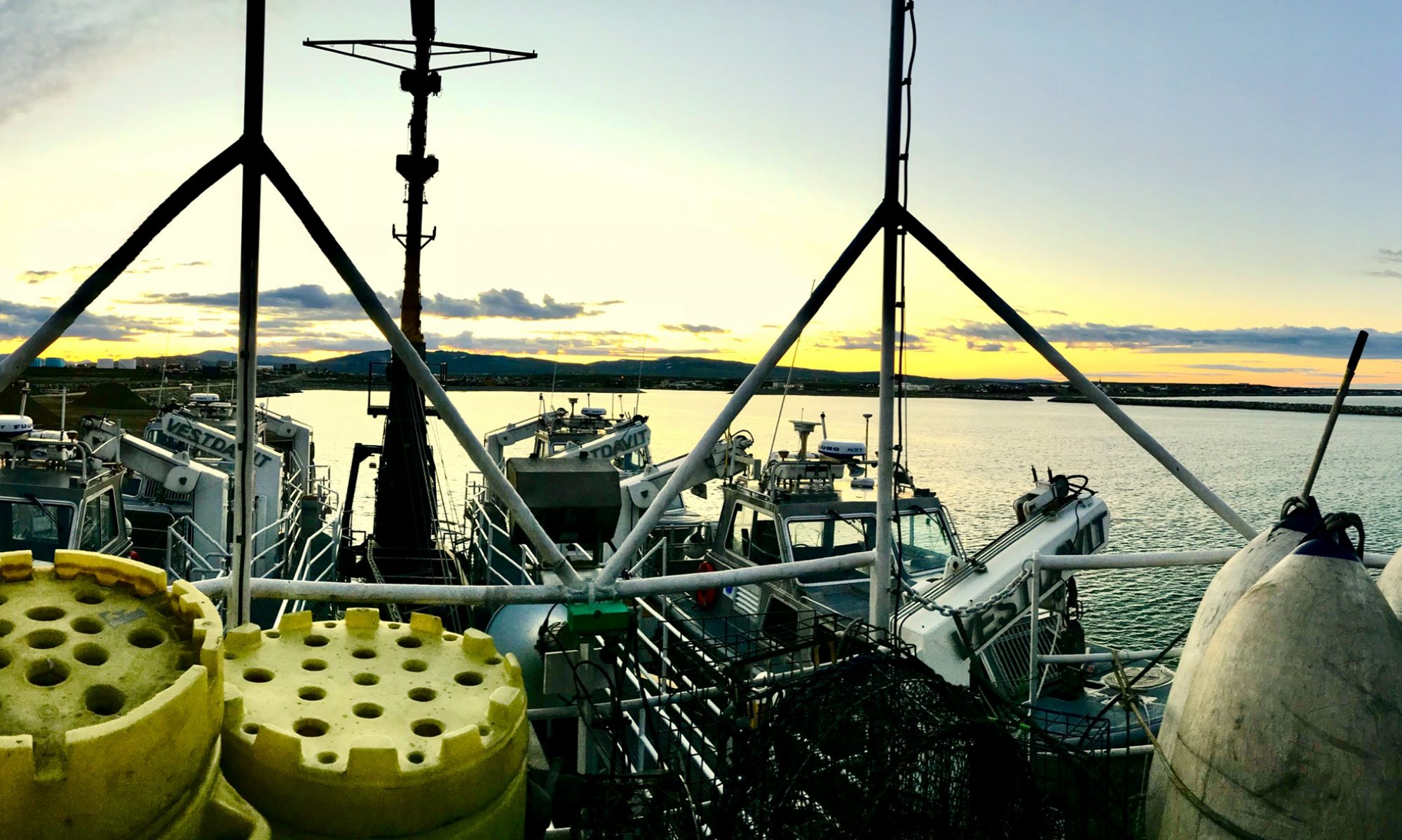
Steven Frantz: Loose Ends at Sea, August 7, 2012

NOAA Teacher at Sea
Steven Frantz
Onboard NOAA Ship Oregon II
July 27 – August 8, 2012

Mission: Longline Shark Survey
Geographic area of cruise: Gulf of Mexico and Atlantic off the coast of Florida
Date: August 7, 2012

Weather Data From the Bridge:
Air Temperature (degrees C): 28.4
Wind Speed (knots): 8.62
Wind Direction (degree): 183
Relative Humidity (percent): 080
Barometric Pressure (millibars): 1015.41
Water Depth (meters): 43.4
Salinity (PSU): 35.660

Location Data:
Latitude: 3040.46N
Longitude: 08011.74W

Loose Ends at Sea

We are getting close to wrapping up this first leg of a four-leg survey. Speaking of wrapping things up, one very important skill you must know when on a ship is how to tie a knot. Not just any knot, but the right knot for the job, or things might not turn out. Got it?

There are three knots, which we used every day. The Blood Knot (sometimes called the Surgeon’s Knot), the Double Overhand Loop (sometimes called a Surgeon’s End Loop), and the Locking Half-Hitch on a Cleat.

The blood knot is used to tie two ropes together. When we return a longline, it has to be tied back on to the main spool. Watch Tim and Chris demonstrate how to tie this knot.

Blood Knot courtesy Google Images

The double overhand loop is used, as the name implies, to put a loop on the end of a line. It is used at each end of the longline to secure the highflier.

Double Overhand Loop courtesy Google Images
Double Overhand Loop

The locking half hitch knot is tied on to a ship’s cleat in order to secure the mainline after it has been sent out. This gives us the opportunity to tie a double overhand loop on to the end in order to clip on the highflier.

Locking Half Hitch on a Cleat
Releasing the Highflier

We have also been seeing some more different animals during the past couple of days. We saw a green sea turtle surface twice. The first time was right in front of us on the starboard side of the ship. The second time was several minutes later at the stern. Just when I thought I would not get a picture of a dolphin, a trio of Atlantic spotted dolphins followed along the Oregon II as we let out the longline. Dolphins and all sea turtles are protected.

Atlantic Spotted Dolphin

We have also been catching more sharks. Again, the most common species caught has been the sharpnose shark. We finally caught a silky shark, Carcharhinus falciformes on our shift. The ridge that runs along their back and the smooth, silky look to their skin can be used to identify them.

Taking the hook out of a Silky Shark
Silky Shark's ridge on its back
Silky Shark’s ridge on its back
Silky Shark
Silky Shark

A 93.6 kilogram nurse shark, Ginglymostoma cirratum was caught and brought up using the cradle. These are bottom-feeding sharks and have an unusual texture to their skin. It feels like a basketball!

Nurse Shark on the line
Nurse Shark in the cradle
Getting a fin clip from the Nurse Shark for DNA studies
All data collected, tagged, and ready for release

It is always nice when you witness the rare or unusual. Such was the case with the next shark we caught. Many photographs were taken in order to document this rare occurrence. After releasing the shark, it was identified as a Caribbean reef shark, Carcharhinus perezi. Mark Grace, who started this survey 18 years ago, believes this is only the third Caribbean reef shark ever caught on the longline survey! Rare indeed! Unbelievable–the very next longline we caught a second Caribbean reef shark!

Carribbean Reef Shark: Measuring Length
Caribbean Reef Shark: Measuring Length
Caribbean Reef Shark: Notice salt water hose to keep oxygen to the gills.

Caribbean Reef Shark
Carribbean Reef Shark
Caribbean Reef Shark

Another first for the first leg of the 300th mission was a dusky shark, Carcharhinus obscurus. This is another rare shark to be found. This one was even bigger than the nurse shark weighing in at 107.3 kilograms! We keep the larger sharks in the cradle while data is collected before releasing them.

Dusky Shark
Dusky Shark
Dusky Shark
Dusky Shark

While cleaning up, this little remora was found on the deck. It is easy to see the suction disc on the top of its head. This is used to hold onto a larger fish and tag along for the ride, cleaning up bits of food missing the mouth of the host fish.

Remora
Remora

This amazing journey is winding down and coming to an end. I would be remiss not to thank the crew and scientists of the Oregon II. Their hospitality, professionalism, friendly dispositions, and patience (LOTS of patience) have made me feel more than welcome. They have made me feel as though, for a brief moment, I was a part of the team. Thank you and may the next 300 missions be as safe and successful as the first 300.

Dinner
Dinner

Geoff Goodenow, May 14, 2004

NOAA Teacher at Sea
Geoff Goodenow
Onboard NOAA Ship Oscar Elton Sette

May 2 – 25, 2004

Mission: Swordfish Assessment Survey
Geographical Area:
Hawaiian Islands
Date:
May 14, 2004

Time: 1600

Lat: 18 40 N
Long: 158 14 W
Sky: Sunnny with widely scattered cumulus
Air temp: 26.4 C
Barometer: 1011.26
Wind: 172 degrees at 12 knots
Relative humidity: 61.4%
Sea temp: 26.4 C
Depth: 888.5 m

Sea: A few white caps out there; swells in 1-3 foot range — easy going today.

Science and Technology Log

A fairly exciting morning on the longline. Several escolar, a barracuda, and a pomfret (a laterally flattened fish about 30cm long but only 2-3 cm in width with a fine set of sharp teeth). Samples taken from all. We also had a blue shark from which samples were taken and an oceanic white tip shark which was tagged and released. I got to wrestle both. Picked up a few remoras from the sharks. We think we have at least two species of remoras.

This afternoon we passed over Cross Seamount and traversed it several times as we trolled but to no avail. There will be no longline set tonight since we have a date in Kona to drop off one of the current scientific party.

I want to fill in with more of the vision story this evening if I can stay coherent long enough to convey it sensibly. I will touch on the work of Steven, Kerstin, and Rickard.

I have been collecting samples of fish lenses. They vary in size, as you would expect, among different sized fishes. What makes the lenses different from those of most vertebrates is that they are spherical rather than oval in cross section. The cornea of fish is also optically non-functional. Since it has the same refractive index as water, focusing is done by moving the lens back and forth in the eye rather than by changing the shape of the lens as our eye muscles do.

Steven uses laser light to determine the focal point for different colors of light. He suspends lenses in a fluid medium then turns on a laser beam that makes two vertical passes through the diameter of the lens. You can watch light’s path change as the beam migrates. Computer analysis then determines focal point.

Kerstin and Rickard must have live cells from the retina for their studies. Among other things, they are looking at the sensitivity of these cells to different light intensities. Live retina cells convert light to electrical signals which travel via the optical nerve to the brain to produce an image. By attaching electrodes to tissue samples about 1 cm square in size and subjecting the cells to different intensities of light electrical responses of different strengths can be detected and measured. They appear as a wave pattern on a screen. As light intensity is increased, the amplitude of the wave pattern increases. So a flat line (no response) becomes one with small amplitude waves which grow as light intensity increases to a point where more light produces no greater effect.

Lets compare two species, mahi mahi, which stay nearer well lit surface and bigeye tuna which like deeper environs. Which eye would you expect to be more light sensitive? The bigeye. Their cells are stimulated by much lower intensities of light than the mahi’s. They (bigeye) have to be able to detect their prey under minimal light conditions and need the more sensitive eye to do that. Big eyes, big pupils (fish pupil size is fixed) and a “super” sensitive set of retinal cells are adaptations of these fish to their deep environment.

I’ve had enough (as I suppose you have too). I will wrap up the vision story tomorrow or Sunday.

Personal Log

We are headed for Kona. Although we probably will not get any shore time, it has been suggested that there might be an excursion to a place where we can swim/snorkel for awhile. I am hoping very much this it true as are others. A plunge into this element (I guess I should say compound) that we have bobbed around on top of for the past 13 days would be a pleasant change in the routine and scenery.

Reading E.O. Wilson’s The Diversity of Life.

I would like to thank, Ron, a fellow teacher from Michigan who I have never met, for writing a note to tell me that he has been enjoying the logs and also to pose a question. Much appreciated!

Questions:

Sunrise here today is at 6AM and the great yellow ball sets here at 7PM. What time is it rising and setting in your area at this time of year? Find out sunrise and sunset times for the solstices for Honolulu and your area. From that determine A) how much longer the sun is above the horizon for each place in summer vs winter B) which place, Honolulu or your home has more sun time at each solstice? If you find that there are differences explain why they exist.

Geoff