Emilisa Saunders: Away We Go! May 13, 2013

NOAA Teacher st Sea
Emilisa Saunders
Aboard NOAA Ship Oregon II
May 14th – 30th, 2013

Mission: SEAMAP Plankton Study
Geographical area of cruise: Gulf of Mexico
Date: Monday, May 13th, 2013

Science and Technology Log:

Boarding the Oregon II
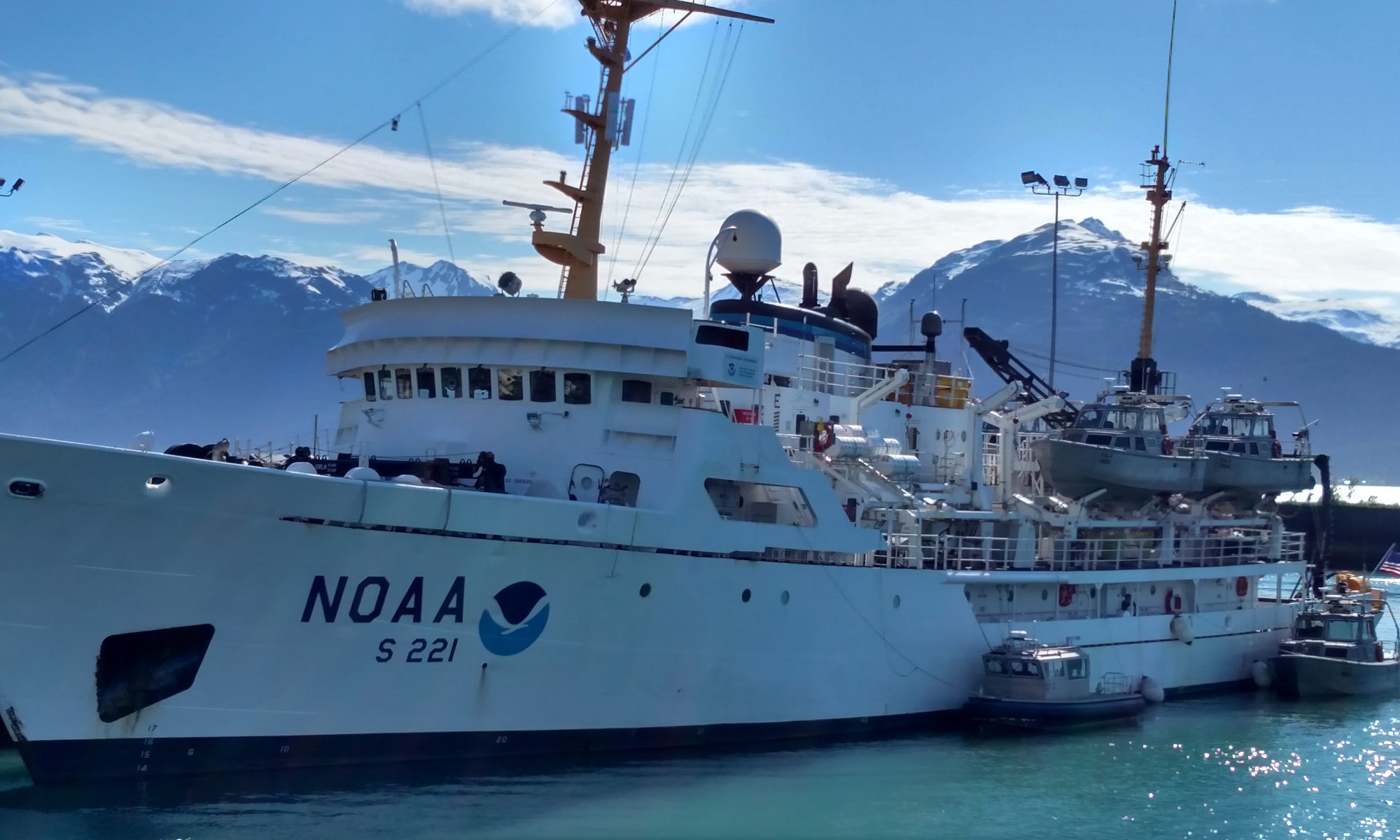
Me and the Oregon II (and the silly crewmember in the background). Photo by Kaela Gartman

I’m finally aboard the Oregon II!

Today I got a sneak preview from the lead scientist, Andy, of the labs and some of the equipment that we’ll be using to collect plankton once we’re underway.  There are three labs where we’ll be doing science for the next 17 days: the dry lab, the wet lab, and the chem lab.  The dry lab, where I’m sitting and typing right now, is a room with computers that are used to remotely monitor the depths of the nets once they have been dropped, and to record data about those drops.  The wet lab is where samples of plankton are preserved in jars to be sent back to shore and studied.  The chem lab is where chlorophyll is separated from plankton samples.

I got to see the CTD, which is a unit that collects water at specific depths in order to measure physical characteristics of the water, such as salinity, fluorescence, temperature, and dissolved oxygen.  I’m looking forward to learning more about this physical data and why it is important once we are underway.

CTD
The CTD collects water samples for testing

Andy also showed me the nets we will use to collect plankton.  All of the nets are large and heavy and are raised and lowered by winches that are operated by the ship’s crew.  The first is a Bongo net.  If you’ve ever seen bongo drums, you can get a sense of what this unit looks like: two side-by-side nets with round openings.  The nets themselves are shaped like cones, and we’ll attach a bottle called a cod end on the end of each to capture all of the plankton from the nets.  Then there are two Neuston nets, which have large, rectangular openings.  The regular Neuston net will be towed along the surface, and the Subsurface Neuston will be towed in a pattern at various depths, as will the Bongo.  The unit that I am most excited about is the MOCNESS.  This big frame holds up to ten nets, which can be opened and closed at certain depths; that way, we can collect samples from various depths and monitor plankton at separate locations and at specific depths in the water column.  In the other nets, you know what you get and where it came from, but not how deep it was.

Bongo nets
Bongo nets
Subsurface Neuston
Subsurface Neuston Net

The water column is an idea that scientists use to think about and study the ocean from top to bottom, or from the surface to the ocean floor.  When you think about the water column, imagine the ocean as an aquarium, and you’re looking into it and seeing the organisms that live at different depths and what the water is like at those depths.

The reason that the MOCNESS is so exciting to me is that it reminds us that the water in the ocean is not just a uniform mixture all throughout; different creatures live at different depths, and in different numbers at those depths.  It’s easy to imagine that creatures that are benthic – meaning, they live on the ocean floor – will vary depending on where they are in the world and how deep the ocean floor is in that spot.  It’s harder to imagine that pelagic organisms – those that live in the water column, neither at the very surface, nor at the bottom or at the shore – will also vary greatly depending on depth and location.  The water itself is different as well; the temperature of the water and the amount of salt, light and oxygen changes with depth.

Challenge Yourself:  Here’s a challenge for my Nature Exchange Traders: go on into the Nature Exchange and explain the terms water column, benthic and pelagic to earn some bonus points.  Tell them Emmi sent you!

NOAA Oregon II
The journey begins! Photo by Kaela Gartman

Personal Log

Flying over Alabama on the descent into Mobile on Sunday, I was struck by how much water there was everywhere below me.  Everywhere I looked, there were slow, meandering rivers, sparkling ponds, lakes and streams.  At times when I thought I was looking down on a forest, I saw the sun reflecting off of water blanketing the ground beneath the trees and shrubs.  I was even struck by the number of puddles in parking lots and lining the streets.  I kept thinking that, living in the desert, I’m just not used to seeing so much water – and I hadn’t even reached the harbor yet!  It was as if I was being slowly introduced to the world that I’m about to live in for the next 17 days.

I’ve been aboard the Oregon II at dock for just a few hours now, and I’m already overwhelmed with fascination, excitement, curiosity, and anticipation.  I started the morning at my hotel feeling very nervous, knowing that I was about to experience a rush of newness: new people, places, sights, sounds, rules, routines, you name it.  I told myself just to take a deep breath and take it in one thing at a time, and that really helped me to enjoy the experience.  Now the nerves are mostly gone and I’m just very much looking forward to the ship’s departure tomorrow afternoon!

To my great fortune, I’ve already found everyone I’ve met to be incredibly kind and friendly.  I got to meet some of the NOAA lab scientists who study the plankton that is collected from the Gulf, as well as field scientists Alonzo and Glenn, with whom I’ll be working the night shift on the Oregon II.  Last but not least is Andy, the lead scientist for this cruise, who helped plan logistics for my arrival, gave me a tour of the ship and helped me get situated on board.

The folks I’ve met on board are from all over the United States.  Some of them came to Pascagoula to work for NOAA to study the effects of the Deepwater Horizon oil spill; some came as part of their graduate school studies.   Everyone I’ve met either has or is pursuing an advanced degree, so the intelligence on board the ship is impressive.  As challenging as it can be to for the scientists to be away from home for more than a hundred days out of the year, all of them have some level of appreciation for doing field work.  Not all of the scientists who study plankton in Pascagoula are able to leave the lab to go on the cruises, so I am even more grateful that I have the honor of taking part.  I’m also extremely grateful to learn that I will be of help to the team.  Because of limited staffing and budgets, the science team depends on teachers, like me, to provide extra sets of hands during the field work.

Stateroom 5
My stateroom on the Oregon II

I’ll be staying in Stateroom 5 for this cruise, which I’ll share with a volunteer scientist named Jana.  “Stateroom” is the word used for a bedroom on a ship.  The stateroom is small, as expected, but it actually feels like it’s the perfect size.  All of my belongings are unpacked in drawers and cabinets, and they all fit just fine.  There’s a bunk with two beds, a sink, and three storage cabinets.  Two of the cabinets are entirely for our use, and one mostly holds safety gear and flotation devices.  There is enough floor space that I could lay on the floor and do snow angels, so there will be plenty of room to move around.  I don’t expect to be spending all that much time in the stateroom once we are underway.

Time has taken on a whole new meaning in the past two days.  Yesterday morning I left Las Vegas in the Pacific Time Zone and flew to Atlanta in the Eastern Time Zone, then to Mobile in the Central Time Zone.  It was almost like time travel.  After we embark tomorrow, I’ll start my work schedule, which will have me on duty from midnight to noon every day.  Work goes on around the clock on NOAA vessels.  This schedule will take some getting used to, but as a morning person, I am excited that I’ll be awake and active for my favorite part of the day, and I’ll get to watch the sun rise.  Right now, I’m attempting to stay awake for my entire first night on the ship so that I can get on my work schedule right away.  To add another level of confusion to my sense of time, ship crews observe 24-hour military time instead of using AM and PM.  Numbers are difficult for me and don’t come naturally, so this will take some getting used to.

Military time
The clocks on the ship show the 24-hour military time system.

Just being on the ship feels quite surreal.  As I write this at 23:33hrs, there are just a handful of people on board, and we are still at dock.  Every once in a while some subtle movement reminds me that this is a ship in the water, but mostly it feels like solid ground.  I know that will change once we get moving.  Aside from the obvious signs, there are other little reminders that this is a ship, where everything must be secured for rougher waters.  Computers and monitors are strapped and bolted to the tables, there are gripper pads spread out on tables and in drawers, and every door, from drawers and cabinets to staterooms, has to be latched shut and unlatched to open, and open doors have to be secured with a hook so that they don’t slam shut when the ship shifts.   There’s also a constant hum of noise on the Oregon II.  I’m interested to see how loud it is when we’re actually moving!

The adventures in science begin tomorrow!

Sunset at Dock
Sunset at dock, from the dry lab of the ship

Did you know?

Bluefin tuna plankton are a type of ichthyoplankton, which comes from the Greek words for “fish drifters.”  For those of you in Nevada, think of our state fossil, the ichthyosaurus, which means “fish lizard!”

Lesley Urasky: Do You See What the Pisces “Hears”?, June 22, 2012

NOAA Teacher at Sea
Lesley Urasky
Aboard the NOAA ship Pisces
June 16 – June 29, 2012

Mission:  SEAMAP Caribbean Reef Fish Survey
Geographical area of cruise: St. Croix, U.S. Virgin Islands
Date: June 22, 2012

Location:
Latitude: 18.5472
Longitude: -65.1325

Weather Data from the Bridge:

Air Temperature: 28.6°C (83.5°F)
Wind Speed:  9 knots (10.5 mph), Beaufort scale: 3
Wind Direction: from SE
Relative Humidity: 77%
Barometric Pressure: 1,014.80  mb
Surface Water Temperature: 28.1°C (82.6°F)

Science and Technology Log

Another aspect (much more technical) of the scientific research conducted on this cruise is the collection of acoustic data.  This field is continually evolving as the detection resolution improves allowing scientists to more precisely identify fish.  This has been used with more success in fisheries farther north because the schools of fish are more likely to be monospecific (a single species).  However, the technique still needs improvement in warmer waters where the fish assemblages tend to be multi-specific (having a much greater variety of fish).

General idea behind an acoustic sounder being used to detect fish. (Source: www.biosonicinc.com)

This field of study is called Hydroacoustics (hydro- means water, and acoustics refers to sound).   It is the science of  how sound moves through water. Leonardo da Vinci noticed how sound travels through water in 1490.  He noticed that, “If you cause your ship to stop and place the head of a long tube in the water and place the outer extremity to your ear, you will hear ships at a great distance from you.” (Urick, Robert J. Principles of Underwater Sound, 3rd Edition. New York. McGraw-Hill, 1983.)  World War I helped promote innovation in the field, especially with the need for anti-submarine detection devices (Wood, A. B., From the Board of Invention and Research to the Royal Naval Scientific Service, Journal of the Royal Naval Scientific Service Vol 20, No 4, pp 1-100 (185-284)).

Hydroacoustic instruments utilize SOund Navigation and Ranging, more commonly referred to as SONAR.  The ship Pisces is equipped with a system located on the center board; this is a flat structure that can be raised/lowered through the water column beneath the center of the ship.

Line drawing of the NOAA ship Pisces showing the location of the center board.

The system used is a sonar beam that is split into quadrants.  This instrument is used to assist in determining fish abundance and distribution.  The premise is relatively simple: an echo sounder transmits a pulse of energy waves (sound), when the pulse strikes an object, it is reflected (bounced) back to the transducer.  The echo sounder is then processed and sent to a video display.  This is the same general process behind the recreationally available fishfinder.

Acoustic beam split into quadrants (Source: http://www.htisonar.com
A short burst of energy is focused into a narrow beam.  When this beam encounters an object such as a fish, a school of fish, plankton, or other object, some of the energy bounces back up through the water to the transducer.   It is the detection of these reflections that allow scientists to determine location, size, and abundance of fish.  These reflections show up on our video monitor.  These measurements are combined with groundtruthed data (for example, fish collected in the field, camera images).

One of the difficulties in data interpretation is that often, the signals that appear on the computer monitor have false readings.  This is a result of the sound wave bouncing multiple times.  It travels to the bottom from the transducer, strikes an object, returns to the ship, bounces off the ship back toward the bottom, strikes another object, and is detected yet again.

Real-time annotated echogram at sampling site.

The Pisces is actually home to one of six multi-beam acoustic instruments in the world.  Of the six in existence, NOAA has five of them.  The benefit of running a multi-beam instrument is that each beam can be set to measure a different frequency (kHz), thus enabling detection of many more features (different species of fish, etc.)

Scientific multibeam echo sounder (Source: www. simrad.com)

Personal Log

Last night the crew of the Pisces carried out a task that they don’t normally perform.  The Pisces was created for fisheries research projects – it focuses on collecting fish samples either by bandit reel, longline, or trawling.  This particular operation was to deploy the anchor for a buoy that will be attached at a later date.  When the buoy is ready to be attached, another vessel will bring it out to the site and divers will go down to the anchor to make the final attachment.

The anchor consists of a huge rebar-reinforced concrete block with a very long chain that has marker floats attached at the end.  Logistically, this took some planning; the A-frame had to be raised and the anchor lifted with the Gilson winch with a 1″ spectra line (has an enormous tensile strength).  The gate to the ship’s ramp was lowered and the A-frame (or as the deck hands call it, the “Tuna Tower”)  repositioned so the anchor was hanging over the water.  The rope holding the anchor, chain, and float was cut through, and the anchor plunged to the ocean bottom.  Again, the crew made the operation go smoothly and demonstrated their ability to complete unexpectedly assigned tasks.

Today was a slow fishing day – no fish at all.  Without any fish to “work up” (collect samples from), the day goes more slowly and we have more down time.  With the extra time, I had a chance to interview Kevin Rademacher, the Chief Scientist on the cruise.

LU: What is your official job title and what are your job duties?

KR: I’m a Research Fisheries Biologist.  I work for the Reef Fish Unit at the NOAA Fisheries Lab in Pascagoula, MS.  I am the Senior Tape Reader/Reviewer, in charge of the readers that analyze  the video data we collect from Reef Fish Surveys.  I also help plan, organize, and run the surveys.  Additionally, I participate in trawl surveys and anything else the lab needs done.

LU: When did you first become interested in the ocean and marine sciences?

KR: I guess that would have been when I was really young.  There is a photo from the Panama City, Florida newspaper, two weeks after I was born with my parents pulling me in a homemade wagon along the beach!  I knew in junior high school that I wanted to be a cross between Jacques Cousteau and Marlin Perkins of Mutual of Omaha’s Wild Kingdom.

LU: It’s such a broad field; how did you narrow your focus down to what you’re currently doing?

KR: I got lucky and kind of fell into reading underwater videos at the initial stages of the project and fell in love with being the proverbial “fly on the wall”! It has allowed me to see the fish in their natural  habitat, different color phases, behavior, etc.

LU: If you were to go into another area of ocean research, what would it be?

KR: Marine Mammal Studies.  After college I trained dolphins and sea lions and put on shows with them for a local Oceanarium on the Mississippi Gulf Coast.

LU: What is the biggest challenge in your job?

KR: Communicating with people and writing papers.

Ariane Frappier and Kevin Rademacher reviewing a dichotomous key in order to determine the species of a fish we caught.

LU: What do you think is the biggest issue of contention in your field?

KR: The impression that commercial fishermen have regarding the work we do to regulate the fisheries they work in.

LU: What are some effects of climate change that you’ve witnessed during your career in fisheries research?

KR: The decline of coral reefs and overfishing of some species.

LU: In what areas of marine science do you foresee a lot of career paths and job opportunities?

KR: Ecosystem management and data modelers.  There has also been a decline in taxonomists over the past few decades.

LU: How would you explain your work to a layperson?

KR: I use underwater cameras to help assess populations of reef fish, especially snappers and groupers.  The data collected is used to manage those fisheries.

LU: If a high school student wanted to go into your field of study/marine science in general, what kinds of courses would you recommend they take?

KR: Math, Biology, Chemistry, and any other science courses available.

LU: Do you recommend students interested in your field pursue original research as high school students or undergraduates?  If so, what kind?

KR: Most definitely! Whatever they are interested in would be beneficial.

Well, only two more days left with the scientists before we pull into San Juan, Puerto Rico.  We have 17 more daytime sites to sample and then this survey will be over.  The scientific crew will be flying home on the 25th, and once home, their work will really begin.  Back in the lab, they will be analyzing the data and reviewing the video.  Some of them will be going back out on other cruises.  Kevin Rademacher will be going out on another reef fish survey in the eastern Gulf of Mexico.  It is currently delayed because of the potential formation of tropical storm Debby.  Joey Salisbury has a couple more; he will be going on a longline cruise and then another reef fish survey, both of which will be in the Gulf of Mexico.  Arian Frappier will be heading off to begin a masters program in marine systems and coastal studies at Texas A&M Corpus Christi.

After a day’s shore leave in San Juan, I’ll continue on to Mayport on the Pisces.  During this time, I’ll focus on the crew members and their jobs.  The cruise will definitely take on a different feel at this point, but it will give me an opportunity to explore other ocean related careers.