Maggie Flanagan, July 7, 2007

NOAA Teacher at Sea
Maggie Flanagan
Onboard NOAA Ship Oscar Elton Sette
June 12 – July 12, 2007

Mission: Lobster Survey
Geographical Area: Pacific Ocean; Necker Island
Date: July 7, 2007

A turkeyfish and white spotted toby found in lobster traps.

Science and Technology Log – Bycatch 

Though spiny and slipper lobsters are our target species for sampling, many other interesting creatures are interested in our bait, and wind up in our traps.  Some of the smaller creatures spend a little time in our on board aquarium for observation and acclimation.  These fish are upside down because their swim bladders, which regulate buoyancy in the ocean, have not yet adjusted to the surface (barotrauma).  They wouldn’t survive if they were immediately released. The turkeyfish, aka Hawaiian lionfish, Dendrochirus barberi, is red/orange with large fins. It has venomous spines in its dorsal (back) fin, and will lunge pointing them at a threat.  We used a net instead of gloves to observe this one. This fish in known to enjoy a meaty diet, eating other smaller fish. The Hawaiian white spotted toby, Canthigaster jactator, is a sharp nose puffer, brown with white spots. This toby is endemic to Hawaii, found naturally only in Hawaii.  These fish can make themselves swell in size to ward off predators by filling their stomachs with water. They carry a toxin in their skin, which can harm other aquarium creatures if released.

Swimming crab (Charybdis paucideutis?) and hermit crab (Dardanus brachyops)
Swimming crab (Charybdis paucideutis) and hermit crab (Dardanus brachyops)

The red figure in the background of the above photo is a sea hare, Aplysioidea, aka sea slug. These invertebrates are hermaphroditic, carrying both male and female sex organs. We also encounter a variety of crabs with a variety of adaptations.  Hermit Crabs, Dardanus,  have been the most numerous in our traps, and there are reported to be up to 2000 species of hermit crabs world-wide.  They take over the shells of marine snails and keep their soft abdomens tucked inside. Many of the hermit crabs we’ve found in the North West Hawaiian Islands take protection even one step further – they keep anemones on their shells. The anemones eject bubble-gum-pink stinging threads called acontia when threatened. We wear gloves when handling the crabs to protect ourselves. Scientists have discovered that the anemones don’t live on the shells when the snail is alive, and that hermit crabs will actually move their anemones from shell to shell as they move to new shell homes.  They figure that the anemones benefit from mobility with the crab and from food particles spread by the hermit crabs as they rip and shred.

Swimming Crabs, Charybdis, are the most aggressive crab in the trap.  In both body and behavior they’re similar to the blue claw crabs of my home waters, so I was prepared for their quick attempts to pinch and slice my fingers.  Their last pair of legs is oval like a paddle – perfect for swimming. On board, we call the box crab, Calappa calappa, the Vader crab. Its claws fold perfectly into its oval body, making it look like the face mask of that notorious space villain. These crabs can be mean too; those wide claws are powerful and help the crab eat mollusks.  Imagine how well camouflaged it is folded up down in the sand.

A box crab (Calappa calappa), a.k.a., the Vader crab

Personal Log 

During our lobster survey work, we catalogue the other animals that also get in the traps, and release them as healthy as possible. The creatures that you catch unintentionally are generally called bycatch. A current issue in commercial fishing is animals killed and wasted because they’re caught as bycatch, and not sold or eaten.  Many times they’re dumped back in the sea dead.  It’s a complicated issue on a global scale considering the definitions of what makes bycatch, all the different kinds of fishing gear, the variety of marine ecosystems, applications of technology, and the multiple political and economic groups involved.  There are many figures being reported, from 30% to over 50% of the take winding up as wasted bycatch, or perhaps 28 million metric tons world-wide. But, statistics on this topic are difficult to determine, which makes solving the problem even more difficult.  Technology has innovated some fishing gear which particularly reduces the bycatch of sea turtles and marine mammals, and recent focus on bycatch by type of fish and type of gear may inspire more solutions to this serious problem.

Maggie Flanagan, June 30, 2007

NOAA Teacher at Sea
Maggie Flanagan
Onboard NOAA Ship Oscar Elton Sette
June 12 – July 12, 2007

Mission: Lobster Survey
Geographical Area: Pacific Ocean; Northwest Hawaiian Islands
Date: June 30, 2007

Science and Technology Log – Setting and Hauling Traps 

Maggie Flanagan, scientists, and ship’s crew work together to set lobster traps

We’ve worked a lot with lobster traps by now, and I’ve had the chance to try every part of the job. The science crew works closely with the experienced fisherman of the ship’s crew – it takes teamwork!  We take turns preparing bait in the early morning.  Thawed mackerel are sliced twice through the middle – be sure to expose the guts which release fluids and oils that are especially attractive to our targets. Later, the traps are set in strings of 8 or 20. Historic data is based on strings of 8, which is why they’re still used even though experience has shown labor is more effective with strings of 20. The traps are all clipped to a gangion, a short line that is spliced (woven) into the length of the ground line (main line of the string) at 20 fathoms (120 feet) apart.  Buoys are clipped in at one end for strings of 8 and at both ends for strings of 20.  A little entertainment comes from the fun names on our buoys which are called out over the radio – Big Momma, 8-ball, Spifferino, Easy Target.  Sadly, we lost the 8-ball float, which is the only gear we’ve lost so far.  Setting baited traps happens from the fantail, or aft working deck, of the ship.  The stackers (scientists on trap duty) lift and shuffle the traps up to the diamond plate (steel non-slip) at the very stern of the ship. A large pallet tub of our line waits there, with eye splices (loops) for attaching gear carefully stacked on a small pipe, keeping the loops ready, in order, and clear from the many coils of line in the tub.   The crew clips a buoy or a trap to a gangion and carefully sends it off the stern.  After beginning the string, the traps slide off on their own with the momentum of the line paying out.

Hauling back lobster traps in the pit aboard OSCAR ELTON SETTE

Everyone has to be careful to not accidentally step in a loop of line and get dragged off too.  While the traps are going over another crew member, the heaver, manages the tension on the line by guiding it off the stern with a stick in great sweeping arcs.  All the while the Chief Bosun, or supervisor, is in radio communication with the bridge to ensure strings are set at the prescribed depth and location. For our data standards, the traps soak overnight. Hauling back the traps happens in the pit, the low open area along the port side of the ship. The officer at the sticks (steering) operates from a side wing of the bridge, and the Chief Bosun operates the pot hauler, a wheel at the top of a tall J frame that helps pull in the line. As the bridge maneuvers close up to the buoy, a crew member throws the messenger (a 4 pronged type hook) to catch the buoy warp (rope). Once the crew pulls in and unclips the buoy, the ground line is led through the pot hauler, and with a steady hiss the traps are brought up. The pot hauler pauses briefly for each trap to be unclipped, and they’re slid down a table to the crackers (members of the science party) to open. Pretty quickly you open, remove creatures to a bucket, remove old bait, fill new bait, and close the trap. Everything and everyone in the pit gets wet and splashed with mackerel juice.  A bucketeer keeps order of the specimens collected and helps with sharks and eels.  A runner brings the specimens and trap out of the pit. Traps are re-stacked on the fantail and specimens go to the Wet Lab, where the intermediary, assistant, and measurer (more members of the science party) work to catalog them. Overhead, the ground line runs through fair leads (hanging metal circles) back to the pallet tubs on the fantail, where another crew member coils the line back in and stacks the gangion eyes in order.  

The lobsters can surprise you with powerful snaps of their tails.  The assistant has to hold them firmly while the measurer uses a digital caliper to find the length of the carapace (back of the shell) in millimeters. On certain females, we also measure the exopod part of the first left pleopod (appendages under the tail), which can indicate level of maturity.  Females with eggs, spongy masses of tiny round orange or brown specks under the tail, are said to be berried. We also check the lobsters for PIT tags by waving them in front of a scanner – like electronic checkout at the supermarket.  These tags are the same type implanted in pets and if sensed, the scanner shows that lobster’s unique number.  After all the specimens have been recorded, or when a tagged lobster needs to go back in the same quadrant, the intermediary does a dump, releasing them.  Lobsters are dumped through a special cage lowered on the pot hauler, which is designed to deliver them back to the bottom without exposing them to sharks.

Personal Log 

It’s hard to say which job in the lobster survey is my favorite.  Cracking open the traps is certainly the center of the action, but quite a wet, messy job.  Being the measurer makes you feel closely involved with the scientific process, but keeps you working inside.  Stacking empty traps is not as interesting, but happens out in the sun while talking and listening to music. I guess I’m enjoying all the jobs, and certainly learning a lot. Since I began writing, we had to stop our lobster survey for a few days to offer medical assistance to another scientist camping on one of the islands.  It wasn’t life threatening, thank goodness, and we’re back to work soon.

Maggie Flanagan, June 26, 2007

NOAA Teacher at Sea
Maggie Flanagan
Onboard NOAA Ship Oscar Elton Sette
June 12 – July 12, 2007

Mission: Lobster Survey
Geographical Area: Pacific Ocean; Necker Island
Date: June 26, 2007

NOAA Teacher at Sea, Maggie Flanagan, repairs a trap aboard NOAA Ship OSCAR ELTON SETTE.

Science and Technology Log 

We just spent an exciting week setting lobster traps at Maro Reef. Sliced mackerel is our preferred bait, and we scrub the bloody patches that drip to deck every day. We hauled back many lobsters, as well as eels, crabs, urchins, and fish. Shark and Octopus can really break up the traps, and ocean conditions can be hard on the gear, so we make repairs as needed. I was proud to put my sailor skills to work helping to splice new bridles on traps.  (Splicing is weaving a line back into itself to create a loop, which is used to attach the trap to a fishing line).  In the past week our Commanding Officer, Karl F. Mangels, shared a little history on The Marine National Monument area created out of the Northwest Hawaiian Islands.  This status is the most protected, but also complex to initiate.  The US Fish and Wildlife Service, NOAA, and the State of Hawaii, among others, have targeted this area for preservation for many years.  Recently President Bush moved quickly to legalize the Monument status, but it is taking time to work out the details of regulations and procedures, considering the multiple jurisdictions involved.

Regulations indicate all activities must be approved by permit, including scientific research, and all ships must have vessel monitoring systems.  But, access for native Hawaiian cultural activities is preserved as several of the islands are ancient holy sites.  Midway Atoll retains special status and will be open to more public visitation. All commercial fishing in the Monument waters will be phased out by 2011, and oil and gas exploration and extraction is prohibited. Having been part of a research crew in the Monument for a week now, I appreciate all these efforts at conservation. There is little dry land surfacing out of the Pacific here, but the bird life and sea life are precious, including rare seals, sea turtles, and albatrosses.

Watch out when there’s an eel in your trap!  Most of the local species have sharp teeth, and are quick and eager to use them to gain their freedom.
Watch out when there’s an eel in your trap! Most of the local species have sharp teeth, and are quick and eager to use them to gain their freedom.

Personal Log

Working at sea makes me think often of the legacy of sailors before me.  Though he was a global voyager, Captain James Cook’s influence is heavily felt in the Pacific.  He honed his seamanship skills in the coasting collier (coal cargo) trade in Britain and honed his surveying skills in Canada, helping the British Navy fight the French.  He charted the St. Lawrence River and the coast of Newfoundland, but was a surprise choice among his contemporaries for the Pacific voyages due to his lack of noble title and lack of Royal Navy training. His first command aboard Endeavour in 1768 was to observe the transit of Venus viewable from Tahiti.  A replica of Endeavour now sails out of Australia, and for $1,000 Aussie you can too! The mission of Cook’s second voyage to the Pacific in 1772 was to “complete the discovery of the Southern Hemisphere.”  He took command of Resolution and penetrated the Antarctic circle several times.

Both Endeavour and Resolution were converted North Sea colliers, sturdy vessels familiar to Cook from his merchant marine experience. For the third voyage, Resolution also carried the latest equipment, including a Gregory Azimuth Compass, apparatus for distilling fresh water from seawater, and a new five inch marine chronometer, the K1, by Larcum Kendall.  The chronometer provided for even better chart making as it was easier to use than lunar measurements and proved more accurate for finding longitude.  In 1778, sailing to find a northwest passage between the Atlantic and Pacific, Cook encountered the Hawaiian Islands. Natives were friendly to the Captain and his crew, and when Resolution’s foremast cracked badly in February 1779, they returned to Kealakekua Bay on the big island of Hawaii to down rig the mast and float it to the beach for repairs.  Misunderstandings developed as from both sides, resources were taken and tempers flared.

When Cook went ashore with marines to seek settlement, a crowd gathered and became aggressive. Cook shot a Hawaiian, and in the retreat to the bay, Cook was clubbed and stabbed from behind, dying in the surf.  Two other important figures were also witnesses that day in Kealakekua Bay.  William Bligh of Bounty infamy was one of the ship’s officers, and Kamehameha, who unified the islands to become the first King of Hawaii, was nobility of the village ashore. Cook left quite a legacy of knowledge with his charts and logs, and a legacy of British influence around the globe.  He accomplished surveys of the Pacific from Australia to Alaska.  Resolution’s officers demanded Cook’s body be returned, but it came back as pieces of bone and flesh, which were buried at sea.  There is a monument to Captain Cook in the form of an obelisk on Kealakekua Bay, and it’s curious to think that perhaps missing parts of his remains are buried there.  Interestingly, that little part of Hawaii is technically British soil even to this day.  Now, Kealakekua Bay is also a Marine Life Conservation District filled with coral, schools of tropical fish, and even spinner dolphins – another legacy this historic site can offer for the future.

Maggie Flanagan, June 15, 2007

NOAA Teacher at Sea
Maggie Flanagan
Onboard NOAA Ship Oscar Elton Sette
June 12 – July 12, 2007

Mission: Lobster Survey
Geographical Area: Pacific Ocean; French Frigate Shoals
Date: June 15, 2007

An anuenue (Hawaiian for rainbow) at sea

Project Log 
NOAA Ship OSCAR ELTON SETTE  Call Sign: WTEE
Length: 224 ft.; Beam (width): 43 ft.
Draft (hull depth beneath the water line): 15 ft.
Cruising speed: 10.5 kts.
Displacement tonnage: 2,301 tons

From the ship’s web site – “Dr. Oscar Elton Sette (is regarded) as the father of modern fisheries oceanography in the U.S. He formulated the concept that the “changing ocean” rather than “average ocean conditions” plays key roles in the natural fluctuations of fish stocks and their vulnerability to harvesting. He originated the importance of multidisciplinary and interdisciplinary approaches, including the interrelationships between fisheries, oceanography, and meteorology, to understanding and solving marine fisheries problems. Although he was a man with big ideas and many strengths and capabilities to implement them, Elton was a relatively small-built man who spoke softly. Whatever Elton sought out to do, he did so with vigor, dedication, and determination. Yet, he was notably inclusive, rather than exclusive, and was a firm believer of the power of teamwork to accomplish goals.  Dr. Sette was a gifted oral and written communicator. He possessed the wonderful ability to explain complex ideas, concepts, and scientific findings in a pragmatic, concise, straightforward, understandable, and clear manner.”

What a great model for our work!

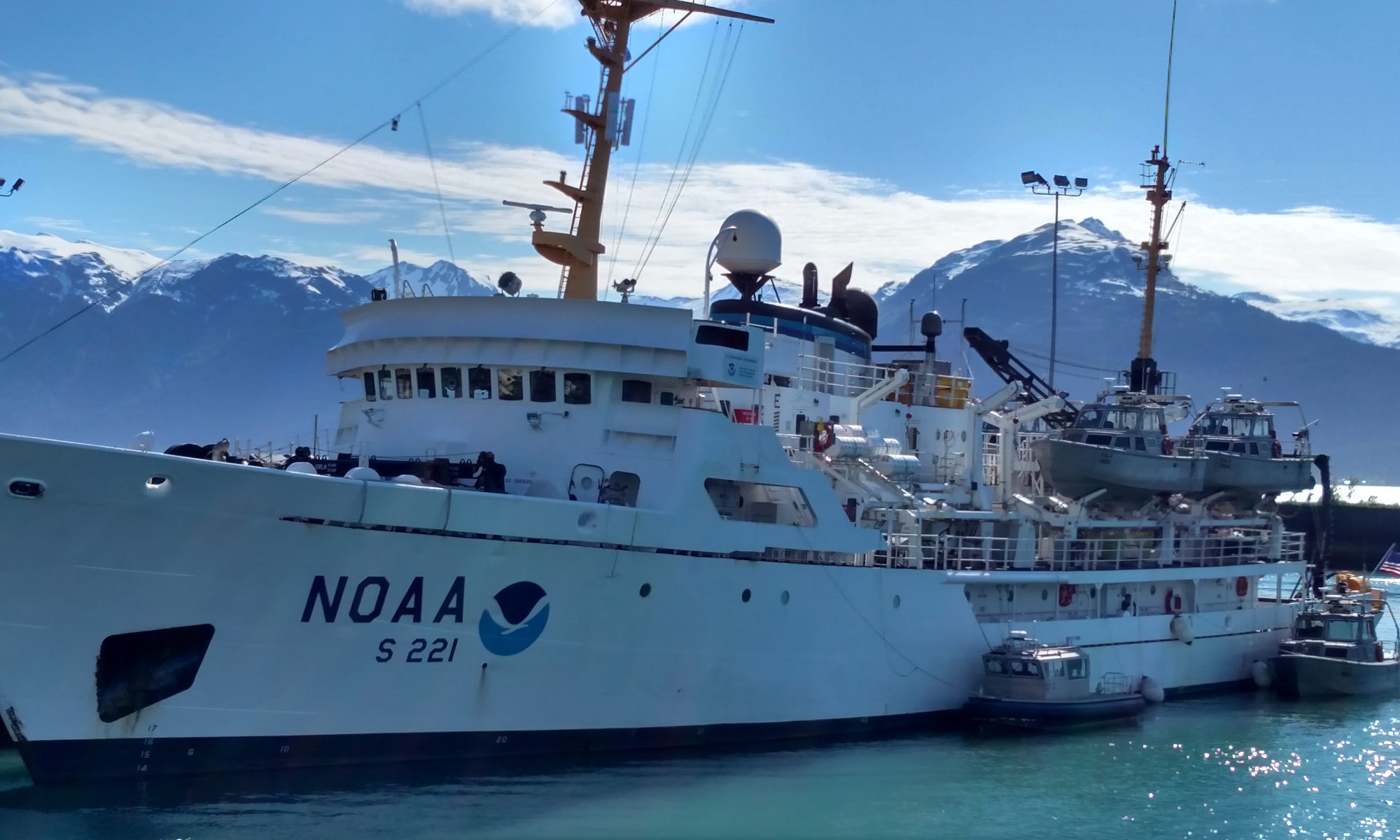
Our ship was originally designed for another kind of ocean monitoring.  She was built for the Navy in Gulfport, MS as a submarine hunter and launched in 1987 as USNS ADVENTUROUS.  In 2002 she was transferred to NOAA and commissioned as NOAA Ship OSCAR ELTON SETTE the following year.  The vessel was recently homeported at historic Ford Island at the Pearl Harbor Naval Station.

Our mission – marine research by permit in one of our country’s newest preserves, the Papahānaumokuākea Marine National Monument.  This area incorporates the North West Hawaiian Islands (NWHI) sanctuary, and is a state/federal partnership.  Our activities are part of a yearly effort by NOAA scientists and their University of Hawaii colleagues to record data on spiny and slipper lobster populations.  These creatures don’t have the famous claws of the New England lobsters I’m used to, but I understand their tails make for great surf and turf. As other stocks dwindled, lobster taking in the NWHI  increased. Around 1989 lobster populations collapsed, and despite restrictions on that fishery, have not recovered well. The scientists aboard are trying to understand and improve this situation.

We’re steaming northwest on our way to our first research area at Maro Reef.  Coils of yellow line and stacks of black traps fill the fantail or aft deck.  Inside the wet lab, a freezer full of whole mackerel wait to be prepared as bait.  Original plans were to collect data from Necker Island first, but this changed as the crew is also delivering fuel and supplies to the Fish and Wildlife Service on Tern Island at French Frigate Shoals.  When the time does come, it will be exciting to get the gear wet!

Susan Carty, March 18, 2001

NOAA Teacher at Sea
Susan Carty
Onboard NOAA Ship Ronald H. Brown
March 14 – April 20, 2001

Mission: Asian-Pacific Regional Aerosol Characterization Experiment (ACE-ASIA)
Geographical Area: Western Pacific
Date: March 18, 2001

Today I thought it would be helpful to discuss why a ship is being used for the aerosol experiments. As you know, our planet is approx. 70% water which logically indicates that particles would be moving over water even more than land. The atmosphere over water, particularly remote waters, provides ideal conditions for sampling. The slower speed at which the ship moves permits the scientists to conduct testing at a manageable pace as compared to samplings taken from airplanes.

The ship can take the scientists to locations on the planet only accessible by water. It becomes a floating platform for data collection and experimentation.  The ship can also follow the wind patterns across the seas (ie:  tradewinds/westerlies). These winds carry particles from one continent to another.

The testing of air samples on board focuses on many aspects of aerosols. For example, some equipment may focus on how light energy and particles interact in the air as well as in the water, while another type of equipment focuses on size distribution of particles in the atmosphere. Understanding what types of organic and inorganic particles are collected is significant in terms of determining origin and interactive behaviors.

This is just a small sampling of the types of experiments taking place on the ship. The testing and collection of aerosols is a daily activity. At times the scientists must work under difficult and awkward conditions that are directly influenced by weather, seas and swells. They also conduct their testing at all hours of the day. It may look like a “cruise” but it is definitely a “working cruise”. It calls for committed scientists with a sense of adventure and endurance.

QUESTION OF THE DAY: What is the difference between a “sea” and a “swell”?

Talk to you tomorrow. The albatross are still with us!
Susan