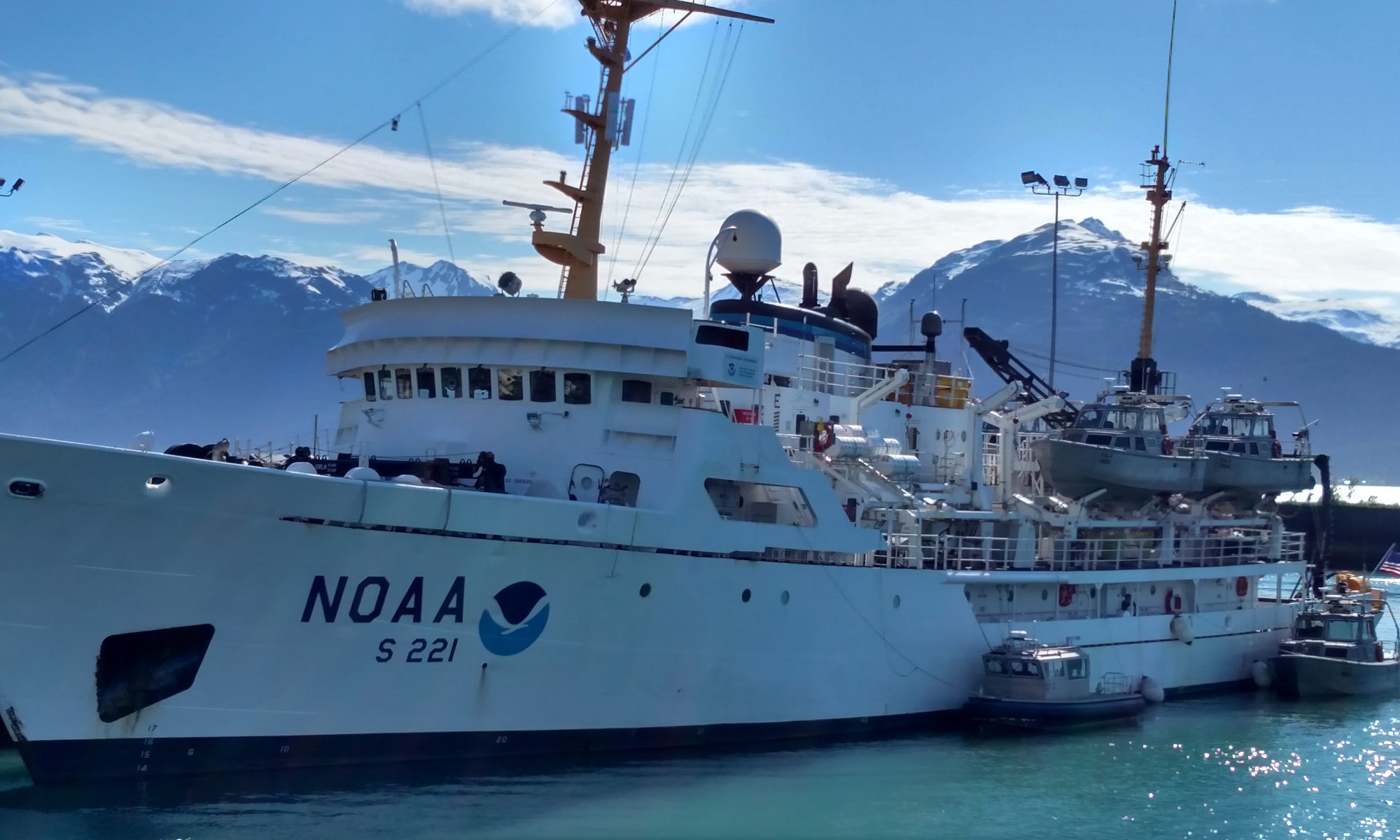
NOAA Teacher at Sea John Taylor-Lehman Onboard R/V Savannah June 24 – July 1, 2011 NOAA Teacher at Sea: John Taylor-Lehman Ship: R/V Savannah Mission: Fisheries Survey Geographical area of the cruise: Continental Shelf off of Florida Date: Monday 26, June 2011
Weather Data from the Bridge
South West Winds 10-15 knots
Cloudy
Barometric Pressure 29.73
Science and Technology Log
I assisted in deploying and retrieving 6 “chevron” fish traps at a time. This was done several times at designated sites. The traps are pushed off the back of the boat (fantail) and winched up along the starboard side. Two buoys are attached to each trap. The traps rest on the bottom of the Atlantic between 45 and 230 ft. deep. Locations are determined before the cruise but can be changed if necessary. Ideal locations have hard bottom with some relief.
Here I am (left) getting traps ready with the crew
Traps are baited with 24 “menhaden”, which is a type of fish. Some of the bait is suspended in the trap while other rests on the bottom. The traps “soak” for 90 minutes before being retrieved. There is great anticipation as each trap is being winched aboard the ship. We are all hoping for large numbers of our target fish: grouper and snapper.
This collection technique has been used for 22 years, which allows valid comparisons of data over time. The fish found in the traps thus far are: gag grouper, Warsaw grouper, red snapper, vermillion snapper, sand perch, black sea bass, gray triggerfish.
Personal Log
Flying Fish
The entire science staff and ship crew have all been very kind and helpful to me, the novice. They have readily answered all my questions, whether it is about the ship operations or the research being conducted. They have gone out of their way to bring to my attention items or events they think would be of interest to me.
Last evening we spent the last hours of our shift processing black sea bass. I learned how to remove the otoliths from the skull and the reproductive organs from the body cavity. The former can be used to age the fish and the latter to determine maturity and sex.
This is called an oyster toad fish
While walking on the back of the boat last night I heard a great deal of splashing in the water. The lights from the ship were bright enough to illuminate the water below me, so in I was able to see 6 dolphins in the water. They were feeding on the many flying fish that were attracted to the ship’s lights. I imagine a few of the fish were able to escape because the dolphins remained for at least 1.5 hours. Some of the dolphins were able to grab the fish out of the air.
Unusual sights: 4 cruise ships heading south, a double rainbow, oyster toad fish
Science & Technology Log: walleye pollock, which is an important fish species here in Alaska. Walleye pollock make up 56.3% of the groundfish catch in Alaska (http://www.afsc.noaa.gov/species/pollock.php), and chances are you’ve eaten it before. It’s a commonly used fish in all of the fast food restaurants, in fish sticks, and it’s also used to make imitation crab meat.
Our first catch had a little over 300 walleye pollock, and we processed all of them. Three hundred is an ideal sample size for this species. If, for example, we had caught 2,000 pollock, we would only have processed 300 of the fish, and we would have released the rest of them back into the ocean. Check out the photos/captions below to see how we process the catch.
After sexing, we then measured the length of each fish. There’s a ruler embedded in the lab table, and we laid each fish down on the ruler. Then we put a hand-held sensor at the caudal (tail) fin of the fish, and the total length was recorded on a computer.At the sexing station, cutting open pollack.
We also removed and preserved 20 stomachs from randomly selected fish in order to (later) analyze what they had been eating prior to them being caught. One of the last things we do is collect otoliths from each of those 20 fish. Otoliths are ear bones, and they are used to determine the age of a fish- they have rings, similar to what you see in trees.
Here’s a look at some of the bycatch in our nets:
Basket Star. Marine 1: What phylum are sea stars in?Arrowtooth flounder.The reason(s) WHY they’re called ARROWTOOTH flounder.
Animals Spotted:
walleye pollock
chum salmon
rockfish
arrowtooth flounder
squid
basket star
Northern Fulmars
Gulls
Albatross (couldn’t tell what kind)
* I did spot some kind of pinniped yesterday, but have no idea what exactly it was!
Personal Log:
I was very excited that we finally got to fish today!! As an added bonus, we caught 2 salmon in the trawl, which means we’re having salmon for dinner tonight! We we supposed the have teriyaki steak, but the cook has changed it to teriyaki salmon instead 🙂 I didn’t get any pics of them because my gloves were covered in fish scales, blood, and guts by that point and I didn’t want to get any of that funk on my camera 🙂
We passed by Dutch Harbor yesterday- it should sound familiar if you watch Deadliest Catch. We didn’t go into the Harbor, so no, I didn’t see any of the crab boats or any of the guys from the show! Below are some pics of the Aleutian Islands that I’ve see thus far…many more to come, since we still have another 13 days (give or take) of sailing left!
QUESTION(S) OF THE DAY:
The Aleutian Islands were formed at the boundary where the North American and Pacific Plates are coming together. The Pacific Plate is denser than the North American Plate, so it slides underneath the North American Plate. What is this type of plate boundary called (where plates move towards each other), and what is it called when one plate slides underneath another?
One thing we’re doing on this trip is trawling for fish. We are conducting both mid-water and bottom trawls. Describe one advantage and one disadvantage to trawling in order to gather scientific data.
NOAA Teacher at Sea: Margaret Stephens
NOAA Ship: Pisces Mission: Fisheries, bathymetric data collection for habitat mapping Geographical Area of Cruise: SE United States continental shelf waters from Cape Hatteras, NC to St. Lucie Inlet, FL Dates: May 25-27, 2011
Weather Data from the Bridge
View from the Pisces bridge: calm seas
As of 11:43 May 27, 2011
Latitude 29.94
Longitude 80.29
Wind Speed 0.60 knots; calm
Wind Direction 167.50 º
Surface Water Temperature 26.60 ºC
Air Temperature 25.70 ºC
Relative Humidity 81.00 %
Barometric Pressure 1013.70 millibars (mb)
Water Depth 54.59 m
Skies: clear to partly cloudy
Science and Technology Log
I struggle to measure a squirmy black sea bass, Centropristis striata.
Previous logs describe in some detail the three principal components of this research work aboard Pisces: overnight mapping using acoustics (SONAR) technology; daytime fish trapping; and underwater videography. The nighttime mapping is used to identify the hardbottom habitats favored by red snapper and grouper species and helps the science team determine where to set traps the next day. The videography provides additional visual clues to the contours and composition of the sea floor, water clarity, and marine life in the area.
Scientific research at sea is far from neat, clean and predictable. Messy, hot, smelly, sometimes frustratingly unpredictable – and not for the weak-stomached– are better descriptors. The work goes on as long as it takes, well past the scheduled twelve hour shifts. The “wet” lab could just as well be called the “fishy” lab. For good reason, the seasoned researchers wear special waterproof bibs and boots and clothing they don’t mind getting dirty. A distinctly fish-infused aroma fills the air and embeds skin, hair and garb. The best laid plans go awry. Equipment and instruments are checked, double- and triple-checked; nevertheless, they don’t always function properly or yield the expected results. Despite using high-tech SONAR to locate what appear to be promising locations, and baiting traps with the most appetizing bait imaginable (dead menhaden), the fish move around and are not always lured into the traps we set so carefully. While this project has been graced so far with unusually calm seas, the currents, other boat traffic, threatening weather and other factors can cause the ship to deviate from its appointed path.
These scientists seem to thrive as they meet the challenges of the ever-changing seascape, solving problems and continuing the hard work day and night.
Todd Kellison (l) and Warren Mitchell (r) confer at sunrise as their long night’s acoustics lab work continues past dawn. Photo credit: David Berrane
After spending the first few days south of Cape Canaveral, mapping and trap sampling, calibrating and making adjustments to the instruments and deployment procedures, we headed north, because strong currents and turbid (cloudy) waters were limiting the team’s ability to deploy traps and capture useful underwater video images. When the currents are too strong (>2.5 – 3 knots, or nautical miles per hour), the moving water tends to drag the traps, making it very difficult to position them in the desired locations on the sea floor. In addition, the currents swirl sediments around, reducing visibility and yielding video images that are less than revealing. Since moving north of Cape Canaveral, the currents have been less of a problem, and the water clarity has improved.
The mapping, trapping, and video procedures all went more smoothly after the team made adjustments guided by the first days’ experiences. The acoustics team leaders, Warren Mitchell and Todd Kellison, have worked assiduously throughout the taxing, tiring overnight shifts to produce useful bathymetry maps with the ship’s state-of-the-art ME70 multibeam sonar unit. Investigator Jen Weaver has applied her expertise with GIS and mapping software to help Warren and Todd translate the sonar data into three dimensional maps most useful for Nate Bacheler, the Chief Scientist, to plan the trapping routes.
Sonar image shows ledges and outcrops. Photo credit: Christina Schobernd
By the second and third nights on the acoustics team, I was getting better at recognizing the features on the sonar screen displays, such as ledges and rocky outcroppings, that are indicative the hardbottom habitats we were seeking. Chief Scientist Nate has perfected the timing and communications with the deck crew so that the traps are released off the stern deck at just the right time, sinking to the bottom in the desired locations. Radio transmitter in hand, Nate studies an array of monitors displaying the sonar images of the sea bottom mapped the night before, the navigation system with the ship’s position and path, and a live video feed showing the crew awaiting instructions on the deck. The helmsman alerts Nate that the ship is approaching the next drop point and slows the ship.
Nate issues a series of commands to the deck crew by radio:
Crew deploys baited trap above guard rail on
“Ready the cameras. Ready the cameras.” – A few minutes before the ship approaches each trap point, a team member activates the two video cameras attached to the trap.
Crew deploys baited trap above guard rail on
“Go on standby; stand by to deploy trap.”- The deck crew positions the trap at the edge of the stern (back) deck and makes sure all the lines are clear.
“Deploy trap; deploy trap.” The deck crew pushes the trap over the edge of the stern and lets the line attaching it to the ship run free. Once the line goes slack, indicating the trap has reached the bottom, the crew releases the bright orange buoys to float on the surface, marking the trap locations to warn other ships to steer clear and facilitate retrieval.
The deck crew then positions the next trap, and the helmsman, Nate and crew repeat the choreographed sequence until all six traps in each set are in place. Soon after, the helmsman maneuvers the ship for the deck crew to retrieve the traps and their contents one by one using a pothauler, a special hoist.
Technical/Logistical Challenges
We ran into some initial difficulties with the video cameras attached to the traps when they turned off and failed to record. As good scientists, the team observed the procedures closely and determined that the force of the cameras hitting the water upon release was probably causing them to shut off. At first, the traps with cameras attached were being pushed off the stern above a fixed guard rail, which sits about 1.5 meters above the deck, with three removable guard wires below the rail. A simple adjustment seems to have fixed that problem – instead of releasing the traps above the guard rail, the crew lowered the traps to the deck floor and pushed them off more gently from there. This modified procedure seems to have done the trick, as the cameras have not shut off since.
Science team adjusts camera-trap arrays on stern deck
We are constantly reminded of the ship’s mantra, “Safety first!”, as anyone working on deck while machinery is in operation is required to wear a hardhat and personal flotation device (PFD). He or she who forgets to do so is quickly alerted by others. Because the change in the trap release procedure necessitated removing the three safety wires below the stationary guard rail, leaving a gap large enough for a person to slip overboard, the crew members tied themselves to tethers attached to the deck. Falling off the stern of the ship is dangerous, not least because the propellers turn rapidly and create a backwash effect that could draw a person underwater, even one wearing a PFD.
After each set of six traps is collected, the crew and wet lab team prepare them for redeployment. They empty any fish caught from the traps into bins, separate them into species, then weigh, measure, and release or preserve them for further study. With the help of the deck crew, two or three members of the science team stay on the side deck, dressed in waterproof bibs, boots, life vests and helmets. They detach and dry the cameras and hand them to the dry lab video coordinator, Christina Schobernd, who immediately removes the memory cards, sets up the video to view, and readies the cameras for the next trapping sequence. Occasionally, a camera tilts out of alignment, possibly in the jolt of travel or by hitting something underwater or on the bottom. Each time that happens, Christina meticulously assesses the situation and adjusts the cameras’ attachments.
Under these conditions, working with expensive equipment, it is crucial to anticipate possible problems and build redundancy into the operations as much as possible. This year, the team added a second, high-definition camera to the video array, and each camera is attached to the trap frames with at least six heavy-duty plastic ties and a tether wire and clip. That tether has been a camera-saver, as in one instance the cameras somehow broke free and would have been lost without it.
Fish measuring “assembly line” in the wet lab
Thanks to good planning, enhanced by a measure of good luck, so far we have not lost any traps or equipment. It is not unheard of to have a trap break free from impact, from a boat propeller running over and cutting the line, or for some other reason. If a trap breaks loose in a place that’s too deep for human divers to search, or if the ship is not equipped with diving capability or a ROV (remote operating vehicle), the trap must be given up for lost.
Once the traps’ fishy contents are brought in and separated by species, three to four people in the wet lab process the fish in assembly-line fashion, as described in the previous log. With traps containing one hundred fifty (150) fish or more, we have to work fast and furiously to weigh, measure and release them before the next haul is aboard. The fish flop and squirm and squirt, and as I learned the first time I handled them, the black sea bass have some mighty sharp spines that can penetrate even the heavy, protective gloves we wear.
To ready the array for the next trap set, the team then
“freshens” the bait by taking out any fully or partially eaten bait and replacing it with the same number of whole menhaden fish;
reattaches the cameras;
lines up the numbered traps on deck, ready to go again.
Sometimes, the interim between trap sets coincides with the ship’s lunch time: 11 a.m. If so, the science team takes a short break to refuel with Steward Jesse Stiggens’ tasty culinary creations. If not, the stewards leave the lunch buffet available for whenever the team can get away for a few minutes. While the traps are “soaking” (sitting on the sea floor for the required ninety minute intervals), the science team keeps busy viewing video from the previous haul, processing fish specimens, tidying the deck and lab area, speculating about what the next trap might yield, and telling fish stories from past field work. As anyone who has spent time around fishers (the gender-neutral form of fishermen) knows, fishing stories always get better with time!
Processing and Collection of Biological Samples
Otolith showing age rings Photo source: dnr.state.oh.us
To assess fish stock and population trends, scientists must do more than identify species and catch, weigh and measure fish. They also determine the sex, size and ages of fish and genetic diversity within the populations studied. Connecting size and age can help determine the fishes’ growth rates, where they are in their reproductive cycles, and how likely they are to spawn, or reproduce.
Why is it important to determine the age of fish? By knowing the age of fish, fisheries managers can better understand and monitor how fish populations change over time, and how they are affected by environmental stresses or disturbances, including environmental changes, storms, pollution, commercial and recreational fishing, natural mortality, predation, and changes in the availability of food. The age information helps inform policies promoting fishing practices that protect the fish resources for sustainable, long-term benefit.
David Berrane removes otoliths from red snapper, Lutjanus campechanus Photo credit: Christina Schobernd
To determine fish age most accurately, the scientists remove otoliths, two bones located on either side of fish’s skull that are analogous to the human ear bone. The otoliths show annual growth rings, so the technique used is similar to counting tree rings. You may clickhereto try aging a sample fish.
On board Pisces, the experienced scientists remove the otoliths from dead fish with a sharp knife and scalpel, then place the otoliths in small envelopes, labeled with the date and location caught, ready to be analyzed back in laboratories on land. At the same time, they preserve tissue samples used for DNA/genetic analysis. They may also remove the gonads, or egg sacs, of female fish, if they are needed for further study. They can approximate how close the fish are to spawning based on the condition of the egg sac. The closer they are to spawning, the fuller and larger the sacs become.
Removing egg sacs from female black sea bass, Centropristis striata
Through laboratory analysis using DNA from tissue samples, scientists can evaluate the genetic diversity within each species and other population dynamics. Genetic diversity among fish populations, as in other animal and plant species, is desired because more genetically diverse populations are generally more resilient, more resistant to disease and more able to withstand changes in environmental conditions, availability of food, and other stresses.
Personal Log
We’ve been fortunate to have had a stretch of unusually fine weather and calm seas. Thank goodness, not a single person has shown a hint of sea sickness. It may be bad luck to say this while we are still out on the water, but I have never been seasick, and I certainly would not want this to be the first time. I’ve seen people who literally turned green and felt absolutely miserable while traveling on rough seas. Some of the crew members who served in the United States Navy or on commercial vessels told me that they had been violently sick every day for weeks when they first went to work at sea. Most eventually get over that. I cannot imagine how debilitating and horrible it must be to feel so wretched. There’s no place to go once you are on a ship — you cannot just jump overboard and swim home through long distances and possibly shark-infested waters, although if you are sick enough, that prospect might seem a welcome relief!
Significant events
Late one afternoon, I noticed that we had changed direction. We had been heading south, and then turned back north. Since this was not the planned route, I thought perhaps I had missed or misunderstood something, so I went up to the bridge to investigate. Commander Jeremy Adams (the CO = Commanding Officer) informed me that he had turned the ship around in response to a radio call from the Coast Guard, the branch of the armed services of the United States in charge of monitoring the coasts for navigation, safety and law enforcement. The radio call was a Pan-pan alert, one step short of the emergency Mayday call that mandates immediate action. A Pan-pan is urgent but not imminent, and ships in the area are not required to respond. In this case, the Coast Guard announced that they had received a report of a partially submerged small boat with possible man overboard/missing. Since Pisces was the closest vessel to the reported location, CO Adams made the decision to deviate from the planned course and redirect her at nearly full speed, approximately fourteen knots (nautical miles per hour), to search and assist if necessary. As Captain Jerry put it, even though he was not obligated to respond, he would not have been able to rest knowing there was a possibility the ship under his command could have helped. While en route there, another radio relay from the Coast Guard canceled the Pan-pan, because the initial report was apparently a false alarm. The CO informed me that false alarms of this kind occur all too often. Sometimes disgruntled or troublemaking recreational boaters, perhaps annoyed with the Coast Guard’s vigilance or just pulling a prank, call in alarms. These are akin to and at least as dangerous as intentionally false bomb scares or fire alarms on land. Such maliciously false reports take emergency personnel and resources away from true emergencies, cause tremendous waste of public funds, and can put emergency responders and others at risk. At sea, if the perpetrators are caught, they can be fined heavily and held responsible for all the costs incurred.
Devastation in Joplin, Mississippi
On Sunday, May 22, news of the catastrophic tornado in Joplin, Mississippi reached Pisces. One of the crew members watched the news feed in horror, as the images of an elementary school that had been completed flattened played over and over again on the large screen in the mess. His friend lived just two blocks from that same school and had probably been at home when the powerful twister hit. The crew member tried in vain to call her cell phone or reach anyone who might have heard from her.
In the next hours, we learned that this NOAA ship’s crew is like family. The CO authorized the crew member to take personal leave and arranged for Pisces to meet a Coast Guard vessel the next morning to transport the young man to shore, so he could catch a flight and drive to Mississippi to search for his friend. Since he is also a certified medic, he would be allowed in to the town, despite any official restrictions.
We all felt for him and waited anxiously for word from Joplin. Thankfully, a day later, the ship received a message that his friend was alive and physically intact, although her home and entire neighborhood were destroyed, and so many other residents were critically injured, missing or dead.
It would be terrible to be isolated at sea in such circumstances and feel utterly helpless. I was reminded of the sacrifices so many service members make. As other crew members who had served in the U.S. Navy and other military branches know all too well, home leave, even in emergencies, is not always possible. Many of them had missed key personal events and tragedies while they were away from home on active duty.
Links & Resources
Pisces –ship tracker– Yes, we may be going around in circles or loops …doing survey work.
Time: 1500 Latitude: 57.34N Longitude: 173.35W Cloud Cover: 2/8 Wind: 10 knots Air Temperature: 8.50 C/ 470 F Water Temperature: 8.10 C/ 470 F Barometric Pressure: 1021.4 mb
During this trip, it has been amazing how the days have blended into each other. There are times when it has been hard to even remember what we did in the morning (before breakfast) by the time lunch rolls around. In some ways, a “day” is not a useful unit of measurement for time. Instead, things happen in moments.
Sightings of mammals and birds require you to be at the right place at the right time. Yesterday, during dinner, a call came into the mess hall from the flying bridge — sperm whales and killer whales off the port bow. Within seconds, everyone hustled into gear, shoveling down the last bites of food, clearing their plates and heading up to see the whales. I went all the way up to the flying bridge and was able to see three different sperm whales catching their breath before diving back to the depths. Ernesto also showed me the killer whales through the big eyes. As sperm whales can be down for 45-50 minutes, it is very exciting to catch them at the surface as we are moving to fast to see them on their next trip up.
Ready to dig out otoliths
In addition, timing is important to ensure that operations on the ship continue smoothly. For example, fishing operations involve three teams (officer on deck, the deck crew and the scientists) all working together to ensure that the fish we spot get in the net, on the boat, and processed as quickly as possible. As Katie, Michele and I became more familiar with processing, we were able to move through the hauls much faster. On Tuesday, we completed three hauls in our shift and still had time to catch up on emails, learn about the Aleutian volcanoes and attempt to master some old-school knots.
Katie eats the jellyfish
While we’re on the subject of timing, I have to mention the crew’s and scientists’ comedic timing. I can’t tell you how much time I have spent laughing and joking while on this cruise. It could be as simple as a funny face someone makes when confronted by a huge jellyfish or as nerdy as when someone uses the word of the day in a sentence. As the trip comes to a close (we will be in port by 9 am on Friday), I have started to think about how I will take this experience back to my classroom and to my friends and family. In addition to the science and the amazing sights I have seen, I will definitely take the memories of how often we fell out of our chairs laughing.
NOAA Teacher at Sea Michele Brustolon Onboard NOAA Oscar Dyson June 28 – July, 2010
NOAA Teacher at Sea: Michele Brustolon
NOAA Ship Oscar Dyson
Mission: Pollock Survey
Geographical area of cruise: Eastern Bering Sea (Dutch Harbor)
Date: July 12, 2010
Weather Data from the Bridge
Time: 1500 Latitude: 61.18N Longitude: 175.22W Cloud Cover: 8/8 Wind: 16 knots Air Temperature: 70 C/ 450 F Water Temperature: 6.90 C/ 450 F Barometric Pressure: 1014 mb
Science and Technology Log
The floating city
A modern city has a network of companies that provide us with modern conveniences (water, electricity, sewage, and trash removal). A NOAA research vessel provides those same conveniences to its crew through a complex engineering network. We wouldn’t be able to eat, drink, take showers, or conduct research without the expertise of our engineers.
Jerry (1st Engineer) over the sea chest
Lots of drops to drink
Sea water is taken in by an intake valve about 6 m below the surface. It goes through a variety of cleaning processes to filter, distill and purify the water for human consumption. First, small sea creatures are removed by a filter known as the “sea chest.” Next, the water is distilled using the heat from the engine under a vacuum to remove dissolved ions. The water is then purified using bromine and UV light before it is pumped into the piping system (running throughout the ship in pipes labeled “potable water”). The water is so pure that we have to add salt for the espresso machine to recognize the water level (the science of the espresso machine will have to wait for a later entry).
Contents of the sea chest
Lights, Camera, Acoustics
The Oscar Dyson requires electricity to run the ships instruments, the scientific equipment and the lights which allow us to keep the ship operational 24/7. Our power is generated by the engines which also propel the ship forward. The Oscar Dyson runs on diesel fuel and uses larger, more powerful versions of the engines we find in cars. We use about 110 gallons of fuel each hour to maintain scientific and navigational operations.
One of the Dyson’s engines
Taking out the Trash
Kitchen and food waste are the main sources of trash on the Oscar Dyson. Trash is sorted and disposed of based on how it breaks down. Food, which decomposes, is released into the ocean to re-enter the ecosystem. Combustible items (such as paper, napkins, etc) are burned in the ship’s incinerator which is run every night. Non-combustible items, such as aluminum cans, are recycled and brought back to land.
The Dyson’s incinerator
And out the other end
Although a less than pleasant topic to discuss over dinner, it is important to remember that a ship must track its human waste as well. Per NOAA regulations, human waste is treated through a complex process before being released into the ocean (to re-enter the eco-system). This process, like those of water treatment plants and septic systems on land, break down the waste through multiple steps involving biological, physical and chemical reactions. Ask me for more information if you really want the dirty details.
Who’s watching the engines?
The Oscar Dyson employs an engineering staff of seven, who have specialized training and job responsibilities to ensure proper functioning and maintenance of the vessel. Like all good engineers, they usually work behind the scenes so it was great to get an inside look at the inter-workings of the ship.
Personal log
Day 13 of my twelve hour shifts; still no rough seas, but we have found the fish! Fishing has definitely picked up over that last few days. Unfortunately we are approaching the last days of Leg II. Both shifts have been fishing more and we are seeing different sizes of pollock in different catches. Although I am not yet an expert, I feel as though I have seen enough fish to determine that the smaller ones (1-2 years old) are much harder to work with because they are not as developed (you can ask me for details later). On the other hand, the larger pollock are smellier and messier. Yesterday after we fished, we immediately did a Methot trawl and found the tiniest squid I have ever seen. It even inked! In the afternoon when we fished, we had 2 herring in our catch. It has become a goal of mine to see something new everyday which happens often in the Bering Sea.
Pollock on the table-ready to be processed
Letting the teacher part of us take over, Rebecca and I decided that we would like to take some samples of otoliths back home with us. After we fished for the last time yesterday, we measured various sizes of male and female pollock and then took their otoliths. (insert picture of otoliths here)Because everyone has been patient with us, this entire trip has been filled gaining experience with different types of equipment and procedures on board a research vessel. This allowed Rebecca and me to actually get what we needed on our own; a small side project if you will. I’m not exactly sure how I will incorporate them into my lessons, but it had to be done. I can figure out the logistics later- I have some ideas!
Taking otoliths (ear bones) from a pollock
After dinner I decided to head up to the Flying Bridge to see what the mammal observers were up to. There are five cetaceans (killer whales, Dall’s porpoises, fin whales, minke whales, and humpback whales) that are typically seen in the Eastern Bering Sea along the shallow part of the shelf. I have only seen killer whales and Dall’s porpoises so naturally I was on a mission to add to my list. While looking through the “Big Eye,” Paula Olson saw spouts from whales in the distance and took the time to help direct me. After watching along the horizon, I was able to see the blow holes of 2 fin whales. Fun fact…fin whales are the second largest mammal on Earth. Like I said…there is always something new to see. It was around 2000 hours at this point, but that means off to bed for a decent night’s sleep because 0315 roles around fast.
Paula looking through the “Big Eye”
New Animals Seen
tiny squid
herring
pteropods
ctenophores
fin whales
If you look closely, you can see tiny squid in the lower left hand corner
Word of the Day
descry: to catch sight of something in the distance
New Vocabulary
hull: watertight body of a ship
distill: remove impurities
dissolved ions: an atom with a positive or negative charge. Ions are created when elements gain or lose electrons. They can be in the form of a solid or a liquid (dissolved)
UV light: ultraviolet light