Karen Matsumoto, April 19, 2010

NOAA Teacher at Sea: Karen Matsumoto
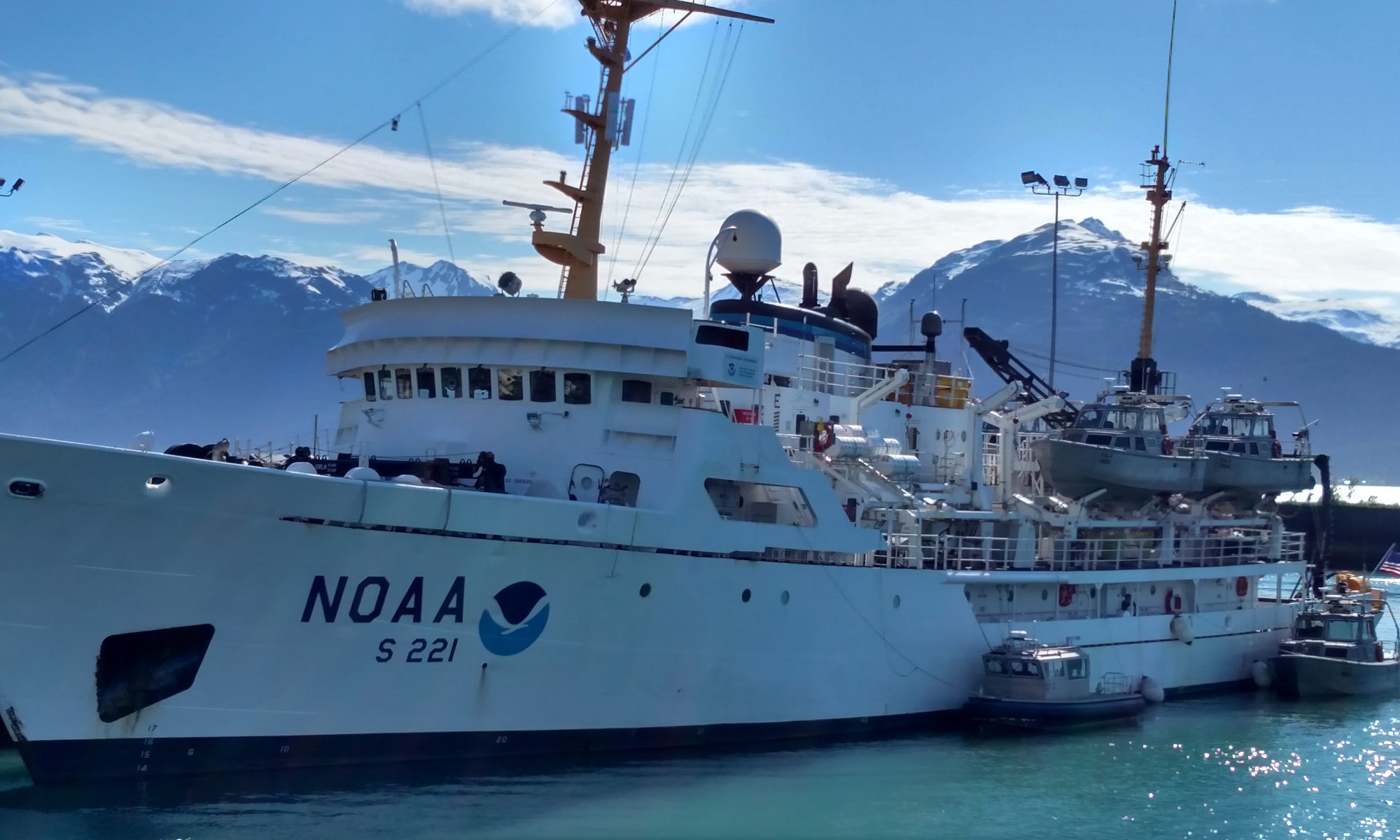
Onboard NOAA Ship Oscar Elton Sette
April 19 – May 4, 2010

NOAA Ship: Oscar Elton Sette
Mission: Transit/Acoustic Cetacean Survey
Geographical Area: North Pacific Ocean; transit from Guam to Oahu, Hawaii, including Wake Is.
Date: Friday, April 16, 2010

Science and Technology Log

The research mission for this cruise is to follow a transit from Guam to O‘ahu, Hawai‘i via Wake Island, and conduct an acoustic (hearing) and visual (seeing) survey of cetaceans (whales and dolphins) along the way. A transit is similar to a transect line you use to monitor our beaches in our nearshore studies! This transit study will be conducted from April 19 to May 4, 2010. This project represents important and groundbreaking research for whale biologists, since very little is known about the distribution and vocal behavior (the sounds made by whales) of baleen whales in this part of the Pacific.

Our research mission has several objectives:

  • Collect data on the presence of whales/dolphins and their abundance (how many)
  • Collect tissue samples from whales/dolphins for genetic studies
  • Collect photo identification on any whales/dolphins observed
  • Collect acoustic (sound) data on whales/dolphins to help in species identification and understanding their vocalizations
  • Collect acoustic data on fisheries to understand the distribution of prey species along the transit line
  • Recover and install underwater acoustic monitoring equipment, called a HARP (High-frequency Acoustic Recording Package), near Wake Island that will remain there for a year.

The research team consists of 12 scientists who are trained in visual observations of cetaceans and acoustic monitoring. I am part of the research team, and will fill in for staff conducting the visual observations and routinely conduct the acoustic monitoring.

The visual observation team consists of eight biologists rotating between four stations: Two “big eye” (25 x 150) binocular stations, one on the port (left) side and one on the starboard (right) side; one station forward observing with the naked eye and 7X binoculars; and one station rear-facing looking behind the ship with naked eye and 7X binoculars. Scientists work on 2-hour shifts and rotate among the scientists.

Visual observation station on flying bridge.
Research team member Adam on a “Big Eye”.

The acoustic team monitors whale vocalizations using two different methods. One method uses a hydrophone array towed behind the ship 24 hours a day (mostly to monitor toothed cetaceans, including dolphins). This hydrophone array is similar to the ones installed at Seattle Aquarium, Neah Bay, and other locations to monitor orcas and other whales in Washington State.

The other acoustic monitoring method uses Navy surplus sonobuoys (which were originally developed to detect submarines) that are launched three times a day at 0900, 1300, and 1700. The sonobuoys have a wide range in frequency response. They are able to pick up sounds between 5 Hz (cycles per second) and 20,000 Hz. Although humans have a hearing range of about 20 Hz to 20 kHz (20,000 Hz), our hearing is most sensitive between the frequencies of 1 kHz (1000 Hz) and 10 kHz (10,000 Hz). So, we can hear some of the clicks, whistles, and ‘boings’ of some dolphins and whales (‘boings’ are made by minke whales), but we have to “visually hear” others that are too low for humans to hear. The vocalizations of some baleen whales are not audible to the human ear, but are detected by the sonobuoy and are visible on the computer with the use of special software. We visually monitor from a range of 10 Hz to 240 Hz, to detect the presence of baleen whales, while listening for higher frequency vocalizations. Signals picked up from the sonobuoys are transmitted to a radio receiver on the ship. All data, including measurements of a vocalization frequency range and duration are recorded on a computer program and also logged in a hand-written journal and rerecorded on an Excel spreadsheet. All data collected will be carefully analyzed in a lab at a later date.

So far on the research cruise, there has been very little cetacean activity observed by visual observers or the scientists conducting acoustic monitoring. These waters have not been widely surveyed for cetaceans, so any data will add to the collective knowledge base of this area. As a scientist, it is important to remember that “the absence of data is data” in understanding the presence/absence and abundance of cetacean species in these deep, low productivity ocean waters.

Personal Log

The Oscar Elton Sette received its sailing orders to leave at 1500 on Monday, April 19, 2010. The generator part we were waiting on finally arrived (by way of Japan!) and we set sail promptly at sailing time. I am finally getting used to using the 24-hour clock!

Sailing orders.
Leaving the dock at Guam.
Sette’s colors flying!

We left Guam with fairly calm seas, but the winds picked up and we were soon rockin’ and rollin’! We had our “Welcome Aboard” meeting, where we learned about ship protocols and safety, as well as getting to know some of the ship’s crew. Of course, a large part of sailing preparation is the “safety drill” and I had my first “close encounter” with a survival suit! The Safety officer, Mike promptly provided me with a survival suit that actually fits much better…the first one could have accommodated two of me!

Karen in survival suit made for 2 Karens.
…and out of the survival suit! Whew!

I was ill prepared for what was to come. With high seas, and no “sea legs” I was struck by seasickness, which sent me right to my bunk to sleep—in fact that was about all I could do! We are fortunate to have a wonderful Doc on board, who provided me with the right meds and advice to be able to recover and feel human again! The greatest comfort I’ve gotten in a long time was to know that “the survival rate for seasickness is 100%!”

Doc Tran who took care of all of the seasick scientists!
My bunk, where I spent most of two days recuperating!

New Term/Phrase/Word of the Day: sonobuoy

Question of the Day: Did you know that sonobuoys were first developed by the U.S. Navy, made to be dropped from aircraft, and designed to locate submarines during WWII?

Something to Think About:

Whales migrate to tropical waters to give birth in winter and spring, and travel to colder, food rich waters for feeding during the summer.

Animals Seen Today:

• Spotted dolphin (Stenella attenuata)

Did you know?

…that scientists take tissue biopsy samples from cetaceans by using a crossbow to shoot a special dart with a metal tip that penetrates the skin and blubber then pops out. The dart has a float and string attached to one end so that it can be retrieved easily with the tissue sample (about the size of a pencil eraser) still inside the tip. Whale research scientists have to be good archers! Don’t worry, the animals rarely notice when they are darted!

Karen Matsumoto, April 16, 2010

NOAA Teacher at Sea: Karen Matsumoto
Onboard NOAA Ship Oscar Elton Sette
April 19 – May 4, 2010

NOAA Ship: Oscar Elton Sette
Mission: Transit/Acoustic Cetacean Survey
Geographical Area: North Pacific Ocean; transit from Guam to Oahu, Hawaii, including Wake Is.
Date: Friday, April 16, 2010

Science and Technology Log

The Oscar Elton Sette is now at the dock at the U.S. Naval Facility in Guam, preparing for our sailing on April 19th, as well as awaiting repairs to one of its generators. I am able to settle into my room and meet my “bunkmates” who are research scientists on the cruise. The science team is readying the scientific equipment for the acoustic monitoring and the visual survey. This includes routine maintenance on the “Big Eyes” (25 x 150) binoculars, checking the computer software, and readying equipment/supplies necessary for cetacean biopsy sampling. We are also preparing sonobuoys for later deployment during our transit survey. I am learning a lot about the extensive preparation necessary for these research cruises, and will explain more about the objectives of the science mission in the next log.

The Oscar Elton Sette at dock, Guam Naval Station.
Karen checking sonobuoys for later deployment.

Personal Log

Each day after taking care of research-related duties, the science team spends time together getting to know each other and the island of Guam. Morning meals are served on the boat, with evening meals in town. There are some great snorkeling spots on the Naval base, and we have opportunities to rent snorkel gear and explore the reef. The coral reefs near the base were in amazingly good shape, and the variety of reef fish was amazing. The fish that stand out in memory include several kinds of butterfly fish, many varieties of trigger fish (including my favorite, the Picasso triggerfish), parrotfish, Sergeant majors, unicornfish, Moorish idols, and bird wrasses. The field identification skills that I depend on when birding proved not to be as useful when fish watching! Too much distraction! Just as I would try to remember field marks on one fish, I would get distracted by 20 others that were just as engaging!

Karen in snorkel gear
Picasso trigger fish
Coral reef off Gab Gab Pt.

We also had a chance to go to the museum at the War in the Pacific National Historical Park run by the National Park Service. Displays on the events of “conquest and liberation” of Guam from 1941 to 1944 were presented, as well as a wealth of resources on WWII history at their small bookstore. Available maps pointed out various caves and tunnels made by the Japanese Army using forced labor for defense fortifications which are located close by. There are still hidden live explosives in many of the caves and tunnels, so exploration is dangerous. I got a small glimpse of the cultural history of the Chamorros, the aboriginal peoples of Guam, and I would like to learn more.

War in the Pacific Museum.
Trail to War Caves built during WWII.
Caves.

Question of the Day: What are those wire cages hanging everywhere on the cyclone fences all around the Naval base? (See photos next page)

These wire traps are baited with live mice to catch the brown tree snake that was accidentally introduced to Guam after World War II. With no natural predators and abundant prey, the snake population grew and spread throughout the island. As the snake dispersed, forest bird and fruit bat populations plummeted. By the late 1980s, nine species of native forest birds and the Mariana fruit bat had disappeared from Guam. There are very few birds or mammals left on the island due to predation by the brown tree snake, and it has upset the balance of the ecosystem. An increase in insect pests, as well as a shift in vegetation is occurring on Guam due to the introduction of this invasive species.

Brown tree snake trap
Close-up of mouse bait in trap

New Term/Phrase/Word of the Day: Chamorro – the indigenous peoples of Guam.

Something to Think About:

The amount of advance preparation you need to outfit a scientific expedition when you are out at sea with no place to get supplies is mind boggling! It is also awesome to think about the kind of expertise you need on your crew, which includes the following: engineer, doctor, NOAA officers, cook, technology expert, safety specialists, mechanic, plumber, carpenter, recreation specialist, and science team! Who else do you think you would need on an expedition at sea?

Animals Seen Today:

  • Pacific golden plover (we have these in Washington!)
  • Cattle egret
  • Philippine turtle dove
  • Eurasian tree sparrow
  • Black drongo
  • Coconut crab
  • Marine toad (from Central/South America and also known as the cane toad in Australia!)
  • Many, many tropical fish species and marine invertebrates (including black sea cucumbers and blue sea stars!!!!)
Coconut crab held by local Chamorro vendor at Chamorro Village.
Did you know?

…that in Guam, many introduced species such as pigs, the marine toad, and the brown tree snake have resulted in the decline and extinction of many native plants and animals. Scientists call these plant and animal invaders “invasive species.” Can you think of an example in your community where an “invasive” species has caused an imbalance to your local ecosystem?

Question of the Day:

What could we learn from the traditional knowledge of the Chamorros about Guam’s coral
ecosystems and how to protect them?

My Challenge:
Learning my way around the ship and getting used to the different research vessel terms such as the
head = bathroom, the mess = dining area, and “Texas deck” = large upper deck on the ship for
gathering people.

Linda Tatreau, MARCH 12, 2010

NOAA Teacher at Sea: Linda Tatreau
Onboard NOAA Ship Oscar Elton Sette

Mission: Fisheries Surveys
Geographical Area of Cruise: Equatorial Pacific
Date: March 12, 2010

Shark! and HARP

Tiger Shark
Tiger Shark
We are into the last day of work before returning to Guam. The first set of BRUVs is being recovered as I write. We will have time for one more set (8) and then we’ll secure the equipment and head for home (home for me anyway―everyone else will still be far from home). Steve is getting great data on the fish populations on the west side of Saipan. As much as we like watching the fish, we got more excited to see a turtle checking the bait, a moray eel chewing on the bait bag, and yesterday, a large tiger shark cruising back and forth nudging the bait bag. Unfortunately, the video ended while the shark was still at the BRUV. When we brought it up, the bait bag was gone.
E paraancora
E paraancora

John and Viv deploy the TOAD each night and make 3 or 4 passes over the reef to assess coral coverage and other bottom features. They were particularly happy to have found several areas of reef with the coral Euphyllia paraancora. This coral is found in the tropical Western Pacific and the Indian Ocean, but it is not common. It is heavily harvested for the aquarium trade and more susceptible to bleaching than more robust coral species. It is listed as vulnerable and is further threatened by the predicted threats of climate change and ocean acidification. It was put on the IUCN Red List and is protected via CITES, both as of October, 2009.

Above: HARP Diagram
Above: HARP Diagram

One night we deployed a HARP, a High-Frequency Acoustic Recording Package used to study cetaceans (whales and dolphins). The scientist in charge of this equipment was not onboard but had arranged with the Chief Scientist to put out this equipment near Saipan. This HARP will sit on the seafloor for 2 years collecting sounds. HARPs record ambient ocean noise including low-frequency baleen whale calls, high-frequency dolphin clicks, sounds in between and man-made sounds from ships, sonar, and seismic exploration. When the HARP is retrieved, the sounds can be analyzed and we will learn more about the cetacean populations of the Mariana Islands.

Engine Room
Engine Room

A few days ago, Glen gave me a great tour of the engine room. It is beyond the scope of this blog to describe it here, but I can’t resist including a few pictures. I am always amazed by what it takes to keep a ship like this running. They call it an “unmanned engine room” because an alarm will ring if something needs attention like overheating or low oil pressure. It may be called “unmanned” but it takes a lot of man-hours to keep it that way. The engine room and machine shop are really clean and well organized―I didn’t see a drip of oil or a smudge of grease.

Right: One of 4 diesel engines that provided the electricity for the ship and run the electric motors that drive the propellers.

Engine Room
Engine Room
Engine Room
Engine Room

Right: Glen, first assistant engineer and my tour guide.

Glen, First Assistant Engineer

Linda Tatreau, MARCH 9, 2010

NOAA Teacher at Sea: Linda Tatreau
Onboard NOAA Ship Oscar Elton Sette

Mission: Fisheries Surveys
Geographical Area of Cruise: Equatorial Pacific
Date: March 9, 2010

TOAD

Sunset
Sunset

It would be easy to start every post with a beautiful sunrise or sunset photo. In this one, you can see Anatahan Island in the background. Just before the sunset, 3 large wahoo were caught. Poke and fried fish are the favorite items on recent menus (breakfast, lunch and dinner).

Steve, Frances and Mills show off their catch.
This photo/diagram shows how sonar waves ping the seafloor and also shows the bathymetric map that is made from the data.

We used the multibeam sonar to map shallow banks north of Farallon de Mendinilla and east of Anatahan and Sarigan. The multibeam work continued day and night and produced huge amounts of data that needed to be processed. I can only sit at the computer for short periods, but the map team members work 10 hour shifts and most of that time is spent processing the data and making new maps. There are always 2 or 3 people processing the data.

The TOAD seen with cameras facing forward.

Monday night, we put out the TOAD (Towed Optical Assessment Device). This camera is towed behind the ship and sends video directly to the control room. We were able to see some of the seafloor we had been mapping. The first run of the camera went for 2.25 hours, covered a distance of 3 miles and went to a maximum depth of 400 feet. The second run went for 3.5 hours, over 4.5 miles to a maximum depth of 300 feet. Towing the camera sounds easy, but someone must be on the controls to keep the camera from crashing into the bottom. The camera needs to be close to the bottom for the best video, but without someone on the controls, it can crash. Driving requires constant attention. Most of the seafloor had a sand coverage with some algae. Occasionally, there would be oohs and aahs over something other than sand and sea weed: sea stars, large sea cucumbers, sponges, sea urchins or the infrequent fish. I really enjoy watching real time video of previously unseen seafloor, but I found myself falling asleep on my feet. I finally had to give up and head to the bunk.

Steve & Viv prepare the TOAD for launch.

Today, we are near Saipan planning to do BRUV work during the day and the TOAD tonight. A nap might be a good plan so I can watch the TOAD through the night, but I don’t want to miss the BRUV action either.

Linda Tatreau, MARCH 4, 2010

NOAA Teacher at Sea: Linda Tatreau
Onboard NOAA Ship Oscar Elton Sette

Mission: Fisheries Surveys
Geographical Area of Cruise: Equatorial Pacific
Date: March 4, 2010

Pinging and Playing

We continue to “kill dots” as we work our way around the island of Farallon de Mendinilla. The mapping here will be finished tonight and then we will head north to map the seafloor of a few seamounts and banks. Most of the recent questions on this blog have been about “killing dots,” as we edit the data from the multibeam sonar. I will tell you more about the map making process in a future post. Today I want to show you some of the fun things we do aboard ship.Fishing is everyone’s favorite activity, either for the catching or the eating. The best method is trolling using lures when the ship is traveling at about 10 knots. This only happens when the ship is heading from one study area to another. When using the multibeam, the ship travels at about 4.5 knots and the fish are less apt to bite a slowly moving lure.

Kenji making poke from a wahoo he caught.
Frances with mahi mahi skins she is drying to make a fishing lure. Before drying she had to remove all the meat and later all the scales were removed. The resulting skin is very tough.
Jonathan on the exercise bike pedaling to Rota. There is an exercise room on the ship with a treadmill, rowing machine and weights. Many of the crew members like the bike best because it’s out on the deck with the great view.
A few of the movies available.
Movies are popular during breaks. The ship has about 800 tapes including older movies and recent releases. Many of the crew members have personal collections as well.
The desk in my stateroom.
Each stateroom (bunkroom) has a monitor so the movies can be watched in the movie room, the lounge or the staterooms. The T.V. in the lounge also gets Fox News via satellite. The internet is a popular pastime. That also comes via satellite. The ship pays a set fee for the satellite service and there is no charge to us. There are three computers in the lounge available for everyone to use. There are internet connections on the bridge, in the science labs and in the bunk rooms for people with laptops. The library has a nice collection of books and board games so there is always something to do during non-working hours.
Bellow: That’s me looking for whales. These binoculars are called “big eyes.” They are used on trips when scientists are studying mammal populations. Using these binoculars from the highest point on the ship increases the likelihood of seasickness.
Big Eyes
Big Eyes
Here we are splicing lines to hold buoys. There have also been several knot-tying sessions.