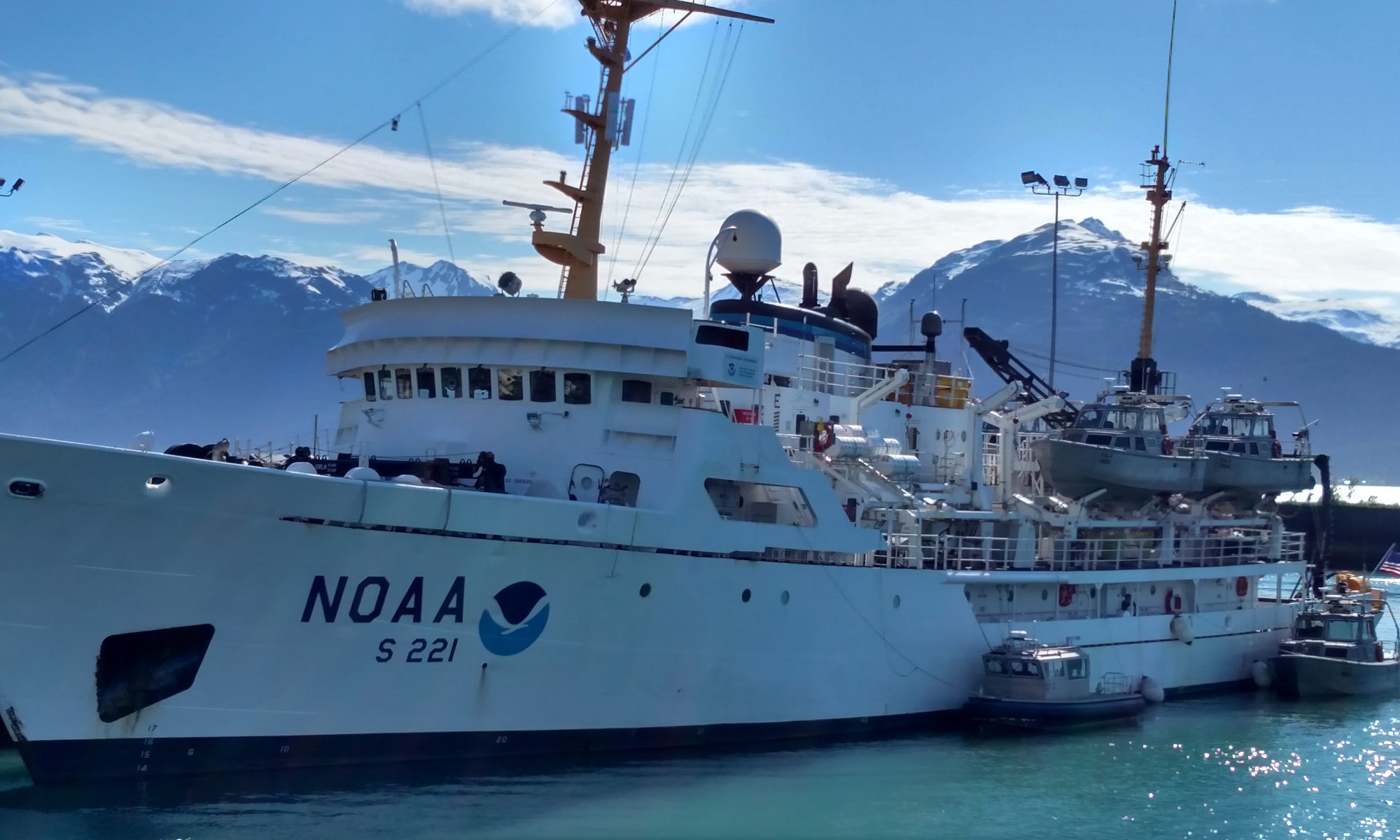

NOAA Teacher at Sea: Bruce Taterka
NOAA Ship: Oregon II
Mission: SEAMAP Summer Groundfish Survey
Geographical Area of Cruise: Gulf of Mexico
Date: Sunday, July 4, 2010
Out in the Gulf
Weather Data from the Bridge
Time: 1000 hours (10:00am)
Position: Latitude = 27.58.38 N; Longitude = 096.17.53 W
Present Weather: partly cloudy, haze on the horizon
Visibility: 8-10 nautical miles
Wind Speed: 17 knots
Wave Height: 2-4 feet
Sea Water Temp: 28.6 C
Air Temperature: Dry bulb = 29.2 degrees Celsius; Wet bulb = 26.1 C
Barometric Pressure: 1011.1 mb
Science and Technology Log
The purpose of the SEAMAP Summer Groundfish Survey is to collect data for managing commercial fisheries in the Gulf of Mexico. SEAMAP stands for Southeast Area Monitoring and Assessment Program.
Right now we’re working along the Gulf Coast of Texas, far from the BP Deepwater Horizon oil spill, so we’re not seeing any effects of oil here. However, part of our mission is to collect fish for testing to make sure that oil spill has not impacted the marine life in this area and that the fish and shrimp from Texas are safe to eat. We’re also collecting water samples from this area to use as baseline data for the long-term monitoring of the impact of the oil spill in Gulf.

There are four main ways the Oregon II is gathering SEAMAP data on this cruise, and we’ve already learned how to use all of them. The main way we collect data is by trawling, and this is where we do most of our work on the Oregon II. In trawling, we drag a 42’ net along the bottom for 30 minutes, haul it up, and weigh the catch.

We then sort the haul which involves pulling out all of the shrimp and red snapper, which are the most commercially important species, and taking random samples of the rest. Then we count each species in the sample and record weights and measurements in a computer database called FSCS (Fisheries Scientific Computer System).

Here on the Texas coast, where we’re working now, the SEAMAP data is used to protect the shrimp population and make sure that it’s sustained into the future. Since 1959, Texas has been closing the shrimp fishery seasonally to allow the population to reproduce and grow. The SEAMAP data allows Texas to determine the length of the season and size limits for each species. Judging by our trawls, the Texas shrimp population is healthy.
Another tool for data collection is the CTD, which stands for Conductivity, Temperature, and Depth. The CTD also measure dissolved oxygen, chlorophyll and other characteristics of the marine ecosystem and takes measurements from the surface to the bottom, creating a CTD profile of the water column at our trawling locations. These data are important to assess the extent of the hypoxic “dead zone” in the Gulf of Mexico, and to relate the characteristics of our trawling hauls to dissolved oxygen levels. SEAMAP data collected since the early 1980s show that the zone of hypoxia in the Gulf has been spreading, causing populations to decline in hypoxic areas.
We also use Bongos and Neustons to gather data on larval fish, especially Bluefin Tuna, Mackerel, Gray Triggerfish, and Red Snapper. The Neuston is a rectangular net that we drag along the surface for ten minutes to collect surface-dwelling larval fish that inhabit Sargassum, a type of seaweed that floats at the surface and provides critical habitat for small fish and other organisms.


We drag the Bongos below the surface to collect ichthyoplankton, which are the tiny larvae of fish just after they hatch. The Neuston and Bongo data on fish larvae are used for long-term planning to maintain these important food species and keep fish stocks healthy.
Personal Log
This is a great learning experience, not only about marine science but also about living and working on a ship. The Oregon II is literally a well-oiled machine, and the operation of the ship and the SEAMAP study depends on a complex effort and cooperation among the science team, the crew, the officers, engineers, and the steward and cook. Everyone seems to be an expert at their job, and the success of our survey and our safety depends on that. It’s a different feeling from life on land.
Life aboard the Oregon II is comfortable, especially now that I’ve gotten my sea legs.(I was hurting after we set out on Friday in 4’ to 6’ swells, but by Saturday afternoon I felt fine.) The food is excellent and most of the ship is air conditioned. The Gulf – at least the Gulf Coast off of Texas right now – is beautiful. The seas are deep green and blue and teeming with marine life. I’m looking forward to spending the next 2 weeks on board the Oregon II and being part of the effort to study the marine ecosystem in the Gulf and how it’s changing.


