Rachel Dane, May 1, 2005

NOAA Teacher at Sea
Rachel Dane
Onboard NOAA Ship Ka’imimoana
April 29 – May 10, 2005

Mission: Oceanographic Survey
Geographical Area: Puerto Ayora, Isla Santa Cruz, Galapagos
Date: May 1, 2005

Personal Log

Following 16 hours of travel that brought me to Guayquil, Ecuador, a 2 hour flight has transported me to the northernmost tip of Baltra Island in the Galapagos.  The Galapagos Islands is the name given to this isolated group of volcanic mounds, which consists of 19 major islands and scores of inlets located 1000km west of mainland Ecuador.  From the air I could observe most of the land mass of the archipelago, which covers 7882 square km.  That these islands have so profoundly influenced scientific thought is astounding! The handful of animals that made their way out here have, through isolation, developed into completely unique species without fear of predation.

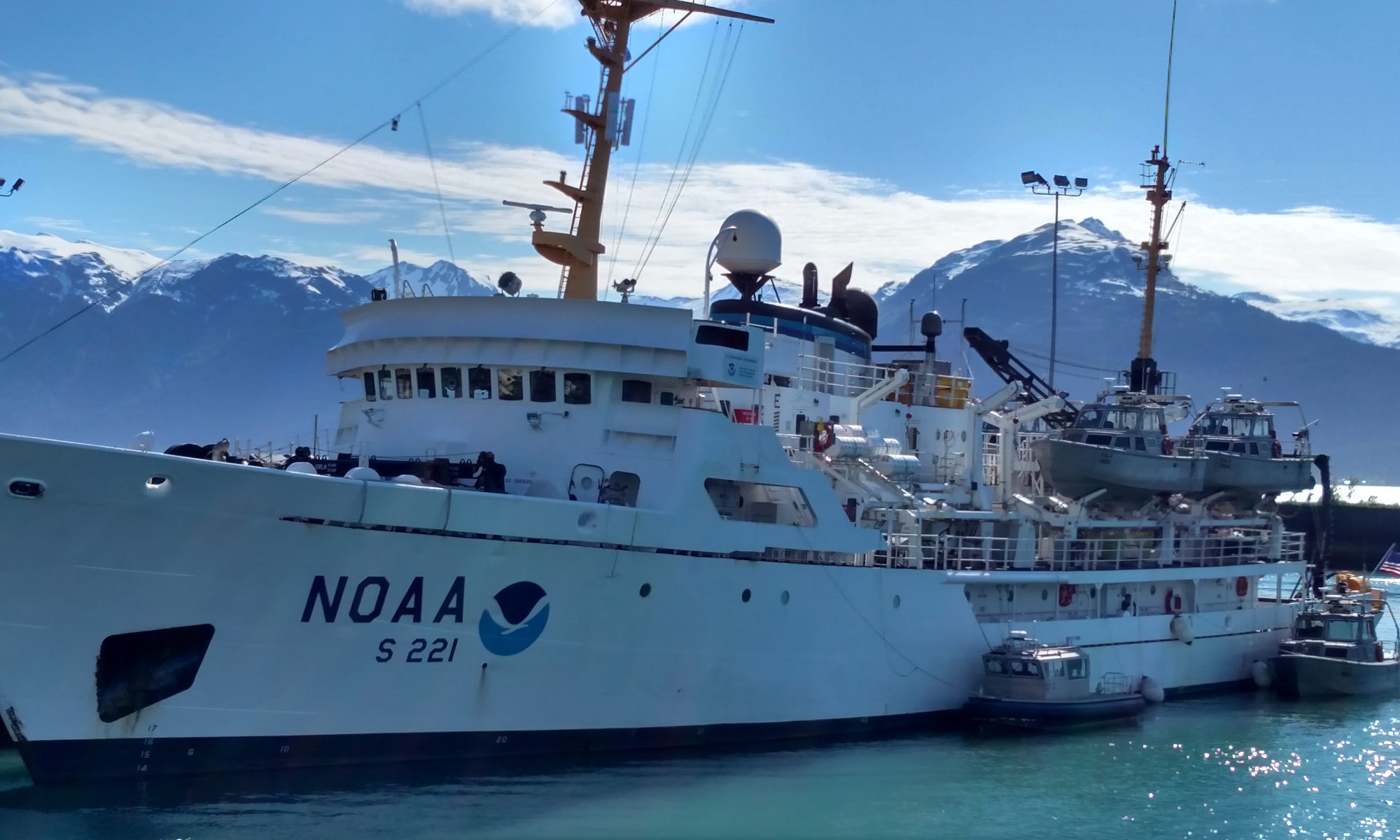
After a 10 minute ferry ride from Isla Baltra to the northern tip of Isla Santa Cruz, I am driven 42km south to Puerto Ayora, the largest town in the archipelago.  The population of this town is growing (too fast!) due to immigration from mainland Ecuador, and now numbers about 12,000 individuals.  During the drive I was observing the vegetation and wildlife, and noticed many plants with brightly colored flowers ranging from deep red to vibrant pinks and purples. Also present were a plethora of small, lemon yellow butterflies. Soon, Academy Bay was stretching far out to the east, and anchored peacefully in the turquoise water I spotted what was to be my home for the next 12 days: the NOAA Ship Ka’imimoana (Hawaiian for “Ocean Seeker”).

Once dropped off at the pier, I was ferried out to the KA’IMIMOANA (KA) via a local “panga”, or water taxi. I was welcomed by Doc, Joe and Sean (more to come about my crew mates!) and given a brief tour of the ship.  Eager to explore Isla Santa Cruz, Joe and I headed back to the island with our panga.  One of the most popular visitor sites in Puerto Ayora is the Charles Darwin Research Station, which is where I met the giant Galapagos tortoises face to face!  The station directs a captive breeding program for several of the 11 remaining subspecies of tortoise, and I was happy to learn that the captive bred animals are generally released to their home islands when they are about 4 years old.

Tired but elated after spending the afternoon at the research station, I enjoyed a meal of delicious fresh sea bass at a local restaurant.  My first day in the Galapagos closed after the short water taxi trip back to the vessel, and meeting several more of my helpful and welcoming ship mates.  I was lulled to sleep by the gentle rocking of the anchored ship, and the comforting view of stars from the window of my berth.

Debra Brice, November 25, 2003

NOAA Teacher at Sea
Debra Brice
Onboard R/V Roger Revelle
November 11-25, 2003

Debra Brice TAS 2003 on RV Roger Revelle
San Diego teacher Debra Brice on RV Roger Revelle

Mission: Ocean Observation
Geographical Area: Chilean Coast
Date: November 25, 2003

Data from the Bridge
1. 251500Z Nov 03
2. Position: LAT: 20-00.0’S, LONG: 073-36.0’W
3. Course: 090-T
4. Speed: 12.0 Kts
5. Distance: 83.7 NM
6. Steaming Time: 7H 00M
7. Station Time: 16H 00M
8. Fuel: 1661 GAL
9. Sky: OvrCst
10. Wind: 220-T, 6 Kts
11. Sea: 220-T, 1-3 Ft
12. Swell: 190-T, 4-6 Ft
13. Barometer: 1014.2 mb
14. Temperature: Air: 22.0 C, Sea 20.4 C
15. Equipment Status: NORMAL
16. Comments: Advanced clocks 1 hour @ 0500Z to conform with +3 time zone.
ETA Arica, Chile 261100Z Nov 03.

Science and Technology Log

“Oceanography is Fun.”

So Roger Revelle thought, and as I spend my last night on the ship that bears this remarkable man’s name I pause to reflect on my voyage of discovery. I have learned a great deal while I have been at sea; from the duties of a chief scientist and how to deploy a buoy to how aerosols are involved in precipitation in the atmosphere, and so much more. The experience of being hundreds of miles from shore with thousands of meters of water beneath you is indescribable. In my last log I wanted to talk about my impressions of oceanography and a little about the history of the vessel I am traveling on and what makes it so special.

The Research Vessel ROGER REVELLE is named after one of the most respected Oceanographers in the field. He was also a graduate of Scripps Institution of Oceanography and eventually, the director. I want to share a little bit of Roger Revelle the man and also the ship.

“The ocean holds me in an enduring spell. Part of the spell comes from mystery – the fourfold mystery of the shoreline, the surface, the horizon and the timeless motion of the sea. At the horizon, where my line of sight touches the edge of the great globe itself, I watch ships slowly disappear, first the hulls, then the tall masts bound on voyages to unknown ports 10,000 miles away. From beyond the horizon come the waves that break rhythmically on the beach, sounding now loud, now soft, as they did long before I was born and as they will far in the future. The restless, ever-changing ocean is timeless on a scale of life, and this also is a mystery.

Being an oceanographer is not quite the same as being a professional sailor. Oceanographers have the best of two worlds – both the sea and the land. Yet many of them find it extraordinarily satisfying to be far from the nearest coast on one of the small, oily and uncomfortable ships of their trade (the RV REVELLE is none of these things!), even in the midst of a vicious storm, let alone on those wonderful days in the tropics when the sea and the air are smiling and calm. I think the chief reason is that on shipboard both the past and the future disappear. Little can be done to remedy the mistakes of yesterday; no planning for tomorrow can reckon with the unpredictability of ships and the sea. To live in the present is the essence of being a seaman.

The work of an oceanographer, however, is inextricably related to time. To understand the present ocean he must reconstruct its history and to test and use his understanding he needs to be able to predict – both what he will find by new observations and future events in the sea.”

From “The Ocean” by Roger Revelle, Sept 1969, Scientific American

Revelle was considered as the director who took the institution to sea. He supported and encouraged and personally participated in many oceanographic voyages and deeply believed in the value of personally collected data. An oceanographer had to spend time in the ocean he studied. Even today with our satellite data and computers the data that is being collected at sea by oceanographers is absolutely irreplaceable. Oceanography is one of the few fields where you can still experience the adventure of exploration and discovery. There is still so much we do not know and for a young person is is an exciting and challenging field. With our new technology we can probe and explore more deeply and with greater accuracy than ever before, but still we need to go to sea to collect our data.

I hope that in the interviews with the scientists and crew of the REVELLE I have been able to share a little bit of the excitement and enthusiasm that these people have for what they do. Everyone I spoke with shared with me that they really enjoy the idea that their jobs, either the actual science itself or the support of the science makes them feel that they are part of a real contribution to our future knowledge. The spirit of Roger Revelle lives on in the ship that bears his name and in the scientists, like Dr. Robert Weller, who follow his dream. There is still so much left for the young oceanographers to come and I look forward to sharing this spirit of exploration and discovery with my students.

Thanks for joining me.

Debra Brice

Dana Tomlinson: Day 15, March 15, 2002

NOAA Teacher at Sea

Dana Tomlinson

Aboard NOAA Ship Ka’imimoana

March 1 – 27, 2002

Date: Friday, March 15, 2002
Lat: 6.2°S
Long: 111°W
Seas: 4-6 ft
Visibility: unrestricted
Weather: partly to mostly cloudy
Sea Surface Temp: 82-86°F
Winds: SE 10-15 knots
Air Temp: 85-74°F

Today was the day that we rounded up our wayward buoy. The buoy was deployed in April 2001 at 5°S 110°W. In November 2001, NOAA scientists knew that it was drifting freely. By the time we found it (it has a tracking device on it) it had drifted one degree south and one degree east. That’s 60 nautical miles in two directions!

Once we pulled it on board, one could see fairly clearly what had happened. There were scrapes on the sides of the buoy (the toroid, or “donut” section) where something like a boat/ship had rubbed up to it. There was a steel cable that had been attached to it and the nylon rope had been cut. So, the theory is that a fishing vessel attached itself to the buoy with the steel slingshot device. It yanks the buoy out of place and it’s easy to catch all the fish that use the buoy’s shade as their ecosystem.

Speaking of the buoy’s fish, while we were bringing in the buoy, folks on board that were not working were fishing the bounty of the ocean with a rod and reel. Several mahi mahi graced our table at dinner that evening – served by Clem four different ways (I think the mahi mahi in coconut sauce was the favorite.)! That woman is amazing. You NEED to use the gym on board to work off her good cooking!

Not to be overshadowed by the morning’s events was the day’s live broadcast. This was our third general broadcast and was the very first ever tried by NOAA out of doors. We had our studio on the buoy deck today. On the live broadcast, Cmdr. Tisch, Chief Scientist McPhaden and I dedicated tomorrow’s buoy to be deployed at 8°S 110°W to Education in America. The bulk of the show was scientist Ben Moore giving us a cook’s tour of the buoy deck’s equipment, and Dr. McFaden talked about our wayward buoy. It was a great show. We can still hook you up for the live broadcasts on 3/18, 3/20 and 3/22 if you’re interested.

Question of the Day:

 This is going to be a bit of a toughie, and might need some Internet research on your part, but it’s interesting. When do most oceanographers consider to be the beginning of modern oceanography? Or, another way of putting it is, what started modern oceanography? Hint: it’s before 1900.

Answer of the Day: 

The question was: how many branches of the armed services are there and what are they? Dennis M. of Lakeside CA got it exactly correct. There are 5 branches of the armed services: Army, Navy, Air Force, Marines, Coast Guard. PLUS, there are two other uniformed branches: NOAA and the US Public Health Service. Great job, Dennis. 🙂

Til tomorrow,
🙂 Dana