Geographic Area of Cruise: Northwest Atlantic Ocean
Date: August 15, 2025
Weather Data from Bridge:
First, Someone named Suzy asked if I am hopeful for the future of our oceans after seeing all the work that is done on my NOAA cruise. I am hopeful every day I get to go to school and see the brilliant young minds that are learning and developing so that they may work to solve our world’s problems. (Read more here). The dedicated people I’ve met through NOAA and on NOAA Ship Pisces remind me that we are using science in productive ways, like taking care of our oceans! Are you learning and doing your part? Thank you for reading and asking questions!
Dorothy and a plankton sieve
Second, the answers to the math problem from the previous BLOG: If we sorted through 1/8 of our Bongo net sample, and identified 20 krill, then we would estimate there to be 160 krill in the total sample. For part 2, the abundance is estimated as the number of krill expected per cubic meter. If the nets filtered through 5 cubic meters of water, we would expect to find 32 krill per cubic meter in this part of the ocean. (Alert, we’ll soon be calculating energy density in Chemistry!)
Observers Observing!
Science at Sea: Purpose! On purpose! With purpose!
It is hard to believe that my two weeks onboard NOAA Ship Pisces have come to an end. In many ways, it seems like I have just started. But when I reflect on all that I have learned about the science being done at sea, I realize I have been here long enough for some important things to sink in! I’d like to share some of these things with you.
Many of the Scientists I spoke with said that math wasn’t their thing. You don’t have to like math to do science, you do have to do some math, understand some math, check behind the computers on some math. There is a difference. We don’t live in a binomial world. You can’t say not liking math is a reason to not do math.
Science is a process. It is not a list of boxes to check or things to do. Science is a way of looking at the world. Observe, analyze, reflect, repeat.
Science can be used for good. NOAA Scientists are making our lives better.
We need more scientists. Are you ready? I’m ready to start a new school year sharing the insights I’ve learned as a NOAA Teacher at Sea!
Gear is ready for next time!
You do the Math: I’ve worked 12-hour shifts, 3pm-3am each day of the Summer2025 EcoMon meeting Scientists, doing science, seeing Science in action, and developing ways to connect my students with relative, real-world experiences. How many hours of professional development credit should I receive? OR Since a work day is considered to be 8-hours, how many days of “comp time” should I earn? (Teachers in some schools can earn “compensatory time” for work done outside of the school day, to be used on teacher workdays, not on regular days with students.) Feel free to post a kind reply in the comments.
Yes, that’s a sea horse!
Interesting Things: As a NOAA Teacher at Sea participant, I have had the privilege to work with an awesome Summer EcoMon 2025 crew. I have basked in the joy of focusing on science and ways to bring back some insights to my classroom in North Carolina. Some observations have come more organically than others. For example, on the Pisces, the mission is clear. Every department is working towards the goal of collecting our scientific data, but not in the same way. At school, our departments are also working, but sometimes our goals are in conflict… Increase test scores? Winning football season? Resume booster? Full stomachs? Social conduit? College acceptance? Understand the world? Develop skills? Create citizens? Workforce development? Avoid gun violence? Learn content?
The Wardroom
NOAA Corps is responsible for operations, safety, and project completion (possibly like school administration) but they must rotate off the ship after 2 years and they don’t make decisions unilaterally. Their well-honed leadership comes in understanding the institutional knowledge of each department.
I wonder what would happen if our school systems invested in clear missions and departmental leadership. I would settle for “just” focusing on science! 😊
View from the Wet Lab
Teacher at Sea/ Career Spotlight:
As part of my Teacher at Sea work, I’ve created a game to help my students see many of the people and careers on the NOAA EcoMon cruises. In addition to the Science, NOAA Corps, Deck, and Engineering departments I’ve been able to highlight in my blog posts, the Stewards, Survey, and Electronic Technician departments are also mission critical. Come to West Johnston to play my Career Exploration game.
I’ve also found ways to integrate real world skills and relevant examples into the content I teach. Next year specifically, we will be honing my “Death at Sea” Forensics Lesson and “Ocean Calorimetry” Chemistry lesson. Finally, I will be leading a session called “Come Sail with NOAA” at the NC Science Teacher’s Association PD conference in November. If you would like to learn more about applying to be a NOAA Teacher at Sea, or a Science Teacher in North Carolina, please come check us out. (read more here: NCSTA)
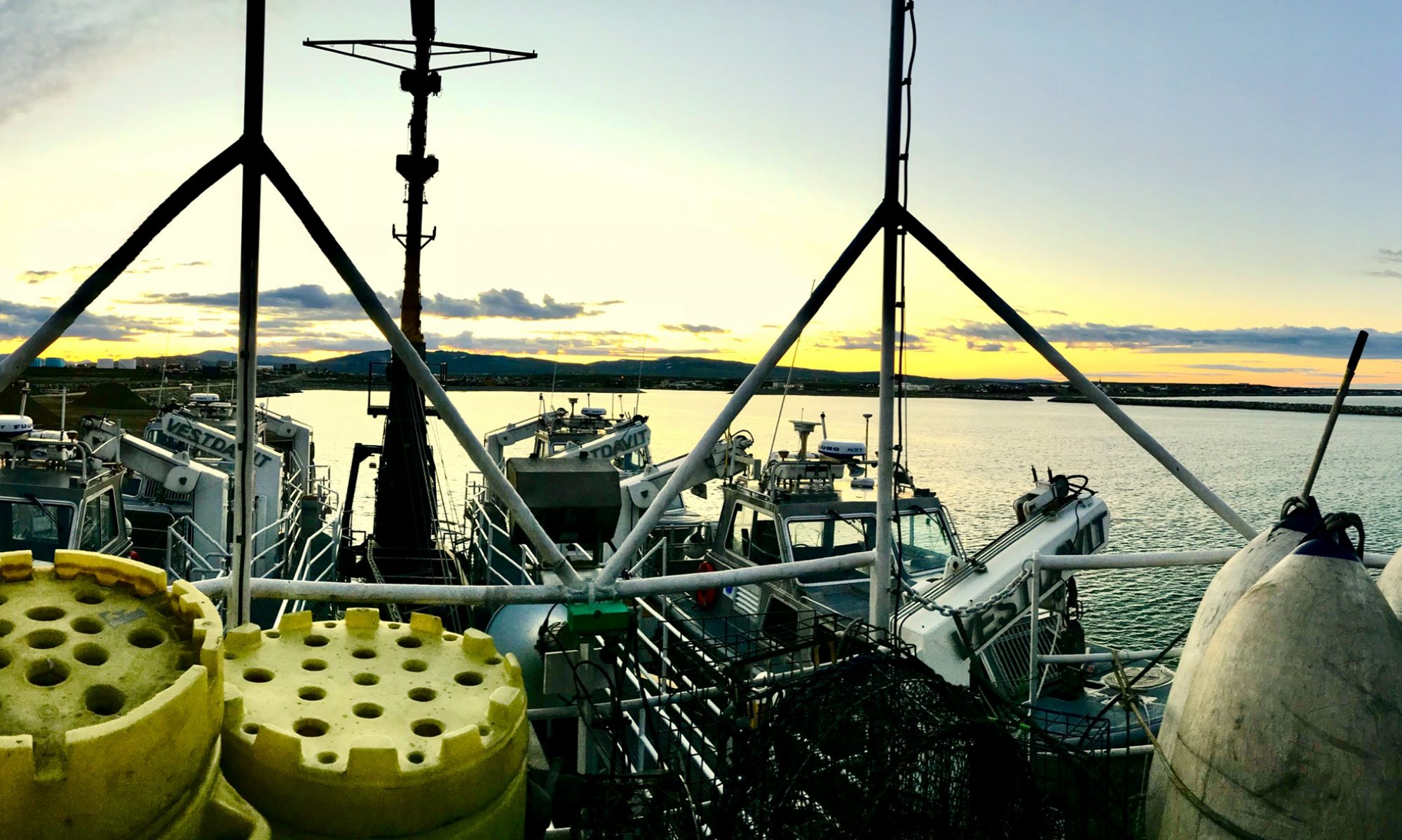
After our last data collection stop, we checked out the last sunset!
Personal Log: I am thankful for my community – those who have and continue to nurture, teach, and inspire me to observe, learn, enjoy, and be curious! This is going to be the best school year ever!!
Latitude: 48° 25.012′ N
Longitude: 122° 44.039′ W
Sea Wave Height: 1-3 feet
Wind Speed: 10-20 knots
Wind Direction: NE
Visibility: 14.1 km
Air Temperature: 14oC
Sky: Scattered Clouds
Science and Technology Log
As NOAA Ship Fairweather began its northward journey through the Inward Passage, I took advantage of a few days at sea to conduct interviews with crew from each of the various departments onboard: deck crew, engineers, officers, stewards, and survey technicians. Through the interview process I realized just how much goes in to making Fairweather successful. Two themes arose again and again in conversations: First, the crew of the Fairweather loves what they do — the crew’s commitment and passion for being at sea was unanimous. . .and contagious. Second, Fairweather is family.
Enjoy the five interviews below, the first of which is with a Edward Devotion School alum. . .
An Interview with AB Carl Coonce, Fairweather Deck Crew & Devotion School Alum (1971-1974)
AB Carl Coonce at the Helm
AB Carl Coonce & Devotion School Alum on Fairweather’s Bridge
Q: What is your role aboard NOAA Ship Fairweather?
A: I’m an able-bodied seaman or AB. My permanent job is to take care of the ship. Some duties include maintaining the ship’s cleanliness, ensuring the security of the vessel, and steering the ship.
Q: Why is your work important?
A: Without AB’s, the ship can’t be driven. AB’s also maintain the security of the ship and watch out for the safety of the ship’s personnel. AB’s work on the upkeep of the ship’s inside and outside condition, checking to prevent rust and other damage. The AB’s ready the equipment for different missions and load and unload equipment, too. Finally, the AB’s help with the officers’ work, with surveying, and with engineering.
Q: What do you enjoy the most about your work?
A: I love being at sea. I love being able to see different sunrises and sunsets every day. I see things most people only see on TV or in pictures. For example, I’ve seen two rainbows cross before at sea. Sometimes rainbows are so close when you are at sea that you can almost reach out and touch them. Every day at sea is a new adventure.
Q: Where do you do most of your work?
A: I mostly work as a helmsman (driver) up on the bridge (which is like the front seat of the car/ship). A helmsman is the person who drives the ship. A helmsman keeps watch, looking for any potential dangers such as things floating in the water, other ships, and certain parts of land (such as sand bridges). Another important part of my job is to understand how to read maps and use all of the radar and other navigational equipment up on the bridge.
Q: What tool do you use in your work that you could not live without?
A: Sleep!
Q: When did you know you wanted to pursue an ocean career?
A: I always wanted to come to sea because my father was a sailor. I took a different route for a long time, but about 15 years ago I started my ocean career. I guess it was in my blood. It was hard to get started because I knew nothing about ships and what was required in the beginning. I went online and researched shipping companies and sent my resume out to a few hundred companies. I received a call from NOAA and began my sea career in Woods Hole, Massachusetts on a fishing vessel, NOAA Ship Albatross. By the way, Albatross is actually where the NOAA Teachers at Sea Program started.
Q: What part of your job with NOAA did you least expect to be doing?
A: I didn’t expect to be around the same people 24/7. You are always with the people with whom you work and your boss. Eventually, though, it becomes like a family.
Q: How do you help wider audiences to understand and appreciate NOAA science?
A: I would tell other people that NOAA is a wonderful job for people interested in going to sea. When you start off, you can go out to sea for a few weeks at a time. With NOAA, you have a chance to see and do things that you don’t get to do on commercial boats. You also are able to see new parts of the country. I’ve seen the east and west cost. The benefits are outstanding. Aside from traveling, I also have three months of vacation each year, something I would probably not have with a desk job, even after many years.
Q: How did you become interested in communicating about science?
A: When I was on the east coast, I was on NOAA Ship Henry Bigelow out of Newport, Rhode Island. A group of scientists came onboard, and we sailed up by Newfoundland. We sent a special net nearly three miles down into the ocean. The most memorable thing was catching a fish that was about 2.5 feet long, incredibly white, paper thin, and had bright red fins. The scientists told me that this fish only lives two miles down. Experiences like this are once in a lifetime. That was one of the most exciting and memorable trips I’ve had with NOAA.
Q: What advice would you give a young person exploring ocean or science career options?
A: Don’t take the sea for granted. There is a mystery for the sea. We know more about the moon than we do about the oceans. There is so much to learn at sea. Even after fifteen years at sea, there is so much more to learn about the ocean. It is never the same. There is always something new to see. I’m still amazed by some of the things I’ve seen at sea, even if I’ve seen them over and over again. For example, hearing the sound of the glaciers hitting the water is unforgettable. Seeing the different colors of the ocean, you realize there is so much more than green and blue. Once you think you’ve learned it all, the ocean changes again on you.
Q: What do you think you would be doing if you were not working for NOAA?
A: I’d probably be back in Boston working as a chef. I went to school for culinary arts, but I think I’d be miserable if I wasn’t at sea.
Q: Do you have an outside hobby?
A: When I’m home, I like to work in my backyard. I like to work on my garden. I also like to work out.
Q: What is your favorite memory as a student at the Edward Devotion School?
A: I loved growing up in Brookline. It was a wonderful town to grow up in. I really feel now that being a kid at Devotion School was one of the happiest parts of my life. There is so much history at the Devotion School. Even after having traveled all around the country with NOAA, I love going back home to Boston and Brookline. Boston and Brookline are my favorite places. I still keep in touch with five of my friends from school in Brookline. We’ve been hanging out together for over thirty years. My friendships from grade school and later at Brookline High are still tremendously important to me today.
An Interview with HST Bekah Gossett, Fairweather Hydrographic Survey Technician
HST Bekah Gossett
The View from the Plot Room
One of HST Gosset’s Projects from Last Season: Notice the Green Plot Lines and Surrounding Glaciers
A Finished Sheet from Last Season: Notice the Contrasting Depths (69 fathoms on a Previous Chart v. 94 fathoms Based on Sonar Data)
Comparing Updated Charts with an Outdated One (Green Represents Data Matched, Blue/Red Show One Data Set is Deeper/Shallower than the Other)
Q: What is your role aboard NOAA Ship Fairweather?
A: My role on the ship is to acquire and process data that gives us information about the depth of the seafloor.
Q: Why is your work (or research) important?
A: This work is important because it contributes to updating and creating charts (maps) that are navigationally significant for US mariners to keep them safe and to support them economically. And, it’s cool!
Q: What do you enjoy the most about your work?
A: I really like working on the small boats (the launches) and working in Alaskan waters is great. It is a really open and good learning environment for this field of work. I have learned a whole lot in just a year and a half. This goes beyond hydrography. I’ve learned a lot about others and myself and about working with people.
Q: Where do you do most of your work?
A: I do most of my work in the plot room and on the launches. During the field season, we’re on the launches almost every day. The plot room is the data processing room where there are lots of computers. It is adjacent to the bridge, the central and most important location on the ship.
Q: What tool do you use in your work that you could not live without?
A: A computer!
Q: If you could invent any tool to make your work more efficient and cost were no object, what would it be and why?
A: I would create something with lidar (lasers) or a super sonar. Lidar is used on planes or drones to scan and provide data back. Lidar on launches would help us get data quicker.
Q: When did you know you wanted to pursue an ocean career?
A: I studied art in school, but then I switched to science. I’ve always liked ocean sciences. I decided to pursue an ocean career when I was 19.
Q: What part of your job with NOAA did you least expect to be doing?
A: I run the ship store, which is never something I expected to be doing. The ship stores sells snacks, candy, soda, and ship swag for the crew to keep morale high.
Q: How do you help wider audiences to understand and appreciate NOAA science?
A: I usually explain the ship’s mission as updating and correcting nautical charts. Sometimes we have different projects. Last year, for example, we were searching for a ship that sunk in Alaska in February 2017. We found it!
Q: How did you become interested in communicating about science?
A: When I was in college studying geology, I realized exactly how important it is to communicate science, because there is a lot of knowledge there that we can all learn from and use.
Q: What advice would you give a young person exploring ocean or science career options?
A: There are a lot of different things one can do. There are many different degrees from engineering, to environmental science, to biology. You can study ocean science, but you don’t have to. Any science can be applied in the ocean. It is not just science. You can learn about many different careers in oceans. Engineers and deck crew are great fields to pursue. You could also be a steward and travel a lot.
Q: What do you think you would be doing if you were not working for NOAA?
A: I would probably be working for an environmental agency, but I would probably not be very happy. I might be at home with my dog.
Q: Do you have an outside hobby?
A: I like to paint. I also have a ukulele. I also love to read.
An Interview with EU Tommy Meissner, Fairweather Engineer
EU Tommy Meissner Hard at Work in Fairweather’s Boat Shop
First Assignment: In the Navy, Onboard the USS Forrestal, The World’s First Supercarrier at 1,060 Feet Long in 1990
EU Tommy Meissner: An Engineer & His Electric Guitar
Q:What is your role aboard NOAA Ship Fairweather?
A: I’m a utility engineer. I stand watch on the main engines and check all of the propulsion equipment. I do maintenance on the small boats. I work on air conditioning, refrigeration, heating, etc. I am jack-of-all-trades.
Q:Why is your work (or research) important?
A: There is always something too hot or too cold, something leaking or blocked. There is always too much of something or not enough of something else. That is really the challenge of the job.
Q:What do you enjoy the most about your work?
A: The travel aspect is the best thing about my job. I can go anywhere in the world I want to go, whenever I want to go. The oil field in Mexico is opening back up, and so now there is lots of work available.
From a work aspect, it is challenging to understand why a piece of equipment isn’t working. Fixing the engines. . .or anything really. . . is all about following a process, working methodically. It feels good to be able to fix the boat and keep it in the water.
Q:Where do you do most of your work?
A: I do most of my work in the boat shop on the small boats on E-Deck. That’s where all the maintenance is performed while the launches are in the davits (the machines that put the boats in the water). When underway, I spend eight hours a day in the machine room, but when in port I work mostly in the boat shop. Eight hours a day, four hours a watch. In addition to the two watches, I usually do at least two hours of overtime a day. During a watch, I walk around, checking all the machines, pumps, generators, boilers, air conditioners, fridge, freezer, etc.
Q:What tool do you use in your work that you could not live without?
A: The first thing I always grab is a pipe wrench. It is always good to have one nearby. A pipe wrench is a tool that we use to take apart plumbing and to loosen and tighten any connections. I am pretty well known on this boat for unclogging restrooms and showers.
Q:If you could invent any tool to make your work more efficient and cost were no object, what would it be and why?
A: I would want a third hand! There is always a time when you need another person. It would be helpful to have one more hand to do work more efficiently. There are lots of times when I can’t reach or need that extra hand.
Q:When did you know you wanted to pursue an ocean career?
A: I’ve been sailing since 1990. I joined the Navy in 1989. All my life I’ve liked being around boats and on the water. Even though I lived around the water when I was little, I never had the opportunity to go to sea, so it was something I dreamed about for when I was older. Living in Fort Lauderdale, I saw the Navy come through and watched all the ships. I thought it would be cool.
Q:What part of your job with NOAA did you least expect to be doing?
A: I had no idea where I would be going when I joined NOAA. Before I said yes to the job, they gave me the choice to go on the Fairweather or the Rainier. Initially, I wondered about Alaska. Nome, Alaska is as far away from home for me as Dubai. I had never been so far west. Alaska has been great, though.
Q:How do you help wider audiences to understand and appreciate NOAA science?
A: Everyone I talk to doesn’t seem to know what NOAA is. NOAA has various missions, mapping the bottom of the ocean, studying coral reefs, fish ecology (understanding how many tuna are in the middle of the Gulf of Mexico and what species of fish are on the reef off North Carolina). I don’t think people know enough about NOAA.
Q:What recommendations do you have for a young person interested in pursuing an ocean career?
A: I would study oceanography and math and science if you want to go to sea. Decide what type of career you would like; there are so many options at sea.
Q:What do you think you would be doing if you were not working for NOAA?
A: If I wasn’t working for NOAA, I would go back to South Carolina and work in building or construction. I prefer NOAA!
Q: Do you have an outside hobby?
I play guitar and teach guitar. I was always a metal head.
An Interview with 2C Carrie Mortell, Fairweather Steward
2C Carrie Mortell Serving a Delicious Meal in Fairweather’s Galley
Q: What is your role aboard NOAA Ship Fairweather?
A: I work in the galley (kitchen), which is very, very busy. It is kind of like the heart of the ship. We work to feed everyone, make sure everything is kept clean, etc. There is a lot to do! We work twelve hours everyday. Many people think the galley is just cooking, but there is a lot more to the galley such as keeping track of massive amounts of stores (supplies), keeping everything fresh, and more.
Q: Why is your work (or research) important?
A: Keeping the mess deck (dining area) clean and keeping people happy and healthy with good meals is key. We boost morale. People look forward to sitting down and having a good meal at sea. We try to take peoples’ requests and keep the crew satisfied.
Q: What do you enjoy the most about your work?
A: I love being at sea. I love to cook. I like to see people happy and satisfied. I always try to keep upbeat. We all have to live together, so it is important to keep morale up. We’re like a big family at sea.
Q: Where do you do most of your work?
A: I spend most of my day in the galley. All of the stewards cook. We rotate every week. One week, one cook is in the galley, and then we switch into the scullery (where dishes are cleaned).
Q: What tool do you use in your work that you could not live without?
A: My hands!
Q: If you could invent any tool to make your work more efficient and cost were no object, what would it be and why?
A: Another pair of arms to help cook. It is really, really busy in the galley!
Q: When did you know you wanted to pursue an ocean career?
A: Well, I used to commercial fish. I have always loved being on the ocean. I grew up around fishing people. When I was little, I always wanted to live in a lighthouse. I also like being able to go to different places. It is exciting to always get to travel when at sea. I loved the French Polynesian Islands, where I traveled with NOAA. I worked out of Hawaii for about eight years, so I spent a lot of time sailing around the Pacific, visiting Guam, Sonoma, the Marshall Islands, and crossing the equator several times. On the East Coast, I enjoyed sailing Puerto Rico and the Caribbean. I also love Alaska, so sailing on Fairweather is great! Eventually, I want to move back to Alaska.
Q: What part of your job with NOAA did you least expect to be doing?
A: I really love cooking, which is what I get to do everyday. I feel really passionate about my job. There isn’t anything I didn’t expect. You do have to really like what you do, though, at sea.
Q: How do you help wider audiences to understand and appreciate NOAA science?
A: All the ships do different missions. NOAA Ship Fairweather, for instance does mapping. Another NOAA ship I worked on put out buoys for tsunamis. NOAA helps keep oceans clean. NOAA also works with fisheries and brings many scientists out to sea to study the population of our oceans. NOAA even has gone on rescue missions for aircraft and other ships in distress.
Q: What advice would you give a young person exploring ocean or science career options?
A: First, you should love the sea. It is hard sometimes if you have a family. Sometimes you miss out on important events, but if you pick a ship in the right area, you can see your family more often. Sometimes, NOAA isn’t what people expect. It is really hard work, but I love it. There are lots of different departments and jobs on the ship though, so it is possible to find something you love.
Q: What do you think you would be doing if you were not working for NOAA?
A: I definitely would be working in culinary arts somewhere.
Q: Do you have an outside hobby?
A: I love to write, paint, draw, crochet, and read. I’ve always dreamed of writing children’s books. I used to tell my children stories, especially scary ones which they loved.
An Interview with ENS Linda Junge, Fairweather Junior Officer
ENS Linda Junge on the Bridge
ENS Linda Junge Leading a Navigation Briefing, Explaining Fairweather’s Course for the Inside Passage
Q: What is your role aboard NOAA Ship Fairweather?
A: I’m a junior officer (JO).
Q: What’s the process for becoming a JO?
A: The process to apply to become a JO is much like applying to graduate school. You write essays, get three to five letters of recommendation, fill out the application, and have an interview. You need a BS in a field relating to NOAA’s mission, which can be pretty much any math or science field (geology, physics, calculus, engineering, biology, environmental sciences, etc.). Then you attend BOTC (Basic Officer Training Class), which is held at the Coast Guard Academy along with their officer candidate school. Another way to become a JO is to transfer in if you were formerly enlisted. BOTC for JO’s lasts five months, and we have lots of navigation classes.
Q: Why is your work (or research) important?
A: NOAA Ships have three main categories: oceanography, hydrography, and fisheries. The major job of JO’s on ships is driving, we’re like bus drivers for science. When we are underway, 50% of my work is navigation, driving the ship, and deck stuff. 30% is collateral duties, extra administrative things to make the ship run such as thinking about environmental compliance and working as a medical officer. 20% (which can fluctuate) is focused on hydrographic survey, driving small boats or helping with survey sheets, managing an area, collecting data, and being sure data is processed on time.
Q: What do you enjoy the most about your work?
A: I really enjoy knowing that I’m keeping people safe while they are sleeping. I really enjoy traveling. I really enjoy the sense of family that comes from living on a ship.
Q: Where do you do most of your work?
A: All of the navigation is done from the bridge. The rest of the work is desk work. Any ship needs lots of administrative work to make it run. It’s like a space ship, a hotel, a restaurant, a family. To make all of those things run you need cooks, plumbers, etc., you need a lots of admin. It is like a government-run hotel. There is lots of compliance to think about. It’s a JO’s job to make sure everything is done correctly and all is well taken care of because it is paid for and continues to be paid for by tax payers. Everyone who serves aboard a ship has documented time of when you have been on the ship, sea-service letters. A commercial ship may have human resources (HR), and yeomen (arranges paperwork for travel, keep everything supplied and running, stocked, etc.), pursers (who manage money and billable hours), but all of these tasks are done by JO’s on Fairweather.
Q: What tool do you use in your work that you could not live without?
A: Red lights. At night, it is dark on the bridge. We can’t destroy our night-vision, so we use red lights, which are gentle on the eyes and don’t affect one’s night vision. It’s important to be able to see the charts as well as to maintain night vision while keeping watch.
Q: If you could invent any tool to make your work more efficient and cost were no object, what would it be and why?
A: I would hire someone to be the yeomen to make sure we never ran out of pens, always had travel vouchers, made sure copiers ran, and helped with all the other random jobs.
Q: When did you know you wanted to pursue an ocean career?
A: Before I did this, I was a fisheries observer. I was a biologist who went out to sea. I always loved standing on the bridge and hearing the stories. I loved not commuting, not having to go to the office. I loved casting out to sea, working hard, and then, pulling in, tying up, and feeling a huge sigh of relief that the crew worked hard and arrived safely back in port. It stuck with me, I enjoyed that, and I decided to pursue a career with NOAA.
Q: What part of your job with NOAA did you least expect to be doing?
A: All the administrative stuff!
Q: How do you help wider audiences to understand and appreciate NOAA science?
A: NOAA is everywhere, and sometimes people don’t appreciate that. NOAA produces weather reports and regulates fisheries in Alaska, where I’m from. NOAA could do a better job of advertising to the public its many pursuits.
Q: What advice would you give a young person exploring ocean or science career options?
A: There are many cool internships on research vessels. The commercial sector will always take people looking for adventure. If you don’t make a career of it, that’s fine. At the worst, you learn something new about yourself while having a really cool experience. That is not such a bad thing. I highly recommend giving an ocean job a try.
Q: What do you think you would be doing if you were not working for NOAA?
A: I would probably be in grad school. I would study city planning.
Q: Do you have an outside hobby?
A: I like walking. I like being in the woods.
Personal Log
While most of the crew spends days working on the bridge (navigation), the plot room (data analysis), in the galley (preparing meals), or in the engine room/boat shop (keeping everything running smoothly), there are a lot of other areas on the ship that help make Fairweather feel more like home. Below are some pictures of such key places:
The Ship’s Gym Next to the Engine Room
The Ship’s Movie Theater. Some Nights the Crew Gathers to Watch Films Together or Play Games.
The Ship’s Library – Lots of Science Fiction and Suspense!
The Ship’s Mailroom – Mail is Sent to Each Port; One of the Many Things to Look Forward to in a New Destination.
The Ship’s Conference Room Where Navigation Briefings and Safety Meetings Are Held
The Ship’s Laundry Room
The Ship’s Store – Candy & Snacks – Treasures at Sea
The Ship’s Store – Swag
A Berth (or Living Space) on the Ship Shared by Two Members of the Crew. Note the Bunk Beds & Curtains. The Crew Works Various Shifts 24/7.
Did You Know?
There is a lot of lingo aboard! Here are some terms helpful to know for navigating a ship:
Aft: towards the back of the ship
Bow: the front of the ship
Bridge: the navigation or control room at the front/top part of the ship
Deck: a floor/level on a ship
Flying Bridge: the top-most deck of the ship that provides unobstructed views
Fantail: area towards the back of the ship
Galley: the ship’s kitchen
Hands: a popular way to refer to the crew or people working aboard the ship
Head: the bathroom on a ship
Helm: the “steering wheel” of the ship
Hull: the outside sides/bottom of the vessels
Mess: dining area on the ship
Scullery: where dishes are washed
Starboard: to the right of the ship
Stores: the supplies kept in the hull that the crew will need while away at sea for a long time
Stern: the back of the boat
Port: to the left of the ship
Challenge Question #3: Devotion 7th Graders – Create a scale drawing of your ideal research or fishing vessel! Be sure to include key areas, such as those shown above. Remember that your crew will need space to eat, sleep, navigate, research, work, and relax. At a minimum, include the plan for at least one deck (or floor). Include your scale factor, show conversions and calculations, and label each area using some of the vocabulary included above. Needs some ideas? Check out this link to NOAA’s Marine Vessels for some inspiration.
Another five ladies who work with and in our H2O world!
Sara Grady
Sara Grady- Watershed Ecologist
Job Title:
Watershed Ecologist and South Shore Regional Coordinator
Massachusetts Bays Program
What She does:
A mix of research, outreach, and management, all to help local coastal communities understand, protect, and restore their watersheds.
Favorite Aspect of job:
It’s a tie between getting out in the field (especially salt marshes and mudflats) and the relationships I’ve formed with town staff and citizens
What type of schooling/experience do you think best set you up for this job:
While I learned the basics of doing research and presenting it properly and clearly while working on my Ph.D., the interaction aspect came through my actual field work. I studied horseshoe crabs on the Cape, and as part of that I spent quality time with the natural resource staff of some of the towns as well as some crab fishermen. It made me realize that I wanted to do something where I helped the local coastal folks in a direct way with my research and outreach. I also spent a few summers as an undergraduate working at the watershed association that hosts my position, so that experience helped me find the sort of community I wanted to participate in.
Helena Reinardy
Postdoctoral Researcher- Helena Reinardy
Job Title: Post-doctoral Scientist in the Molecular Biology Lab
Bermuda Institute of Ocean Sciences
What She does: Developing molecular and genetic techniques for investigating DNA repair mechanisms and trying to understand how capable sea urchins are in repairing damaged DNA. More broadly speaking, I am interested in understanding how organisms are affected by environmental stressors such as chemical pollutants, and the mechanisms they have for dealing with them at all levels of biological organisation (genetics, molecular and cellular, physiology, behaviour, and reproduction).
Favorite Aspect of job: the variety of the work. The work requires so many different things: working in the lab, running experiments, collecting samples from the sea, designing experiments, researching previous work, writing manuscripts, teaching students, and communicating and collaborating with other researchers all over the world.
What type of schooling/experience do you think best set you up for this job:
Getting as much experience of all the aspects of research as was possible. I worked in labs during my holidays as an undergraduate, I have moved around and been able to gain experience from many different scientist with different skills and perspectives, and my PhD was invaluable training in being a self-sufficient all-round science researcher.
Rachel Parsons
Rachel Parsons- Microbial Oceanographer
Job Title:
Research Specialist and Laboratory Manager of the Microbial Observatory
Bermuda Institute of Ocean SciencesWhat She does:
Microbial Oceanography: quantify and qualify the microbes in the ocean – viruses, bacteria and archaea. These microscopic organisms are responsible for using dissolved organic carbon (~40%) in the ocean and re-introducing it back into the food web and oceanic carbon cycle. Autotrophs or plant microbes along with phytoplankton contribute to 45% of the world’s oxygen – basically every other breath that you breathe comes from the ocean. She uses microscopy and molecular techniques to identify specific microbes in the ocean in order to better understand what microbes have adapted in specific ocean depths and why they have made these adaptations.
Favorite Aspect of job:
Teaching students the microscopy and molecular techniques and assisting them in looking at a variety of ecosystems including microbes associated with corals and sponges; those that adapt to a seasonally anoxic marine sound and those that can be used to trace sewage pollution.
What type of schooling/experience do you think best set you up for this job:
A strong mathematics and chemistry background in high school is essential. Being able to do chemical calculations in my head really speeds up many protocols and having a great grounding in these subjects ensures that mistakes are caught in time! Strong writing skills and knowledge of grammar have also been useful when writing scientific papers.
Katie May Lauman
Katie may Lauman- Student and Researcher
Job Title: Ph.D. Candidate, College of William and Mary, Virginia Institute of Marine Science, Department of Fisheries Science
What She does: Katie May is working with other scientists at the Virginia Institute of Marine Science studying sturgeon phylogenetics. There are 25 species of sturgeons, all of which are imperiled due to demand for their meat and caviar, as well as habitat destruction. These species are culturally and economically important to many communities, including Native American and First Nations groups. In order to effectively protect sturgeons, it is important to understand their biology and phylogenetic relationships (how different species are related to one another).
Katie May extracts and sequences mitochondrial DNA from sturgeons, and uses this information to construct phylogenies that help elucidate evolutionary relationships among sturgeon species. She also studies the development of sturgeons during the larval stage to better understand how behavior is linked to morphological development. This aspect of her research requires her to clear and stain hatchery-raised larval sturgeon specimens- a process that turns soft tissue clear, bone red, and cartilage blue. She then dissects the stained specimens- they can be as small as 10mm. Conducting these dissections is a delicate process, which requires use of a microscope- for example, she uses tools such as insect pins to carefully separate the jaws of larval specimens so that she can examine tooth and jaw bone development. Once dissections are complete, she compares her findings to behavioral developmental information documented by other researchers.
Katie May also participates, with her lab and the VIMS ichthyology course (taught by Dr. Eric Hilton), in an annual fish-collecting trip in the southern Appalachians.
Favorite Aspect of job:
Katie May most enjoys dissecting larval sturgeon specimens and finding links between the timing of morphological and behavioral changes. This aspect of her work is extremely interesting because sturgeons undergo very dramatic shifts during the larval stage. For example, they hatch with terminal, forward facing jaws. During the larval stage, the jaws slowly shift until they are ventrally positioned and protrusible- meaning they can extend their mouth away from their body to suction prey from the benthos. Also interesting is the fact that sturgeons hatch without teeth, develop teeth during the larval stage, and then lose these teeth before they are fully mature.
What type of schooling/experience do you think best set you up for this job:
Katie May earned her B.S. in Biology at Southampton College of Long Island University. She then earned an M.A. in Conservation Biology at Columbia University. While at Columbia, she interned at the Blue Ocean Institute, a non-profit organization where she helped develop Seafood Sustainability cards. She also interned and volunteered at the American Museum of Natural History, working on a molecular coral reef project. Before returning to school to pursue her PhD, she worked in the grant-writing department at Rainforest Alliance, an organization dedicated to biodiversity conservation and sustainable livelihoods. The best advice she can give anyone interested in pursuing science is to take advantage of internship opportunities- especially those involving lab or field work.
Yosra Khammeri
Yosra Khammeri- student and regional coordinator
Job Title: PhD student,
National Institute for Sciences and Technology of the Sea,
National Institute of Agronomy of Tunisia,
Regional Scientific Coordinator NF-POGO Alumni Network for Oceans (NANO), Africa region,
What She does: I had the opportunity to benefit from a joint fellowship from the Nippon Foundation (NF) and the Partnership for Observation of the Global Ocean (POGO) to follow a training programme at the Bermuda institute of Ocean Sciences (BIOS). I was particularly interested by the work addressing the impact of Saharan dust deposit on phytoplankton growth. At this stage, I was also involved in using flow cytometry to investigate at the single cell level, the response of phytoplankton to atmospheric dust deposit.
I found this approach very appealing to address the impact of Saharan dust deposit on phytoplankton development in the gulf of Gabès, Tunisia, and integrate it in my PhD project which is “High frequency observation of phytoplankton assemblages with automated flow cytometry, response to pulsed events”.
Favorite Aspect of job: As a scientific coordinator for NANO Africa, I will be able to participate in promoting global oceanography and particularly implementing international and integrated global ocean observing systems.
My PhD project will address several priority areas: fixed point time-series observations, emerging technologies (automated in situ flow cytometry) for ocean observation, data management and coastal observation.
What type of schooling/experience do you think best set you up for this job: Working hard and passionately contributes to the capacity building of my country by applying my skills and transferring my knowledge to other Tunisian scientists. I am proud that Tunisia will become the second country after France to deploy an instrumented buoy including an automated flow cytometer, thus contributing to the cornerstone of a future Mediterranean network of similar observation buoys. Always be motivated, make connections, and be sure that you love what you do. Oceanography is not an easy field so having the support of your family and friends is also very important!
Job Title: PhD student at University of São Paulo – Oceanography Institute
What She does:
I am a first year PhD student in the Biological Oceanography Program and I am developing my field and laboratory work at the Marine Biology Center, located in São Sebastião (northern coast of São Paulo State – Brazil).
My project looks at the estimates of primary production and analysis of photosynthetic rates of the phytoplankton community in the São Sebastião channel. This channel deserves special attention due to the presence of the Port of São Sebastião, which presents potential environmental impacts for this coastal region. Furthermore, there is an important ecosystem located in the continental portion of the channel, the Araça Bay, which presents a very high biodiversity and it is an ecosystem under different types of human pressure.
The project approaches the use of techniques to estimate physiological rates and primary production from the fluorescence emitted by chlorophyll molecules as part of the photosynthesis process in the phytoplankton cells. Several studies on how to accurately estimate primary production rates from the fluorescence data has been developed around the world in order to provide a faster and less invasive method to obtain this kind of data.
Favorite Aspect of job: For me, the most exciting aspect of being in this type of research is to have the opportunity to be in contact with so many different people, sharing experiences and moving to work in different places, from which you can establish networks and good research groups. The second aspect I consider really important is that, different of other jobs, you have the liberty and independence to work on issues and projects that suit you best, and this makes the job much more rewarding. Also, as an oceanography researcher, I am fascinated with being out on the ocean in research vessels.
What type of schooling/experience do you think best set you up for this job: I got my degree in Marine Biology in 2007, when I decided to focus in oceanography, applying for a master degree program in Biological Oceanography in 2008. Then, I have spent two years to get my degree and, during this time, I had great experiences in the oceanography field, participating of different projects, cruises, conferences and so on. By the end of my masters, I was selected to join the Training Program in Observational Oceanography at the Bermuda Institute of Ocean Sciences (BIOS). I have spent 10 months at this training and the course provided great experience and knowledge about different areas of oceanography, such as physical and chemical oceanography, data management, remote sensing, etc. As soon as I got back home, I joined the PhD program, also in Biological Oceanography at University of São Paulo. In summary, that was my schooling and experiences which made me end up at my current position, and that I hope will help to set me up for a good job in a near future.
Lisa Bourassa
Lisa Bourassa- Research Associate/Phycologist
Job Title:
Research Associate, Phycologist
Louisiana State University
Sea Grant Oyster Hatchery
What She does:
I work at an oyster hatchery operated by LSU Sea Grant. Here we grow polyploid Crassostrea virginica oysters for research and development for the oyster industry, as well as restoration working with the Louisiana Department of Wildlife and Fisheries (LDWF). As the Phycologist I am responsible for culturing all of the microalgae that is fed to our broodstock and larval oysters (our system can generate up to 2800 L of algae a day). I also help spawn oysters, culture the larvae, and many other miscellaneous tasks that need to be completed in the hatchery.
Favorite Aspect of job:
My favorite aspect my job is that I’m not chained to a desk! I get to work outside, get my hands dirty, and every day is different! It’s also great to be part of restoration efforts. Our hatchery works with LDWF researching different methods for oyster restoration, so it’s great to be part of something that strives to restore the oyster populations to benefit the environment as well as the industry, which many people rely on for their livelihood.
What type of schooling/experience do you think best set you up for this job:
While a background in marine biology is very important, I think the experience that set me up best for this job was working in the aquaculture laboratory as a tech at Roger Williams University. Here I learned many of the skills I execute on a daily basis, but I really learned how to manage my time, figure out what needs to be done, and get it done. Because this job was mostly taking care of animals, I learned quickly that when you work with live animals, the animals must come first and be cared for, regardless of weekends or holidays. This experience also taught me how to roll with the punches, and troubleshoot any problems that I encounter throughout the day, and it’s always okay to ask for some help if you need it.
Another experience that set me up best for this job was my time spent as a Girl Scout. Although being a Scout may not have given me the technical knowledge for my job, it taught me how to think on my own, work individually, the value of teamwork, and how to use my resources effectively. I also learned that hard work and challenges are not something to be feared, but instead to embrace the opportunities that they provide.
Kate Degnan
Kate Degnan- Educator, North Carolina Aquarium
Job Title:
Educator
Education Department
North Carolina Aquarium at Roanoke Island
What She Does: Kate conducts public education programs at the North Carolina Aquarium on Roanoke Island. The mission of the aquarium is to promote awareness, understanding, and appreciation of the natural resources of North Carolina. Kate facilitates this type of learning by introducing the public to live animals, using the Science on a Sphere technology developed by the National Oceanic and Atmospheric Association (NOAA), playing educational games, or speaking with aquarium divers. Kate has other tasks as well; occasionally she works with the aquarium husbandry staff to help with animal care, each week she dives in the aquariums 285,000 gallon shark tank, and she also helps develop new programs.
Favorite Aspect of Job Each day is different! Typically within a week, Kate will only teach the same program once or twice since the schedule is so varied. However, no matter how many times Kate teaches a program the delivery and execution of each program is different. Due to the location of the aquarium, people from all over the United States and from different parts of the world visit. Each person who visits has some interest, curiosity, or fear of the animals they encounter. As an educator you must understand their reaction and impart some knowledge so they might be less afraid or more interested and educated. The people make the program.
What type of schooling/experience do you think best set you up for this job? Kate has found that having experience working with various age groups of students and being able to modify what you teach to suit the audience is extremely important. Kate has a background in marine biology and education psychology; this combination of education has provided Kate with a scientific background but also the understanding of how people learn. Communicating scientific information is important you must be able to translate that information in a way that the public can relate to it and care about it.
Sarah Fawcett
Sarah Fawcett- Chemical Oceanographer
Job Title:
Postdoctoral Research Associate, Department of Geosciences, Princeton University
What She does:
Sarah is a Chemical Oceanographer studying the interactions between the ocean’s major chemical cycles (specifically nitrogen and carbon) and phytoplankton, the floating single-celled plants that generate chemical energy by photosynthesis and support all of ocean life. Photosynthesis is the biological process that converts carbon dioxide into organic carbon, and nitrogen is essential for photosynthesis. One major consequence of phytoplankton photosynthesis is that it lowers the carbon dioxide content of the atmosphere by storing it in the deep sea. Changes in the efficiency of this storage likely explain past changes in atmospheric carbon dioxide, which in turn have affected climate. We know surprisingly little about which phytoplankton in the surface ocean are responsible for taking up the nitrogen mixed into the surface from depth, and for transporting organic matter back into the deep ocean, or if indeed all phytoplankton participate equally in this process. Sarah’s interest is in discovering the sources of nitrogen that different types of phytoplankton use for growth, with a view to understanding whether phytoplankton diversity is important for ocean processes such as carbon storage in the deep ocean, and how this might change if phytoplankton communities change in the future.
Favorite Aspect of job: I love going out on the ship to collect samples at sea. Being out on the open ocean reminds me of the “big picture”, of the important reasons why I’m doing the research I do. It’s easy to forget that when I spend long periods of time in the lab. I also really enjoy deploying all the different types of instruments that we use to collect scientific samples at sea; some of the engineering that goes into making oceanography happen is genius!
What type of schooling/experience do you think best set you up for this job: I got my bachelor’s degree in Earth and Planetary Science, and was first introduced to marine chemistry during the two summers I spent as an undergraduate on the Great Barrier Reef, reconstructing El Niño signals recorded in 10,000 year-old corals. This experience cemented my fascination with how our planet – and particularly our oceans – work. Ultimately, however, taking math and science courses, and taking advantage of field trip and lab work opportunities was the best preparation for this job.
Ali Hochberg
Ali Hochberg -Education and Development Coordinator
Job Title:
Education and Communications Coordinator
Bermuda Institute of Ocean Sciences
What She does:
Varies from day to day, but includes writing press releases, newspaper articles, newsletter articles; managing social media accounts; assisting with the creation of short- and long-term audience and donor development and communication strategies; working with faculty to highlight current and future science endeavors; identifying new avenues of publication and promotion within local and international circles; website content and design development; creation and design of new marketing materials.
Favorite Aspect of job:
Using my science background to translate the work of science faculty and staff into materials that can be understood by wider audiences.
What type of schooling/experience do you think best set you up for this job:
A science background is crucial, otherwise I wouldn’t be able to understand the details of the research taking place, but experience in public education/outreach, marketing/advertising, and writing are also invaluable.
Kayte Altieri- Associate Research Scholar/Atmospheric Biogeochemist
Job Title:
Associate Research Scholar, Princeton University, Department of Geosciences
What She does:
Katye studies atmospheric biogeochemistry and her research seeks to improve our understanding of how air pollution impacts the ocean. Her postdoctoral work focuses on characterizing the sources and interrelationships among pollutants in rainwater and aerosols deposited in the subtropical North Atlantic surface ocean. Katye conducts her fieldwork on the small island of Bermuda, which is 1000 km off the coast of South Carolina. The rainwater and aerosols collected on the island are analyzed by both chemical techniques and instruments which characterize the types of molecules and provides information on the atmospheric chemistry impacting the pollution as it travels out to the ocean.
Favorite Aspect of job: I love being on the ocean and traveling around the world to conduct my research. I also really enjoy knowing that my work is helping us understand the world around us and how we can better protect it from pollution.
What type of schooling/experience do you think best set you up for this job: I was a Chemistry major in college and I did an internship in an Oceanography lab which is where I first became fascinated with the chemistry of the ocean and atmosphere. I recommend studying as much math and science as you can because they will help prepare you for many career paths.
Kate Rossi-Snook
Kate Rossi-Snook- Bay Management Specialist
Job Title: Bay Management Specialist and Hatchery Manager
East Hampton Town Shellfish Hatchery
What she does:
She works on spawning and growing oysters, clams, and scallops for restoration and enhancement of the natural stocks in East Hampton harbors.
Favorite Aspect of her job: My favorite aspect of my job is witnessing and contributing to the full cycle of life – spawning the shellfish broodstock and being able to see the cells fertilize within minutes, divide within hours, and become larvae the next day; tracking the growth of the shellfish until they are finally large enough to be seeded; and ultimately watching the baymen and recreational fishers harvest the shellfish and directly benefit from the work we do.
What type of schooling/experience do you think best set you up for this job: My bachelors in marine biology and my aquaculture experience gave me the scientific knowledge to manage the spawns and care for the shellfish as they grow, while my masters in applied environmental anthropology set the stage for fully appreciating my work and understanding the complexities and importance of a marine resource management approach that takes into consideration and respects the culture and economy of a region as well as the environment.
Missy Stults
Missy Stults- Research Fellow and Doctoral Student
Job Title:
Research Fellow and Doctoral Student (Previously Climate Director for ICLEI-Local Governments for Sustainability)
University of Michigan
What She does:
Works with and studies strategies for building more resilient and climate friendly urban areas. Includes looking at the psychology of environmental decision-making and working with local stakeholders to devise practical solutions to local climate action.
Favorite Aspect of job:
Working with people. I absolutely, unequivocally love working with people. Research is fascinating, but it’s only through the application of research that really difference can be made. This is particularly true with an issue like climate change that, I’d argue, we have a moral imperative to address in meaningful ways by engaging with stakeholders to co-produce useful and usable tools, resources, and information.
What type of schooling/experience do you think best set you up for this job: My undergraduate training in marine biology and environmental science afforded me the critical thinking skills necessary to be successful in my current role. My graduate degree in climate and society gave me the content expertise needed to truly understand the science behind climate change and variability. However, it was the skills I acquired on the job that made me the most qualified to do the work I’ve been blessed to do. I hope that my doctorate will allow me to refine these skills and give me the remaining training I need to really transform the way we think about urban climate action.
Joanna York
Joanna York- Assistant Professor and Coordinator of Undergraduate Program
Job Title:
Assistant Professor and Coordinator of Undergraduate Program
University of Delaware, School of Marine Science and Policy
What She does: My job includes both teaching and research.
Favorite Aspect of job:
I’m torn here. I love my research which focuses on investigating the sources and impacts of nutrients in estuarine systems. I get to do field work ranging from small boat work to groundwater sampling, and those days are always wonderful– exhausting and wonderful. Lab work is challenging and time consuming, but it produces the cool data that allow me to piece together the story of how the system works. The other part of my job that gives me great satisfaction is teaching. I teach several of the introductory courses our program in Marine Biology and I love working with young people and getting them excited about this field of science. Best are probably the field trips we take. The highlight last year was a moonlit horseshoe crab spawning survey.
What type of schooling/experience do you think best set you up for this job:
My undergraduate work in general, and specifically a semester abroad spent studying marine biology and ecology probably had the greatest impact. Those experiences sparked my interest in the field and provided the enthusiasm to consider working towards a PhD, which is a requirement for academic jobs.
What She does:
Diane is working towards her Masters degree in Marine Science in the Physical Oceanography Lab at Moss Landing Marine Laboratories on the Monterey Bay. Her thesis project focuses on data analysis of multiple oceanographic sensors from the Monterey Bay Aquarium Research Institute’s (MBARI) Dorado autonomous underwater vehicle. She is specifically interested in determining what we can learn about plankton community composition from the Laser In-Situ Scattering and Transmissometry sensor, which detects particle sizes in the upper water column. Diane developed her thesis ideas and questions from work she began during her summer work at where she performed the Drew Gashler Internship. In addition to taking classes and working on her thesis proposal, Diane has worked as a Research Assistant for the Central and Northern California Ocean Observing System, managing the public data portal and oceanographic sensors at MLML.
Favorite Aspect of job: Diane enjoys the adventure of collecting data for her projects and others, whether it is on a research vessel or on SCUBA. The challenges of processing, analyzing, and presenting oceanographic data to address questions about dynamics in a marine ecosystem are among the most rewarding aspects of research. Diane also feels very fortunate for the opportunities to live in beautiful, outdoorsy, and sometimes remote locales in order to study marine science.
What type of schooling/experience do you think best set you up for this job: A background in biology and marine science internships from her undergraduate career helped solidify Diane’s interests and background in oceanography. Exploring a variety of research experiences as an undergraduate was crucial in building a foundation for graduate-level research science. Diane believes that pursuing research and field opportunities in multiple disciplines was and remains among the best ways to be a well-rounded and informed marine scientist.