Rachel Dane, May 3, 2005

NOAA Teacher at Sea
Rachel Dane
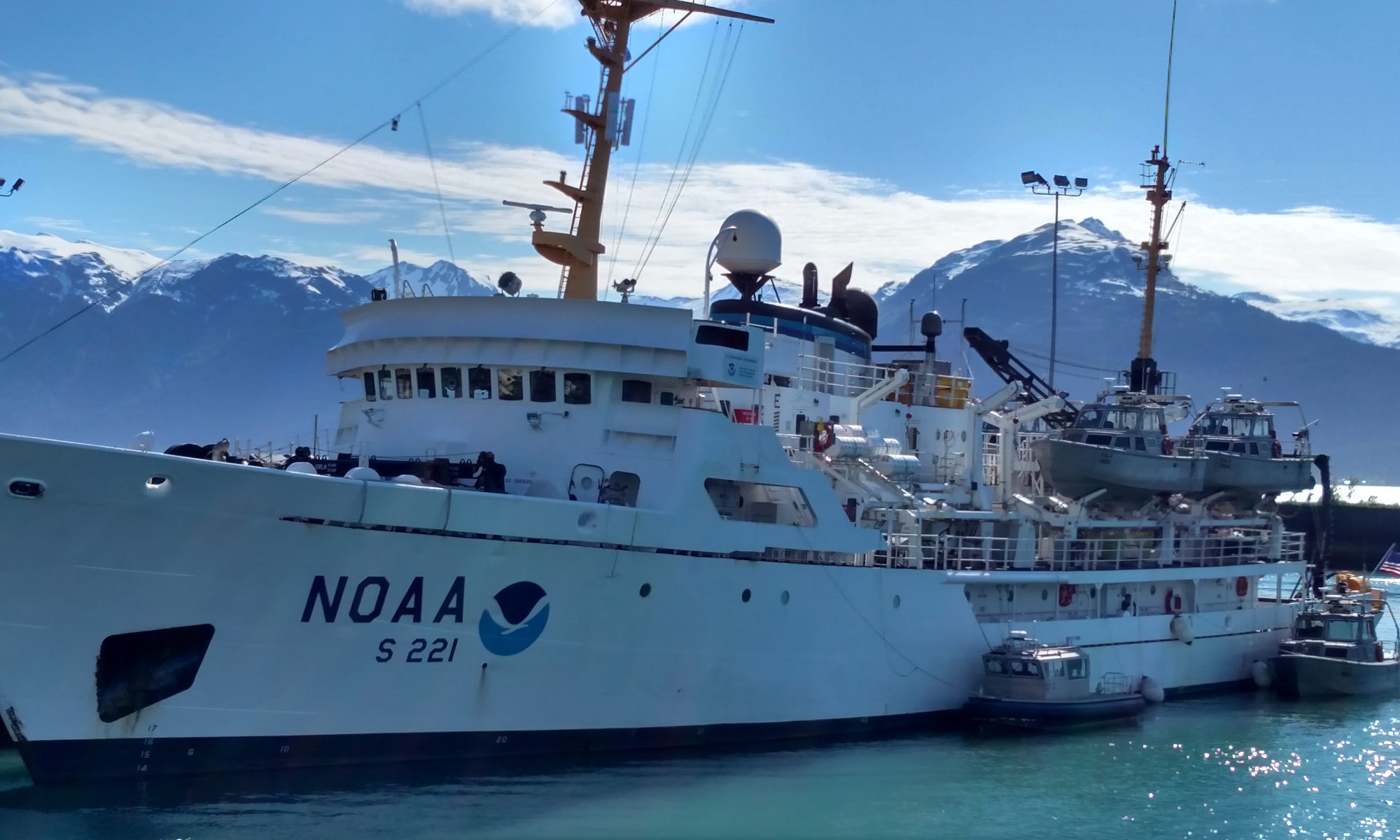
Onboard NOAA Ship Ka’imimoana
April 29 – May 10, 2005

Mission: Oceanographic Survey
Geographical Area: Puerto Ayora, Isla Santa Cruz, Galapagos
Date: May 3, 2005

Plan of the Day
0300: 0.5S CTD
1200: Equatorial mooring repair followed by a deep CTD and an ARGO
1845: 0.5N CTD
2345: 1N CTD

Weather Data
Latitude: 0 degrees N
Longitude: 94 degrees W
Visibility: 12 nautical miles
Wind Direction: 150 degrees
Wind Speed: 12 knots
Sea wave height: < 1 foot
Swell wave height: 2-3 feet
Sea water temperature: 26.5 degrees C
Barometric pressure: 1013.0
Cloud cover: 2/8 cumulus, cirrus

Science and Technology Log 

Today is my first full day on the KA’IMIMOANA (KA).  After sleepily answering my 3:30 AM wake-up call and quickly grabbing a hot cup of caffeine, I met Shawn and Jay on deck to begin the first CTD cast of this second leg of the KA’s journey along the equator. CTD is an acronym for “Conductivity, Temperature, Depth”; it is essentially an analysis of the salinity and chlorophyll levels of a site specific water sample. The casts are performed at each 1 degree change in latitude along the entire TAO array.  The CTD “package” consists of 15 cylinders, each about 1.25m high, attached to a sensing apparatus. Based on commands from the deck, this sensing apparatus will open and close the cylinders and provide real-time data of water conductivity, temperature, density and salinity. For the purposes of this morning’s sample, the package was lowered to a final depth of 1000m for sample collection.  Final depths vary with each cast.  Once the cask is deployed, data analysis of the water sample is displayed graphically on a nearby computer—this morning I was able to view a graphical representation of the thermocline for the first time!

Before lunch, I shadow Doc during her weekly safety inspection.  What a great opportunity for me to see the inner workings of this impressive vessel!  After lunch, the announcement that we have arrived at the site of our first buoy repair comes echoing over the loudspeakers, and it’s buoy time!

The equator! For me, it’s no longer simply a line around the globe.  Not only does the equator represent the dividing line between the northern and southern hemispheres of the earth, but this is also the region where Pacific ocean currents are being extensively studied by NOAA in order for us to better understand the relationship between the oceans and climate.  Essentially, the TAO buoy array acts as a 6000 mile antennae that scientists use to monitor ocean trends.

Donning hard hat and life jacket, I ran to the third deck clutching my zip locked camera and climbed into one of the orange work rafts attached to the KA’s port side.  We (Dave, Brian, Chris, Matt and I) were gently lowered into the water by attentive crew members, and off we motored to our waiting buoy, about 75m away.  Unfortunately, this buoy had been damaged by a fishing vessel so Dave and Brian had some repairs to make.  Fish prefer to swim in the vicinity of buoys because schools feed on the growth that accumulates on the underside, and it is quite common for large fishing vessels to tie up to TAO buoys; oftentimes damage occurs in the process.  After the repairs were complete, I was enthusiastically invited to jump onto the mooring buoy, and it was the absolute highlight of my day! Since fish like to hang out by the buoys sea birds do too; this was immediately obvious to me once I had hopped onto the platform and was clinging to the rungs of the tower.

The entire apparatus was covered from top to bottom with dried guano, and within minutes of climbing and perching on the tower, so was I!  Kind of gross; however, this did not prevent me from reveling in the experience of being on the equator and bobbing like a cork, completely and utterly surrounded by water.  It felt as though I had stepped into a completely foreign liquid universe.  Other than our work boat, the only object in the panoramic view was the KA’IMIMOANA headed towards the horizon. I believe that I could have very happily floated on that buoy for the rest of the day, reveling in the vastness.

Once back in the orange raft, our expert coxswain Chris kicked it into turbo gear and off we sped on a high speed chase, in hot pursuit of our ocean home.  Although the KA remained in sight for the entire operation today and although I longed for more time bobbing in the serene, blue stillness of the equatorial Pacific, there was a feeling of extreme comfort in riding to port side of the mighty Ocean Seeker.  Looking up, we saw 10 of our crew members peering anxiously over the rails on all decks, ready to work together to bring us home safely.

Personal Log

On a daily basis, I continue to be amazed by this ship.  So many aspects of life aboard the KA’IMIMOANA are extremely refreshing: that it is a floating home that operates so efficiently through the patience, teamwork and cooperation of all hands, that a hallway passing almost always evolves into a friendly conversation, and that crew members are consistently willing to share their knowledge and experience with me and excitedly teach new information.

Despite my best intentions and despite a 4.5 mile run on the treadmill, I was not able to squeeze in a rest this afternoon. Now it’s 10:30pm and I’m feeling exhausted, but too overwhelmed to sleep.  This evening I studied the Southern Cross and surrounding constellations with Don. Although I live at the Grand Canyon and regularly study extremely impressive night skies, the stars here rival what I’ve become accustomed to at home.  Thanks to Jimbo’s call I watched over 100 squid swarming on our starboard side, and kudos to Tony–his expert fishing skills have ensured that we will all enjoy fresh calamari tomorrow night!  Matt was the first person to introduce me to an actual example of bioluminescence tonight, visible in the ship’s wake; thank you, Matt, it was so incredibly cool! I definitely plan on taking him up on his offer for me to borrow the “Blue Planet” series to learn more about deep ocean luminescence.  So, brimming with curiosity and excitement, I look forward to the gentle rocking of the ship once I tumble into my bunk later this evening.

Rachel Dane, May 2, 2005

NOAA Teacher at Sea
Rachel Dane
Onboard NOAA Ship Ka’imimoana
April 29 – May 10, 2005

Mission: Oceanographic Survey
Geographical Area: Puerto Ayora, Isla Santa Cruz, Galapagos
Date: May 2, 2005

Science and Technology Log

Today is the big day—my first day at sea! I am excited and nervous at the same time; with no experience sailing my main hope is that sea legs will develop quickly for me!  As Academy Bay receded behind us I was a bit wistful at having to leave the Galapagos with so much left unexplored, but I am phenomenally happy to have had the experience to travel here and truly hope to return someday.

Much of my afternoon was spent picking the brain of Patrick Rafter, our Ph.D. student from the Scripps Institution of Oceanography. Patrick boarded the KA in San Diego at the start of this cruise, and is amazingly knowledgeable about marine chemistry.  He is also super patient with all of my questions, and very fun to chat with! You rock, Patrick! I basically asked him for a crash course in oceanic interactions, and this is what he taught me—too cool!

Essentially, the ocean can be viewed as the shallow, warm “mixed layer” at the surface and the deep, cold ocean. The dividing line between these two is called the thermocline, and it is the level at which a rapid change in water temperature occurs. Think about it as a multi-layered cake, with each water layer maintaining a fairly unique and consistent salinity, density and water temperature.  Generally, the mixed layer at the surface is the warmest.  In the equatorial pacific this surface layer has a depth of about 100m, and it is this first layer of oceanic cake that NOAA is most interested in studying.  Normally, the thermocline that divides the high warm layer from the lower cold layer maintains a gradually increasing easterly slope.  Under normal conditions, there is also less convection occurring and less wind is present.  However, under El Nino conditions the dividing line between the two layers becomes more level, creating a deeper, warmer top layer. This increase in depth of the top layer affects marine interactions in several ways.  First, a much larger percentage of surface water is warmer.  Second, more convection is occurring due to the warmer water temperature, and third, more wind is present.  One of the major uncertainties that TAO project data is attempting to explain is the cause of this thermocline change.

Personal Log

After a long Monday and a fabulous shrimp dinner, I feel quite tired and ready to call it a day. Tomorrow, Joe will set up my ship email account; I am really looking forward to being in touch with friends and loved ones at home, and also communicating with my students! It pleases me to report that, surprisingly, my stomach feels more settled at sea then it did when we were anchored in the Bay!  I’m not feeling 100% yet, but definitely well enough to give the treadmill a try tomorrow—and maybe I can even skip the Dramamine… Until tomorrow!

Rachel Dane, May 1, 2005

NOAA Teacher at Sea
Rachel Dane
Onboard NOAA Ship Ka’imimoana
April 29 – May 10, 2005

Mission: Oceanographic Survey
Geographical Area: Puerto Ayora, Isla Santa Cruz, Galapagos
Date: May 1, 2005

Personal Log

Following 16 hours of travel that brought me to Guayquil, Ecuador, a 2 hour flight has transported me to the northernmost tip of Baltra Island in the Galapagos.  The Galapagos Islands is the name given to this isolated group of volcanic mounds, which consists of 19 major islands and scores of inlets located 1000km west of mainland Ecuador.  From the air I could observe most of the land mass of the archipelago, which covers 7882 square km.  That these islands have so profoundly influenced scientific thought is astounding! The handful of animals that made their way out here have, through isolation, developed into completely unique species without fear of predation.

After a 10 minute ferry ride from Isla Baltra to the northern tip of Isla Santa Cruz, I am driven 42km south to Puerto Ayora, the largest town in the archipelago.  The population of this town is growing (too fast!) due to immigration from mainland Ecuador, and now numbers about 12,000 individuals.  During the drive I was observing the vegetation and wildlife, and noticed many plants with brightly colored flowers ranging from deep red to vibrant pinks and purples. Also present were a plethora of small, lemon yellow butterflies. Soon, Academy Bay was stretching far out to the east, and anchored peacefully in the turquoise water I spotted what was to be my home for the next 12 days: the NOAA Ship Ka’imimoana (Hawaiian for “Ocean Seeker”).

Once dropped off at the pier, I was ferried out to the KA’IMIMOANA (KA) via a local “panga”, or water taxi. I was welcomed by Doc, Joe and Sean (more to come about my crew mates!) and given a brief tour of the ship.  Eager to explore Isla Santa Cruz, Joe and I headed back to the island with our panga.  One of the most popular visitor sites in Puerto Ayora is the Charles Darwin Research Station, which is where I met the giant Galapagos tortoises face to face!  The station directs a captive breeding program for several of the 11 remaining subspecies of tortoise, and I was happy to learn that the captive bred animals are generally released to their home islands when they are about 4 years old.

Tired but elated after spending the afternoon at the research station, I enjoyed a meal of delicious fresh sea bass at a local restaurant.  My first day in the Galapagos closed after the short water taxi trip back to the vessel, and meeting several more of my helpful and welcoming ship mates.  I was lulled to sleep by the gentle rocking of the anchored ship, and the comforting view of stars from the window of my berth.

Nancy Lewis, September 27, 2003

Nancy Lewis
Onboard NOAA Ship Ka’imimoana
September 15 – 27, 2003

Mission: Tropical Atmosphere Ocean (TAO)/TRITON
Geographical Area: Western Pacific
Date: September 27, 2003

Transit to Honolulu, HI

Sunday night arrival at Hotel pier, Pearl Harbor

Monday morning:  clear Customs/Immigrations/Agriculture

Refuel, then depart approximately 1500 for Snug Harbor

Weather Observation Log:  0100

Latitude:  17 degrees, 18.4’ N
Longitude:  153 degrees, 17.5’ W
Visibility:  12 nautical miles
Wind direction:  080 degrees
Wind speed:  14 knots
Sea wave height:  3-4 feet
Swell wave height:  5-7 feet
Sea water temperature:  26.8 degrees C
Sea level pressure:  1013.5 mb
Dry bulb pressure:  27.2 degrees C
Wet bulb pressure:  25.0 degrees C
Cloud cover:  1/8 Cumulus, alto-cumulus

Science and Technology Log

Today I will try and summarize for you the “El Nino Southern Oscillation Diagnostic Discussion” that was forwarded to me by Captain Ablondi of the KA’IMIMOANA.  This report was issued by the Climate Prediction Center.

Current atmospheric and oceanic conditions are near normal and do not favor either the development of El Nino or La Nina. Sea surface temperature anomalies of +0.5 degrees Celcius were noted west of the International Dateline, but there were near-zero anomalies in the equatorial Pacific east of 150 degrees West longitude.  During August, very little SST anomalies were observed in the El Nino regions.

In May there were gains in upper-ocean temperature which spread eastward into the central and eastern Pacific.  This was associated with an eastward Kelvin wave, that resulted from weaker than average easterly tradewinds that occurred in May and June.  SST (Sea Surface Temperatures) anomalies increased during June and July, but then subsided during August.

The Tahiti-Darwin SOI (Southern Oscillation Index)  showed a great deal of month to month variability, but shows no trend towards the development of either El Nino or La Nina.

Most of the statistical forecasts display near neutral conditions for the remainder of 2003 and 2004. This forecast is consistent with the trends revealed by all other oceanic and atmospheric measurements and data.

I have copies of the graphs associated with the above report, and would be happy to make them available to any classes, students or teachers upon request.

Personal Log

Today everyone is readying for our arrival tomorrow night into Pearl Harbor.  Accounts with the ship’s store are being squared up, and some of the computers are having operating systems reinstalled.  Most of us are starting to pack.  I am still answering e-mails, cataloguing photos and catching up with my daily logs.

The real treat came just at sunset after dinner.  The Big Island was visible from our position of 100 miles away.  Mauna Loa showed clearly on the horizon, and I thought I could even see Kilauea off to the east.  It was an exceptionally clear evening, but in spite of that, we saw no “green flash”.  I was really excited to get my first glimpse of land in so many days, and be able to see my much loved mountain.  One other crew member, Curt, also lives on the Big Island, and we joked that we could probably jump ship and swim home.

The prediction is that we will pass by South Point around 2 in the morning.  I plan to be on the bow!

Question of the Day:  What is phytoplankton?

Land Ho!

Nancy Lewis

Nancy Lewis, September 26, 2003

Nancy Lewis
Onboard NOAA Ship Ka’imimoana
September 15 – 27, 2003

Mission: Tropical Atmosphere Ocean (TAO)/TRITON
Geographical Area: Western Pacific
Date: September 26, 2003

Transit to Honolulu, HI

0700:  Wog Breakfast

Sunday night arrival at Hotel pier, Pearl Harbor

Monday morning:  clear Customs/Immigrations/Agriculture

Refuel, then depart approximately 1500 for Snug Harbor

Weather Observation Log:  0100

Latitude:  14 degrees, 54.7’ N
Longitude:  149 degrees, 22.4’ W
Visibility:  12 nautical miles
Wind direction:  090 degrees
Wind speed:  10 knots
Sea wave height:  3-4 feet
Swell wave height:  5-7 feet
Sea water temperature:  28.0 degrees C
Sea level pressure:  1012.7 mb
Dry bulb pressure:  27.8 degrees C
Wet bulb pressure:  24.9 degrees C
Cloud cover:  6/8 Cumulus, strato-cumulus

Science and Technology Log

Last night I was able to interview the Chief Scientist on board the KA, Patrick Ahearn.  Patrick’s responsibilities include assembling and disassembling the buoy components, working with the Captain to map out the buoy operations each day, and also overseeing all the other science projects that are being done on board the KA.

I have received several e-mail questions from students about whether or not they ever put out new buoys.  Research and developments is always going on with the TAO/Triton program. Patrick talked about several experimental instruments that were used for the first time on this cruise.  A new buoy was deployed (parallel with the one at 5 degrees North) that had on it a new type of wind instrument called an Acoustic Wind Anemometer.  This will be a test buoy to see how it performs compared with the older propeller type model, which is greatly subject to damage.

Another experimental device just deployed for the first time on this cruise is called a pCO2 unit. This unit has been laying out here in the lab, opened up, and we are shooting some video footage of it, so that you can see what it looks like.  It is pretty amazing in that inside the waterproof canister are various transistors, wiring, and an iridium modem phone which they use to call up the buoy.  Another canister contains lots and lots of batteries to power the instrument.

The pCO2 unit is being used to measure the amount of carbon dissolved in the water.  It will enable data to be gathered on the amount of carbon dioxide that is either being  dissolved into the ocean, or being diffused out of the ocean water and into the atmosphere.  These studies are very important to the study of the greenhouse effect and relate to studies that are considering whether or not global warming is indeed occurring.  It was truly fascinating to see the inside of this sophisticated instrument, another example of the type of cutting edge science being conducted on board this vessel.

Patrick is the one who always goes out to the buoys, climbs on them to remove the instruments before the buoy is retrieved, or brought on board the ship.  On the night that I rode out to the buoy where a repair would be conducted,  I was amazed to see Patrick bring onto the buoy a laptop computer.  You can imagine how it must have looked, in the pitch dark, with him gazing at the lighted computer screen on the buoy.

Personal Log

All of the Wogs had to serve breakfast to the Shellbacks this morning.  I have been sworn to secrecy about the exact nature of the rest of the morning’s proceedings.  The initiation of Wogs is a tradition that goes way back to the days of sailing ships, but nothing that happened to us was injurious to life or limb. Suffice it to say, that I survived the treatment and was rewarded with a card that proves I have been across the Equator, and am now an honorable Shellback.

The scientists are beginning to pack up all their instruments and gear.  Tom Nolan is still running calibrations with his SINBAD instrument whenever the satellite is overhead.  The crew has been busy cleaning the decks, painting and generally sprucing up the ship for our grand entrance into Pearl Harbor on Sunday.  The Customs officials have to clear us, since the ship has been to a foreign country.  Then, the ship will refuel and make its way over to Snug Harbor.  Many of us will be leaving the vessel, but for much of the crew, a new cruise will begin for them after not too many days.

In the meantime,  I am keeping track of our projected time to approach Ka Lae, or South Point, the southernmost tip of land in the U.S.  My school, Naalehu Elementary and Intermediate School, is located  very close to South Point, and indeed, the school overlooks the ocean near there.  It may be in the middle of the night, but I am planning on being, no matter what time it is.

Question of the Day:  Where is the ozone layer located in the atmosphere?

Aloha from the KA,

Nancy Lewis