Andrea Schmuttermair: Tows Away! June 26, 2012

NOAA Teacher at Sea
Andrea Schmuttermair
Aboard NOAA Ship Oregon II
June 22 – July 3

Mission: Groundfish Survey
Geographical area of cruise: Gulf of Mexico
Date: June 26, 2012 

Ship  Data from the Bridge:
Latitude:  2805.26N
Longitude: 9234.19W
Speed:  10mph
Wind Speed:  5.86 knots
Wind Direction:   E/SE
Surface Water Salinity:  35.867 PPT
Air Temperature:  28.8 C
Relative Humidity: 86%
Barometric Pressure:  1010.51 mb
Water Depth:  96.5 m

Science and Technology Log


Sunrise
Sunrise on the Oregon II

Opisthonema oglinum, Lagadon rhomboides, Chloroscombus chrysurus…..yes, I have officially started dreaming about taxonomic names of our fish. It’s day 4 and I now have a much better grasp at identifying the variety of critters we pull up in our trawls. I am always excited to be out on deck when they bring up the trawl to see what interesting critters we catch. Surprises are great!

Do you want to know where the Oregon II is headed?

Check out Ship Tracker at http://shiptracker.noaa.gov/

If you click on the link above, you can see the path that our ship is taking to hit all of our stations for the survey. We often have station after station to hit- meaning as soon as we are done sorting and measuring, we have to bring in the next catch. Because some stations are only 3-5 miles apart, we sometimes have to do “double dips”, where we put in the trawl for 30 minutes, pull it up, and put it right back in again.

It’s been interesting to note the variety of our catches. Croakers, bumperfish, and shrimp have been in high abundance the last 2 days as we were in shallower water. Before that we had a couple of catches that had a high abundance of pinfish. When we take our subsample, we typically enter data for up to 20 of that particular species. We take length measurements on each fish, and on every fifth fish. We will also weigh and sex it (if sexing is possible).

Shrimp in the Gulf
A comparison of the various sizes of shrimp we pull up from our trawls.
Shrimp waiting to be measures
A relatively small catch in comparison to the 200+ we’ve been pulling up recently.

When we were in shallower waters, we had a significant increase in the number of shrimp we brought up. Tuesday morning was the first catch that did not have well over 200 shrimp (this is because we’ve been moving into deeper waters).  For the 3 commercial shrimp, white (farfantepenaeus setiferus), pink (farfantepenaeus duorarum), and brown (farfantepenaeus aztecus), we take 200 samples, as opposed to our high-quantity fish, where we will only take 20 samples. For each of the commercial shrimp we catch, we measure, weigh and sex each shrimp. I’ve gotten very good at identifying the sex of shrimp- some of the fish are much more difficult to tell. The information we get from this survey will determine the amount of shrimp that boats can take during the shrimping season in Louisiana and Mississippi. During the first leg of the groundfish survey, the data collected determined the amount of shrimp that could be caught in Texas. The groundfish survey is crucial for the shrimping industry and for ensuring that shrimp are not overfished.

Students- think of the food chain. What would happen if we overfished and took out too many shrimp? (Hint: Think of predators and prey.)

Sunrise
The trawl net at sunrise

We’ve now started doing 2 different tows  in addition to our trawls. Some of the stations are trawl stations, whereas others are plankton stations.

The trawl on deck
Alex, Alonzo and Reggie unloading the trawl net.

At a trawl station, we lower the trawl from the stern down to the ocean floor. The trawl net is meant for catching larger critters that live at the bottom of the ocean. There is a chain, also known as a “tickler”, which moves lightly across the ocean floor to lure fish to leave their hiding spots and swim into our net. The trawl is down for 30 minutes, after which it is brought back on deck to weigh the total catch, and then brought back into the wet lab for sorting.

Another important mission of the groundfish survey is to collect plankton samples. To do this, we use a Neuston tow and a bongo tow.

neuston tow
The Neuston tow about to pick up a lot of Sargassum- oh no!

The Neuston tow has a large, rectangular frame with a fine mesh net attached to it. At the end of the net is a large cylindrical bucket, called a codend, with a mesh screen meant for catching the organisms. In comparison to the trawl net, which has openings of 41.4mm , the Neuston’s mesh is only 0.947mm. This means the mesh is significantly finer, meant for catching some of the smaller critters and plankton that would otherwise escape the trawl net. The Neuston tow is put on the surface of the water and towed for 10 minutes. Half the tow is in the water while half is out. We end up picking up a lot of Sargassum, or, seaweed, that is found floating at the water’s surface. When we gather a lot of Sargassum, we have to sift through it and spray it to get out any of the organisms that like to hide in their protective paradise.

Bongo tow
The bongo tow on deck waiting to be sent down to about 3m from the ocean floor.

After we’ve completed the Neuston tow, we do the bongo tow.  The bongo’s mesh is even finer than the Neuston tow’s mesh at only 0.333mm. The bongo has 2 parts- a left and a right bongo (and yes they do look a little like bongo drums- hence their name). The top part of the bongo is a large cylinder with an open bottom and top. The net is attached to this cylinder, and again at the bottom of each side is cylindrical tube  called codends meant to catch the plankton. The bongo tow is meant to take a sample from the entire water column. This means that instead of riding on the surface of the water, it gets sent down to about 3 meters from the ocean floor (there is a sensor at the top that is 2m from the bottom of the net)  and brought back up immediately.

Sifting through the sieve
The remnants from our Neuston tow. This is the sieve we use to weed out what we want and don’t want.
bongo leftover
Here are our 2 samples from the bongo tow. The left one is preserved in ethanol and the right is preserved in formaldehyde (10% formalin and sea water)
Neuston tow samples
Here is a sample from the Neuston tow. Carefully camouflaged are thousands of crab megalops, aka juvenille crabs.

For both tows, it is important to rinse the nets to get any lasting organisms we might not see with our own eyes into our sample. Once we’ve done this, we bring the tubes back into the wet lab where we continue to rinse them through a sieve so that only certain items are leftover. In the Neuston, we often find small fish (usually less than 3mm), baby shrimp, crabs and Jessica’s favorite, the Sargassum fish. Most recently a few flying fish got caught in our Neuston tow. Prior to pulling it up, I was enjoying watching them flit across the water- they were about all we could see in the water in the middle of the night. After being rinsed thoroughly through the sieve, we preserve them by placing the sample in a glass jar with either ethanol or formaldehyde solutions. They are preserved in ethanol for DNA work and in formaldehyde for long-term preservation. These samples are then saved to send to a lab in Poland, which is the sorting center for the SEAMAP samples.

Flying fish
Flying fish we pulled up in our Neuston tow at nighttime.

Personal Log

My stateroom
My sleeping quarters (top bunk), also known as a stateroom. My roommate is Kristin, one of the scientists on board.

Well, I think I am finally getting used to the schedule of working the night shift. I am thankful that my bunk is on the bottom floor of the ship- which means it is completely dark- so that I can sleep during the daytime. Yesterday was probably one of the least busy days we’ve had so far, and because we were in deeper waters, our trawls were much smaller. This means I had a little more time to work on my blogs, which at times can be hard to fit in. It amazes me that we have internet access on the ship, and it’s not even as slow as I expected. It goes down from time to time, especially when the waters are rough. We’ve been fortunate to have pretty calm waters, aside from the first day.

You may have heard about Hurricane Debby on the news as it prepared to hit the Gulf. On Sunday, we were heavily debating heading back to Galveston to “bunker down” and ride out the storm. However, the storm that was forming seemed to dissipate and head in a different direction, thank goodness.  I was not thrilled about the possibility of heading back to port!

We had our first drills the day after we set sail. The drills- fire and abandon ship are distinguished by different types of bells, similar to using Morse code. The abandon ship drill was fun. We got to put on our survival suit, which is like a big orange Gumby suit. It not only protects you in cold water, but also makes you highly visible. I remember reading some of the former TAS blogs, and this picture was always in. Of course, I’ve got to add mine as well.

Survival Suit
Here I am in my survival suit. Judd also decided to be in the picture. 🙂

I’ve been having fun exploring different areas of the ship, even though there is only so far you can go on the ship. Yesterday, I went up to the bridge, which is the front of the ship where the captain or the NOAA Corps officers steer the ship from. You can think of it like a control center of an airplane. There are navigation charts (both computerized and paper) and radars that help guide the ship so it knows what obstacles are out there. There is a great view from the bridge that you don’t get anywhere else on the ship. It’s also fun to watch the folks down on deck when they are deploying the CTD or either of the 2 tows.

We’ve caught such an abundance of critters, I thought I’d share some of my favorite catches thus far:

cownose ray
Here I am holding a cownose ray (Rhinoptera bonasus)- my favorite catch yet. He weighed about 25lbs! This one was the highlight of my day as rays are some of my favorite ocean critters!

Atlantic sharpnose shark
One of the 4 Atlantic sharpnose sharks (Rhizoprionodon terraenovae) we’ve caught so far.

Sharksucker
A sharksucker (Echeneis naucrates)- these guys hang onto sharks to catch a ride- he’s still alive so is able to hang onto my arm!

Critter Query Time!

Critter Query #1: What is a fathom (in your own words please)?

Critter Query #2: What are the differences between skates and rays?

Jennifer Fry: March 9, 2012, Oscar Elton Sette

NOAA Teacher at Sea
Jennifer Fry
Onboard NOAA Ship, Oscar Elton Sette
March 12 – March 26, 2012

Mission: Fisheries Study
Geographical area of cruise: American Samoa
Date: March 9, 2012

Personal Log

Pago Pago

With the morning light, the island’s landscape came into view.  Looking back toward land was the single road, a variety of buildings, consisting of numerous churches, restaurants, schools, and hotels.  I have come to learn that each small village has its own church and outdoor meeting hall.  Behind the buildings the topography extended upward forming a steep hillside covered with green, lush tropical plants, including a variety of palms and fruit trees laden with mangoes and papayas.

After a hearty Samoan breakfast with ten of the scientists that will be on the research vessel, we met with representatives from the local marine sciences community at the American Samoan government building.  Chickens, chickens, and a small clutch of baby chickens happily pecked on the lawn in front of the building which put a smile on my face.

These chickens found their home in front of the Government Building of Pago Pago, American Samoa.

Scientific Log

The chief scientist, Dr. Donald Kobayashi, began by introducing the team of scientists and gave a brief overview of the upcoming mission aboard NOAA Ship Oscar Elton Sette.

The variety of investigations that will be conducted during these next 2 weeks which include:.

  1. Midwater Cobb trawls:  Scientists, John  Denton, American Museum of Natural History, and Aimiee Hoover, acoustics technician , Joint Institute for Marine and Atmospheric Research of the University of Hawaii, will conduct nighttime tows that will focus on epipelagic and pelagic juvenile reef fish and bottomfish species.
  1. Bot Cam: Using a tethered camera that is later released to float to the surface, and using acoustics–a.k.a. sonar readings–scientists Ryan Nichols, Pacific Islands Fisheries Science Center , Meagan Sundberg, Joint Institute for Marine and Atmospheric Research of the University of Hawaii, and Jamie Barlow , Pacific Islands Fisheries Science Center, will collect samples of fish at selected sites during the cruise.
  1. CTD experiments: “Conductivity, Temperature, and Depth.”   At predetermined locations scientists Evan Howell, Pacific Islands Fisheries Science Center, and Megan Duncan, Joint Institute for Marine and Atmospheric Research at the University of Hawaii, will collect water samples called “profiles” taken of the water column at different depths.  This data is very important in determining the nutrients, chlorophyll levels, and other chemical make-up of the ocean water.
  1. Plankton tows:  Using plankton and Neuston nets, scientists Louise Giuseffi, Pacific Islands Fisheries Science Center, and Emily Norton,University of Hawaii, Manoa, Biological Oceanography department, will conduct day and nighttime plankton tows focusing on plankton and microplastic marine debris.  Scientists will be  looking at a specific species of plankton called the copepod.  This study will also be collecting microplastic pieces, some of which are called “nurdles” which are small plastic pellets used in the manufacturing process. Unfortunately most plastic debris will never degrade and just break into smaller and smaller pieces potentially working their way into the food web, making this research and its findings very important to environmental studies.
  1. Handline fishing using a small boat, the Steel Toe: Scientists Ryan Nichols, Pacific Islands Fisheries Science Center, Meagan Sundberg, Joint Institute for Marine and Atmospheric Research at the University of Hawaii, and Jamie Barlow, Pacific Islands Fisheries Science Center, will conduct daily fishing expeditions obtaining scientific data on bottomfish, grouper and snapper species.   They will be focusing on life history factors including age, growth, male/female ratios, length and weight.  This is very exciting research since the last data collected from this region was from the 1970s and 80s.

I am very excited and fortunate to be part of this important scientific research project, and the significant data collected by the scientists.

Did You Know?
American Samoa pronunciation: The first syllable of “Samoa” is accented.
Pago Pago (capital of American Samoa): The “a”  pronunciation uses a soft “an” sound as in “pong.”

Animals Seen Today
Frigate birds
Common Myna
“Flying Foxes” Fruit bats
Kingfisher
Brown tree frog
Dogs, various
Chickens, various

Dave Grant: The Straits of Florida, March 3, 2012

NOAA Teacher at Sea
Dave Grant
Aboard NOAA Ship Ronald H. Brown
February 15 – March 5, 2012

Mission: Western Boundary Time Series
Geographical Area: Sub-Tropical Atlantic, off the Coast of the Bahamas
Date: March 3, 2012

Weather Data from the Bridge

Position:30 deg 37 min North Latitude & 79 deg 29 min West Longitude
Windspeed: 30 knots
Wind Direction: North
Air Temperature: 14.1 deg C / 57.4 deg F
Water Temperature: 25.6 deg C / 78.4 deg F
Atm Pressure: 1007.2 mb
Water Depth:740 meters / 2428 feet
Cloud Cover: 85%
Cloud Type: Cumulonimbus and Stratus

Science/Technology Log:

Entering the  Gulf Stream and Straits of Florida

“There is in the world no other such majestic flow of waters.
Its current is more rapid than the Mississippi or the Amazon.
Its waters, as far out from the Gulf as the Carolina coasts, are of an indigo blue.
They are so distinctly marked that their line of junction with the common sea-water
may be traced by the eye.”

Matthew Maury – The Physical Geography of the Sea

 While our cruise could hardly be called leisurely, most sampling has been spread out between sites, sometimes involving day-long periods on station while the CTD and moorings are recovered from great depths (5,000 meters). However, Chief Scientist Dr. Baringer regularly reminds us that west of the Bahamas in the Gulf Stream transect, our stations are in much shallower water (≤800 meters) and close together (The Florida Straits are only about 50 miles wide), so we should anticipate increased activity on deck and in the lab. In addition to the hydrology measurements, we will deploy a specialized net to sample those minute creatures that live at the surface film of the water – the neuston.

The Neuston net is deployed for a 10-minute tow.

Now that we have crossed the Bahama Banks and are on-station, the routine is, as expected, very condensed, and there is little time to rest. What I did not anticipate was the great flow of the Gulf Stream and the challenge to the crew to keep the Brown on our East-West transect line as the current forces us north.  Additionally, as Wordsworth wrote, “with ships the sea was sprinkled far and wide”  and  we had to avoid many other craft, including another research ship sampling in the same area.

Ben Franklin is famous for having produced the first chart of this great Western Boundary Current, but naval officer Matthew Maury – America’s Scientist of the Sea – and author of what is recognized as the first oceanography text, best described it.  Remarkably, in The Physical Geography of the Sea, first published in 1855, he anticipates the significance of this major climate study project and summarizes it in a short and often-quoted paragraph:

“There is a river in the ocean. In the severest of droughts it never fails,
and in the mightiest floods it never overflows.
Its banks and its bottom are of cold water, while its current is of warm.
The Gulf of Mexico is its fountain, and its mouth is the Arctic seas.
It is the Gulf Stream.”


Gulf Stream water

CTD data from the Straits of Florida
1. Note that temperature (Red) decreases steadily with depth from about 26-degrees C at the surface,
to less than 10-degrees C at 700 meters. (Most of the ocean’s waters are cool where not warmed by sunlight).
2. Dissolved Oxygen (Green) varies considerably from a maximum at the surface, with a sharp decline at about 100 meters, and a more gradual decline to about 700 meters. (Phytoplankton in surface water produce excess oxygen through photosynthesis during daylight hours. At night and below about 100 meters, respiration predominates and organisms reduce the level of dissolved oxygen.)
3. Salinity (Blue) is related to atmospheric processes (Precipitation and Evaporation) and also varies according to depth, being saltiest at about 150 meters.

***************************
“Ron Brown: Phone Home!”

At Midnight, just within sight of the beam of the Jupiter Inlet Lighthouse (And to the relief of the home-sick sailors on board – “Finally –  after  more than two weeks, we are within the range of cell phone towers!”) we began our studies of the Straits of Florida and the Gulf Stream. Nine stations in rapid order – standing-by for a CTD cast, and then turning into the current to set the neuston net for a ten-minute tow.

The purpose of the net is to sample creatures that live on or visit the interface between air and water, so the mouth of the net is only half submerged. Neuston comes from the Greek for swimming and in warm waters a variety of invertebrates and even some young mesopelagic fishes rise within a few centimeters of the surface at night to filter phytoplankton and bacteria, and feed upon other zooplankton and even drowned terrestrial insects that have been blown out to sea.

On the upper side of this water/atmosphere interface, a smaller variety of floating invertebrates, notably Physalia  and Velella (Portuguese man-of-war and By-the-wind-sailor) use gas-filled buoyancy chambers or surface tension to ride the winds and currents. This much smaller group of seafarers is further classified by oceanographers as Pleuston.

Prior to this cruise, my experience with such a sampling device was limited – Years ago, spending miserable nights sailing in choppy seas off of Sandy Hook, NJ searching  for fishes eggs and larva rising to the surface after dark; and later, much more enjoyable times studying water striders – peculiar insects that spend their lives utilizing surface tension to skate along the surface of Cape Cod ponds.

Our CTD and net casts are complicated by rising winds and chop, but some great samples were retrieved. Once the net is recovered, we rinse it down with the seawater hose, collect everything from the bottle at the cod end, rinse off and separate the great mass of weed (Sargassum) and pickle the neuston in bottles of alcohol for analysis back at the lab.

Midnight shift: Recovering the net by moonlight.

Since much of the zooplankton community rises closer to the surface at night where phytoplankton is more concentrated and the chances of being preyed upon are slimmer, there are some noticeable differences in the samples taken then and during daylight hours. Unavoidably, both samples contain great quantities of Sargassum but the weed-colored carapaces of the different crustaceans are a clue to which specimens are from the Sargassum community and which are not.

Gulfweed Shrimp - Latreutes
Gulfweed Shrimp – Latreutes

We hit the jackpot early; snaring a variety of invertebrates and fishes, including the extraordinarily well-camouflaged Sargassum fish – a piscatorial phenomenon I’ve hoped to see ever since I was a kid reading William Beebe’s classic The Arcturus Adventure. What a tenuous existence for such a vulnerable and weak swimmer, hugging the Sargassum as it is dashed about in the waves. Even with its weed-like disguise and ability to blend in with the plants, it must lead a challenging life.

A unique member of the otherwise bottom-dwelling frogfishes, the Histrio histrio has smooth skin, and spends its life hitch-hiking along in the gulf-weed forest. Like other members of the family Antennariidae, it is an ambush predator, luring other creatures to their doom by angling with its fleshy fins.

The Sargassum fish (Histrio)
Needlefish and Sargassum fish

Another highlight for me is the water striders we found in several samples. These “true bugs” (Hemiptera) are remarkable for several reasons. Most varieties of these “pond-skaters” (Or Jesus Bugs if you are from Texas) are found on calm freshwater lakes and streams, but a few members of this family (Gerridae) are the only true marine insects – representing a tentative Arthropod reinvasion of the sea after their splendid foray onto land hundreds of millions of years ago.

Two great finds: Sygnathus pelagicus– A Sargassum pipefish – a cousin of the sea horse. Halobates – the water strider. An example of the Pleuston community.
Two great finds:
Sygnathus pelagicus– A Sargassum pipefish – a cousin of the sea horse.
Halobates – the water strider. An example of the Pleuston community.

Using surface tension to their advantage, they “skate” along by flicking their middle and hind legs, and can even “communicate” with each other by vibrating the surface of the water with the hair-like setae on their feet. On lakes their prey is other insects like mosquito larvae, confined to the surface. How they manage to find food and communicate at the surface of the raging sea is a mystery, but whatever the means, they are adept at it, and we recovered them in half of the samples.

The ocean's insect: The  remarkable water stride
The ocean’s insect: The remarkable water stride

The scientists who provided the net are generally more interested in ichthyoplankton to monitor fish eggs and larvae to predict population trends, and monitor impacts like oil spills; so this is why samples are preserved to return to the lab in Miami.

Before packing up things after our marathon sampling spree I was able to examine our catch and observed a few things:
1. I am the “High-Hook” on the cruise – catching far more fishes (albeit tiny ones) than the rest of the crew with their fishing poles. (Needlefish, sargassum fish, pipe fish, filefish and several larval species)
2. Depending on the time of day the samples were taken, there is a marked difference in the quantity and composition of organisms that have separated from the Sargassum and settled in the sample jars – (Noticeably more at night than during daylight hours).
3. There appears to be a greater variety of sea grasses present (Turtle grass, etc.) on the eastern (Bahamas side) of the Straits. We observed one seabean – drift seeds and fruits (or disseminules) from terrestrial plants.
4. Plastic bits are present in all samples – particularly plastic ties (Table 1.)

Settled organisms in sample jars.

Sargassum fauna: Portunid crab – with eggs on her belly.
(Portunus was a Roman god – Protector of harbors and gates,
who supposedly also invented navigation)

Belly view of a Caridean shrimp
A tiny fish egg ready to hatch!
A larval fish begins its perilous journey in the Gulf Stream.
Site/Local time

Notable Contents*

Biomass Site Depth
8 Day 17:48 Weed, Grasses(3 spp) 3.0 mm 79˚12’ 485 m
7 Day 16:10 Grasses(4 spp) 2.0 mm 79˚17’ 616 m
6 Day 14:30 Grasses(2 spp) Fish eggs and larva Trace 79˚22’ 708 m
5 Day 12:45 Water striders, Grass (1 spp) Trace 79˚30’ 759 m
4 Day 10:13 Crustacean larva, shrimp (large), 7.0 mm 79˚36’ 646 m
3 Dawn 07:53 Crustacean larva, shrimp (large), water striders Trace 79˚41’ 543 m
2 Night 05:10 Crustacean larva, shrimp (small), Pipefish, water striders 7.0 mm 79˚46’ 388 m
1 Night 02:48 Crustacean larva, shrimp, needlefish, Sargassum fish, Herring(?), Portunid crabs, shrimp (large), Copepods 13 mm 79˚51’ 264 m
0 Night 00:37 Crustacean larva, shrimp, Copepods 25 mm 79˚56’ 148 m

*Plastic bits and Sargassum weed and its endemic epibionts are present in all samples.

Table 1.   Contents in sample jars.

There is a marked difference in the quantity and composition of organisms collected at night (Left).
There is a marked difference in the quantity and composition of organisms collected at night (Left) and during the day (Right).
There is a marked difference in the quantity and composition of organisms collected during the day (Right).

With sampling completed we steer north to ride the Gulf Stream towards the Brown’s home-port,  and turn away from the bright lights of Florida …

“Where the spent lights quiver and gleam;
Where the salt weed sways in the stream;
Where the sea-beasts rang’d all around
Feed in the ooze of their pasture ground:”

Matthew Arnold

"Red sky at morning...sailor take warning!"
“Red sky at morning…sailor take warning!”

Homeward bound:

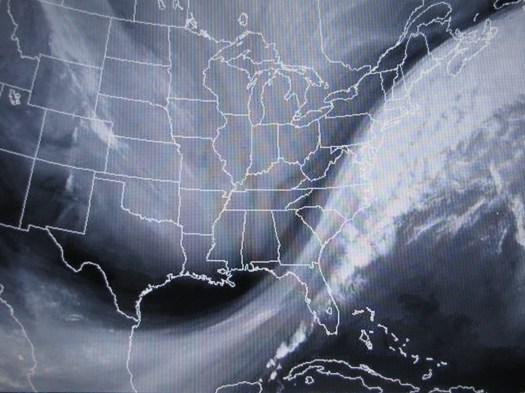
A storm battering the Midwest will impede our progress back north to Charleston and threatens to bring us the only foul weather of the cruise. Note the location of the cold front over the Florida Straits.

“Now the great winds shoreward blow;
Now the salt tides seaward flow;
Now the wild white horses play,
Champ and chafe and toss the spray.”
Matthew Arnold

As the sailors say: "The sheep are grazing." A gale is brewing and kicking up whitecaps as we sail north to Charleston.
As the sailors say: “The sheep are grazing.”
A gale is brewing and kicking up whitecaps as we sail north to Charleston.

Elizabeth Bullock: We Are Underway! December 11, 2011

NOAA Teacher at Sea
Elizabeth Bullock
Aboard R/V Walton Smith
December 11-15, 2011

Mission: South Florida Bimonthly Regional Survey
Geographical Area: South Florida Coast and Gulf of Mexico
Date: December 11, 2011

Weather Data from the Bridge
Time: 2:30pm
Air Temperature: 24.5 degrees C (76 degrees F)
Wind Direction: 65.9 degrees east northeast
Wind Speed: 15.8 knots
Relative Humidity: 78%

Science and Technology Log

Today is the first day of the research cruise.  The R/V Walton Smith left its home port in Miami, FL this morning at about 7:30am.  After a delicious breakfast, the crew and scientific party received a safety briefing from Dave, the Marine Tech.  We learned about the importance of shipboard drills and we were shown the location of all the safety gear we might need in case of an emergency.  This ship works like a self-contained community.  The crew of the ship must also be the policemen and firemen (or policewomen and firewomen).

After our safety briefing, the science party went outside to our first station of the day.  The first piece of equipment we put into the water was a CTD.  The CTD is named after the three factors the equipment measures: conductivity, temperature, and depth.  The CTD will be deployed at precise locations along our route.  Since they conduct this research cruise twice a month, they can see if conditions are changing or staying the same over time.

Liz at computer
Here I am, reading the data that came up from the CTD.
CTD
This is the CTD, which measures conductivity, temperature, and depth.

Question for students: What is the relationship between salt and electrical conductivity?  If the salt content in the water increases, will it conduct electricity better or worse?

The next piece of equipment we deployed was the Neuston Net.  This net sits at the water line and skims organisms off the surface of the ocean.  The net is in the water for 30 minutes at a time.  After bringing the net onto the deck, the fun part starts – examining the contents!  Our Neuston Net had two main species: moon jelly (Aurelia) and sargassum.  The term sargassum actually describes many species, so the scientists on board will study it carefully in order to classify which kinds they caught in the net.  Sargassum is an amazing thing!  It is planktonic (which means that it floats with the current) and it serves as a habitat for bacteria and small organisms.  Since it is such a thriving habitat, it is also a great feeding ground for many different species of fish.

Once we emptied the contents of the Neuston Net, Lindsey and Rachel, two of the scientists on board, began to measure the quantity of each species they caught.  In order to measure the weight of the moon jellies, they used the displacement method.  This is because we can’t use regular scales onboard.  Here are the steps we took to measure the moon jellies:

1)      We poured water into a graduated cylinder and recorded the water level.  For example, let’s say that we poured in 100ml of water.

2)      We put a moon jelly into the graduated cylinder and recorded the new water level.  For example, let’s say that the new water level read 700ml.

3)      We subtracted the old water level from the new, and we could tell the volume of the moon jelly we had caught.  For example, based on the numbers above, we would have caught a 600ml moon jelly!

Neutson Net
Lindsey examines what we caught in the Neuston Net.

Both the CTD and the Neuston Net will be deployed many times over the course of the cruise.


Personal Log

Despite a bit of seasickness, I am having a wonderful time!  Everyone on board is very welcoming and happy to answer my questions.  Everyone is so busy!  It seems like they have all been working nonstop since we arrived on board yesterday.

Answers to your questions

First, let me just say that these are great questions!  Good job, Green Acres.  Here are some answers, below.

1)      How do the currents make a difference in the water temp?  The currents play a major role in water temperature.  In the Northern Hemisphere, currents on the east coast of a continent bring water up from the equator.  For example, the Gulf Stream (which is a very important current down here in Florida) brings warm water from the tropics up the east coast of the United States.  This not only keeps the water temperature warm, but it also affects the air temperature as well.

2)      How does the current affect the different algae populations?  Currents regulate the flow of nutrients (which phytoplankton needs to survive).  Strong currents can also create turbidity, which means that it stirs up the water and makes it harder for light to penetrate the water column.  As you know, phytoplankton rely on sunlight to grow, so if less light is available, the phytoplankton will suffer.  I’m told by Sharein (one of the phytoplankton researchers) that algae are hearty creatures.  This means that as long as the turbid conditions are temporary, algae should be able to thrive.

Stephen Bunker: Sargassum Experiments, 21 October 2011

NOAA Teacher at Sea
Stephen Bunker
Aboard R/V Walton Smith
October 20 — 24, 2011

Mission: South Florida Bimonthly Regional Survey
Geographical Area: South Florida Coast and Gulf of Mexico
Date: 21 October 2011

Weather Data from the bridge

Time: 11:30 AM
Wind direction: Northeast
Wind velocity: 8 m/s
Air Temperature: 23° C (73° F)
Clouds: cirro cumulus

Science and Technology Log

Net Tow
That's me tending the Neuston net as it's being towed aside the R/V Walton Smith.

One of the many experiments we are doing on board is to learn about a plant that grows in the ocean called Sargassum. This tan plant floats near the surface and along in the current. It grows throughout the world’s topical seas. It can grow into large mats the and can be as large as boats and ships. Sargassum provides an environment for distinctive and plants and animals that are not found other places. These ecosystem rafts harbor many different organisms.

On the third stop of the CTD cycle we drag a Neuston net along side of the boat. For 1/2 hour, night or day, the boat takes a slow turn as we drag the net along the surface as we collect samples.  Almost all of the animals below are what we have found in the Neuston net.

We’ll haul in the net and remove the contents. We’ll first try to get all of the animals out. The animals usually don’t survive but every once in a while we can save them (see below for some of the animals we captured with the net).

We’ll next sort the plant life that we collect in the net. Of course we are looking for Sargassum, so we will separate out all of the sargassum.

So, how do you measure what you get? We measure it by volume much like our mom’s measure shortening for cookies. We will fill up a graduated cylinder part way with water, put the samples from the net into the cylinder and then measure how much water they displace.

For example, if we put 2500 ml of water in the graduated cylinder, then put Sargassum in the cylinder, the water level now measures 5500 ml . We then know that there are 3000 ml  (5500 ml – 2500 ml = 3000 ml) of Sargassum by volume measure.

Everything we collect from the net, we measure and record.

Personal Log — Animals I’ve seen

  • Flying Fish— Yes, believe it or not, there are fish that fly. Last night as were preparing to lower the CTD, I noticed silvery-blue streaks in the water. One of the scientists with me explained that they are Flying Fish (Exocoetidae) and the lights of our vessel attracts them and many other types of fish to the surface at night. As soon as she explained this, one of them shot out of the water and glided about a meter and ducked back into the water. Read more about Flying Fish here.
  • Rock Fish
    This fish was found as we unloaded the Moch net.

    Rock Fish — Each time we drag the Moch Net for the Sargassum survey, we can expect interesting things. Last night we captured a type of Rock Fish.

  • Spotted Eel — We also found an eel that has white spots. I tried my best to see if I could more specifically identify it. We have saved it in an aquarium on board the R/V Walton Smith.
  • Mystery Fish
    Help identify this mystery fish. Make a comment below if you think you know what it is.

    Mystery Fish — This fish has many of us stumped. It has a long nose but when the fish opens its mouth, you can see that the pointy part is connected to its lower jaw. Put your investigative skills to use and help me identify the fish. Post a comment if you think you know what it is. For an enlarged view, click here.

  • Moon Jellies — Many people call them Jelly Fish but actually they don’t belong to the fish family at all. They don’t even have a backbone. When we carefully picked these animals up, with gloves on of course, it feels like picking up Jello with your hands; it just slips through your fingers. You can find more about Moon Jellies, Aurelia aurita, at the Monterey Bay Aquarium. You can also find general information about Jellyfish at National Geographic Kids.
  • Sharptail eel
    This eel was found when we were collecting Sargassum.

    Sharptail eel — It’s about half a meter in length and squirms all over. The scientist studying the Sargassum, has saved it in an aquarium so we can observe it. Its scientific name is Myrichthys breviceps.

  • Honey Bee — Believe it or not a honey bee joined us. There was no land in view and a honey bee landed on me. The wind must have blown the bee to sea and it was probably very happy to find a place to land that was not wet.
  • Porpoise — We also call these dolphins. Sometimes a pod of porpoises will get curious and  investigate our boat. They will circle us, swim along side and even ride our bow wave.