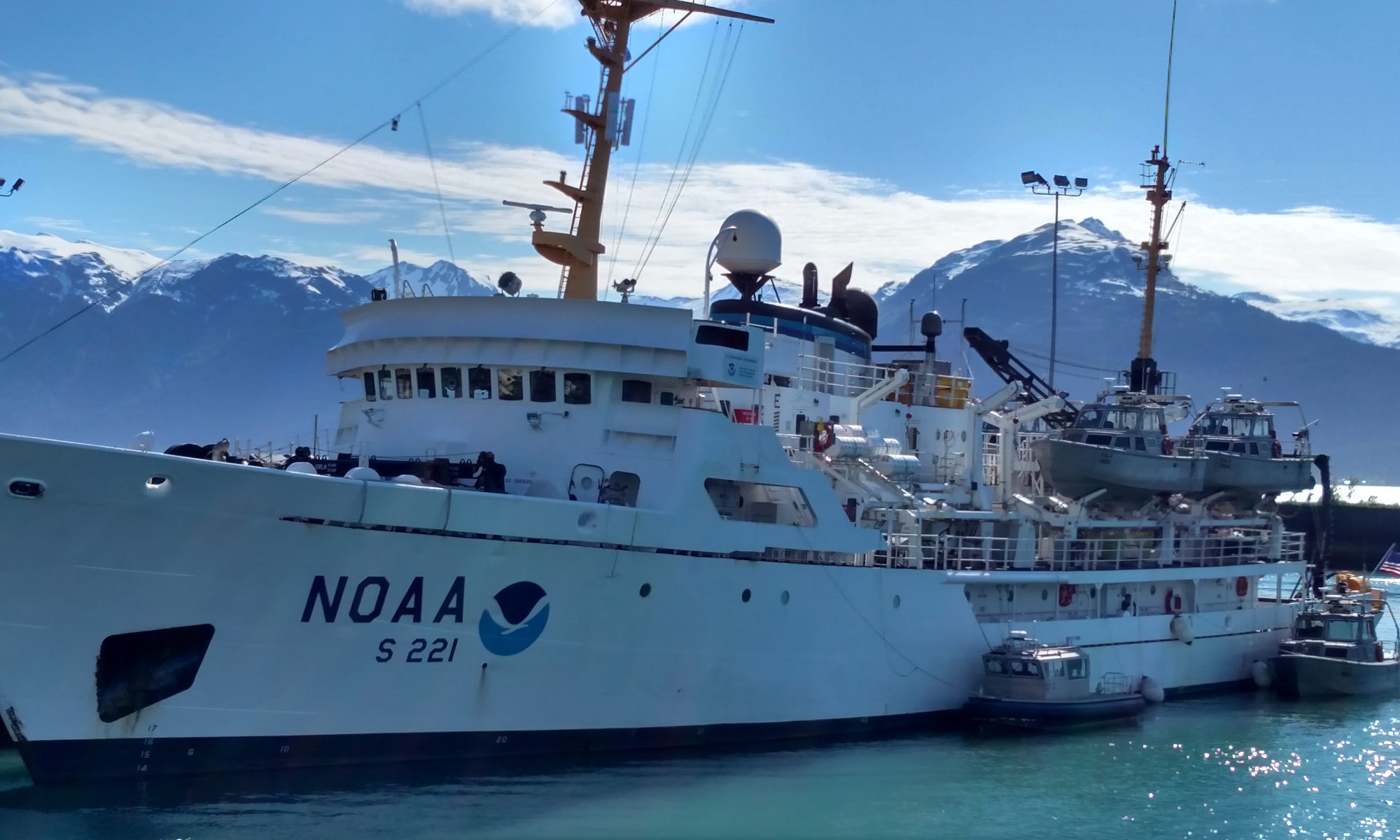
Jenny Gapp: Literate Fish, August 4, 2023

NOAA Teacher at Sea

Jenny Gapp (she/her)

Aboard NOAA Ship Bell M. Shimada

July 23, 2023 – August 5, 2023

Mission: Pacific hake (Merluccius productus) Survey (Leg 3 of 5)
Geographic Area of Cruise: Pacific Ocean off the Northern California Coast working north back toward coastal waters off Oregon.
Date: Friday, August 4, 2023

Weather Data from the Bridge
Sunrise 0614 | Sunset 2037
Current Time: 0700 (7am Pacific Daylight Time)
Lat 43 16.7 N, Lon 124 38.0 W
Visibility:  10 nm (nautical miles)
Sky condition: partly cloudy
Wind Speed: 5 knots
Wind Direction: 030°
Barometer: 1020.3 mb
Sea Wave height: 1 ft | Swell: 340°, 1-2 ft
Sea temp: 13.7°C | Air Temp: 16.2°C

Science and Technology Log

On Wednesday night I stayed up to participate in the first CTD cast of the evening. What is a CTD? The short version: a water sample collection to measure conductivity, temperature, and depth. eDNA information is also collected during the CTD casts.

The longer version: As is true of all operations, all departments collaborate to get the science done. The bridge delayed casting due to erratic behavior from marine traffic in the area. When that vessel moved away, the deck crew got busy operating the crane that lowered the CTD unit to 500 meters. The Survey Technicians, along with the Electronics Technician, had just rebuilt the CTD unit days before, due to some hardware failures at sea. The eDNA scientist prepared the Chem Lab for receiving samples that would confirm the presence of hake as well as other species. 

When I arrived, Senior Survey Technician Elysha Agne was watching a live feed of the sensors on the CTD unit. Agne explained what was happening on the feed: There are two sensors per item being tested, then both sensors are compared for reliability of the data. There is one exception: A dual channel fluorometer, which gauges turbidity and fluorescence (which measures chlorophyll). Turbidity spikes toward the bottom in shallow areas due to wave action. Salinity is calculated by temperature and conductivity.  Sometimes there are salinity spikes at the surface, but it’s not usually “real data” if just one sensor spikes. The CTD unit is sent down to 500 meters as requested by scientists. Measurements and water collection occur at 500, 300, 150 and 50 meters. The number of CTDs allocated to a transect line varies according to how many nautical miles the line is. For example, multiple readings at the 500 meter mark may be taken on a line. CTD casts west of the one done at the 500m depth contour are spaced every 5 nm apart. Scientists are not currently taking CTD samples beyond the ocean bottom’s 1500m contour line.

The main “fish,” called an SBE 9plus, has calibrated internal pressure. As it descends you can tell the depth the “fish” is at. Sea-Bird Electronics (the origin of the SBE acronym) manufactures the majority of scientific sensors used on board, with the exception of meteorological sensors. The Seabird deck box (computer) is connected to the winch wire. The winch wire is terminated to a plug that is plugged into the main “fish.”

The other day, the termination failed. Termination means the winch wire is cut, threaded out, and the computer wire plugged into the winch wire. The spot it’s terminated can be exposed to damage if internal wires aren’t laid flat. Tension and tears may occur anyway because it’s a weak point. The plug on the main “fish” where the winch wire cable connects broke too, so the whole CTD had to be rebuilt. The “Chinese finger,” the metal spiral that pulls the load of the CTD on the winch wire, was also defective, so modifications were made. 

When the CTD is at the target depth, Agne presses a button in the chem lab that logs a bunch of meteorological and location data. She remotely “fires” a bottle which sends a signal to the “cake” that sits on top of the CTD. The signal is an electric pulse to release a magnet that holds the niskin bottle open. If it pops correctly, water is sealed inside. Since two bottles of water were requested at each depth, a second signal is sent to the second bottle. There are 12 niskin bottles on the CTD “carousel.” After two were done at 500 m, the winch operator takes the CTD unit up to 300 m; Agne fires two more bottles there, then two more bottles at 200 m, 150 m, and 50 m. About two and a half liters of water are taken per bottle. 


Samantha stands at a work bench in the wet lab. Wearing blue or purple latex  gloves, she pipettes water onto a filter above a section set up. Elsewhere on the bench, we can see a line of water filters, several styrofoam cases of test tubes, a notebook for recording data.
Samantha Engster, eDNA Scientist

Once the CTD unit returned to the surface, I got to help “pop the nipples” on the bottles to release the water into plastic bags. Back in the Chem Lab, eDNA Scientist, Samantha Engster, pours the water through a filter 1 micron thin. The filter is then folded in half and placed in a vial of Longmire’s solution until the eDNA can be analyzed in a lab back on land. Microscopes are not used for DNA analysis. Phenol-chloroform is used to remove proteins from nucleic acids. Quantitative polymerase chain reaction (qPCR) technique is then used to perform gene expression. This is the third hake survey that has been done in conjunction with eDNA analysis. 

While the CTD “fish” and all its sensors are collecting oceanographic data, Engster collects environmental data from the water samples. Surface water samples are also taken at the underway seawater station courtesy of a pump hooked up near one of the chem lab sinks. The eDNA verifies abundance and distribution of hake. When information from these water samples is partnered with data from the echo sounders, and “ground-truthed” with physical hake bodies in the net, the data set is strengthened by the diverse tests. 

Career Feature

Note: A handful of the people I have met aboard are experienced “Observers.” NOAA contracts with companies that deploy observers trained as biological technicians. Find out more here.

The two Evans stand against an interior wall and smile for a photo. They are each wearing t-shirts and beanie hats. Their similar builds and beards add to the visual symmetry of the photo. On the wall behind them hangs a photo of the ship and several plaques. Right Evan has a walkie-talkie attached to the pocket of his jeans.
Engineers Evan McNeil (Right), and Evan Thomas (Left).

Evan McNeil & Evan Thomas, Engineers

Give us a brief job description of what you do on NOAA Ship Bell M. Shimada.

Evan M.
I’m a manager over our engineers. Below me is the second engineer. We have three third engineers, a junior engineer, and an oiler, also called a GVA (General Vessel Assistant), or wiper. I set the pace of work everyday. I assign all the jobs. Traditionally the Engine Department is under the First Engineer, but technically the Engine Room is mine. The Chief Engineer and the Captain (NOAA Corps Commanding Officer in this case) are in charge of the safety of the whole ship. The Chief Engineer also directs jobs to me that need to get done and I’ll delegate those jobs out. 

Evan T.
Third Assistant Engineer, soon to be Second. I mostly fix stuff that is broken.

What’s your educational background?

Evan M.
I have a Bachelor’s of Science in Marine Engineering Technology with a minor in marine science from California Maritime Academy. I grew up near Bodega Bay, so my background is oriented toward the ocean. I really enjoy it. 

Evan T.
Graduated from Cal Maritime, 2019. I grew up in Southern California, Redlands, a desert that somehow grows oranges. I applied to all the engineering schools in California, and Cal Maritime was one of the few that replied back. I said “Yeah, I could see myself doing this.” And here I am! 

What do you enjoy most about your work?

Evan M.
I enjoy who I work with. It makes work go by quickly. I enjoy our schedule and our time off. This is what I enjoy about my NOAA job and about sailing jobs in general. Shore leave is a type of leave. There’s also annual leave and sick leave. We call it going on rotation or off rotation. Off rotation is usually for a month, and on rotation is usually two months. Every ship is different but that’s how it is for the Shimada, a two-on, one-off schedule. If you talk to other sailors they’ll tell you ratios for time on and time off. For example, I did Leg 2 of the hake survey, I’m on Leg 3, and then I’m off. 

Evan T. Learning new equipment, new ways to do things.

What advice do you have for a young person interested in ocean-related careers?

Evan M.
If you are interested in going straight to being an officer, I would go straight to a maritime academy. It’s a very niche thing to know about. No one knows what they want to do at 19. NOAA’s always hiring. If you are interested in being an engineer, you start out as a wiper, then you can work your way up in the engineering department pretty easily.  

Evan T. 
Imagine being stuck in an office and you can’t go home for a month. Find something that will distract you when you are out on the ocean for weeks at a time. Hang out with people, play games, read a book. You have to be ready to fight fires, flooding, that sort of thing. 

If you could invent a tool to make your work more efficient—cost is no concern, and the tool wouldn’t eliminate your job—what would it be and why?

Evan M.
A slide that goes from the bridge to the engineering operations deck.

Evan T.
I would go for an elevator on the ship.

Do you have a favorite book?

Evan M.
Modern Marine Engineering volume 1

Evan T. My 5th grade teacher wrote their own book that I found entertaining. I also liked Huckleberry Finn, by Mark Twain.

Vince reaches both hands to do something with a pile of wires mounted on the wall
Vince Welton, Electronics Technician

Vince Welton

Give us a brief job description of what you do on NOAA Ship Bell M. Shimada.

I’m an electronic technician. I deal with everything that has to do with electronics, which includes: weather, navigation, radars, satellite communications, phone systems, computers, networking, and science equipment. All the ancillary stuff that doesn’t have to do with power or steering. Power and steering belongs to the engineers.

What’s your educational background?

When I was in high school my father had an electronics shop and I worked with him. He was career Air Force and an electronics technician as well. My senior year of high school  I was also taking night classes at a college in Roseburg, Oregon in electronics. I joined the U.S. Air Force and was sent off to tech school and a year’s worth of education in electronics. Then there was a lot of learning on the job in electronic warfare. I worked on B52s. I was a jammer. In order to learn that you had to learn everybody else’s job. That’s what makes mine so unique. You had to learn radio, satellite, early warning radar, site-to-site radar, learning what other people did so I could fix what was wrong with their electronic tools. I went from preparing for war to saving the whales, so to speak. Saving the whales is better!

What do you enjoy most about your work?

I enjoy the difficulty of the problems. We’re problem solvers.

What are the challenges of your work?

Problems you can’t fix! That’s what disturbs a technician the most, not being able to solve a problem. 

What advice do you have for a young person interested in ocean-related careers?

The sciences are important no matter what you do. Having curiosity is the biggest thing. My hope is that education systems are realizing the importance of teaching kids how to think. Young people need to grow the ability to ask questions, instead of just providing answers.

If you could invent a tool to make your work more efficient—cost is no concern, and the tool wouldn’t eliminate your job—what would it be and why?

I think AI has phenomenal potential, but it’s a double-edged sword because there’s a dark side to it as well.

Do you have a favorite book?

The Infinity Concerto, by Greg Bear
The Little Book of String Theory, by Steven S. Gubser

What’s the coolest thing you’ve seen at sea?

Actually seeing a whale come out of the water is probably the coolest thing. Watching that enormous tonnage jumping completely out of the ocean. If you look out the window long enough and you’ll see quite a few things. 

Markee, wearing a blue jumpsuit over a black hoodie and a beanie that reads "California Republic," smiles for a photo, standing in an interior hallway.
Markee Meggs, Able Bodied Seaman

Markee Meggs

Give us a brief job description of what you do on NOAA Ship Bell M. Shimada.

I’m an AB, or Able Bodied Seaman. The job looks different on different ships. On the Shimada I stand watch and look for things that don’t show up on radar. Most ships you drive—only NOAA Corps Officers drive on the Shimada—I can drive rescue boats, tie up the ship, and do maintenance on the outside. I’m a crane operator. On a container ship you make sure the refrigerated containers are fully plugged in. On a refueling ship (tanker) you hookup fuel hoses. Crowley is a major tanker company. On RoRo ships (roll on, roll off) you work with ramps for the vehicle decks, transporting cars from overseas.

AB is a big job on a cruise ship. I did one trip per year for three years, then got stuck on one during the pandemic in 2020.  On the cruise ship you stand watch, do maintenance, paint, tie up the ship, drive the ship. There’s even “pool watch” where you do swimming pool maintenance. You also assist with driving small boats and help guests on and off during a port call.

I’m a member of SIU (Seafarers International Union) and work as an independent contractor for NOAA. I like the freedom of choosing where I go.

What’s your educational background?

I’m from Mobile, Alabama. I spent four years in the Navy (my grandad served on submarines during World War Two), one year in active Navy Reserves, then eight years as a contractor supporting the Navy with the Military Sealift Command. I spent a year as a crane operator in an oceaneering oil field, and have an Associate’s Degree in electrical engineering. On the oil field job we used an ROV to scope out the ocean floor first. After identifying a stable location I laid pipe with the crane, and took care not to tip over the boat in the process! My first NOAA ship  was the Rainier, sailing in American Samoa. 

What do you enjoy most about your work?

I most enjoy meeting different types of people. Once you’ve been to a place you have friends everywhere. I also love to travel—seeing different places. It’s a two-for-one deal because once you’ve finished with the work you are in an amazing vacation place.

What advice do you have for a young person interested in ocean-related careers?

If ships interest you, do the Navy first. They pay for training, and your job is convertible. Becoming a merchant mariner is easier with Navy experience than coming straight off the street. There is a shortcut to becoming a merchant mariner, but you’ll have to pay for classes. Finally, always ask questions! Yes, even ask questions of your superiors in the Navy. 

What’s the coolest thing you’ve seen at sea?

The coolest things I’ve seen at sea have been the northern lights in Alaska, whales, volcanic activity, and rainbow-wearing waterfalls in Hawaii.

Do you have a favorite book?

Some of my favorite books are Gifted Hands, and Think Big, both by Ben Carson. Gifted Hands: The Ben Carson Story was turned into a film with Cuba Gooding Jr in 2009. Another book that made an impression was Mastery, by Robert Greene. Its overarching message is “whatever you do, do well.” 

Julia points her left index finger an echogram on a large computer monitor.
Julia Clemons, FEAT Team Lead

Julia Clemons

Give us a brief job description of what you do on NOAA Ship Bell M. Shimada.

I am the Team Lead of the FEAT (Fisheries Engineering and Acoustic Technologies) Team with the NWFSC (Northwest Fisheries Science Center). The primary mission of our team is to conduct a Pacific hake biomass survey in the California Current ecosystem and the FEAT team was born specifically to take on that mission from another science center. The results of this survey go into the stock assessment for managing the fishery. Fisheries and Oceans Canada are partners in this survey. Hake takes you down many paths because their diet and habitat are tied to other species. For example, krill are a major prey item in the diet of hake, so understanding krill biomass and distribution is important to the hake story as well. Rockfish also have an affinity for a similar habitat to hake in rockier areas near the shelf break, so we use acoustics and trawling to distinguish between the two. 

What’s your educational background?

My undergraduate degree from University of Washington was in geological oceanography. I began with NOAA in 1993 and worked for the Pacific Marine Environmental Laboratory’s Vents program to study hydrothermal systems. This involved a diverse team of scientists: chemical and physical oceanographers, biologists, and geologists. I got my Master’s in Geology at Vanderbilt but shifted to NOAA Fisheries in 2000 working in the Habitat Conservation and Engineering (HCE) Program where we looked at habitat associations of rockfish. We looked at ROV and submersible video of the rocky banks off Oregon to identify fish and their geological surroundings. The HCE program shifted its focus to reducing bycatch by experimenting with net modifications and I moved to the FEAT team.

What do you enjoy most about your work?

I think one of the most important components of Team Lead is to be a supporter—supporting the facilitation of good science, supporting people. I also think about what I can do to support the overall mission of NOAA Fisheries. That’s my favorite thing, supporting others. I love when the focus is not on me!

What advice do you have for a young person interested in ocean-related careers?

Think about ways you can put yourself in the right place at the right time. Ask about volunteer opportunities. Ask questions, explore, think about what you want to do and look at people who are doing that—ask them how they got to that position. 

What’s the coolest thing you’ve seen at sea?

When I was with the NOAA Vents group in 1994 I got to go to the bottom of the seafloor in the submersible Alvin. I was in there for nine hours with one other scientist and Alvin’s pilot. You think you’re going to know what it looks like, because you’ve seen video, and you think you’re going to understand how it feels, but then you get down there and everything is bigger, more beautiful, in all its variation and glory. We navigated to a mid-ocean ridge system that had an eruption the year previously. There was bright yellow sulfur discharge on black basalt rocks… after all those hours looking at ROV video, to see it in person through the porthole was incredible.

Do you have a favorite book?

The 5 AM Club, by Robin Sharma. I’m a morning person, and this book lays out how to structure those early hours and set you up for a successful day. When I was little I loved The Little Mermaid story by Hans Christian Anderson—the original, not the Disney version. I grew up in Vancouver, Washington and was always asking my parents, “Can we go to the beach?”

Taxonomy of Sights

Day 11. Three lampreys in the bycatch! Risso’s Dolphin (Grampus griseus).
Day 12. Blue Whales! I guess they read my blog post about the Gordon Lightfoot song. What may have been a blue shark came up near the surface, next to the ship. Strange creatures from the deep in the bycatch: gremlin looking grenadier fish.
Day 13. Pod of porpoises seen during marine mammal watch. 

You Might Be Wondering…

How often are safety drills?

Weekly drills keep all aboard well-practiced on what to do in case of fire, man overboard, or abandon ship. Daily meetings of department heads also address safety. One activity of monthly safety meetings is to review stories of safety failures on other ships to learn from those mistakes. Each time a member of NOAA Corps is assigned a new tour at sea they must complete a Survival-at-Sea course. The Fishery Resource Analysis and Monitoring division (FRAM) also requires yearly Sea Safety Training for the scientists. “Ditch Kits,” found throughout the ship, contain: a rescue whistle, leatherman, food rations & water, and emergency blankets. Additionally, there are multiple navigation and communication tools in the ditch kit: a traditional compass, a handheld Garmin GPS, a boat-assigned PLB (personal locator beacon) registered with the Coast Guard, and a VHF radio with battery backup providing access to marine channel 16.   

After a tour of the engine rooms, I learned that the diesel engines also have built in Emergency Diesel Generators (EDG). If you look up at the lights on the mess deck you’ll see some of the light fixtures have a red and white “E” next to them. This label indicates which would be powered by the generators, and which would not. 

Floating Facts

The NOAA Corps is not a part of a union, however there are unions that advocate for other NOAA employees. Licensed engineers are a part of MEBA, The Marine Engineers’ Beneficial Association. Non-licensed positions are represented by SIU, Seafarers International Union. Both of these unions are a part of AFL-CIO, the largest federation of unions in the U.S.

I had been curious whether there was a database that housed an inclusive list of NOAA Fisheries field research, and NOAA did not disappoint. You can find the Fishery-Independent Surveys System (FINNS) here, and browse as a guest. I’m now brainstorming how I might use the database with students—perhaps as a scavenger hunt—to have them practice their search skills. You can search by: fiscal year, fiscal quarter, science center, survey status, and platform type. 

Which Cook Inlet species is the subject of Alaska Fisheries Science Center (AFSC) 2023 research, which is underway in a small boat?
Hint: Raffi 

Another tool I’m looking forward to using in the classroom is NOAA’s Species Directory, which can serve as a scientifically sound encyclopedia for ocean animal reports conducted by students.

Librarian at Sea

“The sea is a desert of waves,
A wilderness of water.”― Langston Hughes, Selected Poems

This quote from Hughes’ poem, Long Trip, had me thinking about the surface of the ocean. I have seen the surface in many states over the past days: soft folds, jagged white-tipped peaks, teal, turquoise, indigo. Sometimes there are long snaking paths of water that have an entirely different surface than water adjacent. Whether it is due to currents colliding, chemical process, biological process, temperature difference—I cannot say. If I were to anthropomorphize the phenomena, I’d say these lines are wrinkles, as the ocean creases into different expressions. A hint of what lies within and beneath.

It also has me thinking about the interviews I’ve conducted with the people on NOAA Ship Bell M. Shimada. I started with a superficial name and title, a face on a board near the Acoustics Lab depicting all hands on Leg 3. When I sat down to talk with people representing Scientists, Engineers, Deck Crew, Electronics, Officers, Survey, and Steward, I began to unspool colorful stories from a broad spectrum of life experiences, many from divergent habitats, all who have converged here to do in essence what the concierge at my Newport hotel said to me as I walked out the door, “Keep our oceans safe!” A tall order in so few words. From shore we’re a small white blip on the horizon; up close there’s a frenzy of activity, a range of expertise, a conviction that our actions can improve living for humans, for hake, and for all the species in Earth’s collective ecosystem.  

a view of the surface of the ocean extending toward the horizon on a clear day
A wilderness of blue water.

Hook, Line, and Thinker

We opened up a hake in the Wet Lab today to find it had a green liver. Why? Parasites? A bacterial infection? An allergy to krill? There’s always more beneath the surface, more stories to suss out. This is what makes science exciting, what makes living with 30+ strangers exciting. It’s what I enjoy about teaching. 

How do the albatross know when we’re hauling back a net full of hake? They seem to appear out of nowhere. First a couple, then maybe 40 of them materialize around the net, squabbling over fish bits. 

Have you ever discovered something unexpected and wondered about its origins?
How could the scientific method support you in finding out an answer… or to at least develop a theory?

A Bobbing Bibliography

Known as “charts” at sea and “maps” on land, NOAA Ship Bell M. Shimada has a small library of charts. Find out more at NOAA’s Office of Coast Survey. Paper charts are actually being phased out. “NOAA has already started to cancel individual charts and will shut down all production and maintenance of traditional paper nautical charts and the associated raster chart products and services by January 2025.”

view of a stack of long, thin metal drawers with printed labels, most too small to read in the photo
Paper chart library on the bridge.
photo of a portion of a paper nautical chart
Nautical chart of Oregon’s southern coast.

Lesley Urasky: June 30, 2012, Goodbye Pisces

NOAA Teacher at Sea
Lesley Urasky
Aboard the NOAA ship Pisces
June 16 – June 29, 2012

Mission:  SEAMAP Caribbean Reef Fish Survey
Geographical area of cruise: St. Croix, U.S. Virgin Islands
Date: June 30, 2012

Location:
Latitude: 29.1215
Longitude: -78.9042

Weather Data from the Bridge:

Water Temperature:
Air Temperature: 32°C (90°F)
Wind Speed:  9 knots (10 mph), Beaufort scale:  3
Wind Direction: from W-SW
Relative Humidity: 61%
Barometric Pressure:   1,012.0 mb
Surface Water Temperature: 28°C (82°F)

Science and Technology Log

During our last night, I had the Third Assistant Engineer, Steve Clement, give me a tour of the engine room and fresh water system.  I can’t believe the engineers are able to work down there – the noise and heat (110°) is amazing!

Steve Clement, Third Assistant Engineer, explaining how things work in the engine room.

I’m not a mechanically oriented person, so Steve had to keep his explanations short; it was more of a show-and-tell tour.  The engine room, majority of equipment controlling the ship’s motion, and water treatment are located on the bottom deck of the ship.  The quantity of both electronic and mechanical equipment is mind-boggling; all the men who work in this capacity have to be proficient in so many areas so the ship can support the science missions.  Hats off to all those hard-working and talented men!

Computer screen showing the operations in the generation plant on the Pisces.

The operation of the ship can be monitored on the main distribution computer screen.  Levels of fluids and functioning of all the components are continually assessed and modifications to operation made from the control panel.

Computer screen showing current fuel consumption for each generator.

The ship uses lots of diesel fuel when it is operating at full steam (14.5 knots/hour) – around 2,500 gallons a day!  The Pisces has a tank capacity of 110,000 gallons; I’d hate to pay their fuel bill when it’s time to fill up! This quantity of fuel allows it to travel about 12,000 NM (nautical miles) or 13,800 miles; that’s a little over half-way around the Earth on one tank of fuel!

Two of the Pisces‘ generators: the one on the left is a 12-cylinder and an 8-cylinder on the right.

The propeller is located at the stern (back) of the ship.  I was able to look down through grating in the floor and see the drive shaft turning at 134 rpm.  It has a diameter of 14.1 feet; it has to be so large so that it can efficiently move the ship through the water.

Main shaft of the Pisces‘ propeller.

Lastly, I got to see the Pisces‘ water generation system.  This is as important as the ship’s engines because without fresh water, the scientists and crew members wouldn’t have drinking water as well as no water for washing or cooking.  The ship isn’t big enough to carry all the freshwater that it needs for a long cruise.  But with reverse osmosis technology, and the fact that we’re surrounded by nothing but water, fresh water is readily available.  The Pisces takes in seawater which is pumped through a reverse osmosis (RO) system.

Reverse osmosis (RO) system that creates fresh water for the Pisces.

In reverse osmosis, the salty water is forced (pumped) through membranes with very small openings.  These are so small that the ions making the water “salty” cannot pass through; the water is able to pass and after leaving the ions behind, becomes fresh water.  The RO system on the Pisces generates about 624 gallons per hour.  The tan “box” in the picture above contains all of the controls and gauges.  The long, white tube behind it contains the permeable membrane that the water is forced through.

Membrane filter in a reverse osmosis apparatus. (Source: Wikipedia)

Personal Log

It is with some sadness that my adventure as a NOAA Teacher at Sea has come to an end.  Today I said goodbye to the crew of the Pisces.  They are an amazing crew, and made my final portion of the cruise without the scientists interesting and fun.  I admit that I was a bit apprehensive about being without the scientists and seeing the ship under different circumstances (lacking a specific scientific objective), but the Pisces steamed forward with two goals in mind: retrieving the buoy (see my last posting on June 27), and arriving in Mayport in a timely manner to receive the next group of scientists as they embark on their cruise.  I’d like to invite you to continue to follow the Pisces and their new Teacher at Sea, Marsha Skoczek as she learns about Deep Sea Corals.

Pisces life preserver

On the afternoon of the 28th, we encountered a line of squalls generated by Tropical Depression Debby as she moved off the coast of Florida and into the Atlantic.  At one point, we had 40 knot (46 mph) winds and rain.  After the winds had died down a bit, I spent some time up on the bridge. Being up so high in the ship, coupled with 8-foot confused seas (waves coming in from different directions) began to make me feel seasick.  I took another meclazine (similar to Dramamine), had some saltine crackers and ginger ale, and sat on deck looking at the horizon for a while.  When even this failed to make me feel better, I crawled into bed.  I really must have been feeling poorly to miss dinner!

By next morning, the seas had calmed down dramatically, and I was feeling as good as new.  As this was our last full day at sea, I headed up to the bridge to do one last thing that the Commanding Officer told me I could do – drive the ship!  While the ship is underway, it is usually under “auto-pilot”.  A course can be entered into the computer and the ship doesn’t need anyone actively at the helm.  The Navigational Officer, Ensign Michael Doig, placed the Pisces under manual control and showed me how to steer the ship.  The Pisces is an incredibly responsive ship and can turn very quickly in just a few feet.  I was shown the current heading and the compass and tried to keep the ship on course – it was definitely much harder than it looks!  After zig-zagging back and forth, off course by about 10 degrees, I handed control back to Ensign Doig.

Lesley Urasky at the helm (aka “driving” the ship).

After this concentration zapping task, he had me plot our current position on the navigational chart and record the hourly weather information.  This included the ship’s current latitude and longitude, course heading, wind speed, air temperature, relative humidity, barometric pressure, and cloud cover.

These are some of the nautical charts the Pisces used while on our cruise: Puerto Rico and the U.S. Virgin Islands and East Coast of Florida: Approaches to St. Johns River

Lesley Urasky plotting the Pisces‘ current position

While many aspects of travel in the modern age have various computer based technologies to assist with navigation, the crew still needs to know how to find their location manually. I spent some time learning about navigation with Peter Langlois, 3rd Mate on the Pisces.  He showed me how they plot their course on a navigational chart.  Once a ship’s current location is determined, those crew members on watch will use dead reckoning to determine where they will be at a given point in time if all the current conditions remain the same (course and speed).  Peter also attempted to show me how to determine the time of sunrise/sunset for each specific location using our latitude, longitude, and an almanac.  For an interesting way to determine when sunrise/sunset (as well as moon rise/set) for your specific location, NOAA has a great website called Solar Calculator.  This site will also tell you when solar noon occurs (point where the sun is most directly overhead) and show you the path the sun takes across the sky.

Plotting our current position and using dead reckoning to project future positions.

Unfortunately, at that point in time, I wasn’t able to fully understand Peter’s directions as the seasickness was just beginning to hit me. The effects were compounded by being up on the bridge (almost the highest point on the ship) and trying to follow lines of small numbers in the almanac while the ship was being  buffeted by waves from all directions.

As my final day at sea came to a close, I spent quite a bit of time “prowling” the ship and taking pictures of all the little things that had become so “ordinary” to me.  After dinner, I climbed up to the flying deck and spent time watching the sunset with the Commanding Officer (CO), Peter Fischel.  It was a beautiful sight; one that I’ll always remember.

Sunset on the last night of the cruise.

Before I went to bed, I checked the ship’s information board to find out when we’d be arriving in Mayport, Florida.  The board holds important information and updates the crew needs to know as part of their jobs as well as other useful information.

Information board on the NOAA ship Pisces.

Last night when I went to bed, there was nothing but open ocean surrounding the ship.  When I woke up the next morning, the sun was rising and Mayport/Jacksonville, Florida could be seen along our port side (left).  It was a welcome sight after not seeing land for a few days.  However, I knew this view was also bringing my adventure to an end.  It was an amazing journey and full of wonderful experiences.  I met so many kind and knowledgeable people who I won’t soon forget.  A HUGE thank you to NOAA, the science team, and the crew members of the Pisces!

Panoramic view of the Mayport Harbor as we pull in at the end of our cruise.

Marsha Skoczek: Who’s Driving this Ship, Anyway? July 9, 2012

NOAA Teacher at Sea
Marsha Skoczek
Aboard NOAA Ship Pisces
July 6 – 19, 2012

Mission: Marine Protected Areas Survey
Geographic area of cruise:  Subtropical North Atlantic, off the east coast of Georgia
Date:  July 9, 2012

Location:
Latitude:  31.30748N
Longitude:  79.43986W

Weather Data from the Bridge
Air Temperature:  29.5C (84 F)
Wind Speed:   10.4 knots (11.9 mph)
Wind Direction:  From the SSW
Relative Humidity:  81%
Barometric Pressure:  1015.7
Surface Water Temperature:  27.88C (82.4F)

Science and Technology Log

Today, the current was too strong in the area we were going to send the ROV.  The boat and the ROV were not able to keep close enough to the assigned transect line, so the dives for today were cancelled.  Since we had some extra time until the Pisces was able to get us to our next location, I decided to spend some time on the bridge learning about how the Pisces works.

Myself and ENS Pawlishen working on the nautical charts.

Third Officer, Pete Langolis, was on duty when I got to the bridge, and he was nice enough to show me around.  After he let me ring the bell for the noon test of the master alarm system, we got started.  The Pisces is able to keep its course by using both a magnetic compass as well as a gyrocompass.  The magnetic compass has the potential for interference depending on the conditions around it such as the roof of the ship, the types of metals that make up the ship, etc.  To find the correct bearing for the Pisces to travel along, the officer on duty has to take into consideration four factors, where is true north, the variation from the compass rose on the nautical chart, where is magnetic north, and the deviation from magnetic north from the deviation card (this will be different from ship to ship).  This all calculates into the correct compass heading for the officer on the bridge to drive the ship.  Once the correct heading is calculated, it can be programmed into the ship’s tracking computers as well as the bow thruster which acts as an autopilot for the ship.  Every thirty minutes, the officer on deck has to verify with the paper nautical charts that the ship is still on the correct heading.  Any variations from the original heading can be corrected simply by changing the direction on the autopilot.  You can follow along with our current position using the NOAA Ship Tracker website.  Select Pisces from the box in the upper left.

When you are out in the middle of the open ocean, the last thing you want to do is run into another vessel.  The Pisces is equipped with two different radar systems that help look for other ships in the area.  The S-Band radar sends out a longer pulse signal which is good for locating ships that are further away and also seeing through dense fog.  The X Band radar sends out a short pulse signal which better helps to locate ships in closer proximity to the Pisces.

X band radar showing the location of ships near the Pisces

Both of these radars are tied to the Automated Information System (AIS) as well as the Global Positioning System (GPS).  The information about each ship identified on the radar screen can be pulled up and used to help steer the Pisces around other vessels such as cargo ships, commercial fishing vessels, or other military vessels. All targets located by the radar need to be visually confirmed by the officer on deck to insure that they are not on a course that will come too close to the Pisces.

Engine monitor screen on the bridge.

The Pisces has a single propeller  that is powered by two electric motors.  These motors are powered by four diesel generators.  Before we could leave port last Friday, we had to fuel up with 70,000 gallons of diesel fuel.  This took about six hours to complete.  This amount of fuel should last the Pisces several months at sea.  The whole propulsion system can be monitored electronically from the bridge to ensure that everything is running smoothly.

So, who actually drives the ship?  Three NOAA Corps officers share bridge watch in shifts of 4 hours on, 8 hours off.  This doesn’t mean they spend the other 8 hours sleeping. All of the officers on board Pisces have other responsibilities such as the Navigation Officer (NAV), the Operations Officer (OPS), Executive Officer (XO) and the Commanding Officer (CO).  Before a new junior ensign can be left on their own to be in charge of the bridge, not only do they complete a twenty-week training, they will also spend about six months shadowing a senior officer.  This lets them get hands on training and experience while still having someone watching over their shoulder double checking everything.  After all, the lives of everyone aboard the Pisces depend on them doing everything correctly.

Personal Log

Being out to sea away from land is not something I have ever done before.  I am struck by the vastness of the ocean.  Everywhere you

Lobate ctenophores are translucent and give off a bioluminescent glow. Bolinopsis infundibulum. Picture: OAR/National Undersea Research Program (NURP)
High resolution (Credit: NOAA)

look, there is nothing but blue water.  It is truly hypnotizing.  Also, knowing that there might not be another vessel within hundreds of miles of us is a little weird.  Last night I went out with my roommate, Stephanie, to see the stars.  There is no light pollution out here in the open ocean, so we were able to see every star in the sky, including the Milky Way Galaxy.  It was an incredible view.  We also could see the bioluminescent organisms as they were getting turned up in the ship’s wake, animals such as jellyfish, copepods, and ostracods.  It was really neat to see bioluminescence in action.

Ocean Careers Interview

In this section, I will be interviewing scientists and crew members to give my students ideas for careers they may find interesting and might want to pursue someday.  Today I interviewed NOAA Corps officers Ensign Michael Doig and Ensign Junior Officer Douglas Pawlishen.

Ensign Michael Doig

ENS Doig, what is your job title?  I am the Navigation Officer for the Pisces and an Ensign in the NOAA Corps.

What type of responsibilities do you have with this job?  I am one of the officers that has bridge duty to steer the ship.  I also keep the nautical charts up to date, maintain the ship’s inventory, and train the new junior ensigns.

What type of education did you need to get this job?  I have a Bachelors’ Degree in Zoology from University of Hawaii and a Masters’ Degree in Science Education.

What types of experiences have you had with this job?  I have been fortunate enough to travel all over the Atlantic and Gulf of Mexico on board the Pisces.  One of the coolest things I have seen is a pod of orca whales trying to kill a baby sperm whale in the Gulf of Mexico.  The baby sent out a distress call and all of the adult sperm whales encircled the baby to protect it.  The baby sperm whale was saved.

How is the NOAA Corps different from other jobs?  First, when you apply for the NOAA Corps, they look at all of the math and science courses you have taken in college.  They are looking for students with strong background in those fields.  After you are accepted and make it through training, you are assigned to a NOAA ship for two years.  After those two years, you can apply for a land assignment, but that will probably only last for about three years before you have to go back out to sea on a new ship.  You work year round and are granted thirty days of personal leave for the year.

Since your time on the Pisces is almost finished, what land assignment are you applying for at the end of your two years?  I have applied to work in the Miami NOAA branch studying coral reef restoration.

What is your best advice for a student wanting to become a scientist?  Companies are always looking for employees with strong backgrounds in science. Don’t be afraid of those upper level physics classes or upper level math classes.  Get in there and do it!!


Junior Ensign Douglas Pawlishen

Ensign Pawlishen, what is your job title?  I am an Ensign Junior Officer aboard the Pisces.  This is my first ship assignment in the NOAA Corps and I just started on the ship last Thursday.

What type of job responsibilities do you have on this ship? To shadow Ensign Doig so he can train me about life aboard the Pisces.

Why did you decide to join the NOAA Corps?  I wanted a job where I wouldn’t be stuck in an office all day every day doing the same thing over and over again.  With my science background, I thought the NOAA Corps offered me the opportunity to do something more hands on and different every day.

What type of education do you need to get this job?  I have a Bachelors’ Degree from University of Massachusetts  Amherst in Natural Resources and  a minor in both Criminal Justice and Wildlife Management.

What types of experiences have you had with this job?  Well, since I am brand new, I haven’t really been out to sea yet.  My best experience so far was aboard the Coast Guard Eagle, which is a massive sail boat confiscated in World War II from the Germans.  All of the NOAA Corps cadets along with the Coast Guard cadets have to spend two weeks on board sailing the Coast Guard Ship Eagle and developing our team work skills.

Paige Teamey: November 6, 2011

NOAA Teacher at Sea
Paige Teamey
Aboard NOAA Ship Thomas Jefferson
October 31, 2011 – November 1, 2011

Mission: Hydrographic Survey
Geographical Area: Atlantic Ocean, between Montauk, L.I. and Block Island
Date: November 6, 2011


Weather Data from the Bridge

Clouds: Clear
Visibility: 10 Nautical Miles
Wind: SE 9 knots
Temperature 14.3 ° Celsius
Dry Bulb: 11.5 ° Celsius
Wet Bulb: 8.9 ° Celsius
Barometer: 1030.0 millibars
Latitude: 41°10’59″ ° North
Longitude: 072°05’63″ ° West

Current Celestial View of NYC:

Current Moon Phase:

Current Seasonal Position (make sure to click on “show earth profile):

http://www.astroviewer.com/ http://www.die.net/moon/ http://esminfo.prenhall.com

OR

http://www.learner.org/

Science and Technology Log

Sunset on either Thursday, Saturday, or....two months ago :).

Frank said an interesting thing today that resonated with a feeling that I have been unable to define. He said that when you are working at sea, every day is a Monday. This specific survey trip is 12 days long, which translates to 11 Monday’s and one Friday. That means there are no weekends, time is not longitudinal, rotational, or accompanied by changing scenery (going from home to the subway to school…all different backdrops). One day drips into the next, sparked by small things that you note as change and reference with a new day. We even had to vote on whether to observe daylight savings this weekend, or pretend it did not exist until we landed in New London on Friday.

Time at Sea.

I awoke yesterday and had the same breakfast I have had for the past week (still tasty, thanks Ace!!); however, there was nothing to punctuate why this day was indeed Saturday and not Friday. Mike the E.T. sat at the same table he had the day before and piled one condiment after the next onto his breakfast until perfection was reached, just as he has done each prior day. I smiled and laughed and told jokes with each of the crew members just as I have each day since I arrived.

Mike: Perfection in every bite.

The mess hall is like an accordion. It acts as a center piece that brings all of us together. After each meal the crew disappears back to the their stations. In this 208ft ship 36 members find their space and focus moving back to our stations to perform our individual duties. When meals begin anew we are pulled back together to resonate until we move away yet again. This center piece is essential otherwise we would continue with our duties whether it be Tuesday evening or Sunday morning. I enjoyed thinking about Frank’s sentence. This idea spoke of time not in hours or minutes, but as a continuum. Time on the TJ is marked with very simplistic relatively small changes that many of us would not pay attention to in our regular New York lives. A small conversation that sparks ideas, or subtle nuances that you begin to discover in an individual especially while sharing silence together, or a new smell that is adrift in the air that allows you to remember Tuesday from Friday (remember Tuesday when we smelled…). A series of simplistic small moments allows you to mark one day from the next.

Brilliant Tom prepping 3102 for a secure departure from the TJ.

There is a lovely gentleman named Tom who has been on numerous ships for over 30 years. He told me his line of work suits him best because he likes being able to keep to himself and if he was unable to work on ships he would be a hermit high on a hill (just a little joke). He has marked time by haircuts or noticing his shirt is slowly falling apart, or having to shave. He does not speak in days, just marked events. His longest time at sea without seeing land was 167 days…

Rock dove...can you find him?

Yesterday, Saturday…I mean Sunday, was marked by a small rock dove staring at me from the deck while I was standing on the bridge as I normally do with Joe and Tony during the 4-8 shift. The dove landed on the steal guard rail and then nestled in an incredibly small nook located in the bow next to the front mast and remained with the ship for the next two hours. It puffed its feathers to a measurable extension and settled in with the rest of the TJ crew. This dove punctuated my day and allowed me to differentiate time from Saturday.

"It's the people that make you happy--that is why I continue. Without people it is like having one shoe," says Tom.

There is constant conversation involved with seeing family, returning home, having creature comforts in hand’s reach, and kissing a wife, husband, or missed child. However many of the crew have also spoken of how even though time away from the ship is welcomed, after a while, they miss these days. Working with and on the ocean takes a certain kind of someone. These individuals tend to have patience, perseverance, and motivation to live on a ship and continue with focus each Monday. Each crew member on the TJ seems very much at ease and almost in a Zen-like state. From what I have observed there is no bitterness or disgruntled workers roaming the ship. Everyone here has served on multiple ships and is self-contained. Silence marks most of the day and conversations occur naturally when the tides are right.

For the last three days I have spoken with every surveyor on the ship at length to understand each stage of the nautical chart making process. I want to know the history, the importance, and most importantly the science. There are many stages and processes that go into the eventual updated chart (this process can take upwards of 1.5 years depending on the layout, and how well the data was accurately retrieved). I have been learning about this information and shooting videos bit by bit in order to make an introduction to hydrographic surveying for those that are following (thanks mom). November 3-5 have been my devoted days to understanding these new ideas. I will hopefully finish with the editing and have the video published soon.

Until then, smooth sails with no gales.

Personal Log

Meals:

Breakfast: Scrambled eggs with cheese and two pancakes (coffee of course!)

Lunch: Grey noodles…no seriously

Dinner: Spicy noodles with green beans (YUM)

Obed Fulcar, July 21, 2010

NOAA Teacher at Sea Obed Fulcar
NOAA Ship Oscar Dyson
July 27, 2010 – August 8, 2010

Mission:Summer Pollock survey III
Geograpical Area:Bering Sea, Alaska
Date: July 21, 2010

Weather from the Bridge:
Time: 0345 pm
Latitude: 57.23 degrees North
Longitude:173.33 degrees West
Wind: 12 knots
Direction: 257 degrees West
Sea Temperature: 8.5 degrees C
Air Temperature: 8.85 degrees C
Barometric Pressure: 1020.0 mb
Skies: Partly Sunny

Science and Technology Log:

Buddy Gould
Buddy Gould

Yesterday, Tuesday July 20, we finally left Dutch harbor, once all the delayed scientific equipment arrived. I was later told that it included some new and sophisticated technology to track and measure fish underwater. We climbed up to the “flying bridge” at the very top of the ship to see the view of Dutch harbor behind us and the open ocean ahead. After that we came down to the bridge where Acting Executive Officer XO Sarah Duncan, Ensign Amber Payne, and Buddy Gould from the Deck Department gave us a tour of the bridge. They explained that the panels of navigational instruments used to sail the ship included Radar screens, to detect any vessels or ships in the proximity, one for long range, and another for short range, showing any ships close by. The screens show the many readings from instruments on board such as wind speed (in knots), Wind direction (in degrees), Latitude, Longitude, and Air Pressure (in millibars).

Navigational Instruments

Next we received a demonstration in how to chart a course using the Electronic chart. I was surprised to understand the navigational terminology, (Iguess my Basic Sailing class is paying off), such as true wind, leeward, aft, forward, et…
I asked if they still used paper Nautical Charts and the answer was yes, they use them to plot the course of the ship using pen, ruler, and compass. I was surprised to know that even with all this technology even though the ship course and navigation is done completely electronically, they still rely on pen and paper charts as back up! On the bridge were also two scientists fro the US Fish and Wildlife service working on Seabird research, as part of the Bering Sea Integrated Ecosystem Project, a multidsciplinary study that is looking at how climate change is affecting the ecosystem of the Bering Sea. liz and Marty were both working from the bridge with binoculars, observing and counting all seabirds within 300 meters from the ship. armed with a laptop computer connected to the ship’s navigational system they were able to count and input the GPS location (latitude/longitude) of every sighting of a seabird, and plot a GIS graph in real time. I found this to be really cool! We saw seabirds found on the Bering sea such as Black-footed Albatross, Northern Fulmar, Tufted/Horned Puffin, Fork-tailed Storm Petrel, and Thick-bill Murre.

Personal Log:
Today is Day 4 of the mission and so far I have done pretty well in terms of motion sickness. A calm sea has been a great factor and has allowed me to get adjusted to life at sea. I am surprised to find myself at home in my my bunk bed, and haven’t had any difficulties sleeping at all, though I do miss my bed. The long schedule from 0400 to 1600 (4pm) full of activities has been of help keeping me busy. The food is great thanks to Floyd the master cook with a variety of international food and home baked pastries. I was also impressed by the international collaboration in this mission, with two Russian scientists on board conducting research on the fisheries of the Bering Sea since part of the transects or line passess done by the Oscar Dyson cover Russian territorial waters as well.
New Vocabulary Words;
Nautical charts, Radar, Latitude, Longitude, GPS (Global Positioning Satelite), Leeward (opposite to wind), Forward (front of ship), Aft (back of ship)

Animals seen today:
Black-footed Albatross, Northern Fulmar, Tufted/Horned Puffin, Fork-tail storm Petrel, Thick-bill Murre
Bitacora Marina #2: Ayer martes, 20 de Julio finalmente zarpamos hacia alta mar. Los oficiales del Oscar Dyson nos dieron un tour del puente explicandonos los sofisticados instrumentos de navegacion electronica como Radares, sonar acustico, y sistema global de ubicacion por satelite (GPS).A pesar de tanta tecnologia, todavia se grafica el curso de la nave usando Cartas Marinas, compas y lapiz!Tambien me presentaron a una pareja de biologos del Servicio de Pesca y Caza de los EEUU, haciendo un conteo de las aves marinas del Estrecho de Bering, graficando en tiempo real cada observacion en un ordenador laptop usando tecnologia GIS, o sistema de informacion geografica.