Lisa Carlson: One Fish, Two Fish, Rockfish, Hake fish! July 10, 2023

NOAA Teacher at Sea

Lisa Carlson

NOAA Ship Bell M. Shimada

July 5, 2023 – July 19, 2023

Mission: Fisheries: Pacific Hake Survey (More info here)

Geographic Region: Pacific Ocean, off the coast of California

Date: July 10, 2023

– – ⚓ – –

Weather Data from the bridge:

July 7 (1200 PT, 1500 EST)
Location: 36° 00.4’ N, 122° 05.9’ W
16nm (21mi) West of Big Sur, CA

Visibility: 10 nautical miles
Sky condition: Overcast
Wind: 20 knots from NW 330°
Barometer: 1013.1 mbar
Sea wave height: 3-4 feet
Swell: 6-7 ft from NW 320°
Sea temperature: 14.0°C (57.2°F)
Air temperature: 14.4°C (57.9°F)
Course Over Ground: (COG): 323°
Speed Over Ground (SOG): 10 knots

July 8 (1200 PT, 1500 EST)
Location: 36° 34.5’ N, 122° 05.3’ W
17nm (20mi) Southwest of Monterey, CA

Visibility: 10 nautical miles
Sky condition: Few clouds
Wind: 19 knots from NW 330°
Barometer: 1013.8 mbar
Sea wave height: 5-6 feet
Swell: 6-7 ft from NW 330°
Sea temperature: 14.0°C (57.2°F) 13.7
Air temperature: 14.4°C (57.9°F) 14.3
Course Over Ground: (COG): 089°
Speed Over Ground (SOG): 10 knots

July 9 (1200 PT, 1500 EST)
Location: 37° 06.8’ N, 123° 00.5’ W
30nm (35mi) West of Pigeon Point Light Station, Pescadero, CA

Visibility: 10 nautical miles
Sky condition: Overcast
Wind: 13 knots from NW 332°
Barometer: 1016.0 mbar
Sea wave height: 2-3 feet
Swell: 4-5 ft from NW 310° 4-5
Sea temperature: 14.3°C (57.7°F)
Air temperature: 15.2°C (59.4°F)
Course Over Ground: (COG): 093°
Speed Over Ground (SOG): 10 knots

July 10 (1200 PT, 1500 EST)
Location: 37° 26.7’ N, 123° 06.4’ W
32nm (37mi) West of Pescadero, CA

Visibility: 8 nautical miles
Sky condition: Overcast, fog in vicinity
Wind: 20 knots from NW 330°
Barometer: 1015.9 mbar
Sea wave height: 2-3 feet
Swell: 3-4 ft from NW 320°
Sea temperature: 14.5°C (58.1°F)
Air temperature: 13.6°C (56.5°F)
Course Over Ground: (COG): 314°
Speed Over Ground (SOG): 3 knots

– – ⚓ – –

Science and Technology Log

Lisa poses for a photo in the wet lab with a hake fish. She's wearing heavy-duty orange overalls and large orange gloves. With her right hand, she grasps the fish by its open mouth, and her left hand holds on to the tail. We can see metal tables and equipment in the background.
Me holding a Hake before sorting. After observation, we determined this was a developmentally mature female, measuring 50cm (20in) long!

In my July 6 blog post, I explained how NOAA Ship Bell M. Shimada is equipped to collect acoustic data in the form of echo grams. The acoustics team uses the data to determine if there are enough return signals to suggest fish are present and attempt a trawl. In this blog post, I will explain how we get the fish onboard, and what we do with the sample of marine life once it is collected from the net.

One question I had after learning about the acoustics and environmental DNA (eDNA) pieces of the survey mission was, “How does physically collecting and researching Hake samples fit into the puzzle of understanding their ecosystem and supporting sustainable fisheries?” (NOAA Fisheries quick facts and video here)

“While echosounders are useful, they do not provide certain quantitative data that researchers need to understand the ecology of these organisms and the midwater zone. To collect quantitative data, such as biomass, length and weight, and age class distributions, researchers must gather representational samples and take direct measurements of them. The best way to do this is by employing trawls.”

NOAA Ocean Exploration: “Trawls

So, although acoustics and eDNA research is important to the overall survey, they are only pieces of the puzzle, and the puzzle is not complete without conducting trawls and physically researching samples. NOAA Ship Bell M. Shimada uses a midwater trawl net that is deployed from the stern over the transom, and towed behind the vessel. As the name suggests, midwater trawls occur in the middle section of the water column, versus surface and bottom trawls. The net is conical in shape and uses two metal Fishbuster Trawl Doors, and two sets of heavy chain links called Tom weights, in order to keep the trawl in the middle of the water column.

a simple and stylized monochrome illustration of a fishing vessel towing a midwater trawl behind it. The net in tow is conical, attached at four points to two bars that hold the opening apart, and these bars are attached to lines (ropes) extending back from the vessel. This net is capturing two fish and missing a third.
NOAA Fisheries: “Fishing Gear: Midwater Trawls

“The midwater region is especially important because the creatures that inhabit it constitute the majority of the world’s seafood. Understanding the ecology of midwater organisms and their vast environment can provide us with better information to manage these important natural resources and prevent their overexploitation.”

NOAA Ocean Exploration: “Trawls

Deck department assisting in recovering the trawl net after a successful deployment.

Two deck crewmembers work with an orange and white fishing net on the aft deck of NOAA Ship Bell M. Shimada. They are wearing foul weather gear, life vests, and hard hats. At right, one leans over the net, searching for remaining captured fish. The other approaches from the left, looking down at the net, to assist. We can see a cloud-capped mountain range in the distance beyond the water.

Once the net is onboard, the net is emptied one of two ways depending on the size of the sample. For large samples, marine life is deposited into a hopper and subsequent conveyor belt. For smaller samples, the Hake will be put into a large basket then divided into smaller baskets of approximately 100 Hake each. Any other marine life like Salps, Myctophids, Pyrosomes, Rockfish, King of the Salmon, and small bony fish, etc. are recorded in the database and returned to the ocean.

“The ship’s wet lab allows scientists to sort, weigh, measure and examine fish. The data is entered directly into the ship’s scientific computer network.”

NOAA Office of Marine and Aviation Operations (OMAO): “Bell M. Shimada
a large black plastic bin filled with fish - mostly hake, but a few splitnose rockfish (eyes bulging from the pressure change) stand out for their red color. An orange-gloved hand reaches toward the basket from the upper left corner of the image.

Large basket containing a sample of Hake with a few (red) Splitnose Rockfish.

With our boots and bright orange rubber pants and gloves on, our first task is to distribute the sample of Hake into baskets of about 100 each. Based on how many baskets we fill, a random selection of baskets will be kept, and the others will be returned to the ocean. With the remaining groups of Hake, we determine their sex and length.

In order to do this, we use a scalpel to make an incision on the underside/belly of the Hake. Once open, we are able to examine their organs, including the gonads to determine if the fish is male or female, and if they are developmentally immature or mature. Young Hake are difficult to sex, and it takes practice to get over any initial fears of cutting into an animal; let alone being able to locate and identify the gonads. Hake usually spawn in early winter, so many of the smaller Hake we sample from during the summer are age one or younger.

Our largest Hake thus far was a developmentally mature female, measuring 50cm (20in). In order to accurately and consistently measure the length of the sample, we use a waterproof, magnetic plastic board with metric (centimeter and millimeter) markings called an Ichthystick (think: high-tech meter stick). The fish is placed on the board with its mouth touching the black board at 0cm, then a magnetic stylus is placed at the fork of the fish’s tail. Once the magnetic stylus is placed on the board, the length to the nearest millimeter is displayed on the LCD screen and automatically entered into the database program. The length data is grouped with the date, time, and identified sex for later observation and comparison.

Additional information, abstracts and outline about Ichthystick here

Ichthystick’s LCD display, motherboard, magnetic board, and magnetic stylus. Digital scale in background.

Ichthystick’s LCD display, motherboard, magnetic board, and magnetic stylus. Digital scale in background.

An even smaller subgroup is then selected and examined to record weights of individual Hake, collect ear bones called Otoliths for aging, stomach samples for diet, liver for RNA, and ovaries for maturity development. Otolith bones help determine the age of the Hake because they grow a new “layer” of bone each year, similar to coral structures and annual tree rings. Organs and bones removed from the Hake are sent to NOAA Fisheries centers for analysis and included in databases with the date, identified sex, length, weight, and location in which they were collected.

This data is used to build more of the puzzle, along with acoustical information, water samples, and eDNA data in order to further understand the ecosystem, biomass, diet, and

“support sustainable populations of Pacific hake on the West Coast.” (…)
“It provides vital data to help manage the migratory coastal stock of Pacific hake. The hake survey, officially called the Joint U.S.-Canada Integrated Ecosystem and Pacific Hake Acoustic Trawl Survey, occurs every odd-numbered year.”

NOAA Fisheries: “Joint U.S.-Canada Integrated Ecosystem and Pacific Hake Acoustic Trawl Survey

– – ⚓ – –

Personal Log

Although this subtopic of explaining the Integrated Ecosystem and Pacific Hake Acoustic Trawl Survey is a bit easier to understand than my July 6 Acoustics Lab post, it certainly does not mean it’s an easy task!

When I had a tour on July 4, I remarked how clean and
organized the Wet Lab is. I hadn’t see it in action yet, but noticed how everything had its place and use. On July 6 we conducted our first trawl and collected a sample of 11 baskets of Hake (approximately 1,100 Hake since we group about 100 Hake together in each basket.) From that sample, we kept four baskets and counted, sexed, and measured 541 Hake.

Five of us were working together in the Wet Lab for that haul. I’ll admit I probably
didn’t sex 100+ Hake. It took a few minutes of watching the others carefully and swiftly cut into the underside of a fish, open the two sides, and know what to look for to determine the sex of very young Hake. Eventually I found the courage to slice in and take a look. By the fourth or fifth Hake, the uneasiness had subsided and I found the process very interesting and educational. Although young samples are hard to sex as they are often undeveloped, the others encouraged me and answered my questions and guesses with enthusiasm and support.

While working on measuring the lengths of our samples, one Science Team member paused and remarked how beautiful he found the fish. Although they do not have vibrant, bold colors, shimmering scales, or anything else particularly remarkable, he found the beauty in them. He digressed into a conversation of their role in the ecosystem, how they are living and breathing creatures, and how they probably all have their own personalities and slight physical differences. I noticed some of their eyes were shiny and sparkling, and how their faces and expressions were
noticeably unique the more you looked. That “down to earth”, heartfelt discussion was very special and demonstrated how the crew respects the process of catching and sampling Hake, while keeping each other and marine mammals safe.

From the NOAA Corps Officers, to the deck department, to the engineers,
electronics, science team, survey team, galley crew, volunteers, and everyone in between; the crew on NOAA Ship Bell M. Shimada is special. They take pride in their vessel and job, and always seem to have a smile and kind greeting. Being away from land and loved ones for weeks and months at a time will certainly take a toll on the body and mind, but this team is there for each other. To all of the crew, thank you for making me feel so welcomed and appreciated. We’re almost halfway through the mission, and as tired as I may get after (sometimes) 12+ hour days, I sleep well knowing the crew trusts their vessel and each other; and look forward to learning and becoming more and more acquainted each day with the people that make this mission possible. Thank you!

– – ⚓ – –

Did You Know? (FAQs)

1. Are you finding schools of them?

We’ve had seven successful trawls out of nine attempts for Pacific Hake fish. They often come with pyrosomes (Sea Pickle) myctophids (Lanternfish), and salps in the net too. Some trawl attempts are successful without a hitch, but more often than not we have to restart our Marine Mammal watches a few times before deploying in order to keep our ocean life safe and not get tangled in the net. Two trawl attempts have been abandoned because of the amount of persistent marine mammal life and playfulness near the ship. (I think they know we’re watching and show off for our cameras.)

2. What’s your average depth?

The transects (Set and numbered longitudinal east-west lines NOAA Ship Bell M. Shimada navigates on while collecting acoustic data) usually range from 50m – 1,500m (164ft – 4,921ft) in depth.

  • However, right now one of the displays in the Acoustics Lab, the depth reading is 3,240m which is about 10,630ft or just over two miles deep! 
  • This depth is only 1,870ft shallower than the wreck of the RMS Titanic! 
  • (We were on a long transect, we do not often see depths this great.)

3. Have you gotten seasick? Seasickness should subside after about 3 days.

I’ve never gotten seasick thankfully! Knock on wood and all the other premonitions, please.

4. What is the Hake role in the ecosystem?

More info on this coming in later posts after explaining our Chemistry lab and technology aboard! 

  • However, as predators, they can be cannibalistic towards their own kind. 
  • As far as their role in human consumption: They are often used as a substitute for Cod and Haddock, and in fish sticks and imitation crab meat.

– – ⚓ – –

Animals seen July 5-July 10:

Mammals: Sea Lions, Harbor Seals, Dall’s Porpoise, Risso’s Dolphins, Pacific White-Sided Dolphins, Northern Right Whale Dolphins, Humpback Whales

Birds: Gulls, Black-Footed Albatross

Bony Fish: Hake, Lanternfish (Myctophid), Flatfish, King of the Salmon, Split Nose Rockfish, Chili Pepper Rockfish

Other Marine Life: Giant or Humboldt Squid (15 foot tentacles in trawl), Spiny Dogfish Shark, Shrimp, Plankton, Krill, Sea Pickle (Pyrosome), Salp, Eel Larva

Lisa Carlson: Come Out, Come Out, Wherever You Are, Hake! July 6, 2023

NOAA Teacher at Sea

Lisa Carlson

NOAA Ship Bell M. Shimada

July 5, 2023 – July 19, 2023

Mission: Fisheries: Pacific Hake Survey (More info here)

Geographic Region: Pacific Ocean, off the coast of California

Date: July 6, 2023

Weather Data from the Bridge:

— July 5 Departure
(1800 PT, 2100 EST)

Location: 37° 44.9’N, 122° 39.2’W
Docked at Pier 30/32
San Francisco, CA

Visibility: 10 nautical miles
Sky condition: Overcast
Wind: 17 knots from NW 300°
Barometer: 1012.8 mbar
Sea wave height: 1-2 feet
Swell: 2-4 ft from W 270°
Sea temperature: 14.2°C (57.6°F)
Air temperature: 14.7°C (58.5°F)
Course Over Ground: (COG): N/A
Speed Over Ground (SOG): N/A

— July 6 (1200 PT, 1500 EST)
Location: 35° 38.2’ N, 121° 18.9’ W
16nm (18mi) West of San Simeon, CA

Visibility: 10nm
Wind: 6 knots from 330°
Barometer: 1013.9
Sea wave height: 1-2ft
Swell: 2-4ft from 280°
Sea wave temperature: 14.4°C (57.9°F)
Air temperature: 14.9°C (58.8°F)
Course Over Ground: (COG): W 270°
Speed Over Ground (SOG): 10 knots

– – ⚓ – –

Science and Technology Log

On July 6, our first full day at sea, we gathered in the acoustics lab to observe and keep watch on data from various screens. Data includes our current course plotted on a digital chart, a camera showing current sea state, measurements of the wind speed and direction, and displays of the multiple frequencies at which the Simrad EK80 transmitter emits sound. The EK80 is used while traveling on numbered longitudinal east-west lines called transects. NOAA Ship Bell M. Shimada navigates on these lines while collecting acoustic data along the west coast of the U.S. and into Canada, in hopes of finding schools of Hake to collect for surveying.

A topographic map of a portion of the coast of California. The topographies of the both the land (beige and green scales) and water (blue scale) are depicted. Black dots mark the locations of three coastal cities: Crescent City, near the top of the map; San Francisco, a little more than halfway down; and Morro Bay, toward the bottom of the map. Black horizontal lines mark transects extending west from the coast line. The black lines are marked with red or black x's (showing previous sampling locations, perhaps) and a couple have green triangles.
Map showing transects 1-45 off the coast of California. Transect 1 is south of Morro Bay, CA and transect 45 is near Crescent City, CA.
(We hope to survey transects 8-35 by Cape Mendocino, CA before traveling north to dock in Newport, OR.)

“For acoustic surveys, the ship uses a multibeam echo sounder (MBES) that projects a fan-shaped beam of sound that bounces back to the ship. The ship’s MBES—one of only three systems of its type worldwide—acquires data from both the water column and the sea floor.”

NOAA Office of Marine and Aviation Operations (OMAO): “Bell M. Shimada

The Simrad EK80 emits sound waves from the hull of the vessel down to the sea floor. The process is very similar to a dolphin or bat using echolocation to find prey. Any object the signal hits that has a different density and reflectivity than the surrounding water will cause the waves to bounce back to the ship. An image, called an echo gram, is pieced together each time this occurs and the acoustics team is able to use this information to determine if there are enough return signals that suggest fish are present to attempt a trawl.

Fish that have swim bladders, like bony fish, reflect or echo the sound wave back to the vessel very strongly. Other marine life such as myctophids and zooplankton also have a different density than the sea water, and reflect sound, although not as strongly as fish with air-filled swim bladders. The sea floor itself also reflects sound very strongly, because of the density difference between water and rocks, sand, and mud.

Marine life that have swim bladders (represented in blue) reflect or echo the sound wave back to the vessel. Examples of such marine life include bony fish, myctophids, and zooplankton, as well as the sea floor itself, which has a different density than the sea water.

Image: Cross section example of a Black Sea Bass to show a swim bladder.

an illustrated diagram of the internal anatomy of a bony fish (perhaps a black sea bass). Labels mark the locations of the gills, kidney, swim bladder, urine bladder, gonad, intestine, spleen, stomach, liver, and heart.

If the acoustics team determines there is enough marine life (that they are interested in surveying) to attempt a haul, they will notify the bridge deck and officers that they would like to have the fishing net deployed.

Before an attempted haul, the science team conducts a marine mammal watch for ten minutes. In this time window, several pairs of eyes are observing from the bridge deck and stern for any signs of dolphins, whales, sea lions, seals, and any other marine mammals that are within 500 meters of the vessel. If any marine mammals are spotted within the ten minute observation, we will stand down and wait ten minutes before restarting the marine mammal watch. Net deployment cannot occur until the full observation window has completed.

First haul July 6:
1422-1432 Mammal watch, no marine mammals spotted.
The net deployment started, at which time the vessel continues forward at two knots. Vessel speed increases to three knots when the net is fully deployed with doors and weights in the water, which assist in opening the conical shaped net outwards linearly and laterally. During this time the science team watches displays of the EK80 frequencies and observe the linear width and depth of the net. Scientists can compare these displays to determine if the net is in the correct position to have the best chance of collecting fish.

Hauling back the net occurs after several minutes, at which time the vessel returns to a speed of two knots, and we estimate how many fish were collected. The amount of time in which the net is submerged depends on the depth of the water and acoustic information about the size of the school of fish the net is (hopefully) sampling. After recovery, the haul is deposited into a hopper which feeds onto a conveyor belt in the wet lab, then into large baskets and the wet lab team takes over.

During the first attempt, two sea lions were spotted which required the haul attempt to be paused. We restarted the ten minute marine mammal watch from 1500-1510, the deck department retrieved and reset the net, and the vessel was turned around to return to the start of the noted longitudinal transect. With no marine mammals spotted during the observation period, the second attempt was successful and resulted in:

– 1604-1634: 30 minute haul at 350m depth.

– 11 baskets of Hake collected.

– 4 sample baskets kept at random.

– 541 Hake counted and studied in the wet lab.

Photo: Two deck department members about to open the net to allow the sample to drop into a large collection basket.

Two crewmembers, dressed in orange paints and black and neon yellow coats, face away from the camera, toward a large orange net suspended from above. They may be working to empty the net.

– – ⚓ – –

Personal Log

On July 4 I arrived to pier 30/32 in San Francisco, CA to board NOAA Ship Bell M. Shimada. Although I grew up volunteering on the 441’ WWII Liberty Ship SS John W. Brown in Baltimore, MD, seeing a new ship still resulted in a mix of emotions, nervousness, adrenaline, excitement, and everything in between. After five and a half years, finally seeing the 208’ vessel that would become my home for the next two weeks was a core memory and feeling I will always remember.

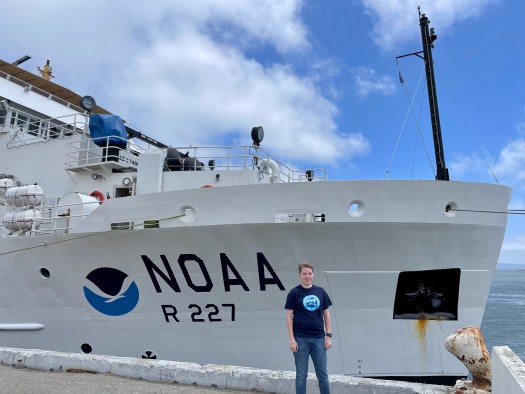
NOAA Ship Bell M Shimada in port, as seen from a point on the dock beyond the bow. We can see the NOAA logo and read: NOAA R 227. The water is calm and turqoise; the sky is blue with clouds. A portion of what may be the Golden Gate Bridge is visible in the background.
NOAA Ship Bell M. Shimada docked at Pier 30/32 in San Francisco, CA on July 4

Once onboard, I met Chief Scientist Steve de Blois and Wet Lab Lead Ethan Beyer. I was given a tour of the acoustic, chem, and wet labs and shown to my cabin. After dinner ashore, I joined some of the crew on the flying bridge to watch the July 4th fireworks. I met additional science team members and enjoyed a long night’s rest.

In the morning on July 5, we had a welcome aboard meeting, various trainings, a safety meeting and orientation, fire and abandon ship drills, and a science team meeting. We introduced ourselves, took an official team photo, and soon departed pier 30/32 for our 14 day mission. After passing under the Golden Gate Bridge and heading to the Pacific Ocean, our cold hands were warmed by a wonderful hot dinner of chicken, steak, fresh veggies, salad, and desserts from our galley crew. After dinner, we settled in for our first night at sea, waiting with anticipation for our first trawl on July 6.

– – ⚓ – –

Did You Know?

an orange-gloved hand holds a hake (fish) up so that it faces the camera. We can see the another smaller hake hanging limply across its open mouth

– Hake can be cannibalistic!
– Some larger Hake we have collected have had a smaller Hake in their mouth, throat, or stomach!
– Their very sharp teeth often stick to our thick rubber gloves.

– – ⚓ – –

New Terms/Phrases:

“Salp: Barrel-shaped, planktonic tunicate in the family Salpidae. It moves by contracting, thereby pumping water through its gelatinous body.”

Wikipedia: “Salp

“Myctophid: Lanternfish (or myctophids, from the Greek μυκτήρ myktḗr, “nose” and ophis, “serpent”) are small mesopelagic fish (…) Lanternfishes are aptly named after their conspicuous use of bioluminescence.”

Wikipedia: “Myctophid

Simrad EK80: Multibeam Echo Sounder (MBES) transducer that emits sound waves from the hull of the vessel down to the sea floor. It allows scientists to observe and study returned sound wave signals that may suggest marine life is present.

Transect: Set and numbered longitudinal east-west lines NOAA Ship Bell M. Shimada navigates on while collecting acoustic data.

Jennifer Fry: March 15, 2011, Oscar Elton Sette

NOAA Teacher at Sea
Jennifer Fry

Onboard NOAA Ship, Oscar Elton Sette

March 12 – March 26, 2012

Mission: Fisheries Study
Geographical area of cruise: American Samoa
Date: March 15, 2012

Pago Pago, American Samoa

Science and Technology Log:

Nighttime Cobb Trawling : Day 4

We began the trawling around 8:30 p.m.  The data we collect tonight will replace the previous trawl on day 2 which was flawed in the method by which the experiment was collected. The Day 2 experiment was when the winch became stuck and the trawl net was left in the water well over 2 ½ hours, long past the 1 hour protocol.

Here’s is what the science team found.

Tonight the trawl nets went into the ocean and were timed as all the other times.

During the sorting we found some very interesting species of fish which included:

  • Pyrosomes: chordate/Tunicate
  • Two Juvenile cow fish (we placed them into a small saltwater tank to observe interesting species caught in the net.)

This is a great place to make further observations of these unique animals.

The data collected included:

Name of fish: Numbers Count Volume (milliliters) Mass (grams)
Myctophids 120 700 650
Non-Myctophids 148 84 115
Crustaceans 77 28 40
Cephalopods: 16 64 50
Gelatinous zooplankton 71 440 400
Misc. zooplankton n/a 840 900

The Cobb trawl net was washed, rinsed and the fish  strained through the net. They were then brought inside the web lab for further sorting.

The white-tailed tropic bird is a regular visitor to the South Pacific islands.

We were close to finishing the sorting, counting, and weighing when suddenly we heard something at the back door of the lab.  Fale, the scientist from American Samoa went to the door and proceeded to turn the latch, and slowly opened the door.  There huddled next to the wall, near some containers was a beautiful black and white Tropic bird, a common bird of this area.  Its distinctive feature was the single white tail feather that jutted out about 1 foot in length.  He looked just as surprised to see us and we were of him.  He did not make a move at all for about 10-15 minutes .  We took pictures and videos to mark the occasion, yet he still didn’t budge or act alarmed.

With a bit more time passing, he began to walk, or more like waddle like a duck. His ebony webbed feet made it difficult to maneuver over the open slats in the deck.  He attempted flight but appeared to get confused with the overhanging roof.

I quickly found a small towel and placing it over his head, gently carried him to a safe spot on the aft deck where he would have no trouble flying away.

The time was about 2:00 a.m. when we were distracted by the ship’s fire alarm, and  we quickly reported to our muster stations.  Luckily, there was no fire and  we returned resuming our trawl data collection.  Upon reaching the wet lab, we noticed at the stern of the ship, our newly found feathered friend had flown off into the dark night.

It was a great way to end our night with  research and early hour bird watching.  How lucky we all are to be in the South Pacific.

Animals Seen:

Ppyrosome

Pictured here is a Pyrosome which many came up in our Cobb net.

Cow fish

Our trawl net caught three juvunile cow fish specimans which were quickly placed in our observation tank for further study.

Tropical bird

The Tropic bird, with its distinctive long tail feather, is common in the South Pacific.

Deborah Moraga, June 23, 2010

NOAA Teacher at Sea Log: Deborah Moraga
NOAA Ship: Fulmar
Date: July 20‐28, 2010

Mission: ACCESS
(Applied California Current Ecosystem Studies)
Geographical area of cruise: Cordell Bank, Gulf of the Farallones and Monterey Bay National Marine Sanctuaries
Date: June 23,2010

Weather Data from the Bridge

Start time: 0705 (7:05am)
End Time: 1708 (5:08 pm)
Position:
Line 2 start on eastern end: Latitude = 38o 3.4080 N; Longitude = 123o 10.9800 W
Line 2 end on western end: Latitude = 38o 2.7660 N; Longitude = 123o 33.7800 W
Line 1 start on western end: Latitude = 38o 7.8240 N; Longitude = 123o 31.9200 W
Line 1 end on eastern end: Latitude = 38o 8.3940 N; Longitude = 123o 11.5200 W
Present Weather: Cloud cover 100%
Visibility: 3‐10 nautical miles
Wind Speed: light, variable winds 5 knots or less
Wave Height: 0.25 ‐ 1 meter
Sea Water Temp: 11.5 C
Air Temperature: Dry bulb = 12.1 C
Barometric Pressure: 1013.5 mb

Science and Technology Log
From the flying bridge…It was noted that there are unusually high numbers of some animals from Alaska ‐ such as Northern Fulmars. There were also many sightings of humpback whales, one blue whale, numerous California sea lions and Dall’s porpoises. Today was the first sighting of a fin whale recorded on an ACCESS survey. the CTD

Krill

The seas were so calm… with a swell height of 0.25 meters, you could say the ocean looked as calm as a bathtub right before you get in.

With the seas being so calm it was great to work on the back deck (stern) of the boat. Today while working line 2 we deployed the CTD six times and took hoop net samples of zooplankton at 50 meters below the surface. The Tucker trawl was also deployed (put into the water and towed behind the boat) to 200 meters. In the jars of organisms that we sampled from line 2 we found adult and juvenile krill. We found some krill with chlorophyll still in their stomachs.

Sending out the CTD

Two small fish found their way into the hoop net. Myctophid ‐ these fish live deeper during the day and come up towards the surface at night. The scales on the myctophid looked like a colored mirror and are iridescent.

Myctophid

I had the chance to do the water samples today as the CTD was deployed. To do a water sample you throw a bucket over board (attached to the boat with a line). Pull the bucket out of the water and “clean it out” by swirling the water around. Drop the bucket back into the ocean and bring it up to the deck. You then take a small vial that is labeled with the sampling location and rinse it out several times before capping with a lid. It is then placed in the freezer to be analyzed for nutrients by another agency. I was just about to cap the sample and I heard this ‘poof’ sound. I looked over and two humpback whales surfaced just meters away from me. I knew they were humpbacks, a type of baleen whale, because their blow hole is actually two holes. They started to swim off and fluked (raised their tales above the water before diving) just as I was finishing the water sample, how lucky I am to be here!

Humpback Whale

Personal Log
Getting My Sea Legs
Okay, I will admit I was seasick the first day. I mean really sick. The sea was rough… 9 foot swell and even with a patch on to combat seas sickness…breakfast came up. I have not been sick again! But tomorrow is another day out at sea!