Amber LaMonte: This Post Is Fishy, June 4, 2026

A close-up image of a small fish through a microscope viewer, showcasing its detailed features including fins and eyes, set against a blurred background.
Two small fish with prominent blue eyes resting on a mesh surface, surrounded by water and sediment.
Haddock larvae in the shape of Pisces from a 75 m bongo sample

NOAA Teacher at Sea

Amber LaMonte

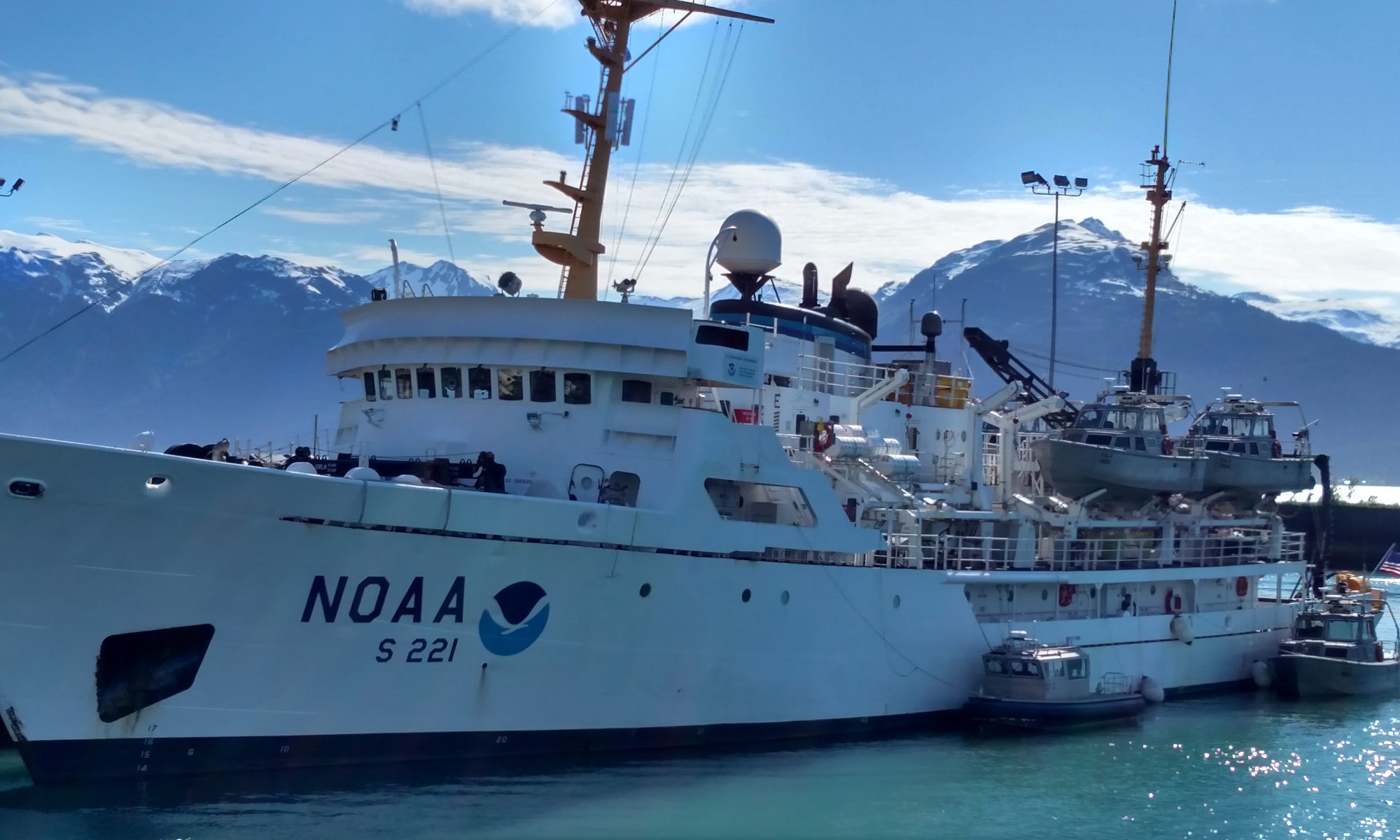
Aboard NOAA Ship Pisces

May 31- June 10

Mission: Northeast Ecosystem Monitoring Survey (EcoMon) Geographic Area of Cruise: Mid-Atlantic Date: June 4, 2026

Data from the Bridge

Greenwich Mean Time (GMT): 8:24 AM Latitude: 39ยฐ 02.599โ€™ N Longitude: 072ยฐ 42.161โ€™ W Doppler Wind Speed: 9.97 knots (kt) True Wind Speed: 3.56 knots (kt) Wave Height: 2โ€™ Air Temperature: 15.556ยฐC/60ยฐF Wet Bulb Temperature: 14.5ยฐC/58.2ยฐF Bottom Depth: 287 m Sky: Clear

A look through a square window on a ship with water droplets on it, some rope handing down and a view of the open ocean. Superimposed on this image is the title "My Office View."

My Office View

Close-up of a navigation screen displaying marine charts, GPS coordinates, speed, and time information, with a focus on a specific waypoint labeled 'PISCES'.
Monitors with the station track
A student holding a paper and examining a map, with rubber duck figures placed on various locations. Another student smiles while seated at the table, engaged in the activity.
Students plotting coordinates for Duck Current Lab
(photo courtesy of York High School)

We are well into our cruise and have been sampling around the Mid-Atlantic today. Each morning, >clears throat<โ€ฆ.at 3 am, I can plan my day from my office window. Luckily, there is high-tech navigational equipment that lets me view my Time To Go (TTG) for the upcoming station and the Estimated Time of Arrival (ETA), since I already understand coordinates and navigation. My students, however, get to label a blank map to illustrate understanding of coordinates when they complete the Duck Current lab.

The first of the drifters has been deployed, YORKYO DRIFT, at coordinates 39ยฐ50.206โ€™N 70ยฐ35.161โ€™W! Shout out, YHS Class of 2026, congratulations!

These are geographic coordinates in the electronic format used by maritime digital equipment. They tell you exactly where a place is on Earth using two measurements:

  • Latitude (39ยฐ50.206โ€™ N)
  • Think of latitude like the horizontal lines on a globe (like rings around a ball).
  • 39ยฐ (degrees) โ†’ how far north you are from the Equator
  • 50.206โ€™ (minutes) โ†’ a more precise measurement within that degree
  • N โ†’ means North of the Equator
  • Longitude (70ยฐ35.161โ€™ W)
  • Longitude lines run up and down from pole to pole.
  • 70ยฐ (degrees) โ†’ how far west you are from the Prime Meridian
  • 35.161โ€™ (minutes) โ†’ extra precision
  • W โ†’ means West of the Prime Meridian
Tossing (deploying) the ball (drifter)Shout Out Class of 2026

Science and Technology Log

Research

A close-up image of a small fish through a microscope viewer, showcasing its detailed features including fins and eyes, set against a blurred background.
Monkfish larva.
Photo from chief scientist Audy Peoples.

Although our focus is on areas where Atlantic Mackerel have historically been, the featured fish for this day of sampling is the monkfish. This is due to the fact that the ocean had not yet produced any larvae large enough to be distinguishable in a photo. Your Atlantic Mack girl really said no paparazzi today! Refer back to the last blog about the expert scientist in Poland identifying fish larvae.

A close-up view of a fish eggs floating in the water, displaying translucent veil.
Monkfish Egg Veil. Photo from New England Aquarium.
A close-up of a larval fish partially biting a white cloth, resting on a mesh surface with water and plankton.
Juvenile monkfish

The U.S. commercial monkfish fishery spans the Gulf of Maine to the Mid-Atlantic, extending to the continental shelf edge. Female monkfish produce large, ribbon-like egg veils that can contain over one million eggs. These veils drift near the ocean surface with prevailing currents for one to three weeks, depending on temperature, before breaking apart and releasing the developing larvae. Commercial fishing for these fish, like many species, can often result in bycatch. Trawl gear is primarily used in northern waters, while gillnets dominate in the south. Because monkfish are often caught alongside groundfish, this fishery is closely linked to the Northeast multispecies fishery. Management relies on days-at-sea limits and trip caps to ensure sustainability. There is no targeted recreational fishery and monkfish are harvested for human consumption. U.S. wild-caught monkfish is a sustainable seafood choice, supported by strict federal management and responsible harvesting practices.

Another surprise in the zooplankton samples that wanted a photo opportunity was a larval squid. The organisms found in the bongo are mostly classified as plankton. Many of you might recall that organisms that cannot swim freely against the current are considered plankton. This is the reason they appear in the bongo; most organisms that have advanced far enough in their juvenile development have the ability to swim out of the nets.

A close-up of a juvenile squid, appearing translucent with some black ink. Superimposed on this image is the title "Juvenile Squid from 150 m Sample."

Juvenile Squid From 150 m Sample

A group of people, wearing safety gear, gather around a woman in an orange jumpsuit who is holding a small object, a squid specimen, on a boat deck.
Teacher LaMonte showing off her cool zooplankton find (photo credit Katey Marancik)
Two students in safety goggles and gloves conducting a biology dissection of a squid specimen in a laboratory setting.
Students dissecting squid
(photo courtesy of York High School)

Scientific Concepts

Group of four students in a school hallway, some wearing playful costumes, with one lying on the floor and others engaging in lively interaction.
Students completing the survivorship types lab (photo courtesy of York High School

Most of you are already aware that when it comes to fish reproduction, it is a numbers game. Some of you remember that fish are an example of an r- strategist life history type. In general, r-selected species have short lifespans and produce many offspring that require little or no parental care, unlike the k-strategists these students were mimicking.

Diagram illustrating fish reproductive strategies categorized as Opportunistic, Periodic, and Equilibrium, featuring various fish types with labeled characteristics and color coding for different species.
Model results showing where fish species (represented by colored dots) fall among three life history strategies. (Webstory: Scientists Can Predict Traits for All Fish Worldwide)

Scientists can now model and predict growth, survival and reproductive patterns across fish species. A speciesโ€™ life history strategy reflects the specific combination of traits it has evolved to thrive in its environment and ecological niche. Using a framework of traits, including size, growth rate, reproduction, lifespan and parental care, researchers have classified more than 34,000 fish species into three primary strategy types.

Fish Life Cycle

  • Egg Stage
  • From spawning โ†’ hatching
  • Eggs vary in size, shape, and color depending on the species.
  • Inside the egg, an embryo develops.
  • Scientists identify eggs by observing:
    • Egg size and shape
    • The yolk (food supply)
    • Embryo development
  • Yolk-Sac Stage
  • From hatching โ†’ yolk used up
  • Newly hatched fish are called larvae.
  • They carry a yolk sac that provides food.
  • Some species skip this stage and hatch more developed.
magnified view of a larval fish in a sample disha lantern fish, with a narrow body, rounded head and hints of bioluminescence, photographed against a black background. possibly underwater.
Left: Mychtophidae (Lantern Fish) larvae from a 200 m bongo sample.
Right: adult lantern fish. Photo from Woods Hole Oceanographic Institution
(Creature Feature: Lanternfishes/)
  • Preflexion Stage (featured in the Mychtophidae larvae above)
  • After yolk is gone โ†’ tail begins bending
  • Larvae begin feeding on their own.
  • Scientists observe:
    • Body shape
    • Early fin development (you can see the fin begin to develop in the Mychotophidae above)
    • Color patterns (you can see the color begin to develop in the Mychotophidae above)
  • Flexion Stage
  • The tail (notochord) bends upward. The tail fin starts forming.
  • Postflexion Stage
  • Tail fully formed โ†’ before metamorphosis
  • Fins and body features continue developing.
  • It becomes easier to identify the species.
  • Transformation Stage
  • The fish changes from larva to juvenile.
  • Changes may include:
    • Body shape
    • Color patterns
    • Fin position
    • Development of scales
  • Juvenile Stage
  • Young fish โ†’ adulthood
  • The fish looks like a small adult. This stage ends when the fish can reproduce.

Methodology

A close-up of multiple Mauve jellyfish in a pot, with its translucent purple body resting on a layer of mixed plankton and water.
Mauve Jellyfish from a 200 m bongo station

Plankton span an extraordinary size range, from just a few micrometers to several centimeters or more. In general, phytoplankton (plant-like organisms) are the smallest, while zooplankton tend to be larger, though both groups exhibit variability in size. What may appear as minor differences to the human eye often translate into significant biological contrasts; for instance, a cylindrical organism measuring 3 mm in length has approximately 27 times the body volume of a similar organism measuring 1 mm. At each station, we conduct a double oblique tow with a bongo net diameter suitable for capturing zooplankton. Sometimes we end up with a large quantity of big zooplankton like these Mauve Jellyfish.

Plankton nets are designed to sample large volumes of water, concentrating organisms into a manageable sample size for analysis. Although plankton are often highly abundant, collecting a representative sample, particularly for less common species, requires filtering large volumes of seawater.

Close-up view of a metallic container with a blue and white fabric inside, featuring a transparent syringe-like device (flowmeter) resting on top.
Flowmeter at opening of one bongo net 

By equipping nets with flowmeters, researchers can accurately estimate the volume of water passing through the net. This enables plankton counts to be standardized as a concentration per unit volume. For example, if 200 organisms are collected from a tow that filtered 2 cubic meters of seawater, the resulting concentration is 100 organisms per cubic meter. Standardizing measurements in this way allows for equivalent comparisons across samples, even when the filtered volumes differ.


Careers

Katey Marancik studies the ecology of ichthyoplankton collected through long-term monitoring programs on the Northeast U.S. shelf. She earned a B.S. in marine biology at the University of North Carolina (UNC) and her M.S. in biology at East Carolina University (ECU). Her work focuses on improving larval fish identification through refined taxonomic descriptions, as well as examining patterns in abundance, distribution and environmental relationships.

In addition to her research, Katey is a published scientist who uses visual communication as a tool to make scientific concepts clearer and more accessible to both specialized and broader audiences. Some of her illustrations of Hake have been published to update the morphological descriptions of the larval stage in the Northeast United States Continental Shelf. The work she does reinforces the value of the natural sciences and real-world observations. The analysis and coordination of ichthyoplankton sampling adds validity to the digital sampling of water quality parameters conducted during ecosystem monitoring surveys. In a world of high tech and AI, be a natural scientist. Katey is truly an environmental steward of our oceans.

Personal Log

Some mornings, I immediately have to put on my foul-weather gear and head out onto the deck because the ship is stopped at one of our sampling stations. Other mornings, I grab a coffee and open my computer to blog. But regardless of how my shift begins, I get to see the first light of day around 4:15 am, and I feel as though I could quite literally seize the day! Watching the sun rise is just something special, an unused part of the day just for yourself. On my usual morning commute across the Chesapeake Bay Bridge-Tunnel, I often wish to just stop and watch the day begin.

1 & 2- Foul Weather Gear that I don about 8 times a day. 3 – The wet lab. 4 – Beautiful sunrise on stern. 5 – My Emergency Billet Locations.

We participate in safety drills on the ship just like we do when we are in school, exceptโ€ฆ one is called โ€œMan Overboardโ€! For that drill, we have to go to the top level of the ship, called the Fly Bridge, and point to the person we see in the water. Unless we can spot the person before the Fly Bridge, in which case we stay and point and yell โ€œman overboard.โ€

A small rescue boat navigating through calm ocean waters, with crew members visible on a larger vessel in the foreground.
Rescue boat coming back after โ€œMan Overboardโ€ drill

Did You Know?

NOAA vessel discharges are governed by EPA Vessel Incidental Discharge Act (VIDA) regulations and international MARPOL standards, with requirements determined by proximity to shore. On this sail date we had sampling stations closer inshore and the NOAA Ship Pisces had to follow different discharge plans based on our locations.

Inshore (< 3 NM): Discharge controls are most restrictive within U.S. state waters. Untreated sewage (blackwater) is prohibited and must be processed through an approved Marine Sanitation Device (MSD) or retained in holding tanks. Graywater discharge is tightly limited and, in some sanctuary areas, fully prohibited. Additional protections apply in marine protected areas; for example, both treated and untreated blackwater discharges are banned within 12 nautical miles of the Papahฤnaumokuฤkea Marine National Monument.

Offshore (> 3 NM): Regulations allow greater flexibility but remain controlled. Treated sewage may be discharged using an approved MSD, while untreated sewage is only permitted beyond 12 nautical miles from land. Graywater discharge (excluding toilet & kitchen is generally allowed in open waters beyond 3 nautical miles. Food waste must be macerated to less than one inch and discharged outside 3 nautical miles; unprocessed waste is restricted to distances greater than 12 nautical miles.

https://www.epa.gov/vessels-marinas-and-ports/vessel-incidental-discharge-act-vida

A document outlining the PISCES Plan of the Day for June 5, 2026, including a schedule of operations, training, and meetings, accompanied by a station list and weather summary.
NOAA Ship Pisces plan of the day

Cecelia Carroll: Goosefish: Not Just Another Pretty Face, May 7, 2017

NOAA Teacher At Sea
Cecelia Carroll
Aboard NOAA Ship Henry B Bigelow
May 2 -13, 2017

Mission: Spring Bottom Trawl Survey, Leg IV
Geographic Area of Cruise: Northeast Atlantic
Longitude: 43degrees 33.310 N
Latitude: 067degrees 07.103W
Weather: Clear

Science and Technology:

One of the most interesting looking fish we have brought on board in the nets is the Goosefish (Lophius americanus), also known as the Monkfish. Its striking feature is its large mouth that can be as wide as the fish is long, lined with several rows of needle sharp teeth. ย The Goosefish has a mobile illicium, an angling apparatus with a fleshy appendage at its tip, the esca, that acts as a lure to attract its prey towards its huge mouth. When the Goosefish opens its mouth suddenly, a vacuum is created and its prey is sucked into its cavernous mouth. Its eyes are on the top of its head and there are small fleshy flaps encircling then lower jaw, almost a beard-like appearance. ย Its back is lined with spikes. ย The female lays an egg veil that can stretch 6-12 meters.

Goosefish weighed and measured on the scales.

Notice another group of teeth further into the mouth

Notice the little eyes.

The underbelly of the Goosefish.


The illicium extended as to entice its prey

Diagram: “Fishes of The Gulf of Maine”, Bigelow and Schroeder, 3rd edition.The Goosefish is marketed as Monkfish for consumption.

Personal Bio

Holding a Spiny Dogfish(Squalis acanthias)

Safety drill


Did you knowย the Goosefish is also known as the “poor man’s lobster” because of its light taste similar to lobster.

Jessie Soder: Happy as a Clam, August 12, 2011

NOAA Teacher at Sea
Jessie Soder
Aboard NOAA Shipย Delaware II
August 8 – 19, 2011ย 

Mission: Atlantic Surfclam and Ocean Quahog Survey
Geographical Area of Cruise:ย  Northern Atlantic
Date: Wednesday, August 12, 2011ย 

Weather Data
Time:ย  12:00
Location:ย  41ยฐ47.405N, 67ยฐ21.702W
Air Temp:ย  18.4ยฐCย  (65ยฐF)
Water Temp:ย  17ยฐC (63ยฐF)
Wind Direction:ย  South
Wind Speed:ย  8 knots
Sea Wave height: 1 foot
Sea Swell:ย  2 feet

Science and Technology Log

TK holding a monkfish caught in the dredge

When I was a little girl I was always excited to pull the minnow trap up from the end of the dock to see what oddities I had caught accidentally while trying to trap minnows.ย  I am reliving this excitement on a much larger scale on this research cruise.ย  The dredge we are using to fish for ocean quahogs and surfclams is 5ft x 20ft, weighs 2500lbs, and is pulled for ยผ nautical mile each time it is towed.ย  (That means it covers an area of about 9000 square feet.)ย  As you might imagine it accidentally catches things besides the ocean quahogs and the surfclams that we are fishing for.

The dredge is lowered into the water off the back of the ship.ย  Once it hits the ocean floor a powerful jet of water is sprayed into the ocean floor in front of it to โ€œliquefyโ€ the sand or mud on the ocean bottom.ย  This loosens the clams and suspends them in the water, just above the bottom.ย  (Ocean quahogs and surfclams aren’t far below the bottom; just a few inches.)ย  Then, while they are suspended in the water the dredge scoops them up.ย  The dredge is brought back up to the ship and dumped and we sort through the catch.ย  The ocean quahogs, surfclams, and a few other species are kept to weigh and measure.ย  Below is a video of the dredge being hauled back on the back deck of the ship.

After three watches I am getting pretty good at identifying ocean quahogs and surfclams.ย  What isย the difference between an Atlantic surfclam and an ocean quahog?ย  Well, they are very similar!ย  They are both bi-valve mollusks, which means that they have two shells covering a soft body.ย  They both burrow into the sand so that only their siphon sticks out.ย  Both of them filter their food, algae and plankton, through their siphon.ย  One of the biggest differences between them is in the way that their shells connect, or hinge together.ย  Another difference is their lifespan.ย  The ocean quahog lives for more than 150 years and the Atlantic surfclam lives for approximately 30 years.ย  Their size and shape are different too.ย  Ocean quahogs are rounder than the Atlantic surfclams, which have a triangular shape.ย  Theย  Atlantic surfclam also grows larger than the ocean quahog.

Ocean Quahog (left) Atlantic Surfclam (right)

Just like I was excited as a kid to find crayfish and bullheads in my minnow trap I am excited to see what the dredge brings up each time.ย  So far our biggest catch was 4400 quahogs!ย  Conversely, our smallest catch was just three quahogs! Sometimes the dredge is filled with empty shells, or empty shells and sand dollars, or thousands of clams, or sometimes it is really sandy.ย  Each time it is a surprise and it gives you a brief glimpse of what the bottom looks like.

Personal Log

Empty shells and sand dollars

There are many potential dangers that you can face every day while working on a ship.ย  In fact, since being aboard we have run three drills; man overboard, fire, and abandon ship.ย  These drills are run on every trip so that everyone knows exactly what to do.

I think that there is something about being at sea on a ship that heightens your awareness of yourself.ย  I have experienced that same sort of feeling when I am sea-kayaking in big water, or hiking on a bear trail.ย  It is the feeling that there is something out there that is bigger than you are.ย  You sense things in a much clearer and acute way.

This evening the sun was going down on the starboard side of the ship and the moon was coming up on the portside.ย  We could see for miles and miles.ย  Earlier today we watched a school of tuna swim past and dolphins in the distance.ย  It was a beautiful clear and sunny day and we were 140 miles from land.ย  We are lucky.

Questions to Ponder

The clams and quahogs are collected on this research cruise from the sea floor using a hydraulic dredge.ย  The dredge is lowered and run along the seafloor for about 5 minutes in order to pick up the clams and quahogs.ย  Each time this is done it is called a โ€œtow.โ€ย  How many people do you think are needed to conduct (operate the machinery and collect the data) one tow for clams and quahogs?ย  How many different jobs are there during one tow?

Kathleen Brown: Last Days at Sea, June 16-17, 2011

NOAA Teacher at Sea
Kathleen Brown
Aboard R/V Hugh R. Sharp
June 7 – 18, 2011

Mission: Sea Scallop Survey
Geographical area of cruise: North Atlantic
Dates: June 16-17, 2011

June 17, 2011

Weather Data from the Bridge
Time: 9:27 AM
Winds 7.2 KTs
Air Temperature: 14.89 degrees C
Latitude 41 47.28 N
Longitude 069 49.13 W

Personal Log

We are headed back into Woods Hole sometime tomorrow.

In one of my conversations with Captain Jimmy, he told me that he likes scientists to โ€œenter the ship as customers and leave as family.โ€ Without a doubt, I feel like the whole R/V Hugh R. Sharp team has made that happen. From the excellent meals cooked three times daily, to the willingness of the crew to answer any of my questions, I have felt included and welcome.

Sunset from the deck

My fellow scientists have made travel on this journey fun and worthwhile. I canโ€™t count the number of times someone yelled over to me, โ€œHey Kathleen, get a picture of this. Your students will love it!โ€ It has been a pleasure to be around others who are curious and passionate about the sea.

In my classroom, I try to convey to my students that science is about collaboration. I will have many real life examples to share with them when I return.

My thanks to the NOAA Teacher at Sea Program, my colleagues and students at Freeport Middle School, and my family, for supporting me on this adventure of a lifetime!

June 16, 2011

Weather Data from the Bridge
Time: 1:28 PM
Winds 9.3 KTs
Air Temperature: 14.67 degrees C
Latitude 41 08.86 N
Longitude 069 20.97 W

Science and Technology Log

It has been amazing to me to see the variations in the catches from the many tows. When the tension on the wire used to haul the net is high, it might be because we have a huge haul of sea scallops. Sometimes the table will be filled with so many sand dollars it is difficult to see anything else. We had a number of tows that contained large amounts of brittle stars. The arms of the brittle stars move like little worms. (It is eerie to see thousands of them wiggling.) The last tow, in the open area, had only forty-six scallops. The pile was filled with quahogs, urchins, starfish, sea cucumbers, hermit crabs, and rocks. Sometimes the animals we collect are covered in mud and sometimes the sediment is very sandy. We are now traveling in the shipping channel and the sea floor is rocky. Before we began to tow in this area, the scientists put the rock chains on the dredge. There is also a metal chute attached to the table so that the larger rocks can more easily be rolled back into the ocean.

Brittle Stars
Brittle Stars

We have now completed the inventories in the closed areas of Georges Bank. I learn that large areas in the Gulf of Maine had originally been closed as a measure to restore groundfish stocks. What scientists discovered is that, over time, the sea scallops flourished in the closed areas. It was an unintended result of the fisheries management policies.

There is always something interesting to learn about the species that we collect. Sea scallops have the ability to move through the water column by clapping their shells together. Sometimes, moving up five or six inches can mean escape from a predator like a starfish. (Of note, during this study we also count and measure empty sea scallop shells, provided that they are still hinged together. These empty shells are called clappers.) Speaking of starfish, on this trip we have seen five species of starfish, in colors ranging from purple to yellow to orange. The common name for my favorite starfish is sunburst, an animal that looks just like it sounds. Monkfish, sometimes referred to as goosefish, are called an angler fish. There is a modified spine at the top of its mouth that appears as though the fish is dangling bait. With this structure, the monkfish can lure a prey near its enormous mouth (and sharp teeth) and capture it. The longhorn sculpin feel like they hiss or grunt when they are picked up. I have learned that it is likely the sound is the vibration of a muscle in their chest.

Scientist of the day watch

The technology used to support the science on this survey is remarkable. In the dry lab, there are fifteen computer screens being used to track all of the data collected. These are in addition to the many that are being used to manage the ship. Everything is computerized: the CTD collection, the route mapping, and the information about the species we are catching. After each tow, the Chief Scientist or Crew Chief can immediately plot the data from the catch. Several screens show images from the cameras that are placed at various locations on board the deck. From the dry lab, the scientists can watch the dredge go in and out and view the tension on each cable. When the technology fails, as it did for four hours one day this week, it is up to the crew and scientists to figure out what is wrong and how to fix it.

When the ship is off shore for hundreds of miles, the skills and talents of each individual on board must be accessed for anything that happens out of the ordinary. The Captain is the chief medical officer. The crew acts as firefighters. The scientists and crew work together on mechanical issues โ€“ like yesterday when the hydraulics on the CTD stopped working. Working aboard a scientific research vessel is perfect for those who are flexible and innovative.

Personal Log

It is difficult to explain how beautiful the scene from the back deck of the ship looks. All I can see to the horizon lines is dark blue water. Flocks of seagulls follow the ship to scavenge the buckets of fish we throw overboard. Last evening the full moon was bright and round. When I breathe in the salt air, I think about how grateful I am that I am here.

Question of the Day
Why are the rubber rain pants worn by marine workers called โ€œoilersโ€?

Kathleen Brown: First Days at Sea, June 8-9, 2011

NOAA Teacher at Sea
Kathleen Brown
Aboard R/V Hugh R. Sharp
June 7 – 18, 2011

Mission: Sea Scallop Survey
Geographical area of cruise: North Atlantic
Dates: June 8-9, 2011

June 9, 2011

Weather Data from the Bridge
Time: 10:00 am
Winds 10 to 20 knots
Seas 3 to 4 feetย 

Science and Technology Log

R/V Hugh R. Sharp
R/V Hugh R. Sharp

This morning is the first day that I have awoken on board the ship. It will be my first twelve-hour shift. The scientists work either from noon until midnight or from midnight to noon. Kevin, the chief scientist, has assigned me to the day shift. I am very happy about this! We suit up in our foul weather gear. Those who have done this before explain to me that it is easiest to slip on the black rubber boots and rain pants like a firefighter who just got a call might do. We eagerly wait for the winch to pull the catch out of the water. The net drops everything out on the table. When we receive word from the engineer that all is clear, I don a hardhat, and hop up on the table with a white board that lists the station, strata and tow. My shipmate, La Shaun, snaps a photo record of the catch. We stand around the table and begin the inventory. We are looking for sea scallops and any we find go into a big orange basket. Other species that we separate out include: red hake, monkfish, haddock, skate, and ocean pout. We measure the length of the fish that we have separated. I imagine how the data might be used by scientists back on land to indicate the health of that portion of the ocean. As soon as we finish the haul and clean up, it is time to do it all over again. Every third catch we count the number of starfish and cancer crabs. I am excited to hold sponges, sea urchins, and hermit crabs. I am surprised to learn that the sand dollars are red.

Scallops!
Scallops!

Once all the sea life on the table has been sorted, it is time to head to the wet lab. There, the buckets of animals are counted and measured. Two persons work at each table measuring the fish. The fish is laid flat against the scale and one scientist uses a magnetic tool to capture the length electronically. During one catch, Aaron and I measured the length of 37 skate. I am impressed by the knowledge of the scientists who can easily tell the difference between a winter skate and a little skate. I hope by the end of the trip, I will be able to do so as quickly as they can.

Personal Log

I hardly notice the rocking of the ship while we are working. I think I may be starting to get my sea legs. On this first day there is very little time in between stations, and there is no real down time. I have learned how to shuck a sea scallop and seen the anatomy of the animal for the first time. I had been promised that I would get to work hard out on the open ocean and I am not disappointed.

Question of the Day Do you know the shape of the sea scallop shell? If you open the shell of a sea scallop you can immediately tell if it is a male or a female. How?

June 8, 2011

Personal Log

I reported to the Woods Hole dock at 7:30 in the morning. The day was bright and sunny, with temperatures in the 70s. The sight of the ship docked next to the NOAA building was so exciting. I climbed on board and introduced myself to Captain Jimmy who showed me right to the galley and offered me a cup of coffee. He was so welcoming! The ship had arrived in port at about 5:00 am and the crew and scientists were working to get everything ready to go by noon. I was shown my room, which is meant for four persons and has two sets of bunk beds. The room is so much bigger than it appeared in the photographs I saw! I chose a lower bunk and stowed my duffel bag underneath the bed in a cubby that was designed just for that. As more of those traveling on the journey arrived, I was interested to find that five of us have ties to Maine. We gathered to hear a briefing on the research that we will be supporting while on board the ship. Did you know that the American Sea Scallop is the most valuable fishery in the United States? Then we went off to lunch in the galley. The cook, Paul, served us an amazing lentil soup and sandwiches. The galley is full of snacks, a fridge with ice cream, and milk juice, coffee and tea, all of which are available day and night. As we were eating, I felt the ship start to move. We were told our first station is about eight hours away. (A station is a place where we collect a sample of the sea life.) Away we go!

Question of the Day What is the reason that Woods Hole became the location on Cape Cod for ocean research?