Mary Cook: Final Day, March 30, 2016

NOAA Teacher at Sea
Mary Cook
Onboard R/V Norseman II
March 18-30, 2016

Mission: Deepwater Ecosystems of Glacier Bay National Park
Geographical Area of Cruise: Glacier Bay, Alaska
Date: Wednesday, March 30, 2016
Time: 8:33 am

Data from the Bridge
Temperature:
40.6°F
Pressure: 1031 millibars
Location: N 58°38.406’, W 136°07.990’

Science and Sea Stories Log

When I heard that this Deep Sea Exploration voyage was going to have a remotely operated vehicle (ROV) working in addition to scuba divers, I was so excited! To be able to watch the operations and meet the people who do the work has been a particular fascination for me on this voyage. I’ve always loved the exploration of the ocean using vessels that can go where humans have limitations.

Kraken2 for the 3-30 blog
The ROV Kraken 2 is owned and operated by the University of Connecticut (UConn)
Crew deploys ROV
Crew deploys the ROV

The big yellow Kraken 2 sits on the stern of the R/V Norseman II. It is a modified ROV that has been customized for special tasks in science research. Kraken 2 is owned and operated by the University of Connecticut. Kraken 2 is usually contracted to do science research for the U.S. government or University clients, but has also done a few jobs of surveying and archaeological work on shipwrecks. Kevin, Matt, Eric, Mike, and Jeff are the members of the ROV team for this voyage. These cool guys have an eclectic background of geography, marine ecology, and engineering coupled with a love of electronics and the computer side of things.


The main parts of the 2,400 lb. Kraken 2 are:

-The big yellow top made of syntactic foam that provides 900 lbs. of buoyancy, which helps maintain neutral buoyancy in water.

-Kraken 2 is tethered to the ship by the green umbilical, which provides power and communications between ship and ROV.

-Kraken 2 carries a number of cameras and lights. Big high intensity lights that provide warm light deep underwater.

-Kraken 2 uses a number of High Definition video and digital still cameras – similar to a camera you might have at home. The video camera has been deconstructed and put into a canister that can withstand high water pressure. These are positioned to get various angles and provide different views around the ROV.

-When the visibility is not good the operators rely on sonar. This allows them to “see with sound” what is in front of Kraken 2 up to 100 meters and helps them make maneuvering decisions.

-An altimeter, which measures height off the bottom and a pressure sensor that determines depth.

-The USBL (ultra short baseline) tracking system has a transducer that emits sound pulses and transponder that receives and sends a pulse back. It can track the vehicle in relation to the ship. All these sound devices are important in marine navigation for obstacle avoidance.

Sample Quivers on ROV
Quivers to hold coral samples

-The manipulator arm is sometimes called the claw. It is very important for collecting samples such as pieces of Primnoa pacifica. An acrylic vacuum tube is also attached onto the arm for “sucking” up moving or delicate samples such as fish and jellyfish. The manipulator arm is used to put samples into quivers then drops a heavy rubber stopper on top to seal it until it is brought to the surface for scientific processing.


There are three people working to “drive” Kraken 2 during deployment. The winch driver gently lifts Kraken 2 from the ship’s stern into the water and also keeps the ROV from crashing into the bottom of the ocean. The pilot is working on the finesse of getting into delicate areas. The navigator operates the claw while maintaining a close dialog with the Bridge. The cameras, radar, and sonar monitors along with the remote controls are all house in a metal shipping container called the Van.

ROV Van Door
Door to the ROV “Van”

Matt and Mike drive the ROV from within the van. The Science Leader in the last picture is Cheryl.


Kraken 2 is a unique ROV for the niche it occupies. It is a science class ROV.

Most Science Class ROVs are large about the size of a small truck and require a dedicated ship and personnel. The advantages of Kraken 2 are that it doesn’t go as deep (up to 1 km) therefore, isn’t as expensive. Smaller ships can deploy it. It’s an excellent ROV for continental shelf and slope exploration.

One night Qanuk got to go down with Kraken 2! Mike attached him to the frame. He is probably the first bald eagle to ever attempt such a feat. Qanuk was videoed as he explored the depths and even had his photo taken with Primnoa pacifica in situ.


Personal Log

Today concludes my voyage as a NOAA Teacher at Sea. Wow! It has been amazing to be a part of the Deepwater Exploration of Glacier Bay. Getting to work alongside scientists, engineers and ship’s crew that are doing adventuresome and cutting-edge work is a dream come true for me. A special “Thank you” to Dr. Rhian Waller, as Lead Scientist for accepting a Teacher at Sea on board to work with her project. I am so thankful that they all welcomed me into their work space and were willing to teach me how to do some helpful things like processing coral for reproductive studies. These people are teachers in their own right. Their enthusiasm for their work and for learning new things is infectious and I plan to carry that attitude back to my students in Scammon Bay, infusing my classroom with awe and excitement to be brave, conscientious, problem-solving citizens of our magnificent Earth!

Mary Cook: Day 11 at Sea, March 29, 2016

NOAA Teacher at Sea
Mary Cook
Onboard R/V Norseman II
March 18-30, 2016

Mission: Deepwater Ecosystems of Glacier Bay National Park
Geographical Area of Cruise: Glacier Bay, Alaska
Date: Tuesday, March 29, 2016

Data from the Bridge
Temperature:
43.5°F
Pressure: 1028 millibars
Speed: 5.3 knots
Location: N 58°52.089’, W 136°05.272’

Science and Sea Stories Log

This afternoon, as science work continues all around, I took a short walk up to the ship’s bridge and chatted with Captain Mike and First Mate Scotty. They gave me a bit of history of the ship.

Pic of Ship Showing Bridge
R/V Norseman II


The R/V Norseman II is privately owned and based out of Seattle.

In 2007 it was converted from an Alaskan king crab boat into a scientific research vessel, especially equipped for Arctic conditions. Oceanography and marine mammal research have been the focus of the voyages, which usually occur between April and November. This is the first time they’ve had work in Glacier Bay. Scotty ranks Glacier Bay as one of his top five most beautiful places to see along the Alaskan coast!

The ship’s bridge is where they pilot the ship. It has windows all around for the best view possible.


Ships Bridge
The ship’s bridge is white with LOTS of windows!

The Captain has a big comfy chair that sits up tall and allows him to have a good command of the ship. He can see the radar and bathymetry monitors, the navigational chart and has good access to the ship’s phone.

On this cruise, Captain Mike works the 7-7 night shift because the ROV deployment off the back of the ship is a delicate and precise operation. The ship’s wheel and a giant compass are also on the Bridge. The wheel is wooden and old-fashioned looking but it really works and can be used to steer the ship in an emergency.

Mary at the Helm
Mary at the helm!

During our conversation, I asked Captain and Scotty to share an interesting sea story. At first they didn’t think they had anything to say. I think everyone has a story. So eventually they began to reminisce.

So the following are some sea stories that various ones on the ship were willing to share with me.

Captain Mike’s Sea Story


Captain at the Helm
Captain Mike

Captain Mike’s story occurred many years ago when he captained his 2nd fishing vessel.

The Captain began his story by saying, “Never make the mistake of letting the ship’s owner tell you where you are going to go and how to operate the vessel.”

We departed Kodiak, Alaska headed for Unimak Pass. The forecast was not good. I wanted to pull in to Sand Point and wait it out. Because he wanted to start fishing, the owner said, “It’ll be fine to keep on going.”

When we got to Sanak Island it was blowing a steady 80 knots with heavy freezing spray. The boat was getting heavier and heavier with ice building up on it. I couldn’t see out of the windows. There was ice on the inside of the windows about ½ inch thick. We went from Sanak Island to West Anchor Cove. It took me 12 hours to go only 8 miles.

The scanner on the radar broke so it was just going in circles. We spent the whole night trying to get to safety. I wanted to go up in a little cluster of crab boats. The owner, on the other hand, wanted to go up in the bay. But that’s where the williwaws were blowing. (A williwaw is a downdraft from the mountains— a sudden blast of wind descending from snow and ice fields to the sea.) Ten inches of ice built up all over the boat. I could barely steer the boat. We were all very glad to make it to the anchorage. It took the crew five days to beat off all the ice from the boat. I have a very healthy respect for ice. It puts the fear of God in you. When we finally made it to our fishing spot, the fishing was great!

Mate Scotty’s Sea Story

Mate Scotty
Mate Scotty

We were in the Arctic doing a walrus study with the US Fish and Wildlife. There was a thick fog and we were slowly navigating through the ice. The walrus were very skittish and we were wondering why. As we rounded a corner, suddenly there appeared a big polar bear! I heard the Inupiat interpreter yell, “Nanuk!” A polar bear!

(Inupiat interpreters work with us because of their vast knowledge of the ice and the animals.) Nanuk means polar bear in the Inupiat language.

Now we knew why the walrus were acting so nervous.

The bear crawled up on the ice and shook himself off. He jumped from one piece of sea ice to another, then back into the water.

To be able to see an animal in its natural habitat was really something!

Scientist/Diver Amanda’s Sea Story

Amanda and Mary in ships bow
Mary and Amanda on the ship’s bow

Amanda’s story is set in the Southern Ocean near McMurdo Station, Antarctica. Amanda and two other researchers were returning to station from their fieldwork under the sea ice. They were riding in a Piston Bully, which is a specially designed vehicle on tracks for gripping the terrain on snowy, icy conditions. The visibility was terrible with the wind blowing the snow all around. Even though the station was less than four football fields away, they couldn’t see it. Amanda was sitting in the back of the vehicle watching for the guiding flags placed every 100 feet leading to the station. But she saw none. In that situation, protocol is to stop and wait out the storm. The driver kept driving even though he couldn’t see where he was going. Suddenly, the backend of the Piston Bully dropped into a huge crack in the ice! The doors in the back were wedged shut! Amanda automatically went for the emergency roof hatch. She couldn’t get it open! Something heavy had been stowed on top of it. The others had escaped but she was trapped! Everyone was fearful that the ice crack would open up and swallow the Piston Bully with Amanda inside.

In a frantic adrenalin surge, Amanda kicked the hatch with all her might! The heavy equipment flew off as the hatch opened. Thankfully, Amanda crawled out to safety. The group waited out the blizzard for the next six hours in a nearby fishing hut.

Pison Bully fallen into ice crack in Antarctica
The Piston Bully fallen into a crack in Antarctica. Photo courtesy Amanda Kelley.

Personal Log

I really am enjoying the great sea stories of the people assembled on board this ship! They are such adventuresome characters doing things I’ve only read about or watched in movies or documentaries. From living at the bottom of the ocean in Hydrolab, diving in the Southern Ocean around Antarctica, riding out the storm, fending off aggressive sea lions, working in the Alvin submersible, to exploring and making discoveries of the unknown—all are so interesting and awe-inspiring! I hope you enjoy their sea stories too!

Stay tuned for more tomorrow…

Mary Cook: Day 10 at Sea, March 28, 2016

NOAA Teacher at Sea
Mary Cook
Onboard R/V Norseman II
March 18-30, 2016

Mission: Deepwater Ecosystems of Glacier Bay National Park
Geographical Area of Cruise: Glacier Bay, Alaska
Date: Monday, March 28, 2016
Time: 7:48 am

Data from the Bridge
Temperature:
39.4°F
Pressure: 1022 millibars
Speed: 5.6 knots
Location: N 58°56.540’, W 136°54.153’

Science and Food Log

Blustery Conditions
Blustery conditions in Glacier Bay

This morning at the science meeting, Chief Scientist Rhian Waller expressed that, even though we’ve had blustery weather conditions the last few days, most of the scuba dive and sample collection goals have been met making this scientific cruise a huge success! It’s nice to be able to take a deep breath and realize the science objectives are going to be met before deadline! Everyone’s hard work has paid off. We are all glad for the exceptionally clear skies and good weather during the first half of the cruise. Rain, snow, fog and wind have been the environmental setting for R/V Norseman II in Glacier Bay this weekend.

I am hoping to get to go back out on the little dive boat today or tomorrow one last time, even though it’s a bit choppy out there.

Yesterday, the scuba divers brought up some more fascinating samples from their dives!

Amongst the curious creatures were beautiful sea stars, a jellyfish that reminds me of a jam-drop cookie, a big yellow nudibranch, a fat-looking brown sea cucumber and a one-armed sea star! The one-armed sea star was alive and moving. Did you know that sea stars have the ability to regenerate missing body parts? So this one-armed guy will grow another body!


Hard working scientists, divers, and crew members need good food to sustain their abilities to concentrate and do the physical labor.

Thanks to our ship’s cooks, Harry and Darrin, we have an abundance of delicious and healthful food choices prepared daily onboard the R/V Norseman II. As each mealtime approaches I look forward to finding out what these two guys have whipped up to serve everyone onboard.


According to Head Cook Harry, who is a retired Navy cook with over 26 years of cooking experience, the biggest difference in meal preparation on a ship is the scale. They are preparing four full meals a day for 23 people in a small kitchen!

Their shifts are from 7 to 7. Harry works the day shift preparing lunch and supper. Darrin, the assistant cook, works the night shift preparing midnight meal and breakfast. You may recognize names of some of the famous chefs that Darrin has worked for during his off-season: Emeril and Chappy.

Darrin in the Galley crop
Assistant Cook Darrin works the night shift


The biggest challenge is planning the meals for 14 days without being able to go to the grocery store if something was forgotten. One thing Harry never, ever forgets is coffee. There must be plenty of coffee onboard.

Bunn Coffee Brewer

Improvisation becomes an important skill for the ship’s cook–to make do with what you have. Rotating foods and re-purposing leftovers into something tasty are essential. I must say these guys do a wonderful job of putting on a sumptuous, nutritious meal four times a day every day!

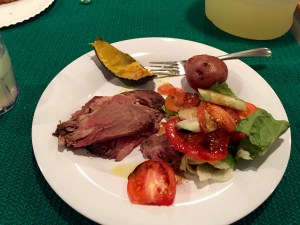
Sumptuous Meal

In addition to the great meals, Darrin is a pastry chef whose baking fills the ship with the delightful scents of cakes and cookies. Darrin shares that when baking on a ship you must rotate what’s in the oven often or it’ll come out lop-sided!

I’m also impressed that we are still having fresh green salads at this point in the voyage.

Harry relates that he buys lettuce in whole heads and keeps them cold. This enables him to get at least two weeks of good out of the fresh produce. A cool, dry place for storage of potatoes, carrots, beets and squash is in the fore peek hold located in the ship’s bow. Every nook and cranny of the ship is used for something! No wasted spaces here.

Good quality food and skilled meal preparation is very important on a lengthy voyage—for the health and overall morale of the hard working people on board the R/V Norseman II.

Hmmm….. I wonder what’s for lunch?

Whats For Lunch

Personal Log

I really can’t express the wonder and awe that I feel when getting to view the creatures from the deep. Seeing pictures is just not as good as seeing them in person and getting to hold them in my hands. They move and creep along exploring their new environs while Dann and Kasey and I take photos. With each new batch I get another wonderful science lesson from one of the scientists explaining the life cycles, behaviors and importance of these animals! Many of you will be happy to know that after their “glamour shots” most of the animals are returned to the ocean.

So, I just found out that I get to go out on the next dive boat! Yay!

This slideshow requires JavaScript.

Mary Cook: Day 9 at Sea, March 27, 2016

NOAA Teacher at Sea
Mary Cook
Onboard R/V Norseman II
March 18-30, 2016

Mission: Deepwater Ecosystems of Glacier Bay National Park
Geographical Area of Cruise: Glacier Bay, Alaska
Date: Sunday, March 27, 2016 (Easter)
Time: 9:56 am

Data from the Bridge
Temperature:
37.0°F
Pressure: 1012 millibars
Speed: 1.2 knots
Location: N 58°49.516’, W 136°32.367’

Science and History Log

I have found the National Park Service’s brochure to be very interesting and would like to share some of this information with you.

The following information has been quoted from the Glacier Bay National Park and Preserve brochure.

Glacier Bay National Park and Preserve is located in Southeast Alaska about 65 miles west of the state’s capitol city of Juneau. It is comprised of 3.3 million acres of mountains, glaciers, forests and waterways. The highest mountain is Mount Fairweather at 15,300 feet. Accessible only by plane or boat, Glacier Bay serves as a home for a multitude of wildlife including grizzlies and black bear, moose, birds, mountain goats, sea lions, otters, orca, and humpback whales. Glacier Bay is a highlight of the Inside Passage and a destination for kayakers, hikers, campers, as well as cruise ship passengers.

This slideshow requires JavaScript.

Just 250 years ago, Glacier Bay was all glacier and no bay. A massive river of ice, roughly 100 miles long and thousands of feet deep, occupied the entire bay. Today that glacier is gone. There are hundreds of smaller glaciers dotting the landscape, tucked into mountain valleys, including about a dozen tidewater glaciers situated at the heads of their inlets.

Tidewater Glacier
An example of a tidewater glacier
Tlingit Totem
Tlingit Totem

Contrary to what you might think, Glacier Bay is a land of rapid change. In the 1600’s-1700’s, the Huna Tlingit lived in the valley in front the big glacier. By 1750, the glacier had reached its maximum and dislocated the people from their homes. Captain George Vancouver sailed there in 1795 finding the glacier melted back five miles into the Bay. In 1879, conservationist John Muir traveled there and the glacier had retreated 40 more miles up the bay. Today you must travel 65 miles up the bay to view tidewater glaciers. You might it interesting that some glaciers are retreating here, and others are advancing.


Personal Log

What a blessing it is to explore Glacier Bay with a group of scientists who want to better understand the climate and interconnectedness of life on Earth. It seems there are glaciers at every turn! And surprisingly, it’s not as cold as I expected. Most days the temperature has been above freezing. Yesterday was the first day I’d seen it snow in the Bay. The snowflakes were big and wet plopping into the blue-green waters– very beautiful sight to see.

Snow Falling
Snowfall in Glacier Bay

Wildlife viewing has also been great fun. We’ve seen lots of bald eagles, seabirds and mountain goats. I spent about an hour watching a group of goats maneuver their way up and down steep slopes one morning. Amazing animals in their own right. A few humpback whales were spotted near the mouth of the Bay as they are just beginning their return migration. More elusive have been the smaller Orca whales. The divers have gotten to see even more amazing wildlife below the surface. I’m so glad they take cameras with them so they can share it with those of us confined to the ship.

Glacier Bay National Park–truly a treasure to protect for future generations.

Mary and sign

Mary Cook: Day 7, March 25, 2016

NOAA Teacher at Sea
Mary Cook
Onboard R/V Norseman II
March 18-30, 2016

Mission: Deepwater Ecosystems of Glacier Bay National Park
Geographical Area of Cruise: Glacier Bay, Alaska
Date: Friday, March 25, 2016
Time: 6:49 pm

Data from the Bridge
Temperature:
35.1°F
Pressure: 1012 millibars
Speed: 0.2 knots
Location: N 58°52.509’, W 137°04.299’

Science Log

Last night we headed out to open-sea and the waters got a bit rougher. I felt queasy so I took seasick meds and went to sleep. We steamed ahead to open sea and arrived to the site for our ROV dive. But the ROV dive didn’t occur due to a mechanical problem with the ship’s engine, so we headed back into the Bay on toward Johns Hopkins glacier for another round of sampling. Today was a very good day for many of the scientists to get a much-needed rest. The ship’s labs were quiet as we traveled back to the glacier. The ship’s crew on the other hand did not get a break. The ship must still be piloted. The galley work continued with meal preparation. The engine room and all of the ship’s operations were still in working mode.

Once we arrived at Johns Hopkins glacier, the ROV proceedings for the night began. It didn’t take long to find Primnoa pacifica! Samples were being carefully taken and put into quivers until resurfacing in the morning.

ROV Quivers for Samples
ROV samples stored in quivers overnight


There are all sorts of other important work that’s occurring in addition to coral collection. One of those is water sampling.

Amanda water sample
Amanda filters water samples

Scientist/Diver Amanda Kelley helps with filtering seawater collected in a Niskin bottle attached to the ROV Kraken. The Niskin bottle has plugs at both ends that are propped open to allow it to fill with water. When the plugs are tripped, the water at a certain depth is collected and sealed so that no other water will enter that sample.

Niskin bottle demo
Dann Blackwood demonstrates Niskin bottle mechanics

Filtering the water sample will help determine the concentration of particulate organic matter in a given amount of seawater at the same location of the Primnoa pacifica being collected. Scientists are trying to determine if the corals derive their food from the particulate organic matter or chemosynthetic sources. The filtered matter will be used to assess for the presence of nitrogen and carbon isotopes helping the scientists better understand the nutritional pathways of the coral ecosystem within Glacier Bay.

The scientists are measuring as many environmental variables as possible and hoping to link these to the health of the coral in Glacier Bay.

Accurate record keeping is of the utmost importance!
Oh my goodness! There are backups to the backups!

Kathy recording data
Kathy records data and checks the logbooks

Geologist Kathy Scanlon shares that she is putting geographic position data into a Geographic Information System (GIS), a digital mapping system, along with the other data collected such as diver comments and coral samples.

Kathy and GIS
Kathy records data in the Geographic Information System (GIS)

In a nutshell, it’s a way to organize data based on geographic location. In the process of gleaning this information, she says it’s also a great way of double-checking the record keeping for any inconsistencies. Another backup to the backups!
Some of the data points being recorded and re-recorded are date, time, site, depth, species, several reference numbers, and diver’s comments.

In addition to samples of Primnoa pacifica being collected, the divers are gathering samples of other organisms for documentation. These scientist divers are looking for something new—something they don’t recognize—possibly a new species or an extension of a known species location. When they surface with something unusual to them, the excitement is palpable! Everyone on the ship wants to see what’s new!

This slideshow requires JavaScript.

Personal Blog

Today I’ve been a bit groggy because seasick meds make me sleepy, but I was glad to avoid the “5-star barfing” as one person described their seasick experience.

I’m so impressed with the enthusiasm for education amongst the people involved with this scientific cruise. Yesterday, I met several people at Bartlett Cove who were reading my blog and keeping up with this research cruise. All the scientists and crew onboard the Norseman II are willing and eager to answer any of my questions.

I got an email from a co-worker, Holly, one of Scammon Bay’s English teachers! She told me that she shared my blog with two of her classes and used it as a journaling prompt. Also, our principal Melissa Rivers, is sharing photos and facts with the entire school on a monitor in the Commons. I so appreciate the enthusiasm from my co-workers and their willingness to help our students learn about this cutting-edge research being done in Alaska. What a wonderful opportunity to learn and expand our horizons together!
Thanks again for your support and interest!

Where’s Qanuk?