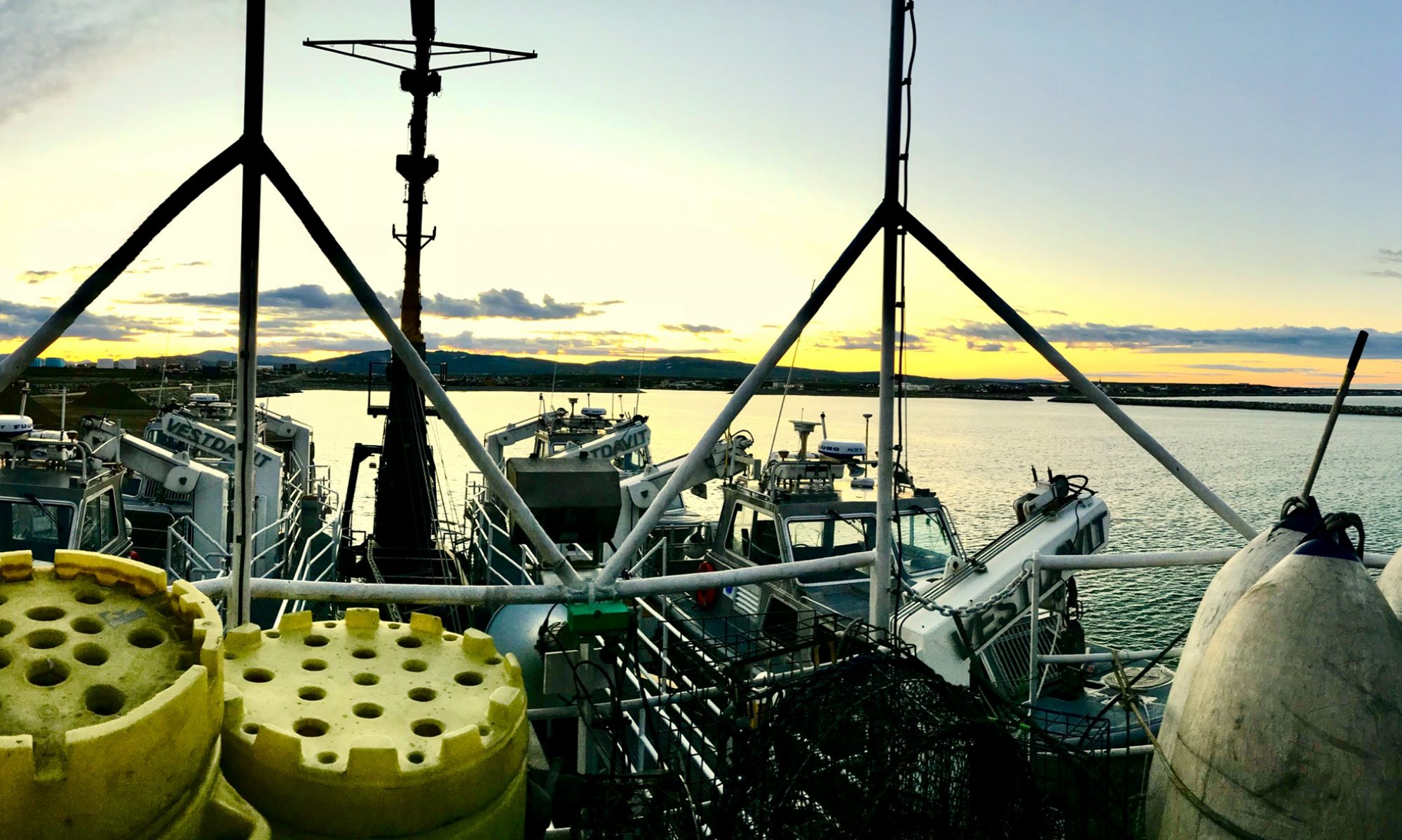
Nick Lee: The Night Shift, July 19, 2024

NOAA Teacher at Sea
Nick Lee
Aboard NOAA Ship Oscar Dyson
June 29 – July 20, 2024

Mission: Pollock Acoustic-Trawl Survey

Geographic Area of Cruise: Eastern Bering Sea

Date: July 19, 2024

Weather Data from the Bridge:

Latitude: 53° 44.5 N

Longitude: 166° 54.0 W

Wind Speed: 15 knots

Air Temperature: 10.9° Celsius (51.62° Fahrenheit)

Science and Technology Log:

As my cruise begins to wrap up, I wanted to highlight some of the people I’ve been working closest with – the scientists on the night shift. Work on the ship continues 24 hours a day, seven days a week, and the night shift works from 4 pm – 4 am. The night shift has the same responsibilities as the day shift of monitoring acoustic data and processing trawls, tasks completed by scientists Sarah Stienessen, Matthew Phillips, and Robert Levine. To learn more about the scientists and their careers, I interviewed each of them:

Why did you decide to become a marine scientist?

Sarah: The short answer is in kindergarten, I checked out a book on dolphins and fell in love with the ocean!

Matthew: I grew up near the ocean, and as a kid, I always loved exploring and finding new fish. I knew I didn’t want to spend every day in an office, and so marine science seemed like a great way to pursue my passion and explore new places.

Robert: I actually wasn’t planning to. I was majoring in geology and environmental science, and I did a field semester in Hawaii. We did a three week class in conservation ecology using passive acoustics, and I thought it was the coolest thing. I did a marine mammal internship with acoustics, and after college, I worked in a zooplankton lab – the rest is history.

Scientist Sarah Stienessen on marine mammal watch. Sarah rests her elbows on a windowsill and looks through binoculars out a large window. Through the windows, we see the sky is gray, and the sea is gray.
Sarah Stienessen on marine mammal watch.

What are your responsibilities during the cruise?

Sarah: My responsibilities are to monitor and analyze the acoustic data and decide when and where to collect a biological sample (trawl) – that’s the daily stuff. I work on combining the acoustic data with the biological sample data to produce abundance and distribution estimates.  I also coordinate pre- and post-cruise logistics.

Matthew: I’m the fish lab lead, so I’m responsible for supervising all of the trawl processing.

Robert: I’m here as an assistant to the fish lab lead and to explore new data types that we could use to enhance our data collection.

Scientist Robert Levine unloading the trawl catch onto the sorting table. Robert wears a heavy orange raincoat and long, elbow-length yellow gloves. He stands behind the sorting table and with his right hand controls the flow of the fish onto the table with a switch or a button on the wall.
Robert Levine unloading the trawl catch onto the sorting table.

What do you enjoy the most about your work?

Sarah: On the boat, it’s teamwork and camaraderie with colleagues. On land, it’s the strategizing and planning around the logistics of fieldwork, both small scale and large scale.

Matthew: Seeing a species that’s new to me! I love seeing new fish, birds, and marine mammals.

Robert: I enjoy the balance between office work, getting to do fieldwork, and working on instrumentation. This group does a lot of research, but it’s all applied, which is the best part.

What part of your career did you least expect?

Sarah: Acoustics, fish, and Alaska!

Matthew: I never expected to be spending so much time in Alaska.

Robert: I never would have thought I would be on a boat actually doing the fishing.

Scientist Matthew Phillips troubleshooting PelagiCam. We see Matthew through an open window in a metal wall, perhaps an outer wall of the ship. He wears a heavy orange reflective coat and a black beanie and works at a laptop on a table at the window. A cable extends from inside the lab through the window out of frame.
Matthew Phillips troubleshooting PelagiCam

What advice do you have for a young person interested in a career in marine science?

Sarah: Take lab-based course work that’s marine related and hands-on. Also, volunteer, intern, try to get a glimpse of the real life experience of what marine science is like. It’s good for giving you connections and for seeing if it’s something you really want to do.

Matthew: Be open-minded about different opportunities and unthought-of locations!

Robert: Find the thing that you like to do or are really good at. If you like chemistry or computer science, get a degree in that. Then apply it to marine science – you don’t have to have a biology degree and you can actually be more effective with an outside perspective.

Personal Log:

When I first boarded NOAA Ship Oscar Dyson I was hoping to be assigned the day shift (4 am – 4 pm). However, after I adjusted to the different sleep schedule, I found myself enjoying the nighttime hours when the ship was quieter. There is still a lot of fish processing to do during the night shift  – this cruise, the ship has actually processed more trawls during our shift! 

While nights are often busy in the fish lab, we’ll also have some downtime between trawls. During a few of these breaks, we played cribbage, a card game that scientist Robert Levine taught me early in the cruise. We’ll also frequent the galley for midnight meals together and to finish off the last of the dessert that our awesome stewards – Danielle and Missy – prepared that day (some highlights include butter mochi, lemon meringue pie, and a zucchini chocolate cake)!

cribbage board and stacks of playing cards on a table
Cribbage Game

On a couple nights, we’ve tracked our candy consumption, competing with the day shift to see who eats more. Being a science team, we felt compelled to convert between different units, expressing our final answer in terms of portion of the bag, mass, and individual sour patch kids!

Did you know?

Because pollock behavior changes at night, the scientists on this particular cruise don’t trawl between sunset and sunrise.

Nick Lee: Fishing, Fishing, Fishing, July 10, 2024

NOAA Teacher at Sea
Nick Lee
Aboard NOAA Ship Oscar Dyson
June 29 – July 20, 2024

Mission: Pollock Acoustic-Trawl Survey

Geographic Area of Cruise: Eastern Bering Sea

Date: July 10, 2024

Weather Data from the Bridge:

Latitude: 50° 40.9 N

Longitude: 178° 29.9 W

Wind Speed: 20 knots

Air Temperature: 6.2° Celsius (43.1° Fahrenheit)

Science and Technology Log:

Last blog post, I talked about acoustic backscatter, which scientists on board use to locate fish. When scientists notice high-intensity backscatter – or backscatter that they’re interested in collecting more biological data about – they’ll call the bridge and ask to go fishing. The bridge then makes the announcement over the radio:

“All stations. This is the bridge. We will be fishing, fishing, fishing.”

This announcement sparks a flurry of action from scientists, NOAA officers, and the deck crew. A few scientists go up to the bridge for a marine mammal watch, where they make sure that there are no marine mammals in the area of the operation. NOAA officers navigate to the science team’s target fishing area, and the deck crew prepares the net to go in the water.

Teacher at Sea Nick Lee on marine mammal watch. Nick stands at a window on the bridge and looks out through binoculars at gray waters under a gray sky.
Marine mammal watch on the bridge.

Before my cruise, I thought fishing nets were relatively simple and uniform. However, I’ve since learned that the net has many different components and sensors, which help scientists collect additional information about the fish seen with acoustics.

Codend

During the trawl, the net is dragged behind the boat. Near the opening at the mouth of the net, the net’s mesh is over a meter wide. This helps reduce drag from the water, while still funneling fish toward the back of the net. The net gradually gets smaller until the very end of the net – called the codend – where the fish are collected. At the end of each trawl, the net is hauled out of the water, and the contents of the codend are emptied into a sorting table for further processing in the fish lab, where length, weight, sex, and maturity are recorded for a representative sample.

Codend being lowered into the water. View of the net suspended by cables from the A-frame at the aft deck of NOAA Ship Oscar Dyson.
Lowering the codend into the water at the start of a trawl.

Pocket Nets

In portions of the net with larger mesh, small fish and other organisms can escape through the holes in the mesh. This creates a problem for scientists – a trawl could show that only adult pollock are present in a certain area when in reality the population is mixed, but all of the juveniles escaped! Since scientists will be using trawl samples to understand the overall population of pollock, they want to avoid bias as much as possible in their data.

Pocket nets. View of the trawl net unspooling over the aft deck.
Pocket nets are fine black mesh on the side of the net made out of the same material as the codend, and they capture organisms that would have otherwise escaped.

To get around this problem, scientists are studying the rates at which different sized pollock (and other organisms) escape from the net. They use pocket nets, or small nets made of the same fine mesh as the codend, to get an idea of what escaped from each trawl. Nine pocket nets are attached to the side, top, and bottom of three different sections of the net with varying mesh sizes. As the trawl net is being hauled back on the boat, one of my jobs is to help empty these pocket nets and collect what’s inside.

We’ve mostly found krill and jellyfish, but occasionally we’ll find a larval fish or squid!

CamTrawl

Near the codend, there is also a camera, referred to as CamTrawl. This camera provides scientists with a visual of what is going into the net, and can be used to help identify species and length of fish that are caught.

On this cruise, scientists are also testing a camera that they lower over the side of the ship (without a net), known as PelagiCam. They are hoping that PelagiCam may be able to collect species and length data, supplementing the data captured when processing fish from the trawl. If PelagiCam can record this data accurately, it could provide an efficient complement to trawling, which requires a lot of time and collaboration between different teams of people.

FS70 Net Sounder

The FS70, nicknamed the Turtle, collects acoustic data and produces a live image of the net’s opening when it is in the water. This data allows scientists and the deck crew to monitor the shape of the net while fishing, ensuring that the net opened correctly. It also monitors when fish enter the net.

Personal Log:

Going fishing can sometimes be a lot of “hurry up and wait.” After the marine mammal watch, at least one scientist stays on the bridge to monitor the net using the FS70, and the others get ready to process the trawl. Letting the net out and hauling it back in is far from simple, however. It requires constant communication between the bridge and the deck crew, and it can be made more complicated by the weather or equipment malfunctions. Once the net is in the water, trawling can take anywhere from 15 minutes to over an hour.

Opening the codend is always exciting, because we’re never quite sure what we caught. While our target is always pollock, we’ll often find other interesting organisms mixed in as well. Some highlights include rockfish, squid, and a smooth lumpsucker.

Did you know?

The net used on NOAA Ship Oscar Dyson was specifically designed for this survey!

Charlotte Sutton: Science at Sea, June 14, 2024

NOAA Teacher at Sea

Charlotte Sutton

Aboard NOAA Ship Reuben Lasker

June 7 – June 18, 2024

Mission: Rockfish Recruitment and Ecosystem Assessment Survey (RREAS)

Geographic Area of Cruise: Pacific Ocean; U.S. West Coast

Date: June 14th, 2024 

Weather Data from the Bridge

Date: Friday, June 14, 2024
Latitude: 33°34.07 N
Longitude: 119°03.108 W
Sea Wave Height: 4ft
Wind Speed: 5.57 knots
Air Temperature: 62°F
Sky: Clear

Science Log

view over the ocean toward the coast. the water is dark, with waves but no whitecaps. we see a thin line of gray clouds in front of the low, gray silhouette of the coastal mountains. beyond the mountains, the sky is orange-to-yellow, fading into gray toward the top of the photo.
View from the deck just before daybreak.

What ocean organisms are you finding?

Each night, the Lasker NOAA Corps Officers, crew, and science team work together to conduct a series of trawls, deploying nets behind the boat to collect samples for the Rockfish Recruitment and Ecosystem Assessment Survey (RREAS).

After the catch from the trawl comes onto the Lasker, scientists identify and measure each of the organisms on board. One of my main tasks during my time as a Teacher at Sea is to help the science team sort and identify the trawl catch each night. A sample of the organisms caught during each trawl, and all of the juvenile rockfish, are collected, labeled and saved for further analysis back at the Southwest Fisheries Science Center Santa Cruz Lab when the science team returns to shore.

Some of the most common organisms caught include pyrosomes, salps (including the large Thetys), krill, and fried egg jellyfish. We also catch a lot of fish, including juvenile anchovy, juvenile hake, many different varieties of myctophid fish, and of course rockfish. To me, some of the most exciting and special organisms caught include the juvenile octopus, all types of squid and king-of-the salmon fish. I am learning so much each day!

Photos: Trawl catch being sorted in the wet lab, trawl catch  just after it came in on the ship.

Photos: Ocean organisms from the trawl being sorted in the wet lab, octopus saved from the catch.

How are marine mammals protected?

Photos: Marine mammal deterrent device (L), mammal watch schedule (R)

view over the aft deck from an upper deck. we can see the a-frame for deploying trawl nets; a folded davit arm; an orange small boat stowed on the starboard side. in the distance, at the horizon, we see the coastal mountain range.
View of marine mammal watch station from deck

Each night, and throughout the night, a member of the science team goes on “Mammal Watch” during trawling operations to protect marine mammals. Fifteen minutes before a trawl, a member of the science team goes up to the bridge mammal watch station, and looks for protected marine mammal species like dolphins, sea lions and whales. If a marine mammal is spotted, then the trawl cannot happen until there are no marine mammals within one nautical mile of the ship. When the trawl begins, another scientist begins mammal watch on the deck from the time the net is launched into the water, until it returns to the ship. Again, if a marine mammal is spotted during this time, the trawl will be canceled and the net will be reeled in immediately.

There are also devices attached to the net called “dolphin deterrent devices.” These devices, often called “dolphin pingers” by the science team, activate as soon as they hit water, and emit sounds to deter dolphins and other marine mammals. This helps to keep marine mammals away from the net to prevent them from getting unintentionally tangled, and do not cause harm to marine animals. 

an orange and gray plastic canister, about 7 or 8 inches in length, with what is likely a loop for a hook at one end. On the orange portion is a beautiful painting of a rockfish in yellow, green, and black.
Retired marine mammal deterrent device with hand-drawn rockfish art (by Jackie – one of the ship’s deck crew)! 

Personal Log

What is the NOAA Corps?

The NOAA Corps is one of the nation’s eight uniformed services, and the only one to consist only of officers. All NOAA Corps Officers attend the Basic Officer Training Class (BOTC) at the U.S. Coast Guard Academy and train alongside Coast Guard officer candidates. NOAA Corps Officers support all aspects of the NOAA mission and may be assigned to serve on either ships or aircraft. The Lasker currently has 6 officers aboard, under the leadership of Commander Claire Surrey-Marsden.

Photos: CDR Claire Surrey-Marsden on the flying bridge, Daily safety meeting in the bridge

I got a chance to interview CDR Claire Surrey-Marsden. Originally from the Bronx in New York City, CDR Surrey-Marsden has always been interested in the ocean and has a background studying marine biology from Florida Tech. After college, she interned and then worked for Florida Fish and Wildlife Conservation Commission, where she worked with manatee conservation. She then applied and was accepted into the NOAA Corps, and went on to officer training at the Global Marine and Transportation School (GMATS) at Kings Point Academy. 

NOAA Corps officers alternate between land and sea assignments in different locations. Her second sea assignment was actually on the delivery team of the NOAA Ship Reuben Lasker, then NOAA’s newest fisheries ship. CDR Claire Surrey-Marsden had land assignments in the Marine Mammal Division, Southwest Fisheries Science Center, and in Washington D.C. working with NOAA Rear Admiral Cary. She now returns to the Lasker on her fourth sea assignment as the Commanding Officer, coming full circle from delivering the same ship early in her career.

When asked what advice she would have for a student interested in a marine science career, CDR Surrey-Marsden advises to volunteer for any opportunity/activity, and to do a good job wherever you go.

Book Recommendations

One of the people I work closely with on the ship is scientist Ily Iglesias. Before arriving on the Lasker, Ily just defended for her P.h.D in ocean sciences at University of California Santa Cruz.

Ily is also a mom to a 3 year old daughter, and they love to read books together. Ily gave me several recommendations of her and her daughter’s favorite science-themed books to read together. Ily has been on survey trips several times, and each time before she leaves she enjoys reading the children’s book Love, Mama by Jeanette Bradley. A story about baby penguin with a mama scientist that goes out to sea on a ship, and both a very relevant and helpful book for Ily and her family. Other ocean related favorites include Who’s Afraid of the Light? by Anna McGregor, and Where the Weird Things Are by Zoleka Filander. I’m excited to read these to my preschool students back in Alaska!

How’s the food?

One of the most asked questions of my family and friends from home is asking about what my meals are like at sea. I am happy to report that the food is great! Breakfast, lunch, and dinner are prepared each day by chefs Arnold and Jude, and available to everyone aboard the Lasker at specific times each day. Working the night shift, I typically begin my day with dinner at 1700, and end it with breakfast at 0700. At night while the science team is working, there is always a full salad bar available, as well as sandwich supplies, snacks and leftovers from the day before. Everyone available on the sip eats together in the “mess” – it’s a great time to relax and get to know everyone.

Photos: Some favorite dinners so far from the cruise.

Christine Webb: August 18, 2017

NOAA Teacher at Sea

Christine Webb

Aboard NOAA Ship Bell M. Shimada

August 11 – 26, 2017


Mission: Summer Hake Survey Leg IV

Geographic Area of Cruise: Pacific Ocean from Newport, OR to Port Angeles, WA

Date: 8/18/2017

Latitude: 48.19 N

Longitude: 125.29 W

Wind Speed: 7.9 knots

Barometric Pressure: 1021.70 mBars

Air Temperature: 55.4 F

Weather Observations: Foggy


Science and Technology Log:

I am learning an unbelievable amount about marine biology! Today I will focus on hake because that is the main type of fish we are surveying on this voyage. Pacific hake are found in great abundance out here off the west coast of North America and Canada. Let me tell you a little bit about what we do.

The first thing we have to do before trawling for hake is find a good aggregation of them based on our acoustics. There is always a scientist in the acoustics lab watching the monitor outputs. The monitors show the acoustics from different frequencies: 18, 38, and 120 KHz. They can “see” when there are things between us and the ocean floor (see picture below). Based on the response of the acoustics to the objects in the water, the scientists make an educated guess about when we are over a hake aggregation. I’ve been learning a lot about how to read these monitors and how to see if we’re over rockfish, phytoplankton, or hake. I think it would be pretty cool to see something giant like a whale go underneath us, but that hasn’t happened. That’s probably for the best – I can’t imagine it’s super safe to have a whale under your ship.

IMG_20170816_090024430_BURST000_COVER_TOP
Acoustic data from the acoustics lab.

Once the acoustic scientists decide we’re over hake, they radio up to the bridge to tell them it’s time to go fishing. The fishermen start getting the nets ready, and the scientists (that’s me!) go up for marine mammal watch. We have to make sure there aren’t any whales or dolphins nearby that might get caught in our nets. I really like marine mammal watch. I get super excited to see whales and dolphins, even though I guess that’s kind of bad because we might have to postpone our trawl. Seeing mammals when we’re not fishing is the most exciting. Today we saw two orcas by the side of our boat – now THAT is cool!

IMG_20170817_103950017_HDR
Me on marine mammal watch

Once the net is fully deployed and well below the surface, the marine mammal watch ends. Then they fish through the sign they saw on the acoustics and bring the net up when they believe they caught an adequate sample. Then it’s time to process the trawl! What we want to see is a majority of hake, but that doesn’t always happen. We’ve had trawls with hundreds of hake, and we’ve had trawls with only seventeen. We sometimes catch a bunch of other stuff too, and we do different things with those creatures (I’ll save that for a different post).

Processing the trawl is pretty intensive. First we have to weigh all of them to get the mass of the entire trawl. Then we sex them to sort into male and female baskets. It’s tricky to tell the difference between males and females. We have to dissect them and find the gonads to be able to tell. Near as I can tell, the male gonads look like ramen noodles and the females look like peach jello. I think of it as, “I wonder what my husband is eating while I’m gone? Probably ramen noodles. Okay, ramen noodles means male.”

IMG_20170818_153044071
Getting ready to sort hake!

Once we have them all sorted, we take length measurements and start extracting the parts we need. The scientists are collecting and preserving the otoliths, gonads, stomachs, livers, and fin clips. We have a LOT of tubes of fish guts in our lab. I’m not entirely sure what scientists will be doing with all of this data, but perhaps I’ll interview our chief scientist about this and put it in a future post.

Personal Log:

Everyone I’ve met on this ship has been so friendly! One of my favorite things about it is that these people seem so passionate about whatever they’re doing. You should have seen my friend Hilarie’s face today when we pulled up a trawl full of pyrosomes (that’s what she studies). Tracie showed me some of the phytoplankton she’s studying, and it was like she was a little kid at Christmas. Personally I’ve never been super interested in phytoplankton, but now I am. She makes it sound like it’s the most exciting subject on earth, and looking at her slides makes me believe her.

IMG_20170817_081818382
Tracie studying phytoplankton

It’s not only the scientists who are passionate about their work. The chief steward, Larry, was so excited about his cauliflower soup today that he seemed personally offended when I didn’t take any. “Take some soup!” he said. “Seriously – it’s really good soup. You’re going to like it.” I took some just to be nice, but after one bite I said, “Larry, will this be out at dinner? Can this please be out at dinner? I LOVE IT.” It was seriously good. I need to learn how to make that.

Our chief scientist takes her job as chief very seriously too. She’s like the momma duck who takes care of all of us (thanks, Julia!). Also, she plans fun and goofy games every day where we can win prizes out of her “bag of goodies.” I haven’t won yet, but I hope I will before this is over. Today Hilarie won some awesome coral reef socks. I’m not sure how I’ve gotten this far in life without owning marine biology socks! It’s great to have Julia around because she makes time for all of us even though her own research is very absorbing and important. She’s a rock star.

IMG_20170818_181046070_HDR
Hilarie choosing her prize

Stay tuned for more info from Leg 4 – bye for now!