
Kiersten Newtoff: How My College Choice Led Me Here, May 26, 2023

NOAA Teacher at Sea

Kiersten Newtoff

Aboard NOAA Ship Oregon II

June 3 – June 16, 2023

Mission: Groundfish Survey

Geographic Area of Cruise: Gulf of Mexico

Departure Port: Pascagoula, MS

Arrival Port: Galveston, TX

Date: May 26, 2023

The inner marine biologist in me is EXCITED. I shouldn’t say inner, as I do have a master’s degree in marine biology! But I definitely feel like a phony as I studied birds… on land… and never once needed to snorkel or SCUBA dive. I am embarrassed to admit it given my educational background and the fact that I grew up in a coastal town, but I cannot even swim. So sure, sign me up to live on a boat for two weeks!


A life-sized dolphin statue, mounted on a black post in a rock bed lining a brick building. The dolphin is painted with images of dolphins and other marine life (fish, seahorses) swimming in a deep blue background.
One of the hundreds of dolphin statues that dot the Virginia Beach, VA landscape. Photo by Mechelle Hankerson.

If I were to trace back the threads to how I ended up in NOAA’s Teacher at Sea program, it would likely have started in 2007, when I was a junior in high school. Like other juniors, we were all feverishly searching College Board on universities to attend, majors to study, and regions to live in. Growing up in a coastal town and like many girls my age, I was obsessed with dolphins. To be fair, we literally have statues of dolphins all over my hometown, so how can you not be intrigued by them?! In Virginia at the time, there was only one university that offered a degree in marine biology: Old Dominion University. Unfortunately, ODU was only 15 minutes from where I grew up and I was ready to spread my wings and fly a little further from the nest. A great school I found for marine biology was the University of North Carolina Wilmington (UNCW), where I applied and was accepted, but the out-of-state tuition was too great for me to financially handle. After conducting more searches on College Board, I applied to Radford University, which is in the mountains of Virginia. Here, I settled into a degree program in Biology, with a concentration of Environmental Biology.

One of the requirements of the Environmental Biology concentration is to take a GIS course. GIS stands for geographic information systems and is a growing technology that has unlimited applications. The intro class I took focused on how to use ArcGIS, the software that is used in the industry. I elected to take an intermediate class where I got to practice my skills more and learn about the applications of the tool. I was the only biology major (and woman!) taking the intermediate course, which is surprising given how much GIS is used in the field now.

As my years at Radford came to an end, I knew that I wanted to teach. I had earned countless opportunities in various teaching or tutoring roles at the college and enjoyed every minute. Well, not every minute. I would get incredibly nervous before each class period and that… processed itself… in different ways… Anyway, if I wanted to pursue a career as a professor, I needed to at least get my master’s degree. With the help of my college professors, they reviewed my materials and shared the expectations of grad school, how to apply, and how to find a research mentor. Since funding was less of an issue as a graduate student, I was not worried about staying within the confines of Virginia. With this boundary lifted, I also set my eyes back on marine biology.

With my environmental background, I was able to shift my mindset away from dolphins to focusing on how humans impact marine organisms. I sent emails to over 50 different professors across 20+ schools and maybe only heard back from about half. I interviewed at 5 different schools, got a verbal offer to study sharks, but was rescinded when their funding fell through. One of the last people I emailed was Dr. Steve Emslie, whose lab at UNCW focused on mercury toxicology in marine birds. I had no interest in birds, and I think they are cheating at being considered a marine animal, but I was starting to realize I needed to expand my scope more because marine biology is a competitive field. And opportunities to study marine organisms larger than an oyster are even more competitive. Steve brought me on to his lab where I shifted my previous dolphin obsession to birds.

I definitely… terned 

Dozens (hundreds?) of two species of terns crowd a beach area. Most are standing, though a few have their wings outstretched. ALl of the terns are white, with black legs, andblack, tufted crowns. The sandwich terns have black bills, while the royal terns have vibrant orange bills.
Colony of Sandwich (foreground) and Royal Terns (background). Photo by Kiersten during graduate school research in the Cape Fear Estuary, North Carolina.
Kiersten, wearing shorts, a t-shirt, a hat, and sunglasses on a sunny day, poses for a photo while gripping a brown pelican carefully with two hands. Her left hand hoists the bird's back, between two semi-outstretched wings, while her left hand holds its bill closed. The pelican braces itself against her middle with its left foot. The right ankle sports a metal band. In the background, we see upland marsh plants, water in the distance, more shoreline beyond the water, and birds flying in the air.
Picture of Kiersten holding a Brown Pelican that she just banded. Taken at Ferry Slip Island in the Cape Fear Estuary, NC.

While I could drone on and on about my research on Brown Pelicans and their mercury loads, we need to focus on the GIS, which is the thread that led me to NOAA. With my fundamental GIS background, I added a spatial variability component to my research to analyze how mercury concentration in Brown Pelican tissues in their breeding colonies varies over space. At UNCW, I took a higher level GIS course entitled Environmental GIS. In this course, I was able to learn about the ecological applications of GIS and about the exciting world of remote sensing. When you think of satellites, you likely think of sensors looking for alien life or GPS or Starlink. And while that is true, NASA has a series of satellites that point back at Earth that remotely sense various parameters, such as particulate matter in our atmosphere, the amount of chlorophyll a on a surface, water temperature, soil moisture, and so much more.

Near the end of the semester, a student in this course shared about an internship she completed and passed out flyers around the room. I took one, but it wasn’t related to teaching so I didn’t immediately jump on it. At this point, I was nearing graduation and was starting my search for a full-time faculty role. Looking back, it was quite ambitious to think I was just going to land a full-time faculty position directly out of my master’s degree. But I did try! I was able to get a couple interviews but was always outcompeted by someone with far more experience than me. Panicking that I need an income after I finished school, I applied for the internship.

a graphic depicting illustrations of satellites on orbits around earth. there are fifteen in this illustration, orbiting earth on three arcs.
Graphic of a subset of NASA’s Earth Observing Satellites. Created by NASA.

In the summer of 2014, I started my internship at NASA Goddard Space Flight Center in the DEVELOP program. This program utilizes Earth remote sensing to answer ecological questions for organizations around the world. The project that I had worked on that summer was using satellite imagery to measure forest fragmentation. We then compared it to bird presence data, which we collected from the Breeding Bird Survey, a yearly bird count through the U.S. Geological Survey. There were 7 other interns working together in a windowless office that was probably 150 sq ft in size. I would not be surprised if this was originally a storage room, given the wires, pipes, and electrical boxes found in the room.  

Let’s do a quick speed run through parts that do not matter too much to this story: I worked at NASA Goddard for about 1.5 years before transitioning to teaching. I had been teaching part-time at a local community college for some of that time and received another part-time role, leading me to leave NASA. I worked at two institutions for a year, before getting the opportunity to move to China to teach the sciences at an international high school. I was there for 6 months before moving back in January 2017 to the United States after landing a full-time professorship at Montgomery College, a community college in Maryland. I have been with MC since then teaching ecology, evolution, and environmental biology.

Flash forward to 2019, and I see a post by one of my friends on social media. This friend was one of the other interns at NASA, whom I literally shared a desk with (it was a very small office space), who went on to work with the U.S. National Weather Service. And, if you did not already know, they are a part of NOAA! Jamie had shared about the Teacher at Sea program on his social media and after I read through the stories of educators on board, I knew I needed to apply. Add in four years while the world sorted itself, and here I am!

screenshot of a Facebook post from October 24, 2019 announcing NOAA's Teacher at Sea Program's application.

I am incredibly excited for this opportunity. The groundfish survey measures population size structures of the species caught and characterizes the water column at the sampling locations. I look forward to creating data driven lessons for my students to use statistics to measure diversity between stations and to compare that diversity with water quality samples. Our world is changing, and if we are to do something about it, we need to understand it.
Lisa Battig: Getting Excited for an Upcoming Adventure… August 18, 2017

NOAA Teacher at Sea

Lisa Battig

Aboard NOAA Ship Fairweather

August 28 – September 8, 2017


Mission: Hydrographic Survey leg IV

Geographic Area of Cruise: Alaska

Date: August 19, 2017

Weather Data from the Bridge (well, from my home city): 33.656311, -117.887800

I haven’t left yet, so I’ll just report on weather here in coastal southern California. It is a fairly typical August day, late morning temperatures in the high 70s, blue skies and a light 4 knot breeze from 235 deg SW. Yes, there is a reason so many people come to live here, but I’m personally ready for the far more extreme temperatures I will get to experience 30 degrees further north and 50 degrees further west!

Science and Technology Log

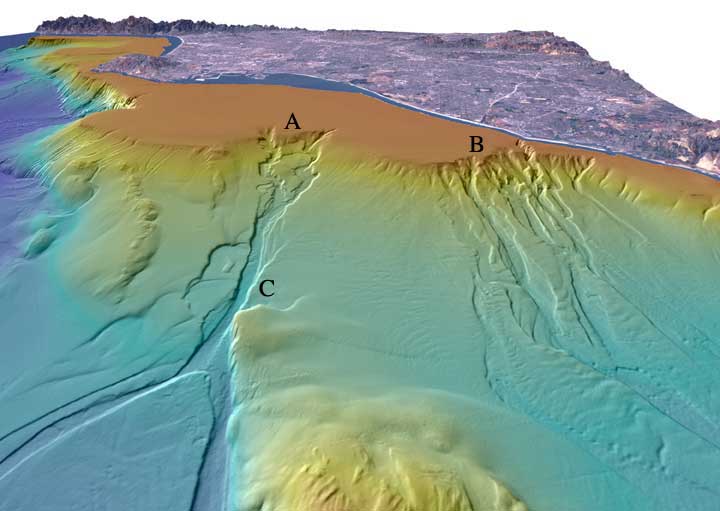
I have the privilege of being a part of the NOAA Ship Fairweather crew for 10 days. We will be off the coast of Alaska doing hydrographic surveys.  While I don’t totally know what to expect, I know that the end goal is mapping for navigation purposes and that the sonar can give some other information, too. Ultimately, that and other hydrographic survey data can be used to make maps and I LOVE maps. This one below (courtesy of USGS) shows the submarine canyons at the end of the Los Angeles River and the Santa Ana River off the coast of Southern California. It’s so cool to have a visual sense of what you’re surfing, paddling, swimming or fishing over.

https://upload.wikimedia.org/wikipedia/commons/8/85/Canyons_off_LA.jpg
A map of the submarine canyons at the end of the Los Angeles River and the Santa Ana River off the coast of Southern California (source: USGS)

So, what I do know about what we’re doing is that we’ll be taking side scan sonar data of an area around Nome, Alaska in the Bering Sea. I know that the ship will be running some predetermined patterns to add to an existent database that was begun with legs I, II, and III of this same mission. The ship, by the way, is the Fairweather(image courtesy of NOAA)

NOAA Ship Fairweather
NOAA Ship Fairweather (credit: NOAA)

She’s quite grand and I can’t wait to board and to meet all of the shipboard personnel and learn more about the operations firsthand. I’ll have lots of science and procedure and people to talk about in my next post, I’m sure.

Personal Log and Introduction

Lisa Battig, here! I’ve been teaching at Fountain Valley High School since 2007. Fountain Valley High School is a comprehensive public high school with about 3,800 students. I currently teach Chemistry and Environmental Science there and I love it!  “FVHS” is filled with teachers who are adventurous and willing to try new things. As a result, we’ve always had an administration that is exceedingly supportive of teacher ideas. The culture is collaborative, encouraging and exciting. I could not wish for a better school. Then there are the 3,800 talented young people who walk on campus every day who really make it a fun place to work. Here is an image of me with 64 of them (and lots of parent chaperones!) at Joshua Tree National Park this past January:


DSC_0127
Fountain Valley High School students at Joshua Tree National Park

So a bit more about me…

I couldn’t tell the story of where I am now without paying homage to the great Bob Perry. You may not have the privilege of knowing Bob, but that man has inspired probably thousands of students over his career. He was my high school marine biology teacher who also was a master dive instructor, owned his own boat, wrote his own plankton keys, did photography on the side, expected his first year students to do real research and read journal articles, taught us DOS commands and some Basic so we could analyze our data on a computer (1987!!), and had his classes out in the field at the local pier weekly taking raw data. Not to mention he had a research permit and kept three enormous saltwater tanks in the back of his room holding local species so we would be familiar with them and kept a wet table in class that I used when I took an independent research course with him during my senior year.

I was challenged by him, certified in SCUBA by him, encouraged by him, directed by him, mentored by him and ultimately owe at least 80% of what I do in the classroom today to him and his methods.

That spark of interest in high school was the impetus for my undergraduate Marine Biology degree. The ocean was and still is one of my greatest passions. In my college years, I was again blessed with a professor who allowed me to help with his research on copepods and who made certain that we had plenty of time in the field doing trawls, dredges, plankton tows and so much more. Sadly, though, with just an undergraduate degree it was difficult to find anyone willing to pay me to sit in the ocean and hang out with dolphins all day. But my program had been broad and garnered me a minor in Chemistry, also. So out of college I went to work as an analytical chemist instead. That later led me into a varied and interesting career in technical sales and then finally into teaching. It was a good place for me to land – and it’s allowed me to indulge my desires to become more involved in Environmental Science. I went back to school for my MS in Environmental Science a few years ago and was able to develop a sanitation and hygiene education program to be used with small communities throughout the world. This is part of the program being used one on one by a volunteer in a village in El Salvador.

Applying Glo Germ
Sanitation and hygiene education program in El Salvador

I haven’t lost my love of the ocean, nor my love of research. These days, I indulge the former through surfing and offering my AP students the opportunity to get SCUBA certified. Their certification ends with a three day boat trip to dive spots all around Catalina Island. For the research component, I have my AP students develop their own field or lab research and present the findings in a poster session at the end of the school year. I also find whatever research might be available to me through summer programs and the like. I’ve been able to assist in two local university labs through Howard Hughes Medical Institute grants. The experiences have had broad impacts on me personally and definitely on my teaching as well.

Nias 2
A surfer off of Nias Island


(For clarification, I am behind the camera for this Nias Island beauty, not behind the sheet of water. It was the best surf trip of my life! But this one day was a bit too big for me.)

And finally, how I got involved with the NOAA Teacher at Sea program.

My first year of teaching in 2005, I had a mentor who was chosen to be a part of the Teacher at Sea program. His stories immediately sparked my interest in it and I started dreaming about where I might be able to go and what I might be able to do. Unfortunately, each year some challenge would prevent me from applying. Last November, though, all the pieces finally fell into place and I was able to get that application in. Now I find it almost impossible to believe that a 12 year dream is finally coming to fruition! Again, I am so thankful to have a supportive administration that is willing to let me miss some school so that I can bring real world research, application and STEM connections back into the classroom.

Did You Know?

The solar eclipse of August 21, 2017 will only cover approximately 28% of the sun in Nome, Alaska where I’ll be embarking. However, on March 30, 2033 Nome will be one of the few land masses to be awarded a total eclipse!


Caitlin Fine: Flexibility! August 6, 2011

NOAA Teacher at Sea
Caitlin Fine
Aboard University of Miami Ship R/V Walton Smith
August 2 – 7, 2011

Mission: South Florida Bimonthly Regional Survey
Geographical Area: South Florida Coast and Gulf of Mexico
Date: August 6, 2011

Weather Data from the Bridge
Time: 4:24pm
Air Temperature: 31.6°C
Water Temperature: 32.6°C
Wind Direction: Southwest
Wind Speed:  4 knots
Seawave Height: calm
Visibility: good/unlimited
Clouds: partially cloudy (cumulous and cirrus clouds)
Barometer: 1013nb
Relative Humidity: 62%

Science and Technology Log

Many of you have written comments asking about the marine biology (animals and plants) that I have seen while on this cruise. Thank you for your posts – I love your questions! In today’s log, I will talk about the biology component of the research and about the animals that we have been finding and documenting.

We have another graduate student aboard, Lorin, who is collecting samples of sargassum (a type of seaweed).

Sargassum sample from Neuston net tow

There are two types of sargassum. One of those types usually floats at the top of the water and the other has root-like structures that help it attach to the bottom of the ocean.

Lorin is filtering a sample from the Neuston net in the web lab

We are using a net, called a Neuston net, to collect samples of sargassum that float. The Neuston net is towed alongside the ship at the surface at specific stations. This means that the ship drives in large circles for 30 minutes which can make for a rocky/dizzy ride – some of the chairs in the dry lab have wheels and they roll around the floor during the tow!

Towing the Neuston net along the side of the ship

Lorin and other researchers are interested in studying sargassum because it provides a rich habitat for zooplankton, small fish, crabs, worms, baby sea turtles, and marine birds. It is also a feeding ground for larger fish that many of you may have eaten, such as billfish, tuna, and mahi mahi.

Small crab that was living in the sargassum

The net not only collects sargassum, but also small fish, small crabs, jellyfish, other types of seaweed, and small plankton.

Small fish from the Neuston net

Plankton can be divided into two main categories: zooplankton and phytoplankton. As I  said in my last post, phytoplankton are mostly very small plants or single-celled organisms that photosynthesize (they make their own food) and are the base of the food chain. Zooplankton are one level up on the food chain from phytoplankton and most of them eat phytoplankton. Zooplankton include larva (babies) of starfish, lobster, crabs, and fish.

Small zooplankton viewed through the dissecting microscope

We also use a Plankton net to collect samples of plankton. This has a smaller mesh, so it collects organisms that are so small they would fall through the Neuston net. Scientists are interested in studying the zooplankton that we catch in the Plankton net to understand what larger organisms might one day grow-up and live in the habitats we are surveying. They study the phytoplankton from the Plankton net to see what types of phytoplankton are present in the water and in what quantities.

Washing off the Plankton net

Today we collected so many diatoms (which are a type of phytoplankton) in the Neuston net that we could not lift it out of the water! This tells us that there are a lot of nutrients in the water (a diatom bloom) – maybe even harmful levels. I am bringing some samples of the diatoms and zooplankton home with me so we can look at them under the microscopes at school!

Evidence of a diatom (phytoplankton) bloom in the Gulf of Mexico

The marine biologists on this cruise are mainly interested in looking at phytoplankton and zooplankton, but we also have seen some larger animals. I have seen many flying fish skim across the surface of the water as the boat moves along. I have also seen seagulls, dolphins, sea turtles, cormorants (skinny black seabirds with long necks), and lots of small fish.

Small flying fish from the Newston net

Personal Log

Working as an oceanographer definitely demands flexibility. I have already mentioned that we chased the Mississippi River water during our second day. After collecting samples, we had to find blue water (open ocean water) to have a control to compare our samples against.  We traveled south through the night until we were about 15 miles away from Cuba before finding blue water. All of this travel was in the opposite direction from our initial cruise plan, so we have had to extend our cruise by one day in order to visit all of the stations that we need to visit inside the Gulf of Mexico. This has meant waking-up the night shift so we can all change their airplane tickets and looking at maps to edit our cruise plan!

Changes to our cruise plan on the survey map

Many of you are writing comments about sharks – I have not seen any sharks and I will probably not see any. The chief scientist, Nelson, has worked on the ocean for about 33 years and he has sailed for more than 1,500 hours and he has only seen 3 sharks. They mostly live in the open ocean, not on the continental shelf where we are doing our survey. If there were a shark nearby, our ship is so big and loud that it would be scared away.

Playing with syringodium

Today I saw a group of about 4 dolphins off the side of the ship. They were pretty far away, so I could not take pictures. Their dorsal fins all seemed to exit the water at the same time – it was very beautiful. A member of the crew spotted a sea turtle off the bow (front) of the ship and I saw several different types of sea birds, especially seagulls.

Yesterday afternoon we passed through the Gulf of Mexico near the Everglades and there were storm clouds covering the coastline. The crew says that it rains a lot in this part of the Florida coast and that Florida receives more thunderstorms than any other state. It is strange to me because I always think of Florida as “the sunshine state.”

Grey sky and green water in the Gulf of Mexico

The color of the ocean has changed quite a lot during the cruise. The water is clear and light blue near Miami, clear and dark blue farther away from the coast in the Atlantic Ocean, cloudy and yellow-green in coastal Gulf of Mexico, and cloudy and turquoise in the Florida Bay. Scientists say that the cloudiness in coastal Gulf of Mexico is caused by chlorophyll and the cloudiness in the Florida Bay is caused by sediment.

It has been hot and sunny every day, but the wet lab (where we process the water samples and marine samples), the dry lab (where we work on our computers), the galley and the staterooms are nice and cool thanks to air conditioning! I can tell that I am getting used to being at sea because now when we are moving, I feel as though we are stopped. And when we do stop to take measurements, it feels strange.

Did you know?

NOAA does not own the R/V Walton Smith. It is University of Miami ship that costs NOAA from $12,000 to $15,000 a day to use!

Organisms seen today…

–       Many sea birds (especially seagulls)

–       2 cormorants (an elegant black sea bird)

–       10-12 dolphins

–       1 sea turtle

–       Lots of small fish

–       Lots of zooplankton and phytoplankton (especially diatoms)

–       Sargassum and sea grass

Caitlin Fine: Mississippi River Chasers! August 3, 2011

NOAA Teacher at Sea
Caitlin Fine
Onboard University of Miami Ship R/V Walton Smith
August 2 – 6, 2011

Mission: South Florida Bimonthly Regional Survey
Geographical Area: South Florida Coast and Gulf of Mexico
Date: August 3, 2011

Weather Data from the Bridge

Time: 10:18pm
Air Temperature: 29.5°C
Water Temperature: 31.59°C
Wind Direction: North
Wind Speed: 3 knots
Seawave Height: calm
Visibility: good/unlimited
Clouds: Partially cloudy (cumulos and cirrus)
Barometer: 1011.0mb
Relative Humidity: 72%

Science and Technology Log

The oceanographic work on the boat can be divided into three categories: physical, chemical, and biological. In this log, I will explain a little bit about the part of the research related to the physics of light. Upcoming 5th graders – pay attention! We will be learning a lot about light in January/February and it all relates to this research project.

Brian and Maria are two PhD students who are working with the physical components. They are using several optical instruments: the SPECTRIX, the GER 1500, the Profiling Reflectance Radiometer (PRR), and the Profiling Ultraviolet Radiometer (PUV).

Bryan and Maria
Brian and Maria take optic measurements with the SPECTRIX and GER 1500

The SPECTRIX is a type of spectroradiometer that measures the light coming out of the water in order to understand what is in the water. For example, we can measure the amount of green light that is reflected and red and blue light that is absorbed in order to get an idea about the amount of chlorophyll in the water. This is important because chlorophyll is the biggest part of phytoplankton and phytoplankton are tiny plant-like algae that form the base of the food chain on Earth.

PUV
Brian lowers PRR into the water

The PRR and the PUV measure light at different depths to also understand what is in the water and at what depth you will find each thing in the water. The light becomes less bright the further down you go in the water. Most of light is between 0-200 meters of depth. The light that hits the water also becomes less bright based upon what is in the water. For example, you might find that chlorophyll live at 10 meters below the surface. It is important to understand at what depth each thing is in the water because that tells you where the life is within the ocean. Most of the ocean is pitch-black because it is so deep that light cannot penetrate it. Anything that lives below the light level has to be able to either swim up to get food, or survive on “extras” that fall below to them.

Personal Log

These few days have been very fun and action-packed! I arrived on the ship on Sunday afternoon and helped Nelson and the crew get organized and set-up the stations for the cruise. Several other people had also arrived early – two graduate students who are studying the optics of the water as part of their PhD program, one college student and one observer from the Dominican Republic who are like me – trying to learn about what NOAA does and how scientists conduct experiments related to oceanography.

On Monday morning, we gathered for a team meeting to discuss the mission of the cruise, introduce ourselves, and get an updated report on the status of the Mississippi River water. It turns out that the water is going in a bit of a different direction than previously projected, so we will be changing the cruise path of the ship in order to try to intersect it and collect water samples.

CTD
I am helping lower the CTD into the water

Monday we all learned how to use the CTD (a machine that we use to collect samples of water from different depths of the ocean) and other stations at the first several stops. It was a bit confusing at the beginning because there is so much to learn and so many things to keep in mind in order to stay safe! We then ate lunch (delicious!) and had a long 4-hour ride to the next section of stops. When we arrived, it was low tide (only 2 ft. of water in some places) so we could not do the sampling that we wanted to do. We continued on to the next section of stops (another 3 hour ride away!), watched a safety presentation and ate another delicious meal. By this time, it was time for the night shift to start working and for the day shift to go to bed. Since I am in the day shift, I was able to sleep while the night shift worked all night long.

Today I woke up, took a shower in the very small shower and ate breakfast just as we arrived at another section of stops. I immediately started working with the CTD and on the water chemistry sampling. We drove through some sea grass and the optics team was excited to take optical measurements of the sea grass because it has a very similar optical profile to oil. The satellites from space see either oil or sea grass and report it as being the same thing. So scientists are working to better differentiate between the two so that we can tell sea grass from oil on the satellite images. The images that Maria and Brian took today are maybe some of the first images to be recorded! Everyone on the ship is very excited!

Several hours later, we came to a part of the open ocean within the Florida Current near Key West where we believe water from the Mississippi River has reached. Nelson and the scientific team believe this because the salinity (the amount of dissolved salt) of the surface water is much lower than it normally is at this time of year in these waters. Normally the salinity is about 36-36.5 PSUs in the first 20 meters and today we found it at 35.7 PSUs in the first 20 meters. This may not seem like a big difference, but it is.

The water from the Mississippi River is fresh water and the water in the Florida Keys is salt water. There is always a bit of fresh water mixing with the salt water, but usually it is not enough to really cause a change in the salinity. This time, there is enough fresh water entering the ocean to really change the salinity. This change can have an impact on the animals and other organisms that live in the Florida Keys.

Additionally, the water from the Mississippi River contains a lot of nutrients – for example, fertilizers that run off from farms and lawns into gutters and streams and rivers – and those nutrients also impact the sea life and the water in the area. Nelson says that this type of activity (fresh water from the Mississippi River entering the Florida Current) occurs so infrequently (only about ever 6 years), scientists are interested in documenting it so they can be prepared for any changes in the marine biology of the area.

For all of these reasons and more, we took a lot of extra samples at this station. And it took almost 2 hours to process them!

In the evening, we stopped outside of Key West and the director of this program for NOAA, Michelle Wood, took a small boat into the harbor because she cannot be with us for the entire cruise.

Key West
Sunset over Key West - a beautiful way to end the day

She asked me if I’d like to go along with the small boat to see Key West, since I have never been there before, and of course I agreed! I got some great pictures of the R/V Walton Smith from the water and we saw a great sunset on the way back to the ship after dropping her off with Jimmy Buffet blasting from the tourist boats on their own sunset cruises.

We will be in the Mississippi River plume for most of tonight. Everyone is very excited and things are pretty crazy with the CTD sampling because we are doing extra special tests while we are in the Mississippi River plume. We might not get much sleep tonight. I will explain in my next blog all about the chemistry sampling that we are doing with the CTD instrument and why it is so important.

Did you know?

On a ship, they call the kitchen the “galley,” the bathroom is the “head,” and the bedrooms are called “staterooms.”

One interesting thing about the ship is that it does not have regular toilets. The ship has a special marine toilet system that functions with a vacuum and very thin pipes. If one of the vacuums on one of the toilets is not closed, none of the toilets work!

Animals seen today…

  • Zooplankton that live in the sargassum (a type of seaweed that usually floats on the water) –baby crab, baby shrimp, and other zooplankton. The sargassum is a great habitat for baby crab, baby shrimp, and baby sea turtles.
  • Baby flying fish
  • Two juvenile Triggerfish

    Triggerfish
    We caught a young triggerfish in our tow net

Channa Comer: The End of the Journey, May 21, 2011

NOAA Teacher at Sea
Channa Comer

On Board Research Vessel Hugh R. Sharp
May 11 — 22, 2011


Mission: Sea Scallop Survey Leg 1

Geographical area of cruise: North Atlantic
Date: Saturday, May 21, 2011

Final Log
This will be my final log of the cruise. Unlike previous posts, it will not be separated into a science and a personal log. For my final post, I’ve integrated the two because what I’ve

The Last Tow
The Last Tow

gained from the trip is both scientific and personal. In addition to all that I’ve learned about what happens on a Sea Scallop Survey, the FSCS, scallops in general, and many of the other creatures that live on the North Atlantic Ocean floor, I will be taking home new questions to answer and new avenues to explore.

This was my first experience with marine biology and I couldn’t have had a better one. Rather than reading about the ocean in a textbook, I was able to experience it, in all its grandeur, wonder, beauty, diversity, and unpleasantness (sea sickness, green sand dollar slime, sea squirts, sea mouse). I also couldn’t have asked for better hosts that all the people at NOAA who helped to make this trip possible –everyone in the Teacher at Sea program who helped before the trip and everyone here on the boat.

With the many, many, many tows and baskets and baskets of sand dollars, I’ve developed a fascination with them and many questions to answer when I get home. While I’ve learned a bit about them here on the ship, there is still so much to learn about them. Why are they in such abundance in certain areas? How can you tell the difference between a male and a female? How exactly do they reproduce? What is there function in the deep sea food web? What is their life span? Why the green slime? If their anus and mouth is in the same place, how what mechanism exists to turn one function off when the other is active? If any of you know the answers to these questions, feel free to share.

I owe a special debt of gratitude to Vic, the chief scientist who was always willing to share whatever he knows (and he knows a lot), answer all of my many questions, always went out of his way that I had everything that I needed to fulfill my Teacher at Sea obligations, and made me feel like part of the “family.” I am also extremely thankful to all the other members of my watch (and Chief Jakub) for being such an amazing group to work with. We worked together for 12 hours each day for 11 days and NEVER HAD A FIGHT! Everyone always made a conscious effort to be kind, courteous and helpful. Definitely a great lesson to take back with me. One of the most special things about this experience has been the opportunity to get to know the people on board, to learn about their varied backgrounds and how they ended up where they are.
Through my participation in the Teacher at Sea program, I’ve also learned a greater appreciation for the food that I eat. There is so much that happens before food gets to my plate that I usually take for granted. In the case of scallops, the Sea Scallop Survey is just one part of a very complex picture that includes fishermen who make a living for themselves and provide jobs and opportunities for others, all of the organisms who share the ocean with scallops that are affected by scallop fishing, the ocean ecosystem, and the consumers who buy and eat scallops. In reflecting on this, I’m reminded of a series of articles that I read recently about integrating Native American science (viewing science from a holistic perspective with consideration of how our choices affect ecological balance) with western science. While our immediate needs and wants cannot be minimized, as a society, we could definitely benefit a broader, more long-term view of how our choices affect us over the long term, especially as we are faced with diminishing resources and an ever-expanding population.

Thanks to all of you who followed my adventure by reading the blog. And thank you for your comments, both on the blog and via email.

Until the next adventure…………