Mission: Alaska Walleye Pollock Survey Geographical Area: Gulf of Alaska Date: July 6th, 2013
Location Data from the Bridge: Latitude: 55.29.300 N
Longitude: 156.25.200 W
Ship speed: 10.7 kn
Weather Data from the Bridge: Air temperature: 8.6 degrees Centigrade
Surface water temperature: 8.6 degrees Centigrade
Wind speed: 14 kn
Wind direction: 210 degrees
Barometric pressure: 1008.5 mb
Science and Technology Log:
The Oscar Dyson is equipped with several labs to accommodate the researchers on board. In this blog post I will describe to you what is happening in the wet/fish lab. This is where I have experienced quite a bit of hands-on data collection.
Pollock being separated on the conveyor belt.Basket full of pollock.
After a trawl, the crew dumps the load of fish into a bin. Inside the lab we can raise or lower this bin to control the amount of fish coming onto a conveyor belt. Once the fish are on the belt the scientists decide how they will be separated. We separate the pollock according to age into baskets. They are categorized by size; under 20 cm (age 1), under 30 cm (age 2), and any larger than 30 cm
A lumpsuckerA basket full of small squid
At this time we also pull out any other sea creatures that are not pollock. So far we have pulled up quite a few jelly fish, la lumpsucker, shrimp, squid, eulachon, and capelin. These are also weighed, measured, and in some cases frozen per request of scientists not currently on board.
Larger squid.
After organizing the pollock into appropriate age groups, we then measure and record their weight in bulk. Scientists are using a scale attached to a touch screen computer with a program called CLAMS to record this information. The pollock are then dumped into a stainless steel bin where their sex will be determined. In order to do this the fish must be cut open to look for “boy parts, or girl parts”. After the pollock are separated into female and male bins we begin to measure their length.
This is the tool used for measuring length of the fish.
The tool used to measure length is called the Ichthystick. This tool is connected to the CLAMS computer system. The fish is placed on the Ichthystick and a pointer with a magnet in it is placed at the tail end of the fish. There are three different types of length measurement that can be done: fork length, standard length, and total length. When the magnetic pointer touches the Ichthystick it senses that length and sends the information to the CLAMS computer system.
Northern shrimp
One of these bins of fish is placed aside for individual weighing, length measurements, and removal of otoliths. You may recall that I mentioned otoliths in the last blog post. These ear bones are sent to a lab and analyzed to determine the age of each of these individually measured fish. The Alaska Fisheries Science Center has created a demonstration program where you can try to determine the age of different types of fish by looking at their otoliths. Click here to try it yourself! (I will add hyperlink to: http://www.afsc.noaa.gov/refm/age/interactive.htm)
Personal Log:
Ben and Brian in fire gear with flares.
One afternoon while waiting for the fishermen to bring up the trawl net, I watched a group of porpoises swimming behind the ship. Another day I was able to see whales from up on the bridge. These were pretty far out and required binoculars to see any detail. I observed many spouts, saw one breach, and some flukes as well.
There is quite a bit of downtime for me on the ship while I am waiting in between trawls. I get to read a lot and watch movies in my free time. I have had the opportunity to talk with different members of the crew and learn about their roles a bit. The chief engineer gave me a tour of the engine rooms (more about this with pictures in a future post.)
The 4th of July fireworks show on the Oscar Dyson was like no others I have ever experienced. Two of our crew, Ben & Brian, dressed in official fire gear shot expired flares off the ship into the sea. America themed music was played over the PA system. I have attached a video of our fireworks display. Happy Independence Day everyone!
Weather Data from the Bridge
Air temperature: 7.9ºC (46.2ºF)
Surface water temperature: 7.3ºC (45.1ºF)
Wind speed: 10.7 knots (12.3 mph)
Wind direction: 323ºT
Barometric pressure: 1007 millibar (0.99 atm, 755 mmHg)
Science and Technology Log
In a recent post, I talked about how one of the things we are doing on board the Oscar Dysonis trawling for fish. The video from that post showed what happens in the fish lab during a midwater trawl. Remember that there are two nets we have been using for a midwater trawl: first, the normal Aleutian Wing Trawl, or AWT, which catches plenty of pollock, but also the 83-112 to which adjustments are being made to use this bottom trawl net for midwater fishing. But what about using the 83-112 for its original purpose: bottom (or benthic) trawling?
Bottom Trawl
The 83-112 net used for bottom trawls (and comparison midwater trawls on this ship).
I’ve been lucky enough to see two bottom trawls on this cruise, although neither of them were actually during my shift. My wonderful roommate Carwyn, one of the other scientists on board, came to tell me about the bottom trawls so I could see all the neat creatures from below! A bottom trawl is used when the pollock are swimming much lower in the water column for one reason or another, but in trying to catch them, there are always many more “trawling treasures” that find their way onto the fish table. The process is basically the same as a midwater trawl, except the 83-112 net is lower down in the water towards the bottom of the sea floor (hence the term bottom trawl). The net is also much shorter in length than the AWT using in midwater trawling.
DYK?: How do the scientists know exactly how far down the net is in the water column? One of the sensors attached to the net is called the SBE (Seabird) 39. This will measure the depth and temperature during the trawl and determine the average head rope depth (which is the top of the net) and average temperature during the trawl between EQ (equilibrium – start of the trawl) and HB (haul back – end of the trawl). The sensor is then uploaded on the computer and the data is used by the scientific party.
This plot is used to determine the average head rope depth and temperature during the trawl (between EQ and HB). Depth is measured in meters and temperature in degrees Celsius on the y-axis versus time on the x-axis.Field guides to classify various species found in the Pacific Ocean.
I attempted to classify all of these great bottom trawl treasures, and discovered that this was way easier said than done. There are some books in the fish lab with photos and descriptions just of the species that may be found around the Alaskan waters, and it was incredibly difficult to nail down a specific species for most of the finds!
Enjoy the slideshow below with photos of the bottom trawl treasures (and an interesting fact or two about some of them) or click on the link to open it in a new window!
The other trawl we’ve done outside of the normal AWT (Aleutian Wing Trawl) midwater and 83-112 midwater comparison trawl is something called a methot trawl. This uses a completely different net because the others have mesh that is much too large to catch something so small. The methot net has very fine mesh and a hard square opening with a fixed height. The cod end (very end of the net) is actually a small white container because the organisms collected are so small. A methot trawl is done to collect euphausiids, otherwise known as krill. Sometimes other microscopic (small) organisms are collected as well, including jellies, salps, and amphipods, which must then be carefully sorted out.
DYK?: Krill are part of the phylum Arthropoda, which includes species with an exoskeleton and jointed legs such as spiders, crabs, insects, and lobsters. They are an important part of the ecosystem because these small, reddish-orange animals are a source of food for many larger animals.
Steps to process a methot trawl in the fish lab:
1. Dump contents of the hard cod end container into a large gray bin.
2. Remove any large jellyfish (and weigh those separately).
3. Rinse contents from the gray bin into the sieve to remove any water.
4. Using tweezers, sort through the small microscopic organisms on the sieve and remove anything that isn’t krill.
5. Weigh krill sample.
6. Collect a random subsample in a scoop and weigh it.
7. Count all of the krill in the subsample (yes, this is as tedious as it sounds!).
Processing a methot trawl: removing water with the sieve, sorting through all of the krill and pull out any amphipods, salps, or jellies with tweezers (to weigh separately).
Personal Log
Heading down to check out the bowthruster on the Oscar Dyson!
It continues to be a little slow on the trawling during my shift, but that’s okay, because I was lucky enough yesterday to get a tour of some of the lower bridge levels from the 1st Assistant Engineer, Tony.
DYK?: There are 8 levels on the Oscar Dyson. They are numbered, starting from the topmost deck, as follows: O4 – flying bridge O3 – bridge O2 – staterooms (CO, XO, chief scientist) O1 – staterooms (scientists), CTD winch, FRB (fast rescue boat), Peggy D (boat), liferafts 1 – galley, labs (acoustics, chem, dry, fish) 2 – engineering (machinery, centerboard, oceanic winch, trawl winch, and more), staterooms (deck crew and then some) 3 – engineering (machinery, bilge/ballast, workshop, and more) 4 – bowthruster, transducer, fuel oil tanks, ballasting tanks
I plan to share some of the facts I learned related to chemistry and biology from this tour (and other things on board) in one of my next blogs, so be sure to look for all of the info on the generators, sea water purification, MSD, cathodic protection system, and more.
We did have two trawls yesterday (July 10) – the first was an AWT midwater trawl that had caught so many fish it was actually a “splitter”! In a splitter, there’s an extra step between hauling in the net and getting it to the table in the fish lab. The cod end of the AWT net is opened over a separate splitting crate, where there is another net underneath that will only take about half of the fish to release on the table. The rest are then returned to the water.
Splitting an AWT midwater trawl that collected too many pollock.
We also had drills yesterday (these are required once a week) and after gaining permission from the bridge, I checked in to my muster station (which is in the conference room for the science party, away from all of the action) and then went and watched what everyone else on board does. When we have fire drills in school, the alarm sounds, we walk outside, and wait for the “all clear” before heading back in. When they have fire drills on the Oscar Dyson, they use a smoke machine to produce smoke, there is an on-scene crew (first responders), there may or may not be a “victim” involved, the hose team actually dresses out (with the help of another person on the alpha or bravo firefighting teams), and the fire hoses are actually used. It may seem like old hat to everyone else on board, but I found it incredibly interesting to watch!
Fire drill (smoke in the oceanic winch room) on board the Oscar Dyson.
Following the fire drill, there was an abandon ship drill, where everyone on board grabs their survival suit, PFD, and heads to one of three life rafts (there are actually 6 on the ship). The CO had me stay up in the TV lounge so that my life raft (#5) wouldn’t have a “full muster” until they sent out a search party to find me. Just as there are two people on hose team in both alpha and bravo for the fire drill, people must go in pairs for the search party, so Patrick and Rick came and found me. I think some people thought I’d actually not heard the alarm (I was wearing headphones), but I was instructed to be up there! We will have one more day of drills before we get back to Dutch Harbor, so maybe I’ll actually don my bright orange survival suit, which other Teachers at Sea in the past have affectionately called the “gumby suit” (even though Gumby was green).
Animal Love
In yesterday’s AWT midwater trawl, we had a new visitor in the fish lab. Introducing the lumpsucker!
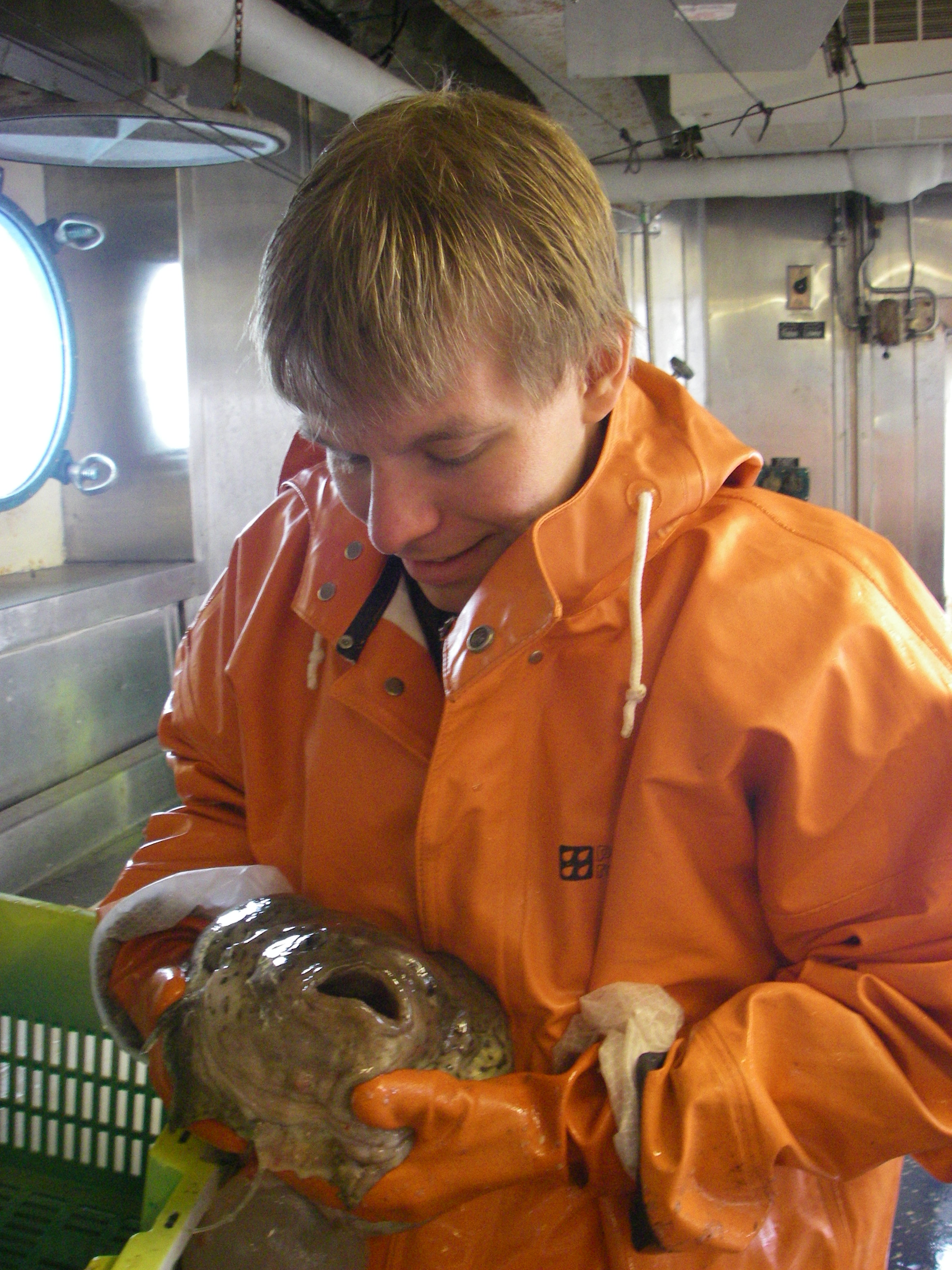
Me (left) and ENS Libby (right) showing some love for a lumpsucker (middle).
The lumpsucker is in the family Cyclopteridae, which is derived from Greek words that mean circle and fin in reference to their round-shaped pectoral fins. There is a sucker on the bottom of them, so when we put this little sucker in some sea water while we were processing the fish, he stuck himself to the bottom of the container! Lumpsuckers are poor swimmers, so they are mostly benthic, meaning they stay at the bottom of the sea floor. However, that doesn’t mean they are incapable of swimming (especially since this one was caught during a midwater trawl). We took some photos and tossed this little guy back to sea, so hopefully he makes it!
NOAA TEACHER AT SEA CATHRINE PRENOT FOX ONBOARD NOAA SHIP OSCAR DYSON JULY 24 – AUGUST 14, 2011
Mission: Walleye Pollock Survey
Location: Kodiak, Alaska
Date: October 25, 2011
Personal Log:
“It’s not a party without a lumpsucker?”
What is the best birthday party you ever had? Let me set the stage for you to picture mine. It was a theme celebration: the guests came as a superhero or supermodel. Everyone was in costume. Balloons covered the floor. People brought so many flowers that I started putting them in washed out mayonnaise and pickle jars. The cake was homemade: I can’t now remember if it was chocolate oblivion or an upside-down fruit. I just remember that it was made from scratch. There were prizes for the best costumes. People danced for hours. I didn’t think that it could have ever gotten better. Until recently. Recently, I discovered lumpsuckers. For all of these years, I had no idea that my 29th could have gotten any better. Until now. Now I know that It’s not a party without a lumpsucker (Cartoon citations 1, 2 and 3).Adventures in a Blue World, Issue 16
Smooth and spiny lumpsuckers.
I should explain why I chose a squishy dumpling with fins for the final cartoon of Adventures in a Blue World. It isn’t because my 29th birthday balloons should have been adorned by adorable fish (although admittedly they would have been grand). It is because, once again, I have found yet another inhabitant of our planet that I was ignorant of. As a biology teacher, I like to think that I have a fairly good handle on life, especially of our Animalia Kingdom. Who could have guessed, in their wildest dreams, that there were creatures like the lumpsucker that inhabit our oceans–our planet? With only 3% of the oceans explored, I can’t even fathom what else is out there. If we don’t explore, catalog and protect our oceans, we may never know.
I want to thank the Teacher at Sea Program of NOAA for an excellent and amazing adventure. In particular, the crew of the Oscar Dyson, the scientists of MACE, my fellow Teacher at Sea (rockstar) Staci DeSchryver and Elizabeth McMahon deserve special recognition. Thank you all so much.
Until our next adventure!
I wish you fair winds and following seas, a sailor’s farewell…
Cathrine Prenot Fox
Last evening: green flash watch.Leaving Kodiak, AK.Before I left I may have tagged some of the hard hats with cartoons…
NOAA TEACHER AT SEA JASON MOELLER ONBOARD NOAA SHIP OSCAR DYSON JUNE 11 – JUNE 30, 2011
NOAA Teacher at Sea: Jason Moeller Ship: Oscar Dyson Mission: Walleye Pollock Survey Geographic Location: Gulf of Alaska Dates: June 21-22, 2011
Ship Data
Latitude: 55.03N
Longitude: -163.08W
Wind: 17.81 knots
Surface Water Temperature: 6.7 degrees celsius
Air Temperature: 10.10 degrees celsius
Humidity: 85%
Depth: 82.03 meters
Personal Log
Welcome back, explorers!
June 21
Today has been the calmest evening since I boarded the Oscar Dyson. The night shift did not fish at all, which meant that I basically had an evening off! Even the evenings we have fished have been relatively calm. It takes us about an hour to an hour and a half to process a haul of fish, and up to this point we average about one haul per night. That gives me quite a bit of down time! When I am on shift, that down time is usually spent in one of two places.
The first spot is the computer lab in the acoustics room. This is the room where we wait for the haul to be brought in. I write the logs, lesson plan, check emails, and surf the web during quiet times.This is the lounge. The cabinet under the TV has over 500 movies, and a movie is usually playing when I walk in. Behind the couch is a large bookshelf with several hundred books, so I have done a fair amount of pleasure reading as well.
When I am not sitting in one of these two places, I am usually running around the ship with my camera taking nature photos. Below are the best nature photos of the past three days.
One of the coolest things about the Aleutian islands has to be the number of volcanoes that can be seen. This is the one on Unimak Island.A second picture of the same volcano.This is just a cool rock formation off of the coast. The Oscar Dyson has been hugging the coast the entire trip, which has been great for scenery.A gull skims the water by the Oscar Dyson.A gull wings toward the Oscar Dyson
June 22
We resumed fishing today! These trawls brought in quite a few species that I had not seen before, along with the ever plentiful pollock.
The net, filled with fish!Jason waits for the net to load the fish onto the conveyor belt.Here, I am separating the arrowtooth flounder from the pollock.We managed to catch a skate in the net! Skates are very close relatives to sharks. We quickly measured it and then released it into the ocean.A second photograph of the skate.Do you remember the little lumpsucker from a few posts back? This is what an adult looks like!The lumpsucker was slimy! I tried to pick it up with my bare hands, and the slime gummed up my hands so that I couldn't pick it up! Even with gloves designed for gripping fish I had trouble holding on.A closeup of the lumpsuckerThis fish is called a sculpin.I finally saw a crab! None of us know what was attached to it, but the scientists believe that it was an anemone.This is a starfish the net pulled up.
Science and Technology Log
There is no Science and Technology Log with this post.
Today’s question comes from James and David Segrest, who are two of my homeschool students!
Q. What do you eat while you are on your adventures? Do you get to catch and eat fish?
The food is great! Our chef has a degree in culinary arts, and has made some amazing meals!
I wake up at 2:30 pm for my 4 pm to 4 am night shift, and usually start my day with a small bowl of oatmeal and a toasted bagel. At 5 pm, about two hours after breakfast, dinner is served, and I will eat a huge meal then too. Every meal has two main courses, a vegetable, a bread, and dessert. We have had a wide variety of main courses which have included bratwurst, steak, gumbo with king crab, fish, chicken parmesan, spaghetti with meatballs, and others!
We will often eat some of the fish we catch, usually salmon and rockfish since those provide the best eating. The salmon disappears to the kitchen so quickly that I have not actually been able to get a photo of one! We have not caught a halibut in the trawl net yet, otherwise we would likely have eaten that as well. Yum! We have not yet eaten pollock, as it is viewed as being a much lower quality fish compared with the rockfish and salmon.
NOAA TEACHER AT SEA JASON MOELLER ONBOARD NOAA SHIP OSCAR DYSON JUNE 11 – JUNE 30, 2011
NOAA Teacher at Sea: Jason Moeller Ship: Oscar Dyson Mission: Walleye Pollock Survey Geographic Location: Gulf of Alaska Dates: June 19-20, 2011
Ship Data
Latitude: 54.29 N
Longitude: -165.13 W
Wind: 12.31 knots
Surface Water Temperature: 5.5 degrees Celsius
Air Temperature: 6.1 degrees Celsius
Humidity: 97%
Depth: 140.99 meters
Personal Log
Welcome aboard, explorers!
To be honest, there is not a great deal to write about for the personal log. My daily schedule has settled in quite nicely! I get off work at 4 in the morning, shower, sleep until 2:30 in the afternoon, and then head down to the acoustics room where we track the fish. When we are processing a catch (see the science and technology section of this blog), I am in the fish lab wearing bright orange waterproof clothes that make me resemble a traffic cone.
Jason in fishing gear.
The rest of the time is down time, which is spent reading, working on the blog, learning about the ship, and dreaming up lesson plans that I can use to torment my students. I hope they are interested in a summer fishing trip, as that is the one I am currently planning.
Most of the blog work involves running around and taking photographs. My wife’s camera was soaked beyond repair during the prank that was pulled (see the previous post) as Sarah was holding the camera when the wave came over the railing. Fortunately, there was another camera on board.
Our survey is keeping us very close to the coast and islands of Alaska. As a result, I’ve gotten some gorgeous photos. This place is just beautiful.
An island shrouded by clouds.A waterfall falls off into the ocean.Jason in front of an island. It was a bit windy, but at least it was sunny!Mountaintops visible just above the island coast. Jake took this photo while I was in the fish lab.Sunset over Alaskan waters.
Science and Technology Log
Walleye Pollock waiting to be processed
We finally started fishing! As I mentioned in my very first blog, the Oscar Dyson is surveying walleye pollock, which is an important fish species here in Alaska. Walleye pollock make up 56.3% of the groundfish catch in Alaska, and is eaten in fast food restaurants around the world such as Wendy’s, McDonalds, and Burger King. It is also used to make imitation crabmeat.
Our first catch had a little over 300 walleye pollock, and we processed all of them. Three hundred is an ideal sample size for this species. If, for example, we had caught 2,000 pollock, we would only have processed 300 of the fish, and we would have released the rest of them back into the ocean.
The photo captions below will provide a tour of the fish lab as well as introduce blog readers to the data we wish to collect and how scientists aboard the Oscar Dyson collect it.
This is the conveyor belt. After the catch is pulled on board, it is loaded onto this conveyor belt and moved down the belt and into the lab. At this point, the scientists separate the pollock from the rest of the sea life that was accidentally in the net. Today, the majority of the "extra" sea life were brittle stars, sponges, and a few squid.Once the pollock and other sea life are separated, they are moved to this box to be sexed. In order to do this, we would have to cut the fish open and look at the internal organs of the fish. Once this was done, females would go over the yellow sign on the right and into the box that was hidden behind it. The males went into the box on the left.Once we had determined the pollock's gender, we moved to the measuring station, which was on the other side of the last station. We laid each individual fish on the table on top of the ruler, and then measured the fish from the head to the fork of its tail. We recorded the length by tapping the table at the fork of the fish's tail with a sensor that we carried in our hand. A sensor in the table recorded the data and sent it to the computer monitor seen above the table.Jason measures a pollock on the board!
From this catch (we will do this for any following catch as well) we also took and preserved twenty stomachs from random fish. This was done in order to later analyze what the pollock had eaten before they died. We also took forty otoliths from random pollock as well. An otolith is the ear bone of the pollock, and it is incredibly important to researchers as they will tell the pollock’s age in a similar manner to the way a tree’s rings will.
This is a pollock otolith!After removing the otolith from the fish, they were put into these vials. Each pair of otoliths received their own vial.
While looking at pollock is the main focus of the survey, we did run into some other neat critters in this haul as well!
This is an Atka Mackerel. We also caught a salmon, but I didn't get a good look at it. Our kitchen grabbed it!
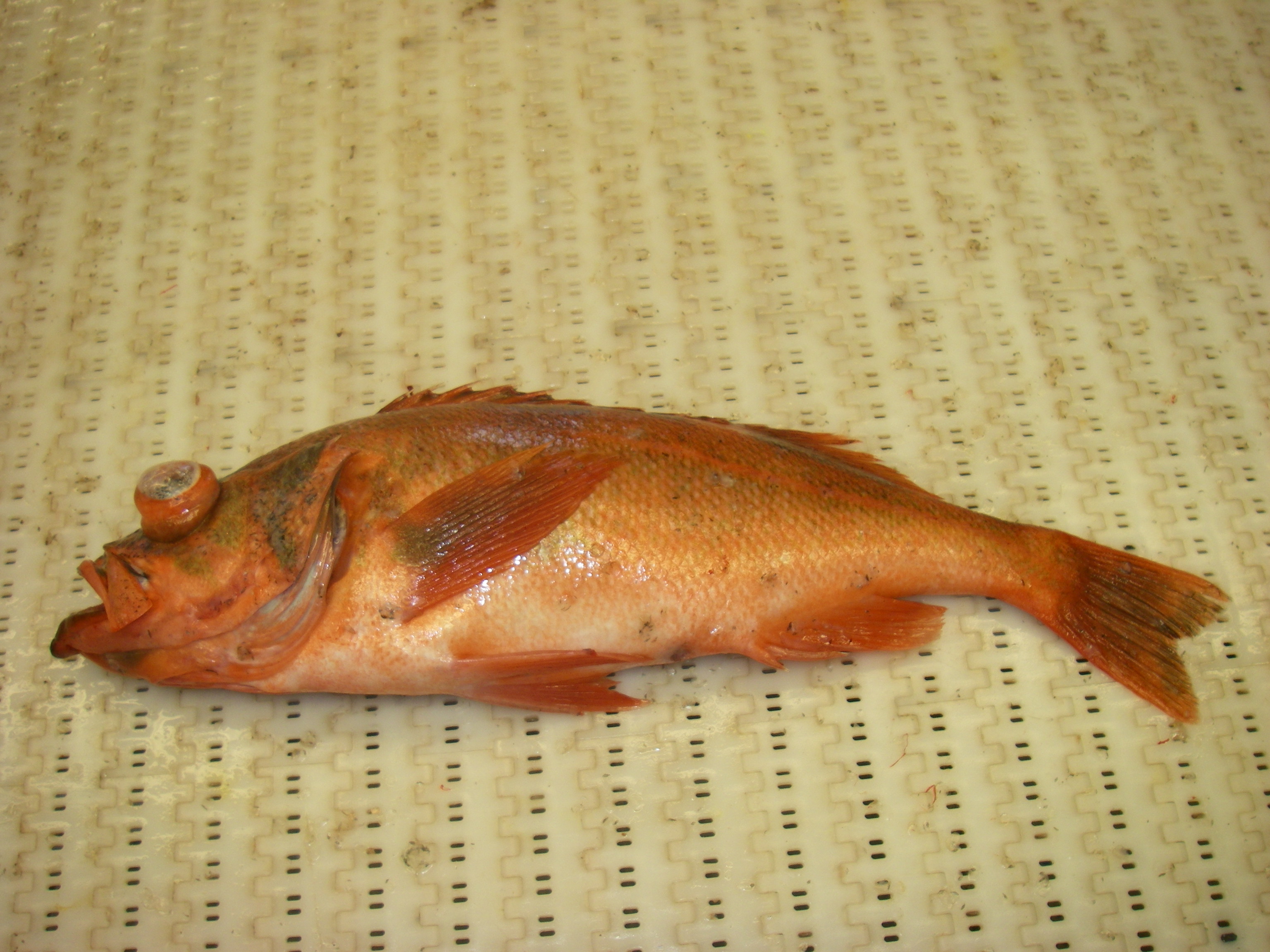
This is a basket starfish. We were trawling close to the bottom and pulled it up in the nets.This is a lumpsucker! They spend their lives on the bottom where they eat slow-moving animals such as worms and mollusks.This is an arrowtooth flounder. These are not very good eating fish, and are not the flounder found in the supermarket. Check out the nasty teeth in the photo below this one!I wouldn't want to be bitten by this fish!Finally, this is a rockfish! The red snapper that we see in the marketplace is often this fish instead.
Today’s question is actually a request. It comes from Tish Neilson, one of our homeschool parents.
Hey Jason –
I had a super favor to ask of you. There is a little girl from Jackson’s school that is a 5th grader and she was recently diagnosed with leukemia. There have been some bracelets created for her that say “Going Bananas for Anna” to show support and several moms and I have gotten together and are putting together a scrapbook for her and trying to get as many people as possible wearing her bracelets in really cool places. Then we are having them take pictures to send to us to put in her scrapbook so she can she how far her bracelets have traveled and how many people are pulling for her. If it’s possible to do so and you would be willing to do it I would LOVE to try and get you a bracelet to take some pictures and send to me from Alaska. Her nickname is Anna Banana and she is always asking for pictures and such so that is why we came up with this idea.
Tish Neilson
Unfortunately, I had left for Alaska before I received the email, and as a result I do not have a bracelet. Hopefully, a sign will work just as well.
Hi Anna! This is Unimak Island! It is one of the Aleutian Islands off the coast of Alaska! Hang in there, we are rooting for you!