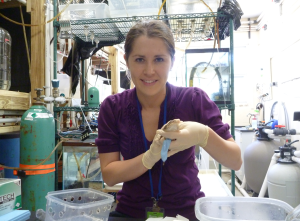
Kaitlin Baird, Women in an H2O world: Girl Power in Science (7), March 20, 2013

Margie Turrin

Margie Turrin- Science Education Coordinator at Lamont-Doherty Earth Observatory

Job Title:
Science Education Coordinator Program: Lamont-Doherty Earth Observatory of the Columbia University

What she does:

Margie’s job focuses on linking education and research in field based science. She works with students, teachers and college faculty, training and engaging them in collecting samples and data that they can study, and that research scientists can use to improve our understanding of estuaries and ocean systems. Whether she is living onboard a research vessel or land-based and organizing trainings, Margie is focused on helping expand the reach of science, developing and sharing ways that teachers and student groups can be involved in field based stud and research.

Favorite Part of her Job:
Hands down Margie’s favorite part is being out in the field. She loves working on a ship or along the shoreline – anything that is outside is OK! Aside from her own love of working in the field she enjoys being with students as they work outdoors since it is never what they expect! Students think science is like a lab experiment with a set beginning and end, but in the field things are always changing and you have to be able to think critically, make decisions and carefully record your data so that when you get back to the lab it makes sense and is usable.

What type of schooling/experience do you think best set you up for this job:
A background in biology and ecology was really helpful for Margie, but just as important is spending time volunteering or interning in any programs you can find that are related to your interest. Test it out before you commit your education to it,  see if you really like working outside in the field, being dirty and wet and collecting your own data and samples! Always be willing to say ‘yes I can help’ because that is where the real opportunities lie…and ask plenty of questions when you are helping on a project – that is how we all learn an scientists LOVE to talk about their work to an interested audience.

Olga Shatova

Olga Shatova- Graduate Student/Resarcher (marine ecology/biological oceanography)

Job Title:
PhD student
Marine Science Department, University of Otago, New Zealand

What She does:
I am currently working on my PhD project that focuses on the role of nutrients recycled by seabirds for the phytoplankton productivity in the vicinity of sub-Antarctic islands. I’m doing my field working in the New Zealand sector fo the Southern Ocean: from off-shore Otago Peninsula to the Ross Sea, Antarctica.

 Favorite Aspect of job:
My job gets me to unique places protected from any public visits. Encounters with sub-Atarctic and Antarctic wildlife is really once in a lifetime experience.

What type of schooling/experience do you think best set you up for this job:
I think the most important goal is to get work experience outside the classroom. I value most 2 internships I’ve done in Moneterey Bay Aqurium Rsearch Institute and Bermuda Institute of Ocean Sciences; this helped me a lot in understanding marine science research and allow me to choose what to do.

Darcy Saxion

Darcy Saxion- Student
Darcy Saxion- Student and Volunteer Reseacher

Job Title:
Senior at SUNY-ESF – Volunteer on NOAA Autumn Bottom Trawl Survey

What She does:
As a volunteer on the NOAA Autumn Bottom Trawl, I measured, weighed, dissected, and classified many fish species. I learned where otoliths were located on various fish, learned how to extract them and compared the size of otoloths between various fish. Additionally I learned the classification difference between a scup and a croaker. Most importantly, I became increasingly aware that volunteering/interning for NOAA aboard the Henry Bigelow was the best hands-on out of the classroom learning experience I ever had. I highly recommend this experience to gain a step up in your education.

Favorite Aspect of the job:
My favorite aspect of the job was networking with the crew members; getting to know them, how they got where they are today, and how I can get there myself. Many teachers at SUNY-ESF and Sea Semester have always told me that networking is the main way to achieve your goals and get your dream job. With that in mind I asked for advice, got emails, and most importantly worked hard on this two week cruise to prove my strong work ethic.

What type of schooling/experience do you think best set you up for this job:
I have not graduated from College yet,  but would say my experience aboard the NOAA ship  Henry B. Bigelow and my past Sea Semester Ocean and Climate experience have been invaluable. Both are visual learning experiences where you’re thrown into a new routine – the learning curves are steep but I recommend them to every woman to better prepare for future jobs.

Claire Grenfell

Claire Grenfell- Student and Researcher

Job Title:
Master of Science Marine Environmental Protection
Bangor University, Wales

What She does:
Claire is working towards completing her Master of Science degree in Marine Environmental Protection.  The degree consists of nine months taught courses and three months conducting an individual research project.  During the taught component of the course, Claire is undertaking five modules which each include a lecture period followed by a short research project.  Most recently, Claire conducted a survey to study the distribution of infaunal species along a sand beach in North Wales as a component of the Coastal Habitat module.

Favorite Aspect of job:
The many opportunities that Claire has to gain practical experience during her course, through field and laboratory work, is her favourite part of the degree so far.  She enjoys being able to complement the theory taught in lectures with the acquisition of skills through practical endeavours.

What type of schooling/experience do you think best set you up for this job:
Students accepted onto the course generally require academic or work experience in marine, environmental or biological sciences.  Claire completed her undergraduate degree in Environmental Science and gained practical experience in marine research through a Bermuda Program internship at the Bermuda Institute of Ocean Sciences (BIOS).  She recommends gaining volunteer or work experience in a research environment before undertaking an MSc degree, even if you have a relevant academic background.

Grace Seo

Grace Seo
Grace Seo, Master of Science Student

Job Title
Master of Science Student
Marine Affairs and Policy, RSMAS, University of Miami

What she does
Grace works at the University of Miami Experimental Hatchery (UMEH). She works with cobia, mahi mahi, Florida pompanos, goggle eyes, and blackfin tuna. These are all species of pelagic fish that occur naturally in the waters off Miami. Her focus is live feeds, specifically rotifers. Rotifers are the first live feed that is given to the larvae after they have fully utilized their yolk supply. Live feed is essential to the survival of larvae that are spawned at UMEH. It is her responsibility to ensure the maintenance, growth, health, and quality of the live feed that are essential for larval survival and proper development. She also works with students to teach and guide them to learn the proper protocols of live feed management.

Favorite part of her job
Grace’s favorite part of her job is being a mentor. Having gone through the process of learning all the protocols to a successful aquaculture project, she understands the nuances that it takes to keep the fish healthy and productive. Since she went through the process of learning all the protocols herself, she can relate with upcoming students in their learning process. She is able to relay the message in a manner that makes sense to a person who is new to the aquaculture world.

What type of schooling/experience do you think best set you up for this job
Grace believes that a background in marine science will help but volunteer and hands-on practice is best for aquaculture. Understanding why certain protocols are followed is essential and is best learned through practical application. If you are interested in aquaculture, volunteering at a hatchery would be the best exposure that you can get.

aquatic careers
Girl Power in Science

Thanks for learning about all of these great women working in aquatic careers!

Kaitlin Baird, Women in an H2O world: Girl Power in Science (5), March 18, 2013

Fernanda Giannini

Fernanda Giannini- Oceanography Researche
Fernanda Giannini- Oceanography Researcher

Job Title:
PhD student at University of São Paulo – Oceanography Institute

What She does:
I am a first year PhD student in the Biological Oceanography Program and I am developing my field and laboratory work at the Marine Biology Center, located in São Sebastião (northern coast of São Paulo State – Brazil).

My project looks at the estimates of primary production and analysis of photosynthetic rates of the phytoplankton community in the São Sebastião channel. This channel deserves special attention due to the presence of the Port of São Sebastião, which presents potential environmental impacts for this coastal region. Furthermore, there is an important ecosystem located in the continental portion of the channel, the Araça Bay, which presents a very high biodiversity and it is an ecosystem under different types of human pressure.

The project approaches the use of techniques to estimate physiological rates and primary production from the fluorescence emitted by chlorophyll molecules as part of the photosynthesis process in the phytoplankton cells. Several studies on how to accurately estimate primary production rates from the fluorescence data has been developed around the world in order to provide a faster and less invasive method to obtain this kind of data.

Favorite Aspect of job:
For me, the most exciting aspect of being in this type of research is to have the opportunity to be in contact with so many different people, sharing experiences and moving to work in different places, from which you can establish networks and good research groups. The second aspect I consider really important is that, different of other jobs, you have the liberty and independence to work on issues and projects that suit you best, and this makes the job much more rewarding. Also, as an oceanography researcher, I am fascinated with being out on the ocean in research vessels.

What type of schooling/experience do you think best set you up for this job:
I got my degree in Marine Biology in 2007, when I decided to focus in oceanography, applying for a master degree program in Biological Oceanography in 2008. Then, I have spent two years to get my degree and, during this time, I had great experiences in the oceanography field, participating of different projects, cruises, conferences and so on. By the end of my masters, I was selected to join the Training Program in Observational Oceanography at the Bermuda Institute of Ocean Sciences (BIOS). I have spent 10 months at this training and the course provided great experience and knowledge about different areas of oceanography, such as physical and chemical oceanography, data management, remote sensing, etc. As soon as I got back home, I joined the PhD program, also in Biological Oceanography at University of São Paulo. In summary, that was my schooling and experiences which made me end up at my current position, and that I hope will help to set me up for a good job in a near future.

Lisa Bourassa

Lisa Bourassa- Research Associate/Phycologist

Job Title:
Research Associate, Phycologist
Louisiana State University
Sea Grant Oyster Hatchery

What She does:
I work at an oyster hatchery operated by LSU Sea Grant. Here we grow polyploid Crassostrea virginica oysters for research and development for the oyster industry, as well as restoration working with the Louisiana Department of Wildlife and Fisheries (LDWF). As the Phycologist I am responsible for culturing all of the microalgae that is fed to our broodstock and larval oysters (our system can generate up to 2800 L of algae a day). I also help spawn oysters, culture the larvae, and many other miscellaneous tasks that need to be completed in the hatchery.

Favorite Aspect of job:
My favorite aspect my job is that I’m not chained to a desk! I get to work outside, get my hands dirty, and every day is different! It’s also great to be part of restoration efforts. Our hatchery works with LDWF researching different methods for oyster restoration, so it’s great to be part of something that strives to restore the oyster populations to benefit the environment as well as the industry, which many people rely on for their livelihood.

What type of schooling/experience do you think best set you up for this job:
While a background in marine biology is very important, I think the experience that set me up best for this job was working in the aquaculture laboratory as a tech at Roger Williams University. Here I learned many of the skills I execute on a daily basis, but I really learned how to manage my time, figure out what needs to be done, and get it done. Because this job was mostly taking care of animals, I learned quickly that when you work with live animals, the animals must come first and be cared for, regardless of weekends or holidays. This experience also taught me how to roll with the punches, and troubleshoot any problems that I encounter throughout the day, and it’s always okay to ask for some help if you need it.

Another experience that set me up best for this job was my time spent as a Girl Scout. Although being a Scout may not have given me the technical knowledge for my job, it taught me how to think on my own, work individually, the value of teamwork, and how to use my resources effectively. I also learned that hard work and challenges are not something to be feared, but instead to embrace the opportunities that they provide.

Kate Degnan

Kate Degnan- Educator, North Carolina Aquarium

Job Title:
Educator
Education Department
North Carolina Aquarium at Roanoke Island

What She Does:
Kate conducts public education programs at the North Carolina Aquarium on Roanoke Island. The mission of the aquarium is to promote awareness, understanding, and appreciation of the natural resources of North Carolina. Kate facilitates this type of learning by introducing the public to live animals, using the Science on a Sphere technology developed by the National Oceanic and Atmospheric Association (NOAA), playing educational games, or speaking with aquarium divers. Kate has other tasks as well; occasionally she works with the aquarium husbandry staff to help with animal care, each week she dives in the aquariums 285,000 gallon shark tank, and she also helps develop new programs.

Favorite Aspect of Job
Each day is different! Typically within a week, Kate will only teach the same program once or twice since the schedule is so varied. However, no matter how many times Kate teaches a program the delivery and execution of each program is different. Due to the location of the aquarium, people from all over the United States and from different parts of the world visit. Each person who visits has some interest, curiosity, or fear of the animals they encounter. As an educator you must understand their reaction and impart some knowledge so they might be less afraid or more interested and educated. The people make the program.

What type of schooling/experience do you think best set you up for this job?
Kate has found that having experience working with various age groups of students and being able to modify what you teach to suit the audience is extremely important. Kate has a background in marine biology and education psychology; this combination of education has provided Kate with a scientific background but also the understanding of how people learn. Communicating scientific information is important you must be able to translate that information in a way that the public can relate to it and care about it.

Sarah Fawcett

Sarah Fawcett- Chemical Oceanographer

Job Title:
Postdoctoral Research Associate, Department of Geosciences, Princeton University

What She does:
Sarah is a Chemical Oceanographer studying the interactions between the ocean’s major chemical cycles (specifically nitrogen and carbon) and phytoplankton, the floating single-celled plants that generate chemical energy by photosynthesis and support all of ocean life. Photosynthesis is the biological process that converts carbon dioxide into organic carbon, and nitrogen is essential for photosynthesis. One major consequence of phytoplankton photosynthesis is that it lowers the carbon dioxide content of the atmosphere by storing it in the deep sea. Changes in the efficiency of this storage likely explain past changes in atmospheric carbon dioxide, which in turn have affected climate. We know surprisingly little about which phytoplankton in the surface ocean are responsible for taking up the nitrogen mixed into the surface from depth, and for transporting organic matter back into the deep ocean, or if indeed all phytoplankton participate equally in this process. Sarah’s interest is in discovering the sources of nitrogen that different types of phytoplankton use for growth, with a view to understanding whether phytoplankton diversity is important for ocean processes such as carbon storage in the deep ocean, and how this might change if phytoplankton communities change in the future.

 Favorite Aspect of job:
I love going out on the ship to collect samples at sea. Being out on the open ocean reminds me of the “big picture”, of the important reasons why I’m doing the research I do. It’s easy to forget that when I spend long periods of time in the lab. I also really enjoy deploying all the different types of instruments that we use to collect scientific samples at sea; some of the engineering that goes into making oceanography happen is genius!

 What type of schooling/experience do you think best set you up for this job:
I got my bachelor’s degree in Earth and Planetary Science, and was first introduced to marine chemistry during the two summers I spent as an undergraduate on the Great Barrier Reef, reconstructing El Niño signals recorded in 10,000 year-old corals. This experience cemented my fascination with how our planet – and particularly our oceans – work. Ultimately, however, taking math and science courses, and taking advantage of field trip and lab work opportunities was the best preparation for this job.

Ali Hochberg

Ali Hochberg -Education and Development Coordinator

Job Title:
Education and Communications Coordinator
Bermuda Institute of Ocean Sciences

What She does:
Varies from day to day, but includes writing press releases, newspaper articles, newsletter articles; managing social media accounts; assisting with the creation of short- and long-term audience and donor development and communication strategies; working with faculty to highlight current and future science endeavors; identifying new avenues of publication and promotion within local and international circles; website content and design development; creation and design of new marketing materials.

Favorite Aspect of job:
Using my science background to translate the work of science faculty and staff into materials that can be understood by wider audiences.

What type of schooling/experience do you think best set you up for this job:
A science background is crucial, otherwise I wouldn’t be able to understand the details of the research taking place, but experience in public education/outreach, marketing/advertising, and writing are also invaluable.

aquatic careers
Girl Power In Science

Kaitlin Baird, Women in an H2O World: Girl Power in Science (3), March 16, 2013

Rachael Heuer

Rachael Heuer- Doctoral Student/Research Scientist

Job Title: Graduate Student, Rosenstiel School of Marine and Atmospheric Science, University of Miami
Division: Marine Biology and Fisheries
PhD Research area: Fish physiological response to ocean acidification

What She does:
Rachael is a third year graduate student researching the impacts of future predicted oceanic carbon dioxide levels on marine fish. As atmospheric carbon dioxide levels are increasing, the ocean is taking up more CO2, making it more acidic and causing potential challenges for a variety of organisms. Most of her research is conducted in a laboratory setting, where she is able to manipulate seawater to mimic future predicted conditions and see how this affects the physiology of fish. She is responsible for performing the experiments, analyzing the data, and making sure her results are shared with other scientists.

Favorite Aspect of job:
Rachael’s favorite part of the job is performing experiments that could help others better predict what may happen to fish populations in the future as our oceans become more acidic. She enjoys carefully planning out controlled experiments to look at how a fish’s body is responding to high CO2 levels. She also enjoys traveling to conferences where she can learn the most up-to-date information in the field from other students and scientists.

What type of schooling/experience do you think best set you up for this job:
Rachael received a degree in Zoology, but ended up conducting research in Marine Biology. Having good grades and a general science background is important, but prospective employers and supervisors are most interested in your experience and passion for the subject. Rachael’s best advice for students considering a career in science is to immerse yourself in the scientific process by volunteering agency or a scientist to get an idea of all aspects of the job. The variety of research that can be conducted on the ocean is very broad, so it is important to find the subject that interests you the most. Rachael also spent three years teaching high school science prior to beginning a graduate degree, which showed her the importance of communicating science with the public.

Julia Lawson

Julia Lawson- Graduate Student/Researcher (Marine Biology/Conservation)

Job Title:
MSc Student with Project Seahorse
Zoology Department/Fisheries Centre
The University of British Columbia

What She does:
Seahorses are little fish that are heavily harvested for their use in traditional Chinese medicine, the aquarium trade and curiosities. Scientists estimate that as many as 20 million individuals are traded annually, yet very little is known about seahorse basic biology, which has made it difficult to determine how seahorse populations are responding to this harvest. My research focuses on seahorses in Thailand, the largest exporter of seahorses globally. I will be using life history parameters like number of offspring produced, seahorse sex, size and reproductive state to determine how susceptible seahorses are to the current harvest. The results from my study will be used to assist Thailand and other countries in Southeast Asia in developing better management plans for seahorses.

Favorite Aspect of job:
I am always amazed and surprised by coral reef ecosystems, and love watching and learning new things about coral reef fish and invertebrates. I only began working with coral reefs in Bermuda in 2008 and since then I have seen so many amazing things and learned so much. From learning in Bermuda that surgeonfish get their name because of a tiny ‘scalpel’ on the base of their tail, to swimming with manta rays, seeing a tiger shark and hearing humpback whales in Australia, every day in the field is full of surprises.

What type of schooling/experience do you think best set you up for this job:
I completed my undergraduate degree at Dalhousie University, where I was also a student in the Science Co-op Program. The Co-op program allowed students to alternate work terms with academic terms, gaining hands-on work experience. While in the program, I spent two semesters interning at the Bermuda Institute of Ocean Sciences where I completed my honours research on coral reef reproduction and recruitment. My internships in Bermuda opened many doors for me, especially since i earned my AAUS Science Diver certification. After graduating I worked as a research assistant in the Bahamas looking at invasive lionfish, I worked for the Canadian Department of Fisheries and Oceans analyzing deep sea sponges on the Grand Banks of Newfoundland, and most recently I worked as a research assistant for the University of Queensland on Heron Island with a PhD student looking at surgeonfish grazing impacts. Not being afraid to go to new places and try new things is critical, and using connections from previous experiences has helped me expand my research experience.

Stacey Goldberg

Stacey Goldberg- Student and Researcher
Stacey Goldberg- Graduate Student/Researcher  (Marine Biology/immunology and natural product/drug discovery)

Job Title:

Ph.D. Graduate Student
University of Prince Edward Island
Biomedical Sciences/Marine Natural Products

What She does:


Marine natural products, otherwise known as secondary metabolites, are structurally complex chemical compounds with well-defined biological targets.  They provide a validated starting point for drug discovery as a chemical scaffolds.  As the need for new drugs becomes vital to combat multidrug resistant pathogens, marine natural products research is on the rise.  This area of science seemed a clear direction for me to pursue due to my interests in a combination of subjects including marine biology, immunology, and biochemistry.  I am currently completing my first year as a graduate student at University of Prince Edward Island (UPEI) in the Biomedical Sciences Department within the Atlantic Veterinary College.  I am working in the lab of Dr. Russell Kerr, a leading marine natural product scientist, alongside an exceptional group of faculty, scientists and students.  My research will focus on the assessment of marine sponges and their associated microbiota to produce bioactive halogenated natural products, and to investigate the biosynthetic origin of these metabolites.


Favorite Aspect of job
:

More than anything, I appreciate the process of scientific investigation.  As a graduate student, I am already learning the tools necessary to critically evaluate, think creatively and independently, and establish clear objectives.  I enjoy feeling a sense of accomplishment and fulfillment when being involved in the completion of a project in order to address a question or hypothesis.  It took some time to discover my version of a “dream job”, which utilizes biotechnological advancement for the purposes of exploring our oceans to exploit novel chemistry for potential therapeutic applications.  Such is why I chose marine natural products research to further my education, as I my biggest hope is to make some small contribution to science and quality of human life.  And, scuba diving to collect marine specimens for my research is not bad either.


What type of schooling/experience do you think best set you up for this job:

There are a few key experiences/positions that I think best prepare me for being a successful scientist.  Some of my experience includes working as a research technician at Johns Hopkins University (JHU) in the cancer research department, and working as research scientist in the immunology department at a non-profit Tuberculosis vaccine development company.  Just prior to entrance into my current program, I participated in a graduate internship at Harbor Branch Oceanographic Institute (HBOI) with Florida Atlantic University (FAU).  I worked in the Biomedical Research Department under the mentorship of Dr. Esther Guzmán and Dr. Amy Wright, a distinguished marine natural products chemist.  It was designed to provide hands-on experience in a research environment in areas that include immunology, drug development, and marine natural product chemistry.  It was a perfect segue into my current graduate studies program, and an exceptional experience that assisted in honing in on my true career and life goals, to be a better scientist and genuinely challenge myself.

aquatic careers
Girl Power in Science