Chris Harvey, June 12, 2006

NOAA Teacher at Sea
Chris Harvey
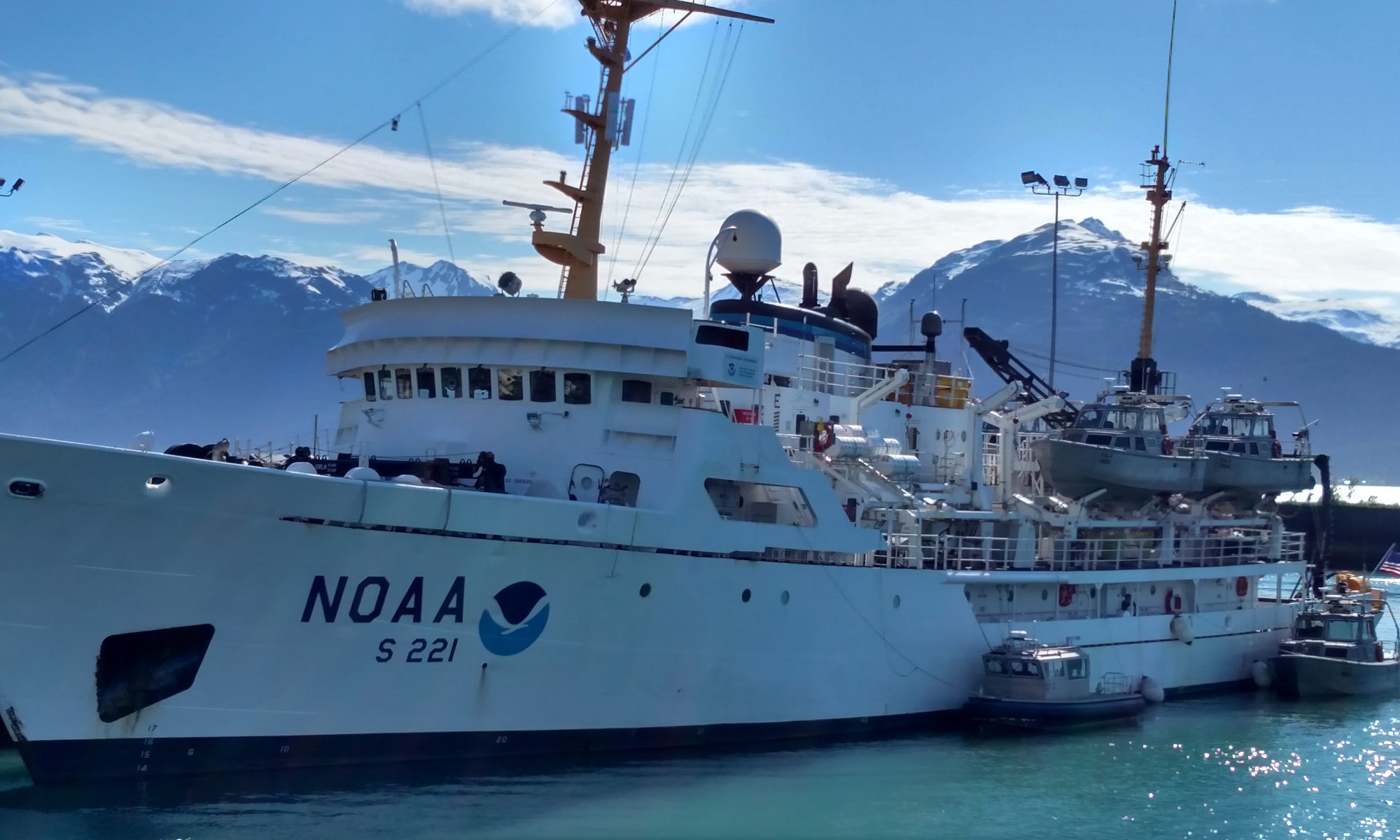
Onboard NOAA Ship Oscar Elton Sette
June 5 – July 4, 2006

Mission: Lobster Survey
Geographical Area: Central Pacific Ocean, Hawaii
Date: June 12, 2006

Science and Technology Log

The hardest part of this job, aside from waking up around 6:30 in the morning, is keeping track of the events of the day through my journal entries.  Yesterday I didn’t feel like writing much, so I skipped an entry just to make it harder on myself today.  I’ve been told that I don’t need to write about everything each and every day, but I know from all of the journals that I have kept during my travels, writing is as much for me to look back on as it is for those of you keeping up on my experiences here.  So this entry is a bit of a hodgepodge, smorgasbord, or mishmash of sorts.

I have read through my last entry a half dozen times and I am still amazed at the experience. It seems premature of me to say that I’ve had my turning point in this trip already. But it sure feels that way.  It is a struggle to work now.  I feel like a man on a great pilgrimage to some Holy Land who has found Enlightenment midway through his journey, and so longer needs to travel–but does so for the sake of sharing his experience along the way. And on a ship at sea, one does not really have the luxury of turning the ship around and going home.  That’s how I know that there is quite a bit more in store for me.  And so I will go another day, awaiting what will be.

A common theme of the voyage is the regular showing of “Groundhog Day” at 8 PM each evening.  I have not taken to watching it yet, but I love the idea of showing it again and again. I was warned, after the ship left the harbor of course, that the lobster cruise becomes Groundhog Day after a few days.  And so far, this must be true.  Yesterday I was back in the wet lab measuring lobster all day.  Nothing much happens there, and I am in the air conditioning rather than in the sun, so I should be grateful for that.  However, I am starting to wonder if the costs involved in this research expedition are worth the results that we are getting.

I have been asked by some of you to share the results of our catch.  I don’t have all of the numbers next to me right now, but the general trend is that the lobster catch in the NWHI really sucks. We are pretty much right on par for the last few years of data, which for the most part averages less than one lobster per trap.  In some cases, such as today, the catch rate is much, much lower than that.  Which leads me into explaining part of the reason for this mission to exist.  I will do my best to explain this, as it has been related to me thought my prying and probing.

Part of NOAA’s purpose for existence, as an extension of the US Department of Commerce, is to conduct surveys to promote the use of sustainable fisheries for the US.

What this means is that the US government has recognized that fisheries provide the economy a fairly sizable chunk of change, employment opportunities, and the likes, and would like to continue to improve the industry.  The Hawaiian Islands are some of the most protected land areas in the United States, governed by up to three different organizations. Since the year 2000, commercial fishing of lobster in the NWHI has been completely eliminated.  Commercial bottom fishing is still permitted, but on a very restricted basis. There were concerns that, for the 100+ years that commercial lobster fishing was legal in the NWHI, the lobster population was suffering a serious blow and was unable to recuperate itself year after year.  For this reason, various government agencies, particularly during the end of the Clinton era, gained a greater control over the environmental protection of the NWHI and the waters surrounding them.

We are here now as part of a study to document the growth, or lack thereof, of two types of lobster native to the Northwest Hawaiian Islands: the Slipper Lobster and the Spiny Lobster. Scientists have been interested in the growth rates of these two lobsters because, for the most part, growth has been very, very slow over the last few years.  Determining the age of lobster is extremely difficult, as is left to best estimates based on size.  Over the last few years, thousands of lobsters have been tagged, and we are on the prowl for such lobster so we can document their growth over time.

The best place to see what is going on in the lobster community is to spend time in the wet lab measuring the specimen with Bob, the Chief Scientist of the ship, who has spent over thirty years working out of Hawaii. Although he probably gets tired of my probing, most of what I have come to know about our mission has come from the last two days I have spent in the wet lab. There we take measurements of each lobster, and after we are through, Bob crunches the numbers and spits out data for us to compare to previous years. As I said before, we are right on par for last year’s numbers.  Perhaps slightly higher, at best.

If we are not catching more than one lobster per trap, and the lobster that we are catching are only slightly larger than the year before, if that, can we open the waters to commercial lobster fishing again?  Think about that for a minute, and then come back to me…The answer seems to be, no.

As scientists, we must move further into the issue and ask ourselves why aren’t the lobsters growing?  In a time where every scientific question seems to be answered with “Global Warming,” we must take into consideration many other factors as well.  Water temperature and salinity may be changing over time.  But there is also the issue of food supply for the lobsters. Is the quantity or quality of food decreasing?  What about predators?  There are many times more white tipped reef sharks present in these waters now than ever before. Could this be influencing lobster growth (how is the marine food chain in the NWHI changing?)?  Are the lobster stressed for other reasons? Are the coral heads in which the lobsters take shelter growing, or dying?

With so many variables, we must do our very best to keep our constants in this investigation constant. Such constants include: location of traps, type and amount of bait, and measuring points on the lobster.  Bob has done a very good job of keeping these things constant over the last few years, despite how easy it would be to change any of them at any other time.  If he were to do that, he would essentially be throwing out years and years of previous work.

So what are we doing here?  I ask myself that every day!  We are here to make evaluations of the sustainability of the lobster fishing industry–not quite as “treehugging” of a mission as I had first anticipated, but important nonetheless, if the Hawaiian Islands’ fisheries are to significantly contribute to the US economy.  Whether or not we are justified in spending the time and money we are spending is still up in the air for me, but maybe that is why I am just an “observer,” and “scientist,” rather than head of some government agency.

Today I switched jobs and became a “cracker.”  Yeah, according to some of my students I already am a “cracker.”  But in this use of the word, I was paired again with Amee in opening the traps as soon as they were hauled onto the ship.  I tell you, the only thing worse than smelling dead mackerel is smelling dead mackerel that have been sitting at the bottom of the ocean for a day growing more and more putrid.  I was very reluctant to begin the job today. I have resigned myself to simply stacking traps.  This gets me away from the lobster, shark, crabs, and dead fish of the traps and allows me to listen to music on the fantail while small-talking with the crew about anything and everything.  As I have made reference to already, I am very undecided about my involvement in the research we are conducting. Since I signed up for the job, I will do it to the best of my ability.  But it is already difficult for me to do jobs, such as cracking, because I see some things that do not sit well in the stomach.

Amee and I sang Disney songs all day long to pass time, to the chagrin of the others around us. In all, we were finished rather early.  I threw the bait overboard to the waiting sharks (one of my undecided arguments), and took a nap (never an undecided argument!).  I am about to head outside to watch another Pacific sunset, followed immediately by the task of setting out bait to thaw overnight.  Tomorrow is an early morning, since I have to wake up at start cutting bait by 6:30 if I want to eat breakfast (another undecided argument, breakfast is NOT to be missed!).

Not to be forgotten, last night was another first for me.  Doc, Amee, and I were sharing conversation over a cup of tea on the weather deck when the moon rose like a flame over the ocean. For a moment I thought we were drinking hallucinogenic tea.  But we were all having the same trip.  I pointed out what looked to be an island on fire, perhaps a volcanic eruption. Amee said it was a Viking ship of old.  Doc said it was the moon.  I didn’t believe any of us, so I ran towards the bridge to ask more experienced sailors what it could be. Then the fire spread into the sky, outlining the shape of a mushroom.  So this is the end! The Nuclear Holocaust has begun, and Honolulu is gone! My love story with the sea would soon turn into one of survival, with no one left to read about it!

Then the curve of a red/orange moon nudged itself above the clouds.  And with each passing second I could see Her rise, red and rich as fire.  And full.  I trembled at the sight of a red moon and thought of any nautical expressions that might predict the outcome of such a sight. Red sky at night, sailor’s delight. Red sky in morning, sailors take warning.  No, that wouldn’t work! It doesn’t say anything about red moons!  And that was the only nautical expression I knew! In my trembling, I eventually grew comfortable at the sight of something amazing.  I stood there in silence for the next hour as I watched the blazing moon shed its color as it rose into a darkened sky.  The few stars that were bright enough to hold their own light in its presence seemed to glow red and orange in its reflection.  Rising still into the night, I went to bed again truly impressed at whatever forces allowed this moment to be…again.  When I thought I had seen it all, something like this comes along. What a Beautiful life!  Have I said this before?

Chris Harvey, June 10, 2006

NOAA Teacher at Sea
Chris Harvey
Onboard NOAA Ship Oscar Elton Sette
June 5 – July 4, 2006

Mission: Ecosystem Survey
Geographical Area: Central Pacific Ocean, Hawaii
Date: June 10, 2006

Science and Technology Log 

Have you ever wanted to create something so Beautiful, but didn’t know where to begin? I have. It happened last night just before sunset, and lasted until about midnight when I finally closed my eyes.  I tried to capture the moment with my words and with my camera, but both failed in every attempt.  Here are the words anyway.  Pictures will have to wait.

“I don’t know if I have ever seen anything as Beautiful as the sunset tonight.  I can’t describe it in words. Nor should I even try. They wouldn’t do it justice.  All I can do is try to describe myself right now, incredibly inspired to live in this one moment–and take back every other one, just to remain here now.  A nearly full moon arises as the sun retires for the evening. White cumulus clouds of different shapes and heights scatter themselves across the sky and then fade into colors as they meet on the horizon.  Every color exists right now. And with the setting sun, a flash of green to outline the furthest clouds. The depth my eyes perceives exceeds the depth of the ocean.  Dolphin dance quietly in the waters around us to the sounds of Coltrane to make the evening complete. If I don’t wake tomorrow, I know where I shall be–forever in this moment.  Remove the people. Remove the steel from this ship.  Remove my pen and paper and camera and lenses. Leave nothing but me in a dinghy to drift about through this lovely sea and sky.  And let me go here in quiet moments, if I wake in the morning and this is no longer real. And let my soul reside in solitude among the gentle rolling swells and mirrored moon upon their hills and valleys. Keep me here, where I know that Everything that belongs here is in its right place. Let me sing along in wordless song to the music in my heart.  Let my senses overwhelm me.  I am here, right now.  Not dreaming.  Or am I?  Will I wake tomorrow morning worn and weary, awaiting another breath, wishing and wondering when I–if I–should ever see a moment so still as now? Unimaginable. Love. Beauty. Life. All the same right now.  All in front, behind, beside, within me.  Love and Beauty and Life, forever in this moment.  Until I close my eyes, and wake again…”

I would have painted the moment for you if I could paint.  Or I would have sung it to you, if my voice could describe the colors, depth of perception, taste of salt in the air, and slightest feeling of air pressed from the wind against my skin.  Not even Monet could paint it though.  Nor could a church choir reach the solemnity of such a peaceful moment.  And I fail with my words again and again.  So I’ll stop.

I spent a good part of the morning recounting the evening with everyone on board.  Many of the crew agreed that they have never seen such a night before.  All of us scientists, who are just along for the ride this one time, believe much the same.  Last night was incredibly spiritual–on so many levels.  I expect them to peel away from me over time, like layers of an onion.

The anchor was broken this morning, so we did not begin work until about 9:30.  In the meantime, I sat on the fantail of the ship watching the sun change the colors of the sky from pastels to brighter primary and secondary colors.  Joe put some Grateful Dead on the PA, and we sat in silence for a good while taking in the scenery around us.  Except for Necker Island, we are entirely surrounded by water and clouds and blue sky.  The Pacific remains so calm, and keeps the crew knocking on wood at every mention of Her stillness. It is becoming taboo around here to speak of the gently rolling swells.  Though not quite as comparable as the Great Nor’easters that menace sailors off the coast of New England in a matter of minutes, the Pacific is known for turning on a dime and changing such silence into a terrible mess.  I have grown to respect her Peace with us.  I pray for it each morning in my own stillness.  The birds also welcome such moments and offer their best unto the sea and sky with their graceful flight throughout the clouds. Everything is truly in its right place.

As for work, I was inside the wet lab today measuring lobster.  I saw a side of science that did not seem to fit my picture of what it should be. Not that it was bad, per se.  It just was not what I expected it to be. Though I should know from traveling time and time again, my expectations of what should be will never fully match up with what really is.  I am constantly reminded of this.  And I constantly forget it.  And my heart has been stirred, to say the least, to consider the nature of science and all of its implications.  I am still a scientist.  But I am learning that perhaps I am not a scientific researcher.  Perhaps I will remain on the other side of science for a while, until I can sort out the disparity between my heart and my head in this matter.

It was an easy day, full of air conditioning and fluorescent lighting.  I saved my skin from an ultraviolet beating, and kept myself fully hydrated.  I didn’t even break a sweat, and almost started feeling bad about it later in the day when I saw how exhausted everybody else seemed to be.  Then I reminded myself how spent I had been the last three days, and how I would be again on Monday when I left the lab and returned to the deck of the ship. I have trouble slowing myself down sometimes, and feel as though I should be thoroughly involved in anything and everything that happens.  So I intentionally withdrew myself after work into the Rec Room to watch a video with some of the other scientists.  I need the down time.  I need the break from reality.  I take everything so seriously all of the time. And I wonder, shouldn’t I? Can I afford to take these breaks? There is always something that I can do, something that I can write, some song that I can play. And there is always that drive in me to create something so Beautiful, and to begin doing it sometime soon…

Chris Harvey, June 9, 2006

NOAA Teacher at Sea
Chris Harvey
Onboard NOAA Ship Oscar Elton Sette
June 5 – July 4, 2006

Mission: Ecosystem Survey
Geographical Area: Central Pacific Ocean, Hawaii
Date: June 9, 2006

Science and Technology Log 

I actually woke up on time for work today (though my muscles, or lack thereof, were extremely sore)!  I dreaded the idea of stacking again today, though yesterday I thought I would volunteer my services as a stacker for the entire trip.  Due to the tremendous amount of physical labor in the sun, I thought that working as a stacker would be great for me to get back in shape (what shape that is, is yet to be determined!) and give me a chance for a good tan. As it turns out, one must first know what shape they would like to be, before they can pursue getting back into it.  For example: Homer Simpson would prefer to be in the shape of a beer, so he practices by drinking beer.  Presently, I am in the shape of a Dunlap. That is, my belly is so big it “dun lapped” over the rest of me!

I stacked again today, though we were much more efficient as an entire ship.  The bridge (control part of the ship) seemed to get us to our strings of traps in a timely manner, and our trap-hauling assembly line was wonderfully efficient.  We finished our strings of eight early enough to have a full hour for lunch (yesterday it was only about 20 minutes), and our twenties were out of the water by 1:30. We continued on and re-set the traps in their new locations and were completely finished swabbing the deck by 3:30.  All in a day’s work!

Some highlights of the day were: feeding the sharks again (or course!  I don’t know if that will ever get old!), throwing a small white-tipped shark out of a trap and into the water where the larger Galapagos sharks consumed it in a matter of seconds (yes, sad but incredibly fascinating to watch.  Sharks seem to me to be a nearly perfect species–aside from the fact that they eat dead animals, have a brain about the size of a walnut, and do not have opposable thumbs! They are incredibly agile and flexible–being made of cartilage and not bone–very swift, strong, and efficient in their use of energy.  Plus they look very sleek, unless they are trying to bite your arm off, in which case I am assuming they look extremely frightening!), catching a decent number of lobster, crab, eel, and other such marine life that is fun to see up close, and not having to work with Amee.

The Pacific has been eerily calm these last few days.  Today we had some gentle swells, but nothing I couldn’t handle. My “sea legs” seemed to have turned into “S legs,” because when I try to walk a straight line with the ship rocking, my line looks more like a curved “S”! We have been dancing around Necker Island, never staying further away than eyesight. She stills looks like a Dragon at times, and a Sperm Whale at others.  But she is company in this voyage.

I had some incredibly insightful thoughts while meditating earlier this morning.  Thoughts come much clearer when you are surrounded by such beautiful scenery.  One of my favorite things these days, besides trying to count the different shades of blue between the open sea and sky, is looking off in the distance where the clouds meet the sky. In places they seem to gently “bubble” up out of the sea.  Joe says that this is where the world ends. I asked him if we could go there, but he says that it is an insurance liability thing with NOAA.  I asked if I could take a life raft and check it out myself, since I enjoy life on the edge. He said “No!” I’d still like to know if it’s the end of the world or not. Whatever it is, it is one of the many things that I am noticing at sea that I have never noticed about the world before. Strange, this recent talk of perspective–my entire journey is from a different perspective.  I am growing so much every day.

I have come across two ideas that I hope to expound upon over the coming weeks.  The first is the human condition, and how hard it is to diagnose, treat, and remedy the human body, mind, and soul.  Lots of people are making lots of money off of books and videos and CD ROMs that promise to do just that.  However, I have good reason –via the scientific method and the perspective of science I am gaining out here–to argue against such media.

The second is the human element in science.  Science is our way of understanding the world around us. Ever since someone had a question about something natural–from astronomy to gravity to cells to atomic particles–someone else has come up with a process of answering that question through science.  That is why I love science so much. I have so many questions about the world around me; I know that science is the only way to learn how to answer my questions. But science is no living creature.  It is no solid set of information, or database with solutions to every riddle.  Humans have invented “science” as a process through which we ask questions, design controlled experiments, collect data, and interpret that data.  There is a whole lot of room for error there.  Especially since the first word in that sentence is “humans.”  (I hope that I do not offend anyone by saying that humans, whether by nature or by nurture or by neither, have a tragic flaw instilled in their perspective that tends to cause error of some degree in nearly everything. Call it “Original Sin,” “human nature,” or what have you- the one thing we are great at doing is screwing something up.)  I don’t mean to sound pessimistic; just realistic. And again, I will return to this idea later.

On the drama side of things, some tension has been created between Eric, a student at the university, and myself.  He wanted to help us set traps yesterday afternoon and I asked him to leave the deck so I could finish the job.  I didn’t mean to offend him by asking him to leave.  It is just that I worked hard from the beginning of the job, and I wanted to see the project through to the end. I am terrible with finishing things well.  So I am continually trying to practice this when I can. It is kind of ironic, but we were partners today in the stacking job. I don’t think he said 10 words to me all day.  But we seemed to get along all right, and the work was done well.  I am not the kind of guy to go and ask him if I offended him.  And he is not the kind of guy to tell me if I did.  So as long as this lack of communication between us does not create any future problems, it will be all right for each of us to remain the type of people that we are.  Otherwise I will come forward and address the issue. Everyone is working far too well together for conflict.

Chris Harvey, June 8, 2006

NOAA Teacher at Sea
Chris Harvey
Onboard NOAA Ship Oscar Elton Sette
June 5 – July 4, 2006

Mission: Ecosystem Survey
Geographical Area: Central Pacific Ocean, Hawaii
Date: June 8, 2006

Science and Technology Log 

A splash of water on my face, a trip to the head, and a brief breakfast before work…that is all I wanted as I laid in bed at 7:15. I wasn’t looking for fame or fortune today.  I wasn’t even looking for a penny on heads. All I wanted was a nice day full of sunshine and subtle rocking, and maybe a little “scientific work” on the side.

But today I officially became a man!  At least, I’m going to put in my application now to become a man!  I was interrupted from my breakfast of a sausage patty and fresh fruit by Garrett, one of the more experienced scientists onboard, to tell me that I had a meeting to attend. I was previously told that work began at 8 AM sharp, so my intentions were to enjoy my breakfast and then begin work at 8 AM sharp.  Instead, I skipped the rest of breakfast, lubed up in suntan lotion, and hit the fantail of the ship for the first part of a very long day.

We set 160 traps around Necker Island yesterday afternoon.  And after leaving them overnight, our task was to haul them up in the morning, take our catch to the lab to be scanned, weighed, and measured, re-bait the traps, and then stack them on the fantail to be set in new locations later in the day. Each scientist had a different job on the SETTE assembly line.  There were 1) the “crackers,” who opened the traps, removed any catch, and then re-baited the trap; 2) the “runner,” who brought the empty trap down the line and dropped off the bucket with the catch at the intermediary wet lab; 3) the intermediary wet lab, who took the fresh catch into the wet lab for examination, and brought the measured catch back to a trash can filled with salt water to act as a holding pen until the catch could be re-inserted where they were taken from at the bottom of the ocean (our scientists took great care to ensure that each lobster was returned very close to where it was taken from by dropping them to the ocean floor in a cage with a quick release. Rather than just tossing them overboard, where predators could eat them on the way down, the lobster are securely released in their natural habitat.);  4) the wet lab scientists, who took the catch and performed the required measurements on them; and 5) the stackers, who took the empty, re-baited traps and stacked them on the fantail to await being reset.

I was a stacker today, and will be again tomorrow until my rotation is up.  Stackers have the most difficult job because they have to stack the traps four high and then maneuver them across the deck and arrange them in a way so as not to clutter the deck.  Then, when everyone else’s job is done for the day, stackers are responsible for maneuvering the same traps across the same deck in order to be set later in the afternoon.  In addition, stackers have the joy of “swabbing the deck,” as I say in a not-so-good attempt to speak Pirate (Cakawww! My sister!  Cakawww!). Yes, that means we get to scrub the fish blood and any other acquired nastiness from the deck with our toothbrushes!  (Just kidding about the toothbrushes. We still use them to brush our teeth.  We got to use regular, long-handled brushes for this task.  But that doesn’t mean it was any easier or any more fun!)

We set 10 lines of 8 traps and 4 lines of 20 traps for a total of 160 traps in the water yesterday.  So from 8 AM until about 1:30 PM we hauled in the traps.  The hardest part of this was actually waiting for the ship to reposition after each string of traps.  If we had one string of 160 traps, the job wouldn’t have taken so long.  But we had to reposition the ship 14 times!

About 15 minutes after I stacked the last of the traps, I was given the order to begin setting them again.  Talk about government work!  Dig one hole, then turn around and fill it with sand! We set traps from about 1:45 until 4:00, with 20 minutes or so to clean the deck. I think the hardest part of the job was actually watching the deck go from being entirely empty, to entirely full, and then right back to being empty again.  That makes you feel like you haven’t done a thing at all, and you are so darn tired at the end of it all.

But a rewarding thing, aside from the collection of great scientific data, was that we got to throw all of the old bait over the side of the ship.  What do you think would take joy at the sight (or rather, smell) of rotten, dead fish?  That’s right boys and girls, sharks!!!!  In a matter of minutes we had about a dozen Galapagos sharks, raging from about 6 to 10 feet in length, fighting each other for the old mackerel.  The entire ship, crew and scientists, gathered around the side to watch the sharks fight it out about 8 feet below.  That was pretty cool! I offered to throw Amee overboard, but she didn’t want to go.  She said only if I went first. So I took a diving knife in my teeth, in the style of a true Pirate, and jumped over board to wrestle with the sharks!  (Can you tell it’s been a long day? Of course, I didn’t wrestle with the sharks.  But I did offer to throw Amee overboard!)

After the long day of stacking and resetting the traps and swabbing the deck, I ate a brief dinner and watched the end of a movie.  At this point I was notified that people were bottom fishing again outside.  Those of you who know me know that I cannot turn down a chance to bottom fish, even if I am exhausted!  So I headed outside to participate in the action.

But rather than fishing myself, I watched everyone else fish for a while.  One thing that I have learned over the years is to enjoy enjoyment. When other people have an opportunity to enjoy themselves, sometimes it is best for me just to sit back and let them.  So rather than fight my way into the fishing rotation, I let my colleagues fish away.  Believe it or not, some of them have never gone fishing before!  We used hydraulic wenches to fish anyway. And that didn’t seem like true fishing to me.  But since our goal was to catch fish in about 100 fathoms (600 feet) of water, you can count me out of fighting a fish all the way to the surface.

About midway through our fishing expedition, the sharks started showing up again.  Kenji, one of the ship’s crewmembers, caught a very nice sized snapper, but only managed to bring in a very nice sized head.  A shark got the rest of the body! He later landed a good-sized grouper. It seemed strange at first to fish from the ship.  But with scientific permits, we are able to collect specimen for measurements and population density studies. And after the fish have been chilled, the scientists cut into them and look for certain parts that tell them certain things (I don’t have a great memory of what parts they look for, and although I am a fan of eating fish, cutting them up has never been my favorite thing so I stay away from it as much as possible.).

Around sunset, I was given a chance to fish and, despite my focus on seeing a green flash (we saw one the first night at sea), I took over on the fishing wench.  As soon as my line hit bottom I had a fish on.  Huntley, another crewmember and now good friend of mine, told me to wait a couple more minutes to see if any more fish would take any more of the 4 baited hooks (we fished with 5 hooks in total).  I waited and it seemed as though I had at least another fish on, so I began to haul in the line.  Anyone who has ever fished knows that most, if not all, of the excitement of fishing comes from the anticipation of the catch.  The fishing line bridges the world above water to the world under water and, without singing the Little Mermaid song “Under the Sea,” I think it is our fascination with the unknown that makes this bridge so exciting.  In all my patience, I expected to have the largest and best catch. I am known for that sort of thing.  And about 30 or 40 feet from the surface, I felt my line jerk up and down really hard several times.  Had this occurred while my bait was on the bottom, I would have become very excited.  However, I knew exactly what that meant.  I hauled the line up to the surface and to my disbelief, the shark that took my fish also took my five-pound lead weight!  Jeff, the ship’s doctor and my fishing buddy, commented on the fact that some shark was going to be regretting its decision to swallow the weight. I laughed, but then thought about the countless Shark Week episodes I watched as a kid where they split open freshly caught sharks to examine their stomachs.  Sharks will truly eat anything.  Including nosy British girls who won’t stop staring over my shoulder as I type (Amee is standing behind me reading every word I write, making sure that I do not write poorly of her anymore!)

No green flash at sunset tonight.  But a beautiful “Miami Dolphin Sunset,” as I call it, when the sky is full of the Miami Dolphin’s shades of aqua and orange.  We are watching Groundhog Day tonight, and I am already late!  They say we are watching it because setting and hauling traps becomes one continuous blur of a day.  I believe them after a day like today.  Eight full, and much needed, hours of sleep will be immediately followed by a splash of water on my face, a trip to the head, and a brief breakfast before work…

Chris Harvey, June 7, 2006

NOAA Teacher at Sea
Chris Harvey
Onboard NOAA Ship Oscar Elton Sette
June 5 – July 4, 2006

Mission: Ecosystem Survey
Geographical Area: Central Pacific Ocean, Hawaii
Date: June 7, 2006

Science and Technology Log 

Necker Island came into view about an hour ago.  But alas! I was enthralled in Kurt Vonnegut’s latest (last?) masterpiece, “A Man Without a Country.”  It was rather hard to put down. Having the same critical side to me as Vonnegut, I have become a fan of his recently.  In this novel he comments on the times, and on the times ahead from a socialist/humanist standpoint.  I enjoyed most of it, though some parts struck a nerve.  It is strange to think that as a writer, some people think the same thoughts as I and are able to express them so much more eloquently.  We have stopped now to bottom fish in about 120 fathoms of water.  Good for us! For those of you who skipped Pirating 101, or Sailing Across the Atlantic 101, a fathom is 6 feet.  So you do the math!  I have a feeling I am spending a lot more time writing than it is intended.  But as the proverbial “they” say, practice makes perfect.  Or rather, as my high school basketball coach stressed, perfect practice makes perfect!

If you cannot tell, I have taken a peculiar fascination with Amee.  I have become a scientist of sorts on board this ship.  And she is a rather strange creature to study.  So I spend much time dissecting her horrible English accent, and injecting as much sarcasm as possible when we communicate.  Recently she commented on how nice my boots looked.  I thanked her and told them that they were called “Euro trekkers,” and that they were good for trekking Euro. They don’t really match my board shorts and t-shirt, but this is no fashion show!

By the way, on a semi-serious note: Amee is a police officer back in England, so we have had many stories to swap about our less-than-ideal work conditions.  I think that is why we get along so well. The other researchers onboard are just “kids,” as I have explained before. They are all undergraduate students with slightly less life experience than either of us. So I truly enjoy having a friend who can relate to my experience, especially one with a diverse perspective. We have debated the solution to all of the world’s problems from various angles, and I am continuing to see why perspective is so important to solutions.  (By the way, the solution to all of the world’s problems is Ahu, a little red snapper that dwells around Hawaii.  It is a pretty little thing, with big eyes and a fat belly.  Well, the solution is either Ahu, or Peanut Butter and Jelly.  You can never go wrong with that!)

I am often viewed as a complainer, because I tend to see the world through very critical eyes. But I also do my best to gain as much perspective in a situation as possible before opening my mouth.  This is something that I have learned through traveling time and time again. I remember very clearly the first time I spoke without perspective on my first journey. I was sitting in a lounge in a hostel in Dublin, Ireland having a conversation with a Canadian, a Kiwi (New Zealand), a Welshman, and a Pole (is that what someone from Poland is called?) about the politics of the war in Iraq. It had first broken out just days before my travel, and I was anxious about the reception that I would have in Europe.  In some cities there were riots and American exchange students were being spit on and beaten up in public. And here we were, a bad joke waiting to be told, trying to figure out the ethics, reasons for, and solution to the war in Iraq, each of us from a different standpoint. I started to open my mouth to say what I truly felt as an American who survived the 911 attacks and grew up under the protection of and respect for the military, which would have been brutally honest, when the Welshman cut me off and began ranting and raving about how terrible US politics were.  I was growing furious inside and if it weren’t for the good-natured Kiwi who spoke up before me, I would have said something rude and most likely provocative of a fight.  The Kiwi asked the Welshman if he had ever lived in the United States.  The Welshman said no.  “Have you ever visited the United States?” Again the answer was no. “Then what right have you to speak of the politics of the United States if you have never been there?”  Silence filled the room and suddenly I was aware of what perspective truly meant.

Had I opened my mouth to defend my country, I would have most likely ended up looking just as angry and ignorant as the Welshman for his point of view.  Instead, through patience and persevering through another person’s point of view, I was able to objectively understand the arguments from another person’s side of things.  I had NEVER been able to do this before. And at this particular moment, my life was forever changed.

Would we all take the time to get to know our neighbors and those people who we don’t seem to get along with, I am sure things would be much better in the world.  While I can only promote this notion on a small scale, I hope that others can see how important perspective truly is. EVERY time I travel I learn something new about myself.  Every time I stop and listen to the complaints of someone else about myself, I am able to see things in myself that I need to change.  Again, can I save the world? Most definitely not.  But can I learn enough to change a small part of the world through conversations with people such as Amee?  Certainly.  Should it be my purpose in life to listen and extend my perspective on various ideas and notions?  I believe so.  And not to sound preachy, or “teacher-ish,” as I like to refer to these moments, but do you ever wonder how much confrontation, stress, anxiety, and negativity we could avoid if we only took the time to stop and listen to another person’s point of view?

As Amee knows, I am ALWAYS right!  She has affectionately dubbed me the American Redneck. And to make the name stick, I have intentionally earned myself a farmer’s tan over the last day and a half. I am officially an American Redneck, and Amee is officially a Bloody Brit, but we are officially friends, and that makes a day for me…

We have “made a bed” for ourselves a short distance away from Necker Island.  For all of the huff and puff of reaching the island, I am a little disappointed.  It is definitely nothing more than a rather small island, or a rather large piece of rock, sticking out of the water just enough to attract several dozen birds.  Apparently there are some monuments engraved into the island, left over from primitive Pacific cultures.  Scientists’ best guess is that they were used for navigation, or small religious ceremonies, since the island is definitely not habitable.

It has been a long day today and I am grateful for the change in pace.  At 12:45 we were called into the wet lab, a laboratory set up on the inside of the ship where most of the science of the project will take place.  We, the novice researchers, were given instructions on how to set up and bait the traps, as we would be setting them in our first sites almost immediately.  Joe, one of the scientists and leading authorities on the North West Hawaiian Island (NWHI) lobsters, gave us the run through in Trap 101.  I can teach any of you Trap 101 upon my return to the mainland if you so desire.  He didn’t have certificates to print out, so my knowledge of lobster traps will be filed away under the “Important Once Upon A Time” folder inside my head that contains information such as: how to remove a tick from a dog’s rear end, how to speak Pig Latin, and how to cook microwave popcorn in a microwave.

By 1 PM we were all out on the fantail of the ship assembling, baiting, and locking 160 lobster traps. This again was a wonderful portrait of the unity that we have formed among us, with no instruction to cooperate as such.  To give you an idea of our working conditions, whenever fish blood was spilled on the hot, black deck, a filthy steam would rise into the air. I went through a gallon of water in the course of an hour or so.  And at times the sweat was pouring into my eyes so much that by the time I wiped my eyes with my shirt, more sweat was pouring in. (Remember, no pity parties…yet!)  Now take into consideration that there was many of us working together in a rather tight spot (after we have assembled 160 lobster traps, the deck is rather full) all requiring the same basic materials to complete our task, in such heat as I’ve just described.  I can count the number of times one of us complained by using a Goglesplotcha (That’s right, whatever that “word” is, it does not exist.  NO ONE complained once.).

By 2:30 we were setting traps in the water with the help of the more experienced ship crew. Although no specific jobs were assigned, we seemed to rotate the workload between us, ensuring that the job was done effectively and efficiently.  Again, coming from a business mind, I am thoroughly impressed with the way things went today.  Our boss was so confident in our working together that he stood on the next deck above us and drank a diet coke while we sweated away (I guess that is the reason we should all strive to become a boss one day!).  Nobody had to thank me for the work I had done.  Nor did I have to thank anyone else. We all knew that we had successfully completed the task. Had I a PhD behind my name, I might study our methods a little closer and try to coin a phrase to describe our cooperation and put it in a book!  I think, if somehow our faculty could cooperate the way we did today, there is no question in my mind we would become the best school in the district.  There were probably flaws along the way, and at times some of us may have been thinking that we were carrying more or less of the workload. But when it was all said and done, the job was done wonderfully and we will be rewarded by the data we begin collecting tomorrow.

That’s it for now. Life aboard the ship is peachy keen (or something cheesy like that).

PS- The “sea legs” have arrived, complete with a nice sunburn!  The only trouble I have now is closing my eyes in the shower to keep the shampoo out of my eyes.  When I do this, it seems my inner ear loses its balance and I bang my head against the showerhead.  Believe it or not, the methodical scientist that I am, it is not enough to have this happen once. I must try several times, testing variables such as water temperature, width of stance, and pace of head scrubbing.  In the end I get the same bruised noggin.  O’ the price I have to pay in the name of science!  (It may just be that I am clumsy.  I haven’t taken that variable into consideration yet!)