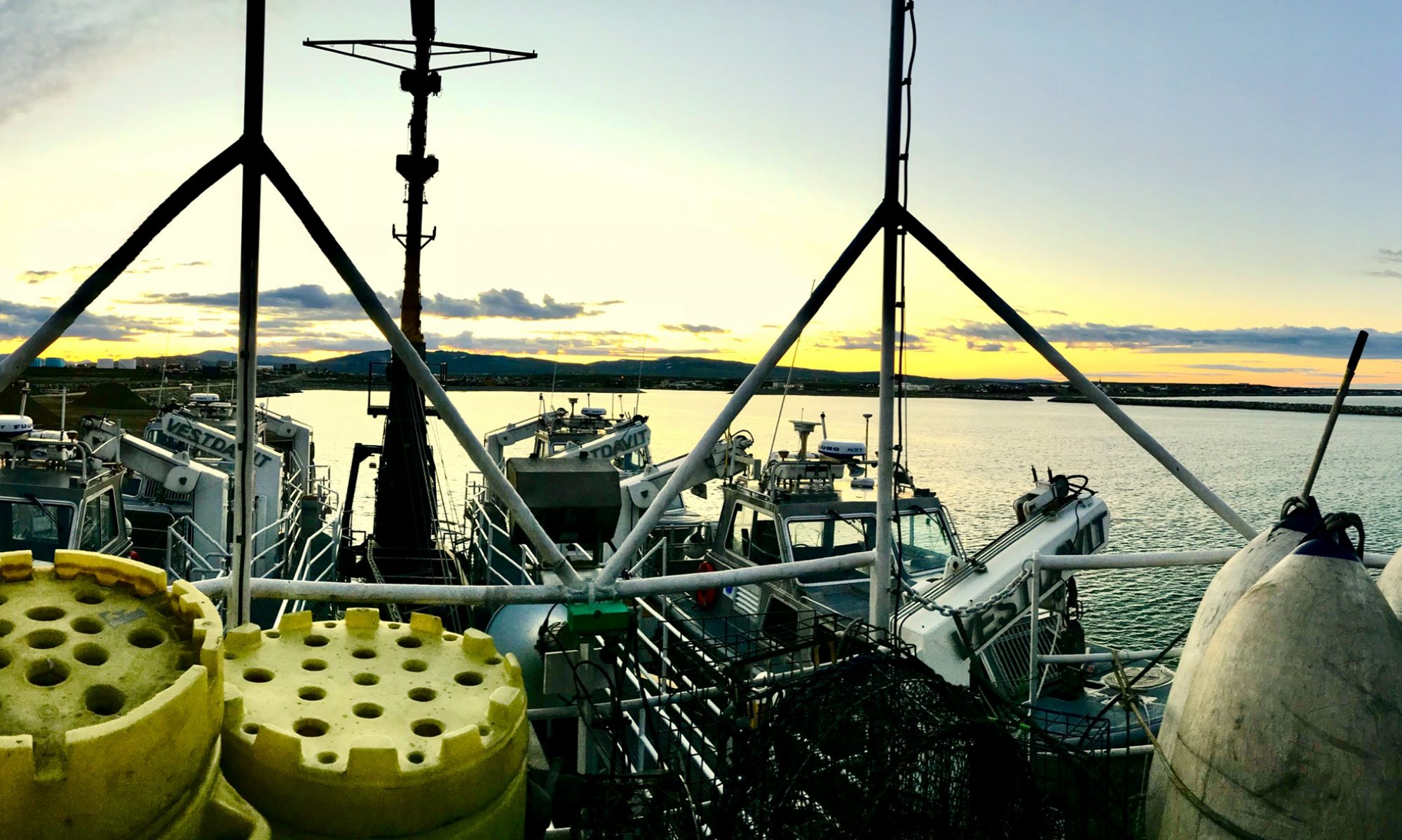
Mary Ann Penning, July 15, 2007

NOAA Teacher at Sea
Mary Ann Penning
Onboard NOAA Ship Albatross IV
July 9 – 20, 2007

Mission: Sea Scallop Survey
Geographical Area: North Atlantic Ocean
Date: July 15, 2007

Weather Data from the Bridge 
Visibility: 4 nautical miles(nm)
Wind direction: 196 degrees
Wind speed: 59 knots (kts)
Sea wave height: 2 feet
Swell wave height: not available
Seawater temperature: 24.3 degrees C
Sea level pressure: 1013.2 millibars (mb)
Air Temperature: 25.1 degrees C
Cloud cover: partly cloudy, hazy

Penning at the Limnoterra Boards (measuring boards) measuring the length of a goose fish caught along with the scallops in the dredge.

Science and Technology Log 

We have traveled along the continental shelf of the eastern seaboard since we set sail from Woods Hole almost a week ago. The route of the ship zigzags from one location to another, visiting previously selected underwater stations, where scallop and fish specimens are collected. Some areas are in shallower water than others and some have been closed to commercial fishermen, while others have just recently opened.  NOAA maps showing these locations are posted in our workroom outside the fantail (rear deck of the ship where we work) along with charts showing the distance between the tows.  The NOAA officer on the bridge works in tandem with the three skilled fishermen who control the dredge equipment – the gantry and the winch.  We wait for 15 minutes while the dredge is towed over an area approximately 4500 square meters.  The ALBATROSS IV is working nonstop. The teamwork is incredible!

Before the sorting begins, the pile dumped from the dredge is photographed with location information.

When the dredge is opened on deck, it is amazing what we find.  Usually eight of us, on hands and knees, sort a pile that can be about eight by six feet wide and about one to two feet high. It’s like playing in a sand pile looking for hidden treasure.  Sometimes the pile is somewhat dry and packed with sand and rusty red sand dollars that camouflage the scallops. Sometimes the catch seems to be wet and slimy and filled with nothing but astropectin, the starfish that gobble the baby scallops whole.  As a result there are very few adult scallops in that area. At one station it was projected that there were about 30,000 astropecten. That would be about five per square meter.  And if we took into account the ones that we missed, there could be approximately ten per square meter.  When we first entered an area named Elephant Trunk, recently opened in March, the pile dumped from the dredge seemed nothing but scallops.  The catch was very clean and we just shoveled them into baskets.  At another station we measured 792 scallops.  Expanding on the sampling size with a special formula, it was determined that there were 7,920 scallops at this location.  Imagine the economic value of this one station alone.

Mixed in with the haul can be a variety of other organisms such as crabs, starfish, little skates, goose fish with their big mouth and ugly teeth, various sizes of four spotted flounder, and sea mice with their spiny edges. Usually we find a variety of hakes: red, spotted or silver, (commercially known as whiting). These fish seem to “hang around” scallops. We collect and count the fish and crabs, too, at some points.  At one such “crab station” I counted 146 crabs.  I’m getting a “hands on” course in fish and scallops.

After sorting scallops into round, laundry type plastic baskets and fish into separate buckets, the residue is shoveled into baskets and accounted for too.  Using various sampling techniques, it is determined how many scallops or baskets of scallops will be weighed and measured on three sophisticated, computerized measuring devices.  But still everything has to be done by hand. Age and growth samples on five scallops are taken at various sites which are packaged and taken back to the lab to be evaluated.  At one site we analyzed 60 scallops for age and growth. The rings on scallops are analogous to tree rings. After cleaning our equipment with hoses spraying sea water, we’re ready for the next station. All these techniques are employed about once an hour around the clock for an expected total of 200 stations. That’s a lot of scientific data for someone to analyze.

Personal Log 

Where can someone spend their “down time” on a cruise like this?  While waiting for the catch to come in, most of us like to sit around the Chief Scientist’s office or the similar space across the hall.  It’s close to the fantail where we do most of our work.  I like to read if I only have a few minutes.  I finished Harry Potter and the Sorcerer’s Stone this way. I brought a laptop computer with me and I finally realized I could work on my logs from there.  A lounge upstairs, where you can watch satellite TV or movies, provides ample entertainment.  In that same area is the computer room where we can e-mail from the ship, however no internet is available.  Occasionally, I like to go to the galley for a snack which, fortunately or unfortunately, is right down the hallway from our workspace.  Fresh fruit is available, along with cereal and popsicles or ice cream.  There may be leftover dessert from dinner, too.  Our rooms are downstairs one level, but as a courtesy to those sleeping from the opposite watch, we don’t enter our rooms then.  Sometimes I like to go out and just look at the water. There was a sliver of a moon last night with the planet Venus peering over it.  That was an awesome sight!

Questions of the Day 

How big can scallops grow? What is their habitat like?  Why is this data on scallops collected?  Who or what benefits from this labor intensive work?  Join me in my next log as I discuss these important mollusks with Dr. Dvora Hart, a scallops’ expert, participating in our scientific survey.

Noah Doughty, September 21, 2006

NOAA Teacher at Sea
Noah Doughty
Onboard Research Vessel Western Flyer
September 18 – 22, 2006

Mission: USS Macon Wreck Archeological Expedition
Geographical Area: California Coast
Date: September 21, 2006

Weather Report from the Bridge
Visibility: Good
Wind direction and speed:  NWxW 24kts
Swell direction and height: NW 6’-8’
Seawater temperature: 55.7oF
Sea level pressure: 1019 millibars
Cloud cover: 2/8

Science and Technology Log 

Work at the USS MACON wreck site continues, alternating between mosaic work and survey work depending on water conditions at the bottom.  Today’s log will profile two members of the expedition whose jobs provide a context for the information being gathered.

Erica Burton works for the Monterey Bay National Marine Sanctuary and is responsible for operating VARS, which stands for Video Annotation and Reference System.  VARS is a database that allows screen images to be captured, logged, and georeferenced with annotated notes. For the MACON expedition these notes list the possible identity of the artifacts. In addition to the captured image, VARS also records the time stamp in the video and a geographical location. All the images and video captured are archived at MBARI (the Monterey Bay Aquarium Research Institute), and later, in conjunction with the National Marine Sanctuary Program, staff will process and interpret to produce a final photo-mosaic poster that will be made available to the public. Burton, who has a background in marine biology, also notes that the USS MACON wreckage provides an artificial hard-bottom habitat in an otherwise soft-bottom habitat, and the organisms observed are primarily soft-bottom fishes with occasional encrusting organisms on the wreckage.

Erica Burton, on the left, operates VARS (Video Annotation and Reference System), and works for the Monterey Bay National Marine Sanctuary. Lee Murai, on the right, is the expedition’s GIS (Geographical Information System) analyst, and comes from Moss Landing Marine Laboratories.

Lee Murai is a Geological Oceanography student at the Moss Landing Marine Laboratories and is the GIS (Geographical Information System) analyst.  Through GIS software he is able to spatially organize the data collected on this expedition and compare it to the 1990 and 1991 expeditions. Types of data collected in the past include side-scan sonar, multi-beam bathymetry, and waypoints collected by Remotely Operated Vehicles (ROVs) and manned submersibles.  For this expedition he is working closely with the Stanford University team to assist with the photomosaic collection procedure. The GIS map posted on day 1 was provided by Murai. Compare that to the low-resolution image tiles posted today.  While the use of GIS is relatively new to the field of marine archeology, it is generally used in marine environments to provide geologic and biologic habitat characterization maps.

This image, created with low-resolution copies of the image files, shows a Curtiss F9C-2 Sparrowhawk (plane #4 in the GIS map on the Day 1 log).  High-resolution tiles will be fused into the final photo-mosaic.  The nose of the plane is in the lower left.
This image, created with low-resolution copies of the image files, shows a Curtiss F9C-2 Sparrowhawk (plane #4 in the GIS map on the Day 1 log). High-resolution tiles will be fused into the final photo-mosaic. The nose of the plane is in the lower left.

Melissa Fye, April 18, 2005

NOAA Teacher at Sea
Melissa Fye
Onboard NOAA Ship Hi’ialakai
April 4 – 25, 2005

Mission: Coral Reef Ecosystem Survey
Geographical Area: Northwest Hawaiian Islands
Date: April 18, 2005

Location: Latitude: 23*36.3’North, Longitude: 164*43.0’W

Weather Data from the Bridge
Visibility: 10
Wind Direction:90
Wind Speed: 14 knots
Sea Wave Height: 2-4 feet
Swell Wave Height: 5-7 feet
Sea Level Pressure: 1018.8
Cloud Cover: 2/8 Cu, As, Si
Temperature outside: 24.4

Sea turtles on the beach

Science and Technology Log

The AHI research vessel was launched just prior to eight a.m. this morning with Scientist Joyce Miller and Jeremy Jones aboard.  The red and silver sonar boat would continue mapping shallow areas near 23 degrees North and 166 degrees West in the Northern Hawaiian Island chain. The ship resumed running benthic habitat mapping lines also, filling in gaps from previous surveys. Half past noon brought the deployment of several divers to the hull of the ship to determine the installation of the Trackpoint II testing. They dove in adorned with black suits, colorful air tanks, and metal weight belts.  It turned out that the Trackpoint II wasn’t installed properly and was off by 15 degrees.  That noted, changes were made to computer software to account for the degree change. Another boat trip was organized for the La Perouse Pinnacle area. Coxswain Merlyn Gordon led me, ENS Amy Cox, Scientists Rob O’Connor and Jonathan Weiss out to sea to snorkel the reef ecosystem.  Upon approaching La Perouse, it was determined to be too dangerous, so we changed course and swam the reef area near East Island.  We returned to the ship a few hours later and the AHI followed suit, and was hoisted out of the water once again. The HI’IALAKAI transited to deeper waters and ship based TOAD operations and Trackpoint II testing carried on once again. Ten p.m. brought about the reoccurrence of shipboard mapping around the outer circumference of French Frigate Shoals using the onboard multibeam sonar system.

Personal Log

I awoke and after the morning ritual of breakfast and shower, I answered emails from students in my fourth grade classroom in Ashburn, VA.  I climbed the stairs and passageway to the drylab to check to see if I could be of some assistance editing data.  The efficient scientists were caught up on the editing so my services were not needed.  I soon found out about an impromptu snorkeling trip and clambered to get ready and join the expedition. The seas were the calmest I had seen yet, so the ride was very smooth across the Pacific towards Perouse Pinnacle (a volcanic rock out cropping that serves as a good landmark in this area). The ocean looked like glass and the sun rays flashed and hit the water like bright diamonds. There was an underlying surge though, which might indicate a coming storm in the next 48 hours (according to sailors onboard).

After nearing Perouse, we could see the waves crashing around the rock, and pressed on for a safer snorkeling environment where we wouldn’t be churned to bits! We approached East Island and could see dark figures grazing the beach.  Upon closer inspection, we realized they were not monk seals, but giant green sea turtles basking in the sun. Mating season was upon us, and many of the sea turtles were populating this area to find mates. We snorkeled in four different areas of the reef, being careful not to get near the beach or disturb the coral reef ecosystem.  Several sea turtles were curious and encircled our boat, whereas I snapped some good photos.

I finally saw my first Ulua fish, indigenous to this area.  The fish had eluded me prior to today and I had been told stories of their aggressive biting behavior. Although quite large, about 3-4 feet, I was told it was small compared to most.  It swam around us, but never ATTACKED! It wasn’t nearly as ferocious as the picture the crew on board had painted in my mind.  It was a very flat, circular fish with a silver sheen. We saw many school of fish, one of which was bright yellow, and neon green coral. I learned from Coxswain Gordon that some of the clouds above the reef bore a greenish undercast or tint.  The color was reflected from the coral below and was an aide in locating reef areas. We returned to the HI’IALAKAI later in the afternoon and I spent the evening conducting some more interviews (which will be included in future logs). The sun and exercise tired me out and I fell asleep as soon as I hit the pillow in my stateroom.

QUESTION OF THE DAY for my fourth grade students:  A habitat is the place where an organism lives and grows.  Examples include ponds, forests, and a coral reef. A niche is the role an organism plays in its surroundings. A niche includes an animal’s complete way of life–where it lives, how and what it eats, and how it produces. Find out more about the giant green sea turtle. Think about why the turtle is laying on the beach also. List the answer’s to the sea turtle’s niche: 1) Where does it live? 2) How does it eat (what body parts does it have to aid in eating?) 3) What does it eat?  (don’t say it eats Ms. Fye:)!! Ugh! 4) How does it reproduce?  (Does it give birth to live young, lay eggs, etc?) 5) What resource did you use to find these answers?

ANSWER TO YESTERDAY’s Question:  The ocean floor is full of nutrients and food particles resulting from decaying matter settling on the bottom.