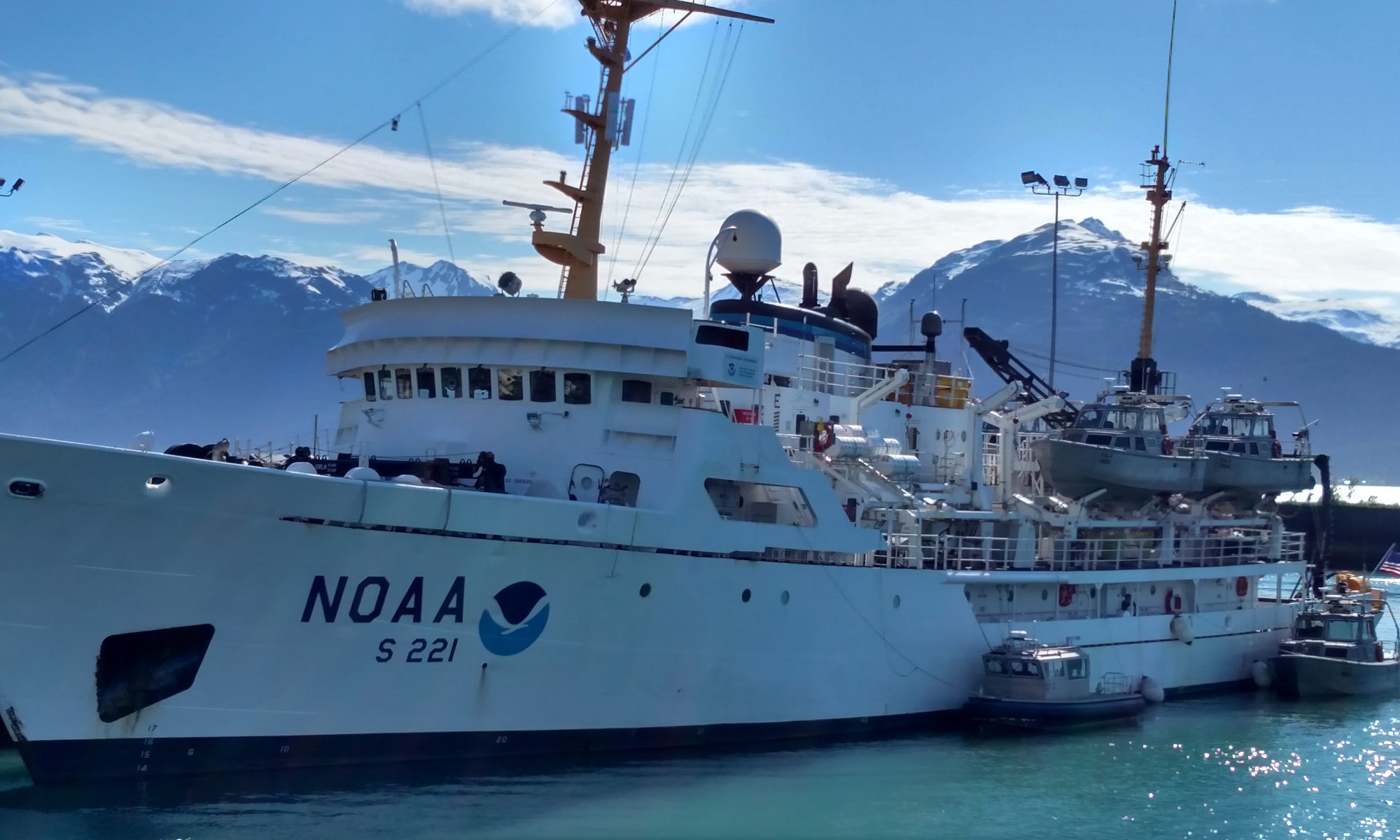

NOAA Teacher at Sea
Julia West
Aboard NOAA ship Gordon Gunter
March 17 – April 2, 2015
Mission: Winter Plankton Survey
Geographic area of cruise: Gulf of Mexico
Date: March 17, 2015
Personal Log
I made it! A smooth flight down to Mississippi (which is a new state for me – I’ve never been here). I arrived to sunshine and warm temperatures – OK, downright hot to me, but I’ll get used to it quickly I’m sure. Pamela Bond, the chief scientist on this cruise, met me at the airport and brought me out to the Gordon Gunter. I quickly learned that it is not only Pam who is super nice and welcoming, but the entire crew. I’ll be introducing them more in future posts.
The ship is not at the usual port near the NOAA lab, but at the former naval station, on an island at the mouth of the Pascagoula River. This yard has multiple uses now, as you can see from the pictures below. So not only is the Gunter here, but it has the company of a Coast Guard vessel, and both are dwarfed by a massive oil rig. On the other side of the pier (not pictured) is a USGS vessel and others. There’s a lot going on here!


Across the way is Pascagoula’s largest employer, and Mississippi’s largest manufacturing employer, Ingalls Shipbuilding, with 11,000 employees right here in Pascagoula! I can see ships in various stages of construction.


I have learned a lot about this area in the one day here at port. Two major events have happened here in recent years – Hurricane Katrina (2005) and the BP oil spill (2010). Both events simply ravaged this area. Everywhere we have been in the last day – the naval station, the NOAA lab, the highway – was under several feet of water during Katrina. You’ve seen the pictures. To hear about it from the folks here is profound. The BP oil spill (also known as Deepwater Horizon oil spill), another devastating event, changed the whole NOAA season (as it did for the fishermen and just about everyone else here). All the NOAA ships on the east coast, and one from the west coast, had to cancel their season’s research and congregate down here to be involved as needed, looking for oil, looking for marine mammals, etc. Today we visited the NOAA lab, where several employees are analyzing plankton samples taken from the affected waters. This is five years later, and still very relevant and ongoing data collection! (sorry, forgot to bring my camera to the lab, but I got to check out lots of plankton under the microscope).

Backing up now, to my arrival: Pam showed me to my room – I’m surprised that I have my own room! It has a refrigerator, closet, desk, comfy chair, my very own sink, and a shared bathroom with the room next door. And it has a TV – I barely know how to use a TV!
And then Tony, the ET (electronics technician) gave me a tour of the boat. Since then, I have been wandering around, sometimes in circles, trying to figure out the layout. I can tell right away that the food is going to be amazing.
My head is already spinning with some of the details about the equipment and technology. Pam was not sure if we would be launching on time – everything has to be just perfect for a research cruise to start, and if there are any issues, we don’t go. There were two repairs that needed to be made since the ship came to port just two days ago: one had to do with the unit that makes our water, by distilling seawater (very important!), and the other had to do with a malfunctioning gyro, or gyrocompass, needed for navigation (also important!). I wanted to know more about how a gyrocompass works, so I first looked it up on Wikipedia, and then talked to Dave Wang, the NAV (navigations officer). It’s so fascinating – a compass that points true north partly by using the rotation of the Earth. The good news is that both of the repairs are done and we will be launching on time!

I just want to share one bit info about a simple piece of equipment on the aft deck. It’s a water tank. I asked Tony what it’s for, when we have the technology to make fresh water. Well, after the oil spill, getting fresh water was a problem, so the tank was added. It was decided that it was convenient to have after it was no longer needed, and is now used for things that need a freshwater wash.
I am wrapping up this blog post now, a day after I started it. I’ve had my safety and ship protocol briefing, and we are underway. We’ve passed the barrier islands, and the ship is starting to rock a bit. Here we go! We have another 5 hours or so to go to get to our first sampling station, so the science work will start tonight. One final photo – to get out of the tight spot we were docked in, a tugboat was necessary:

Word of the Day (time to start learning the terminology):
Neuston – the organisms that are found on the very top of the water, in the surface film. Contrast that with plankton, which can be said to be found within the water, not always right at the surface.