Wes Struble: Science Research in the Bahamas? Sign me up! February 27, 2012

NOAA Teacher at Sea
Wes Struble
Aboard NOAA Ship Ronald H. Brown
February 15 – March 5, 2012

Mission: Western Boundary Time Series
Geographical Area: Sub-Tropical Atlantic, off the Coast of the Bahamas
Date: February 27, 2012

Weather Data from the Bridge

Position: 26 degrees 31 minutes North Latitude & 76 degrees 48 minutes West Longitude / 9 miles east of the Bahamas
Windspeed: 8 knots
Wind Direction: East by Southeast
Air Temperature: 24.8 deg C / 76.5 deg F
Water Temperature: 24.2 deg C / 75.5 deg F
Atm Pressure: 1025 mb
Water Depth: 3830 meters / 12,770 feet
Cloud Cover: Approximately 60%
Cloud Type: Some altostratus and cumulostratus

Science/Technology Log:

The temperature has become quite warm and it has been a delight to walk around the deck in the sunshine in a t-shirt and shorts (the current weather back home is between 10 and 20 deg F and snowing). As you can see from the photo below the weather continues to be clear with some fair weather cumulus clouds and a light breeze.

A view of the wide western Atlantic off the Ron Brown's bow from the weather deck several days after leaving the port of Charleston, SC
The Ron Brown's wake trailing off into the west as we head toward our first CTD station
NOAA research scientist, Dr. Molly Baringer, Chief Scientist during the cruise, catches up on some computer work and reading in the shade of the bridge on the "lifeguard chair" on the "steel beach" (the weather deck) of the NOAA research vessel Ronald H Brown
A drifter buoy arrives prepackaged and ready for deployment
Removing the plastic packaging and recording the coordinates and serial number of the drifter buoy before deployment
A drifter buoy ready for deployment by Dr. Aurelie Duchez
Dr. Aurelie Duchez tosses the drifter over the stern of the Ron Brown. This cruise is a continuation of a long period of study (over 30 years) of the Gulf Stream and the Western Boundary currents in and around the region of Florida and the Bahamas. This region is of particular interest because of the impact these currents have on the weather and climate patterns of the northeastern North America and Northern Europe. The Gulf Stream current helps transport large amounts of heat energy derived from the equatorial Atlantic to the northern latitudes of America and Europe. An image of the Gulf Stream current from space - NASA photo. The Gulf Stream is the orange colored current that passes on the east coast of Florida and flows north along the eastern seaboard of the US

This phenomenon helps to moderate the climates of those areas by producing milder temperatures than would normally occur at these latitudes. Changes in the characteristics of these currents could potentially have a profound affect on the climates of these regions and it would be of particular interest to understand in detail the nature and interaction of these mobile bodies of water. To study these currents a combination of techniques have been employed. We should all be familiar with the concept of induction – the process of producing a current in a conductor by moving it through an electromagnetic field. This was one of the more important discoveries of Michael Faraday and is one for which we should be very grateful since most of our modern world depends upon the application of this scientific discovery.

Michael Faraday - the great British Scientist

As an example think of what modern life would be like without electric motors or generators. Well, it just so happens there exist old communications cables on the seafloor under these very currents between south Florida and the Bahamas. These cables are affected by a combination of the earth’s magnetic field and the motion of the seawater (a solution composed primarily of dissolved ions, charged particles, of Na+ and Cl). This combination of charges, motion, and the earth’s magnetic field causes a weak electrical current to be induced in the cable – a current which researchers have been able to measure.

A schematic showings the induction of an electric current in the underwater cable by motion of the sea water current (NOAA Image)

The electric current in the cable can be related mathematically to the strength of the ocean currents flowing over them. In addition to the data produced by the cable, the NOAA scientists are also deploying moored buoys below the surface that measure the characteristics of the seawater (temperature, density, etc) and use an Acoustic Doppler array to measure the relative motion of the current.

ADCP (Acoustic Doppler Current Profiler) and two other types of buoys - image from Grand Valley State University
An ADCP (Acoustic Doppler Current Profiler) buoy - Image from SAIC
A buoy deployment operation on the Ron Brown. Notice the large orange spherical ADCP buoys in the right foreground on the deck of the ship
These two data acquisition systems (in addition to the drifter buoys and CTD sampling) provide the data used to analyze the dynamics of the currents. As more data is collected and analyzed the nature and impact of these currents is slowly unraveled. Consider visiting the following website for a more detailed explanation:

http://www.aoml.noaa.gov/phod/wbts/index.php

Jessie Soder: Geology on Georges, August 17, 2011

NOAA Teacher at Sea
Jessie Soder
Aboard NOAA Ship Delaware II
August 8 – 19, 2011 

Mission: Atlantic Surfclam and Ocean Quahog Survey
Geographical Area of Cruise:  Northern Atlantic
Date: Wednesday, August 17, 2011

Weather Data
Time: 12:00
Location:  41°19.095 N, 71°03.261
Air Temp:  22°C (°F)
Water Temp:  21°C (°F)
Wind Direction: South
Wind Speed: 7 knots
Sea Wave height:  0
Sea Swell:  0

Science and Technology Log

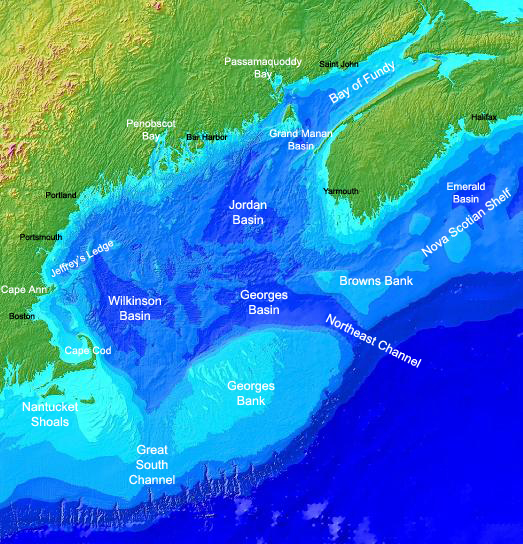
Gulf of Maine: Including Georges Bank

So far, we have spent this entire trip on Georges Bank.  This famous geographical location off the east coast of the United States is something that I had only heard about before this trip.  After several tows over the past week I have been able to see a variety of materials brought up from the ocean floor of Georges Bank.  I have seen loads of clams, empty shells, sand, mud and clay, and smooth polished rocks.  We have even pulled up a few boulders that must have weighed a couple of hundred pounds.  It was the smooth polished rocks that caught my attention. How would a rock from the bottom of the ocean become smooth and rounded?  It probably meant that Georges Bank must not have always been the bottom of the ocean.

During the Wisconsin Glaciation the ice reached its maximum around 18,000 years ago.  The Laurentide ice sheet paused in the area of Georges Bank and Cape Cod and left behind a recessional moraine that created these landforms.  This ice also had several meltwater streams flowing from it and these streams were responsible for the polishing the rocks and cutting some of the canyons found on the seafloor today.  The Northeast Channel off the northeast side of Georges Bank was the principle water gap for most of the meltwater.

Smooth Polished Rocks From the Ocean Floor

Georges Bank is a huge oval-shaped shoal bigger than Massachusetts that starts about 62 miles offshore.  It is part of the continental shelf and its shallowest areas are approximately 13 feet deep and its deepest areas 200 feet.  In fact, thousands of years ago Georges Bank used to be above water and an extension of Cape Cod.  About 14,000 years ago the sea rose enough to isolate this area and it was home to many prehistoric animals such as mastodons and giant sloths.  Today, traces of these animals are sometimes found in fishing nets!  These animals died out about 11,500 years ago when the sea level rose further and submerged the area.

Georges Bank is a very productive fishing area in the North Atlantic.  (The Grand Banks is more productive, but not as geographically accessible as Georges Banks.)  Why is Georges Bank a prime feeding and breeding area for cod, haddock, herring, flounder, lobsters, and clams?  It has to do with ocean currents.  Cold, nutrient rich water from the Labrador Current sweeps over the bank and mixes with warmer water from the Gulf Stream on the eastern edges of Georges Bank.  The mingling of these two currents, plus sunlight, creates an ideal environment for phytoplankton, which is food for the zooplankton.  In fact, the phytoplankton grow three times faster here than on any other continental shelf.  All of this plankton feeds the ecosystem of fish, birds, marine mammals, and shellfish that flourish on Georges Banks.

Personal Log

Yesterday we left Georges Bank for stations off the coast of Rhode Island.  After dark, I stepped out on the back deck and Jimmy pointed out the lights of Nantucket and Martha’s Vineyard.  We were in sight of land for the first time in a week.  It wasn’t long before people had their cell phones out and were making calls.

A few times during this trip I have thought about sailors in the past and how they would leave for months, and even years, at a time and not have contact with their families and loved ones until they returned.  I have had email contact this entire time, yet I am really excited to go home to see those that I miss.  I can hardly imagine what it would be like to be gone for a year with no contact at all.

Throughout this trip I have been getting to know others on this cruise.  I have learned that several of them have families and young children at home.  Many of them are at sea for many weeks, or months, a year.  After being on this cruise, I have gained a lot of respect for people who choose to work on the ocean for a living.  It takes a certain type of person who can work hard, maintain a positive attitude, and live away from their home and loved ones for extended periods of time.  It has been an honor to work with these people.