Melanie Lyte: On the Brink of an Adventure at Sea! May 7, 2013

NOAA Teacher at Sea
Melanie Lyte
Aboard NOAA Ship Gordon Gunter
May 20 – 31, 2013

Mission: Right Whale Survey, Great South Channel
Geographical Area of Cruise: North Atlantic 
Date: May 14, 2013

Personal Log

Hello, from Castleton, New York. My name is Melanie Lyte and I am a first grade teacher at Bell Top Elementary School . I am very fortunate to teach in a school of dedicated staff where creativity and innovation is fostered, and embraced. My principal, Jim McHugh, was the one who urged me to apply for the NOAA Teacher at Sea program, and I am grateful to him for his support and encouragement. Although Bell Top is a public school, many of the yearly activities our students are involved in are unique, especially in a public school setting. With funds from a NSTA administered Toyota Tapestry Grant we built a Learning Barn on our school grounds. The barn, built uniquely using both Dutch and English architectural styles so students can compare the two ways, houses an evaporator for a school wide maple sugaring project, as well as cider press for making apple cider in the fall.  We also have amazing parental support at our school, a very active PTO, and of course the best kids in the world walk through our doors each day!

Bell Top Elementary School,Troy, NY
Bell Top Elementary School, Troy NY

I originally applied to be a teacher at sea because I love science and adventure, and I love to bring my experiences outside the classroom back to enrich my students. In the last few years I have camped in the jungles of Sumatra, Indonesia, hiked and kayaked in Alaska,  visited the rain forests of Brazil, and traveled to China. I believe we must expose our children to the the broader world, and the natural world around them in order to foster a curiosity about far away places, and  love and appreciation for our earth. We need to feed every student’s innate sense of wonder and excitement for the world around them.

My friend Harold and I on top of a volcano in Sumatra, Indonesia.

I think the opportunity to work with real scientists doing research will be a life changing event for me, and I am even more enthused because the mission of this voyage, conducting a right whale survey in the North Atlantic, is perfect for my first graders! What child doesn’t get excited about whales?!?! I am also very fortunate to teach with my partner in first grade, Sarah Lussier. She and I truly have a the best teaching partnership imaginable, and we, and our students, are enriched by it.  To prepare our students for my upcoming voyage, we have been learning all we can about right whales, and whales in general. We painted a  right whale and whale calf on the parking lot at school (that was an adventure in itself – think 42 first graders  with paint brushes and black concrete paint). The students also researched right whales, created diagrams of the whale, and developed informational posters of what they learned. I think the consensus of the students is that right whales are “really cool, but a little lazy, and kind of ugly.” (as one of my first graders so  eloquently put it). They are fascinated by the callosities on the whales and are saddened that the whales sit on top of the water so often and are in danger of being hit by boats. While I’m at sea the students in both our classrooms will be working on many other whale related activities, as well as following my blog.

Right whale calf created by first graders at BellTop Elementary School.
Categorizing toothed and baleen whales by the first graders at Bell Top School
Whale Facts by first graders at Bell Top School.
Whale Sizes by the first graders at Bell Top School.
Right whale (1980) Massachusetts Secretary of ...
The right whale became the official state marine mammal of Massachusetts in 1980. Photo credit: Florida Fish and Wildlife Conservation Commission/NOAA

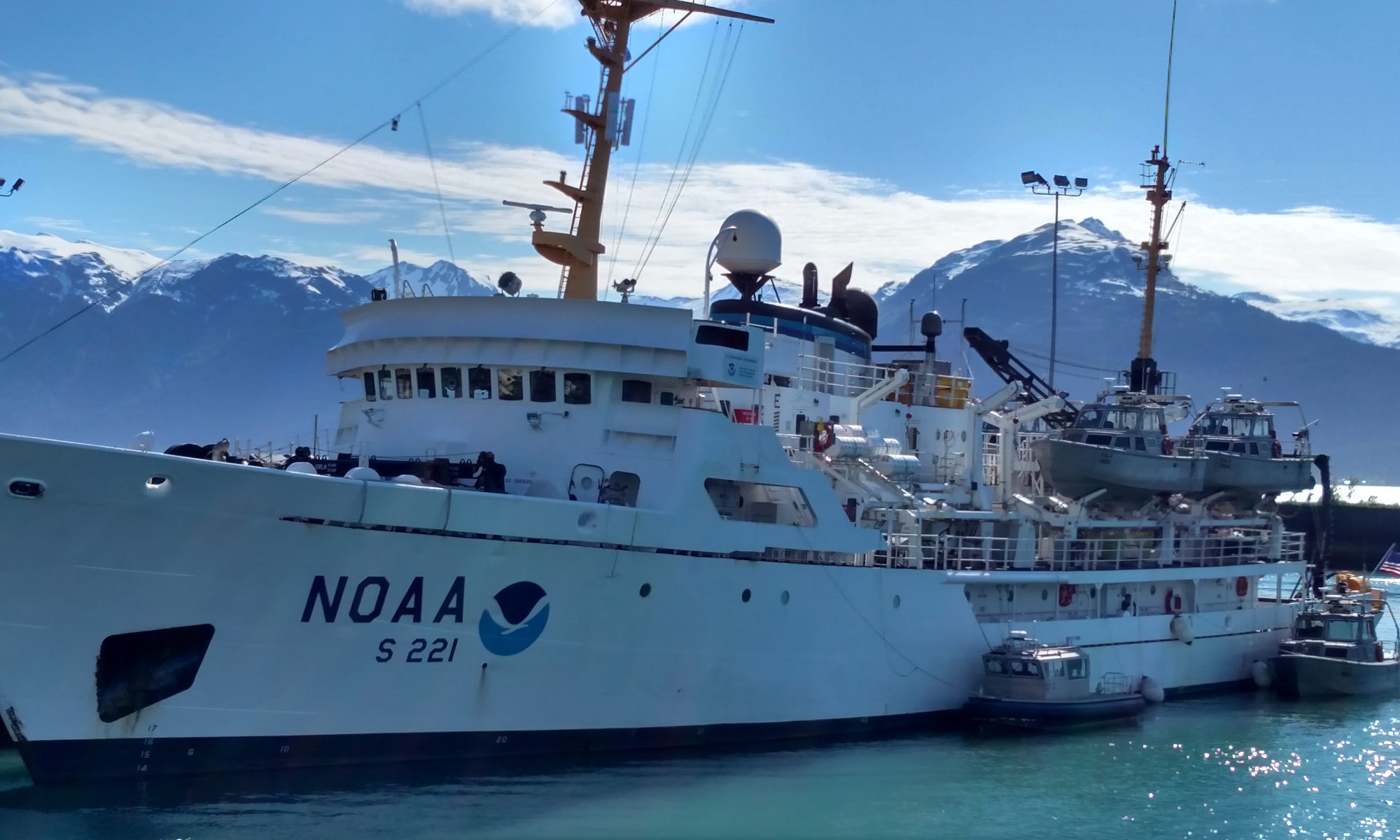
So in less than two weeks my adventure at sea will begin! I will be joining head scientist Allison Henry and the crew of the  National Oceanic and Atmospheric Administration (NOAA) on Gordon Gunter out of Boston MA. We will be conducting a North Atlantic Right whale survey, but I have been told we will see other whales as well such as humpback, sei, and minke. I can’t wait to explore the ocean with scientists, and learn all I can about the creatures who live there. I hope you will join me on my adventure by reading my blogs while I’m at sea.

Gordon Gunter
NOAA Ship Gordon Gunter (photo credit NOAA)

Angela Greene: “Entangled with Superheroes” May 2, 2013

NOAA Teacher at Sea
Angela Greene
Aboard NOAA Ship Gordon Gunter
April 29-May 11, 2013

Mission: Northern Right Whale Survey
Geographical Area of Cruise: Atlantic Ocean out of Woods Hole, MA
Date: May 2, 2013

Weather Data from the Bridge: Average Air Temperature- 7°C or 44.6°F, Winds out of the north, Sky Conditions-clear

Science and Technology Log:

Lowering CTD
Deploying CTD cast. “All in a days work.”

Time seems to be flying by on the NOAA ship Gordon Gunter as one day quickly runs into the next.  I am learning so many new things, and doing brand new tasks that I am not sure where to begin telling my story.  Every time something awesome happens I want to write it down, but something even more awesome happens.  It’s such a busy work environment for the crew and the scientists!

I am on the ship with a scientist whose job is to “disentangle” whales. Of course I had a million questions such as, “Disentangle whales from what?” The first night on board, we were treated to a “science talk” from David Morin of the Large Whale Disentanglement Program, Protected Resources Division of NOAA.

Large whales can swim into and get entangled by gear of commercial fishermen. Apparently they swim into the gear, panic while attempting to get free, and make the entanglement worse. The gear can be in the form of long ropes, buoys, and even lobster pots.

Trident gillnet
Disentanglement team trying to remove a gill net from a large whale. Photo credit Provincetown Center for Coastal Studies under fisheries permit number 932-1489.
Cutting tools
Tools used for disentanglement. Photo credit Provincetowne Center for Coastal Studies.

Sometimes the whales can free themselves either fully or partially, but all too often they have to learn to cope with all the gear wrapped around fins, flippers, or flukes. The entanglement can become so tight and restrictive that it actually embeds into the flesh of the animal, creating deep gashes, and scars.

When an entangled whale is spotted and reported, a disentanglement team springs into action.  A large boat takes them to the reported location and a small rubber boat gets them as close to the whale as possible.  With cameras mounted on head-gear, the disentanglement team must first assess the type of gear and configuration of the entanglement.  Obviously every case is different, with a wide range of fishing gear, and different species and sizes of whales.  Right then the small boat a plan is launched and put into motion to attempt to free the whale from its bindings using a variety of sophisticated cutting tools mounted to large poles.

Yellowfin lift
Disentanglement is a dangerous job. Photo Credit Florida Fish and Wildlife under fisheries permit # 932-1489.

Dave has been in situations where the whale has become frightened and slapped a fluke down on the small rubber boat.  One swift move from a whale could be the end of a crew attempting disentanglement.    This doesn’t stop Dave from telling the details of his work with passion and admiration for the opportunity to work with whales.  I’ll stick with teaching!

Big Eyes
Me and “Big Eyes” Photo Credit Mark Baumgartner

My job during the right whale survey has, so far, been very addicting!  We run ninety minute “watch shifts” on the flying bridge searching for any signs of life, particularly whales.  The flying bridge, the highest point on the ship, gives you the best vantage point when looking out into the ocean for marine life.

Blow
A “Blow”

There are three stations that I rotate through every thirty minutes while “on watch”. Station one is a set of “Big Eyes”, or really large binoculars. The view of the ocean using the “Big Eyes” is specific and fantastic! During that thirty-minute segment of my watch duty, I scan my side of the ocean, which is bisected by the bow of the ship. I look for any signs of life such as a splash, a “blow”, a dorsal fin, a fluke, or even “suspicious water patterns”. If I think I have spotted marine life such as a dolphin, seal, or a whale I shout out “SIGHTING” to the data recorder. I have to tell the data recorder very specific data about my animal sighting, which is added to a computer program.

The middle station on the fly bridge of watch duty is the data recorder. This is the scariest job for me because sometimes multiple sightings have to be recorded at once. The third position of watch duty is thirty additional minutes on a second set of “Big Eyes”.

Data Collection
Me as “Data Collector” Photo Credit Allison Henry

My very first official sighting was a Mother Sei whale and her calf. Her dorsal was long and sickle shaped as she arched through the glassy water. Then her baby arched right after she did. It was amazing! The process of being on watch is smooth, simple, calm, and easy. I’ve adjusted well to it and look forward to scanning the water. However all this peacefulness changes dramatically when the sighting is a Right Whale… I sighted one today…

Fluke
“Could it be a fluke?”

Personal Log: Many people know that my hobby is “collecting scientists”! I have a rather eclectic sampling of amazing people that I have acquired through the years. Each one of them has an amazing supernatural ability that sets them apart from the normal human. Each of them is a superhero. Watching the scientists on this field experience solidifies my hypothesis. My chief scientist, Allison Henry has the superpower of being able to identify a right whale by glancing at the animal or a photograph the same way I could look at a yearbook and identify a student in my class. This is not a normal skill possessed by regular humans. Scientist, Dave, untangles whales, much like I untangle the Christmas lights each year. Normal people don’t untangle large mammals in the ocean. Aside from possessing supernatural abilities, the new scientists in my collection exude a passion toward their chosen career paths. While these superpowers set them apart, I think that passion is what connects them to us. Maybe my job as an educator is to recognize the passion in each student and encourage him or her to find the superhero within.