NOAA Teacher at Sea Mary Cook Onboard R/V Norseman II March 18-30, 2016
Mission: Deepwater Ecosystems of Glacier Bay National Park Geographical Area ofCruise: Glacier Bay, Alaska Date: Thursday, March 17, 2016
Introduction
Hello! My name is Mary Cook and I’m a science teacher in Scammon Bay, Alaska. Scammon Bay is a cozy little Yupik village nestled at the base of the Askinuk Mountains on the edge of the vast frozen tundra where the Kun River meets the Bering Sea. We live in what many people call Bush Alaska. It’s remote. We have no roads connecting our village to other places. Everything comes and goes mostly by small Bush planes. Barges bring supplies in the warmer months. We get around locally by snow-go, 4-wheeler, or boat.
Map of Alaska showing Scammon BayEntrance to Scammon Bay School
The Yupik Eskimo of Scammon Bay are traditionally fishers, bird hunters and trappers. Moose have also become an important food source over the last 20 years or so. Today they continue with this subsistence lifestyle blended with more modern conveniences such as cell phones and running water.
My students, co-workers and I are so excited to be involved with the NOAA Teacher at Sea program! Our school has been abuzz with preparations over the last few weeks.
Congratulations to our 4th graders for making a fantastic banner to take aboard the Research Vessel Norseman II! Also, thanks to many students who submitted names for our eagle mascot.
Scammon Bay 4th Graders with Vice Principal Harley Sundown (L), TAS Mary Cook, Principal Melissa Rivers, and 4th Grade Teacher Michele Benisek (R)
Drum roll……His name is Qanuk! (Qanuk means snowflake in the Yupik language.) I anticipate that he will make some mystery appearances around the ship in the coming days.
Stryofoam Cups decorated by Scammon Bay students
We have decorated and signed lots of Styrofoam cups to be sent to the bottom of the Bay. We are very curious about what will happen to our cups as they descend into the depths! We also can’t wait to find out more about the secrets of the Red Tree Coral, which is the focus of the research for this voyage into Glacier Bay.
Wednesday, I left my students in Scammon Bay as I boarded the small bush plane headed for Bethel. Then flew from Bethel to Anchorage and from Anchorage on to Juneau. It was a long day of flying and waiting and flying and waiting. But the late night flight into Juneau was worth it when, as we rose above the snow clouds, I peered out the window to see a magnificent aurora glowing in the sky!
Mary’s students wave goodbye
Aerial view of Scammon Bay Village
Yesterday I had a little bit of time to get out and see the sights of Juneau. My favorite was the Mendenhall Glacier. Wow! So beautiful and powerfully majestic in all its frozen splendor. In addition to the glacier, there are bald eagles perched in treetops all around town.
Where’s Qanuk?
Bald eagles (not just Qanuk!) are a common sight around Juneau
Last night I met many of the science crew and a few of the ship’s crew. What a positive and exciting group of people. Even they are excited about being part of the NOAA Teacher at Sea Program!
This is going to be fun—-and educational.
Don’t you just love that combination? Fun and educational.
Today we load the ship.
Tomorrow we sail away into the Bay.
NOAA Teacher at Sea
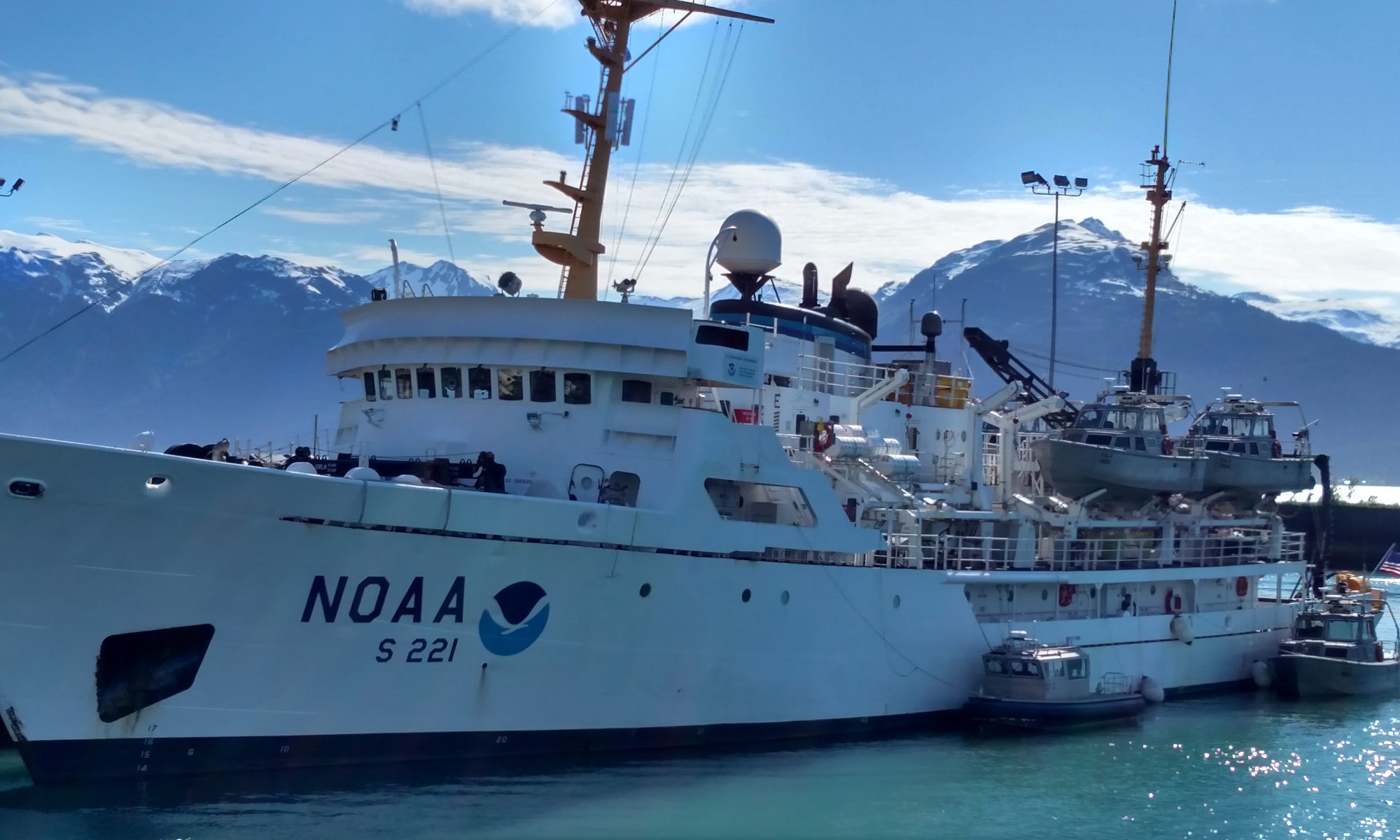
Susan Smith
Onboard NOAA Ship Rainier
June 1-12, 2009
Mission: Hydrographic survey Geographical area of cruise: Trocadero Bay, Alaska; 55°20.990’ N, 33°00.677’ W Date: June 11, 2009
Weather at 9:45 AM
Temperature: Dry Bulb: 7.8°C (46°F); Wet Bulb: 6.7° (44°F)
Cloudcover: OVC
Visibility: 10+ nautical miles
Wind direction: 285, 7 kts.
Sea Wave Height: -0
Sea water temperature: 8.3°C (41°F)
Margerie Glacier
Science and Technology Log
Today’s log is an accounting of our voyage up Glacier Bay to the Margerie Glacier. Along the way we received information about Glacier Bay from Lewis, the National Parks Service employee whose assistance we enlisted. At approximately 5:30 AM Lewis came on board. He was delivered by boat in the Sitakaday Narrows, near Bartlett Cove. We actually entered Glacier Bay a few hours later. Our destination- Margerie Glacier,at the border of the United States and Canada.
Reid Glacier, south of Tarr Inlet
Margerie Glacier’s height is 250 feet. The glacier also extends another 100 feet below the water line. The Statue of Liberty is 307 feet tall by comparison. The Reid Glacier, south of the Tarr Inlet, is 150 above the waterline and is ••• mile across. It is the fastest moving Tidewater glacier, moving at approximately 8 feet per day. A Tidewater glacier is defined as “a glacier that terminates in the sea, where it usually ends in an ice cliff from which icebergs are discharged”.
Questions of the Day:
Why does the ice look blue? The ice in the glacier absorbs shorter red and green wavelengths.
Why is part of the glacier black? Rocky debris mixes in with the ice.
Why are the edges jagged? Because glaciers advance and recede constantly they leave jagged patterns on the ice edges.
I took several photographs through the Flying Bridge’s high powered binoculars, or “Bug Eyes”. As you can see the crevices are very deep and unstable, causing the ice to break off and drop into the water. Ice breaking away from a glacier is called calving.
Interesting patterns as seen through the high powered binocularsTop of the glacierBlack debris covers part of the glacier
Lewis explained several interesting historical things to us.
John Muir traveled this area in 1879, by canoe, giving vivid descriptions of what he had encountered. This opened up tourism like never before.
In 1925 President Coolidge, by presidential order, declared this area as Glacier Bay National Monument. It wasn’t until 1980 that it became Glacier Bay National Park.
In the 1990’s it was officially recognized as a UNESCO (The United Nations Educational, Scientific and Cultural Organization) World Heritage Site. Each World Heritage Site is the property of the state on whose territory the site is located, but it is considered in the interest of the international community to preserve each site.
Glacier Bay was covered with glaciers 100 years ago. When the glaciers receded they carved out the bay as we know it today.
Margerie Glacier with calving splash
Glacier Bay National Park has 3.3 million acres of land, with a park shoreline of 1,000 miles in the bay proper. Outside of the official boundary the waters three miles out cover another 300 miles. (When the Grand Pacific Glacier receded into Canada’s land area the Canadians jokingly stated they should build a deep water port because now the water was on their side of the border)
Park Regulations: No more than two cruise ships may enter the park per day. This provides less disturbance on the wildlife and environment. The park director may mandate a speed limit of 10 knots, depending on whale proximity.
Recreation
There are no trails in the backcountry.
Geikie Inlet is a kayaker’s haven
There are five areas of wilderness waters, four of which are closed to motorized traffic and sea planes during the summer, and one area with two sections, each closed half of the summer.
1. Beardslee Islands- forested with 200 year old trees
2. Adam’s Inlet- young, flat area with moose, wolves, bears
3. Rendu Inlet- raw and exposed area, not protected
4. Hugh Miller complex- including Scidmore Bay and Charpentier Inlet, west of the wilderness boundary at the mouth of the Hugh Miller Inlet.
5. Upper Muir and Wachusett Inlets- a. Muir, a large and exposed area, is closed from June 1-15; and b. Wachusett is closed July 16-August 31
Launch up close with the glacier
Research Projects-There are many research projects going on in Glacier Bay National Park. Academic research is continually being done by universities. There are long term weather stations set up within the park and 24 CTD (Conductivity, Temperature, Depth) stations to check. Three specific populations being studied are the brown bears, whales, and birds. These populations are being monitored to determine the extent they are affected by motor vessels, tourism, and land management. There is also huge research (approximately 40 projects each summer) on plant succession. Simply by the multitude of research projects occurring you can easily see why Glacier Bay National Park is known as a research park. For more photographs and information, go here.
Grand Pacific Glacier- The mountains are Canadian.
Teacher at Sea Experience Summary
This trip has given me such insight on all the work done to insure the safety of all who utilize Alaska’s waterways. Before coming on board I had no idea of the volume of intricate data which must be collected and processed to make navigational charts. I had no knowledge of how a NOAA ship as large as Rainier operates and the myriad of jobs necessary to make it all run smoothly. After 11 days on the Rainier I can honestly say there is no other ship I would have enjoyed being on more- the hospitality shown me from day one was remarkable, the patience required to answer the same questions over and over was stellar, I got to take the helm, and I learned more science and nautical vocabulary than even I anticipated. Thank you, NOAA, for this opportunity and thank you, the people of Rainier S-221, who allowed me to spend part of my summer vacation living and working with you. Bravo Zulu!