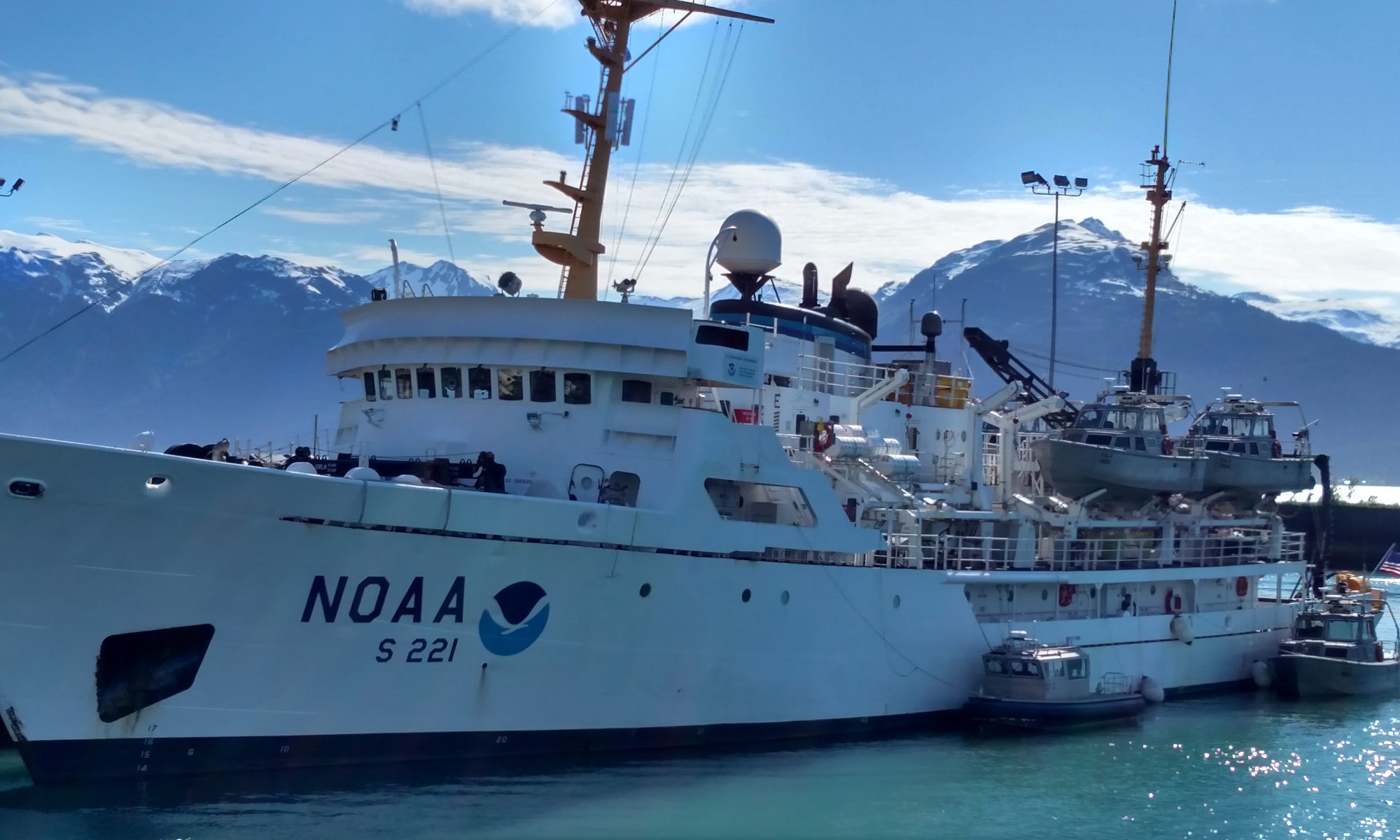
Jenna Cloninger: From Sleeping with the Fishes to Sailing with the Fishes, June 1, 2025

NOAA Teacher at Sea

Jenna Cloninger

Aboard NOAA Ship Bell M. Shimada

June 11 – June 26, 2025

Mission: Integrated West Coast Pelagics Survey (Leg 1)

Geographic Area of Cruise: Pacific Ocean, California Coast

Today’s Date: June 1, 2025

Embarkation Date: June 11, 2025

Personal Introduction

I have always had a deep love for all things conservation-related, ever since I discovered Steve Irwin, “The Crocodile Hunter,” on television as a small child growing up in Virginia Beach, Virginia. I love animals, I love nature, and I particularly love the ocean. After graduating from high school, I pursued a biology degree with the hope that my passion for the natural world would lead me to a job that I loved.

In 2018, I became a part-time overnight program specialist at the Georgia Aquarium in Atlanta, Georgia. What is an “overnight program specialist,” you may ask? It means that I led educational “sleepover” tours after-hours at the largest aquarium in the United States, and instead of sleeping under the stars, I slept under the sharks. (Literally – sleeping in the tunnel of the Ocean Voyager gallery was like a dream come true.)

a view through a glass tunnel at the aquarium. schools of fish swim on either side, and a large manta ray swims overhead. in the center of the tunnel is an inflatable bed and a comforter.
A view of my inflatable bed in the Ocean Voyager gallery of the Georgia Aquarium, with an appearance by Tallulah, my favorite manta ray, in the upper right-hand corner.

In 2019, after graduating with a bachelor’s degree in biology and with my teaching certification, I became a high school oceanography teacher in Gwinnett County, Georgia. It was an opportunity to take all my knowledge from the Georgia Aquarium and share it on a deeper level. Being a high school oceanography teacher in a landlocked region of Georgia is not always easy, partially because many of my students have never visited the ocean themselves. And as a young adult, I have not had many opportunities to visit the ocean outside of the occasional beach vacation.

To help me gain more experience in the field of marine science, I joined the Georgia Association of Marine Education (GAME) in 2023. Each year, GAME holds a conference for educators from around the state, and I have been lucky enough to attend the last two annual conferences as a representative of my district, Gwinnett County Public Schools. These conferences are held on the Georgia coast, most recently on Jekyll Island and St. Simons Island. These conferences give me opportunities to network with other marine educators, but I am always left wanting “more”.

in the center of the image, in focus, a hand holds a clear plastic cup filled with seashells. in the background, out of focus, we a beach filled with large driftwood pieces
Collection of Shells from Jekyll Island’s Driftwood Beach, November 2023
Jenna holds up a shark with two hands. She's wearing sunglasses and a Georgia Aquarium baseball cap. we can see that she's on the deck of a small boat, with water and marsh in the background past the railing.
Me with a Juvenile Bonnethead Shark, St. Simons Island, October 2024

That’s why this opportunity with NOAA is so phenomenal – I am finally going to experience the concepts that I teach firsthand and gain valuable experiences that I can share with my students upon returning to the classroom in August. For 16 days, I will have the privilege of becoming a student again as I learn from the experts and engage in authentic research at sea.

Preparing for My Mission

Sailing aboard NOAA Ship Bell M. Shimada from San Diego, California, I will be helping the science team with the Integrated West Coast Pelagics Survey. As a Teacher at Sea program participant, my job is to not only aid the research team with daily tasks, but also to communicate the science of our mission to the public in a manner very similar to how I communicate scientific information to my 12th grade students in the classroom.

I am currently typing this blog post from my home in Georgia, where my husband is watching me attempt to pack nearly three weeks’ worth of clothing into a single carry-on suitcase. Participating in a fisheries survey is dirty work, so instead of bringing along my usual summer clothes, I have purchased a variety of secondhand clothing from local thrift stores. Since the climate near the California coast is not nearly as hot and humid as Georgia’s, I have also packed a variety of layers so that I will be warm during my assigned working shift from midnight to noon each day. (There is a second shift from noon to midnight, and each person on the ship is assigned to one shift for the entirety of the cruise.) And in addition to clothing, I have packed plenty of anti-nausea medication, just in case I discover that I am prone to seasickness!

I am looking forward to switching roles from “sleeping with the fishes” and “teaching with the fishes” to “sailing with the fishes” in just a week’s time. Until then, you can track NOAA Ship Bell M. Shimada here and join in my excitement as I prepare to visit the west coast of the United States, and the Pacific Ocean, for the first time!

Carmen Andrews: News from Somewhere in the Atlantic Ocean off the Coast of Georgia, July 9, 2012

NOAA Teacher at Sea
Carmen Andrews
Aboard R/V Savannah
July 7 – July 18, 2012

Mission: SEFIS Reef Fish Survey
Geographical Location: Atlantic Ocean, off the coasts of Georgia and Florida
Date: July 9, 2012

Location Data:
Latitude: 30 ° 54.55’   N
Longitude: 80 ° 37.36’  W       

Weather Data:
Air Temperature: 28.5°C (approx. 84°F)
Wind Speed: 6 knots
Wind Direction: from SW
Surface Water Temperature: 28.16 °C (approx. 83°F)
Weather conditions: Sunny and fair

Science and Technology Log

Purpose of the research cruise and background information

The Research Vessel, or R/V Savannah is currently sampling several species of fish that live in the bottom or benthic habitats off the coasts of Georgia and Florida.

Reef fish study area
The coastal zone of Georgia and Florida and the Atlantic Ocean area where the R/V Savannah is currently surveying reef fish

These important reef habitats are a series of rocky areas that are referred to as hard bottom or “live” bottom areas by marine scientists. The reef area includes ledges or cliff-like formations that occur near the continental shelf of the southeast coast. They are called ‘reefs’ because of their topography – not because they are formed by large coral colonies, as in warmer waters. These zones can be envisioned as strings of rocky undersea islands that lie between softer areas of silt and sand. They are highly productive areas that are rich in marine organism diversity. Several species of snapper, grouper, sea bass, porgy, as well as moray eels, and other fish inhabit this hard benthic habitat.

Reef fish
Hard bottom of reef habitat, showing benthic fish — black sea bass is on left and gray trigger fish is on right side of image.

It is also home to many invertebrate species of coral, bryozoans, echinoderms, arthropods and mollusks.

Bottom organisms pulled up with fish traps
Bottom-dwelling organisms, pulled up with fish traps deployed in the reef zone.

The rock material, or substrate of the sea bottom, is thought to be limestone — similar to that found in most of Florida. There are places where ancient rivers once flowed to a more distant ocean shoreline than now. Scientists think that these are remnants of old coastlines that are now submerged beneath the Atlantic Ocean. Researchers still have much to discover about this little known ocean region that lies so close to where so many people live and work.

The biological research of this voyage focuses primarily on two kinds of popular fish – snappers and groupers. These are generic terms for a number of species that are sought by commercial and sports fishing interests. The two varieties of fish are so popular with consumers who purchase them in supermarkets, fish markets and restaurants, that their populations may be in decline.

Red snapper close up
Red snapper in its reef habitat

At this time, all red snapper fishing is banned in the southeast Atlantic fishery because the fish populations, also known as stocks, are so low.

How the fish are collected for study

The fish are caught in wire chevron traps. Six baited traps are dropped, one by one from the stern of the R/V Savannah. The traps are laid in water depths ranging from 40 to 250 feet in designated reef areas. Each trap is equipped with a high definition underwater video camera to monitor and record the comings and goings of fish around and within the traps, as well as a second camera that records the adjacent habitat.

Chevron fish trap
Fish swimming in and out of a chevron fish trap

I will provide the details of the fish trapping and data capture methods in a future blog.

Who is doing the research?

When not at sea, the R/V Savannah is docked at the Skidaway Institute of Oceanography (SKIO)on Skidaway Island, south of Savannah, Georgia. The institute is part of the University of Georgia. The SKIO complex is also the headquarters of the Gray’s Reef National Marine Sanctuary. The facility there has a small aquarium and the regional NOAA office.

The fisheries research being done on this cruise is a cooperative effort between federal and state agencies. The reef fish survey is one of several that are done annually as part of SEFIS, the Southeast Fisheries Independent Survey. The people who work to conduct this survey are located in Beaufort, North Carolina. SEFIS is part of NOAA.

The other members of the research team are from MARMAP, the Marine Research Monitoring Assessment and Prediction agency, which is part of the South Carolina Department of Natural Resources . This team is from Charleston, South Carolina.

Carmen, suited up to retrieve fish from traps
Mrs. Andrews, on deck near the stern of the R/V Savannah, getting ready to unload fish traps

NOAA also allows “civilians” like me — one of the Teachers at Sea– as well as university undergraduate and graduate students to actively participate in this research.